

Sales Management Definition: What It Actually Means (and Requires) in 2026
69% of B2B sales reps missed quota last year. Not because they couldn't sell - because the system around them couldn't keep up. Reps spend 60% of their time on non-selling tasks, average B2B sales cycles now run about 6.5 months (https://www.trykondo.com/blog/b2b-sales-data-insights), and buying committees routinely bring 6-10 stakeholders into the decision. If you're looking for a sales management definition that reflects 2026 reality, the textbook version won't cut it. This discipline isn't about motivation anymore. It's about building an operating system that doesn't break under pressure.
The 30-Second Version
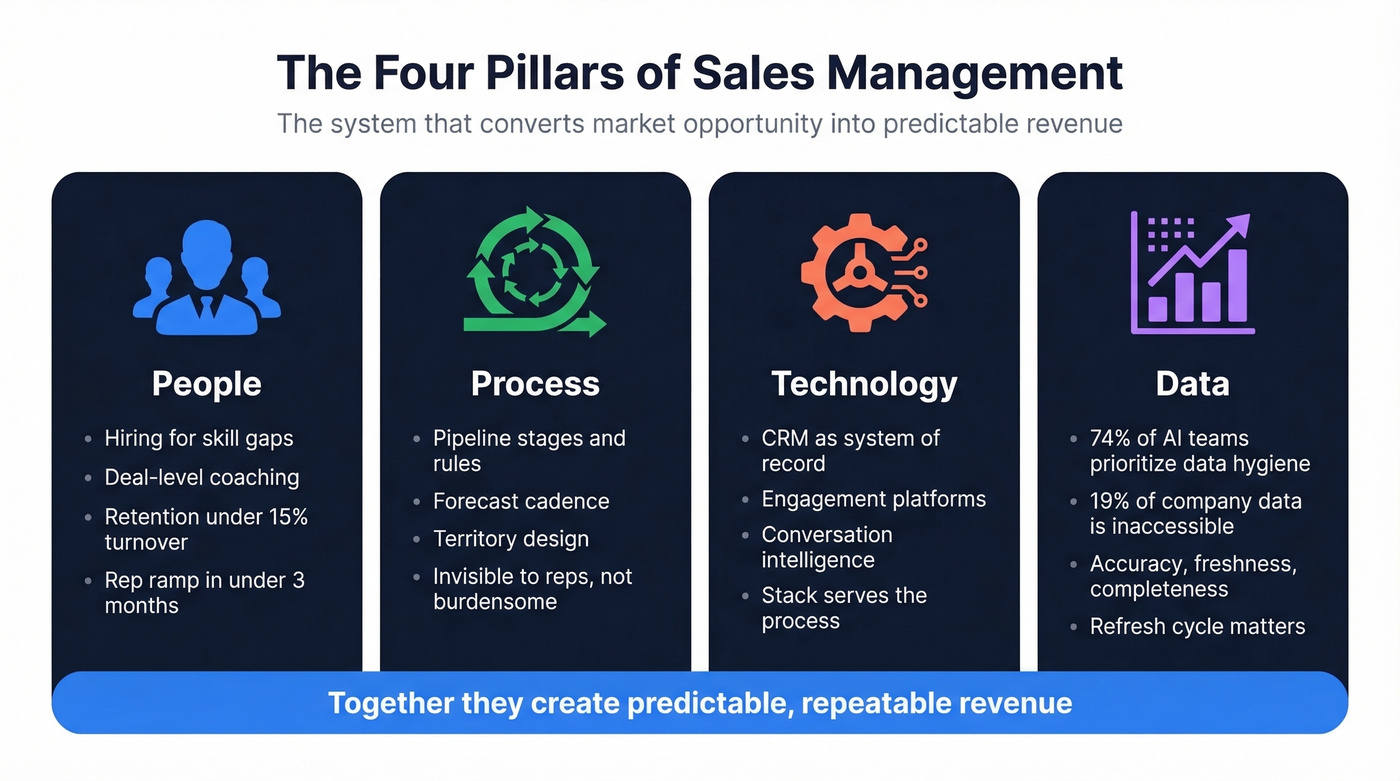
Whether you're a new manager looking for a crash course, a VP auditing your team's operating system, or a founder building your first sales org - here's what matters. Sales management is the discipline of designing and running the system that turns a group of reps into a revenue engine. It rests on four pillars: People, Process, Technology, and Data.
The single most important KPI is pipeline coverage: 3x: 3x is the minimum, and 3-4x quota is the common benchmark. The thing most managers get wrong? Coaching cadence. They default to weekly forecast calls instead of deal-level coaching sessions that actually move pipeline.
Beyond the Textbook Definition
The academic consensus is straightforward: sales management is the process of leading, motivating, and directing a sales team to achieve sales objectives. Fine as far as it goes. It doesn't go far enough.
Stephen Diorio at the Revenue Enablement Institute frames modern growth as a "digital, data-driven, and technology-enabled team sport." Closer - but even that misses the operational reality of what a frontline manager does on a Tuesday morning: reviewing pipeline, coaching a struggling AE through a stalled enterprise deal, fighting with CRM data that's three months stale, and trying to forecast Q3 with any confidence.
Here's our working definition. Sales management is the discipline of building and running the system - people, process, technology, and data - that converts market opportunity into predictable revenue. Notice the word "predictable." Anyone can close a deal. Management is about making revenue repeatable.
The principles apply differently across B2C retail, B2B mid-market, SaaS velocity, and enterprise sales. We're focusing on B2B here, where the complexity of long cycles, multiple stakeholders, and data-dependent workflows makes management hardest - and most consequential.
Why data as a fourth pillar? Because in 2026, every other pillar depends on it. Your coaching is only as good as the pipeline data you're coaching from. Your process only works if reps trust the information in the CRM. Your technology stack is worthless if it's built on stale contacts and bounced emails.
The Four Pillars
People
Hiring, coaching, and retention. This is where most managers spend the plurality of their time - or should. A common benchmark for annual sales team turnover is under 15%. Exceed that and you're stuck in a perpetual ramp cycle, burning pipeline coverage every quarter.
Coaching isn't a weekly 1:1 where you ask "how's the pipeline looking?" It's deal-level, skill-specific, and tied to observable behaviors. The managers we've seen build the strongest teams run two types of sessions: one focused on pipeline mechanics, the other on rep development. Conflating the two kills both.
Process
Pipeline stages, deal progression rules, forecast cadence, and territory design. The best process is invisible to reps - it guides behavior without creating busywork. If your reps spend more time updating Salesforce than talking to prospects, your process is broken.
Technology
CRM, engagement platforms, conversation intelligence, and data tools. The stack should serve the process, not the other way around. We've seen teams buy Gong before they've defined what "good" looks like on a discovery call. That's backwards.
Data
This pillar makes or breaks everything else. 74% of sales teams using AI prioritize data hygiene to support it - because AI models trained on garbage data produce garbage outputs. Sales leaders estimate 19% of their company data is inaccessible, a blind spot that compounds every quarter.
Data quality means accuracy, freshness, and completeness. When the industry average refresh cycle is six weeks, your CRM is decaying faster than most teams realize.
The Sales Management Process
Think of this as the operating system. Seven steps, run continuously.
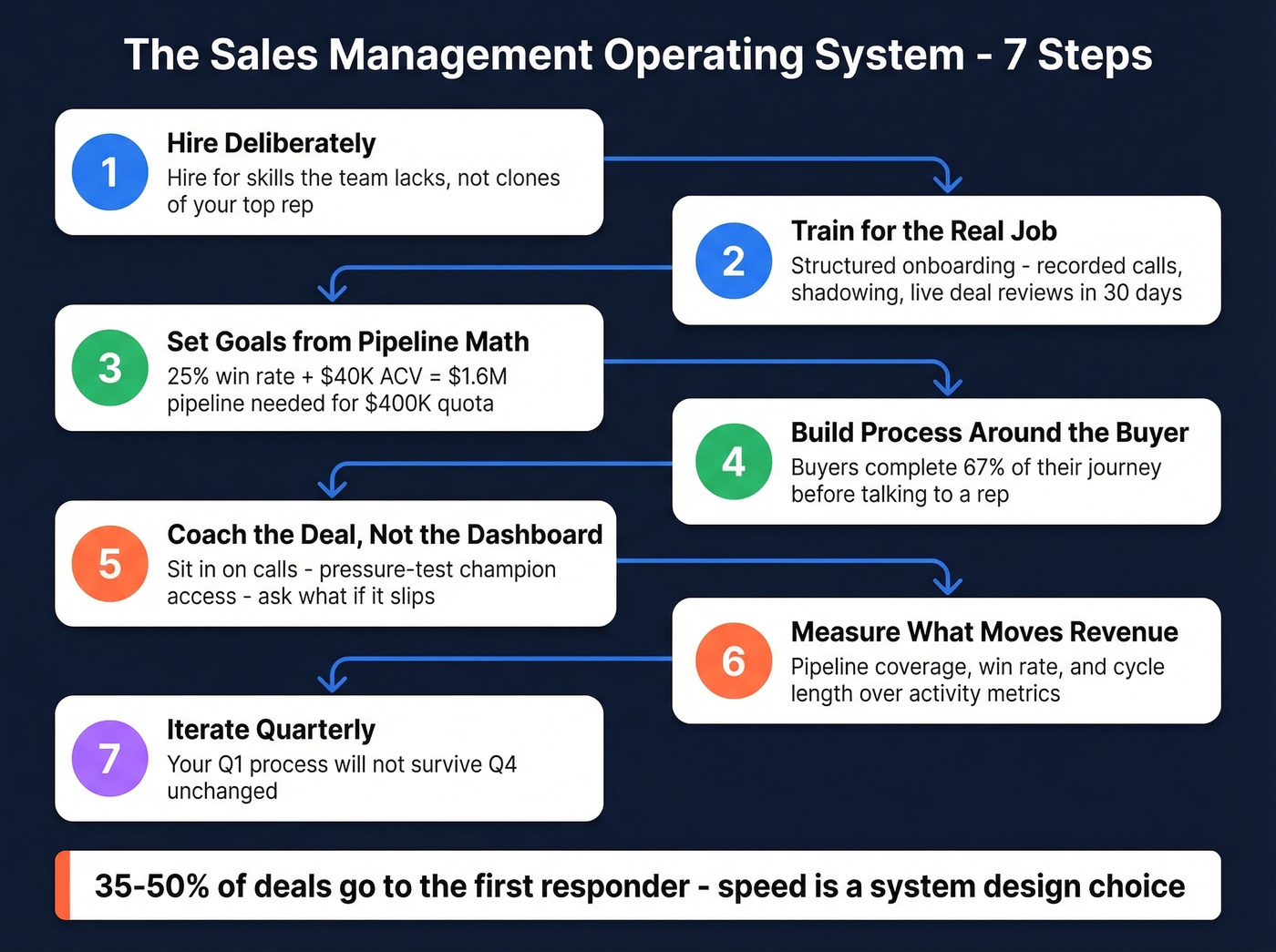
1. Hire deliberately. Don't clone your top rep. Hire for the skills the team lacks - enterprise negotiation, technical discovery, or outbound discipline. A bad hire costs 6-9 months of lost productivity.
2. Train for the real job. Rep ramp time runs 3-6 months to full quota. Compress it with structured onboarding: recorded calls, shadowing, and live deal reviews in the first 30 days. (If you need a template, use a 30-60-90 day plan to standardize ramp.)
3. Set goals that connect to reality. Quota should be derived from pipeline math, not a board deck. If your win rate is 25% and average deal size is $40K, a $400K quarterly quota requires $1.6M in pipeline. Work backwards.
4. Build process around the buyer. Buyers complete 67% of their journey independently before talking to a rep. Your sales process needs to meet them where they are, not where you wish they were.
5. Coach the deal, not the dashboard. The difference between a manager and a spreadsheet is judgment. Sit in on calls. Pressure-test champion access. Ask "what happens if this deal slips?" and watch whether the rep has an answer.
6. Measure what moves revenue. Activity metrics are table stakes. The metrics that matter are pipeline coverage, win rate, and cycle length. (For a deeper set, track pipeline health alongside stage conversion.)
7. Iterate quarterly. Markets shift. Buyers change. Your process from Q1 won't survive Q4 unchanged.
Speed matters more than most managers realize. 35-50% of deals go to the first responder, and conversion rates jump 8-21x when you respond within five minutes. If your process doesn't account for response time, you're leaking pipeline.
Frameworks for Pipeline Reviews
MEDDIC - Forecast Hygiene Tool
Use this for enterprise deals with long cycles and multiple stakeholders. MEDDIC - Metrics, Economic Buyer, Decision Criteria, Decision Process, Identify Pain, Champion - saves the forecast. Run it in Monday pipeline reviews to pressure-test whether your reps actually have champion access and understand the decision criteria. Skip this if you're running high-velocity transactional sales where deals close in days, not months. (If you're implementing it, start with these MEDDIC discovery questions.)
Challenger - Coaching Philosophy
Challenger's core idea - teach, tailor, take control - frames comfort as the enemy. It pushes reps to lead with insight rather than discovery questions. For complex, consultative sales where the buyer doesn't fully understand their own problem, Challenger gives managers a coaching language. It's a philosophy, not a qualification checklist.
Sandler and BANT
Sandler is built on mutual commitment and early disqualification: fewer demos, faster decisions, higher close rates. If your team's biggest problem is bloated pipeline full of deals that never close, Sandler's discipline around "going for the no" is the antidote.
BANT sits at the other end - it's a triage tool for high-velocity inbound where you need to sort leads fast. Don't try to make it do more than that. We've excluded SPIN Selling here because it's primarily a discovery technique, not a pipeline-review framework.
Choosing the Right Framework
| Deal Complexity | Sales Motion | Recommended Framework |
|---|---|---|
| High (6+ months) | Outbound/enterprise | MEDDIC + Challenger |
| Medium (1-3 months) | Mid-market | Sandler or MEDDIC-lite |
| Low (< 30 days) | Inbound/velocity | BANT |
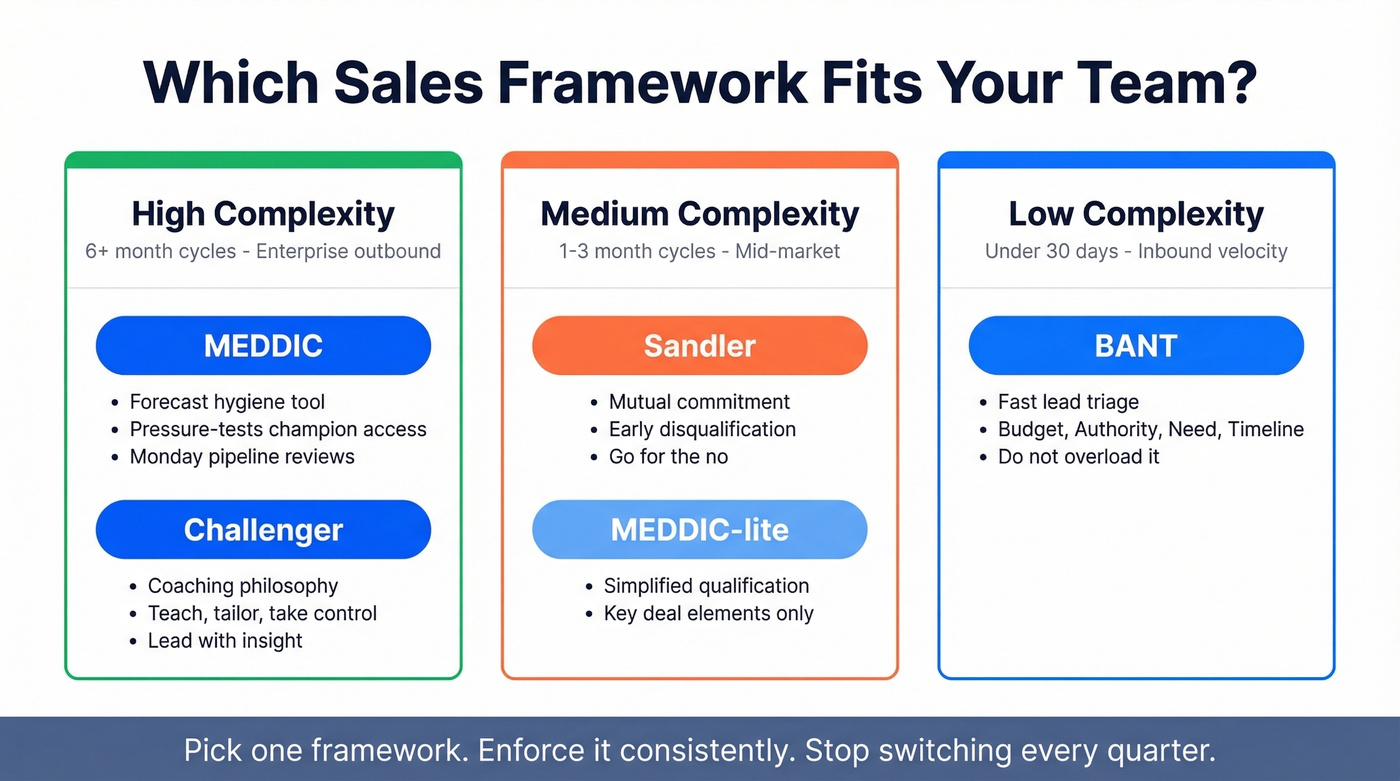
Buyers arrive with 90% of their research done and bring 6-10 stakeholders to the table. Frameworks don't close deals - judgment does. Pick one, enforce it consistently, and stop switching every quarter.

You just read that 19% of company data is inaccessible and the industry average refresh cycle is 6 weeks. Prospeo refreshes all 300M+ profiles every 7 days with 98% email accuracy - so your pipeline reviews are built on data reps actually trust.
Stop coaching from stale CRM data. Start with contacts that are current.
Key KPIs Every Manager Should Track
Here's the thing: most managers track too many metrics and act on too few.
| KPI | Benchmark | Best-in-Class |
|---|---|---|
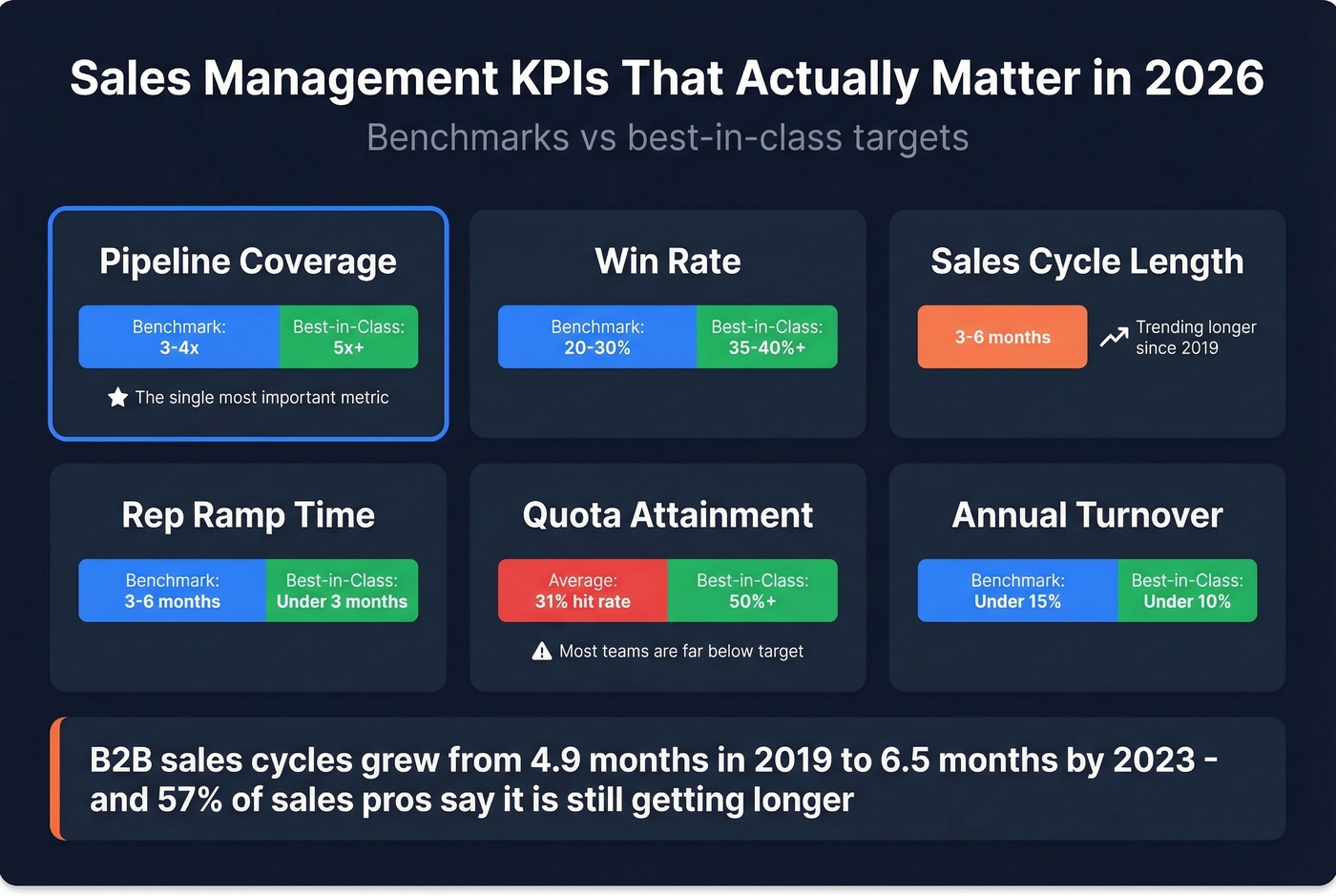
| Win rate | 20-30% | 35-40%+ |
| Pipeline coverage | 3-4x | 5x+ (enterprise) |
| Sales cycle length | 3-6 months | Trending longer |
| Rep ramp time | 3-6 months | Under 3 months |
| Annual turnover | < 15% | < 10% |
| Sales efficiency ratio | 3:1+ | 5:1+ |
| Quota attainment | ~31% hit rate | 50%+ |
| Cold outreach to meeting | 2-3% | 5%+ |
| Warm outreach to meeting | 15-20% | 25%+ |
| Meeting to opportunity | 25-40% | 40%+ |
The cycle length trend deserves attention. Average B2B sales cycles stretched from 4.9 months in 2019 to 6.5 months by 2023, and 57% of sales professionals say it's still getting longer. If your forecast model assumes the same velocity as two years ago, you're building on sand.
Pipeline coverage is the single metric that predicts forecast accuracy. Below 3x means your forecast is built on hope. Enterprise teams with lower win rates should target 5x+. If you only track one number, track this one.
The Tech Stack That Supports It
CRM. Salesforce remains the default for mid-market and enterprise. Entry plans start around $25/user/month, while larger deployments commonly land in the low-to-mid hundreds per user per month once you factor in editions, add-ons, and scale. HubSpot's free CRM is the obvious starting point for early-stage teams, with Sales Hub starting at $15/seat/month. Pipedrive starts around $15/user/month for smaller teams that want simplicity over configurability. (If you're comparing options, see examples of a CRM.)
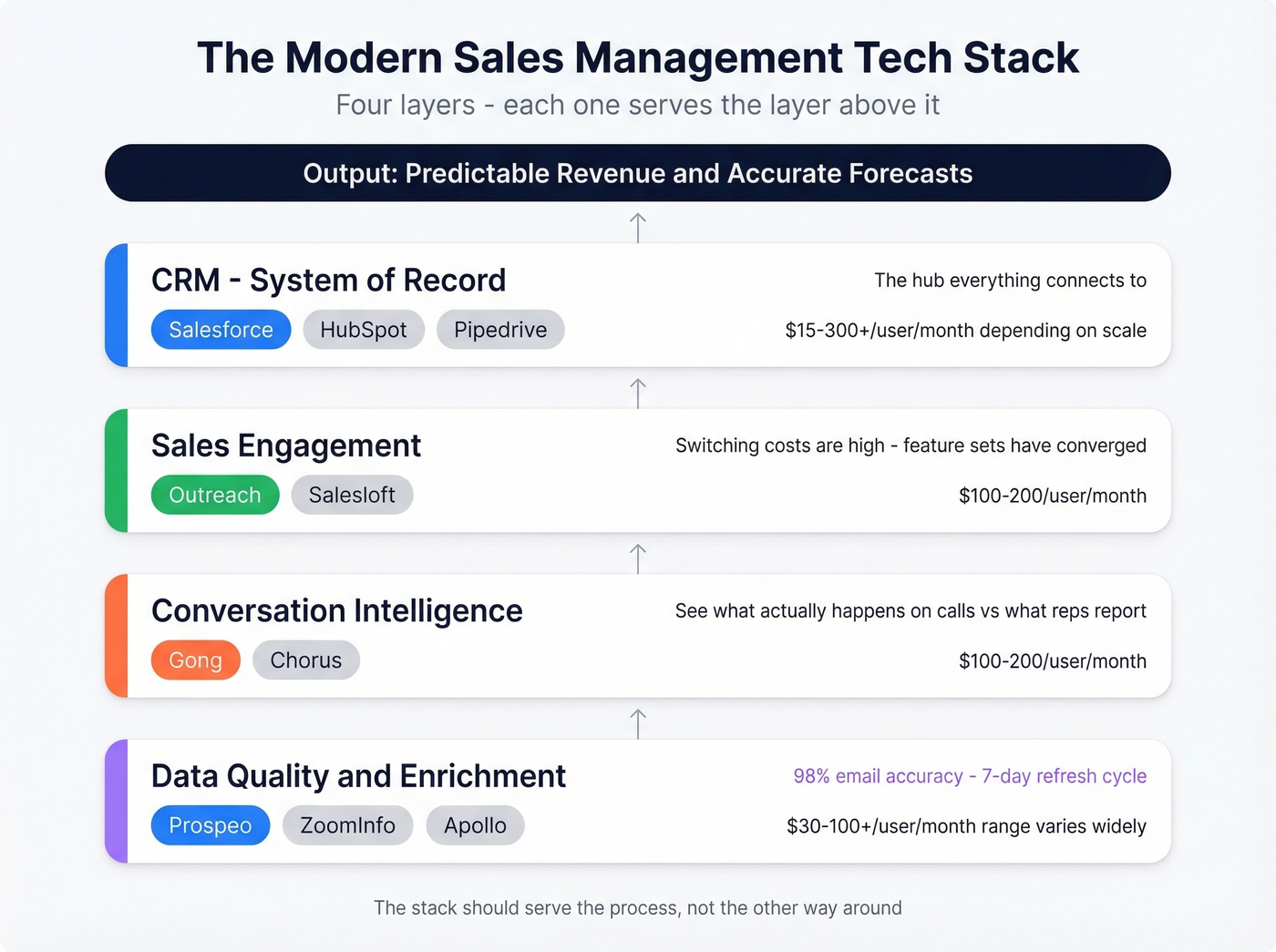
Sales Engagement. Outreach and Salesloft dominate, with teams commonly paying $100-200/user/month depending on package. The choice usually comes down to which one your team already knows - switching costs are high and the feature sets have converged.
Conversation Intelligence. Gong is the market leader, typically in the $100-200/user/month range. These tools give managers visibility into what's actually happening on calls, which matters far more than what reps report in CRM notes.
Data Quality & Enrichment. Your CRM is only as good as the data inside it. This is where most sales management operating systems quietly fail. Prospeo covers 300M+ professional profiles with 98% email accuracy and a 7-day data refresh cycle that keeps enrichment from decaying between pipeline reviews. (If you're evaluating vendors, start with these data enrichment services.) For teams whose primary need is accurate contact data for outbound, it's a fraction of the cost of enterprise-tier alternatives like ZoomInfo, which runs $15-40K/year depending on seats and modules.

Let's be honest: most teams with deal sizes under $25K don't need ZoomInfo-level tooling. A CRM, a data provider with verified emails, and a conversation intelligence tool will cover 90% of your management needs. The other 10% is judgment you can't buy.
AI in Sales Management
94% of sales leaders using AI agents say they're essential for meeting business demands. 88% say AI increases their odds of hitting targets. These aren't future projections - this is the current state.
But the tension is real: 51% of sales leaders say data security concerns halt AI initiatives, and a separate 51% say tech silos delay or limit them. AI readiness is a data problem before it's a technology problem. (If you're building a roadmap, borrow from data-driven selling to define what "good data" means operationally.)
AI Coaching vs. Human Coaching
A 2025 neuroscience study found that sellers receiving AI-coach feedback remembered 50% more information after 48 hours than those receiving human feedback. But human coaching drove greater motivation, emotional well-being, and engagement - participants spoke more during simulations.
The operational takeaway: let your AI coach the deal. Let your manager coach the rep.
Gartner projects that by 2028, AI will close 70% of sales cycles by automating prospecting, qualification, and negotiation steps. Managers who can't interpret AI-generated insights will fall behind those who can - and dashboards inflated by AI-generated activity are the next generation of vanity metrics.
Sales Management vs. Sales Ops vs. RevOps
| Dimension | Sales Management | Sales Ops | RevOps |
|---|---|---|---|
| Owns | People + outcomes | Systems + process | Full revenue cycle |
| Focus | Coaching, quota, hiring | CRM, territories, reporting | Cross-functional alignment |
| Reports to | VP Sales / CRO | VP Sales | CRO or CEO |
| Scope | Sales team | Sales function | Sales + Marketing + CS |
75% of the highest-growth companies will adopt a RevOps model by 2026, per Gartner. Staffing benchmarks: plan for roughly 12:1 sales reps to RevOps personnel. At $50M ARR, that's 4-5 RevOps headcount. Management owns the people; RevOps owns the plumbing. (If you're hiring for it, see what a RevOps manager typically owns.)
The IC-to-Manager Transition
Your best AE just got promoted. It's been 90 days and pipeline is down 20%.
This is the most predictable failure mode in sales organizations, and it happens because companies promote for selling ability and then provide zero management training. The Reddit consensus on r/sales about moving into management is blunt: "long working hours, stress, and lower pay." The worst version of the job? Managers who "attend meetings and poorly micromanage." We've all worked for one.
The common mistakes are consistent across every team we've observed:
- Micromanaging deal execution instead of coaching skills
- Staying an IC by jumping on calls instead of developing reps
- Weak coaching cadence and poor pipeline hygiene
- Inconsistent expectations across the team
- Avoiding hard performance conversations until it's too late
Real talk: if you can't fire someone who isn't performing, you can't manage a sales team. That's the job.
Salary context: Frontline sales managers typically earn $90-130K base with OTE of $150-200K+, depending on team size and vertical. That's often less than what a top-performing AE takes home - which is why the transition needs to be a deliberate career choice, not a default promotion path. (If you're calibrating comp, start with OTE in sales so you don't misalign incentives.)
Predictable revenue requires predictable data. Prospeo's CRM enrichment returns 50+ data points per contact at a 92% match rate - so your reps spend time selling, not fixing records. At $0.01 per email, enterprise-grade data no longer requires enterprise budgets.
Give your sales team the data pillar they're missing.
FAQ
What is the definition of sales management?
Sales management is the discipline of building and running the system - people, process, technology, and data - that converts market opportunity into predictable revenue. In 2026, the operational scope includes hiring, coaching, process design, technology selection, data quality, and forecasting accuracy.
What are the three core functions?
Strategy (territory planning, goal-setting), operations (process design, pipeline management), and analysis (KPI tracking, forecasting). Modern frameworks add a fourth - data quality - because every other function depends on accurate, fresh contact and account information.
What skills does a sales manager need?
Coaching, pipeline analysis, hiring judgment, forecasting accuracy, and the ability to have difficult performance conversations. In 2026, add data literacy and AI fluency - managers who can't interpret AI-generated insights will fall behind those who can.
How does sales management differ from sales operations?
Sales management owns people and outcomes - coaching, quota attainment, hiring. Sales operations owns systems and process - CRM configuration, territory rules, reporting. RevOps sits above both, aligning sales, marketing, and customer success around a unified revenue model.
What's a good pipeline coverage ratio?
3-4x quota for most B2B teams, with 3x as the absolute minimum. Enterprise deals with longer cycles and lower win rates should target 5x+. Below 3x means your forecast is built on hope, not math.