

Sales Management Plan Template Every Other Guide Forgot to Build
It's Q1. Your top rep just quit, two new hires aren't ramped, and the board wants 30% growth. You open the sales management plan template you downloaded last year and realize it's a revenue target spreadsheet with some activity goals bolted on. That's a sales plan - not a management plan - and the difference is why your quarter is already sideways.
Every template you've downloaded answers the wrong question. They give reps a roadmap. They don't give you, the manager, an operating system. Let's fix that.
What a Real Template Covers
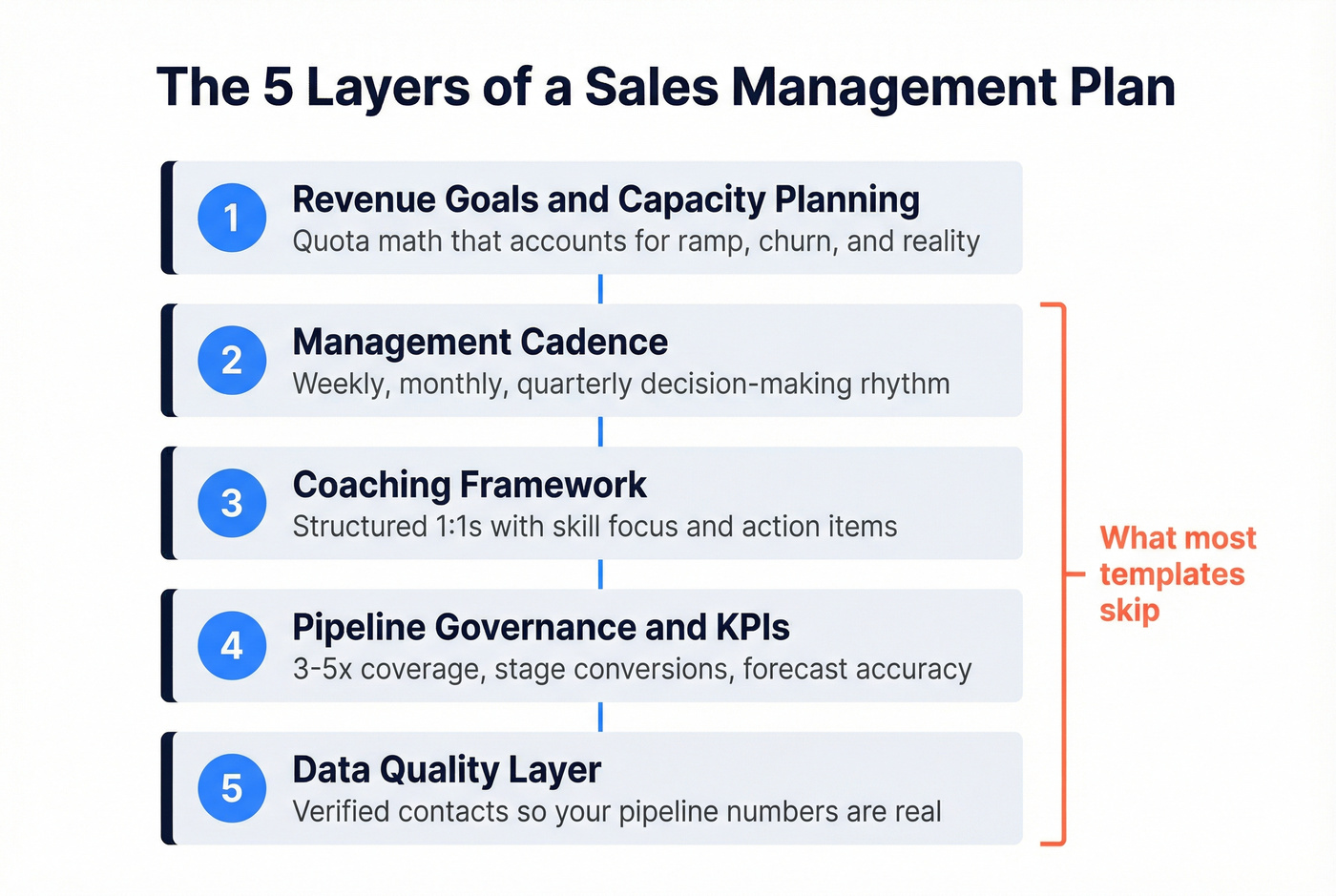
A sales management plan addresses five layers generic sales plans skip:
- Management cadence - the weekly, monthly, and quarterly rhythm that keeps your team aligned without drowning in meetings.
- Coaching framework - structured 1:1s and deal reviews, not ad-hoc check-ins.
- Pipeline governance - coverage ratios, stage definitions, and hygiene rules that make your forecast trustworthy.
- Capacity planning math - quota assignment that accounts for ramp, churn, and the reality that not every rep hits 100%.
- Data quality layer - because pipeline targets built on bounced emails and stale contacts are fiction.
Sales Management Plan vs. Sales Plan
Most guides - including Pipedrive's popular walkthrough - focus on activity-based planning: reverse-engineer revenue into cold calls, demos, and proposals. That's useful for reps. It's not a management plan.
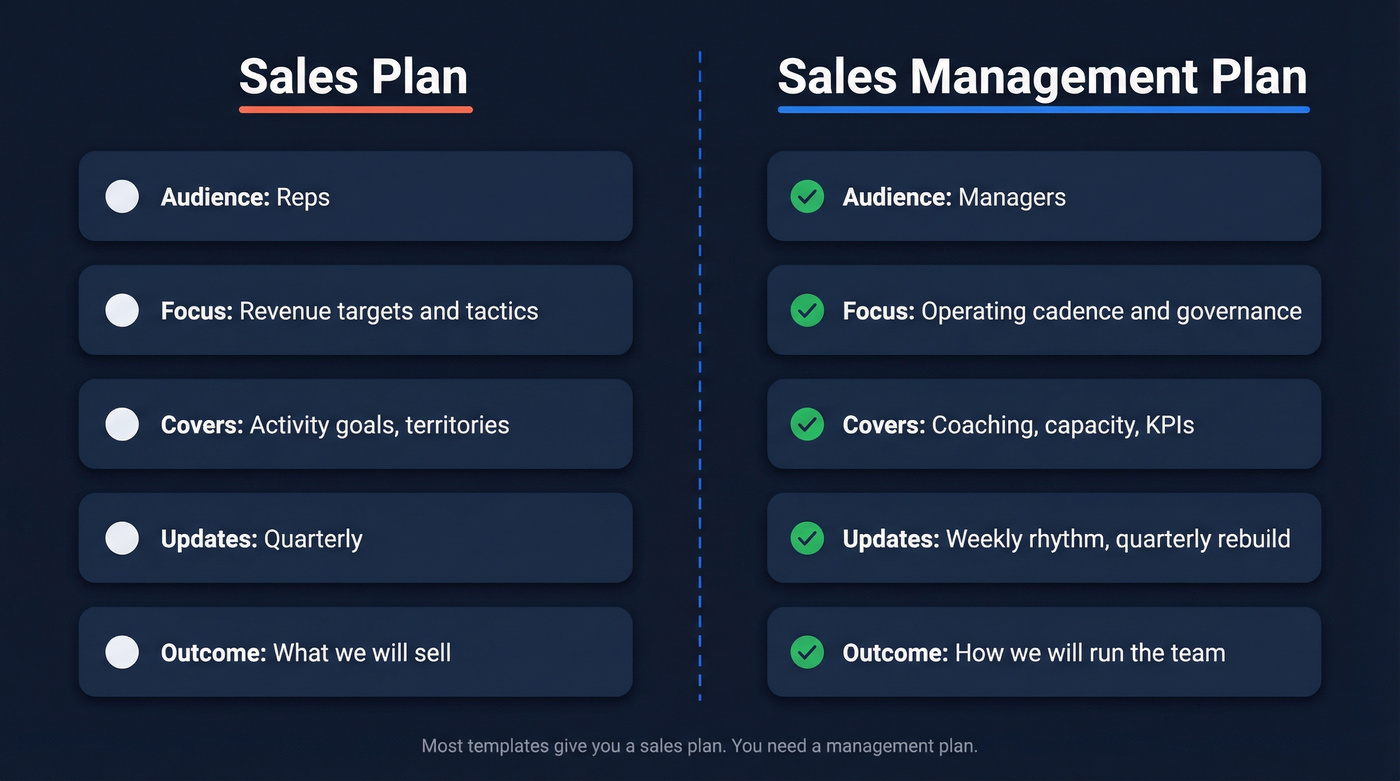
| Sales Plan | Sales Management Plan | |
|---|---|---|
| Audience | Reps | Managers |
| Core focus | Revenue targets + tactics | Operating cadence + governance |
| Covers | Activity goals, territories | Coaching, capacity, KPIs |
| Updates | Quarterly | Weekly rhythm, quarterly rebuild |
| Outcome | "What we'll sell" | "How we'll run the team" |
The sales planning software market hit ~$6.8B in 2024 and is projected to reach $18B by 2032. Even with all that tooling, the management layer still breaks down in spreadsheets, inconsistent coaching, and "we'll fix it next quarter."
The Template - Section by Section
Revenue Goals & Capacity Planning
Start with the number everyone cares about, then work backward through the math that makes it achievable.
Assuming 100% of reps hit 100% of quota is fantasy. Build quota capacity with a buffer so you're not instantly behind when someone's ramping, leaving, or having a rough quarter. We've seen teams plan for full attainment and then scramble by week six when reality sets in - don't be that team.
Document these inputs:
- Average deal cycle length
- Rep ramp time - typically 3-6 months depending on deal complexity (use a 30-60-90 Day Plan for Sales Reps to standardize ramp expectations)
- Expected churn and hiring timeline (tie this to your churn analysis)
- Funnel conversion rates (average sales conversion runs 2.46%-3.26%, so use your actual data) (compare against sales conversion rate benchmarks)
- Quota per rep, adjusted for ramp stage
- Sales team budget - headcount costs, tools, and training spend that constrain how aggressively you can hire ahead of plan
Capacity planning isn't a spreadsheet exercise you do once a year. It's a living input that changes every time the team changes.
Management Cadence
A cadence isn't a meeting schedule. It's a decision-making rhythm that protects selling time while keeping you close enough to deals to intervene early.
Demandbase's operational cadence research suggests reps should spend 60-70% of their time on selling activities, 10-15% in internal sales meetings, 10% on training, and 5-10% on admin. If your reps spend more than 15% of their week in meetings, you've got a cadence problem - and it's your cadence problem, not theirs.
| Rhythm | Meeting | Duration | Owner |
|---|---|---|---|
| Weekly | Pipeline review | 30-45 min | Manager |
| Weekly | 1:1 coaching | 30 min/rep | Manager + rep |
| Weekly | Forecast call | 30 min | Manager + leadership |
| Monthly | Team all-hands | 60 min | Manager |
| Quarterly | QBR | 90 min | Manager + leadership |
Don't copy someone else's cadence. A net-new SMB team running 15-day cycles needs a tighter weekly pulse than an enterprise team working 9-month deals. Tailor the rhythm to your deal velocity, team size, and how much direct intervention your reps actually need at their current experience level.
Coaching Framework
73% of sales managers spend less than 5% of their time coaching. Meanwhile, structured coaching programs produce 28% higher win rates, and elite organizations are 2.2x more likely to have managers who excel at call coaching. The math is obvious. The execution is where managers fail.
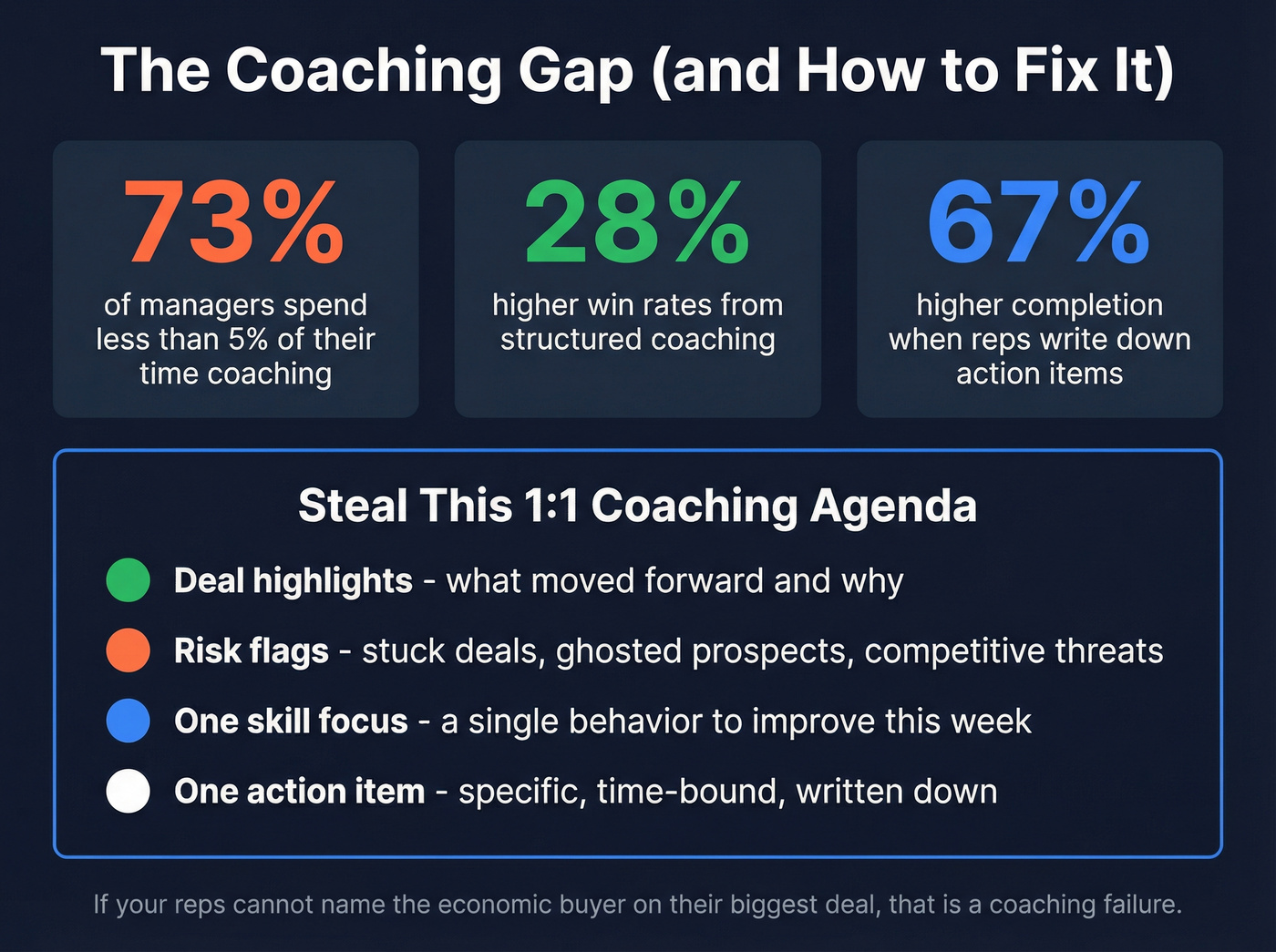
Here's a 1:1 coaching agenda you can steal today:
- Deal highlights - what moved forward this week and why
- Risk flags - stuck deals, ghosted prospects, competitive threats (use sales pipeline challenges as your diagnostic checklist)
- One skill focus - a single behavior to improve this week
- One action item - specific, time-bound, written down
Here's the thing: we've seen teams where reps can't clearly name the economic buyer on their biggest deals. That's a coaching failure, not a rep failure (align on MEDDPICC economic buyer definitions). When reps document their action items and share them with you, completion rates jump 67%. Don't let coaching conversations evaporate into "good talk, let's catch up next week."
Pipeline Governance & KPIs
Your management plan needs a short list of KPIs you'll actually review weekly - not a dashboard with 40 metrics nobody looks at (start with pipeline health).
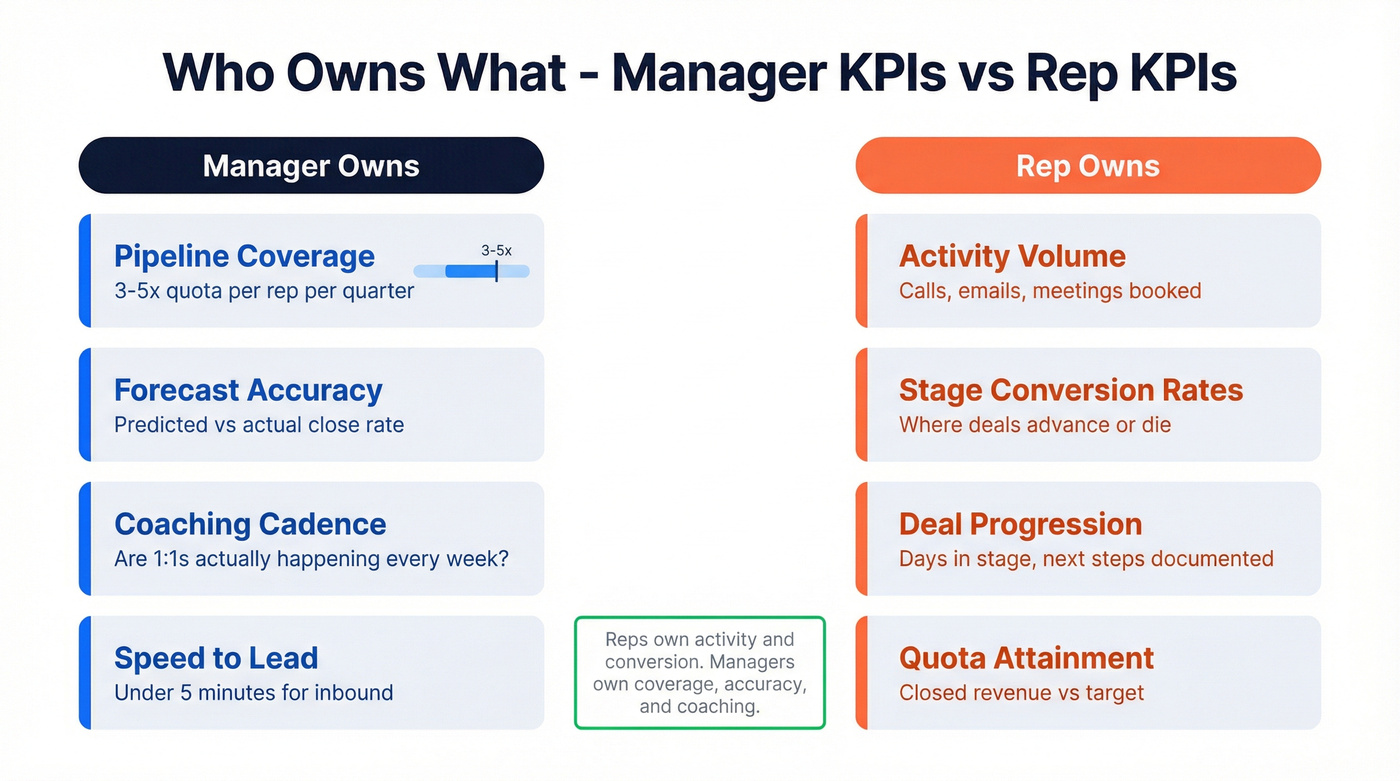
- Pipeline coverage: 3-5x quota per rep per quarter - below 3x and you're flying blind (sanity-check against sales pipeline benchmarks)
- Speed-to-lead: under 5 minutes for inbound
- Stage conversion rates by rep, which diagnose where deals die
- Forecast accuracy vs. actual (see sales forecast vs sales goal)
- Coaching completion - are 1:1s actually happening?
Separate manager-level KPIs from rep-level ones. Reps own activity and conversion. You own coverage, forecast accuracy, and coaching cadence.
For tools, you need a CRM that enforces your stage definitions and a data quality platform that keeps contact data fresh. If a meaningful chunk of your outbound emails bounce, your pipeline coverage math is fiction. Prospeo's 98% email accuracy and 7-day data refresh cycle handle that - it integrates with Salesforce and HubSpot so your pipeline and capacity planning reflect real, reachable accounts instead of stale records (compare options in data enrichment services).


Your capacity plan assumes reps can actually reach prospects. When 15-20% of emails bounce, your 3-5x pipeline coverage is a lie. Prospeo delivers 98% email accuracy on a 7-day refresh cycle - so your pipeline governance reflects real, reachable buyers.
Stop managing a pipeline built on stale data.
How to Run a Sales Strategy Meeting
Your quarterly QBR is where the management plan gets stress-tested. Structure it around three questions: What worked last quarter? Where did the plan break? What changes to cadence, coaching, or capacity do we need for next quarter? (If you need a tighter structure, use these QBR questions to ask.)
That's it. Three questions.
The consensus on r/salesmanagement is that most QBRs fail because they turn into slide-deck performances where everyone presents but nobody decides anything. Assign owners and deadlines before anyone leaves the room, and keep the meeting under 90 minutes - if you can't stress-test your plan in that window, the plan is too complicated.
SWOT Analysis for Your Sales Team
Before you finalize the plan each quarter, map internal strengths and weaknesses against external opportunities and threats. Strengths might be experienced closers or a strong inbound pipeline; weaknesses could be long ramp times or a thin bench. On the external side, look at new market segments and competitor churn as opportunities, and budget freezes or emerging competitors as threats.
This exercise turns vague "we need to improve" conversations into prioritized action items that feed directly into your coaching framework and capacity model. Skip it if your team is under five reps and you already have a clear picture of where you're strong and where you're exposed - for smaller teams, the overhead isn't worth it.
Mistakes That Kill Management Plans
If your plan doesn't address these, it's a wish list.
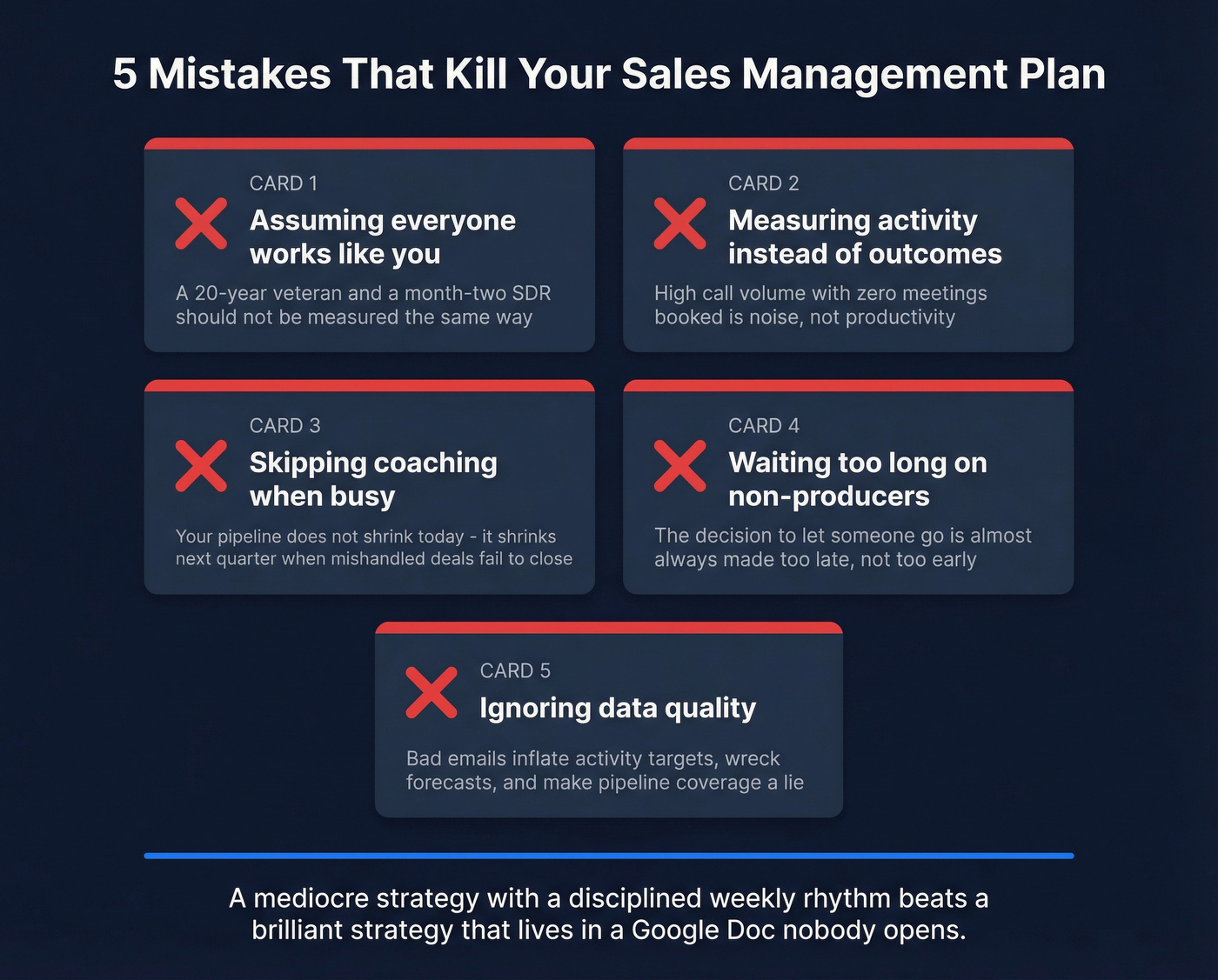
Assuming everyone works like you. Your reps aren't you. Build weekly KPIs that accommodate different selling styles and experience levels - a 20-year veteran and a month-two SDR shouldn't be measured the same way.
Measuring activity instead of outcomes. High call volume with zero meetings booked isn't productivity. It's noise (ground your activity targets in sales activities examples).
Skipping coaching when things get busy. What happens when you skip coaching for three straight weeks? Your pipeline doesn't shrink immediately. It shrinks next quarter, when the deals your reps mishandled today fail to close. Protect the two hours.
Waiting too long on non-producers. Every quarter you delay costs you the quota gap and the opportunity cost of a better hire ramping. In our experience, the decision to let someone go is almost always made too late, not too early.
Ignoring data quality. Stale contact data quietly erodes every metric downstream. Bad emails inflate the activity volume reps need to hit targets, wreck forecast accuracy, and make your pipeline coverage a lie. Treat data quality as a capacity planning input, not an afterthought (track it like an email bounce rate KPI).
Let's be honest: most sales management plans fail not because the strategy is wrong, but because the manager never builds the operating cadence to execute it. A mediocre strategy with a disciplined weekly rhythm will outperform a brilliant strategy that lives in a Google Doc nobody opens.
Every KPI in your sales management plan - coverage ratios, stage conversions, forecast accuracy - collapses when reps prospect with bad data. Prospeo integrates directly with Salesforce and HubSpot, enriching your CRM with 143M+ verified emails at $0.01 each.
Make your management plan work with data that actually connects.
FAQ
What's the difference between a sales plan and a sales management plan?
A sales plan sets revenue targets and tactics for reps. A sales management plan is the manager's operating system - cadence, coaching, pipeline governance, and performance accountability. If it doesn't include a coaching framework and capacity planning, it's not a management plan.
How often should I update my sales management plan?
Review cadence adherence weekly and adjust quarterly after QBRs with fresh conversion and performance data. Rebuild annually alongside territory, quota, and comp planning.
How does data quality affect pipeline governance?
Stale contacts silently degrade every metric - from forecast accuracy to coaching effectiveness. A 7-day data refresh cycle and 98%+ email accuracy keep your contact database current so the plan reflects what your team can actually deliver.
What KPIs should a sales manager track weekly?
Focus on pipeline coverage (3-5x quota), stage conversion rates by rep, speed-to-lead for inbound, forecast accuracy, and coaching completion. These five metrics surface problems early enough to fix them within the quarter.