

6 Sales Meeting Agenda Templates You Can Copy in 60 Seconds
79% of leaders rate meetings they initiated as extremely productive. Only 56% say the same about everyone else's meetings. That gap isn't confidence - it's delusion. Meanwhile, 70% of meetings are unproductive, and the average organization loses roughly $29,000 per employee per year to poorly run meetings.
The right sales meeting agenda template is the difference between a meeting that moves pipeline and one that steals an hour of selling time. These six templates are timed, opinionated, and ready to paste into a Google Doc. No meeting software required.
Jump to Your Template
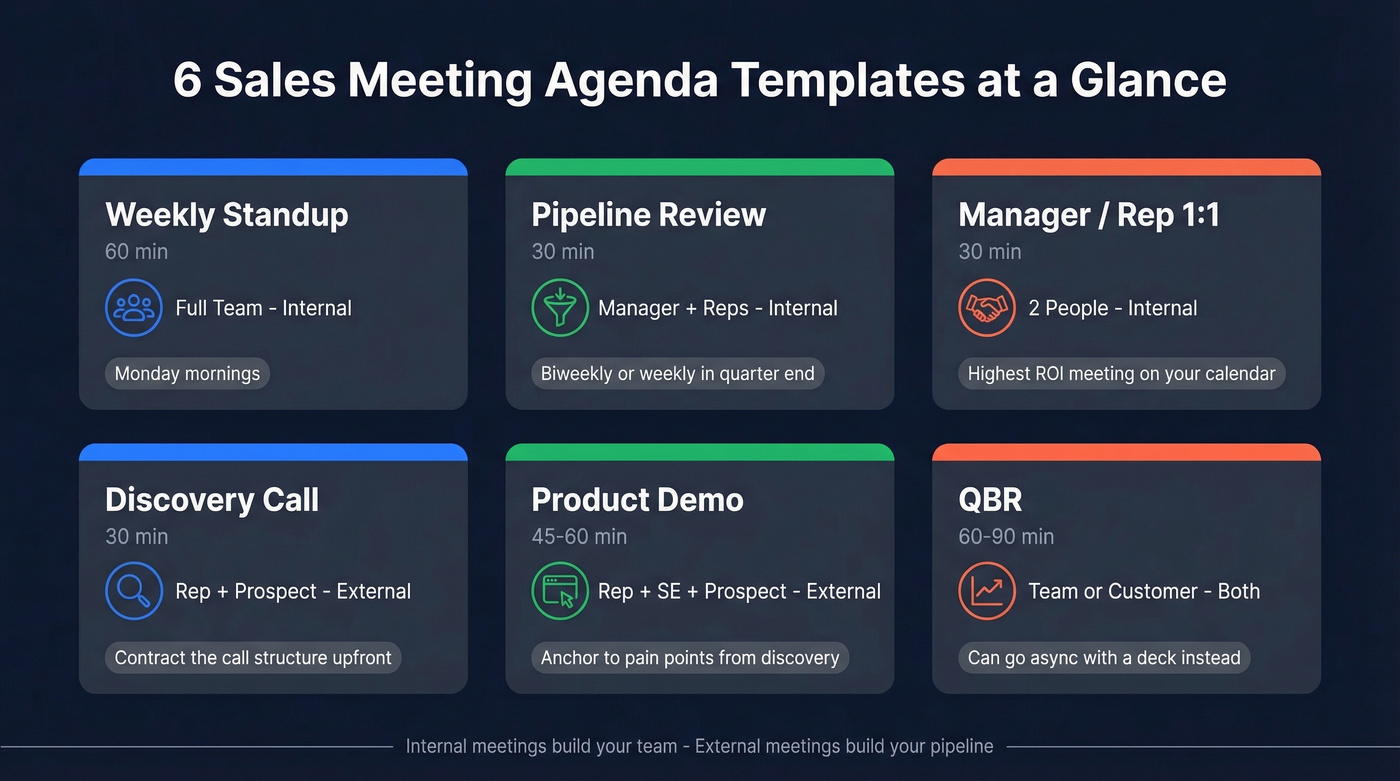
- Weekly Sales Team Standup - 60 min, internal, full team
- Pipeline Review - 30 min, internal, manager + reps
- [Sales Manager / Rep 1:1](#sales-manager - rep-11-30-min) - 30 min, internal, two people
- Discovery Call - 30 min, external, prospect-facing
- Product Demo - 45-60 min, external, prospect-facing
- Quarterly Business Review - 60-90 min, internal or external
What Makes a Great Agenda Work
You don't need Fellow or Tactiq or any AI meeting assistant. You need a Google Doc and discipline. The fancy tooling is a distraction from the real problem: most agendas are either nonexistent or a vague list of topics with no structure.
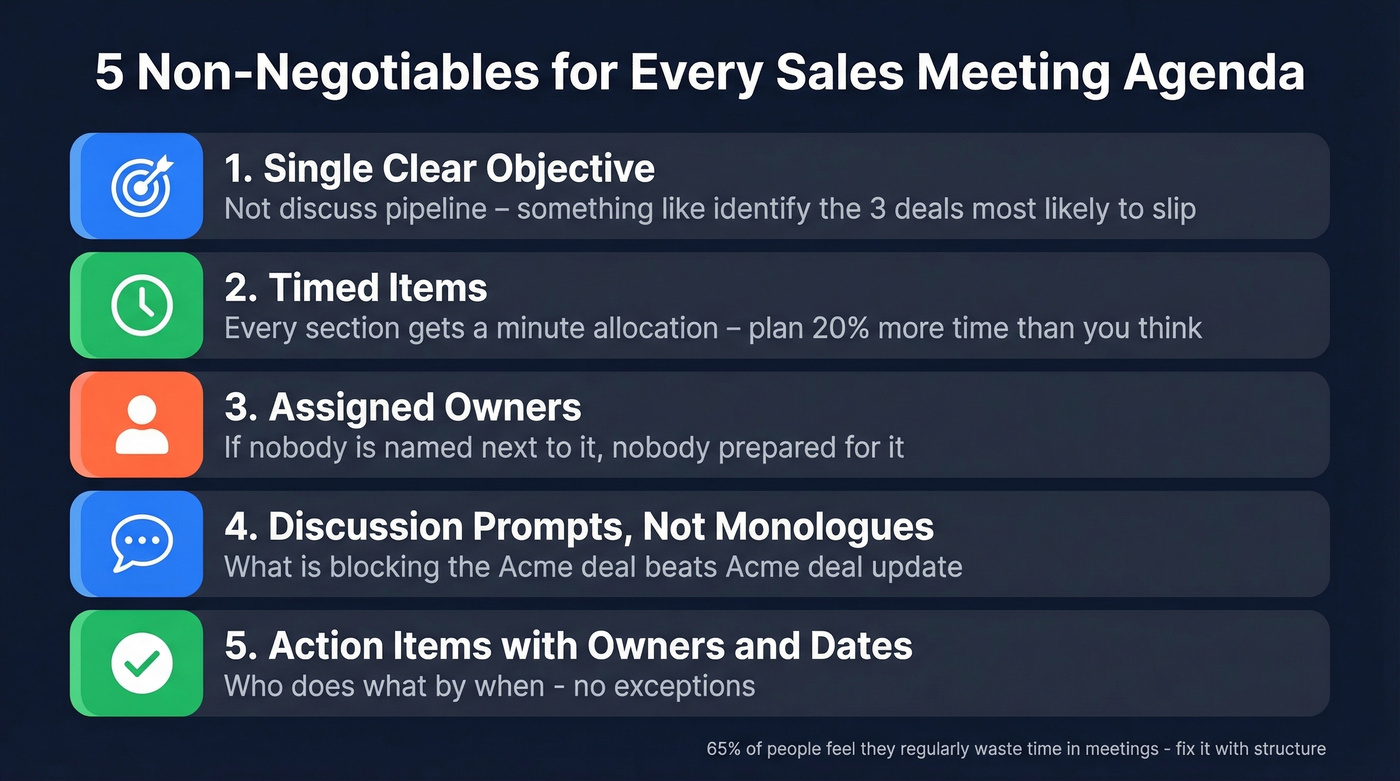
There's a framework called SCAAPID that covers the basics - objectives, topics, roles, time, engagement, feedback, action items. Useful as a mental model. But in practice, every agenda that actually works has five non-negotiable components:
- A single clear objective. Not "discuss pipeline." Something like "identify the 3 deals most likely to slip this quarter and assign save plays." If you can't state the objective in one sentence, you don't have a meeting - you have a hangout.
- Timed items. Every section gets a minute allocation. Plan for 20% more time than you think each topic needs - a "5-minute" update always runs 6-7 minutes. Without time constraints, pipeline updates expand to fill the entire hour.
- Assigned owners. Someone owns each section. If nobody's name is next to it, nobody prepared for it.
- Discussion prompts, not monologues. "What's blocking the Acme deal?" beats "Acme deal update."
- Action items with owners and due dates. Every meeting ends with who does what by when. No exceptions.
65% of people feel they regularly waste time in meetings. That's not a meeting problem - it's a structure problem. These five components fix it.
How to Build Your Agenda
Start with a single objective, list the topics that support it, assign an owner and time block to each, and end with a slot for action items. That's the skeleton. The templates below flesh it out for every common scenario so you can copy, customize, and send.
If you want a tighter operating rhythm, pair these agendas with clear sales activities and a consistent sales process optimization cadence.

A perfect agenda means nothing if your reps are calling wrong numbers and bouncing emails. Prospeo gives you 98% accurate emails and 125M+ verified mobile numbers so every pipeline review has real deals to discuss - not dead contacts to clean up.
Stop reviewing dead pipeline. Start with data that connects.
6 Templates for Every Sales Meeting
Weekly Sales Team Standup (60 min)
Think of this as a weekly health check for your pipeline. We schedule ours Monday mornings for start-of-week alignment and to give reps a clear picture of what matters right now.
If your standup keeps drifting into "deal updates," consider tracking pipeline health metrics separately so the meeting stays focused.
| Time | Section | Owner |
|---|---|---|
| 0-5 min | Icebreaker | Rotating |
| 5-10 min | Wins & recognition | Manager |
| 10-25 min | Pipeline updates | Reps (round) |
| 25-30 min | Roadblocks | Reps |
| 30-35 min | Prospect feedback | Reps |
| 35-40 min | Competitor intel | Assigned rep |
| 40-50 min | Guest speaker | Invited |
| 50-60 min | Pitch roundtable | All |
Don't skip the wins section. 84% of highly engaged employees were recognized the last time they went above and beyond, compared to just 25% of disengaged employees. Two minutes of public recognition costs nothing and compounds over time.
The guest speaker slot is optional but powerful - rotate in product managers, customer success leads, or marketing. It breaks the monotony and gives reps context they'd never get from Slack. If you don't have a guest, reallocate those 10 minutes to pipeline or the pitch roundtable.
Pipeline Review (30 min)
This isn't a status update meeting. If the deal stage, next step, and close date are in the CRM, don't recite them out loud. The pipeline review exists to pressure-test deals and improve forecast accuracy.
| Time | Section | Owner |
|---|---|---|
| 0-3 min | Forecast snapshot | Manager |
| 3-15 min | At-risk deals deep dive | Reps |
| 15-22 min | Stalled deals (no recent activity) | Reps |
| 22-27 min | New pipeline created | Reps |
| 27-30 min | Action items & owners | Manager |
Run this biweekly. Shift to weekly during the last three weeks of the quarter when forecast accuracy matters most. The manager's job isn't to interrogate - it's to ask "what do you need to unstick this?" If a rep can't articulate why a deal will close this quarter, it probably won't. That's the conversation worth having.
If forecasting is a recurring pain point, standardize your definitions and tooling with a lightweight sales forecasting solutions approach.
Sales Manager / Rep 1:1 (30 min)
Here's the thing: this meeting should be rep-led, not manager-led. The rep sets the agenda, brings the deals they want to workshop, and drives the conversation. The manager coaches. That's it.
| Time | Section | Owner |
|---|---|---|
| 0-3 min | Rep's top priority | Rep |
| 3-15 min | Deal coaching (2-3 deals) | Rep + Manager |
| 15-22 min | Skill development | Manager |
| 22-27 min | Blockers & asks | Rep |
| 27-30 min | Action items | Both |
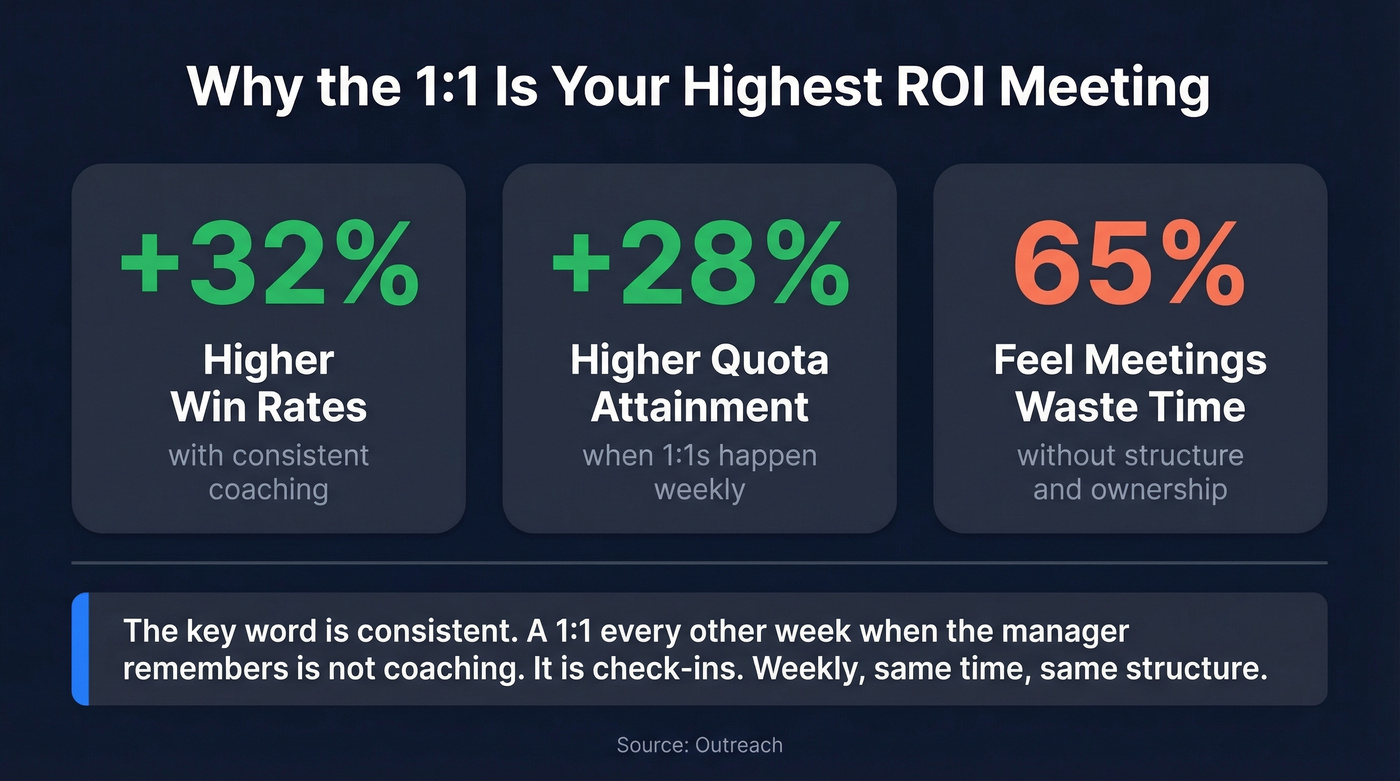
This is the highest-ROI meeting on your calendar. Consistent coaching drives 32% higher win rates and 28% higher quota attainment. But "consistent" is the key word - a 1:1 that happens every other week when the manager remembers isn't coaching. It's check-ins. Weekly, same time, same structure. The rep should never wonder whether this meeting is happening.
To make coaching more repeatable, align on a shared sales leadership system and a few core sales communication behaviors.
Discovery Call (30 min)
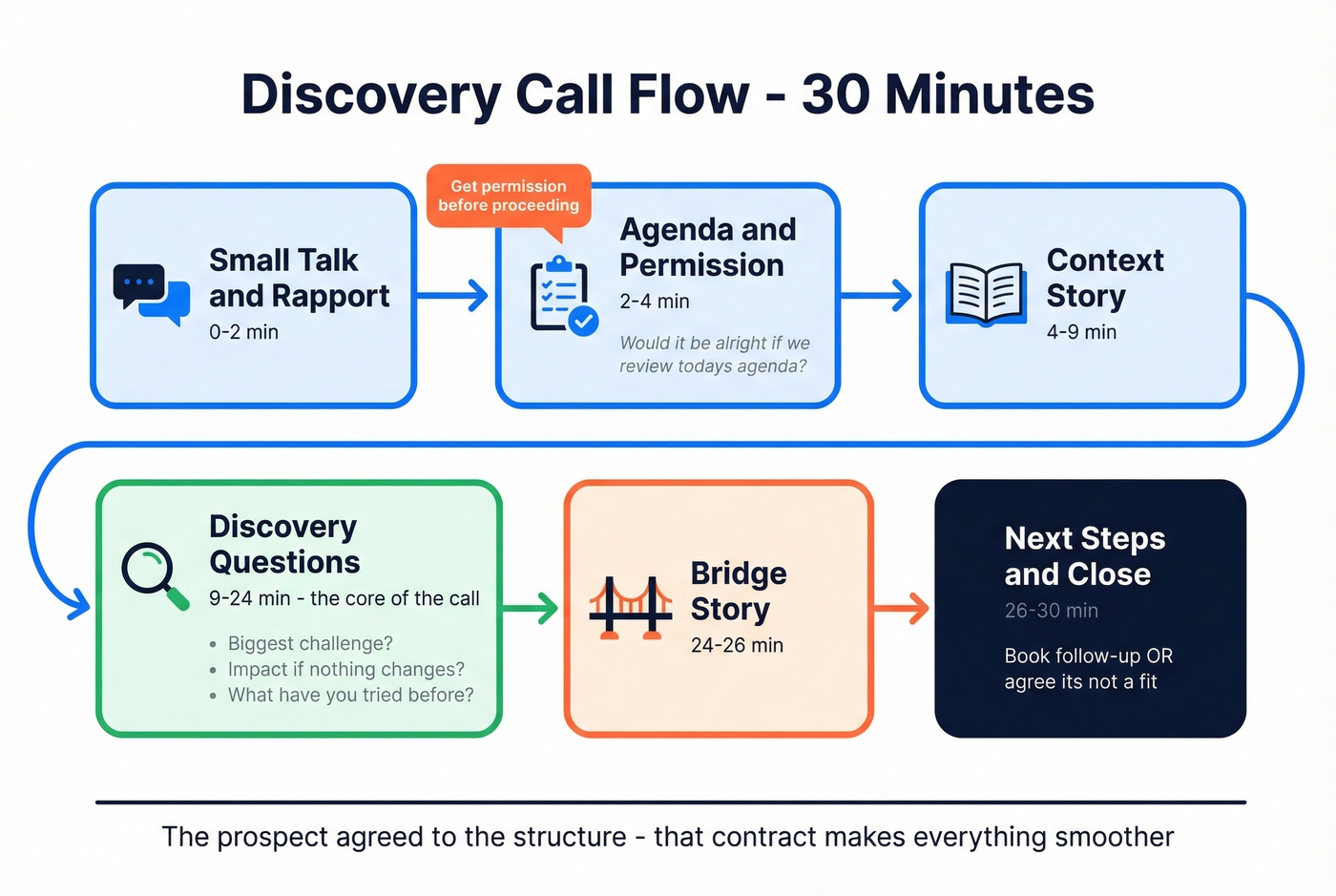
This template draws from a framework shared widely on r/sales that we've adapted over time. The key insight: you're not just running through questions. You're creating a contract with the prospect for how the call will go.
| Time | Section | Owner |
|---|---|---|
| 0-2 min | Small talk & rapport | Both |
| 2-4 min | Agenda & permission | Rep |
| 4-9 min | Context story | Rep |
| 9-24 min | Discovery questions | Both |
| 24-26 min | Bridge story | Rep |
| 26-30 min | Next steps & close | Rep |
Open the agenda section with: "Would it be alright if we quickly review today's agenda so we make the most of our 30 minutes?" Don't proceed until they say yes. Then lay out three simple points - what you'll cover, what you hope to learn, and how the meeting could end (either you book a follow-up or you both agree it's not a fit). That "contract" makes the rest of the call smoother because the prospect agreed to the structure.
Discovery questions worth asking:
- What's the biggest challenge you're facing with [area]?
- What's the impact if nothing changes?
- What have you tried before, and why didn't it stick?
If you want a deeper bank of prompts, use a structured set of discovery questions and keep a printable discovery call script handy.
Pre-call prep: Verify the prospect's email and mobile number before sending the invite. Use Prospeo's Email Finder to pull verified contact data - if the invite bounces or you need a backup channel when they don't show, you'll be glad you checked.
Product Demo (45-60 min)
A demo isn't a slideshow. It's a conversation anchored to the pain points you uncovered in discovery. If you're showing features the prospect didn't ask about, you've already lost.
| Time | Section | Owner |
|---|---|---|
| 0-5 min | Recap pain points | Rep |
| 5-10 min | Agenda & expectations | Rep |
| 10-40 min | Interactive demo | Rep + SE |
| 40-50 min | Pricing & decision process | Rep |
| 50-60 min | Next steps & calendar | Rep |
Start by restating what you heard in discovery: "Last time, you mentioned X, Y, and Z. Did I get that right? Has anything changed?" This shows you listened and gives the prospect a chance to update priorities.
The demo itself should be interactive. Stop every 5-7 minutes and ask: "Does this map to how your team would use it?" And never end without a calendar invite for the next step. "We'll follow up" is where deals go to die.
If you want to tighten this meeting even more, use a simple product demo checklist and borrow a few battle-tested software demo tips.
Quarterly Business Review (60-90 min)
QBRs come in two flavors: internal (your team reviewing performance) and external (showing a customer the value they're getting). The structure below works for both - just shift the lens.
| Time | Section | Owner |
|---|---|---|
| 0-10 min | Goals from last quarter | Lead |
| 10-25 min | Performance metrics | Analyst/CSM |
| 25-40 min | Achievements & challenges | Team/Customer |
| 40-55 min | Feedback & insights | All |
| 55-75 min | Strategic alignment (90-day plan) | Lead |
| 75-90 min | Action items & owners | Lead |
For internal QBRs, focus on OKRs, blockers, and priority shifts. For external QBRs, focus on adoption metrics, NPS trends, and renewal probability. The goal is the same: align on what happened, why, and what changes next quarter.
If you’re formalizing QBRs, it helps to align on the QBR meaning and keep a running list of QBR questions to ask.
Async alternative: Not every QBR needs a live meeting. A well-structured deck - performance snapshot, usage insights, and new features - can replace the call entirely. Send it with a note: "Happy to walk through this live if you'd like, or review at your pace and send questions." Some of the best QBR conversations we've seen started as async decks that prompted a focused 20-minute call instead of a bloated 90-minute session.
Pre-Meeting Prep That Matters
The agenda should land in the prospect's inbox 24-48 hours before the call. Not 10 minutes before. Not the morning of. Send it with a line like: "To make the most of our time, here's a quick agenda - let me know if there's anything you'd like to add."
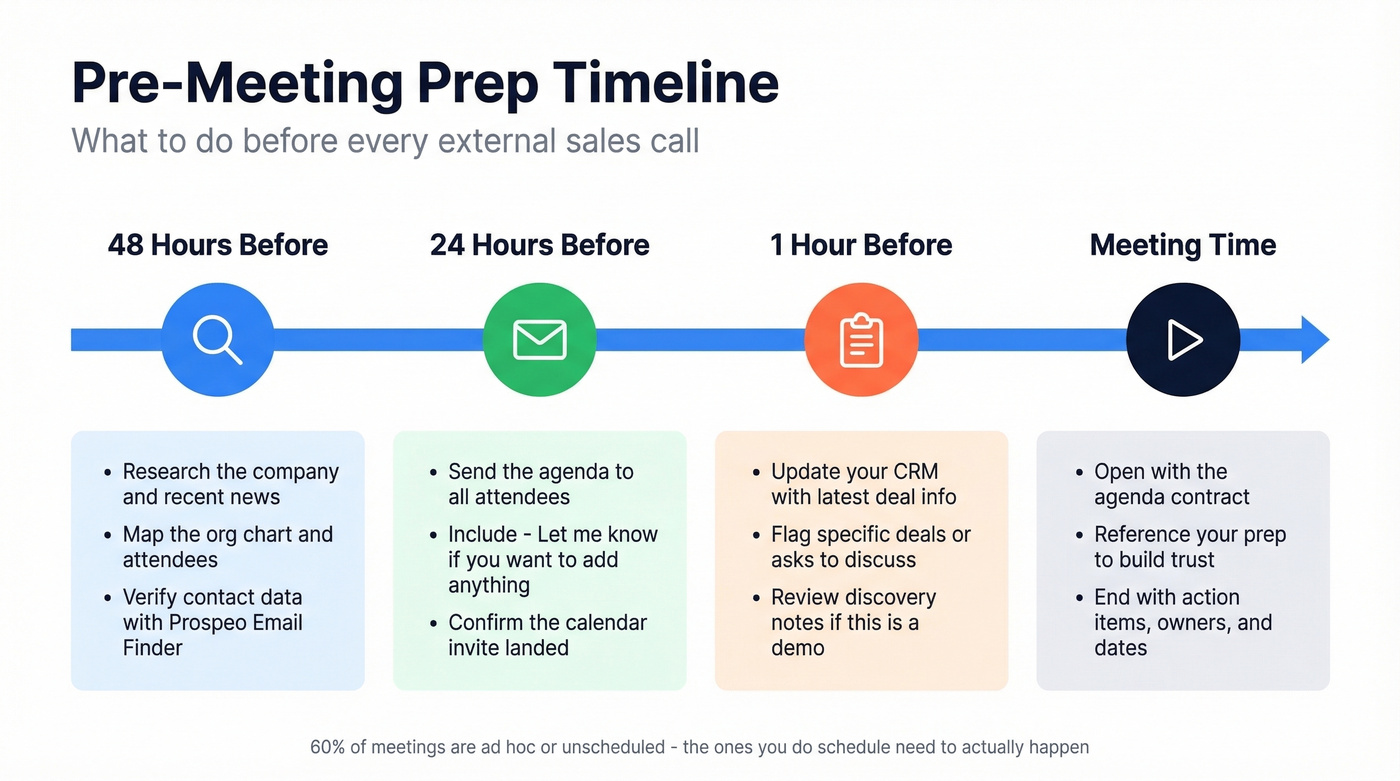
That sentence signals professionalism, gives the prospect ownership, and reduces no-shows because they've mentally committed to the structure.
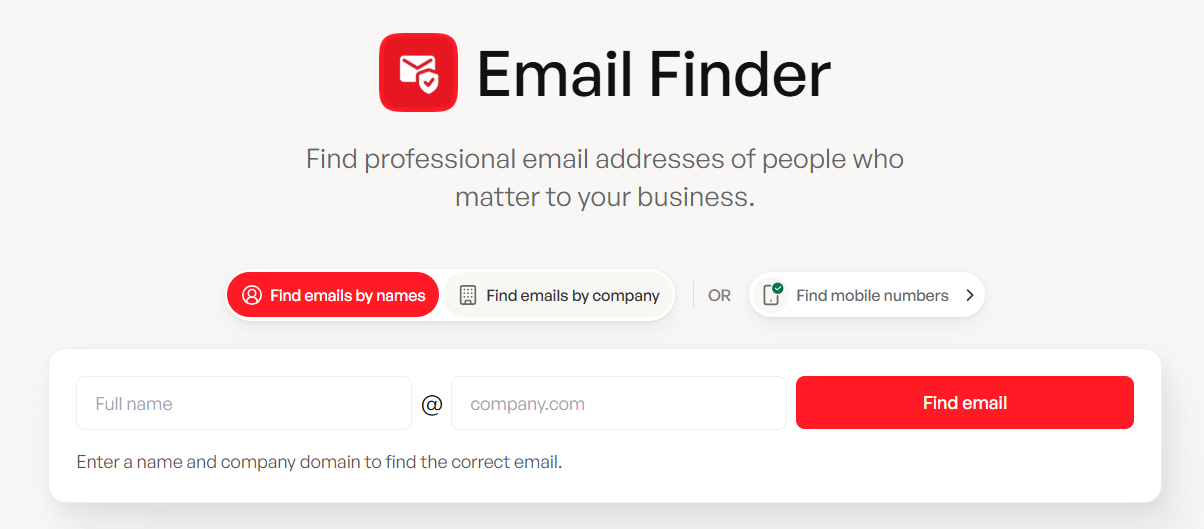
For external calls, prep goes beyond the agenda. Research the prospect's company, recent news, tech stack, and org chart. Know who else might be in the room. Verify the contact data before you send that invite - 60% of meetings are ad hoc or unscheduled, which means the ones you do schedule need to actually happen.
For internal meetings, prep is simpler: update your CRM, flag the deals you want to discuss, and come with specific asks. "I need help with the Acme deal" beats "things are going okay." Send meeting notes within an hour of the call ending - they're the follow-up artifact that keeps action items from evaporating.
Meeting Cadence Cheat Sheet
| Meeting | Frequency | Attendees | Duration | Output |
|---|---|---|---|---|
| Team standup | Weekly (Mon) | Full sales team | 60 min | Weekly priorities |
| Pipeline review | Biweekly | Manager + reps | 30 min | Forecast updates |
| Manager / Rep 1:1 | Weekly | Manager + 1 rep | 30 min | Coaching actions |
| Discovery call | As needed | Rep + prospect | 30 min | Qualified/disqualified |
| Product demo | As needed | Rep + SE + prospect | 45-60 min | Next step booked |
| QBR | Quarterly | Leadership or CSM + customer | 60-90 min | 90-day action plan |
7 Mistakes That Kill Sales Meetings
Round-robin status updates. If every rep recites what's in the CRM, you've turned a meeting into a podcast nobody asked for. Status updates belong in Slack or your CRM dashboard.
No agenda. Look - if there's no agenda, cancel the meeting. A meeting without an agenda is just a group of people sitting in a room hoping something useful happens.
Starting late. Five minutes late with 8 people in the room is 40 minutes of collective time gone. Start on time, every time, even if two people are missing.
Too many attendees. A 30-minute meeting with 8 reps costs 4 hours of team time. If someone can get the takeaways in a 2-minute Slack summary, cut them from the invite.
No action items. A meeting that ends with "great discussion, let's keep pushing" produced nothing. Every meeting ends with who does what by when. Write it down. Send it out.
Same format every week. When the agenda never changes, people go through the motions. Rotate the structure - bring in a guest speaker, run a pitch workshop, do a deal teardown. Variety keeps attention.
Leader running on autopilot. The manager's energy sets the ceiling for the room. If you're phoning it in, so is everyone else. Show up prepared, show up engaged, or delegate the meeting to someone who will.
Skip the 60-minute standup entirely if your average deal closes under $15K. Cut it to 30 minutes, drop the guest speaker slot, and give reps that half hour back for selling. The best meeting is often the one you shorten.
Pick one template, paste it into a doc, and run your next meeting with it. Adjust the timing and topics to match your team's rhythm. A solid sales meeting agenda template doesn't need to be complicated - it needs to be used.
If you want the follow-through to be as structured as the meeting, use a simple sales meeting follow-up email format so action items don’t disappear.
Your discovery calls deserve prospects who actually pick up. Prospeo's verified mobiles hit a 30% pickup rate - nearly 3x the industry average - so reps spend those timed agenda slots talking to buyers, not voicemails.
Fill your calendar with conversations, not bounces.
FAQ
How long should a sales meeting be?
Internal meetings default to 30 minutes for pipeline reviews and 1:1s, or 60 minutes for weekly standups. External calls run 30 minutes for discovery, 45-60 for demos, and 60-90 for QBRs. If you can't fit the content into the allotted time, your objective isn't clear enough. Tighten the scope before extending the clock.
What's the difference between internal and external agendas?
Internal agendas focus on team performance, pipeline health, coaching, and blockers - they're collaborative and manager-driven. External agendas center on the prospect: their pain, your solution, and concrete next steps. Internal meetings can be directive; external meetings should be permission-based and prospect-led.
How do I reduce no-shows on external calls?
Send the agenda 24-48 hours in advance with a clear value proposition for why the meeting is worth their time. Verify the prospect's email and phone before sending the invite so it actually reaches them. Include a specific outcome they'll walk away with, not just "let's chat."
What tools do I need to run structured meetings?
A Google Doc and a timer - that's the minimum viable stack. Notion, Confluence, or a shared CRM note all work too. The tool doesn't matter; the structure does. Where tooling helps most is pre-meeting prep: verifying contact data, researching the prospect's company's company, and confirming the invite landed.