

Sales Operations Roles and Responsibilities: The Practitioner's Guide
A post on r/SalesOperations sums up what most people feel when they land in this function: it's "a bit of everything." Insights, tool implementation, bridging leadership and BDRs - the poster wasn't sure which one they were actually hired for. That ambiguity isn't a personality quirk of one company. It's an industry-wide problem that makes defining sales operations roles and responsibilities critical for every growing org.
Sales Ops teams now spend 68% of their time on non-sales functions, up from 39% in 2019. When the role owns everything, it owns nothing well.
Clear responsibilities by level, salary benchmarks, org models, and the mistakes that quietly destroy Sales Ops teams from the inside - that's what we're covering here.
The Short Version
What does Sales Ops own? Seven core areas: forecasting and pipeline management, territory and quota planning, data governance, tech stack management, process optimization, reporting and analytics, and compensation design.
How much should you (or they) be making? Analyst: $68K-$80K base. Manager: ~$107K base / ~$123K total comp. Director: $140K-$200K base. VP: $180K-$300K+.
How do you build this team? Start with one Sales Ops hire per 30 reps. Keep it centralized early. Once you're scaling past ~50 reps, evaluate federated or hybrid models. First hire should be a generalist manager, not a specialist.
What Is Sales Operations?
The function traces back to J. Patrick Kelly at Xerox in the 1970s, who realized sellers shouldn't be doing their own territory planning, compensation math, and pipeline reporting. The logic hasn't changed - sellers still spend nearly 70% of their time on non-selling tasks. Someone has to own the infrastructure that lets reps actually sell.
Sales Ops isn't "sales support." It's the strategic layer between revenue leadership and frontline execution. The team designs how deals move through the pipeline, how territories get carved, how forecasts get built, and how data flows between systems. The scope has expanded dramatically - from territory planning and comp admin to CRM architecture, tech stack governance, cross-functional alignment, and AI-driven analytics. That expansion is exactly why clarity around each ops role matters more than ever.
The 7 Core Responsibilities
Forecasting & Pipeline Management
Mature orgs aim to keep forecast accuracy within plus or minus 5-10%. Most teams aren't there. The gap usually traces back to inconsistent stage definitions, not bad reps.
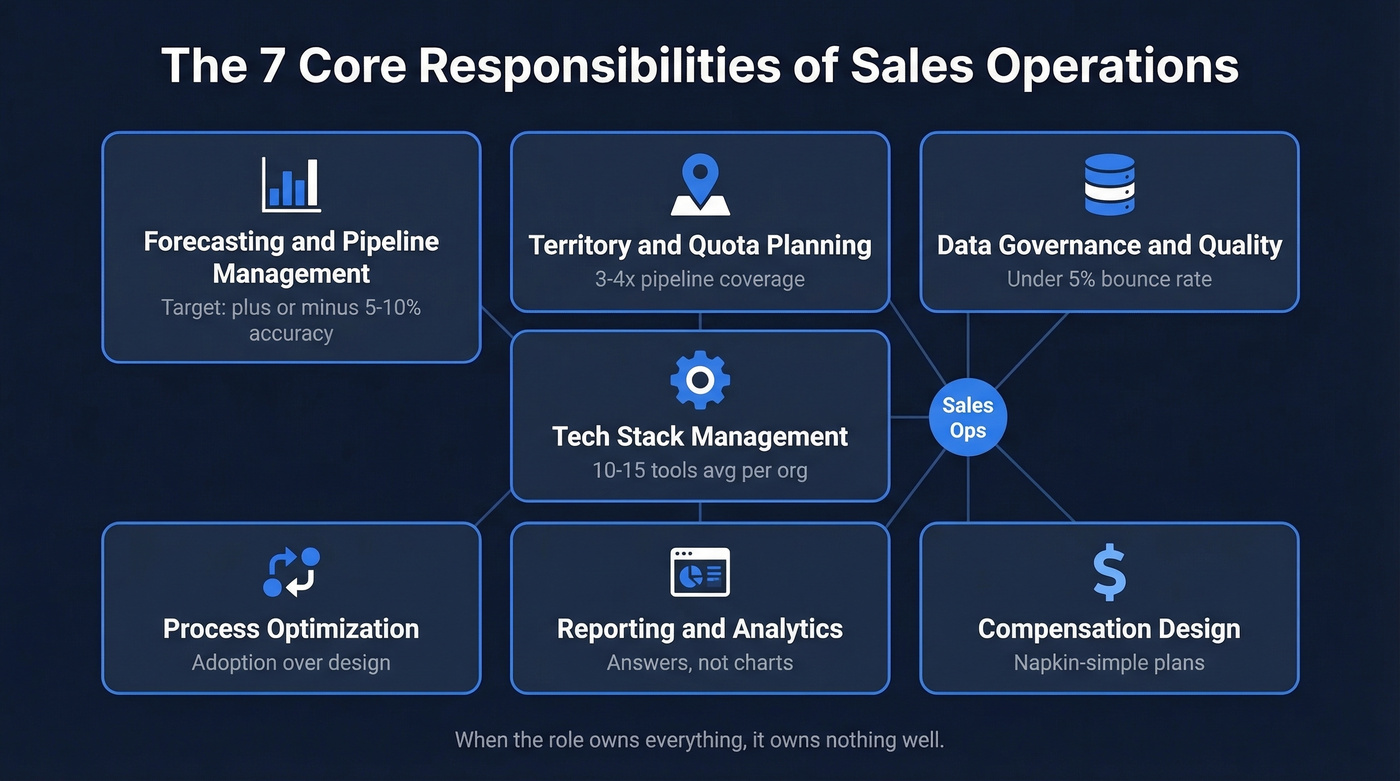
Sales Ops owns the forecast model - defining pipeline stages, enforcing stage-exit criteria, and building the cadence that turns rep-level guesses into something the board can trust. When we've audited forecast processes at mid-market companies, the single biggest fix is almost always the same: write down what "Stage 3" actually means and make reps prove they've hit the criteria before advancing a deal.
Territory & Quota Planning
Territories should balance opportunity, not just geography. Sales Ops designs the model (geographic, named account, vertical, hybrid), sets quotas based on historical attainment and market potential, and rebalances quarterly. A common operating target is 3-4x pipeline coverage across territories. When one rep has 6x coverage and another has 1.5x, that's a territory design failure, not a performance gap.
Data Governance & Quality
Bad contact data is a massive operational tax. Bounce rates above 5% wreck deliverability, poison reporting, and erode rep trust in the CRM. Teams using verified enrichment tools with short refresh cycles can eliminate most of that chaos - Prospeo, for instance, runs a 7-day data refresh and delivers 98% email accuracy, which is why several of our customers saw bounce rates drop from 35-40% to under 5%.
Data governance also means enforcing field-level standards, deduplication rules, and lifecycle stage definitions so every downstream report is trustworthy. (If you’re evaluating vendors, start with this breakdown of data enrichment services.)

Tech Stack Management
The average B2B sales org runs 10-15 tools. Sales Ops decides which stay, which go, and how they integrate. CRM, sales engagement, CPQ, forecasting, territory planning, comp management, enrichment, BI - every tool should map to a measurable outcome. If it doesn't, it's burning budget. (If you’re standardizing your stack, it helps to align on examples of a CRM and what “good” looks like.)
Process Optimization
Here's the thing: process only works if reps follow it. Sales Ops designs the workflows - lead routing, deal handoffs, approval chains, QBR cadences - and monitors adoption. Well-documented processes are what separate scalable orgs from ones that break every time headcount grows. When reps route around the process, the data breaks, the forecast breaks, and leadership makes decisions on fiction. (For a deeper framework, see sales process optimization.)
Reporting & Analytics
Every report should answer a question someone is actually asking. Pipeline velocity, conversion by stage, win/loss analysis by segment, rep productivity ratios - Sales Ops builds the reporting layer that connects activity metrics to business outcomes. (If you want a KPI list to start from, use these sales operations metrics.)
A dashboard with 47 charts and no narrative is worse than no dashboard at all. If your VP of Sales can't open a report and know what to do differently this week, the reporting has failed.
Compensation Design
Comp plans drive behavior. The best ones are simple enough that a rep can calculate their commission on a napkin.
Sales Ops designs incentive structures, models payout scenarios, handles SPIFs, and administers the plan. When reps can't explain how they get paid, you've already lost.

You just read that bounce rates above 5% wreck deliverability, poison reporting, and erode rep trust. That's a Sales Ops problem with a simple fix. Prospeo's 7-day data refresh and 98% email accuracy cut bounce rates from 35%+ to under 5% - so your CRM stays clean and your forecasts stay honest.
Stop letting bad data sabotage every downstream report your team builds.
Sales Ops Roles by Level
| Level | Key Responsibilities | Owned KPIs | Base Salary (US) |
|---|---|---|---|
| Analyst | CRM hygiene, lead routing, dashboards | Report accuracy, pipeline conversion | $68K-$80K |
| Manager | Forecasting, territory/quota, comp admin | Forecast accuracy, quota attainment, cycle length | ~$107K (~$123K total) |
| Director | GTM model design, capacity planning, cross-functional alignment | Revenue efficiency, tech ROI, headcount productivity | $140K-$200K |
| VP | End-to-end revenue process, org design, long-range forecasting | Total revenue attainment, cost of revenue | $180K-$300K+ |
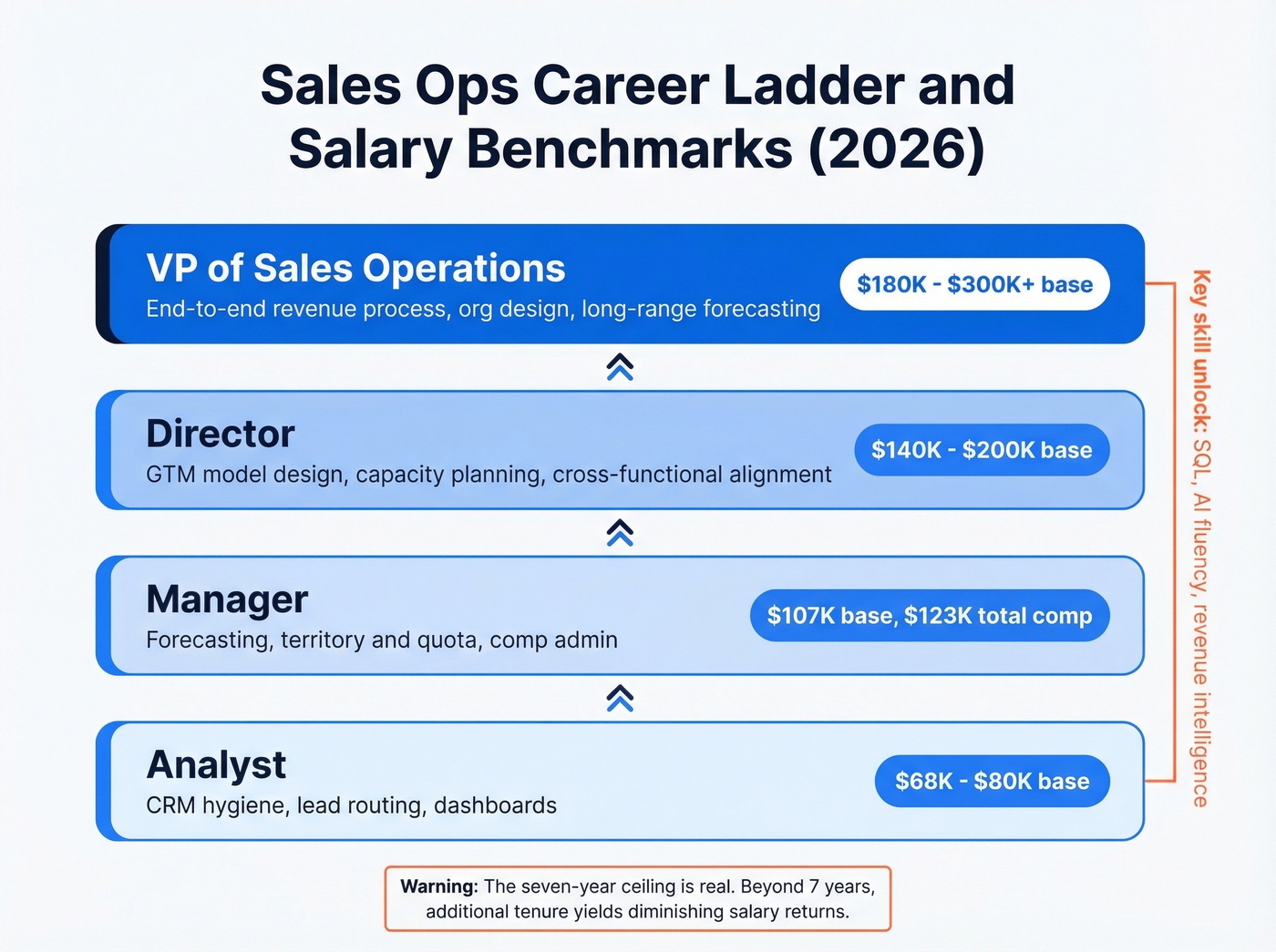
The salary story has shifted. The pandemic-era surge averaged +34% growth across Sales Ops roles, but 2024 brought just 0.35% growth. The real story is compression: entry-level roles saw +8.4% growth while senior roles contracted by over 10%. As of 2026, the market rewards technical skills - SQL, revenue intelligence, AI fluency - over years of experience alone. DealHub calls it the "seven-year ceiling": beyond ~7 years, additional tenure yields diminishing salary returns.
For analysts, geography still matters enormously. San Francisco pays around $95K; Google and Meta pay $129K-$133K.
If you're a Sales Ops analyst without SQL skills in 2026, you're competing for roles that are shrinking. The technical floor has risen permanently. (If you’re mapping the career path, compare this ladder to a modern Sales Ops Manager role.)
How to Structure a Sales Ops Team
Centralized
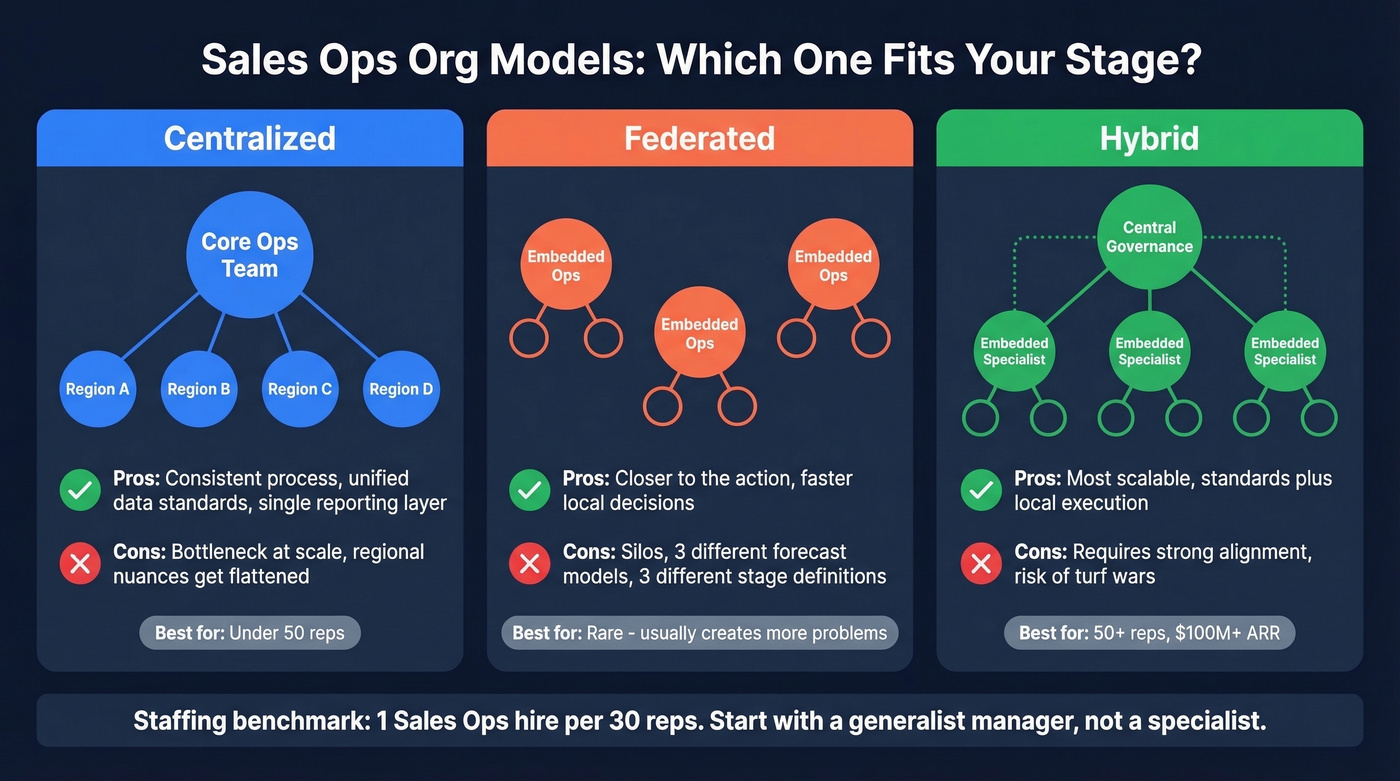
One core team serving the entire sales org. Consistent process, data standards, and reporting. Works well early, but as you scale past ~50 reps the team starts to strain - every request funnels through the same queue, and regional nuances get flattened.
Federated
Ops professionals embedded by region, business unit, or product line. Closer to the action, but the risk is silos. In our experience, three embedded ops people building three different forecast models with three different stage definitions creates more problems than it solves.
Hybrid
Central governance sets the standards, embedded specialists execute locally. This is the most scalable model for complex orgs, but it requires strong alignment to avoid turf wars. Many companies above $100M ARR land here.
Staffing benchmarks: The standard ratio is 1 Sales Ops professional per 30 reps. PeerSignal's analysis of 2,500 B2B SaaS companies found a 12:1 sales-to-RevOps ratio.
| ARR Stage | Sales Headcount | RevOps Team Size |
|---|---|---|
| $50M | 43-58 | 4-5 |
| $100M | 87-116 | 7-10 |
| $200M | 173-231 | 14-19 |
At $50M, that's typically 1 manager plus 3-4 ICs. By $200M, you're looking at a VP, 2 directors or managers, and 12-16 ICs.
Hiring order matters. Start with a generalist manager who can own the CRM, build the forecast model, and design initial processes. Second hire: an analyst for reporting and data hygiene. Third: a dedicated CRM admin once system complexity justifies it. (If you’re building the broader function, this RevOps Manager guide helps clarify scope and handoffs.)
Sales Ops vs. RevOps
| Dimension | Sales Ops | RevOps |
|---|---|---|
| Scope | Sales only | Sales + Marketing + CS |
| Key Metrics | Win rate, quota, deal velocity | CAC, CLTV, churn, ARR growth |
| Reports To | Head of Sales | CRO / CEO |
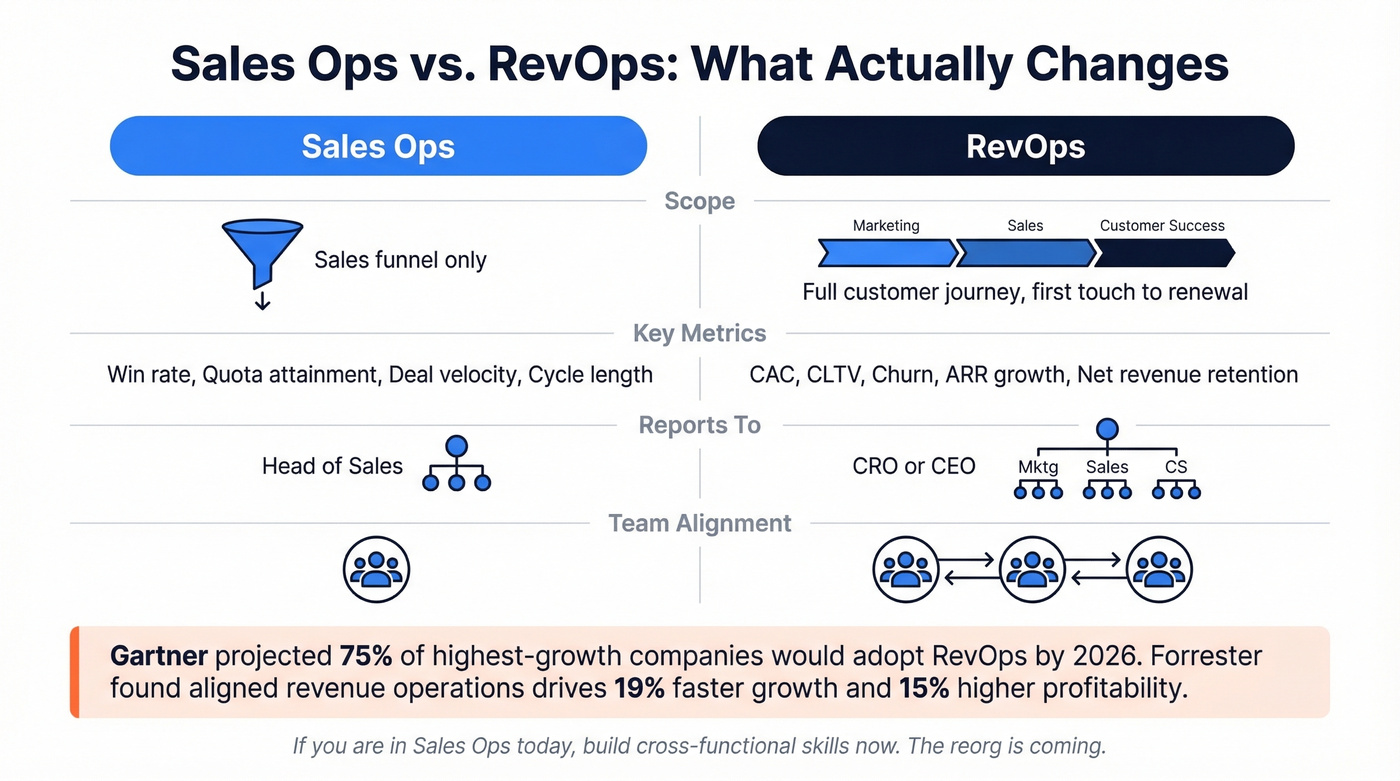
Gartner projected that by 2026, 75% of the highest-growth companies would adopt a RevOps model - and the early data suggests they were right. Forrester's research backs the case: B2B companies with aligned revenue operations see 19% faster revenue growth and 15% higher profitability.
Let's be honest: the RevOps reorg is coming for your Sales Ops title. That's fine. The skills transfer directly. What changes is scope - instead of optimizing the sales funnel in isolation, you're optimizing the entire customer journey from first touch to renewal. If you're in Sales Ops today, build cross-functional skills now. Learn the marketing ops stack. Understand CS metrics. The teams that resist the shift don't disappear; they just get reorganized under someone who didn't resist. (If you want a clean way to quantify the CS side, start with churn analysis.)
Mistakes That Kill Sales Ops
Most Sales Ops teams fail for the same five reasons. We've seen every one of these firsthand.
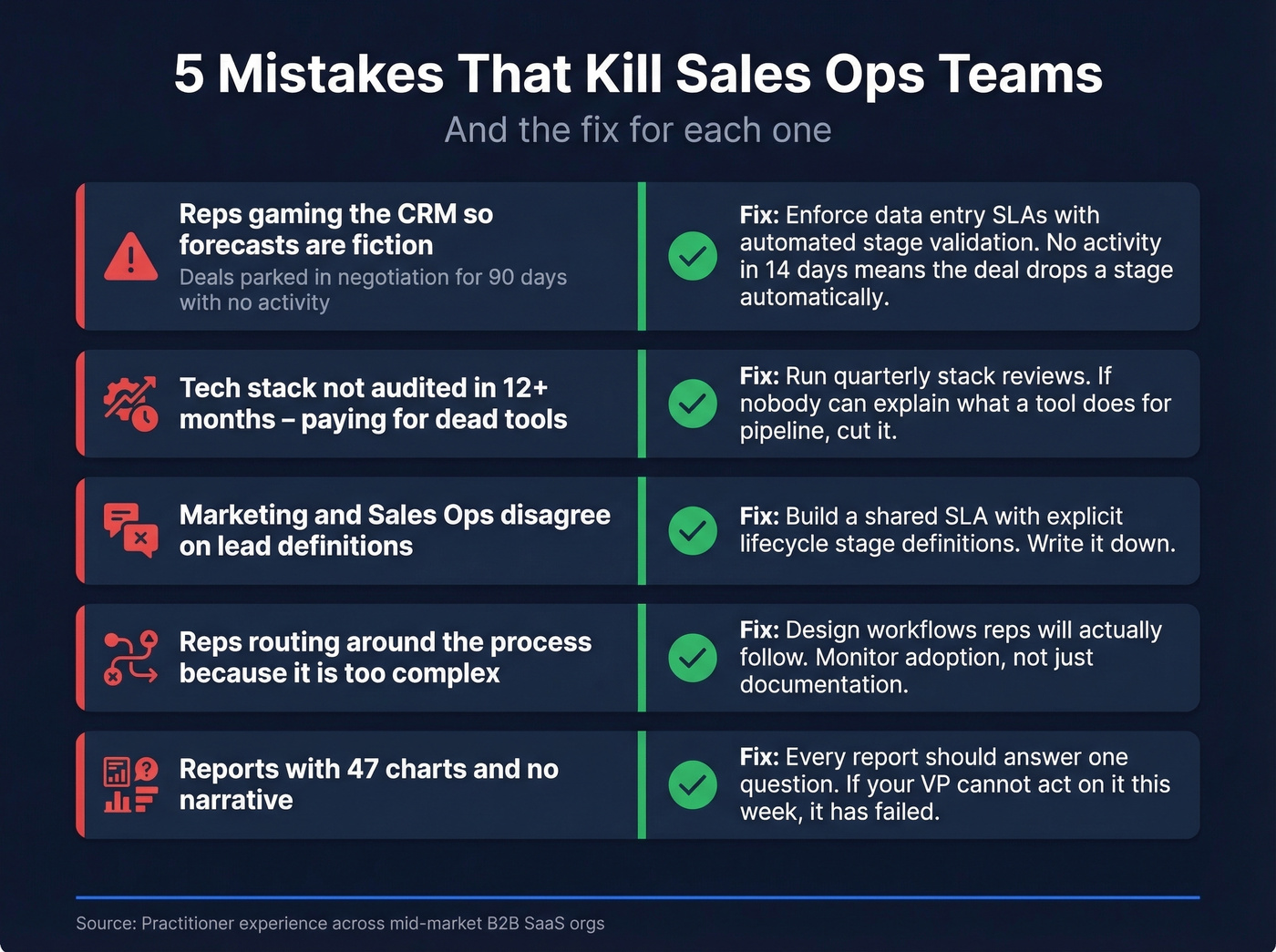
Reps gaming the CRM so forecasts are fiction. Deals parked in "negotiation" for 90 days with no activity are the symptom. Fix: enforce data entry SLAs with automated stage validation. If a deal hasn't had a logged activity in 14 days, it drops a stage automatically. (This is also why tracking pipeline health matters more than “pipeline size.”)
Tech stack not audited in 12+ months. You're paying for dead tools. Run quarterly stack reviews. If nobody can articulate what a tool does for pipeline or revenue, cut it.
Marketing and Sales Ops disagree on lead definitions. Every pipeline metric becomes unreliable. Build a shared SLA with explicit lifecycle stage definitions. An MQL means the same thing to both teams, or the handoff breaks. (If you need a practical setup, use a clear lead status taxonomy.)
Tracking metrics without tying to strategy. Vanity dashboards. Map every report to a business question someone is actually asking. If you can't name the person who needs the chart, delete the chart.
Manual data cleanup consuming your analysts' time. A $120K/year analyst fixing Salesforce records by hand is an expensive way to avoid a tool that costs $0.01/email. Automate enrichment and verification so analysts can do actual analysis. Skip this if your database is under 5,000 contacts - at that scale, manual cleanup is still manageable. Above that, it's a losing battle.
Sales Ops manages 10-15 tools. Every one should map to a measurable outcome. Prospeo replaces fragmented enrichment workflows with 300M+ verified profiles, 30+ search filters, and native integrations into Salesforce, HubSpot, and every major sequencer - at $0.01 per email.
One platform your reps actually trust, at 90% less than ZoomInfo.
FAQ
When Should You Hire Your First Sales Ops Person?
Hire when your team exceeds 15-20 reps and the CRM is becoming unreliable, forecasts are consistently off, or the VP of Sales is spending 10+ hours a week on operational tasks. Start with a generalist manager who can own the CRM, build the forecast, and design processes - those are the sales operations roles and responsibilities that show up in every real-world JD.
What's the Difference Between Sales Ops and Enablement?
Sales Ops optimizes processes, systems, and data. Enablement optimizes people - training, content, coaching, onboarding. Ops builds the machine; Enablement trains the operators. If you're hiring one first, hire Ops. You can't enable reps on a broken process.
What Tools Does a Sales Ops Team Need?
The core stack: a CRM (Salesforce or HubSpot), forecasting (Clari), territory planning (Fullcast), compensation management (CaptivateIQ or Xactly), BI (Tableau or Power BI), sales engagement (Outreach or Salesloft), and data enrichment for keeping every other tool's data clean.
How Do You Measure Sales Ops Success?
Track forecast accuracy (plus or minus 5-10% variance target), quota attainment distribution, sales cycle length, pipeline coverage ratio (3-4x), and tech stack ROI. The best ops teams also measure rep time-on-selling - if reps spend more than 35% of their week on admin, the operational infrastructure needs work.