

Sales Opportunities: How to Create & Close More Deals in 2026
It's Monday morning. Your VP pulls up the pipeline review, and half the "opportunities" on the board haven't moved in six weeks. Everyone starts talking about closing tactics and better demos. But the real problem isn't downstream - the pipeline was half-empty before anyone tried to close anything.
Creating and qualifying sales opportunities is where most teams fall apart, and it's where the biggest gains hide.
The Short Version
Most pipeline problems are opportunity creation problems. Fix your data foundation first - verified contacts, intent signals - then apply a qualification framework like MEDDIC or BANT, then track pipeline coverage at 3x minimum. If your outbound bounce rate is above 10%, your data provider is the bottleneck, not your reps.
The Pipeline Problem Nobody Talks About
Average B2B win rates sit somewhere between 20% and 30%. That means 70-80% of pipeline deals die. Every team knows this, and almost every team responds by investing at the bottom of the funnel - better pitch decks, negotiation training, discount approval workflows.
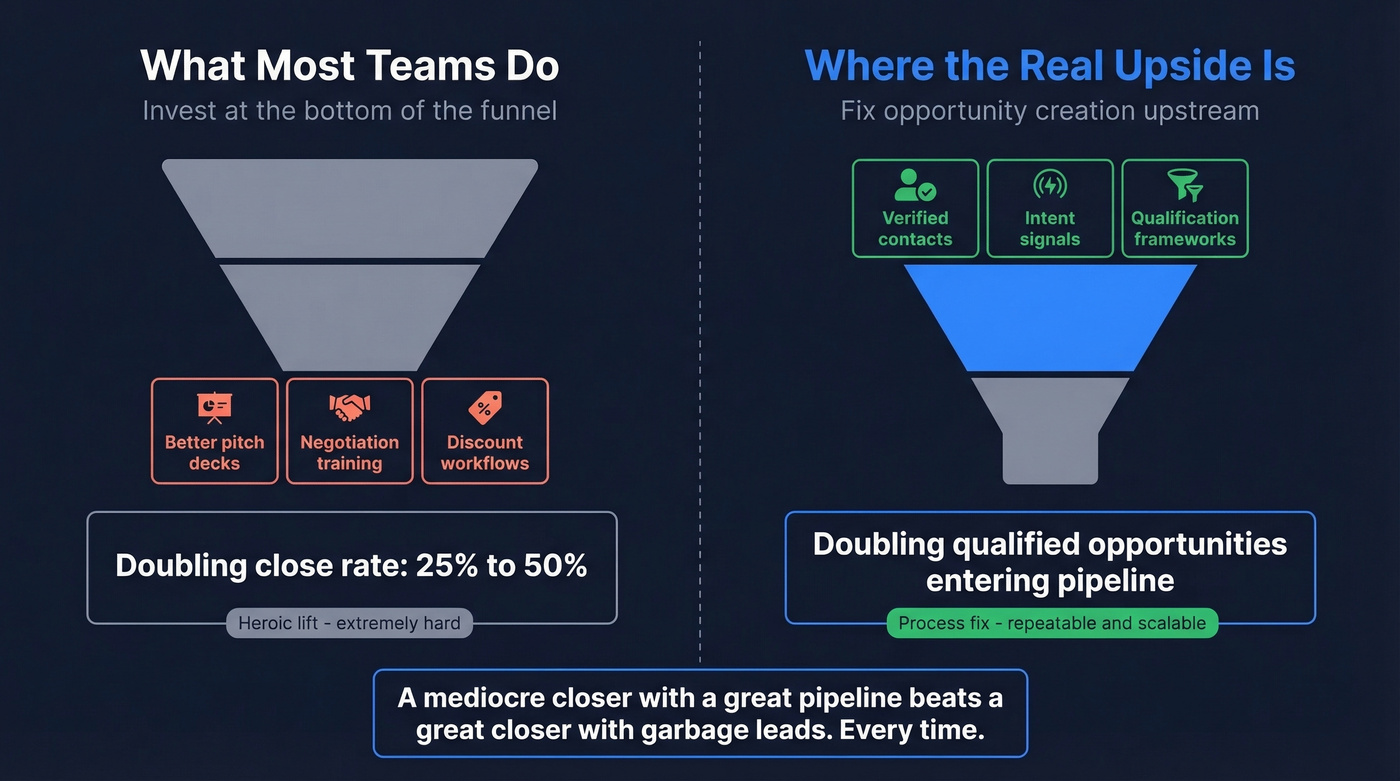
Here's the thing: if you're closing 25% of your deals, doubling your close rate to 50% is a heroic lift. Doubling the number of qualified opportunities entering the pipeline? That's a process fix. The real upside in any sales org is upstream, at the point where deals get created and qualified.
Spend any time on r/sales or r/salesengineers and you'll see the same theme repeated: most teams don't have a closing problem - they have a "garbage-in pipeline" problem. A mediocre closer with a great opportunity pipeline beats a great closer with garbage leads. Every time.
What Is a Sales Opportunity?
A sales opportunity is a qualified deal that's entered your pipeline with confirmed interest, a real business need, and at least a rough sense of budget and timeline. It's not a lead. It's not a prospect. Teams that blur these lines end up with inflated pipelines full of zombie deals that never close, and understanding What Is a Sales Opportunity? actually means - then enforcing that definition across your team - is the first step toward a healthy pipeline.
| Lead | Prospect | Sales Opportunity | |
|---|---|---|---|
| Definition | Unqualified contact | Engaged, partially qualified | Fully qualified deal |
| Stage | Top of funnel | Mid-funnel | Active pipeline |
| Qualification | None | Initial fit confirmed | Budget, authority, timeline |
| CRM Status | Marketing Qualified | Sales Accepted | Opportunity (staged) |
| Example | Webinar attendee | SDR-booked meeting | Proposal sent |
If your CRM has 200 "opportunities" but only 40 have a confirmed decision-maker and a next step scheduled, you don't have 200 opportunities. You have 40.
Pipeline Opportunity Stages
Most CRMs map opportunities through a standard progression. Labels vary, but the logic is consistent:
- Lead Identified - a potential fit surfaces through inbound, outbound, or referral.
- Qualified - initial discovery confirms budget, authority, need, and timeline.
- Discovery / Needs Analysis - the deep-dive into the prospect's pain, current stack, and buying process. This is where you earn the right to propose. (If you need a tighter structure, use a discovery question bank.)
- Proposal / Solution Presented - you've mapped your solution to their problem.
- Negotiation - terms, legal, and procurement get sorted.
- Closed Won or Closed Lost - revenue hits the board, or the deal dies and you log why.
Salesforce and HubSpot both let you customize these stages, and you should. The key is that every stage has a clear exit criterion - a specific action that moves the deal forward. Without exit criteria, deals sit in "Proposal" for months and nobody notices until the pipeline review.
How to Qualify Effectively
Two frameworks dominate. Which one you pick depends on deal complexity.
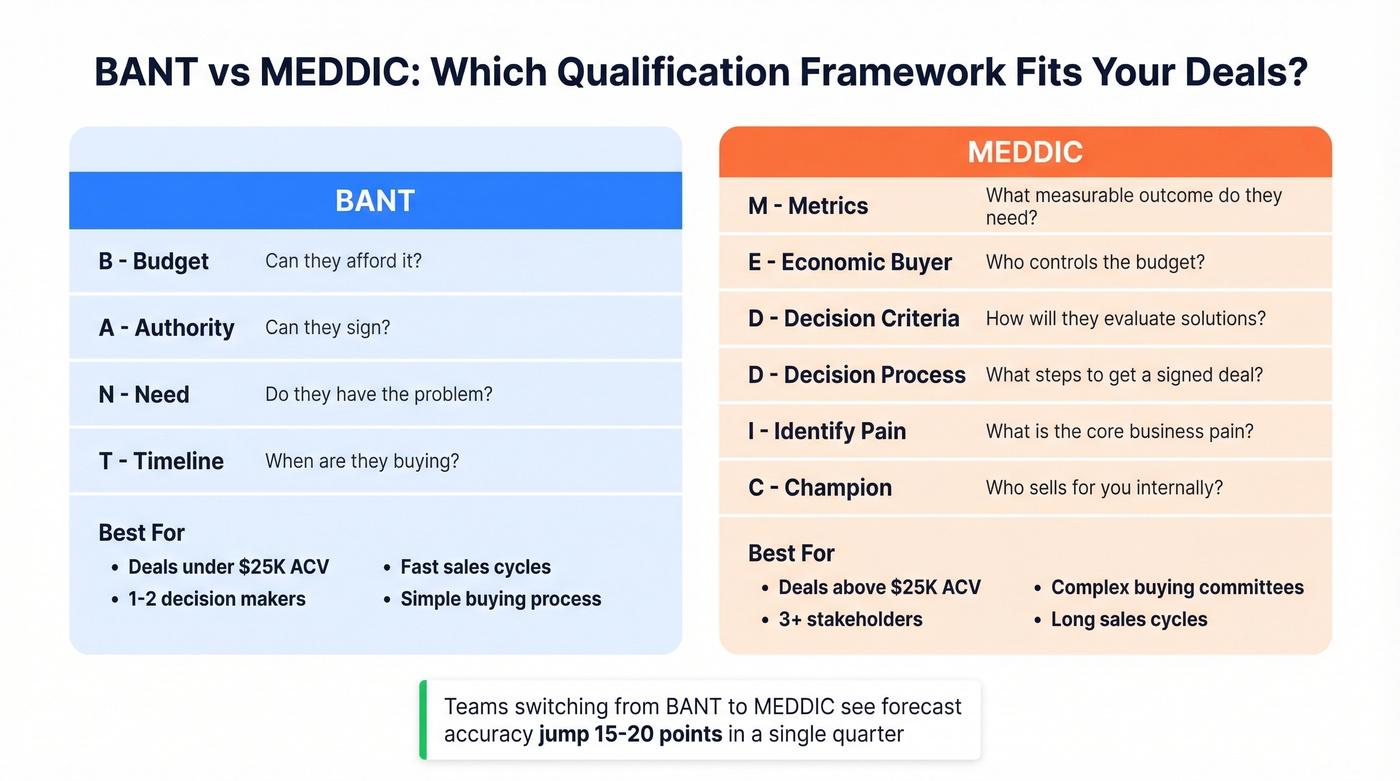
BANT (Budget, Authority, Need, Timeline) works well for deals under $25K ACV involving one or two decision-makers. It gives reps a fast checklist to separate real prospects from tire-kickers.
MEDDIC (Metrics, Economic Buyer, Decision Criteria, Decision Process, Identify Pain, Champion) is built for complex, multi-stakeholder deals. It forces reps to map the entire buying committee, understand the internal decision process, and identify a champion who'll sell internally when you're not in the room. For deals above $25K with 3+ stakeholders, MEDDIC is the better framework - and it's not close.
We've watched teams switch from BANT to MEDDIC and see forecast accuracy jump 15-20 points in a single quarter. Complex deals don't die because of bad demos. They die because the champion left, the economic buyer was never engaged, or the decision process changed and nobody told you. (If you want a ready-to-run version, use a MEDDIC checklist.)

Half your pipeline problems start with bad data. Prospeo gives your reps 300M+ profiles with 98% verified emails, intent signals across 15,000 topics, and a 7-day refresh cycle - so every opportunity entering your pipeline is built on contacts that actually connect.
Snyk's AE-sourced pipeline jumped 180%. Yours is next.
How to Create More Sales Opportunities
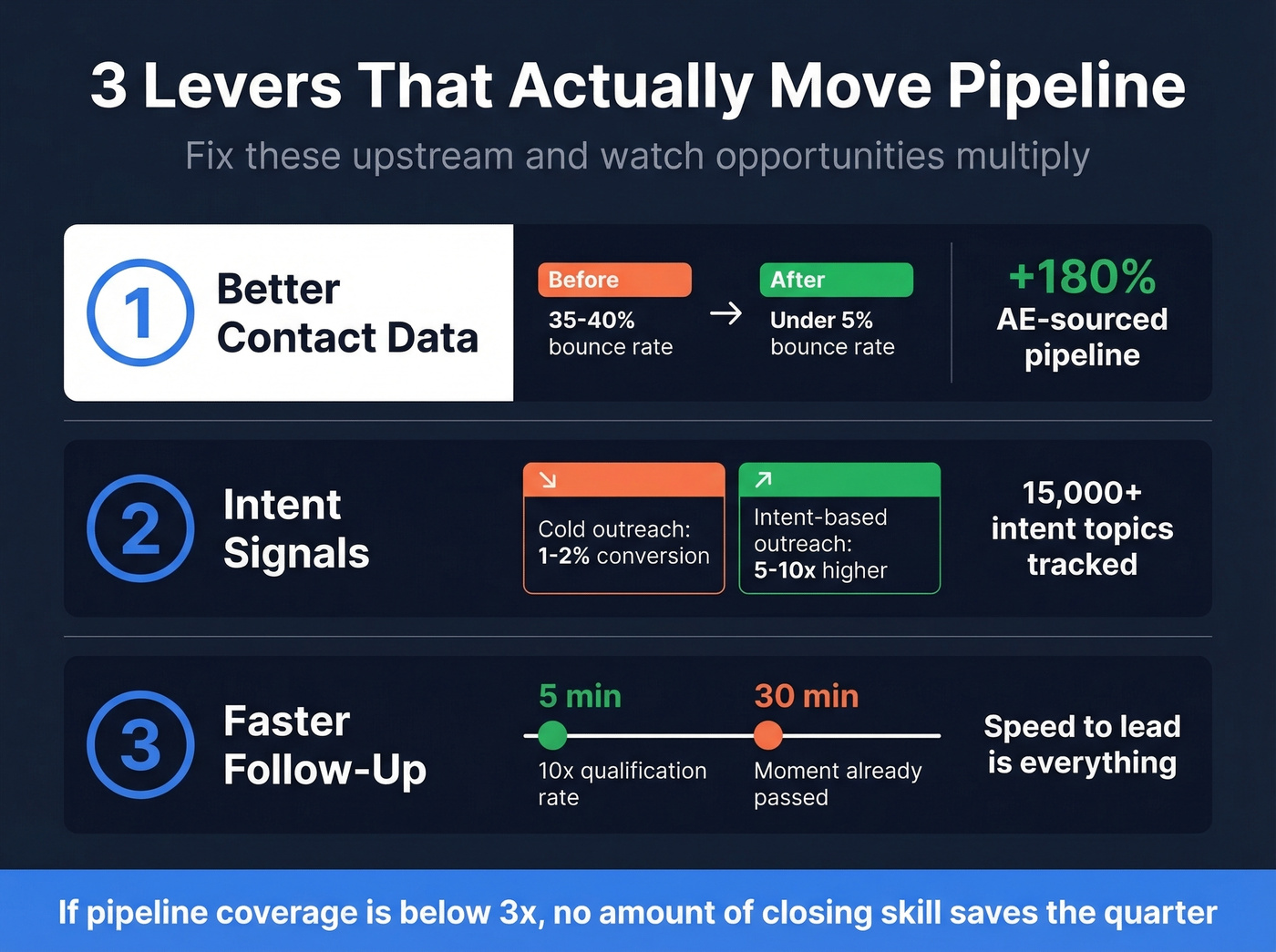
If your pipeline coverage is below 3x, no amount of closing skill saves the quarter. Three levers actually move the needle.
Better contact data
If your outbound bounce rate is above 10%, a third of your reps' effort is wasted before a single conversation happens. Snyk ran into exactly this problem: 50 AEs prospecting 4-6 hours per week, bounce rates at 35-40%. After switching to Prospeo, bounces dropped below 5%, AE-sourced pipeline jumped 180%, and the team started generating 200+ new opportunities per month. That's the kind of result clean, verified contact data creates. (If you're evaluating vendors, start with data enrichment services and a sales prospecting database.)

Intent signals
Cold outreach to companies with no active buying intent converts at 1-2%. Outreach to companies showing intent signals - researching your category, hiring for relevant roles, expanding headcount - converts at 5-10x that rate. Layer intent data into your prospecting workflow and you're creating pipeline from warm signals instead of cold guesses. (For a practical scoring model, see identifying buying signals.) Bombora tracks over 15,000 intent topics and powers the intent layer in several major platforms.
Faster follow-up
Speed-to-lead data consistently shows that responding within 5 minutes versus 30 minutes can 10x your qualification rate. The opportunity isn't just about finding the right people - it's about reaching them before the moment passes. If you need copy you can deploy today, use these sales follow-up templates.
Why Deals Stall Mid-Pipeline
Three things kill deals before they ever reach negotiation.
Bad contact data. When bounce rates hit 35-40%, a third of your outreach never arrives. Meritt faced this exact problem - bounce rates at 35%, pipeline stuck at $100K/week. After fixing their data source, bounces dropped below 4% and weekly pipeline tripled to $300K. (If you're diagnosing deliverability, start with email bounce rate benchmarks and an email deliverability guide.)

Wrong contact. Reaching an individual contributor instead of the decision-maker is worse than reaching nobody, because it creates the illusion of progress. Your CRM shows activity, your rep logs calls, but the person on the other end can't sign a PO. MEDDIC solves this structurally - it forces you to identify the economic buyer before the deal advances.
No urgency. If the prospect isn't actively evaluating solutions, you're creating a deal from scratch instead of entering one already in motion. Intent signals - topic research, competitor page visits, relevant job postings - tell you when a company is in-market.
Kill Zombie Deals, Don't Hire More Reps
If your average deal size is under $15K, you probably don't need a 12-stage pipeline or enterprise-grade sales methodology. You need clean data, fast follow-up, and ruthless disqualification.
The teams we see consistently hitting number aren't the ones with the most sophisticated process. They're the ones who kill bad deals early and pour energy into the 30% that are real. Let's be honest - reps who aggressively disqualify outperform reps who nurture everything, and sales engineering communities echo this constantly. Skip the complex methodology if your ACV doesn't justify it.
Metrics That Matter
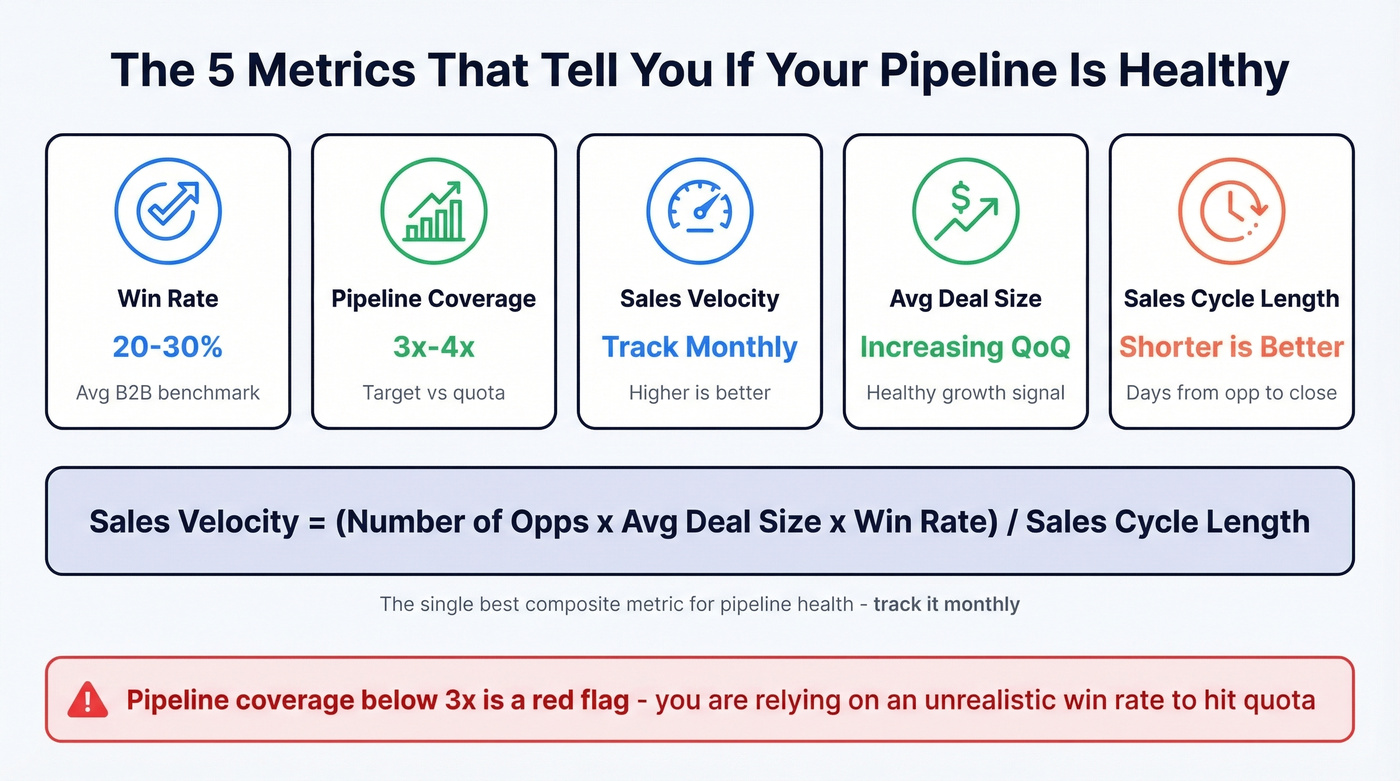
Five metrics tell you whether your opportunity engine is healthy.
| Metric | What It Measures | Benchmark |
|---|---|---|
| Win Rate | Deals won / total opps | 20-30% avg B2B |
| Pipeline Coverage | Pipeline value / quota | 3x-4x target |
| Sales Velocity | Speed of revenue generation | Track monthly; higher = better |
| Avg Deal Size | Revenue per closed deal | Increasing QoQ = healthy |
| Sales Cycle Length | Days from opp created to close | Shorter = better |
Pipeline coverage below 3x is a red flag. It means you're relying on an unrealistic win rate to hit quota, and any deal that slips pushes the whole quarter into danger. In our experience, teams obsess over win rate while ignoring coverage - then act surprised when they miss by 30%. (To pressure-test your numbers, compare against sales pipeline benchmarks and track pipeline health weekly.)
Sales velocity - (number of opportunities x average deal size x win rate) / sales cycle length - is the single best composite metric. Track it monthly to see whether your pipeline is actually getting healthier or just getting bigger.
Essential Tools for the Opportunity Engine
Three categories of tools power the pipeline.
CRM. Salesforce runs about $25-$330/user/month depending on tier and is the enterprise standard. HubSpot offers a free CRM with Sales Hub tiers around $20-$150/user/month - a strong choice for teams under 50 reps who want fast setup. If you're standardizing your stack, start with examples of a CRM.
Prospecting and data. This is where most teams underinvest. Prospeo offers 98% verified emails, 125M+ mobile numbers, and intent data across 15,000 topics at roughly $0.01/email with a free tier of 75 emails/month. Apollo ($49-99/mo per user) is solid for teams wanting all-in-one prospecting and sequencing. ZoomInfo ($15-40K/year) remains the enterprise default, though you're paying for features most teams never activate. (For more tactics, see sales prospecting techniques.)
Intent data. If you're not using intent signals to prioritize outreach, you're leaving the highest-converting opportunities on the table. Bombora is the dominant provider here, and it integrates with most major sales platforms.
Meritt's pipeline was stuck at $100K/week with 35% bounce rates. After switching to Prospeo, bounces dropped below 4% and weekly pipeline tripled to $300K - same team, same effort, better data. At $0.01 per verified email, fixing your data foundation costs less than one lost deal.
Stop losing deals to bad contact data. Fix the upstream problem now.
FAQ
What's the difference between a sales opportunity and a lead?
A lead is an unqualified contact who hasn't been vetted for budget, authority, or timeline. A sales opportunity is a qualified deal with all three confirmed and a next step scheduled. Skipping qualification is how pipelines fill up with deals that never close.
How many opportunities should a rep carry?
Target 3-4x pipeline coverage relative to quota. A rep with a $200K quarterly target needs $600-800K in active pipeline. Below 3x, you're relying on an unrealistic win rate to hit number.
What's a good win rate?
Average B2B win rate is 20-30%. Top-performing teams hit 30-40%. Below 20% typically means qualification criteria are too loose - tighten entry standards before investing in close-rate training.
How do I create more pipeline without hiring?
Fix data quality first - eliminate bounced emails and surface in-market buyers with intent signals. Layer in sub-5-minute follow-up and volume climbs without adding headcount.
What causes deals to stall?
Bad contact data, reaching the wrong stakeholder, and lack of buyer urgency. The first two are data problems solved with better tooling and verification. The third requires intent signals to time outreach to active evaluation windows.