

How to Build a Sales Organisation That Actually Hits Quota
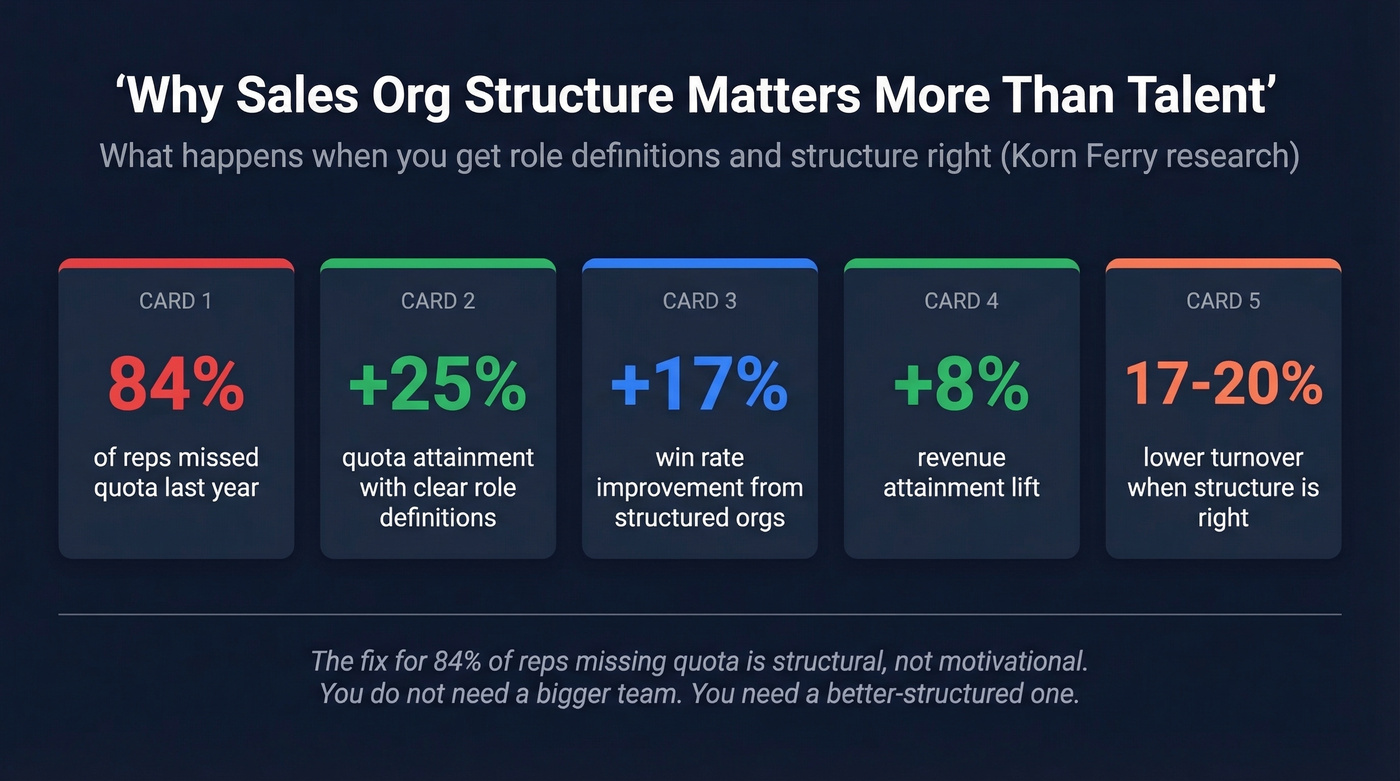
84% of reps missed quota last year. Not 50%. Not 60%. Eighty-four percent. The typical sales organisation has already been through four major transformations in the past decade, yet only 11% say they can execute a transformation while still driving commercial results.
Picture this: you've hired 15 reps, built a comp plan, launched enablement, and invested in a tech stack. Pipeline is flat. Your best AE just quit. Half the team is "ramping" at any given time, and nobody can explain why conversion dropped 20% last quarter. The buying side isn't helping either - the average B2B deal now involves seven decision-makers, and 89% of buyers had at least one deal stall in the past year. The average close rate across B2B sits at just 29%.
The problem isn't lazy reps or bad managers. It's structural. Every sales organization guide gives you the same four types and says "it depends." That's useless. What you actually need is a framework for deciding which structure fits your stage, your ACV, and your market - then a way to diagnose when it's broken.
What You Need (Quick Version)
If you're short on time, here's the thesis in three lines:
- Two layers, not one. Sales org design has a segmentation layer and a workflow layer. Most companies need a hybrid of both.
- Structure should evolve by stage. Specific roles and leadership get added at each ARR threshold. A $2M company shouldn't look like a $20M company.
- Structure beats talent. If 84% of reps are missing quota, the fix is structural - coverage, comp, data quality - not motivational. You don't need a bigger team. You need a better-structured one.
What Is a Sales Organisation?
A sales organisation isn't an org chart. It's the system that determines how revenue gets created - who talks to which customers, how work moves between roles, what gets measured, and how people get paid. When that system is well-designed, the numbers follow. Korn Ferry's research shows that orgs with clear role definitions achieve +8% revenue attainment, +25% quota attainment, +17% win rates, and 17-20% lower turnover. That's not marginal. That's the difference between a team that compounds and one that churns.
The context has shifted, too. 80% of B2B sales interactions now happen in digital channels, and buyers use roughly 10 interaction channels on average. McKinsey's rule of thirds holds: at any stage, a third of buyers prefer in-person, a third prefer remote, and a third want digital self-serve. That rule matters structurally because each third requires a different coverage model - field reps, inside sales, and product-led or digital channels. A single-channel org fails two-thirds of its buyers by default.
Two Layers of Sales Org Design
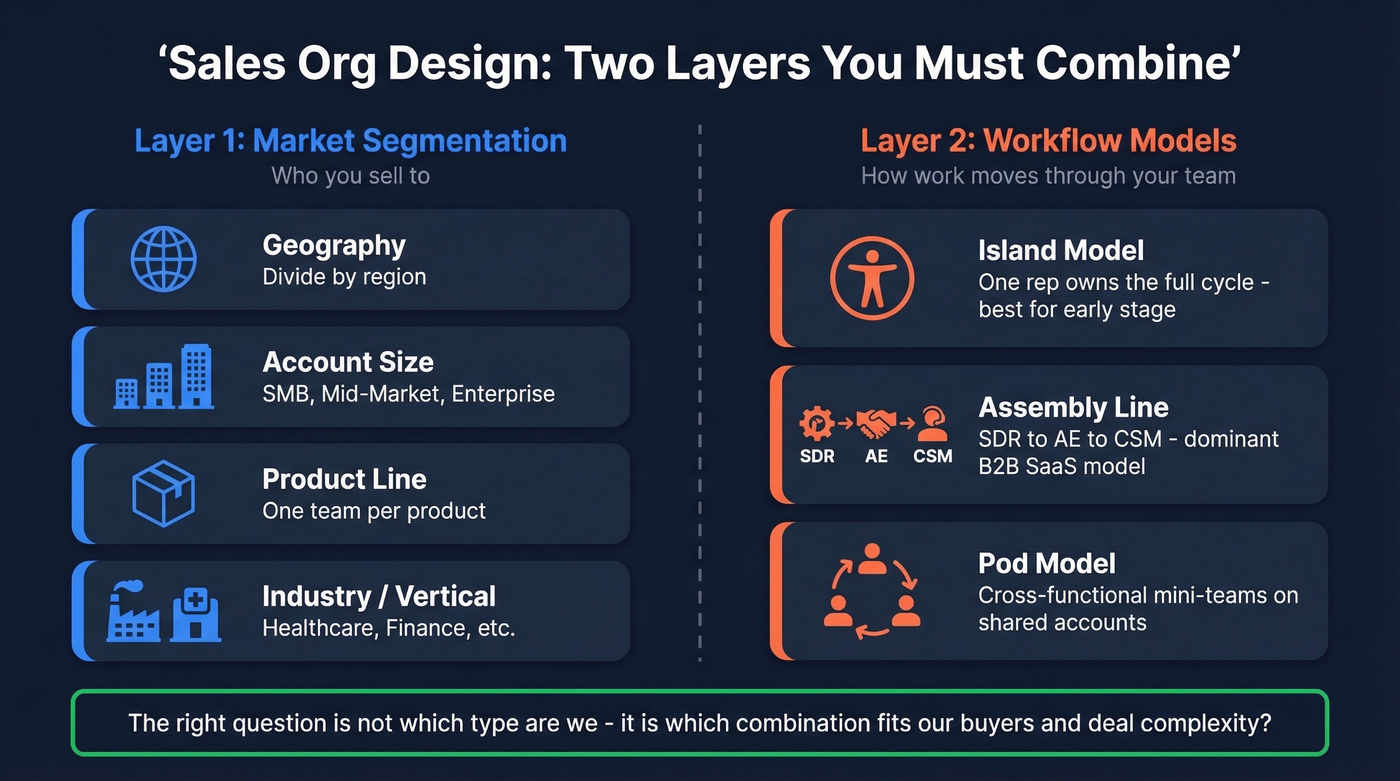
Most articles list four or five "types" of sales orgs and leave you to pick one. That framing is broken. Sales org design operates on two distinct layers: a market segmentation layer that determines who you sell to, and a workflow layer that governs how work moves through the team. You combine them. The right question isn't "which type are we?" - it's "which combination fits our buyers and deal complexity?"
A useful way to pressure-test this is to map your addressable market first, then decide how you want to cover it.
Layer 1: Market Segmentation
This is how you divide the market among your sellers. Four common approaches, each with a genuine tradeoff that shapes everything downstream.
Geography. Assign reps by region. It reduces travel costs, simplifies territory management, and gives reps local market knowledge. The tradeoff: multi-region accounts get fragmented, and opportunity distribution is rarely even. A rep covering the Midwest and a rep covering the Bay Area aren't playing the same game.
Account Size. Split by SMB, mid-market, and enterprise. This is the most common segmentation for B2B SaaS because the selling motions are genuinely different. SMB deals close in days with a single decision-maker. Enterprise deals take months and involve seven or more stakeholders. The risk: when an SMB account grows into mid-market, the handoff disrupts the relationship. Build the transition rules before you need them.
Product Line. Each rep or team owns a specific product. This works when products serve different buyers or require deep technical knowledge. The failure mode is fragmented messaging - the customer gets pitched by three reps from the same company in the same quarter. Cross-sell suffers.
Industry / Vertical. Reps specialise in healthcare, financial services, manufacturing, and so on. Vertical expertise builds credibility fast. But you're concentrating risk. If your healthcare vertical hits a regulatory freeze, that team's pipeline evaporates overnight while other verticals are fine.
Layer 2: Workflow Models
This is how work flows from prospect to customer. Three models, each suited to different levels of deal complexity.
Island Model. One rep owns the entire cycle - prospecting, qualifying, closing, sometimes even onboarding. It's the simplest model. Clear ownership, single point of contact for the buyer, minimal handoff friction. The downside: you're betting on generalists. Performance swings wildly based on individual talent, and it's nearly impossible to diagnose where the process breaks when a rep underperforms. Best for early-stage teams or low-ACV transactional sales.
Assembly Line. Specialised handoffs: SDRs prospect and qualify, AEs close, CSMs onboard and expand. This is the dominant B2B SaaS model for good reason - it lets each role develop deep expertise and creates measurable conversion points between stages. The failure mode is handoff friction. Every transition is a moment where context gets lost and the buyer repeats themselves. If your CRM hygiene is poor, the assembly line becomes a game of telephone.
If you want to make the handoffs measurable, define your funnel metrics and stage conversion targets before you add headcount.
Pod Model. Cross-functional mini-teams - typically an SDR, AE, and CSM, sometimes a solutions engineer - working together on a shared book of business. Pods reduce handoff friction and create tight feedback loops. Here's the contrarian take: pods require operational maturity most Series A companies don't have. You need clean data, shared dashboards, defined SLAs between pod members, and managers who can coach a multi-role unit. Without that infrastructure, pods just create three people who are confused instead of one.
Hybrid Examples That Work
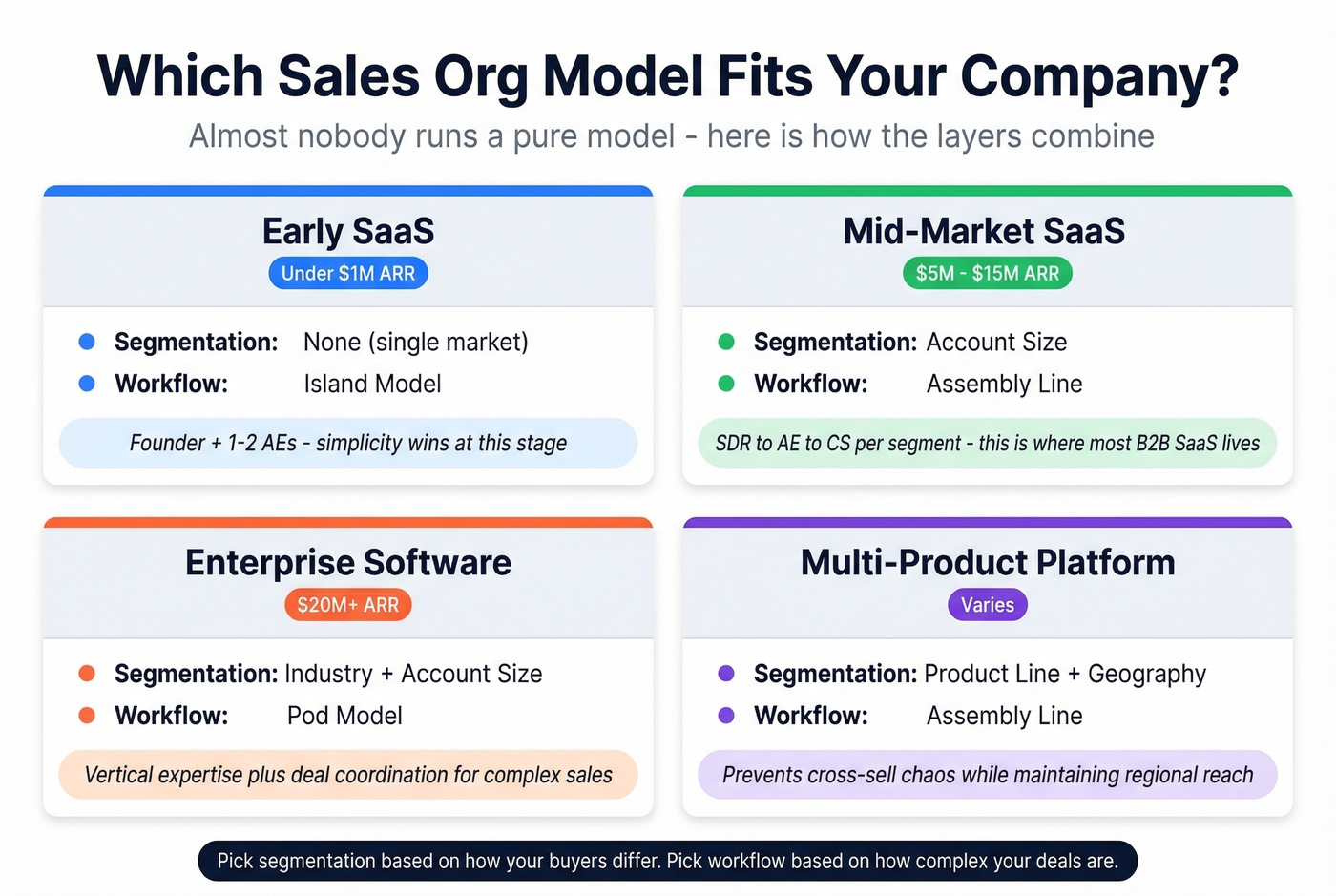
Almost nobody runs a pure model. Here's how the layers combine in practice:
| Company Type | Segmentation | Workflow | Why It Works |
|---|---|---|---|
| Early SaaS (<$1M ARR) | None (single market) | Island | Founder + 1-2 AEs; simplicity wins |
| Mid-market SaaS ($5M-$15M) | Account size | Assembly line | SDR to AE to CS per segment; scalable |
| Enterprise software ($20M+) | Industry + account size | Pod | Vertical expertise + deal coordination |
| Multi-product platform | Product line + geography | Assembly line | Prevents cross-sell chaos; regional reach |
Pick your segmentation based on how your buyers differ, and pick your workflow based on how complex your deals are. A $5K ACV product sold to SMBs doesn't need pods. A $200K enterprise deal sold into regulated verticals probably does.
Structuring by Company Stage
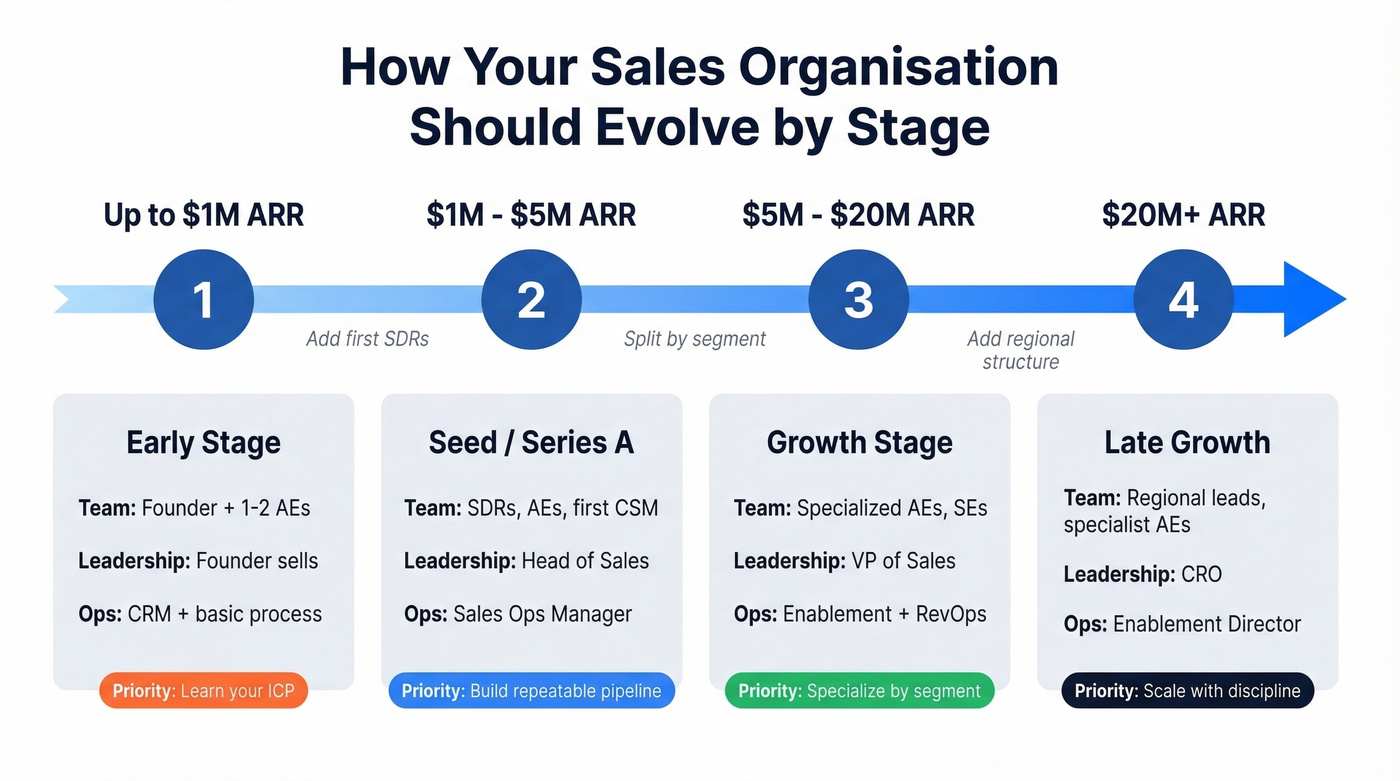
Structure should evolve as you scale. The mistake most founders make is either staying too flat for too long or over-hiring into a structure they can't support. Here's what each stage typically looks like, drawing on Sloane Staffing's ARR thresholds and patterns we've seen across dozens of teams.
| Stage | ARR Range | Key Roles | Leadership | Ops/Enablement |
|---|---|---|---|---|
| Early | Up to $1M | Founder + 1-2 AEs | Founder | CRM + basic process |
| Seed/Series A | $1M-$5M | SDRs, AEs, first CSM | Head of Sales | Sales Ops Manager |
| Growth | $5M-$20M | Specialised AEs, SEs | VP Sales | Enablement + RevOps |
| Late Growth | $20M+ | Regional leads, specialist AEs | CRO | Enablement Director |
Early Stage (Up to $1M ARR)
The founder is the sales team. Maybe you've added one or two AEs. The priority isn't structure - it's learning. What's the ICP? What objections come up? What's the actual sales cycle? Implement a CRM, define your pipeline stages, and build a repeatable deck. That's it.
Before you hire your first SDR, make sure your prospect data is clean. Bad data at this stage doesn't just waste time; it poisons your understanding of what's working. A tool like Prospeo gives you verified emails and direct dials from 300M+ professional profiles on a free tier - no contracts, no sales calls required. If you’re building lists from scratch, a simple ideal customer profile template helps you avoid “everyone” targeting.
Seed to Series A ($1M-$5M ARR)
This is where you add your first SDRs and a dedicated Head of Sales. The hiring heuristic from a founder on r/startup is useful: "If we got 10 more opportunities this month, how many would we drop the ball on?" When the answer is "most of them," it's time to hire. AEs should still do roughly 30% outbound even with SDRs - it keeps them sharp and reduces single-point-of-failure risk on pipeline generation.
If you’re standardising outbound, keep a shared library of sales prospecting techniques so new SDRs don’t reinvent the wheel.
Growth Stage ($5M-$20M ARR)
Now you're specialising. AEs split by segment - SMB vs. mid-market vs. enterprise. You add Solutions Engineers for complex deals. A VP of Sales owns the number. Sales Enablement starts formalising onboarding and content. SDR-to-AE ratios typically run 1:1 to 1:3 depending on outbound intensity and ACV.
Manager span of control should stay between 6 and 10 direct reports. Wider than that and coaching disappears - you end up with a team of individual contributors who happen to share a Slack channel.
To keep pipeline from going “flat” again, track pipeline health weekly, not quarterly.
Late Growth ($20M+ ARR)
Regional or segment leaders. An enablement director. A RevOps leader connecting marketing, sales, and CS data. Potentially a CRO. The org chart gets more complex, but the principle stays the same: every role should have a clear definition of what "excellent" looks like, and every handoff should be documented.

You can't out-hire a structural problem. When your assembly line runs on bad data, every handoff from SDR to AE leaks pipeline. Prospeo gives your sales org 98% verified emails, 125M+ direct dials, and a 7-day refresh cycle - so reps spend time selling, not chasing dead contacts.
Structure your org right. Then arm it with data that actually connects.
Compensation Design That Reinforces Structure
Compensation is structure. If your comp plan rewards new logos but your org chart says "land and expand," you've built a machine that fights itself. Here are the benchmarks that matter, based on Activated Scale's data:
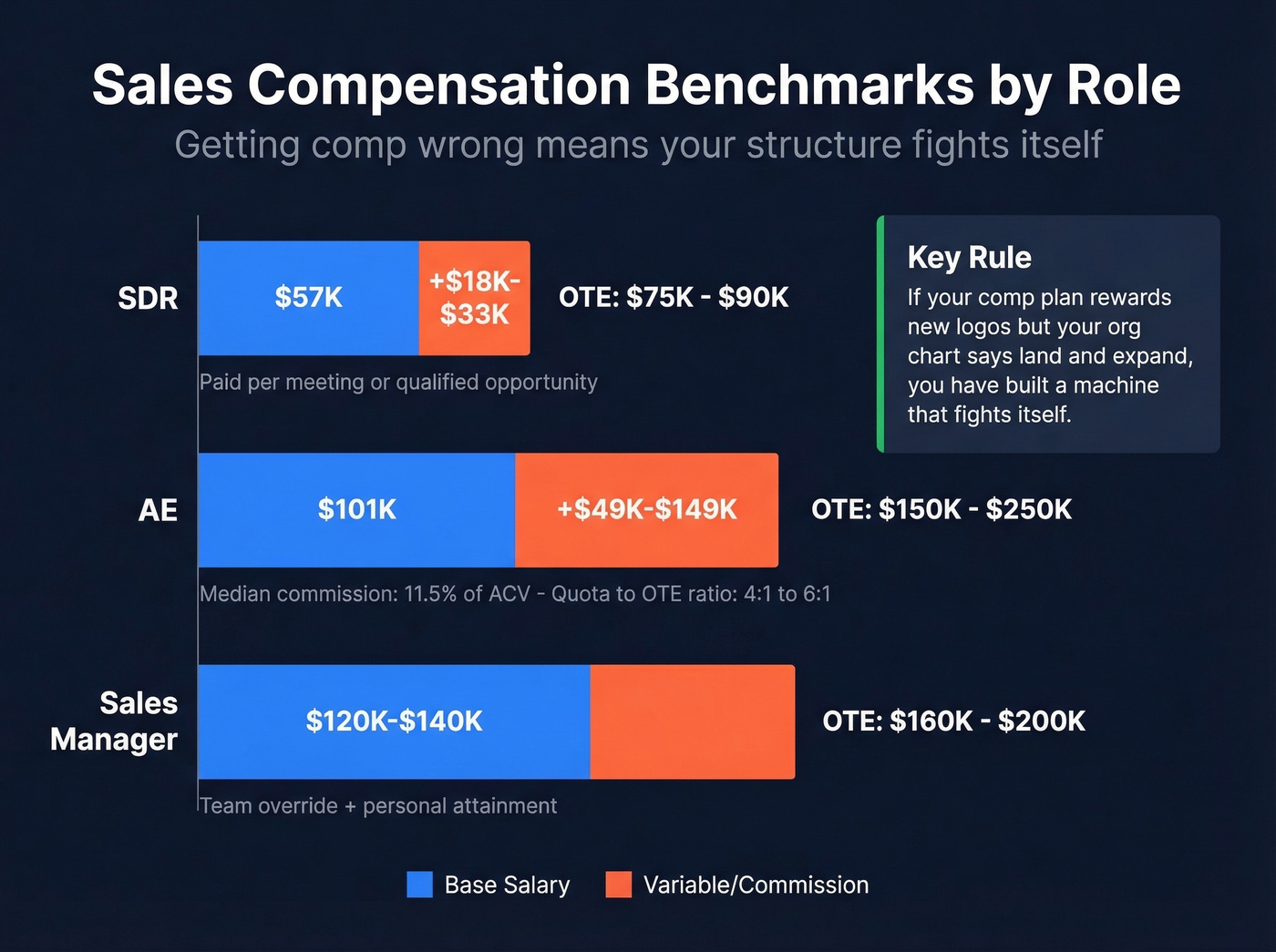
| Role | Avg Base | Typical OTE | Quota:OTE Ratio | Commission Rate |
|---|---|---|---|---|
| SDR | $57,739 | $75K-$90K | N/A | Per meeting/opp |
| AE | $101,250 | $150K-$250K | 4:1 to 6:1 | 11.5% ACV (median) |
| Sales Manager | $120K-$140K | $180K-$250K | Team-based | Override + team quota |
The typical base/variable split in the US runs about 44:56. That ratio skews more toward base for enterprise AEs with longer cycles and more toward variable for transactional roles where reps can directly influence volume. OTE for AEs is roughly 20% of their quota - so a rep with a $1M quota should be earning $150K-$200K OTE if they hit it. (If you need the math spelled out for your team, use an OTE explainer in onboarding.)
Now the anti-patterns, and these are the ones that actually break teams. Unrealistic quotas create stress, burnout, and turnover - if fewer than 40% of reps are hitting quota, the plan is wrong, not the people. Overcomplicated commission structures kill motivation because reps can't calculate their own earnings. And misaligned incentives - rewarding volume over margin, or new logos over retention - create long-term profitability problems that take quarters to surface.
Pay within 60 days. Every month you delay commission payouts past that, you erode trust. Reps talk. And the best ones leave first.
How AI Is Reshaping Sales Orgs in 2026
The structural question isn't "how many SDRs do I need?" anymore. It's "what work should humans still do?"
The data is directional but significant. Emergence Capital surveyed 400+ B2B companies and found 36% decreased SDR/BDR headcount in the last year. SaaStr deployed AI agents that generated $1M in revenue in 90 days from inbound alone - 71% of their Q4 closed-won sponsorship deals came from AI-qualified leads. The volume difference is staggering: AI SDR agents send 3,200+ emails per month compared to 75-285 from a human rep, an 11-40x increase. AI-native companies are running 2:1 or 3:1 SE-to-AE ratios, inverting the traditional model where AEs outnumbered SEs.
Bain's 2026 Technology Report puts it more precisely: sellers spend only about 25% of their time actually selling. AI can double that by handling research, data entry, follow-ups, and qualification. Early adopters are seeing 30%+ improvement in win rates when AI is applied across the full funnel. But Bain also identifies the biggest blocker: data cleanup, governance, and standardisation. AI amplifies whatever data quality you feed it - garbage in, garbage out, just faster.
Here's a stat that should make every sales leader uncomfortable: G2's buyer behaviour data shows buyers trust AI chatbots (17.2%) more than vendor salespeople (9.3%) for final purchase decisions. The human seller's edge isn't information delivery - it's relationship complexity, negotiation, and multi-stakeholder orchestration. A modern sales organisation structures around this reality rather than fighting it.
If you’re rebuilding outbound around agents, treat it like a tooling decision too: pick an SDR tool stack that matches your workflow model.
The assembly line model is compressing. AI handles the top of the funnel - prospecting, initial qualification, meeting scheduling - while humans focus on the middle and bottom: discovery, negotiation, closing. The SDR role isn't disappearing, but it's evolving from "send 100 emails a day" to "manage AI-generated pipeline and handle the conversations that require judgment." Teams that restructure around this will run leaner and close more.
Hot take: If your average deal size is under $10K, you probably don't need human SDRs at all in 2026. An AI agent plus clean verified data will outperform a junior rep doing manual outreach - and cost a tenth as much. Save the human headcount for deals where relationships actually move the needle.
When and How to Restructure
Calendar cadence matters less than trigger-based restructuring. Declining quota attainment, entering a new market segment, or a major product launch - these are the moments that demand structural change. Korn Ferry recommends reviewing your sales org structure every 2-3 years as a baseline, but waiting for the calendar is how you end up 18 months behind your market.
A quick diagnostic before you start: if more than a third of your team is underperforming across your top three metrics simultaneously, the problem is structural, not individual. Fix the system before you coach the people.
The Brevet Group's 4 C's framework is the most practical restructuring tool we've come across:
- Customer: Are you segmenting and prioritising the right accounts?
- Coverage: Does your coverage model match those segments?
- Capacity: Do you have the right headcount and time allocation?
- Capability: Do your people have the competencies each segment requires?
Their CPG case study shows what's possible. A firm with six siloed sales teams calling on the same retailers ranked 7,000+ customers by revenue and cross-sell potential, redesigned territories, and achieved $1.9M in savings (11% of cost of sales) plus a 22% increase in sales. Average overnight stays dropped from 89 to 41. The fix wasn't more reps - it was better structure.
Alexander Group documented a similar pattern: a company with "wild west" rules of engagement where reps competed for the same accounts, creating unequal customer experiences and underperforming new logo acquisition. The fix was structural clarity, not more training.
One anti-pattern we've seen repeatedly - and Korn Ferry flags it too - is unclear structure leading to 20-40 internal people involved in a single $1M deal. That's not collaboration. That's a mess. Every person on a deal should have a defined role, or they shouldn't be on the deal. And don't underestimate the political difficulty of account reassignment during a restructure. Reps who've built relationships will fight to keep accounts. Acknowledge the friction, set clear transition timelines, and protect the customer experience above all else.
Mistakes That Break a Sales Organisation
1. Scaling headcount before systems. The consensus on r/sales and r/startup is consistent: teams that "wing it" without CRM discipline, defined stages, and documented processes can't diagnose failures or replicate wins. Hire your CRM before your third rep. (If you need examples, here are examples of a CRM to model.)
2. Reusing the SMB playbook for enterprise. As David Kreiger puts it: "A common mistake is trying to apply your founder-led or SMB playbook to enterprise... the buying motion is completely different." Enterprise deals involve more stakeholders, longer cycles, and different evaluation criteria. The structure has to reflect that. If you’re moving upmarket, align the org to enterprise B2B sales realities early.
3. Ignoring data quality - the hidden structural problem. Bad contact data is a structural problem disguised as a performance problem. If 35% of your emails bounce, you don't need more SDRs - you need verified data. Snyk's 50-person AE team cut bounce rates from 35-40% to under 5% and grew AE-sourced pipeline 180% after switching to Prospeo - without adding a single rep. That's not a tool upgrade. That's a structural fix that changed their capacity math entirely. If you’re evaluating vendors, start with a shortlist of data enrichment services and compare coverage vs. verification.

4. Overcomplicated comp plans. If your reps can't calculate their own commission on a napkin, the plan is too complex. Complexity reduces focus and breeds distrust.
5. No operating cadence. Weekly KPI measurement isn't micromanagement - it's structure. Without it, problems compound for weeks before anyone notices. Pipeline coverage, activity metrics, conversion rates - pick five numbers and review them every Monday. If you’re stuck on what to track, use a sales operations metrics framework.
6. Romanticising pods without operational maturity. Skip pods if you're below $10M ARR and don't have clean shared data, defined SLAs, cross-functional dashboards, and managers who can coach multiple roles simultaneously. Most teams at that stage don't have the infrastructure, and forcing the model just creates confusion with extra steps.
Whether you run pods, an assembly line, or islands - your reps need accurate contact data to hit quota. Prospeo delivers 300M+ verified profiles with 30+ filters for account size, intent, technographics, and headcount growth. Teams book 26% more meetings than with ZoomInfo, at $0.01 per email.
Stop blaming reps. Start giving them data that converts.
FAQ
What's the best sales org structure for a startup?
Founder plus one or two AEs running the island model, a CRM with clean data, and documented pipeline stages. Don't add SDRs until AEs can't handle inbound volume. The hiring trigger: "If 10 more opportunities came in this month, how many would we drop?"
How often should you restructure a sales team?
Korn Ferry recommends reviewing every 2-3 years, but trigger-based restructuring matters more. Declining quota attainment below 40%, new market entry, or a segment shift should prompt a review regardless of when you last reorganised.
What's the difference between island, assembly line, and pod models?
Island means one rep owns the full cycle. Assembly line uses specialised handoffs - SDR to AE to CS. Pods group cross-functional mini-teams around shared accounts. Assembly line suits most B2B SaaS companies at $5M+ ARR; pods require mature ops infrastructure most earlier-stage companies lack.
What's a good SDR-to-AE ratio?
Typically 1:1 to 1:3 depending on ACV and outbound intensity. Higher ACV and complex enterprise deals justify more SDRs per AE. With AI handling volume outreach in 2026, many teams are shifting toward fewer SDRs and reallocating budget to solutions engineering.
How does data quality affect sales org performance?
Directly - if a third of outreach bounces, you're paying SDR salaries for wasted activity. Clean, verified data cuts bounce rates to under 5%, effectively increasing team capacity without adding headcount.