

The 7 Biggest Sales Pain Points in 2026 (And How to Fix Each One)
Fewer than half your reps will hit quota this year. 43.5% of sales professionals hit quota in the most recent RepVue benchmark, win rates have declined 18% since 2022, and reps barely get two hours a day of actual selling time. That's not a motivation problem. It's structural - inside your team and in how your reps run discovery.
Understanding sales pain points is the first step toward fixing what's broken. Let's walk through the seven that do the most damage and what actually works against each one.
What to Fix First
- Data quality - bad emails and dead numbers cascade into bounced sequences, wrecked domain reputation, and missed meetings
- Admin burden - redesign the process before layering AI on broken workflows
- Discovery methodology - teams with 75%+ methodology adoption see a 21% lift in quota attainment
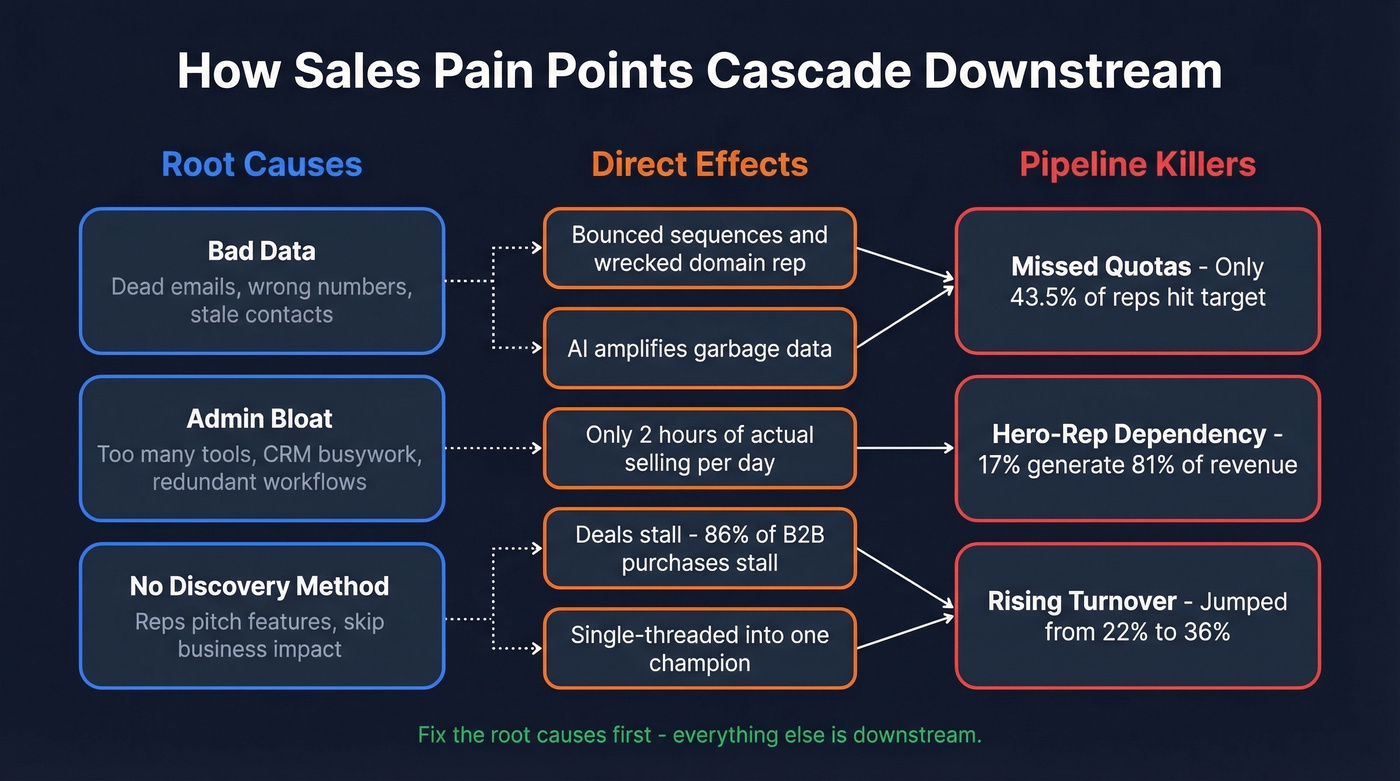
Everything else - missed quotas, longer cycles, hero-rep dependency - is downstream.
The Pain Points Hurting Sales Teams Right Now
Admin Burden and the Time Famine
Ask any rep what kills their day and you'll hear the same answers: CRM busywork, internal meetings that should've been emails, and toggling between six tools to do one task. 29% of sales pros say reducing their tech stack would make them more efficient. The problem isn't a lack of tools. It's too many tools doing overlapping things, none of them well.
Before you add another platform, audit what you've got. Kill the redundancies. We've seen teams reclaim five-plus hours per rep per week just by consolidating three overlapping tools into one that actually works.
Bad Data Is the Silent Killer
Picture this: your SDR makes 200 dials and gets 12 connects - not because they're bad at their job, but because 40% of the numbers are dead. They send 500 emails and 180 bounce. Now your domain reputation is damaged, deliverability tanks across the entire team, and next week's campaign performs even worse.
Bad data doesn't just waste time. It compounds. And 73% of B2B buyers actively avoid sellers who send irrelevant outreach, so the damage extends beyond your team to how prospects perceive your brand.

Prospeo breaks this cycle with 98% email accuracy, 143M+ verified emails, 125M+ verified mobile numbers, and a 7-day data refresh cycle versus the six-week industry average. One customer, Meritt, dropped bounce rates from 35% to under 4% and tripled weekly pipeline from $100K to $300K.
If you're evaluating vendors, start with a clear view of data quality and verification, not just list size.
Longer, More Complex Sales Cycles
57% of sales professionals say cycles are getting longer. Forrester's commonly cited benchmark is roughly 13 stakeholders in the average B2B deal, and 86% of B2B purchases stall at some point.
The fix isn't patience - it's multi-threading earlier. If you're single-threaded into one champion at a 13-person buying committee, you're one reorg away from a dead deal. Map the committee in week one, not week eight. Get verified contact data for every stakeholder you can identify, and start building relationships across the org before your champion goes on vacation or gets promoted out of the project.
This is also where account-based selling tends to outperform spray-and-pray outbound.
Quota Pressure in a Declining Market
Only 43.5% hit quota. 17% of reps generate 81% of revenue. Turnover jumped from 22% to 36%.
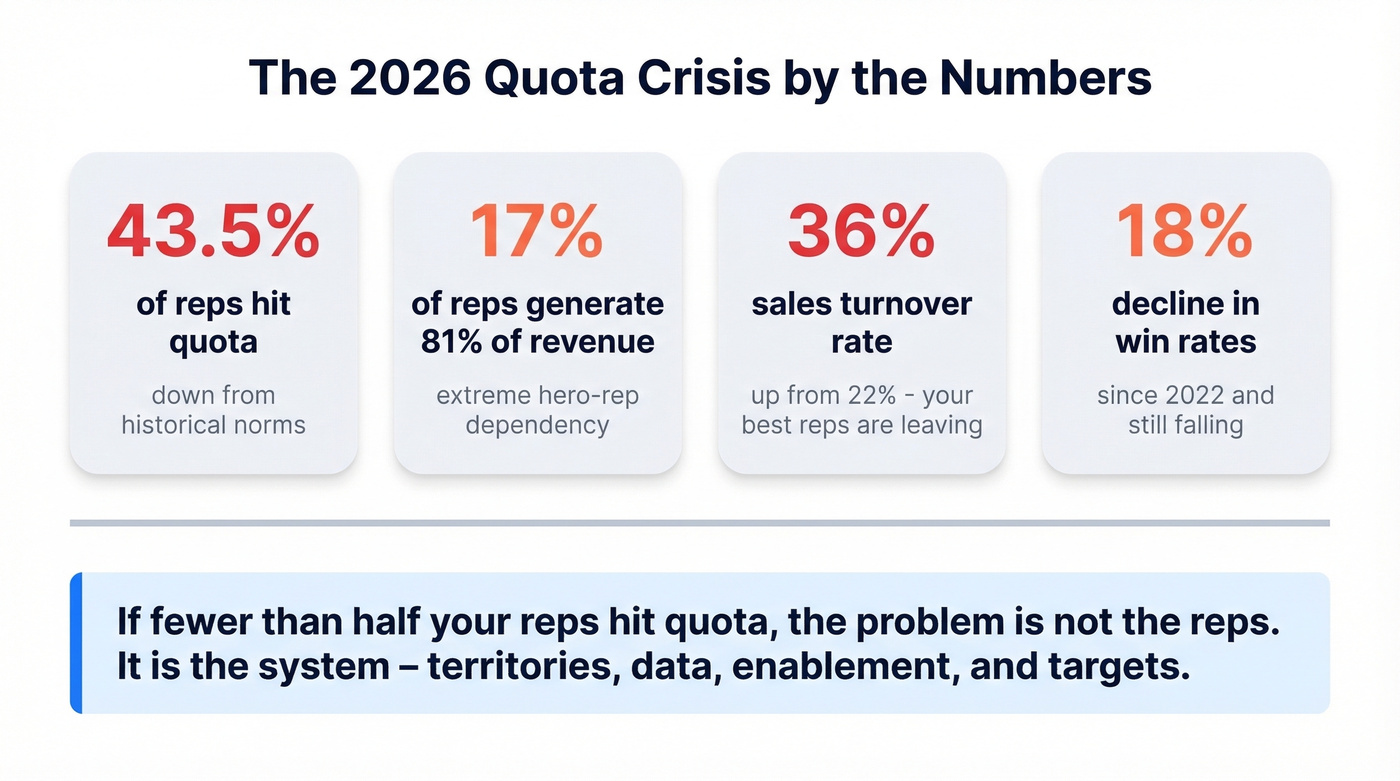
Here's the thing: if only 43.5% hit quota, the problem isn't the reps. It's the system - the territories, the data, the enablement, the targets themselves. Blaming individual performance when the structural inputs are broken is how you lose your best people faster. That hero-rep skew means your pipeline depends on a handful of people who could leave tomorrow, and when they do, they're taking institutional knowledge and relationships with them.
If you want to diagnose the real drivers, start with factors affecting sales performance and fix inputs before you raise targets.
AI Confusion and Tool Overload
85% of reps with AI say it frees them for higher-value work, and 94% of sales leaders with agents call them essential. But 51% say data security concerns halt AI initiatives, and another 51% say tech silos limit rollouts.
AI fails when you automate bad processes - you just get bad outcomes faster. That's why 74% of sales teams with AI are already prioritizing data hygiene: they've learned AI amplifies whatever data quality you feed it. When AI is layered on clean data and redesigned processes, Bain reports 30%+ win rate improvements.
Most teams buying AI sales tools in 2026 would get a bigger pipeline lift from cleaning their contact data and cutting two tools from their stack. AI on top of garbage data is just faster garbage.
If you're building your stack, compare SDR tools and generative AI sales tools based on workflow fit, not hype.
Misalignment Between Sales and Marketing
This one doesn't get its own stat-heavy section because it doesn't need one. You already know the symptoms: MQLs that sales ignores, lead scoring models nobody trusts, and finger-pointing when pipeline is thin. The fix is shared definitions - agree on what "qualified" means, build a feedback loop that takes less than five minutes per week, and hold both teams accountable to the same revenue number. Skip this if your sales and marketing teams already share a dashboard and meet weekly. But in our experience, that's maybe 15% of companies.
If your handoffs are messy, tighten lead scoring and build lightweight marketing enablement so both teams operate from the same definitions.
Losing Deals to Indecision
Your biggest competitor isn't another vendor. It's "do nothing." Gartner's research consistently shows that a huge percentage of B2B deals end in no decision at all - the buyer just stalls out. Reps who can quantify the cost of inaction and tie it to personal stakes close more of these. We'll get into exactly how in the discovery section below.

Bad data compounds every sales pain point on this list - longer cycles, missed quotas, wrecked deliverability. Prospeo delivers 98% email accuracy, 125M+ verified mobiles, and refreshes every 7 days. Meritt cut bounce rates from 35% to under 4% and tripled pipeline to $300K/week.
Stop bleeding pipeline to dead emails and disconnected numbers.
How to Sell to Prospect Pain Points
The 3-Level Pain Framework
Buyers define their requirements 83% of the time before speaking with sales. Your job isn't to educate on features - it's to surface pain they haven't fully quantified.
If you want a tighter call structure, use a discovery questions checklist and enforce it across the team.
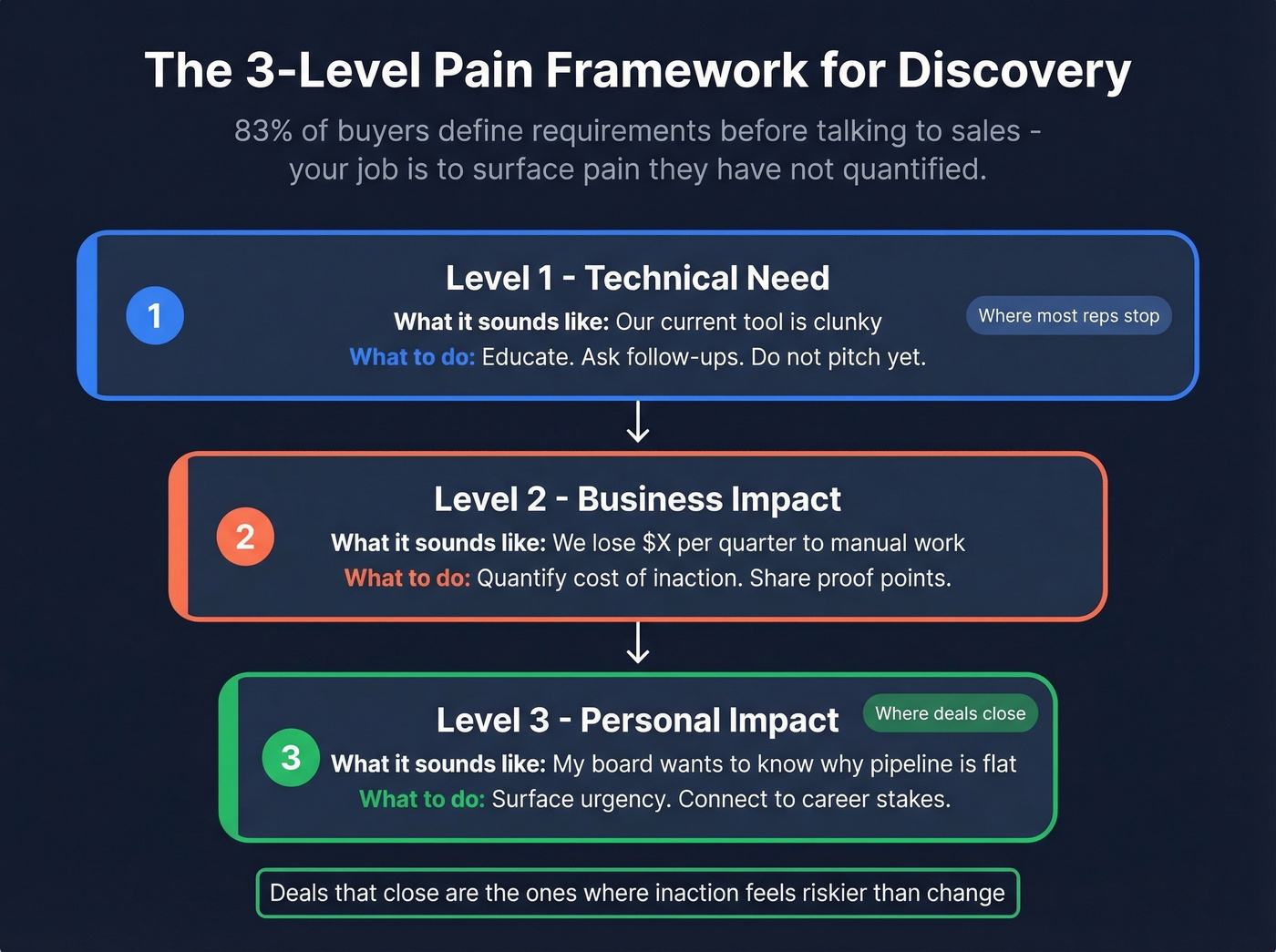
| Pain Level | What It Sounds Like | What to Do |
|---|---|---|
| Technical need | "Our current tool is clunky" | Educate. Ask follow-ups. Don't pitch yet. |
| Business impact | "We lose $X/quarter to manual work" | Quantify cost of inaction. Share proof points. |
| Personal impact | "My board wants to know why pipeline is flat" | Surface urgency. Connect to career stakes. |
Most reps pitch at Level 1. The deals that close - especially complex B2B deals - are the ones where you've surfaced the personal impact and made inaction feel riskier than change.
Discovery Questions That Actually Work
Map your questions to the three levels. Every question should peel back another layer of urgency:
- "Walk me through what happens when [process] breaks down." Surfaces the technical symptom without leading the witness.
- "How does that impact your team's numbers this quarter?" A VP of Sales once told me this single question cut his team's average discovery call from 45 minutes to 25 because it skipped straight past feature talk.
- "What happens to your targets if this doesn't get fixed by Q3?" Personal stakes plus timeline pressure. You'll hear things prospects don't put in RFPs.
- "Who else feels this pain internally?" Maps the buying committee early. If they can't name anyone, the urgency isn't real enough to buy.
- "What have you already tried?" Reveals budget precedent and urgency level. Understanding the challenges your prospect has already failed to solve helps you anticipate objections before they surface.
Pick one framework - SPIN, MEDDIC, Challenger - and enforce it. The framework matters less than adoption. Teams at 75%+ adoption see a 21% lift in quota attainment and 15% higher win rates. The consensus on r/sales is similar: consistency beats cleverness every time.
Three Priorities, in Order
Fix data quality upstream. The cascade from bad data - bounces, dead dials, domain damage, missed meetings - is the root cause of half the sales pain points teams deal with today. We've watched teams triple pipeline just by fixing their contact data layer. Start there.
If bounces are already hurting you, benchmark against email bounce rate and follow a real email deliverability guide before you scale volume.
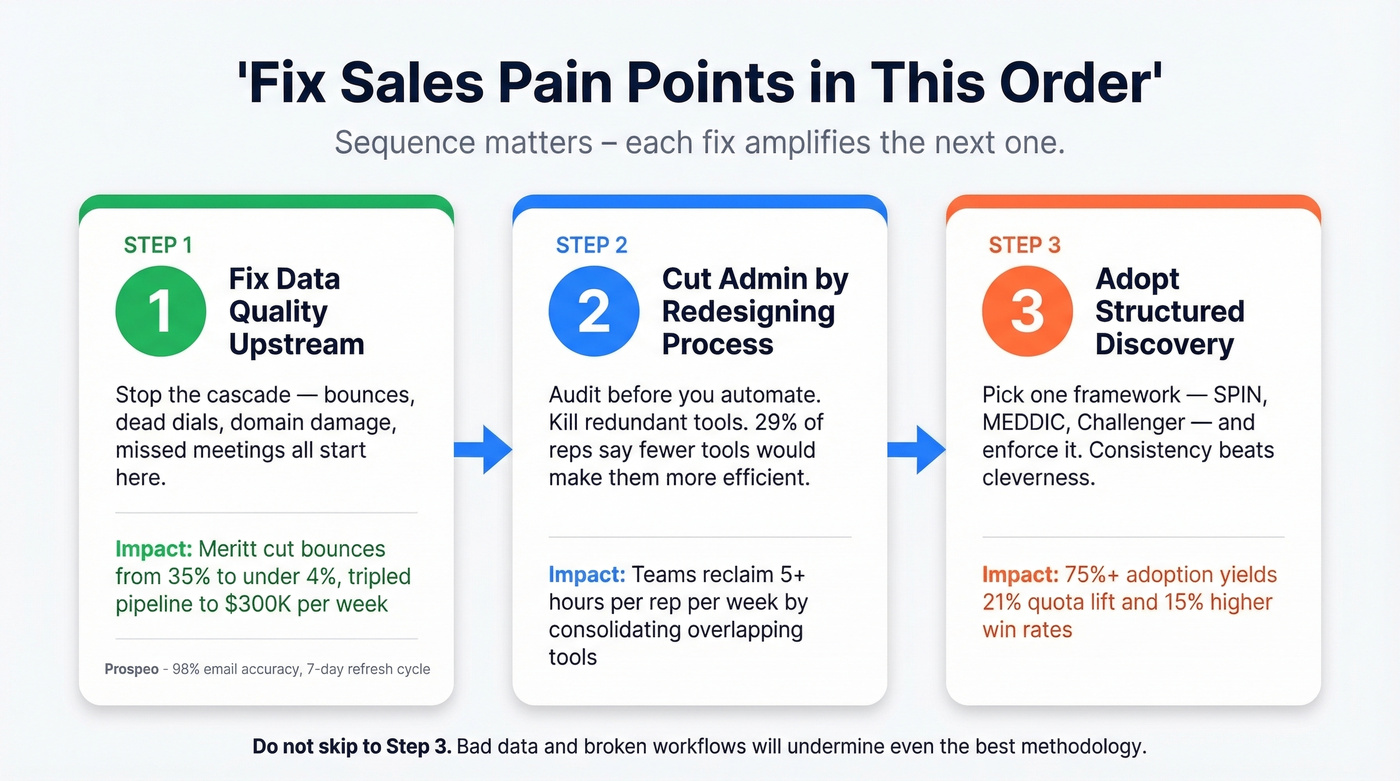
Cut admin overhead by redesigning process, not adding tools. Audit before you automate. Automating a broken workflow just produces broken outcomes faster.
Adopt a structured discovery methodology. Unity is a case example of how discipline compounds: after implementing structured pipeline discipline with Clari, it saw a 29.9% win rate increase and 30.2% fewer slipped deals.
If you're still leaking deals mid-funnel, audit your sales pipeline challenges and fix the stage definitions.
You just read that 29% of reps want fewer tools, not more. Prospeo replaces your email finder, phone database, and enrichment tool in one platform - 143M+ verified emails, 125M+ mobiles, 30+ search filters, and CRM enrichment at $0.01/email. No contracts.
Kill three tools and reclaim five hours per rep per week.
FAQ
What are the four types of customer pain points?
Financial (budget and ROI concerns), productivity (time and efficiency drains), process (workflow and operational friction), and support (lack of training, enablement, or post-sale help). Effective discovery questions should probe all four categories to surface real deal blockers.
How do you uncover a prospect's real pain?
Use the 3-level framework: start with the technical symptom, quantify the business impact, then surface personal stakes - career risk, KPI pressure, board scrutiny. Most reps jump to solutions before the prospect feels the urgency of inaction. The best problems to solve are the ones the buyer hasn't fully articulated yet.
How does bad data make pipeline problems worse?
Invalid emails bounce, killing domain reputation. Dead numbers waste dial time. Outdated contacts mean pitching people who left months ago. Fixing your data layer with verified contacts and a weekly refresh cycle means reps spend time selling instead of chasing ghosts - and your domain stays healthy for every campaign after.