

The Sales Persona Template Your Reps Will Actually Use
You've probably downloaded three persona templates already. They all had fields like "hobbies" and "favorite social media platform." When was the last time knowing a VP of Operations' hobbies helped you close a deal?
Most sales persona templates are built for marketers, not salespeople - and the r/b2bmarketing consensus backs this up. One thread calls them "fairytale personas" created by people who never talk to customers. If yours doesn't include objections, buying triggers, and committee roles, it's a marketing exercise disguised as a sales tool.
What Makes a Sales Persona Different?
The term gets used three ways, and the confusion causes real problems.
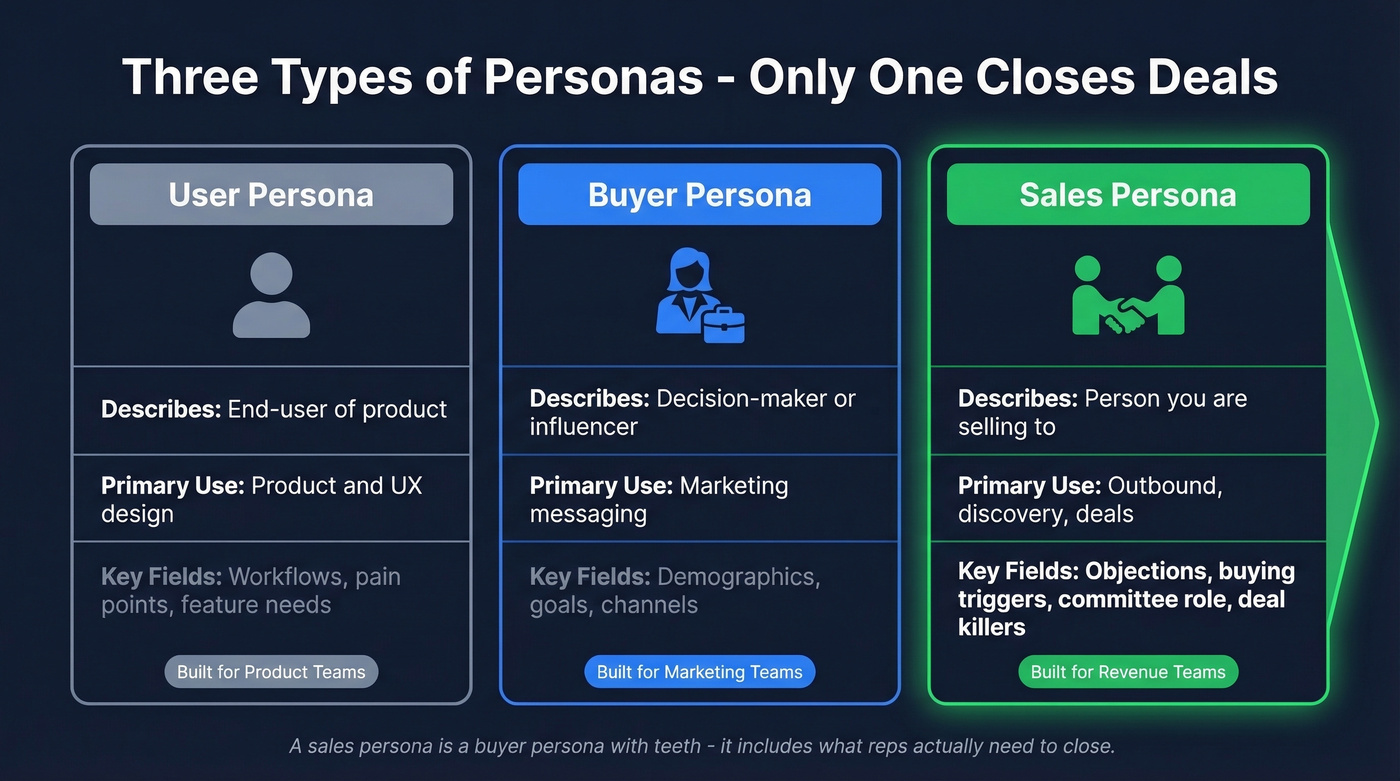
| Type | Describes | Primary Use |
|---|---|---|
| User Persona) | End-user of product | Product/UX design |
| Buyer Persona | Decision-maker/influencer | Marketing messaging |
| Sales Persona | Person you're selling to | Outbound, discovery, deals |
A sales persona is a buyer persona with teeth. It goes beyond demographics to include the fields reps actually need: objections they'll hear, triggers that create urgency, buying committee position, and what kills deals. 82% of top-performing B2B marketers say detailed, role-specific audience understanding is central to their success, and teams that operationalize personas see 56% higher-quality leads and 36% shorter sales cycles.
The difference is whether that understanding lives in a slide deck or in your reps' daily workflow.
The Template (Copy-Paste Ready)
Stop designing your persona in Canva. A sales persona isn't a poster - it's a working document that drives outbound targeting, discovery questions, and objection handling.
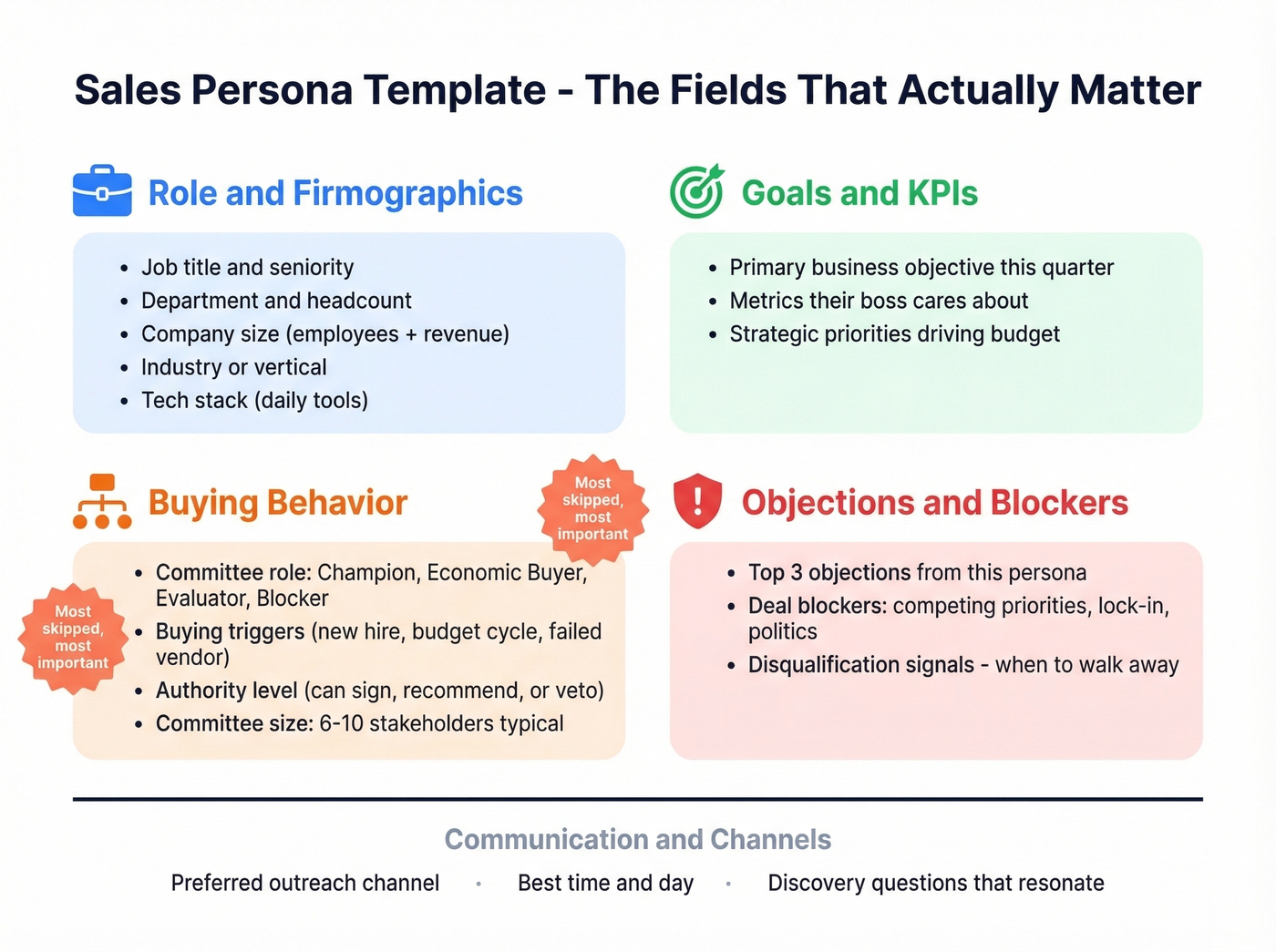
Role & Firmographics
- Job title and seniority level
- Department and department headcount
- Company size (employees + revenue range)
- Industry / vertical
- Tech stack (tools they use daily)
Goals & KPIs
- Primary business objective this quarter
- Metrics they're measured on - the KPIs their boss cares about
- Strategic priorities driving budget allocation
Buying Behavior - This is the section that separates a sales persona from a marketing one. We've seen teams skip committee roles entirely and then wonder why deals stall at the 11th hour with a stakeholder nobody mapped.
- Buying committee role: Champion, Economic Buyer, Evaluator, or Blocker
- Typical buying triggers (new hire, budget cycle, failed vendor, growth milestone) - see how to track sales triggers
- Authority level (can sign, can recommend, can veto)
- Buying committee size: around 6-10 stakeholders for mid-market deals
Objections & Blockers - If you can't list three objections per persona from memory, you haven't talked to enough prospects. Pull these from call recordings, not assumptions.
- Top 3 objections you'll hear from this persona - use a discovery questions framework to surface them early
- Common deal blockers: competing priorities, contract lock-in, internal politics
- Disqualification signals - when to walk away - see how to reduce sales objection rate
One more thing: build a negative persona too. Document the profile you should stop selling to - the title that wastes pipeline, the company size that never converts. We've watched teams cut 20% of their outbound volume and increase pipeline by disqualifying faster.
Communication & Channels
- Preferred outreach channel (email, phone, social)
- Best time/day for outreach - use data from best time to send cold emails
- Discovery questions that resonate with this role
Filled Example: "Operations Olivia"
Role & Firmographics: VP of Operations, 12 direct reports. Mid-market SaaS, 200-500 employees, $30-80M revenue. Tech stack: Salesforce, Asana, Looker, Slack.
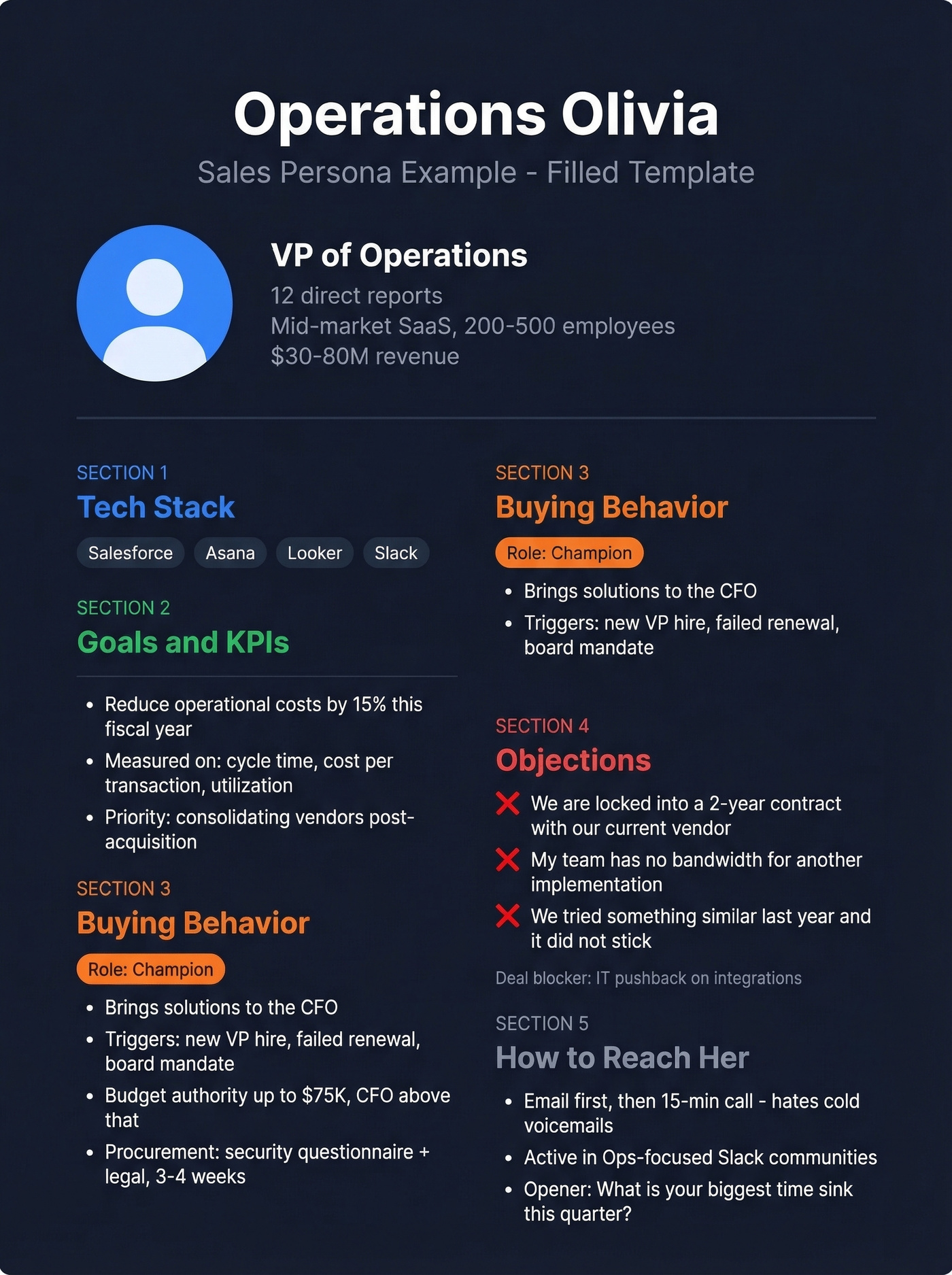
Goals & KPIs: Reduce operational costs by 15% this fiscal year. Measured on process cycle time, cost per transaction, team utilization rate. Strategic priority: consolidating vendor stack post-acquisition.
Buying Behavior: Committee role - Champion who brings solutions to the CFO. Buying triggers: new VP hire, failed vendor renewal, board mandate to cut costs. Budget authority up to $75K; above that, needs CFO sign-off. Procurement involves a security questionnaire plus legal review, typically a 3-4 week process.
Objections & Blockers: "We're locked into a 2-year contract with our current vendor." "My team doesn't have bandwidth for another implementation." "We tried something similar last year and it didn't stick." Deal blocker: IT team pushback on integrations.
Communication & Channels: Prefers email first, then a 15-minute call - hates cold voicemails. Active in Ops-focused Slack communities. Discovery openers: "What's your biggest time sink this quarter?" / "How are you measuring success on the consolidation initiative?"

You just defined your persona's title, tech stack, department size, and buying triggers. Prospeo's 30+ search filters - including technographics, buyer intent, and headcount growth - turn that persona into a targeted list of verified contacts. 98% email accuracy means your reps reach real people, not bounced inboxes.
Stop describing your ideal buyer. Start reaching them.
Operationalizing Your Persona in Outbound
Here's the thing: a persona on paper is worthless. A persona wired into your sequences, filters, and discovery calls is a weapon.
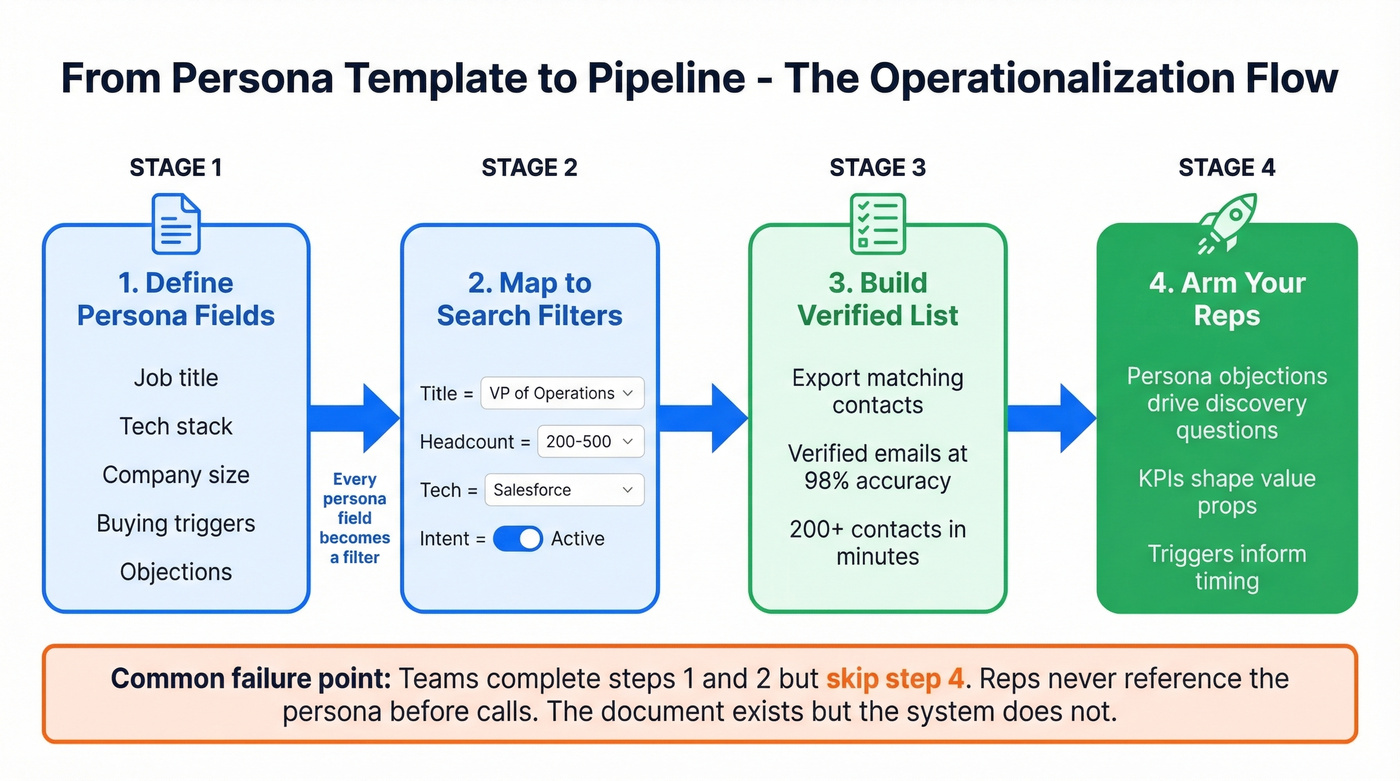
Take your persona's fields - job title, tech stack, department headcount, buying triggers - and use them as search filters in a B2B database. Prospeo's 30+ filters cover these attributes, including technographics, buyer intent, and company growth signals, so you go from "we target mid-market VPs of Ops" to a list of 200 verified contacts in minutes.
Then use the persona to prep your reps. 57% of the buying journey happens before a prospect talks to sales, and only 5% of B2B buyers say salespeople exceed expectations. Your persona's objections and KPIs should drive discovery questions, not generic "tell me about your challenges" openers. If your reps aren't referencing the persona before every first call, you've built a document, not a system.
Let's be honest about scope, too. If your average deal size is under $15K and your sales cycle is under 30 days, you probably don't need more than two personas. I've seen teams build 12 and use none of them. Start with your Champion and your Economic Buyer. Add others only when you see a clear pattern in lost deals - track it with win/loss analysis discipline.
Common Mistakes
Building B2C-style personas for B2B. Demographics like age and hobbies don't close deals. Firmographics, buying committee roles, and procurement processes do.
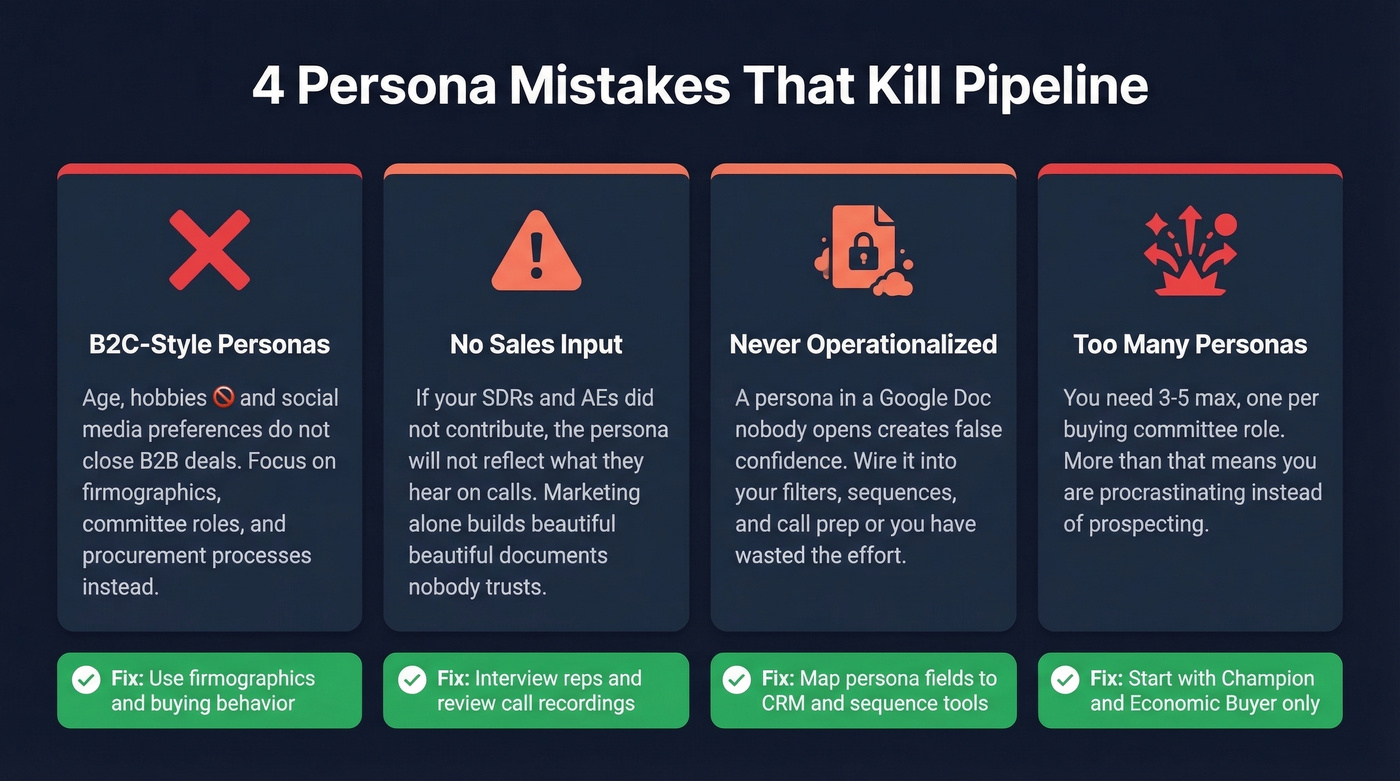
Creating personas without sales input. If your SDRs and AEs didn't contribute, the persona won't reflect what they actually hear on calls. Marketing can't build this alone - we've watched this play out dozens of times, and the result is always the same: a beautiful document nobody trusts. This is where marketing enablement matters.
Never operationalizing. A persona that lives in a Google Doc nobody opens creates false confidence. Wire it into your filters, sequences, and call prep. Skip this step and you've wasted the effort - especially if you don't have solid sequence management.
Too many personas. You need 3-5 max - one per buying committee role in your primary ICP. If you're building more than that, you're procrastinating instead of prospecting. Start from an Ideal Customer Profile Template and work inward.
Keeping Personas Fresh
A persona nobody updates is worse than no persona at all.
For fast-moving markets like SaaS and fintech, refresh quarterly using win/loss analysis, call recordings, and CRM data. Stable categories can get away with biannual reviews. The signals that matter: are objections shifting? Are new competitors entering deals? Has the buying committee structure changed? If your persona still references a pain point from 18 months ago, it's a liability - not a guide.
A persona without operationalization is a slide deck. Prospeo lets you filter by job title, company size, tech stack, and intent signals - every field in your template becomes a search parameter. At $0.01 per verified email, building a list of 500 contacts matching 'Operations Olivia' costs less than lunch.
Go from persona template to pipeline in under five minutes.
FAQ
How many personas should a B2B sales team build?
Three to five - one per buying committee role in your primary ICP (Champion, Economic Buyer, Evaluator). Start with two and add only when lost-deal patterns reveal a recurring stakeholder you're not addressing. More than five usually means none get used.
What's the difference between an ICP and a sales persona?
An ICP describes the company - industry, revenue, headcount, tech stack. A sales persona describes the person within that company - their role, objections, buying triggers, and decision authority. You need both: the ICP filters your market, the persona guides your conversations.
How do I find prospects who match my persona?
Use a B2B database with filters that map to your persona fields - job title, tech stack, department headcount, buyer intent - then export verified emails directly into your sequence tool. Prospeo covers all of these with 30+ filters and 98% email accuracy, and alternatives like ZoomInfo and Apollo offer similar filtering with different accuracy and pricing tradeoffs.