

Sales Pipeline Management CRM: The 10 Best Tools in 2026
Your VP pulls up the pipeline dashboard. It says $2.3 million. Everyone nods. But half those deals haven't had a touchpoint in six weeks, three contacts have bounced emails, and the "negotiation" stage is a graveyard of deals nobody wants to mark as lost. 63% of sales managers say their org does a poor job managing its pipeline - and the root cause isn't usually the CRM itself. It's stale data, undefined stages, and tools that don't match how the team actually sells.
Here's the uncomfortable truth: picking a pipeline CRM isn't about Kanban boards and drag-and-drop deals. The best pipeline starts before the CRM - with verified contacts that actually pick up the phone. That's the lens we used for this list.
We evaluated each tool on pipeline visualization, pricing transparency, data quality, and setup time, prioritizing tools that consistently hold 4+ stars on G2 or Capterra.
Our Picks (TL;DR)
| Tool | Best For | Starting Price |
|---|---|---|
| Pipedrive | Simplest visual pipeline | $14/user/mo (annual) |
| Prospeo | Pipeline data quality & verified contacts | Free / ~$0.01/email |
| Close | Phone + email selling | $9/seat/mo (annual) |
| HubSpot Sales Hub | Marketing-sales alignment | $20/user/mo |
This list covers both CRMs and the data layer that feeds them. A CRM with bad contact data is just an expensive spreadsheet.
What Is Sales Pipeline Management?
Sales pipeline management is the process of tracking and optimizing how deals move from first touch to closed-won. It's the seller's operating system - every deal gets a stage, every stage has exit criteria, and the whole thing should tell you at a glance where revenue is stuck.
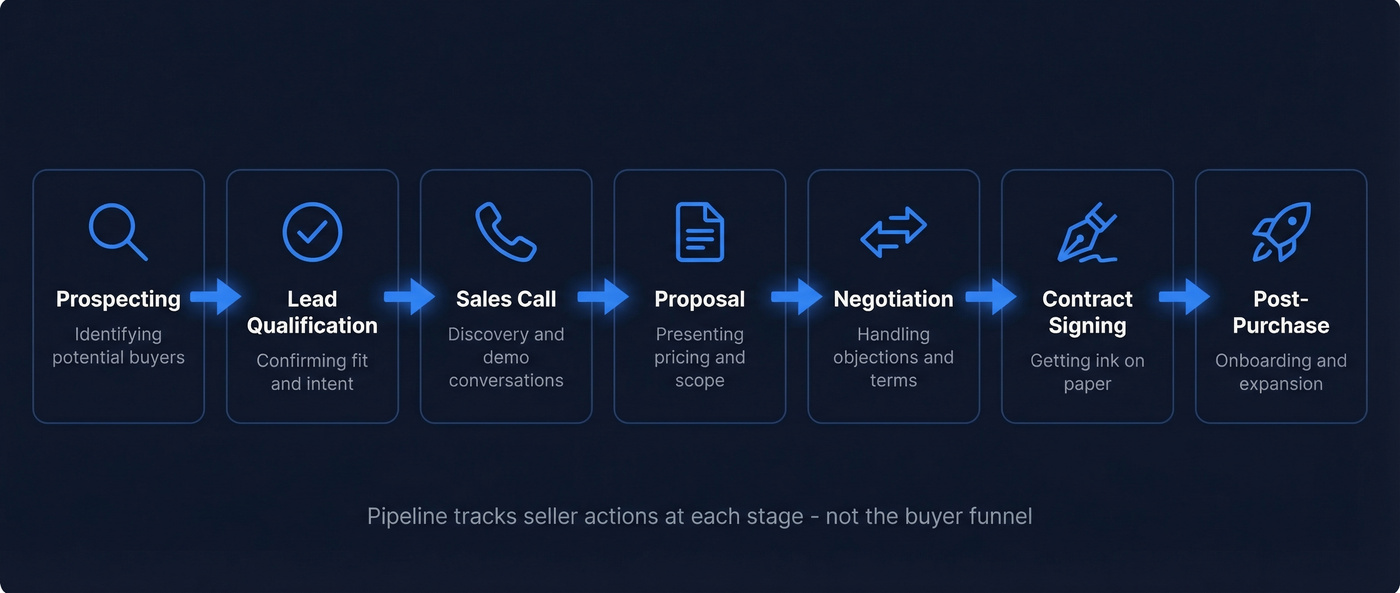
Most pipeline CRMs organize around some version of these seven stages:
- Prospecting - identifying potential buyers
- Lead qualification - confirming fit and intent
- Sales call - discovery and demo conversations
- Proposal - presenting pricing and scope
- Negotiation - handling objections and terms
- Contract signing - getting ink on paper
- Post-purchase - onboarding and expansion
One distinction worth internalizing: a pipeline tracks the seller's actions. A funnel tracks the buyer's journey. Same deals, different perspectives. Your CRM should model the pipeline - what your reps do at each stage - not the abstract buyer funnel that marketing cares about. (If you need a clean framework, start with funnel metrics.)
Pipeline Benchmarks That Matter
You can't manage what you don't measure. But most teams measure the wrong things - or nothing at all. For more context, see our full breakdown of sales pipeline benchmarks.
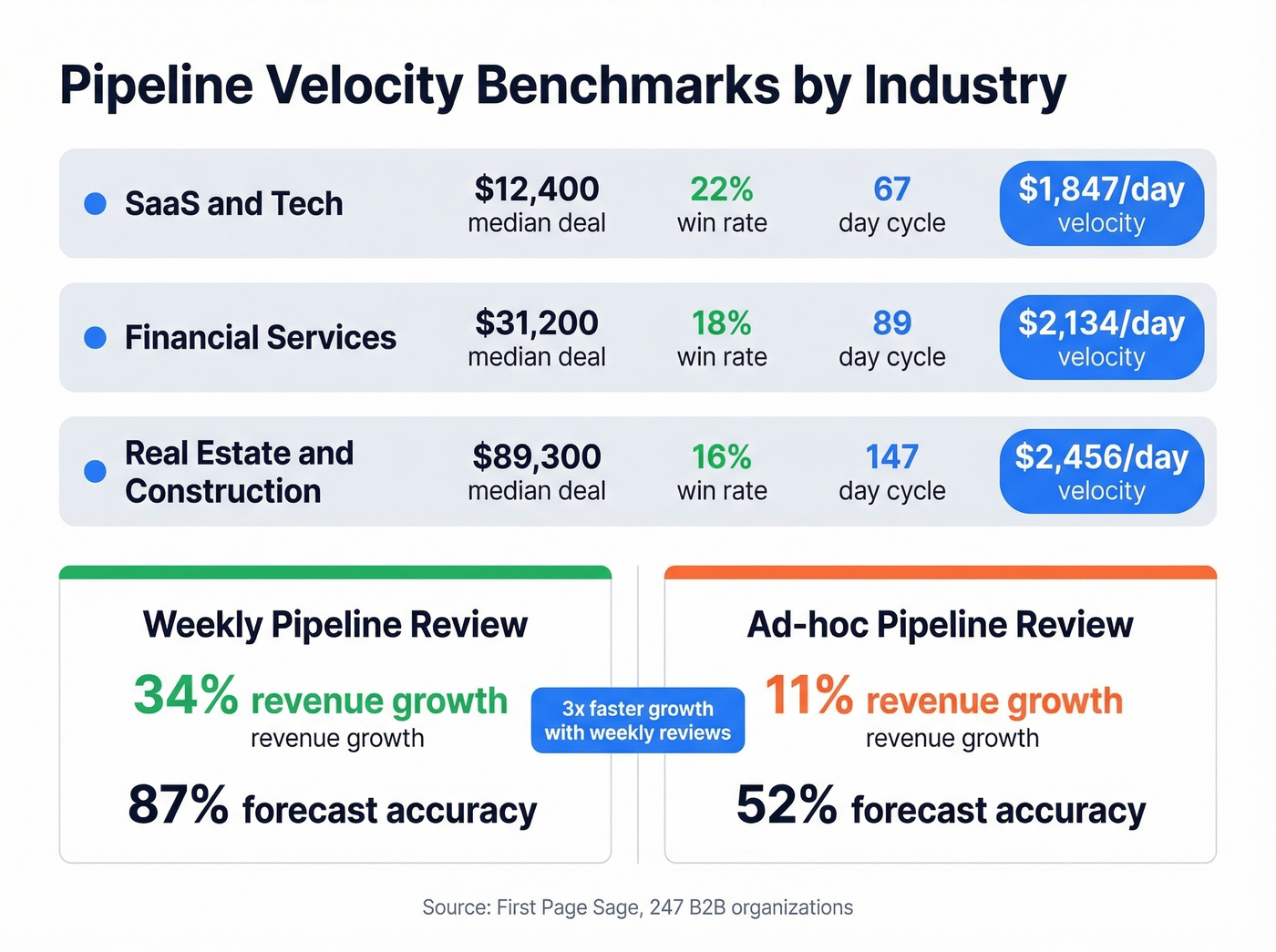
A First Page Sage study across 247 B2B organizations found these pipeline velocity benchmarks by industry:
| Industry | Median Deal Size | Win Rate | Cycle Length | Velocity/Day |
|---|---|---|---|---|
| SaaS & Tech | $12,400 | 22% | 67 days | $1,847 |
| Financial Services | $31,200 | 18% | 89 days | $2,134 |
| Real Estate & Construction | $89,300 | 16% | 147 days | $2,456 |
Pipeline velocity is the single most useful metric. It combines deal size, win rate, cycle length, and volume into one number that tells you how fast money moves through your pipeline. (If you want a health checklist, use these pipeline health metrics.)
On the back end, Opportunity-to-Close rates run 39% for SMB/mid-market versus 31% for enterprise - meaning enterprise teams need proportionally more pipeline to hit the same revenue targets. The same study found a striking correlation between tracking frequency and results:
| Tracking Cadence | Revenue Growth | Forecast Accuracy |
|---|---|---|
| Weekly | 34% | 87% |
| Ad-hoc | 11% | 52% |
Teams that review pipeline weekly grow 3x faster and forecast with 35 points more accuracy. That alone justifies the CRM investment. (If forecasting is your main pain, compare sales forecasting solutions.)
On stage conversions, B2B SaaS benchmarks show Visitor-to-Lead conversion at 1.4% for SMB/mid-market versus 0.7% for enterprise. The biggest bottleneck across the board? MQL-to-SQL. That's where most pipeline value evaporates - and it's almost always a data quality or qualification problem, not a CRM problem.
What AI Actually Does in a Pipeline CRM
Every CRM now claims "AI-powered" something. Let's be honest about what AI in a pipeline CRM actually does today:
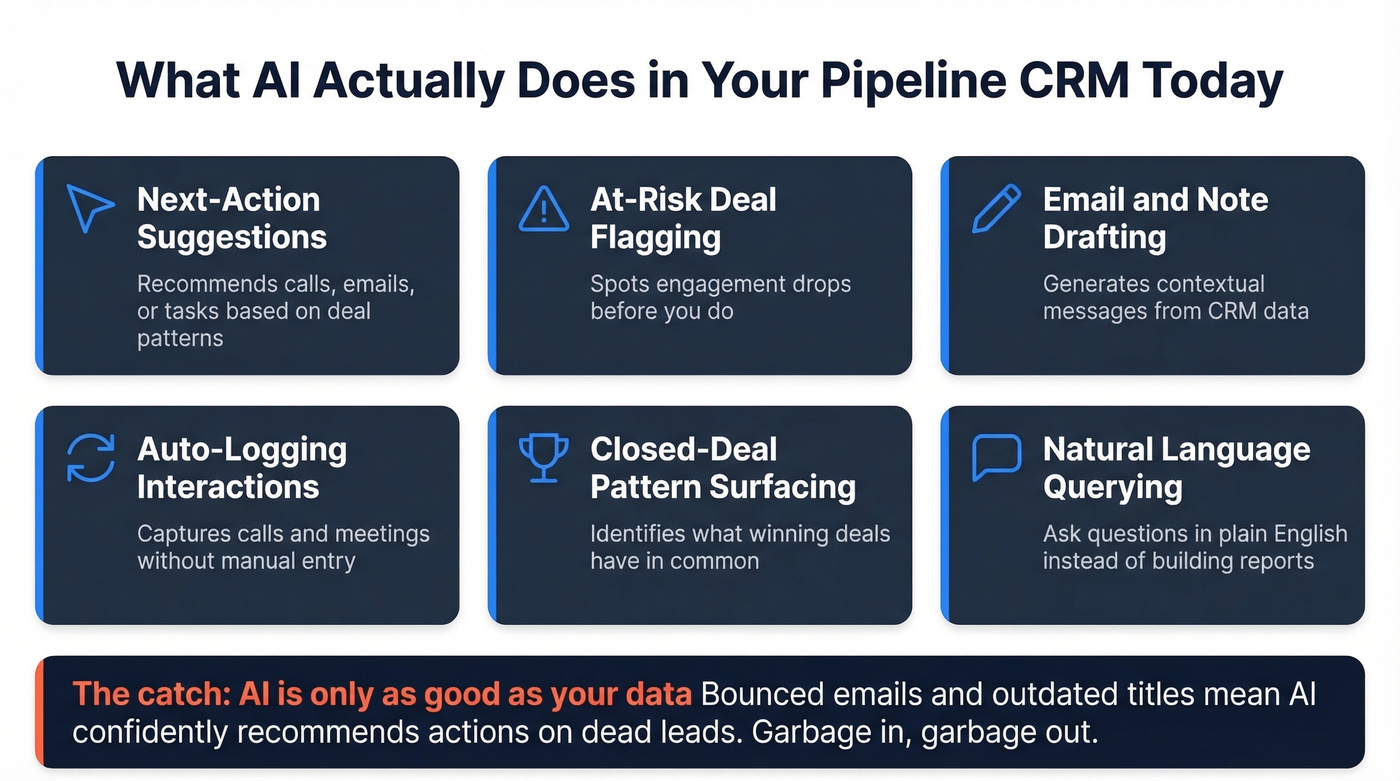
- Next-action suggestions - recommends calls, emails, or tasks based on deal stage and historical patterns
- At-risk deal flagging - spots engagement drops and missed follow-ups before you do
- Email and note drafting - generates contextual messages using CRM data
- Auto-logging interactions - captures calls, meetings, and messages without manual entry
- Closed-deal pattern surfacing - identifies what winning deals have in common
- Natural language querying - "Which deals haven't been touched in 30 days?" instead of building a report
Here's the thing: AI in your CRM is only as good as the data feeding it. If half your contacts have bounced emails and outdated job titles, AI will confidently recommend actions on dead leads. Garbage in, garbage out. No amount of machine learning fixes a contact list full of wrong numbers and invalid addresses. (Related: data-driven selling.)

AI deal scoring, next-action suggestions, at-risk flagging - none of it works when half your contacts have bounced emails and outdated titles. Prospeo's 7-day data refresh and 98% email accuracy mean your CRM actually reflects reality, not a graveyard of stale records.
Stop letting bad data poison your pipeline forecasts.
The 10 Best CRM Tools for Pipeline Management
Here's the full comparison before we get into each tool:
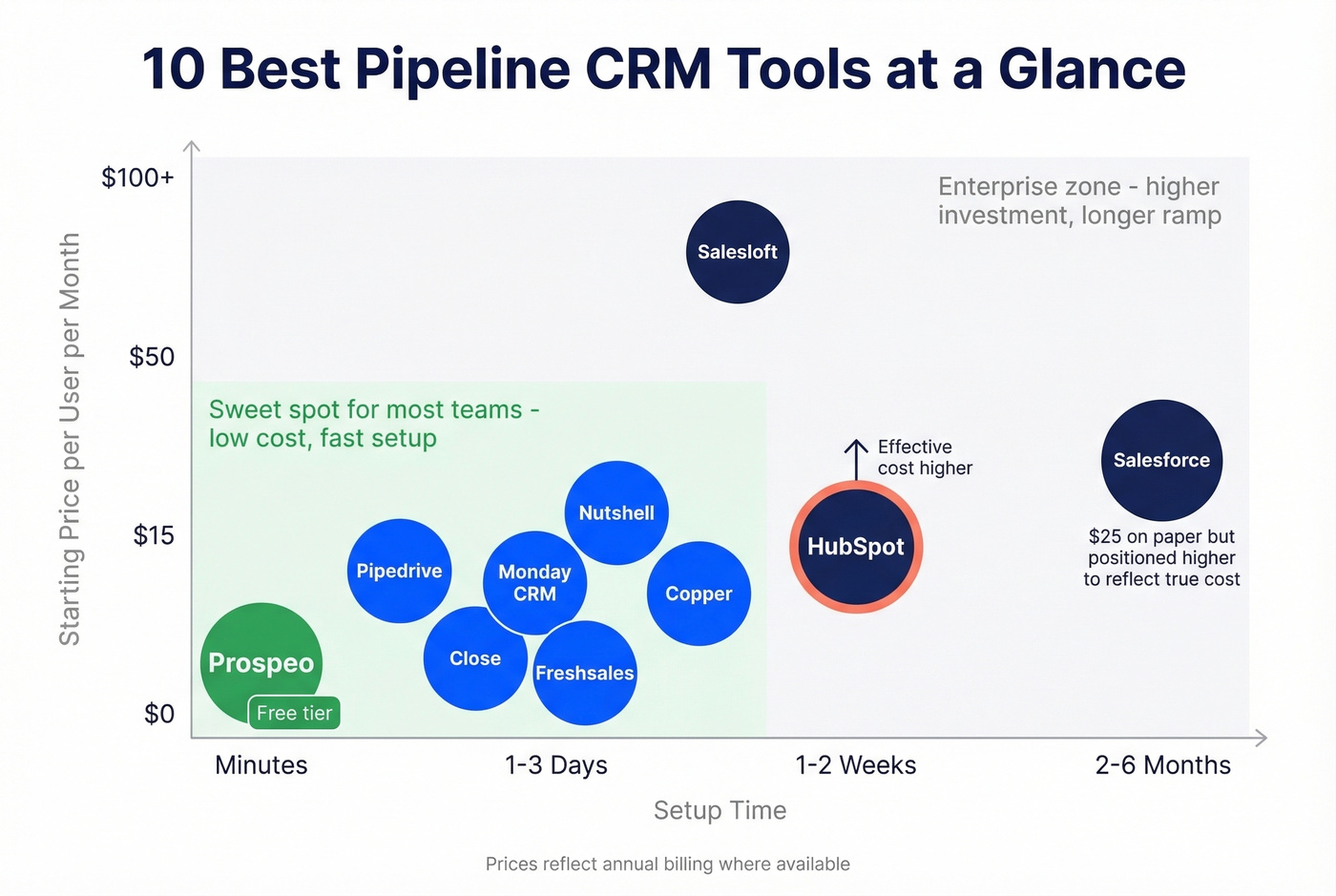
| Tool | Best For | Starting Price | Free Tier | Setup Time |
|---|---|---|---|---|
| Pipedrive | Visual pipeline | $14/user/mo (annual) | No | 2-3 days |
| Prospeo | Data quality layer | Free / ~$0.01/email | Yes | Minutes |
| Close | Phone + email sales | $9/seat/mo (annual) | No | 1-3 days |
| HubSpot Sales Hub | Marketing alignment | $20/user/mo | Yes | 1-2 weeks |
| Salesforce | Enterprise custom | $25/user/mo | No | 2-6 months |
| Monday Sales CRM | Monday.com teams | $12/user/mo | No | 1-2 days |
| Freshsales | AI at low price | ~$9/user/mo | Yes | 1-3 days |
| Copper CRM | Google Workspace | $12/user/mo | No | 1-2 days |
| Nutshell | Simple SMB | ~$16/user/mo | No | 1-2 days |
| Salesloft | Enterprise engagement | ~$100-150/user/mo | No | 2-4 weeks |
Pipedrive - Best Visual Pipeline CRM

Use this if you want the fastest path from "we need a CRM" to "reps are actually using it." Pipedrive does one thing extremely well: visual pipeline management. The Kanban board isn't a feature - it's the entire philosophy. Most teams onboard in 2-3 days, which is rare for any CRM worth using.
Pricing runs from Essential at $14/user/mo (annual) to Enterprise at $99/user/mo. The Advanced tier at $29/user/mo is the sweet spot for most SMB teams - it adds email automation and scheduling. One catch: phone system integration costs an extra $24/user/mo, which adds up fast for inside sales teams that live on the phone. (If you’re comparing CRMs, here are more examples of a CRM.)
Skip this if you need built-in calling and SMS without add-ons, or if you're running complex multi-product pipelines that need Salesforce-level customization. Pipedrive is a sales-first tool, not a platform.
Prospeo - Best for Pipeline Data Quality
Your CRM tracks deals. Prospeo makes sure the contacts in those deals are actually reachable.

We've seen teams with beautiful Kanban boards and $500K in "pipeline" - except 30% of the contacts had bounced emails and disconnected phone numbers. That's not a pipeline. That's fiction.
Prospeo's database includes 300M+ professional profiles, 143M+ verified emails, and 125M+ verified mobile numbers. Email accuracy sits at 98%, mobile pickup rate at 30%, and records refresh every 7 days while the industry average lags at 6 weeks. It also supports CRM and CSV enrichment with an 83% match rate returning 50+ data points per contact, plus API workflows at a 92% match rate - so clean contacts flow into the systems your reps already live in. (If you’re evaluating vendors, start with these data enrichment services.)
Native integrations with Salesforce, HubSpot, Lemlist, Instantly, and Clay mean verified contacts land directly in your CRM and sequences without spreadsheet gymnastics. (If you’re building lists in Clay, see Clay list building.)
The proof is in the numbers. Meritt tripled their pipeline from $100K to $300K per week after switching, while dropping their bounce rate from 35% to under 4%. That's not a UI upgrade - that's fixing the inputs so your pipeline reporting stops lying to you.
Pricing starts free (75 emails/month) and scales at roughly $0.01 per email. No contracts, no sales calls required.
Close - Best Built-In Communication CRM
Close is the most underrated pipeline CRM on the market - and the one we'd pick for any team under 20 reps that sells primarily by phone and email.
Every plan includes built-in calling, SMS, and email. No add-ons, no integrations to maintain. The Solo plan starts at $9/seat/mo (annual) for solo founders with a 10K lead cap. Growth at $99/seat/mo unlocks automated workflows, Power Dialer, and AI email assistance. Scale at $139/seat/mo adds role-based permissions, lead visibility rules, and predictive dialing. All plans above Solo include unlimited contacts and leads. (If you’re building a full outbound stack, compare SDR tools.)
Add-ons are minimal: premium phone numbers run $19/month per line, and the Call Assistant is $50/month per org plus $0.02/min.
Skip this if you need deep marketing automation or ABM workflows. Close is built for teams that sell through conversations, not content funnels.
HubSpot Sales Hub - Best for Marketing-Sales Alignment
The pricing reality check first: HubSpot starts at $20/user/mo, but meaningful automation and custom reporting often require higher tiers, which pushes effective costs to $50-$150+/user/mo depending on seat types and add-ons. Enterprise runs $4,300/month for 7 users.
That said, the pipeline tools are solid - customizable deal stages, automated task creation, and decent forecasting. Where HubSpot genuinely wins is the handoff between marketing and sales. If your marketing team already runs on HubSpot, the lifecycle stage data and lead source attribution are worth the premium. Where it loses is pricing transparency. You'll hit upgrade walls faster than you expect.
Skip this if your marketing stack isn't HubSpot. The alignment advantage disappears if marketing runs on Marketo or Mailchimp.
Salesforce Sales Cloud - Enterprise Customization
Salesforce starts at $25/user/mo on paper. In practice, a small team's all-in cost - including implementation, admin time, and the inevitable consulting hours - runs $15K-$50K/year. Setup takes 2-6 months.
That's not a knock; it's the reality of a platform built for enterprise complexity. If you have 100+ reps, multiple product lines, and a dedicated RevOps team, Salesforce is the standard for a reason. Einstein AI handles lead scoring, at-risk deal flagging, and next-best-action recommendations within the workflow. (If you want the full breakdown, see Salesforce pricing, reviews, pros & cons.)
Hot take: For 80% of teams evaluating Salesforce, it's overkill. If your average deal size is closer to five figures than six and you have fewer than 50 reps, you'll spend more time configuring it than selling. Start with Pipedrive or Close and migrate when complexity demands it.
Monday Sales CRM - Best for Monday.com Teams
Monday Sales CRM starts at $12/user/mo and turns Monday.com's visual workflow builder into a pipeline management tool. If your team already lives in Monday for project management, adding the sales CRM is a natural extension - shared boards, automations, and dashboards without switching contexts.
The pipeline visualization is clean and customizable. It won't match Pipedrive's depth for pure sales workflows, but for teams that need project management and deal tracking in one place, it's a strong pick.
Freshsales - Best AI at a Low Price
Freshsales offers AI lead scoring and deal insights starting at ~$9/user/mo - a fraction of what Salesforce charges for Einstein. The Freddy AI assistant flags at-risk deals and suggests next actions, and it works surprisingly well for the price point. Mid-tier plans run ~$30-$60/user/mo and add workflow automation and custom modules.
The trade-off is ecosystem. Freshsales works best inside the Freshworks suite with Freshdesk and Freshmarketer. If you're already there, it's a no-brainer. If you're not, the integrations with external tools are thinner than HubSpot or Salesforce.
Copper CRM - Built for Google Workspace
Copper starts at $12/user/mo for basic plans, scaling to $134/user/mo for the Business tier with advanced automation. It lives entirely inside Google Workspace - if your team runs on Gmail and Google Calendar, Copper auto-logs emails and events without any manual entry. The experience feels native rather than bolted on, which drives adoption faster than most CRMs. (If you’re deciding between similar options, see Copper vs Pipedrive.)
Skip it if you're not a Google shop. There's no reason to use Copper outside that ecosystem.
Nutshell - Simple SMB Pipeline
Nutshell runs ~$16-$67/user/mo and targets SMBs that want pipeline management plus basic email sequences without the complexity of HubSpot or Salesforce. Simple, functional, and forgettable in the best way - it just works. Good for teams that want to stop evaluating CRMs and start selling.
SalesLoft - Enterprise Revenue Orchestration
Salesloft isn't a pure CRM. It's a full revenue orchestration platform, and the pricing reflects that - expect custom quotes in the $100-$150+/user/mo range. It's built for large sales orgs that need engagement tracking, conversation intelligence, and pipeline management in one platform. Overkill for teams under 50 reps, but if you're already running Salesloft for sequences, adding pipeline management keeps everything in one view.
Sales Pipeline Management CRM Pricing Comparison
CRM pricing is deceptive. The "starting at" number almost never includes the features you actually need - automation, forecasting, and custom reporting usually live two tiers up. Here's what you'll really pay:
| Tool | Entry Price | Automation Tier | Free Tier | Setup Time |
|---|---|---|---|---|
| Pipedrive | $14/user/mo (annual) | $29/user/mo | No | 2-3 days |
| Close | $9/seat/mo (annual) | $99/seat/mo | No | 1-3 days |
| HubSpot | $20/user/mo | $50-150/user/mo | Yes | 1-2 weeks |
| Salesforce | $25/user/mo | $75-150/user/mo | No | 2-6 months |
| Monday CRM | $12/user/mo | Higher tiers | No | 1-2 days |
| Freshsales | ~$9/user/mo | ~$30-60/user/mo | Yes | 1-3 days |
| Copper | $12/user/mo | $134/user/mo | No | 1-2 days |
| Nutshell | ~$16/user/mo | ~$42-67/user/mo | No | 1-2 days |
| Salesloft | ~$100/user/mo | Custom | No | 2-4 weeks |
For context, typical CRM costs in 2026 run $10-$30/user/mo for small teams, $40-$100 for mid-market, and $150-$650 for enterprise. If you're paying above those ranges, you're either getting exceptional value or overpaying for features you don't use.
How to Choose by Team Size
Three questions matter more than feature lists:
- How many reps? This determines complexity tolerance.
- Do you need built-in calling and email? Or do you already have a separate engagement tool?
- What's your real budget? Not the "starts at" price - the tier you'll actually need in 6 months.
Solo founder or startup (1-3 reps): Pipedrive Essential or Close Solo. Keep it simple. Don't overthink this - you need to be selling, not configuring. (If you’re still shopping, start with these contact management software options.)
SMB (5-20 reps): Close Growth or Pipedrive Advanced. This is where data quality becomes critical - 20 reps with bad contact data waste exponentially more time than 3. Pair your CRM with a data verification layer so reps aren't chasing dead contacts all day.
Mid-market (20-100 reps): HubSpot Professional or Salesforce. You need forecasting, territory management, and marketing attribution. Budget for implementation time.
Enterprise (100+ reps): Salesforce with a dedicated admin. There's no shortcut at this scale.
Pipeline Mistakes That Kill Your Forecast
We've watched teams build gorgeous pipeline dashboards and still miss forecast by 40%. Here are the mistakes that cause it:
Not defining pipeline stages. If reps can't articulate what moves a deal from "discovery" to "proposal," your stages are meaningless. Define exit criteria for each stage - written down, not assumed. (If you’re seeing recurring issues, these sales pipeline challenges are the usual culprits.)
Skipping training and adoption. A CRM nobody uses is a $30K/year spreadsheet. Budget time for onboarding, not just licenses.
Overloading with stale data. Old contacts with bounced emails and outdated titles inflate your pipeline and destroy forecast accuracy. Run your contact list through a verification tool before import - bad data is the fastest way to corrupt a forecast. In our experience, teams that clean their data before CRM migration save weeks of frustration down the line.
Inconsistent prospecting. Teams that prospect in bursts create feast-or-famine pipelines. Consistent daily prospecting keeps the top of the funnel healthy. (Use these sales prospecting techniques to keep volume steady.)
Poor lead qualification. Not every inbound lead deserves a deal record. Qualify before creating pipeline - otherwise you're tracking noise.
Letting leads go cold. 44% of reps give up after one follow-up, but it takes 8+ touches to close most B2B deals. Build follow-up cadences into your CRM workflows. (If you need copy you can paste, use these sales follow-up templates.)
Keeping stagnant deals. That $80K deal that's been in "negotiation" for 4 months? It's dead. Remove it. Stagnant deals are the #1 source of inflated pipeline, and the consensus on r/sales is that anything sitting untouched for more than 2x your average cycle length should be killed or sent back to nurture.
Not tracking conversion data. If you don't know your stage-by-stage conversion rates, you can't diagnose where deals die. Track lead sources, win rates by stage, and cycle length.
Skipping weekly reviews. Teams that review pipeline weekly hit 87% forecast accuracy versus 52% for ad-hoc reviewers. Put a 30-minute pipeline review on the calendar every Monday. No exceptions.
FAQ
What's the difference between a sales pipeline and a sales funnel?
A pipeline tracks the seller's actions - the stages your reps move deals through, from prospecting to contract signing. A funnel tracks the buyer's journey - awareness, consideration, decision. Same deals, different perspectives. Your CRM should model the pipeline; your marketing platform models the funnel.
How often should I review my sales pipeline?
Weekly at minimum. Daily during end-of-quarter pushes or high-volume periods. Weekly pipeline tracking correlates with 87% forecast accuracy versus 52% for teams that review ad-hoc. A 30-minute Monday review is the single highest-ROI habit a sales manager can build.
What's a good pipeline velocity benchmark?
It varies by industry. SaaS median pipeline velocity runs $1,847/day based on a 22% win rate and 67-day cycle. Financial services hits $2,134/day with larger deals but longer cycles. Calculate yours: (number of deals x average deal size x win rate) / cycle length in days.
Do I need a separate tool for contact data, or does my CRM handle it?
CRMs track deals but don't verify contact data. Unverified lists often bounce at 15-30%, which inflates pipeline and wrecks forecasting. A dedicated verification tool keeps records fresh so reps spend time selling, not chasing dead contacts.
What's the real cost of Salesforce for a small team?
Salesforce starts at $25/user/mo, but real-world all-in cost for a small team - including implementation consulting, admin time, and the add-ons you'll inevitably need - runs $15K-$50K/year. Setup takes 2-6 months, so it's best when you have dedicated RevOps/admin coverage and genuine complexity that simpler tools can't handle.
Picking the Right Stack
A sales pipeline management CRM won't save you if stages are fuzzy, follow-ups are inconsistent, and your contact data is stale. Pick a tool your reps will actually use - Pipedrive or Close for most small teams, HubSpot for marketing alignment, Salesforce for enterprise complexity - then protect your pipeline with verified emails and direct dials so the numbers on the dashboard mean something.
Teams that review pipeline weekly grow 3x faster - but only if the contacts in those deals are reachable. Prospeo enriches your CRM with 50+ data points per contact at $0.01/email, so every deal in your pipeline has a valid email and a direct dial behind it.
Turn your pipeline from a wish list into a revenue forecast.