

The Sales Pitch Agenda That Actually Closes Deals
You've sent the calendar invite. It says "Sales Discussion - 30 min." No agenda, no context, no reason for the prospect to show up prepared. They join two minutes late, half-distracted, and you spend the first five minutes fumbling through small talk while they wonder why they accepted.
That meeting was dead before it started.
Here's the fix: three timed sales pitch agenda templates - discovery, demo, and executive - that you can copy, send to the prospect beforehand, and run. Half your prospects will never buy from you no matter what you do, so the real job of a great agenda is qualifying fast and spending time with the right people.
Why a Structured Agenda Changes Everything
An agenda is a contract with your prospect. You're both agreeing on what the next 30 or 45 minutes look like, and there's no downside to that.
It forces prep. You can't write a timed agenda without thinking through your questions, your story, and your ask. It creates collaboration - sending it beforehand lets the prospect add topics, which means it's their meeting too. And it establishes control from minute one, because presenting the agenda at the open sets the pace and builds trust before you've said a word about your product.
Let's be honest: by 2030, Gartner predicts 75% of B2B buyers will still prefer human interaction over AI-driven sales. A structured, human-led meeting is your competitive moat. Invest in it.
How Long Should Your Pitch Meeting Be?
Not every meeting needs an hour. Benchmarks on call duration show clear patterns:
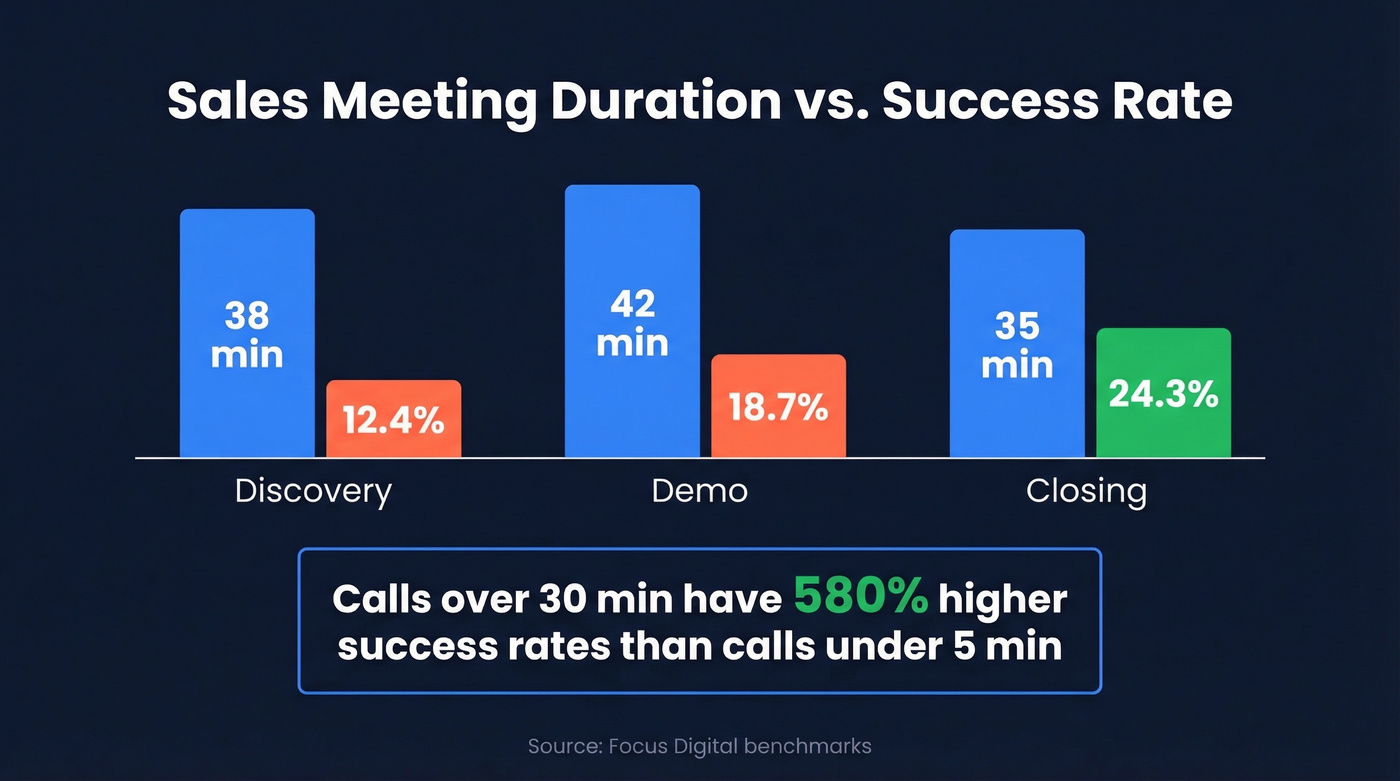
| Meeting Type | Avg. Duration | Success Rate |
|---|---|---|
| Discovery | 38 min | 12.4% |
| Demo | 42 min | 18.7% |
| Closing | 35 min | 24.3% |
The big number: calls over 30 minutes achieve 580% higher success rates than calls under five minutes. That's why the templates below are built around 30, 45, and 60-minute blocks - long enough for a real conversation, short enough that prospects actually accept the invite.
Sales Pitch Agenda Templates
The 30-Minute Discovery Agenda
Your reps will use this one 80% of the time. The pacing comes from a practitioner framework shared on r/sales that we've seen work across dozens of teams.
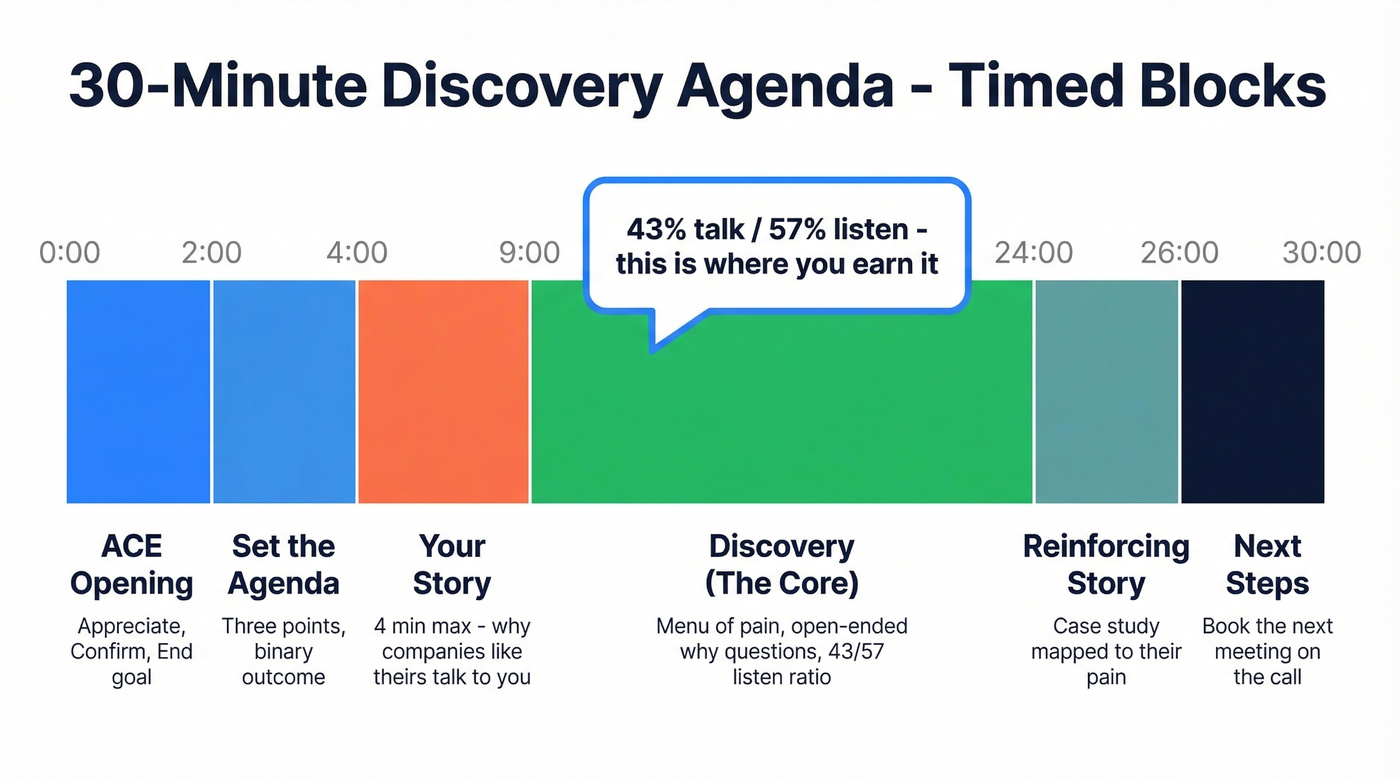
0:00-2:00 - ACE opening. Appreciate ("Thanks for making time"), Confirm time ("We've got 30 minutes - still work?"), End goal ("Here's what I'd love to cover..."). Then ask: "Would you like to change anything before we start?" That single question turns your agenda into a shared contract.
2:00-4:00 - Set the agenda. Three points: understand their current state, explore challenges, share a relevant case. Pre-frame the outcome as binary - either we book a follow-up, or we agree it's not a fit.
4:00-9:00 - Your story (brief). Not a product dump. A "here's why companies like yours talk to us" narrative, four minutes max. If you can't explain your value in four minutes, you don't know your value well enough.
9:00-24:00 - Discovery (the core). Fifteen minutes of listening. Open with a "menu of pain" - offer two or three common challenges and ask which resonates. Then dig with open-ended "why" questions. Find 3-4 reasons behind the struggle. Don't pitch yet. (If you want a deeper bank of questions, see discovery.)
Keep your talk-to-listen ratio at 43/57. Low performers average 54% talk in won deals vs 64% talk in lost deals - a 10-point swing that correlates directly with outcomes.
24:00-26:00 - Reinforcing story. A 1-2 minute case study that maps to what they just told you.
26:00-30:00 - Next steps. Book the next meeting on the call. Never end with "I'll send over some times." (If you need copy, use these follow-up templates.)
The 45-Minute Demo Agenda
Demos fail when they're 40 minutes of clicking through features nobody asked about. We've sat through enough of those to know. This structure keeps the prospect's problems front and center. For a tighter run-of-show, borrow a demo checklist.
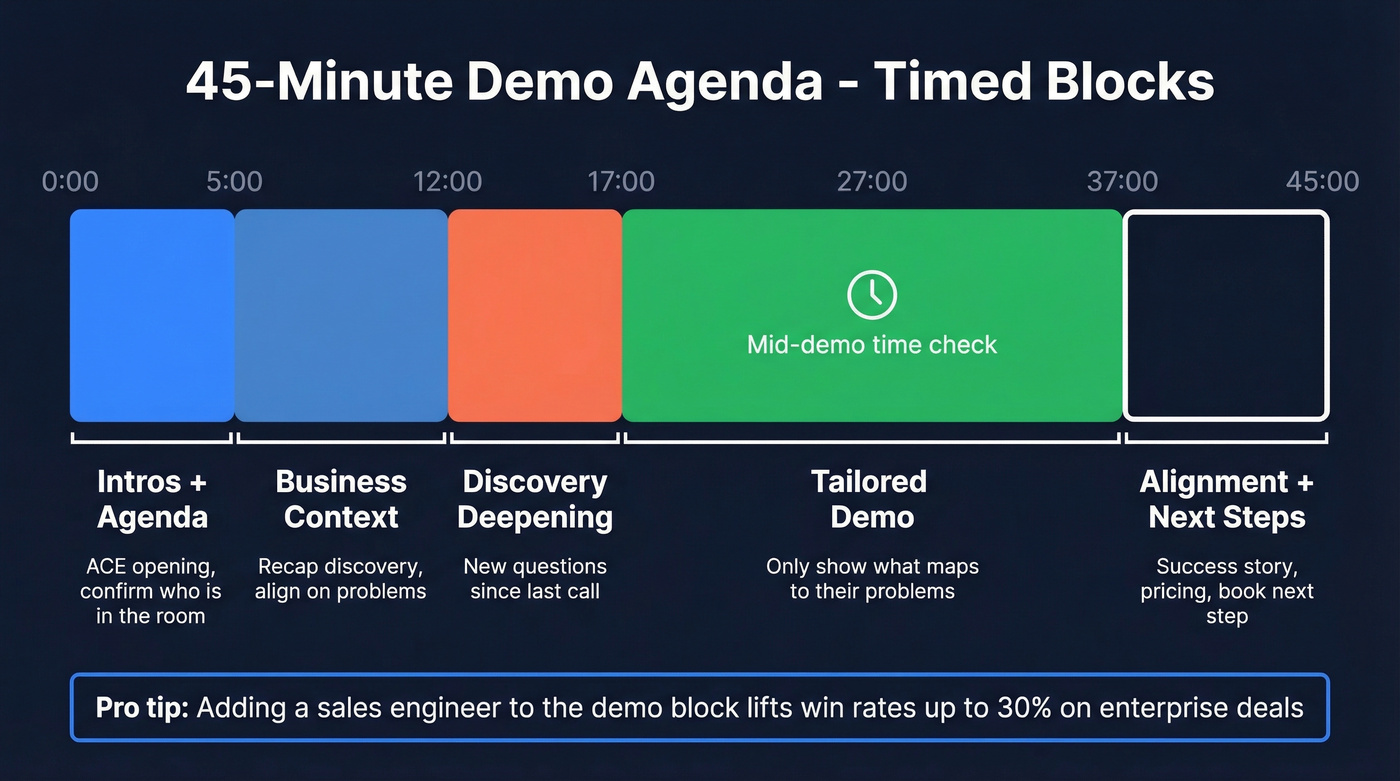
0:00-5:00 - Introductions + agenda confirmation. Same ACE opening. Confirm who's in the room and what they care about.
5:00-12:00 - Business context. Recap discovery. Align on the problems you're solving today. If new stakeholders joined, do a compressed discovery here - don't assume they got the memo.
12:00-17:00 - Discovery deepening. New questions based on what's changed since the last call. Align your demo to their words, not your script.
17:00-37:00 - Tailored demo. Show only what maps to their stated problems. At the midpoint, do a time check: "We've got about 10 minutes left in the demo - are we covering the right areas?" Bringing in a sales engineer for this block lifts win rates up to 30% on enterprise deals.
37:00-45:00 - Solution alignment + next steps. Share a success story. Discuss pricing and decision process. Book the next step before you hang up.
The 60-Minute Executive Pitch
This is the meeting where the deal gets made or stalls for six weeks. Skip this template if you're selling to individual contributors or small teams - it's built for rooms with multiple stakeholders and higher-stakes objections. (For the bigger picture, see enterprise B2B sales.)
0:00-5:00 - Introductions + agenda. ACE opening, but acknowledge every stakeholder by name and role.
5:00-15:00 - Strategic context. Frame the problem at the business level using a hero's journey: where they are, what's at stake, what the future looks like. Executives don't care about features. They care about outcomes and risk.
15:00-30:00 - Solution presentation. Use the "prescribe solutions" formula: [Product] has [feature] which means [benefit]. Check in after each section: "How does that sound?"
30:00-45:00 - Objection handling. Build this block in explicitly. Use the "peel the onion" technique: "Supposing we could address that, would you move forward? Any other reason?" For emotional resistance, try feel/felt/found: "I know how you feel. Others felt the same way. What they found was..." (More on reducing pushback: objection rate fixes.)
45:00-55:00 - Case study + ROI. A detailed success story with numbers mapped to their situation.
55:00-60:00 - Next steps + stakeholder alignment. Closed-won deals involve 2x more buyer contacts than lost deals, and multi-threading boosts win rates by 130% in deals over $50K. Before this meeting, verify emails for every stakeholder who should be in the room - Prospeo's 98% email accuracy means your agenda emails actually land instead of bouncing into the void. (If you're building lists, start with name to email.)

Your 60-minute executive pitch falls apart if your agenda email bounces. Prospeo verifies emails across 300M+ profiles with 98% accuracy - so every stakeholder gets your agenda, shows up prepared, and you close faster.
Stop losing deals to bounced emails before the meeting even starts.
Send the Agenda Beforehand
This is the highest-leverage move in the entire article. Send your agenda 24-48 hours before the meeting. It aligns expectations, lets the prospect add topics, and dramatically reduces no-shows.
Copy-paste email:
Subject: Agenda for [Day]'s call
Hi [Name],
Looking forward to our chat. To make the most of our time, here's a quick agenda - let me know if you'd like to add anything.
- Quick intros (5 min)
- [Their challenge / your discovery topic] (15 min)
- [Your solution / demo / case study] (10 min)
- Next steps (5 min)
See you [Day].
If you're emailing a new stakeholder you haven't contacted before, verify their address first. A bounced agenda email kills the meeting before it starts. (If you're seeing issues, check your bounce rate benchmarks and fixes.)

The Agenda Slide
If you're presenting a deck, include one roadmap slide at the top with approximate timings for questions, demo, and closing discussion. This is a credibility signal that tells the room you have a plan. Show time blocks, not bullet lists, and include when Q&A happens so executives know they'll get their turn. (If you want to level up the narrative, use sales deck storytelling.)
Three Rules for Any Meeting Agenda
Talk less than you think. The 43/57 talk-to-listen ratio isn't a suggestion - it separates winners from losers. Build your agenda with discovery as the longest block to keep this ratio honest. (More sales communication benchmarks here.)
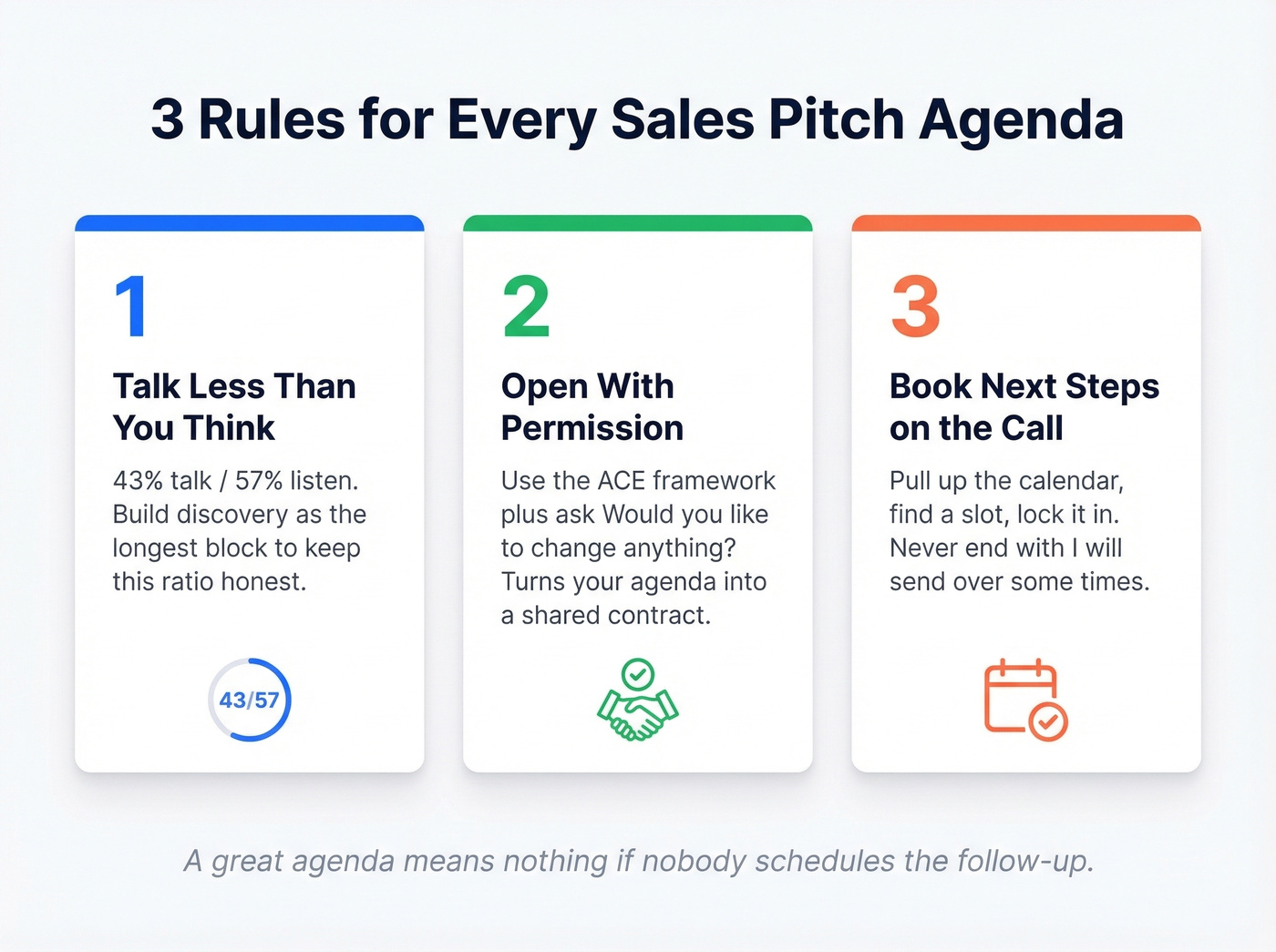
Open with permission, not a pitch. The ACE framework plus "Would you like to change anything?" turns your agenda into a shared contract. The prospect stops being an audience and becomes a collaborator. (If you need a tighter opener, steal from these elevator pitches.)
Book next steps on the call. Pull up the calendar, find a slot, and lock it in while you're both still engaged. A well-run sales pitch agenda means nothing if the deal stalls because nobody scheduled the follow-up. (Use a sales meeting follow-up email to recap and confirm.)
Multi-threading boosts win rates by 130%, but only if you can reach every buyer in the room. Prospeo finds verified emails and direct dials for decision-makers at $0.01 per email - so your pre-meeting agenda lands with the full buying committee.
Reach every stakeholder before your next pitch meeting.
FAQ
What's the ideal talk-to-listen ratio during a sales meeting?
Analysis of millions of calls shows 43% talk / 57% listen is optimal. Low performers average 54% talk in won deals vs 64% talk in lost deals - a 10-percentage-point swing that correlates directly with close rates. Structure your agenda with discovery as the longest block to enforce this ratio.
Should I send the agenda to the prospect beforehand?
Always. Send it 24-48 hours before the meeting. Pre-sending aligns expectations, lets the prospect add their own topics, and signals professionalism. It's the single highest-leverage move you can make to reduce no-shows and run a tighter call.
How do I handle objections during an executive pitch?
Build a dedicated 15-minute objection block into your agenda - don't pretend pushback won't come. Use the "peel the onion" technique: ask "Supposing we could address that, would you move forward?" This surfaces the real blocker instead of letting it stall the deal post-meeting.
How do I make sure every stakeholder joins the pitch?
Multi-thread before the meeting, not after it stalls. Pull verified emails and direct dials for the VP, technical lead, and budget holder so your agenda emails actually reach them. Closed-won deals involve 2x more buyer contacts than lost ones - the math is clear.