

Sales Pitch Examples That Actually Work in 2026
You finally get a decision-maker on the phone. You've got about 30 seconds before they decide whether to keep listening or hang up. And you open with "Hi, I'm calling from..." - exactly what the last four reps said.
The pitch isn't the problem. The opening is the problem. Below you'll find copy-paste sales pitch examples for every channel - cold calls, emails, voicemails, demos, and follow-ups - plus the delivery mechanics that separate reps who book meetings from reps who burn through dial lists.
If You Only Learn 3 Moves
Before you scroll to the scripts, internalize these three moves. Every example in this article is a variation of them:
- Permission-based opener - earns the next 30 seconds. Acknowledge you're interrupting, ask for a minute, and immediately sound different from every other cold caller.
- One-sentence value + proof - earns the next 5 minutes. Name the outcome, drop a recognizable competitor or result, let curiosity do the work.
- Direct calendar close - earns the meeting. Don't ask "would you be open to chatting sometime?" Propose a specific day and time. Then pause.
Master these, and the channel doesn't matter.
Why Most Pitches Fail
You've spent 45 minutes researching a prospect, crafted a personalized opener, and finally reached a live human. Then you burn the first 20 seconds introducing yourself, your company, and your product's feature set. By the time you get to the value, they've already checked out.
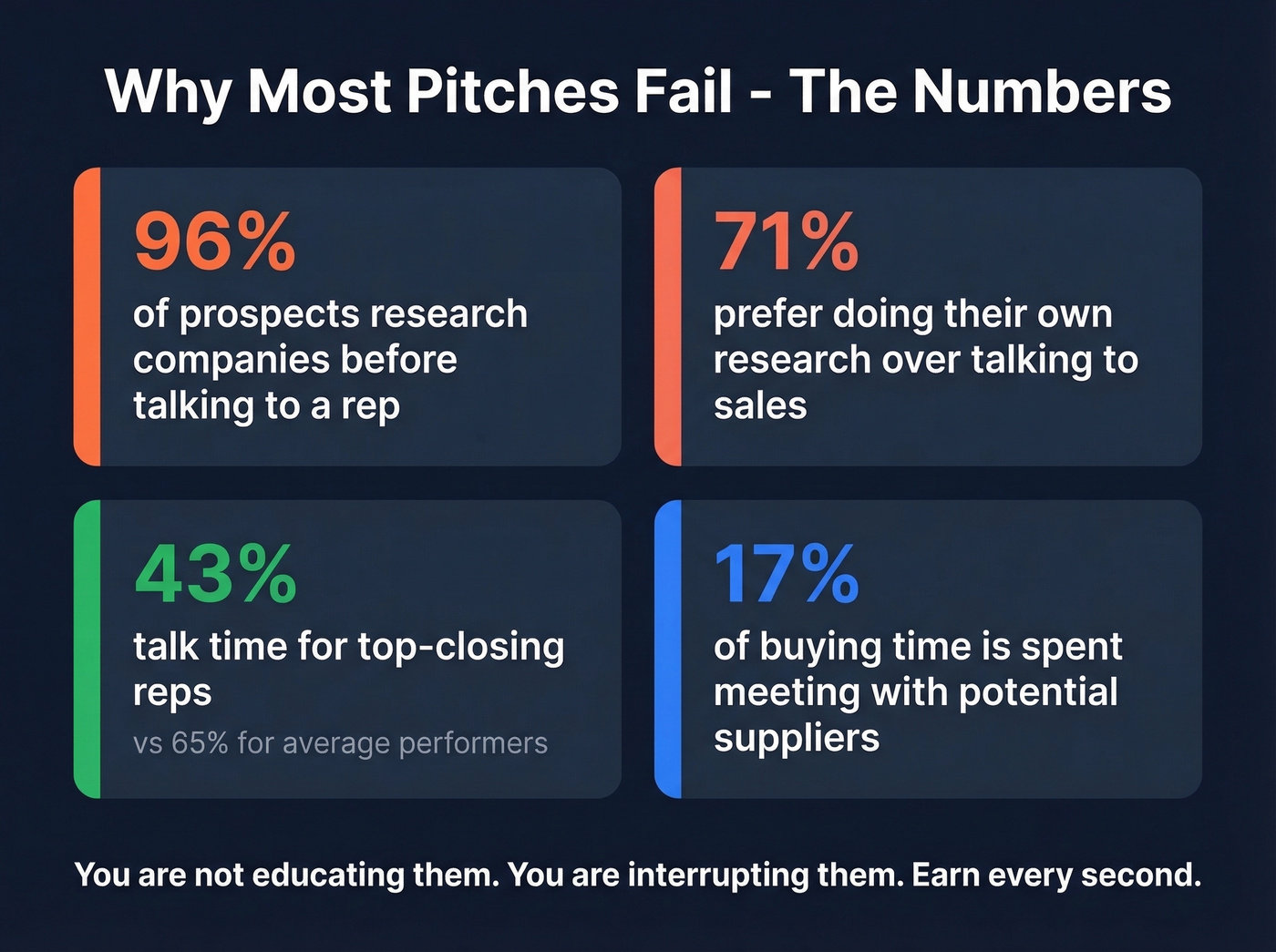
96% of prospects research companies before engaging with a rep. 71% prefer doing their own research over talking to you at all. Buyers spend just 17% of their buying time meeting with potential suppliers - the rest is independent research. You're not educating them. You're interrupting them. Your pitch needs to earn every second it gets.
Here's the thing: top-closing reps talk just 43% of the time, while average performers monologue at 65%. The best pitches aren't speeches. They're conversations that start with a hook sharp enough to make the prospect want to keep talking.
The 6-Part Pitch Structure
Every script below follows the same skeleton. Memorize this framework, and you can improvise a pitch for any channel, any audience, any product:
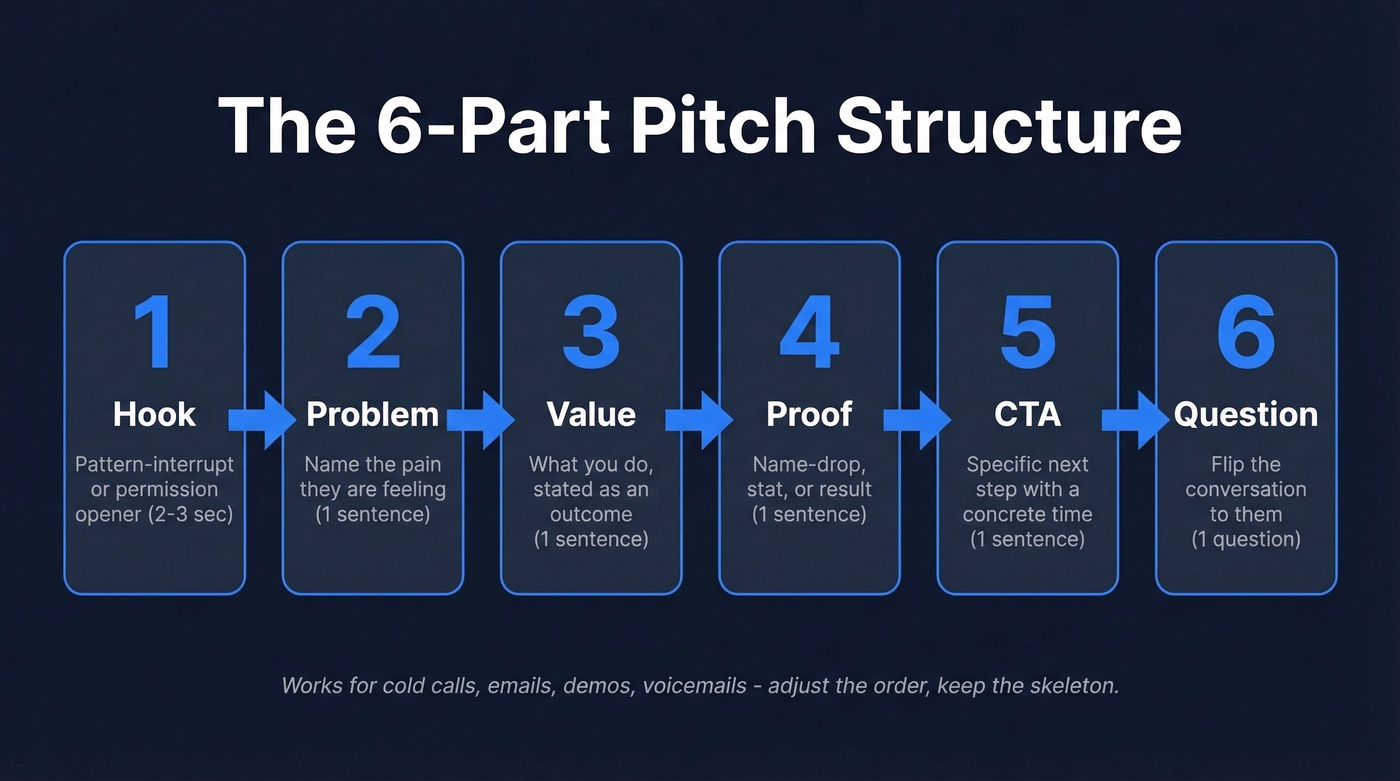
- Hook - Pattern-interrupt or permission-based opener (2-3 seconds)
- Problem - Name the pain they're likely feeling (1 sentence)
- Value - What you do, stated as an outcome (1 sentence)
- Proof - A name-drop, stat, or result (1 sentence)
- CTA - A specific next step with a concrete time (1 sentence)
- Question - Flip the conversation to them (1 question)
You won't always hit all six in order. A voicemail skips the question. An elevator pitch compresses to steps 2-4. But the skeleton stays the same.
Pitch Scripts for Every Channel
Cold Call: Permission-Based + Qualify-Fast
Here's the full script. Annotations in brackets.
You: "Hi [First Name], this is [Your Full Name] calling from [Company]. Appreciate I caught you out of the blue here - you got a minute?"
[2-second pause. Let them respond. If they say yes, you've earned 30 seconds.]
You: "We do [your coolest feature/outcome] for other companies in your space like [biggest competitor or recognizable name]. The reason I'm calling is that most [their role] teams we talk to are dealing with [specific pain point] - and we've helped [proof point: company or metric]."
[Pause again. Let them react.]
You: "The purpose of my call was actually to set aside 20 minutes later this week to show you how. Does Thursday at 2 work?"
Get the meeting and get out. Don't try to sell on the cold call - you're selling the meeting.
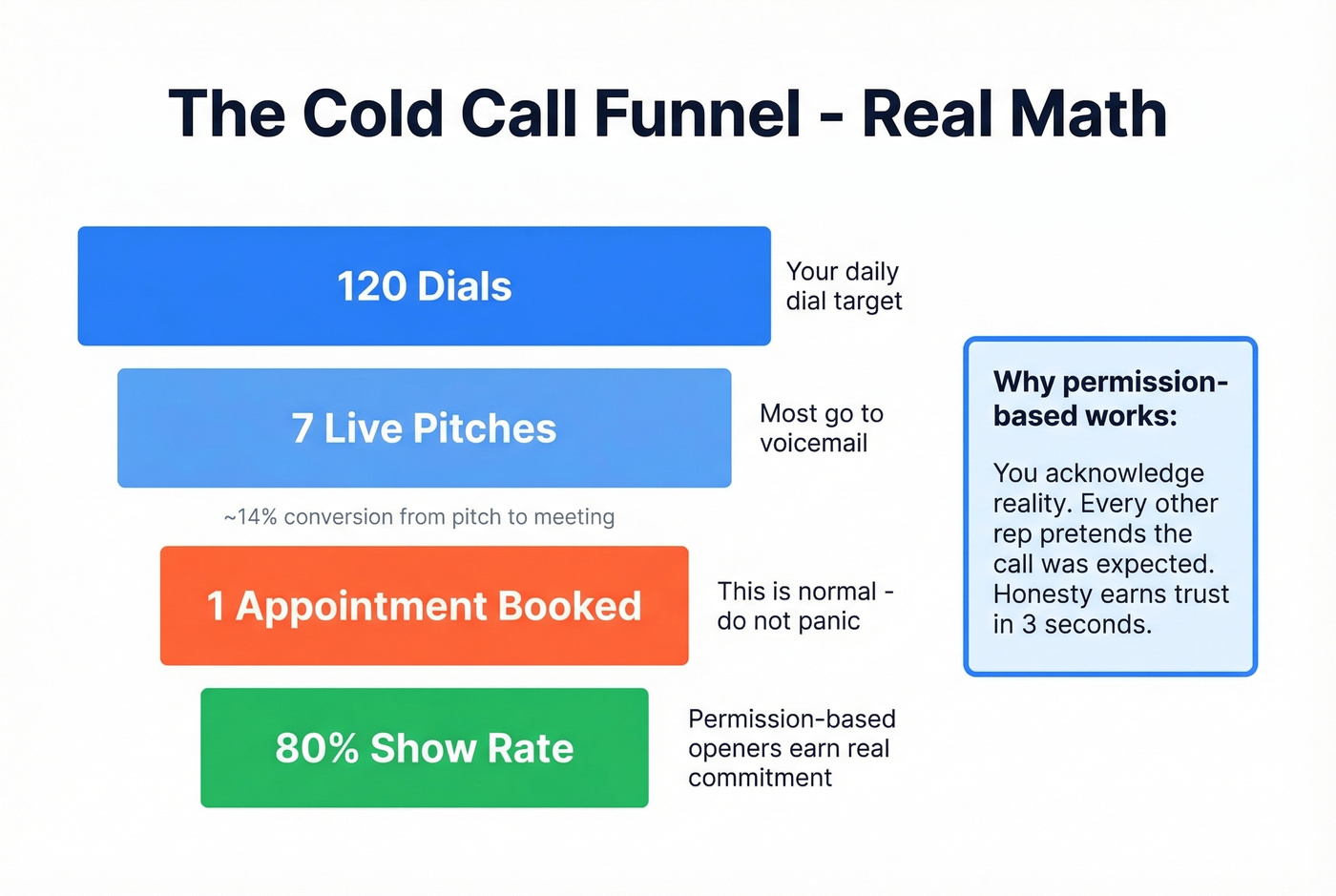
The math is humbling. Out of 120 dials, you'll typically deliver the pitch about 7 times. Of those 7, roughly 1 books an appointment. But appointments set with this permission-based approach show at about an 80% rate, because the prospect actually agreed to the conversation. The permission-based opener works because it's honest - every other rep pretends the call is expected, and you're the one who acknowledges reality. That earns trust in the first three seconds.
If you want to systematize this, build it into a repeatable cold calling system and pair it with proven sales prospecting techniques so you're not relying on luck.
Cold Email: Under 150 Words
Your cold email has one job: get a reply. Not close a deal. Not explain your product. Get a reply.
Subject: [Competitor name] → [their company name] (quick question)
Hi [First Name],
[One sentence about their specific situation - a recent hire, funding round, or pain signal you noticed.]
We helped [similar company] [specific outcome with a number] by [your unique approach in 5 words or fewer].
Worth 15 minutes this week to see if it fits?
[Your name]
That's under 60 words. Personalize each line - the prospect's name, their situation, a relevant competitor.
If you want more options, steal from these email subject line examples and build a full B2B cold email sequence around the same value + proof logic.
Here's why this matters more than your copywriting skills: 69% of cold email senders say performance declined year-over-year due to spam filtering and AI-content fatigue, and 48% report bounce rates between 2-5%. Your pitch can't convert if it bounces. Verify your list before you send - Prospeo's real-time verification delivers 98% email accuracy on a 7-day data refresh cycle, which is the difference between your carefully crafted email reaching an inbox and disappearing into a spam trap.
Voicemail: 30 Seconds Max
Most voicemails get deleted in the first five seconds. Lead with the problem, not your name.
"Hi [First Name], quick voicemail. Most [their role] teams I talk to are losing [specific pain - e.g., '15-20 hours a week on manual data entry']. We've cut that in half for companies like [name-drop]. I'll shoot you an email with details - if it's relevant, my number is [number]. That's [repeat number]. Talk soon."
Under 30 seconds. Your name comes last, not first - because nobody cares who you are until they care what you can do for them.
If you're getting shut down a lot, tighten your opener using these cold call rejection fixes.
Elevator Pitch: 2 Sentences
The template: "We help [persona] [outcome] by [mechanism]."
- "We help B2B sales teams book 30% more meetings by giving them verified contact data that doesn't bounce."
- "We help SaaS companies cut onboarding time in half by automating the 47 manual steps between 'signed contract' and 'first login.'"
- "We help e-commerce brands recover abandoned carts by triggering personalized SMS within 90 seconds of exit."
Notice the specificity. "We help businesses grow" earns a polite nod. "We help e-commerce brands recover abandoned carts" earns a follow-up question.
For more variations you can adapt, see these sample elevator pitches.
Demo Opening + Close
Don't open a demo with a product tour. Open with a question.
You: "Before I show you anything - what's the one thing that, if we solved it today, would make this call worth your time?"
[Let them answer. Build the demo around their answer.]
Then close with a direct next step:
You: "Based on what you've told me about [their pain], here's what I'd recommend: a 30-minute working session with your [relevant stakeholder] where we map this to your actual workflow. Tuesday or Thursday afternoon - which works better?"
If you want a tighter process, use a product demo checklist and these software demo tips to keep the call outcome-first.
We've seen teams double their show rates just by switching from "would you be open to a follow-up?" to a concrete time ask. Aim for a 40/60 talk-to-listen ratio. If you're talking more than 40% of the demo, you're pitching when you should be discovering.
Follow-Up Email
Never write "just checking in." Lead with the next step.
Subject: Next step from our [day] call
Hi [First Name],
Following up on our conversation about [specific pain point they mentioned]. You mentioned [their exact words if possible] - here's a 2-minute case study showing how [similar company] solved that.
[Link]
Can we lock in 20 minutes on [specific day] to map this to your team?
[Your name]
Reference the previous touchpoint. Use their language. Propose a concrete time.
If you need more follow-up angles, pull from these sales follow-up templates.
Video Pitch: 60 Seconds
Async video is underused and effective. 80% of B2B sales interactions now happen in digital channels, and a 60-second video stands out in an inbox full of text.
- 0-10 sec: Name the problem ("I noticed your team is hiring 3 SDRs - which usually means pipeline isn't where you want it")
- 10-30 sec: Quick screen-share demo of the one thing that solves it
- 30-50 sec: Proof point - one customer, one number
- 50-60 sec: Direct ask - "Reply to this email and I'll send a calendar link"
If you're doing this at scale, a Loom video cold email workflow helps keep it consistent.
Objection-Handling Mini-Scripts
These aren't rebuttals - they're redirects. The goal is to keep the conversation alive, not win an argument.
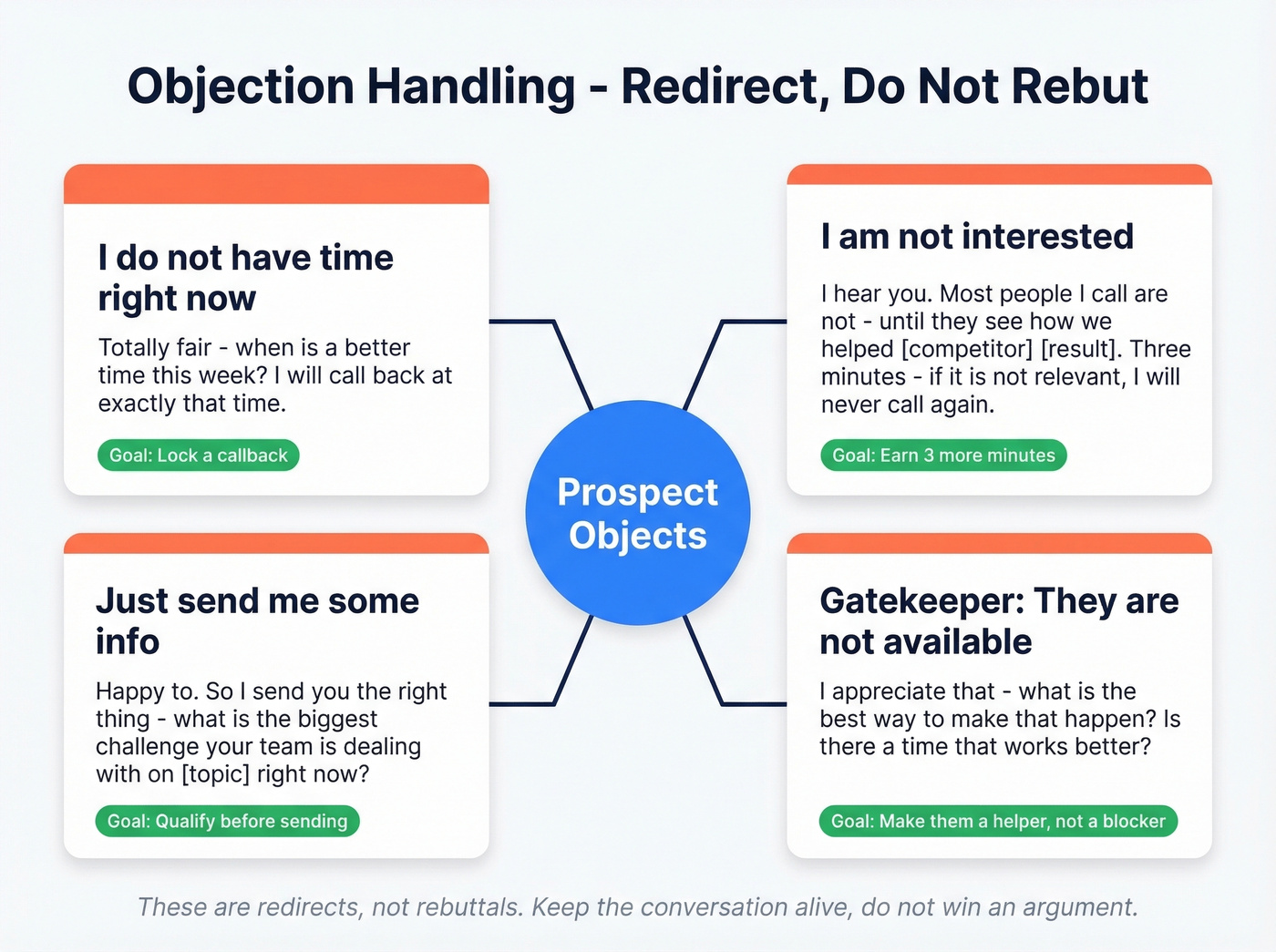
"I don't have time right now." "Totally fair - when's a better time this week? I'll call back at exactly that time."
"I'm not interested." "I hear you. Most people I call aren't - until they see how we helped [competitor name] [specific result]. Three minutes - if it's not relevant, I'll never call again."
"Just send me some info." "Happy to. So I send you the right thing - what's the biggest challenge your team's dealing with on [topic] right now?"
Gatekeeper: "They're not available." "I appreciate that - what's the best way to make that happen? Is there a time that works better, or should I try their direct line?"
The gatekeeper script positions them as a helper, not an obstacle. The "send me info" response qualifies before you waste a follow-up on someone who'll never open it.

Your cold email pitch doesn't matter if it bounces. 48% of reps report bounce rates up to 5% - that's half your carefully crafted pitches vanishing. Prospeo delivers 98% email accuracy on a 7-day refresh cycle, so every script you write actually lands in an inbox.
Stop perfecting pitches that never get delivered.
Before and After: Generic vs. Specific
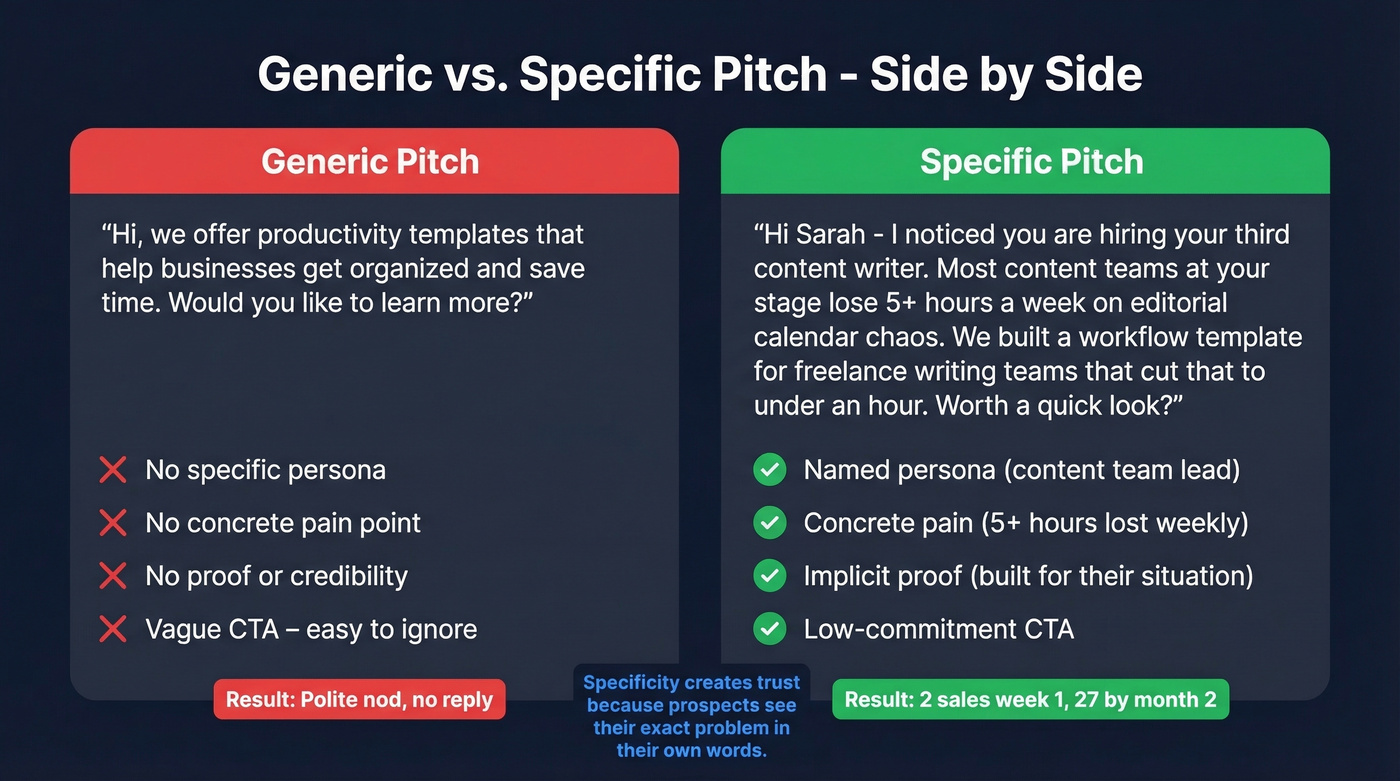
Before (generic):
"Hi, we offer productivity templates that help businesses get organized and save time. Would you like to learn more?"
After (niche-specific):
"Hi Sarah - I noticed you're hiring your third content writer. Most content teams at your stage lose 5+ hours a week on editorial calendar chaos. We built a workflow template specifically for freelance writing teams that cut that to under an hour. Worth a quick look?"
What changed: the persona is specific (content team lead), the pain is concrete (editorial calendar chaos), the proof is implicit (built specifically for their situation), and the CTA is low-commitment.
This isn't theoretical. One practitioner described repositioning from a generic "templates for everyone" pitch to a niche message for freelance writers. Results: 2 sales in week one, 5 in week two, 8 in week three, and 27 by month two. Specificity creates trust because prospects recognize their exact problem in their own words.
Hot take: If your deal size is under $25K, you don't need a 45-minute discovery call. You need a pitch sharp enough to close in one conversation. Most reps over-complicate small deals with enterprise sales motions, and it kills their velocity.
Choose Your Framework by Deal Size
Not every pitch needs the same methodology. Match your framework to the deal complexity:
| Deal Size | Cycle | Framework | Pitch Style |
|---|---|---|---|
| <$25K | 1-4 weeks | BANT | Direct, fast-qualify |
| $25K-$100K | 3-6 months | SPIN / Challenger | Consultative, insight-led |
| >$100K | 6-18 months | MEDDIC / MEDDPICC | Multi-threaded, champion-built |
Only 38% of sales teams have formal methodology guidelines. That means most reps are winging it - using enterprise discovery questions on a $5K deal, or trying to BANT-qualify a six-figure contract. In our experience, matching the framework to the deal size is the single fastest way to make your pitch feel appropriate to the buyer.
If you're running six-figure cycles, these MEDDIC sales qualification notes help you keep the process tight.
Personalize by Personality Type
Same pitch, four different buyers. Using the DISC framework:
| Type | What They Want | Pitch Tone |
|---|---|---|
| D (Dominant) | Results, speed | Concise, outcome-first |
| I (Influential) | Vision, energy | Enthusiastic, big-picture |
| S (Steady) | Stability, trust | Calm, relationship-first |
| C (Conscientious) | Data, proof | Fact-based, detailed |
A D-type wants "We cut pipeline build time by 40% - here's how." A C-type wants "98% accuracy, 7-day refresh cycle, 143M+ verified emails - let me walk you through the methodology." Personalizing email subject lines by personality type drives a 22% increase in open rates. You don't need a psychology degree - just pay attention to how the prospect communicates in their first reply and mirror that style.
Delivery Tips That Move the Needle
The best script in the world fails with bad delivery. You can study pitch templates all day, but if your tone is off, none of it converts.
Speak almost uncomfortably slow. New reps talk too fast. Slow down, and you sound more confident and easier to understand.
Pause for 2 full seconds before the ask. Silence creates weight. "Does Thursday at 2 work?" hits harder after a pause.
Call Friday afternoons for VP/C-suite. Gatekeepers are gone, executives are in a better mood - it's counterintuitive, but it works. Prioritize calling people who opened your emails 2+ times; they're warm, they just haven't replied yet. Run a cadence of 4 calls + 4 emails over 2 weeks, because buyers need 5-12 touchpoints across multiple channels before they engage.
Let's be honest - none of these delivery tips matter if you're dialing wrong numbers or emailing dead addresses. Clean data is the unglamorous foundation that makes everything else work.
If you're tightening the ops side, track the right lead generation metrics and fix deliverability issues at the source with an email deliverability guide.
Pitch Self-Audit Checklist
79% of buyers say most sales presentations are ineffective. Run your pitch through this before you send or dial:
- ❌ Lack of clarity - Can you explain your value in one sentence? If not, rewrite.
- ❌ Features over benefits - Swap every feature for the outcome. "Real-time sync" becomes "no more manual data entry."
- ❌ Wrong audience understanding - Name the prospect's specific pain in the first 10 seconds.
- ❌ No social proof - Drop one name, one number, one result.
- ❌ Weak CTA - Propose a specific day and time. Never "let me know if you're interested."
- ❌ Information overload - Cut your pitch in half. Then cut it again.
Skip this checklist if you're already booking meetings at a 15%+ conversion rate from dials to appointments. If you're below that, something on this list is broken.
You nailed the 6-part pitch structure. Now you need the direct dials to deliver it. Prospeo gives you 125M+ verified mobile numbers with a 30% pickup rate - 3x higher than ZoomInfo or Apollo. More live conversations, more chances to use those scripts.
Get decision-makers on the phone, not their voicemail.
FAQ
How long should a sales pitch be?
Cold call opener: 30 seconds. Cold email: under 150 words. Elevator pitch: two sentences. Demo opening: one question. The universal rule is shorter than you think - brevity drives every format above. After the hook lands, let the prospect's responses dictate how long you talk.
What's the best way to start a cold call?
Use a permission-based opener: state your name, acknowledge you're interrupting, and ask for a minute. This works because it's honest and immediately differentiates you from scripted callers. Reps who use this approach see roughly 80% show rates on booked meetings because the prospect opted into the conversation rather than being ambushed.
How many touchpoints to book a meeting?
Most deals require 5-12 touchpoints across multiple channels. Buyers now use roughly 10 interaction channels on average, up from 5 in 2016. Plan a cadence combining calls, emails, and async video over two to three weeks.
How do I make sure my cold emails actually land?
Start with verified contact data - 48% of senders report bounce rates of 2-5%, which tanks domain reputation fast. Pair clean data with a sub-150-word email and a personalized subject line, and you'll stay out of spam folders.
Can I reuse one pitch across different industries?
The structure stays the same, but the specifics must change. Swap the pain point, the proof point, and the name-drop for each vertical. A pitch built for SaaS onboarding won't resonate with an e-commerce buyer - even if the underlying framework is identical.