

How to Close a Sales Proposal: The Data-Backed Playbook
You sent the proposal Tuesday afternoon. By Friday, nothing. No reply, no questions, no "we're reviewing internally." Just silence. That gap between "proposal sent" and "deal closed" is where revenue disappears - and it's where most teams fall apart. The median close rate of 25% means roughly 75% of the proposals teams send never convert.
The problem isn't your product. It's what happens after you hit send.
Three Moves That Improve Close Rates
Three things separate top-quartile teams (35%+ close rate) from everyone else:
- Don't propose before discovery is complete. If you can't clearly restate the prospect's core objectives and challenges from your prior conversations, you're not ready to send a proposal. (If you need a tighter framework, start with better discovery questions.)
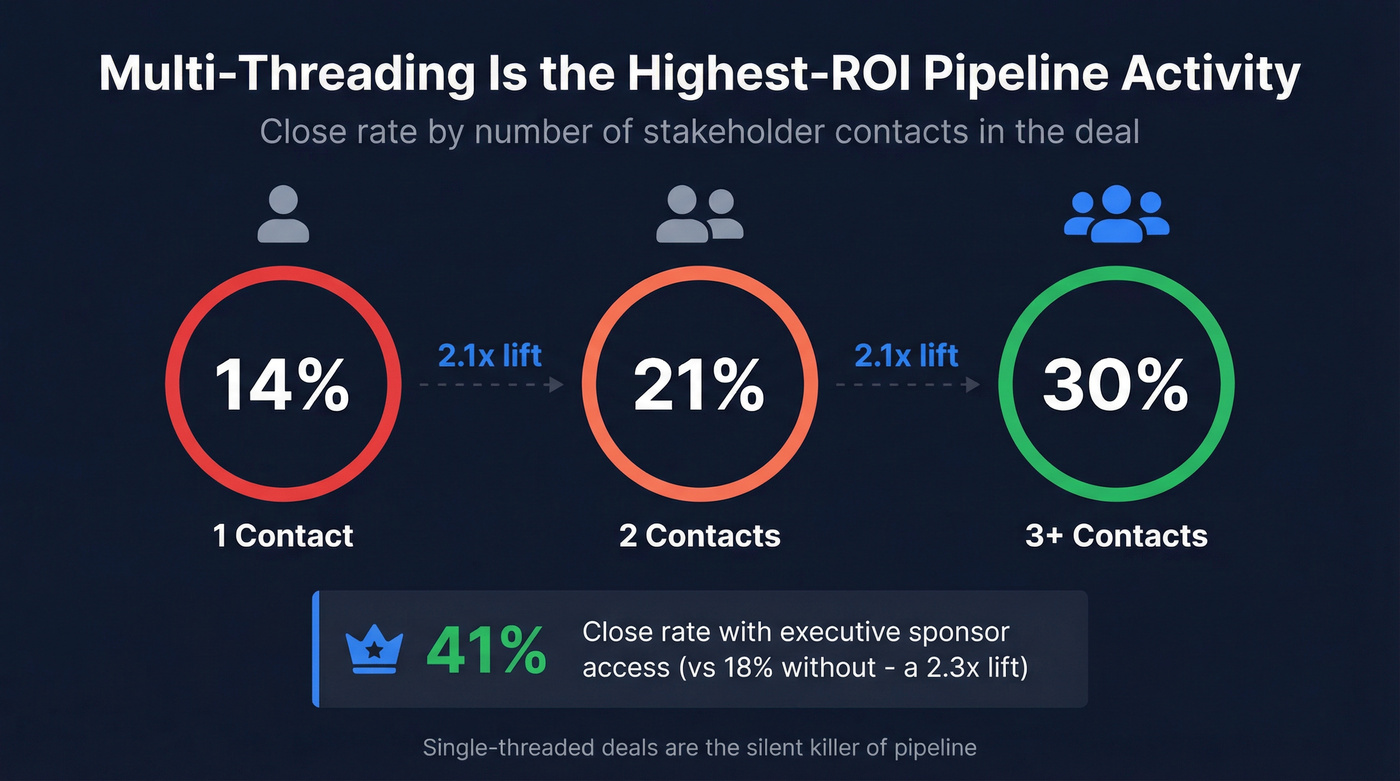
- Multi-thread every deal to 3+ stakeholders. Single-threaded deals close at 14%. Three or more contacts push that to 30% - a 2.1x lift.
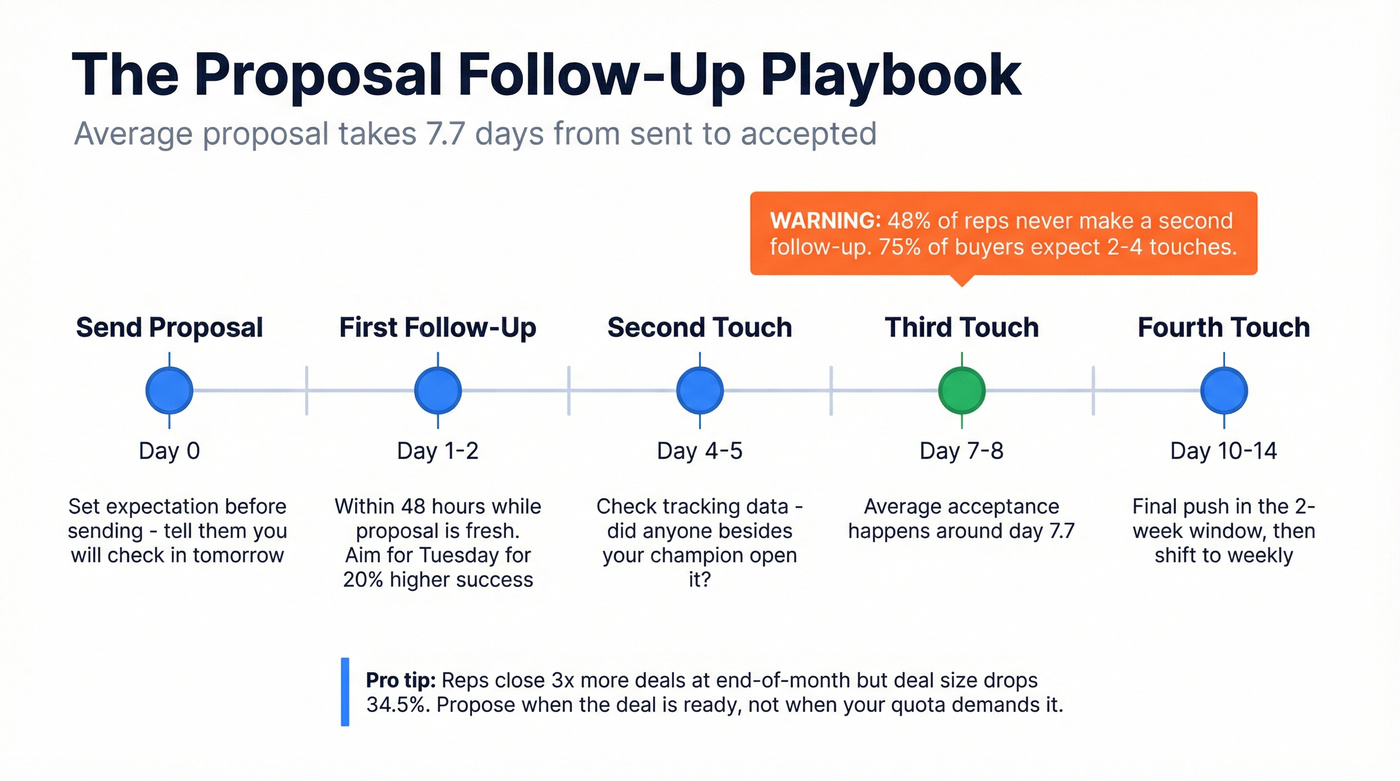
- Follow up 2-4 times using proposal tracking data. 75% of buyers expect 2-4 follow-ups, but 48% of reps never make it to the second one. (Keep a swipe file of sales follow-up templates so you don’t default to “just checking in.”)
Here's the thing: multi-threading is the single highest-ROI activity in your pipeline - higher than any closing technique, any objection-handling framework, any fancy proposal design. If you only fix one thing, fix that.
Why Proposals Die
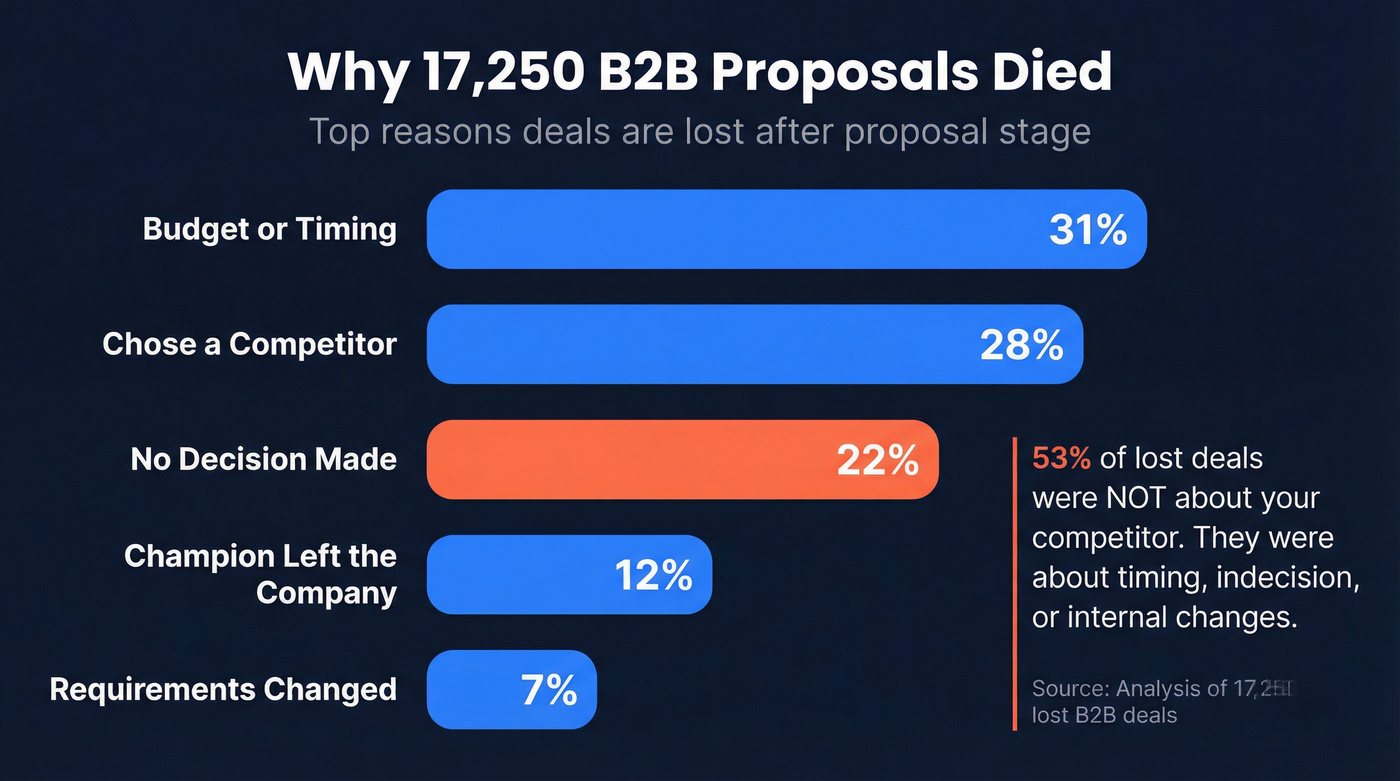
Across 17,250 lost B2B deals, the breakdown looks like this:
| Reason | % of Lost Deals |
|---|---|
| Budget / Timing | 31% |
| Chose Competitor | 28% |
| No Decision Made | 22% |
| Champion Left | 12% |
| Requirements Changed | 7% |
The biggest killer isn't your competitor - it's indecision and timing. Nearly a third of proposals die because the budget wasn't confirmed or the timing was wrong, which means the proposal was sent before the deal was actually qualified. (If this keeps happening, audit your sales pipeline challenges before you tweak proposal copy.)
Close rates also vary wildly by industry. Benchmarks spanning 2017-2026 show the range for deals where the buyer has a proposal or contract in hand:
| Industry | Close Rate |
|---|---|
| B2B SaaS | 37% |
| Cybersecurity | 46% |
| Manufacturing | 51% |
| Financial Services | 53% |
| Software Development | 59% |
If you're in B2B SaaS closing at 20%, you're below the industry median. Know your number before you try to improve it. (More context: sales conversion rate benchmarks vary a lot by motion.)
When NOT to Send a Proposal
The fastest way to improve your close rate is to send fewer proposals.
Mike Weinberg calls it "Premature Proposal Syndrome" - the pattern where a rep has a 10-minute discovery call and responds with a 30-page proposal. That proposal screams "I'm guessing." The prospect knows it. Their CFO definitely knows it. The right sequence is Discovery, then a working session, then the proposal. The proposal documents what you've already agreed on, not new ideas you're hoping will stick.
If you can't restate the prospect's top objectives and challenges from memory, you haven't earned the right to propose.
Below 18% close rate? Stop sending proposals entirely until you fix discovery. You're in the bottom quartile, and more proposals won't save you.
The 2-Page Proposal Template
An analysis of 50,000 proposals found that shorter proposals win more often. We've seen the same pattern on our team - groups that trim to two pages consistently outperform the ones sending 15-slide decks. The goal is a proposal that closes deals, not one that impresses your design team.
Page One - The Prospect's World
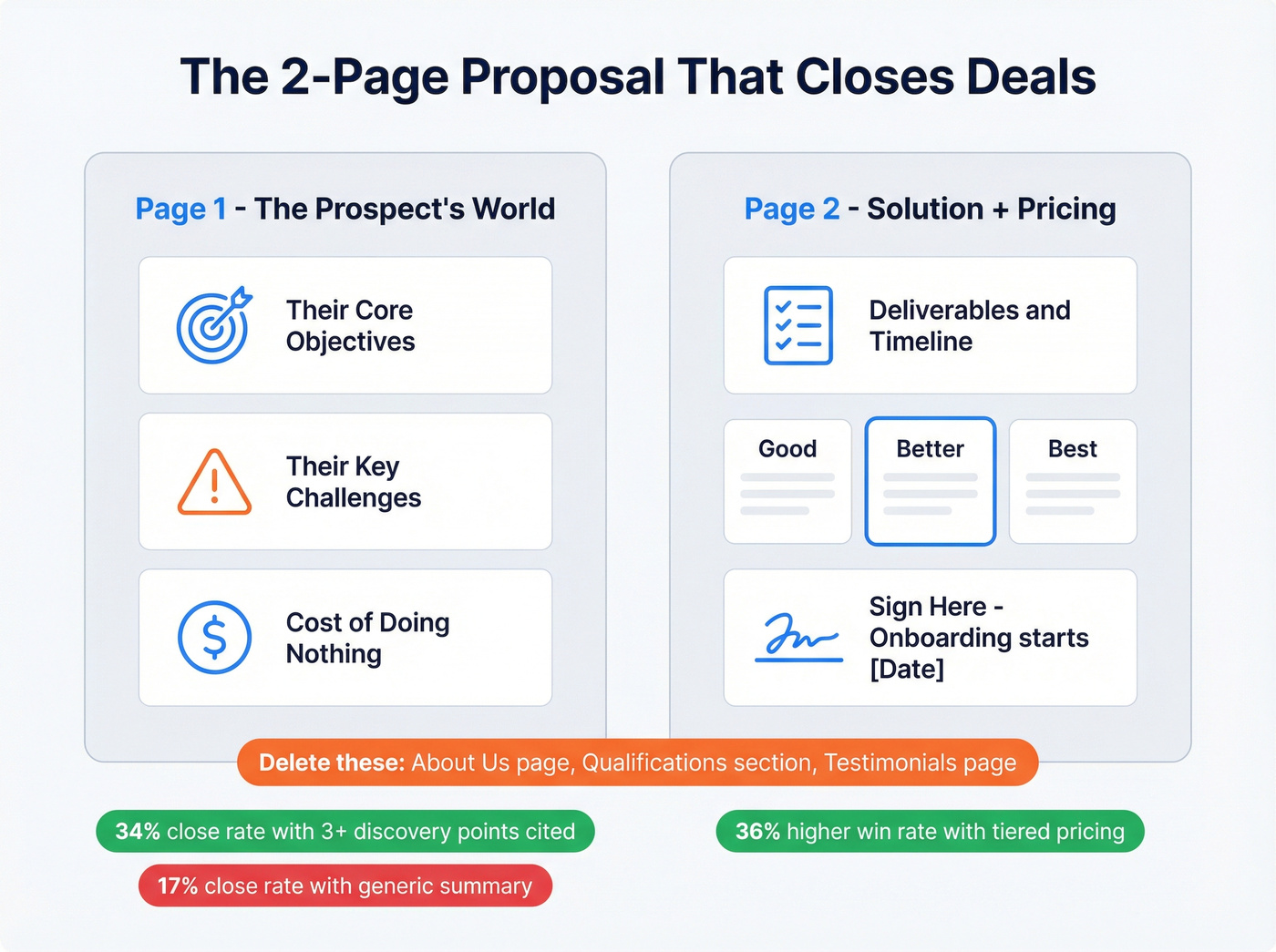
Page one isn't about you. It restates the prospect's core objectives, challenges, and the cost of inaction, all pulled directly from discovery. This is your personalized executive summary. It proves you listened. It forces the prospect to nod along before they ever see a price.
The data backs this up: a personalized executive summary citing three or more discovery points closes at 34%. A generic one closes at 17%. That gap is the cost of skipping discovery.
Page Two - Solution + Pricing Tiers
Page two covers deliverables, timeline, and pricing. The critical move here is offering three tiers - Good, Better, Best. Proposals with multiple packages see a 36% higher win rate than single-option proposals. The middle tier anchors the decision, the top tier makes the middle feel reasonable, and a 1% improvement in price optimization drives an 11.1% profit increase - so don't leave money on the table with a single flat rate. (If you want a deeper framework, use an anchor in negotiation to control the pricing conversation.)
Make the proposal signable. If your prospect has to wait for a separate contract, you've introduced friction and delay. End page two with a clear call to action: a single, specific next step like "Sign below to kick off onboarding on [date]." Vague closings like "Let us know your thoughts" invite delay.
What to Delete
Delete your "About Us" section. Delete your qualifications page. And here's one that surprises people: Gong's research found that social proof techniques lower close rates by 22% in sales conversations - and the same principle applies to proposals. That testimonials page you're proud of? It's probably hurting you. The prospect already decided to evaluate you. They need to see that you understand their problem, not that other people like you.

Multi-threading lifts close rates from 14% to 30%, but only if you can actually reach those stakeholders. Prospeo gives you verified emails and direct dials for 300M+ professionals - filtered by department, seniority, and company - with 98% email accuracy and a 7-day refresh cycle.
Stop losing deals to single-threaded proposals. Find every decision-maker now.
Multi-Thread or Lose
Single-threaded deals are the silent killer of pipeline. One contact: 14% close rate. Two contacts: 21%. Three or more: 30%. When you have executive sponsor access, close rates jump to 41% versus 18% without - a 2.3x lift.
We've watched deals die in real-time when the only contact goes dark. Your champion loved the demo, the proposal looked great, and then the CFO killed it in a meeting you weren't invited to. That's what single-threading gets you. Mutual Action Plans help too - deals with MAPs close 28% more often because they force alignment across stakeholders before the proposal stage. (This is also where team selling pays off.)
The practical problem is simple: you can't multi-thread if you don't have verified contact data for the VP of Finance, the Head of IT, or whoever else signs off. Prospeo's database covers 300M+ professional profiles with 30+ search filters including department and seniority, so you can pull verified emails and direct dials for the two or three stakeholders you actually need to reach. With 98% email accuracy and a 7-day data refresh cycle, you're not bouncing off dead addresses. (If you’re cleaning lists, track your email bounce rate so deliverability doesn’t quietly tank.)

The Follow-Up Playbook
Timing Your Outreach
The average proposal takes 7.7 days from sent to accepted. Your first follow-up should land within 48 hours - that's when the proposal is still fresh. Tuesday outreach sees roughly 20% higher success rates, so time your sends accordingly. (More data on timing: best time to send cold emails.)
Prospects remember the first and last proposals they review. That's the primacy-recency effect in action. If you can't be first, be last. Never be the one that lands in the middle of a five-vendor evaluation with no follow-up.
One warning: reps close 3x more deals at end-of-month, but deal size drops 34.5%. Rushing proposals to hit quota costs you real money over a full year. Propose when the deal is ready, not when your calendar demands it.
What to Say
Every rep on r/sales shares the same fear - that following up makes you sound annoying or needy. It doesn't. Buyers expect it. The real problem is the line "Did you get a chance to look at my proposal?" Every rep sends it. Every buyer ignores it.
The fix: set expectations before you send. Tell the prospect, "I'll check in tomorrow to walk through any questions." Then your follow-up isn't a cold ping - it's a scheduled conversation. In our experience, reps who set this expectation before sending close at nearly double the rate of those who wing it. Space three to four touches across two weeks, then go weekly. (If you want to systematize this, build it into your sequence management.)
Use Tracking Data
Modern proposal tools show you who opened your proposal, how long they spent on each section, and whether they forwarded it. When more than one stakeholder views a proposal, close rate doubles. If only your champion has opened it after three days, push for a broader review.
From the 50,000-proposal analysis: 86% of accepted proposals were sent via both email and text. Multi-channel delivery isn't optional anymore.
Mistakes That Kill Deals
Proposing before discovery is the most common and most expensive mistake. You're guessing, the prospect knows it, and you've burned your one shot at a first impression. (If you need a tighter process, use a discovery call script to standardize what “qualified” means.)
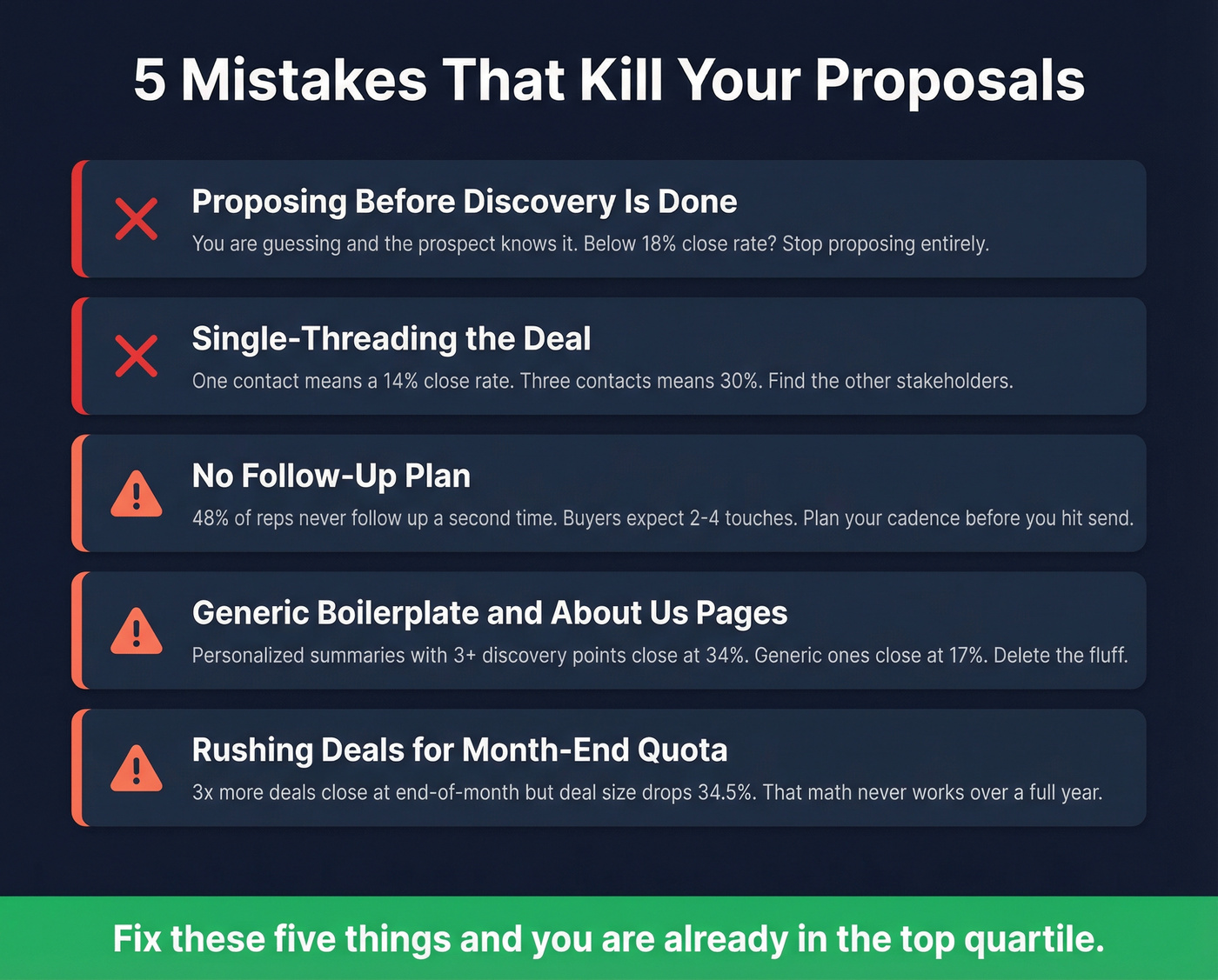
Single-threading and no follow-up are two sides of the same coin - both stem from laziness after the demo. Identify 3+ stakeholders before you propose, and plan a 2-week follow-up cadence before you hit send.
Generic boilerplate is a close second. Cookie-cutter "About Us" pages signal you didn't listen. Restate the prospect's specific challenges on page one instead.
Rushing for month-end will inflate your deal count but shrink your deal sizes by 34.5%. That math never works in your favor over a full year. And a missing or weak CTA at the end of your proposal hands the buyer an excuse to stall - tell them exactly what to do next, with a specific date.
Let's be honest about one more: sending the wrong attachment. One rep on r/sales accidentally emailed their internal bid sheet - cost, price, and profit margins all visible. Use controlled proposal templates with locked documents. Always double-check.
Tools That Help
You don't need a massive tech stack. You need a proposal tool and clean contact data. (If your stack is messy, start with best contact management software before you add more tools.)
| Tool | Starting Price | Best For |
|---|---|---|
| PandaDoc | From $19/mo | Best all-around for teams under 50 reps |
| Proposify | From $49/mo | Granular tracking + analytics |
| Qwilr | From $35/mo | Interactive web-based proposals |
| Better Proposals | From $19/mo | Budget-friendly, fast setup |
PandaDoc is the right default for most teams - skip Proposify unless you genuinely need its deeper analytics. Better Proposals punches above its weight for small teams that want to look polished without the overhead.
Your 2-page proposal won't close anything if it lands in a dead inbox. Prospeo's 5-step verification and 7-day data refresh ensure your follow-ups reach real people - not bounced addresses that tank your domain reputation. At $0.01 per email, bad data is no longer an excuse.
Every bounced follow-up is a deal you handed to your competitor.
FAQ
What's a good proposal close rate?
The median across 939 B2B companies is 25%. Top-quartile teams close at 35%+. Industry matters - B2B SaaS averages 37%, Financial Services 53%. Below 18% signals a qualification problem, not a proposal problem.
How long should a sales proposal be?
Two pages. Page one covers the prospect's situation and cost of inaction. Page two covers deliverables and three pricing tiers. Delete the "About Us" section and make the document signable inline.
What makes a strong proposal closing section?
A strong closing restates the prospect's core problem, summarizes the agreed-upon solution, and ends with a single, unmistakable next step. Specify the action and deadline - "Sign by Friday to begin onboarding June 1" - instead of vague language like "Let us know your thoughts."
How many times should I follow up after sending a proposal?
Two to four times over two weeks, starting within 48 hours. Use proposal tracking to time outreach based on when stakeholders actually open the document - that signal beats any calendar reminder.
How do I find contact info for multiple stakeholders?
Use a B2B data platform to search by company, department, and seniority. Prospeo's database covers 300M+ profiles with 98% email accuracy, so you can multi-thread deals without bouncing off outdated addresses. The free tier includes 75 email credits per month.