

Sales Strategies for 2026: A Benchmark-Driven Guide to Building What Works
Your team is doing more activity than ever. More emails, more calls, more sequences. But reply rates are flat, pipeline quality is worse, and your forecast calls feel like group fiction.
The problem isn't effort - it's that most sales strategies are just methodology names dressed up as a plan. A real strategy is a measurable system: who you target, through which channels, measured by which benchmarks, refined by which playbook. Let's build one.
The Three Moves That Matter Most
If you implement nothing else from this guide, these three shifts will move pipeline quality more than any methodology rebrand:
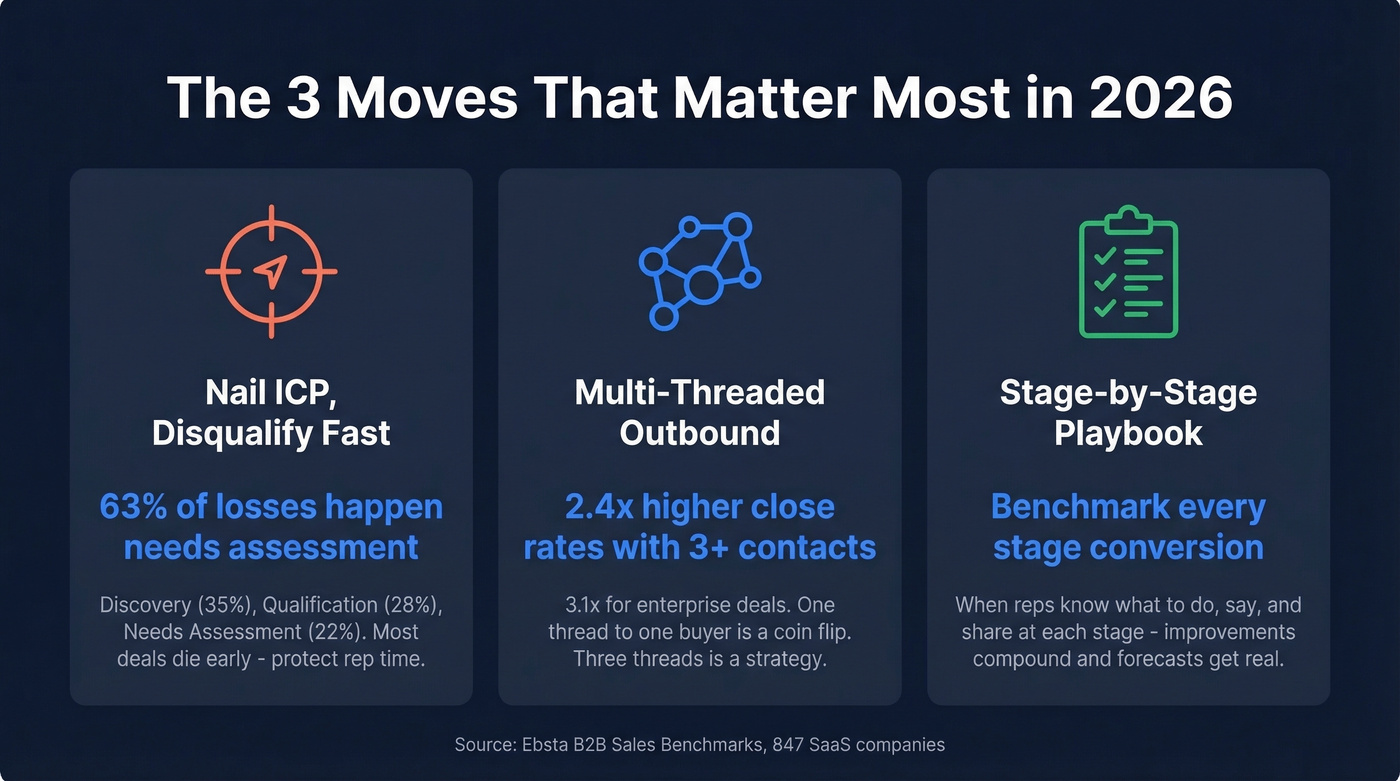
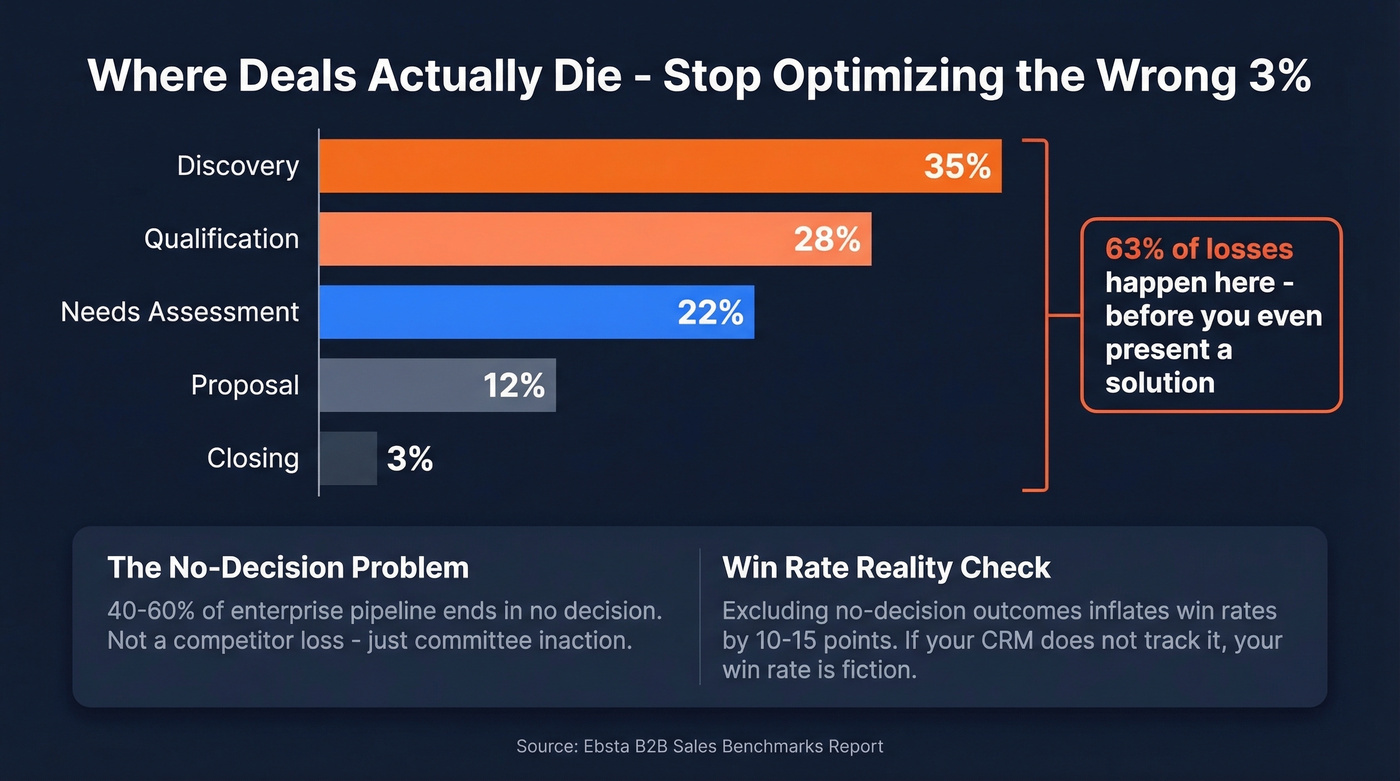
- Nail ICP and disqualify fast. 63% of losses happen before needs assessment - discovery (35%), qualification (28%), then needs assessment (22%). Most deals die early. Protect rep time by killing bad-fit opportunities sooner.
- Run signal-based, multi-threaded outbound. Engaging 3+ contacts per account yields 2.4x higher close rates - and 3.1x for enterprise deals. One thread to one buyer is a coin flip. Three threads is a strategy.
- Build a stage-by-stage playbook with benchmarks. When reps know what to do, say, and share at each stage - and you're measuring conversion between stages - improvements compound and forecast accuracy stops being guesswork.
Strategy vs. Tactics vs. Process
These three words get swapped around in every sales kickoff deck, and it creates real confusion. Here's the distinction: a strategy is the system connecting your motion, ICP, channels, and benchmarks into a coherent plan. Tactics are the specific moves reps make inside that system - the cold call opener, the Loom mini-audit, the mutual action plan. Process is the repeatable workflow that ensures tactics happen consistently.
| Layer | Definition | Example | Who Owns It |
|---|---|---|---|
| Strategy | Motion + benchmarks + playbook | "Multi-threaded ABM into mid-market fintech" | CRO / VP Sales |
| Tactics | Specific moves within the strategy | Loom audit, SPIN questions, 3-thread cadence | Reps + Enablement |
| Process | Repeatable workflow + systems | Stage gates in CRM, cadence rules, routing | RevOps |
Highspot's research frames the best playbooks as showing reps "what to do, say, and share in each deal stage." That's the bridge between strategy and execution. Without it, you've got a slide deck, not a system.
What Changed in 2026
The buyer has shifted, and most sales orgs haven't caught up. 96% of prospects now research companies before engaging with a rep, and 71% prefer doing that research independently. Your buyers are forming opinions about your product before you ever get a meeting.
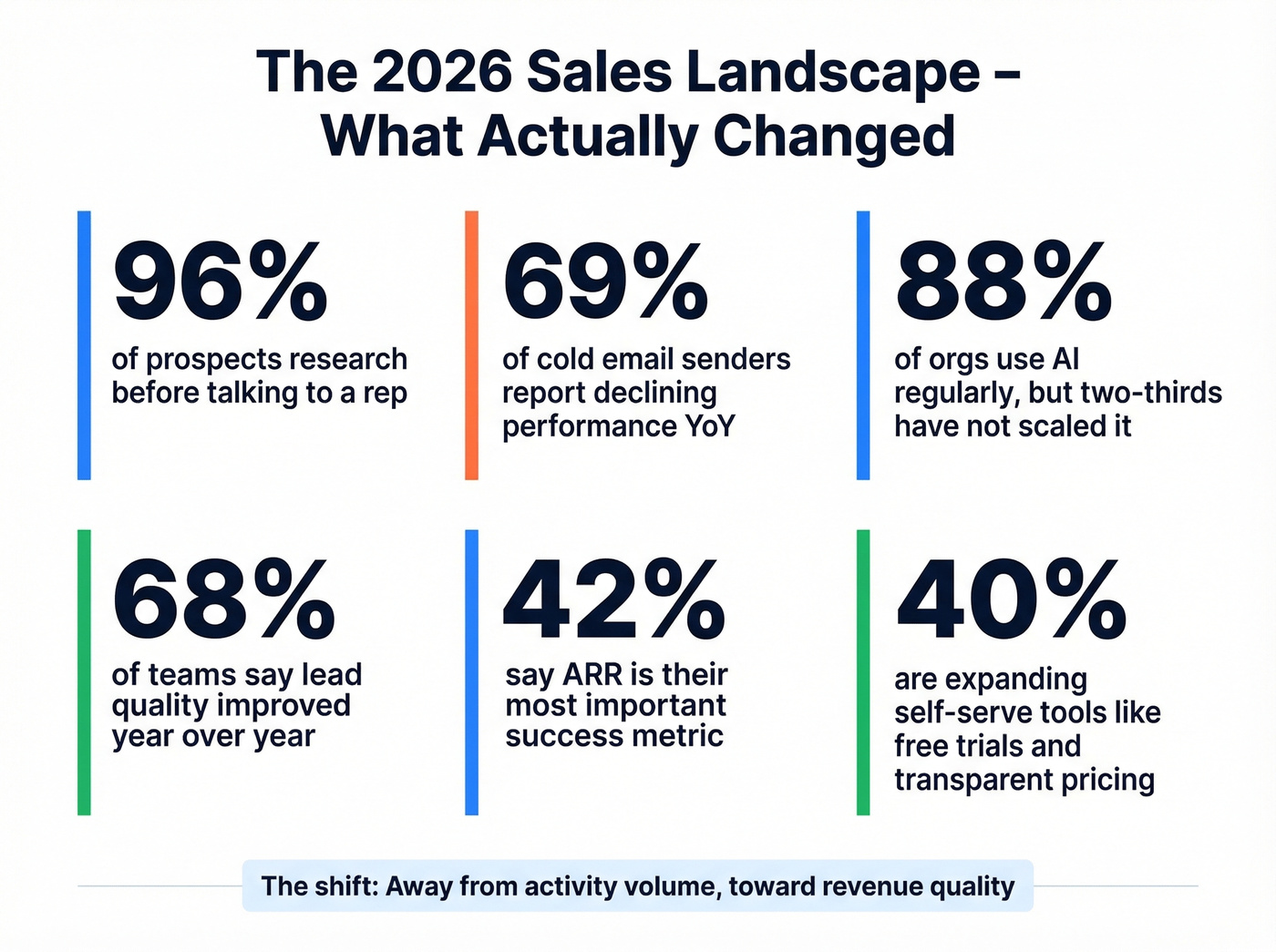
Cold outreach is feeling the squeeze. 69% of cold email senders report declining performance year-over-year, driven by spam filtering and AI-generated content fatigue. One enterprise rep on r/sales put it bluntly: it's "a lot harder to connect" than 2019 or 2020, and the old playbook of voicemails, emails, and connection requests isn't cutting it anymore.
Meanwhile, AI adoption is accelerating - 88% of organizations report regular AI use in at least one function, yet nearly two-thirds haven't begun scaling it enterprise-wide. The tools are there. The workflow redesign isn't.
Despite the headwinds, 68% of teams say lead quality improved year-over-year. The teams adapting to signal-based approaches are pulling ahead. What those teams prioritize tells the story: 42% now say ARR is their most important success metric, followed by profit margin (30%) and conversion rate (29%). The shift is away from activity volume and toward revenue quality. 35% of teams are focusing on solution-based selling, and 40% are expanding self-serve tools like free trials and transparent pricing pages. The era of "more dials = more deals" is over for most motions.
How to Develop a Winning Sales Strategy
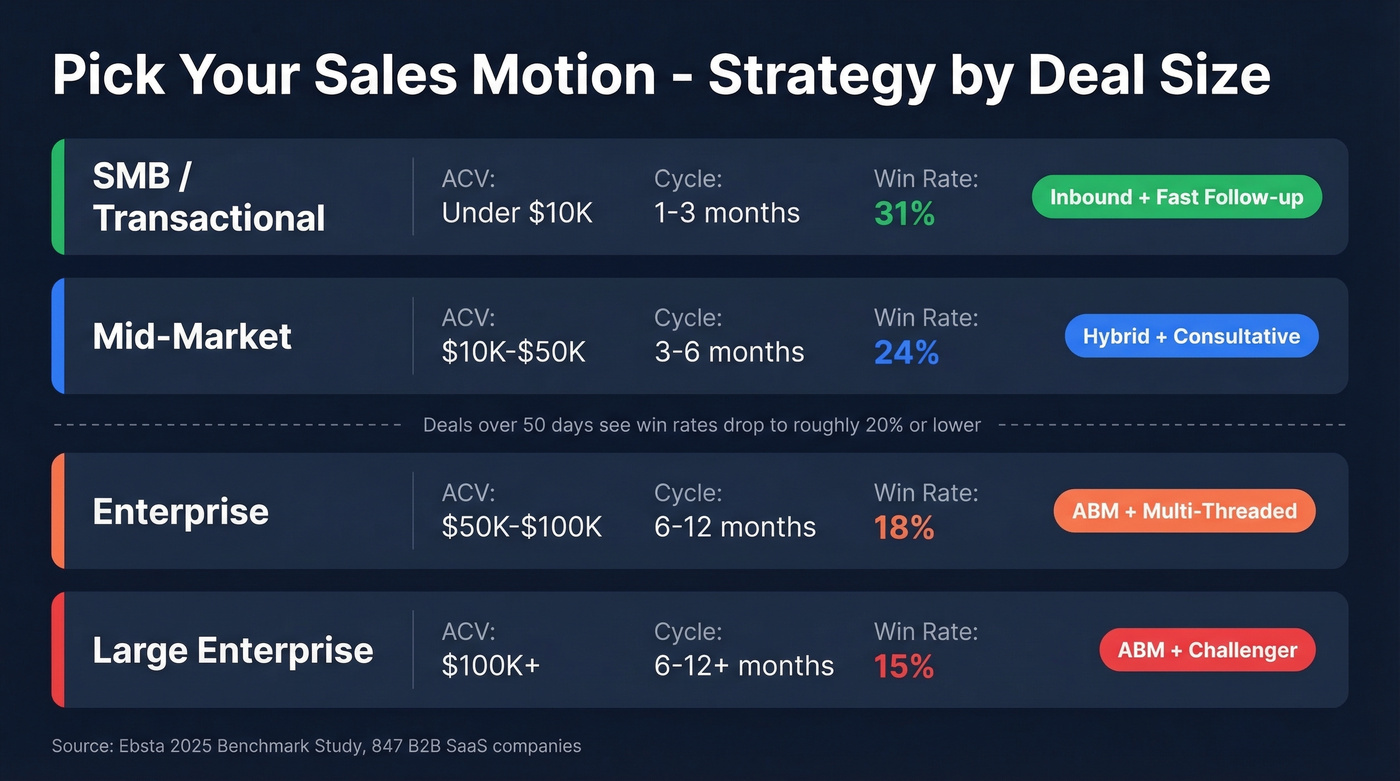
Not every team needs the same approach. Your motion type - determined by deal size, cycle length, and buyer complexity - dictates which framework will actually produce results.
| Motion | ACV Band | Cycle Length | Expected Win Rate | Strategy Archetype |
|---|---|---|---|---|
| SMB / Transactional | Under $10K | 1-3 months | ~31% | Inbound + fast follow-up |
| Mid-Market | $10K-$50K | 3-6 months | ~24% | Hybrid + consultative selling |
| Enterprise | $50K-$100K | 6-12 months | ~18% | ABM + multi-threaded |
| Large Enterprise | $100K+ | 6-12+ months | ~15% | ABM + Challenger |
Win rate data comes from a 2025 benchmark study of 847 B2B SaaS companies. The pattern is clear: as deal size increases, win rates drop and cycle length extends. That's not a problem to solve - it's a reality to plan around.
One velocity benchmark worth memorizing: deals that exceed 50 days see win rates drop to roughly 20% or lower. Speed matters as much as volume. If your mid-market deals are averaging 90 days, the strategy isn't broken - the qualification is. You're letting bad-fit deals linger and drag down the whole pipeline.
Here's the pipeline math that makes this concrete. Say your target is $2M in new ARR, your average deal is $25K, and your qualified win rate is 24%. You need roughly 333 qualified opportunities to hit the number. Work backward from there to figure out how many leads, meetings, and sequences that requires. If the math doesn't work, the plan needs to change - not the activity targets.
Most teams pick a methodology based on what their VP saw at a conference, not on their actual motion. A company closing $8K deals doesn't need a Challenger framework. They need fast inbound response, a tight demo-to-close process, and enough outbound to fill gaps.
Here's the thing: if your average deal is under $15K, you probably don't need ZoomInfo-level tooling or a Sandler-certified sales floor. You need verified data, a 3-step sequence, and a rep who can run a 20-minute demo. Overengineering the go-to-market plan is just as dangerous as having none at all.

You just did the pipeline math - 333 qualified opportunities to hit $2M. That math falls apart if 20% of your emails bounce. Prospeo delivers 98% email accuracy, 30+ ICP filters, and intent data across 15,000 topics so every opportunity in your pipeline reaches a real buyer.
Stop building pipeline on bad data. Start at $0.01 per verified email.
Core Approaches That Work Now
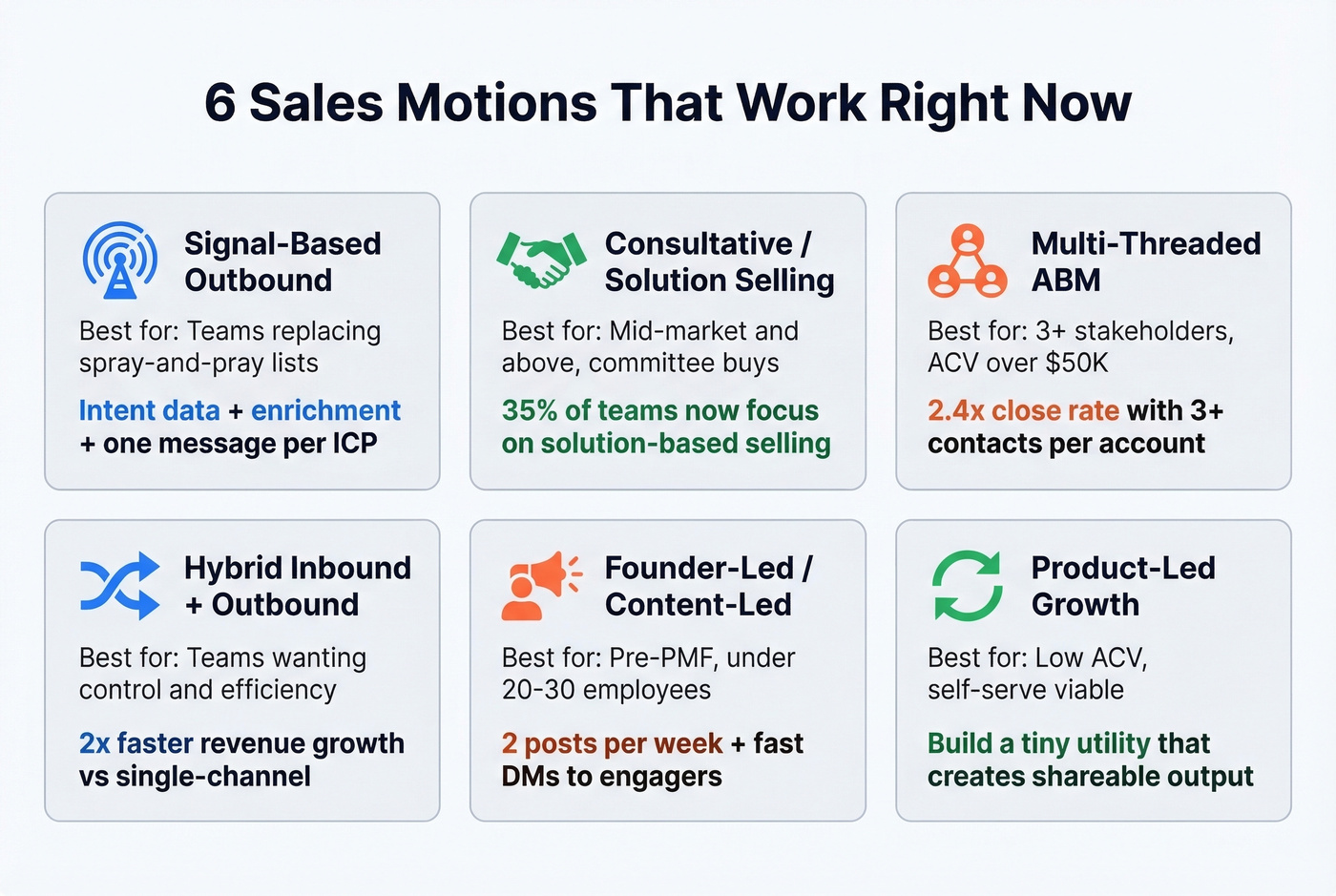
Below are the six motions producing results right now, along with when to use each one.
Signal-Based Outbound
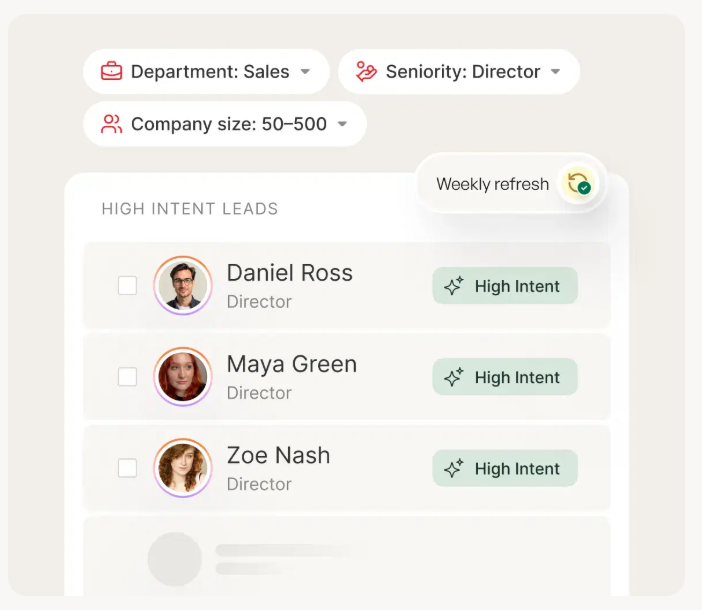
The old outbound model - buy a list, blast 10,000 emails, hope for 2% reply - is dying. Signal-based outbound is replacing it. Build narrow ABM lists using enrichment and intent data, then target accounts showing actual buying signals: job changes, funding rounds, tech stack shifts, content consumption patterns.
Practitioners on r/ycombinator are running this exact stack: Clay for enrichment, short Loom mini-audits as personalized hooks, and "one message, one ICP, one channel" as the operating principle. Signal-based outbound only works if your contact data is accurate - Prospeo's 98% email accuracy and intent data across 15,000 topics let you build verified lists filtered by buyer signals, so reps reach the right person at the right time instead of blasting stale lists.
Consultative / Solution Selling
35% of teams now focus on solution-based selling, and the reason is simple: the top deal-killers are "no product fit" (37%) and "poor value for money" (35%). Both are value-perception problems that consultative selling directly addresses. This works best for mid-market and above, where buyers need to justify spend to a committee and the rep who diagnoses the problem best wins the deal.
If you're formalizing this motion, start with discovery and a consistent sales qualification standard so reps aren't improvising deal criteria.
Multi-Threaded Account-Based
Use this if you're selling into accounts with 3+ stakeholders in the buying committee. Skip this if your ACV is under five figures and deals close with a single decision-maker.
Engaging 3+ contacts per account yields 2.4x higher close rates - and 3.1x for enterprise. When 40-60% of enterprise pipeline ends in "no decision," multi-threading is how you prevent deals from stalling because your single champion went on vacation or changed roles.
To operationalize it, borrow proven account-based selling patterns and define how you'll spot and score buying signals.
Hybrid Inbound + Outbound
Companies using a hybrid approach see 2x faster revenue growth than inbound-only or outbound-only. Inbound leads cost up to 60% less than outbound, but outbound lets you control deal size and target specific accounts. Responding to inbound within 5 minutes increases conversion by up to 9x. Most teams know this. Many teams still take hours.
If you're tightening this motion, map your lead generation workflow and track pipeline health so speed doesn't come at the cost of quality.
Founder-Led / Content-Led
For early-stage companies where brand trust is zero, the founder is the brand. The playbook from YC practitioners: two posts per week on professional networks, fast DMs to anyone who engages, and treating content as a top-of-funnel engine. This doesn't scale past 20-30 employees, but it's the highest-ROI motion when you're pre-product-market fit.
Product-Led Growth Loop
When ACV is low and self-serve is viable, build a "tiny utility inside the product" that creates shareable output - the best-performing free growth loop according to YC founders testing acquisition channels. PLG works when the product can demonstrate value before a rep ever gets involved.
Benchmarks That Actually Matter
Teams celebrate "win rate improvements" while quietly excluding no-decision and unqualified opportunities from the denominator. That's not improvement - that's accounting.
Win Rate Benchmarks
| Metric | Benchmark | Context |
|---|---|---|
| Overall B2B win rate | ~21% | All opportunities |
| Qualified opp win rate | ~29% | Qualified only |
| Under $10K ACV | 31% | B2B SaaS, 847 companies |
| $10K-$50K ACV | 24% | B2B SaaS, 847 companies |
| $50K-$100K ACV | 18% | B2B SaaS, 847 companies |
| $100K+ ACV | 15% | B2B SaaS, 847 companies |
B2B SaaS Funnel Conversions
| Stage | Conversion Rate |
|---|---|
| Lead to MQL | 39% |
| MQL to SQL | 38% |
| SQL to Opportunity | 42% |
| SQL to Closed | 37% |
Funnel data comes from FirstPageSage's analysis of B2B SaaS companies across 2017-2025.
The "no decision" problem is massive and underreported. Excluding no-decision outcomes inflates win rates by 10-15 percentage points. In enterprise, 40-60% of pipeline ends in no decision - not a loss to a competitor, just a slow death by committee inaction. If your CRM doesn't track no-decision as a distinct outcome, your win rate is fiction.
Where losses actually happen tells you where to invest. 63% of losses occur before needs assessment: discovery accounts for 35%, qualification for 28%, and needs assessment for 22%. Only 12% of losses happen at proposal stage. Just 3% at closing. If your team is obsessing over closing techniques, they're optimizing the wrong 3% of the problem.
If you want to benchmark this properly, align on funnel metrics and compare against real sales pipeline benchmarks.
Turn Strategy Into a Playbook
A strategy without a playbook is a PowerPoint. The best playbooks show reps exactly what to do, say, and share at each deal stage - with decision points where reps can diverge based on industry, company size, or persona. Teams with documented qualification criteria see 40% higher close rates, which makes building a playbook less of a nice-to-have and more of a revenue lever.
The measurement side matters just as much. Track which playbook sections correlate with wins. If reps who use the discovery framework close at 35% and reps who skip it close at 18%, that's not a suggestion - it's a mandate.
One data point that should change how you think about follow-up: 80% of sales require 5+ follow-ups, but 48% of reps stop after one touch. That's not a training problem - it's a playbook problem. If the cadence isn't built into the system, reps will default to what's comfortable.
We've seen teams lift win rates by 15-20% by replacing pressure tactics with data-backed proposals and value maps. Bryan Vasquez at LinkBuilder.io documented a 20% win-rate increase over two quarters after making exactly this shift. The era of fake scarcity and aggressive urgency is over for B2B buying committees. If you want to improve results, start by auditing what your reps actually do at each stage - not what the CRM says they should do.
If you need a starting point, build your cadence around proven sales follow-up templates and standardize sequence management so reps don't reinvent follow-up every deal.
What AI Changes (and Doesn't)
AI-using revenue organizations saw 29% higher revenue growth than peers, per Gong's most recent State of Revenue Growth report. The top use cases are practical, not futuristic: email automation (63%), call analysis (52%), note-taking (42%), and data entry (42%).
| AI Handles Well | Humans Still Own |
|---|---|
| Prospecting/outreach automation | Strategic messaging |
| Lead scoring and qualification | Buying committee dynamics |
| CRM updates and data entry | Custom deal structures |
| Call summaries and coaching insights | Real-time negotiation |
Gartner projects AI will close 70% of sales cycles by 2028. But the scaling gap is real: 62% of organizations are experimenting with AI agents, yet only 23% are scaling them.
Look - AI is a productivity multiplier, not a strategy replacement. If your inputs are wrong - bad ICP, stale data, no playbook - AI just automates the wrong things faster. We've watched teams deploy AI sequencing on top of garbage contact data and wonder why deliverability tanked. The tool isn't the problem. The inputs are.
Fix Your Inputs Before You Scale
Stop adding channels. Fix your inputs. If your contact data is wrong or stale, every sales strategy described in this article becomes a deliverability problem. That 69% cold email performance decline isn't just about spam filters - it's about teams blasting unverified lists and torching their domain reputation in the process.
Speed-to-lead within 5 minutes is linked to 21% higher win rates - but only if you're reaching the right person. Responding fast to a bad-fit lead doesn't help. Reaching the right VP with a verified email and direct dial does.
The proof is in the results. When Snyk's 50-person AE team switched to verified contact data, their bounce rate dropped from 35-40% to under 5%, AE-sourced pipeline jumped 180%, and they generated 200+ new opportunities per month. Bad data wasn't just an inconvenience - it was the bottleneck.
Prospeo refreshes its 300M+ profiles every 7 days - compared to the 6-week industry average - and verifies emails through a proprietary 5-step process that delivers 98% accuracy. At roughly $0.01 per email with a free tier, it removes the "bad data" excuse before you scale any outbound motion.
If deliverability is the constraint, start with email bounce rate and a practical email deliverability guide before you add more volume.

Signal-based outbound only works when your contact data matches the signal. Prospeo combines buyer intent, technographic filters, and job change signals with 143M+ verified emails - refreshed every 7 days, not every 6 weeks. Multi-thread into accounts knowing every email will land.
Teams using Prospeo book 26% more meetings than ZoomInfo users.
FAQ
What are sales strategies?
A sales strategy is the system that defines who you target, through which channels, measured by which benchmarks, and refined by which playbook. It connects your go-to-market motion to measurable outcomes. Picking a methodology like SPIN, Challenger, or Sandler is a conversation framework reps use within that system - strategy comes first.
What's a good win rate for B2B sales?
The average B2B win rate is roughly 21% across all opportunities and 29% for qualified opportunities. By ACV: 31% under $10K, 24% at $10K-$50K, 18% at $50K-$100K, and 15% above $100K. Always check whether "no decision" outcomes are included - excluding them inflates the number by 10-15 points.
Is cold outbound still effective in 2026?
Yes, but only when it's signal-based and multi-threaded. Volume blasting with unverified data is what's dying. Teams using intent signals, verified contacts, and 3+ stakeholder threads still see strong results - Snyk generated 200+ new opportunities per month after switching to verified data.
How long should a B2B sales cycle be?
SMB deals close in 1-3 months, mid-market in 3-6 months, enterprise in 6-12+ months. Deals exceeding 50 days see win rates drop to roughly 20%. If cycles are stretching, look at qualification criteria and discovery process - not closing tactics.
How do you build a sales strategy from scratch?
Start by defining your ICP, motion type, and ACV band - these determine which archetype fits. Then build around pipeline math: work backward from your revenue target to the number of qualified opportunities you need. Document stage-by-stage playbooks with benchmarks, assign ownership across sales and RevOps, and review conversion data monthly. Teams that follow this process consistently outperform those that start with tactics.