

Sample Email to Client Introducing Yourself: Templates That Get Replies
Every intro email template you've ever seen opens with "I hope this email finds you well." Nobody actually writes like that. A good introduction email to a client is 40-60 words, leads with value, and skips the resume. You don't need 15 templates. You need three structures and the discipline to keep them short.
Here's the part most guides skip: 55% of replies come from follow-ups, not the first email. Your cadence matters as much as your copy. (If you want more ready-to-send options, see our sales follow-up templates.)
What Every Introduction Email to a Client Needs
Every effective introduction email follows the same five-part anatomy:
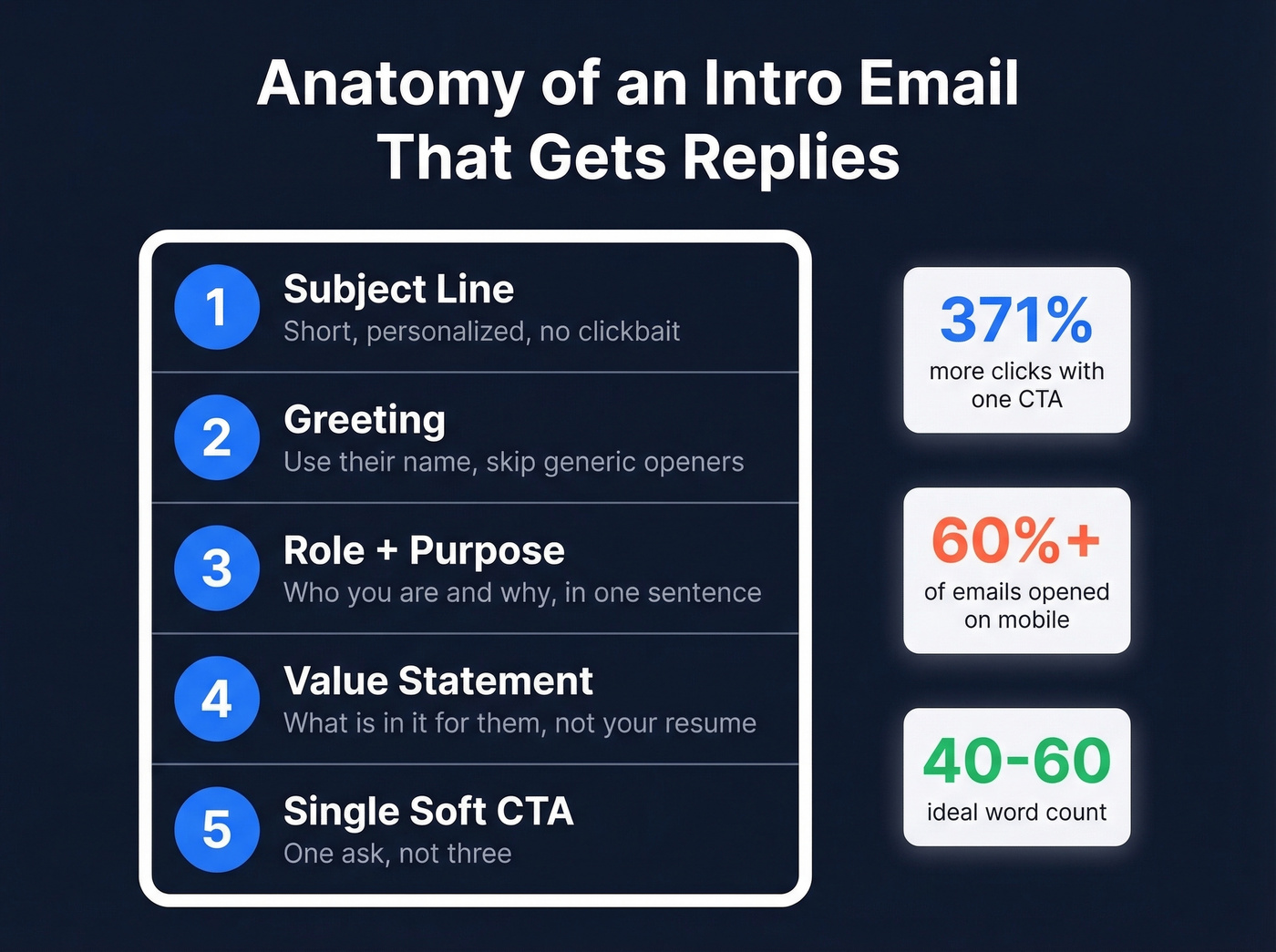
- Subject line - short, personalized, no clickbait
- Greeting - use their name; skip "To Whom It May Concern"
- Role + purpose - who you are and why you're emailing, in one sentence
- Value statement - what's in it for them, not your credentials
- Single soft CTA - one ask, not three
Your credentials don't matter in the first email. Clients care about what you'll do for them. That single CTA isn't optional - emails with one CTA get 371% more clicks than emails with multiple asks. And since over 60% of emails are opened on mobile, a wall of text on a phone screen is an instant delete. (If you want to tighten your ask, use these email call to action rules.)
Subject Lines That Get Opened
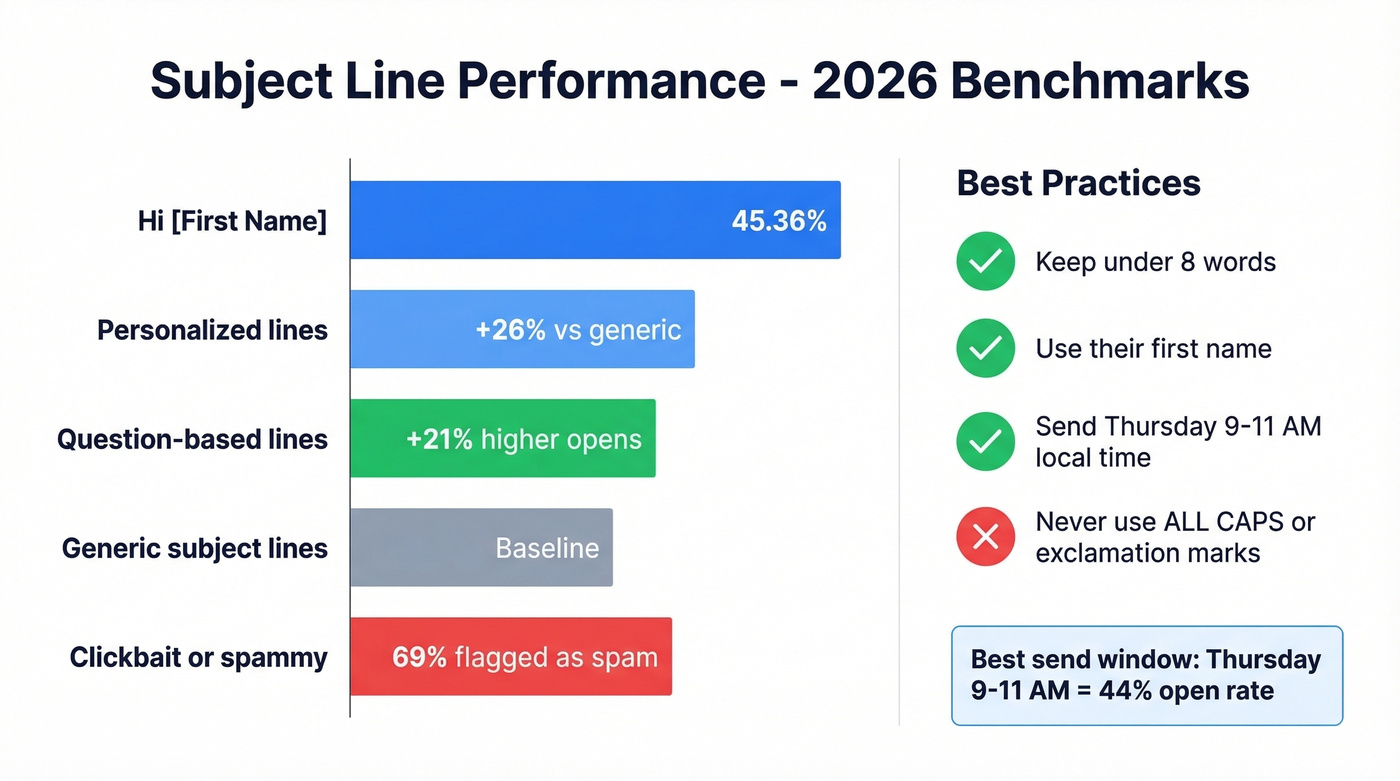
47% of recipients decide whether to open based on the subject line alone - and 69% flag emails as spam based on it. This single line does more work than your entire email body. For more ideas, borrow from our email subject line examples and subject lines that get opened guides.
| Formula | When to Use |
|---|---|
| Hi [First Name] | Cold outreach |
| Quick question, [Name] | Warm intro / referral |
| Mutual contact intro | Referral-based |
| New point of contact for [Company] | Account handoff |
| Following up from [Event] | Post-event |
The best-performing subject line in 2026 data is "Hi {{first_name}}" at a 45.36% open rate. Personalized subject lines are 26% more likely to be opened, and question-based subject lines get 21% higher opens. Keep them under eight words.
If you can control send timing, Thursday between 9-11 AM in the recipient's time zone hits a 44% open rate - the best window we've seen in the data. (More data here: best time to send cold emails.)
Let's be honest: if your industry average open rate is already above 35%, your subject line isn't the problem - your list quality is. SaaS averages 25.71%, consulting hits 28.93%, and investment firms reach 45.47%. Know your baseline before you start A/B testing subject lines. (If you’re diagnosing deliverability, start with our email deliverability guide.)

A perfect intro email means nothing if it bounces. Prospeo gives you 98% verified emails for the exact decision-makers you want to reach - with 30+ filters to find them by role, industry, intent signals, and more. At $0.01 per email, bad data is no longer an excuse.
Stop crafting intro emails to addresses that don't exist.
Email Templates by Scenario
Cold Outreach to a Prospect
No company pitch, no "we don't know each other" preamble. Just value and a soft ask. The 40-60 word format is what actually gets replies when you're reaching out to someone cold. (For a full sequence, see our B2B cold email sequence guide.)
Subject: Hi [First Name]
Hi [First Name],
[One sentence about a specific problem their company likely has]. We helped [similar company] [specific result] in [timeframe].
Worth a quick call?
[Your Name] [Title, Company]
Formal variant: Swap "Worth a quick call?" for "Would you be available for a brief conversation this week?" Use this for finance, legal, and enterprise buyers.
Don't attach anything. No PDFs, no decks, no case studies. Attachments in a first email trigger spam filters and signal "sales pitch" before the recipient reads a word. (If you’re seeing issues, run a quick email spam checker pass.)
Warm Introduction via Mutual Contact
Cold outreach is far less effective when chasing a specific target. A warm intro through a mutual contact converts at multiples of cold. Here's the email your contact sends on your behalf:
Subject: Connecting you with [Your Name]
Hi [Target Name],
I wanted to connect you with [Your Name] at [Company]. [One sentence praising the target's work]. [Your Name] specializes in [specific value] and has helped companies like [example] with [result].
I've cc'd both of you - please connect directly.
[Mutual Contact Name]
Account Handoff - New Point of Contact
This is the most underserved scenario. The consensus on r/CustomerSuccess is clear: skip the resume, lead with what you own. (If you need more variations, use our handoff email template library.)
Subject: Your new point of contact at [Company]
Hi [First Name],
I'm [Your Name], your new [title] at [Company]. I'll be your primary contact and your advocate on the inside for everything from [scope area] to [scope area].
I'd love a 15-minute intro call to cover what success looks like for your team right now and any open items from the transition.
Does [day] or [day] work?
[Your Name]
PS - Congrats on [personalized detail from their website or recent news].
If you're looping in other teammates like implementation, support, or an exec sponsor, CC them so the client knows who's involved.
Formal variant: Replace "advocate on the inside" with "dedicated point of contact" and drop the PS for C-suite recipients who prefer brevity.
Introducing a New Team Member to Clients
Subject: Introducing [New Person], your new [role] at [Company]
Hi [Client Name],
Due to recent changes on our team, [New Person] will be taking over as your [role] effective [date]. [New Person] has been with [Company/Department] for [time] and specializes in [relevant area].
You can reach [them] directly at [email] or [phone]. We'll handle the transition on our end - reach out with any questions.
[Sender Name]
Post-Event or Conference Follow-Up
Subject: Good meeting you at [Event]
Hi [First Name],
Great connecting at [Event] - our conversation about [specific topic] stuck with me. I think [one sentence about how you could help].
Open to a 15-minute call next week?
[Your Name]
Reference the specific conversation. Generic "nice to meet you" follow-ups get buried.
Referral-Based Introduction
Subject: [Referrer Name] suggested I reach out
Hi [First Name],
[Referrer Name] mentioned you're [dealing with X / looking into Y] and thought we should connect. We've helped [similar company] [specific result].
Worth a quick conversation?
[Your Name]
Name-drop the referrer in the first line. It's the only reason this email gets read.
The Follow-Up Sequence
If you're not following up, you're leaving 55% of replies on the table. Most people send one email and give up. That's a strategy problem, not a template problem. (If you want the benchmarks behind this, see importance of follow-up in sales.)
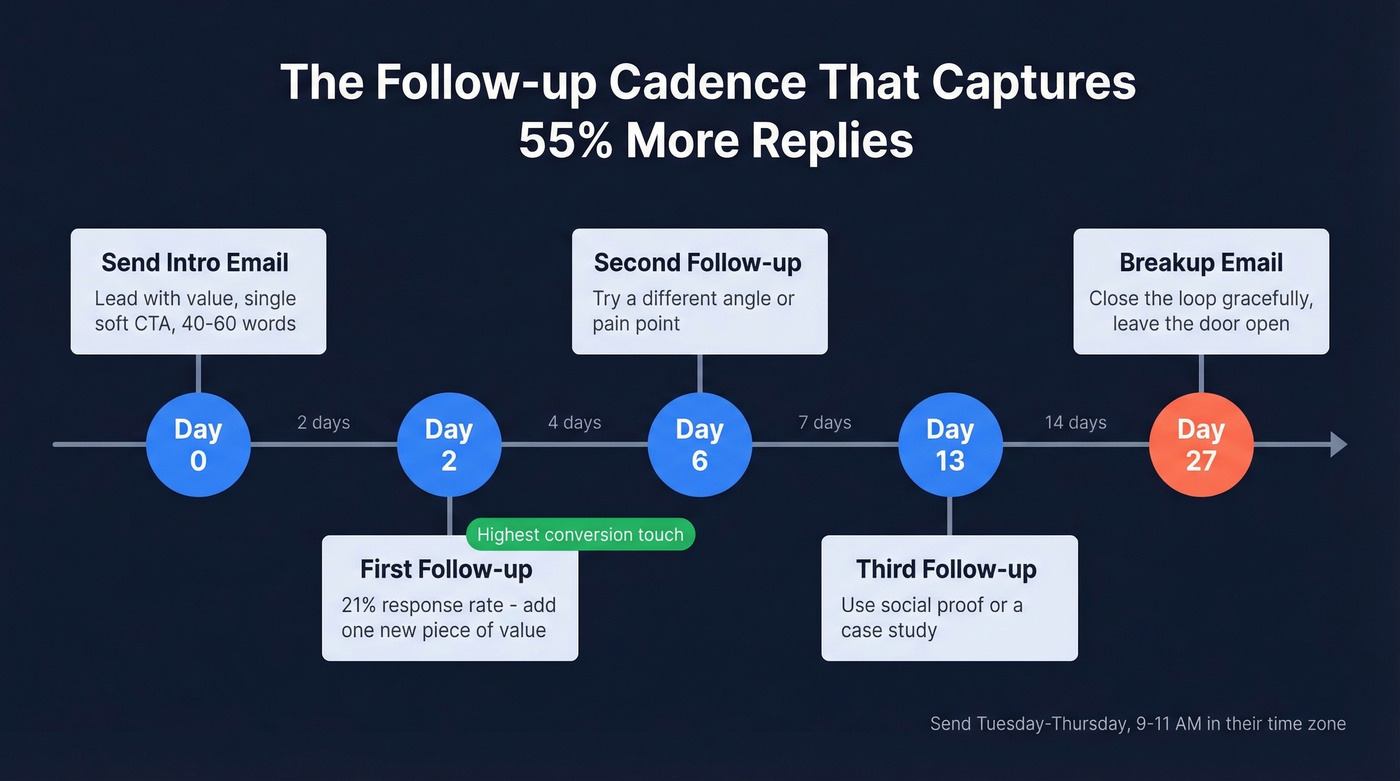
In our experience, the third touch is where most replies come from. Here's the cadence we recommend:
- Day 0 - Send the intro email
- Day 2 - First follow-up, short, add new value (first follow-ups achieve a 21% response rate)
- Day 6 - Second follow-up with a different angle
- Day 13 - Third follow-up using social proof or a case study
- Day 27 - Breakup email
Send Tuesday through Thursday, 9-11 AM in the recipient's local time. (If you’re building a system around this, use follow up email software.)
Follow-up template:
Hi [First Name], circling back on my note from [day]. [One new piece of value or insight]. Still open to a quick call?
Breakup template:
Hi [First Name], I've reached out a few times and don't want to be a pest. If [problem you solve] becomes a priority, I'm here. Closing the loop for now.
The graduated spacing avoids the robotic "every 3 days" pattern that gets you flagged. Each touch should add something new - a different angle, a relevant stat, a case study.
Mistakes That Kill Your Reply Rate
Writing a novel. Emails over 150 words tank engagement. On mobile, anything past a short paragraph feels like homework. Cut ruthlessly. And never attach files to a first email; they trigger spam filters. (If you’re troubleshooting, start with email bounce rate and email reputation tools.)
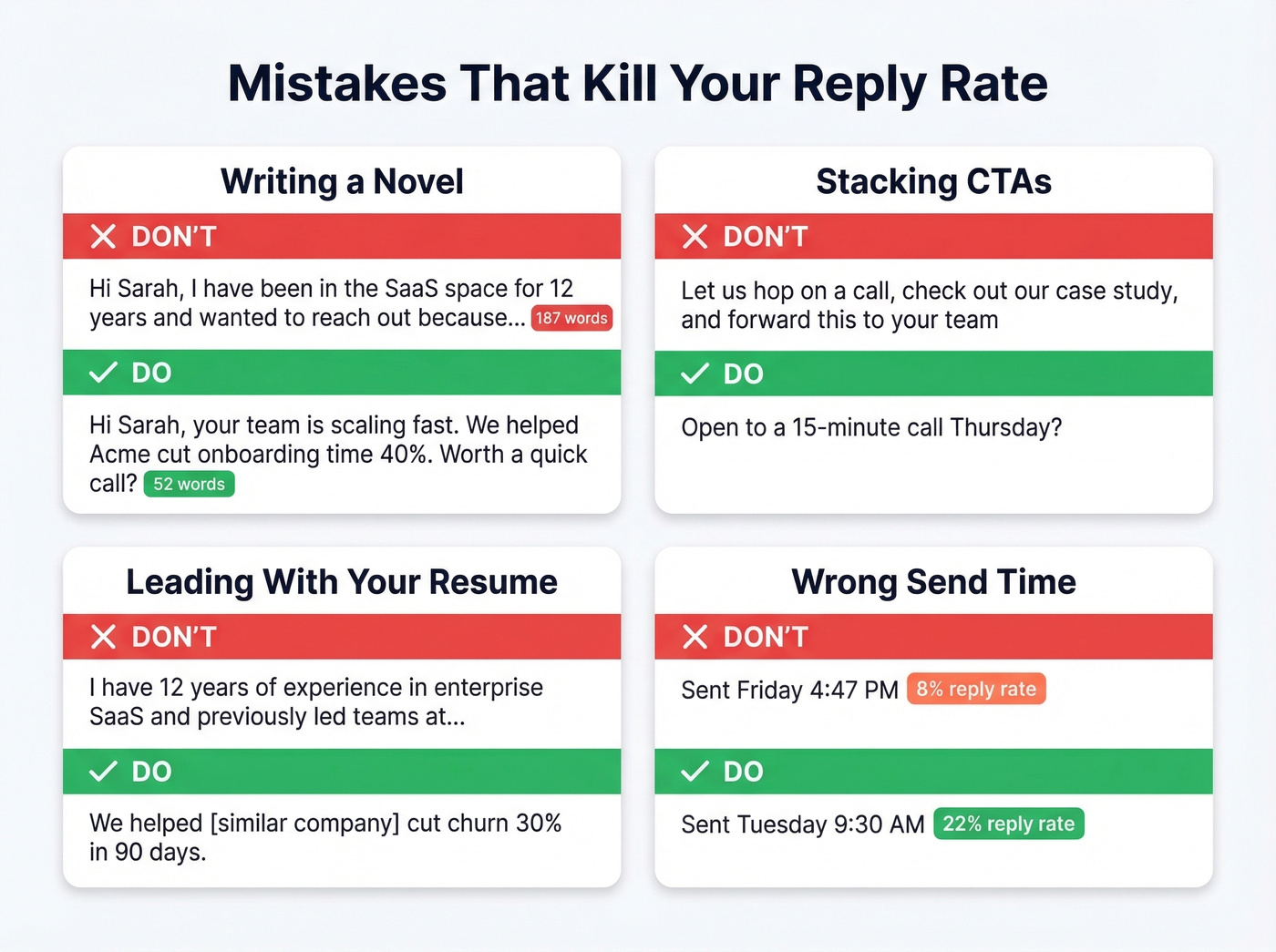
Stacking CTAs. "Let's hop on a call, also check out our case study, and feel free to forward this to your team." Pick one ask. One.
Leading with your resume. "I have 12 years of experience in enterprise SaaS and previously led teams at..." Nobody cares in the first email. Lead with what you'll do for them.
Sending at the wrong time. Friday at 4 PM is where intro emails go to die. Stick to Tuesday-Thursday, 9-11 AM in their time zone. We've seen the same template go from 8% to 22% reply rate just by shifting the send window.
Your follow-up cadence won't generate that 55% reply lift if half your list is outdated. Prospeo refreshes every record every 7 days - not the 6-week industry average - so your intro emails reach real inboxes at real companies. 143M+ verified emails, zero guesswork.
Send your intro to the right person at the right address, every time.
FAQ
How long should an introduction email to a client be?
40-60 words for cold outreach; account handoffs can stretch to 100 words. Anything over 150 kills engagement on mobile, where 60%+ of emails are read. Trim every sentence that doesn't serve the recipient directly.
Should I follow up if I don't get a response?
Always - 55% of replies come from follow-ups, not the first touch. Use a graduated cadence of 2, 4, 7, and 14 days between messages, sent Tuesday-Thursday at 9-11 AM in the recipient's time zone.
What's the best subject line for a self-introduction email?
"Hi [First Name]" hits a 45.36% open rate - the highest in 2026 benchmarks. Personalized lines are 26% more likely to be opened. Avoid clickbait; 69% of recipients flag spam based on the subject line alone.
How do I verify a client's email before sending?
Use a real-time verification tool like Prospeo's email finder, which checks deliverability with 98% accuracy across 143M+ verified addresses. The free tier covers 75 lookups per month - enough to validate a small outreach list before you hit send.
Should I include credentials in a first email?
No. Save credentials for the second or third touch. The first email earns a reply by showing you understand the client's problem, not by listing years of experience or past titles.