

SDR Performance: 2026 Benchmarks, Metrics, and the Playbook to Fix What's Broken
Your top rep has the fewest dials but the most pipeline. Your newest hire is logging 60 calls a day and hasn't booked a meeting in two weeks. SDR performance isn't about effort - and the answer isn't "work harder." Sellers spend roughly 25% of their time actually selling. The other 75%? Admin, bad data, and broken processes eating the rest.
Quick Navigation
If over half your team is missing quota, it's not a people problem - it's a system problem. Jump based on what you're solving:
- Need benchmarks? 2026 SDR Performance Benchmarks
- Team is busy but not producing pipeline? What Actually Kills SDR Productivity
- Need the fix? How to Improve SDR Performance
2026 SDR Performance Benchmarks
The Bridge Group's 2025 report surveyed 351 B2B companies (83% SaaS, $47M median revenue, $50K median ASP). It's the most concrete benchmark dataset we've found.
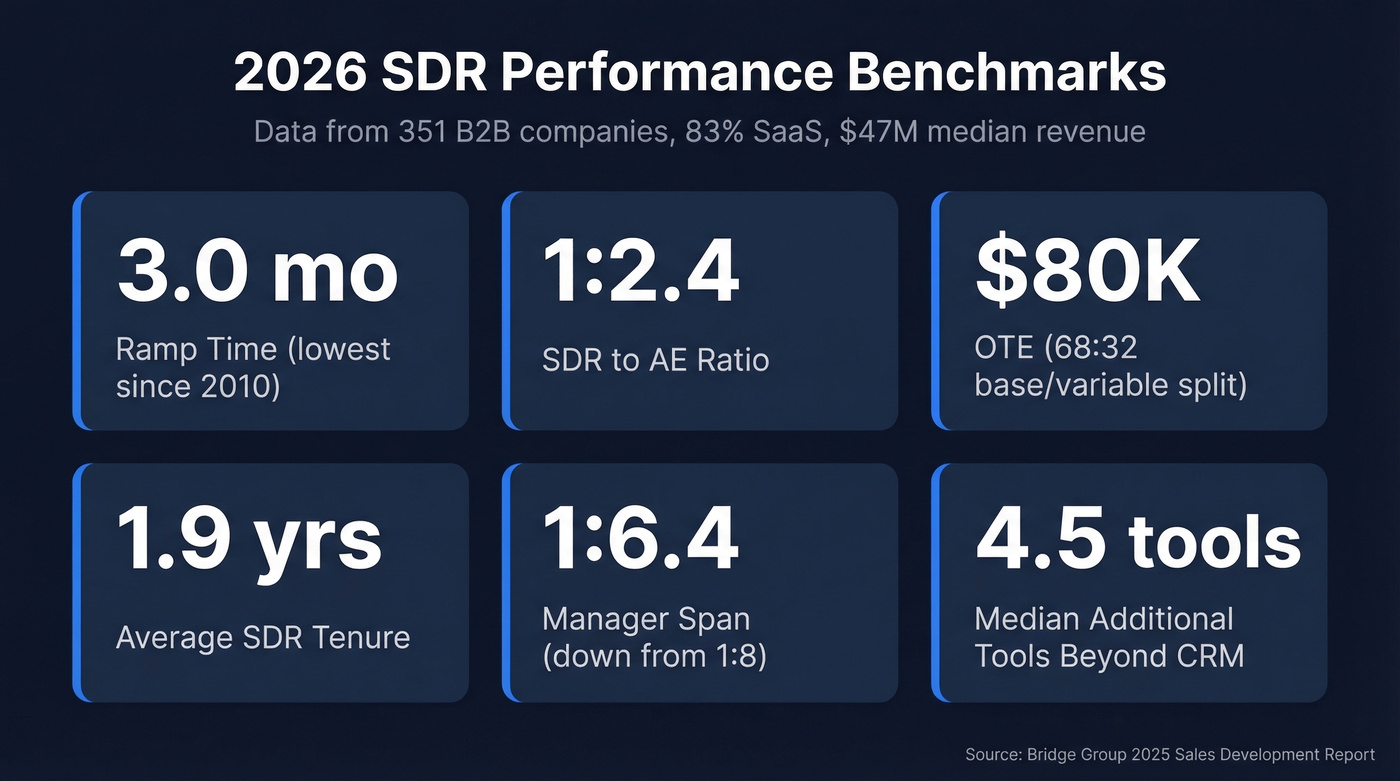
| Metric | Benchmark |
|---|---|
| SDR:AE ratio | 1:2.4 |
| Ramp time | 3.0 months |
| Average tenure | 1.9 years |
| Base salary | $55K |
| OTE | $80K (68:32 split) |
| Reports to Sales | 60% |
| Aligned to AE territories | 82% |
| Hiring experience | 1.2 years |
| Median manager span | 1:6.4 SDRs |
A few things stand out. Ramp time at 3.0 months is the lowest reading recorded since 2010. Median manager span has tightened from 1:8 in 2021-2023 down to 1:6.4 - teams are investing more in coaching and rep development. The SDR:AE ratio has held steady at 1:2.4 since 2018, which tells you the model itself hasn't fundamentally changed even as the tools have.
Activity Benchmarks
Daily activity numbers from the 351-company study: 44 dials, 41 emails, 4.1 quality conversations. SDRs average about 10.6 attempts per prospect before moving on, and the median tech stack is a CRM plus roughly 4.5 additional tools. The 9-12 attempt sweet spot is where most teams land when they're disciplined about cadence.
Output Benchmarks
Pipeline is what matters. The average SDR in SaaS produces $3M/year in pipeline. An Operatix study across 150 SDRs found 15 meetings booked per month on average. Factor in a 20% no-show rate and you're looking at about 12 attended meetings, with roughly 1 in 2 SALs advancing to a next step.
For inbound teams, the conversion math splits dramatically by intent level: 5-10% for low-intent leads like ebooks and webinars versus 75-80% for high-intent demo requests. Capacity planning typically runs around 15 leads/day per inbound SDR.
The Metrics That Actually Matter
Most guides give you 15 metrics. That's dashboard paralysis. With about 85% of SDRs running mostly outbound motions, track three things and track them well.
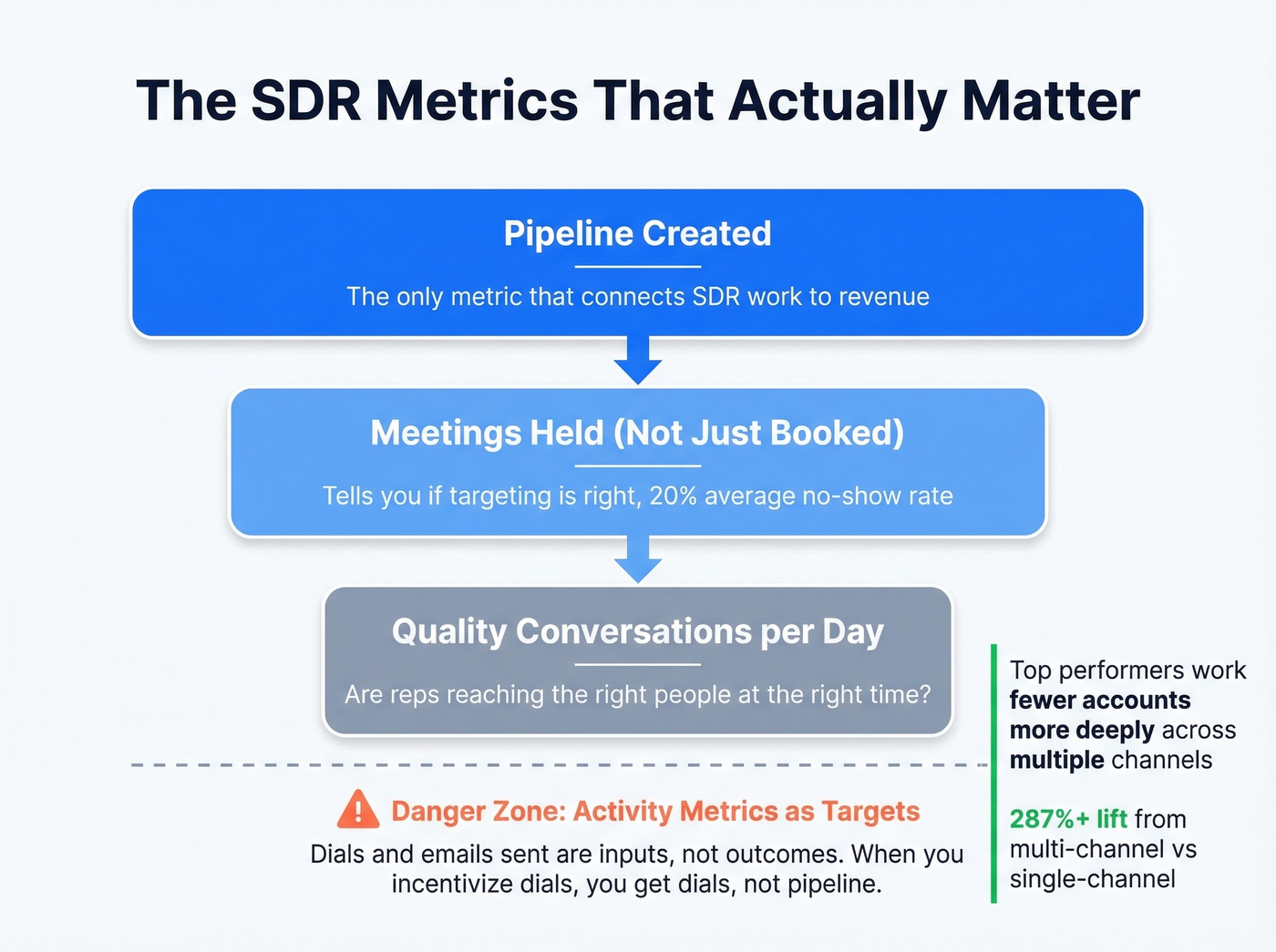
Pipeline created is the only metric that connects SDR work to revenue. Below that, meetings held - not just booked, but actually attended - tells you whether your targeting is right. And quality conversations per day reveals whether reps are reaching the right people at the right time.
Activity metrics like dials and emails sent are inputs, not outcomes. They're useful for diagnosing problems but dangerous as targets. When you incentivize dials, you get dials. You don't necessarily get pipeline.
Here's the thing: outbound-sourced opportunities average roughly 50% larger deal sizes than inbound, and teams running multi-channel motions across calls, email, and social see 287%+ lift versus single-channel. The reps who look "lazy" on activity dashboards but crush pipeline are usually the ones working fewer accounts more deeply across multiple channels. Studying what top performers do differently - fewer accounts, deeper research, multi-threaded outreach - is more instructive than staring at aggregate dial counts.
What Actually Kills SDR Productivity
Territory Quality Over Effort
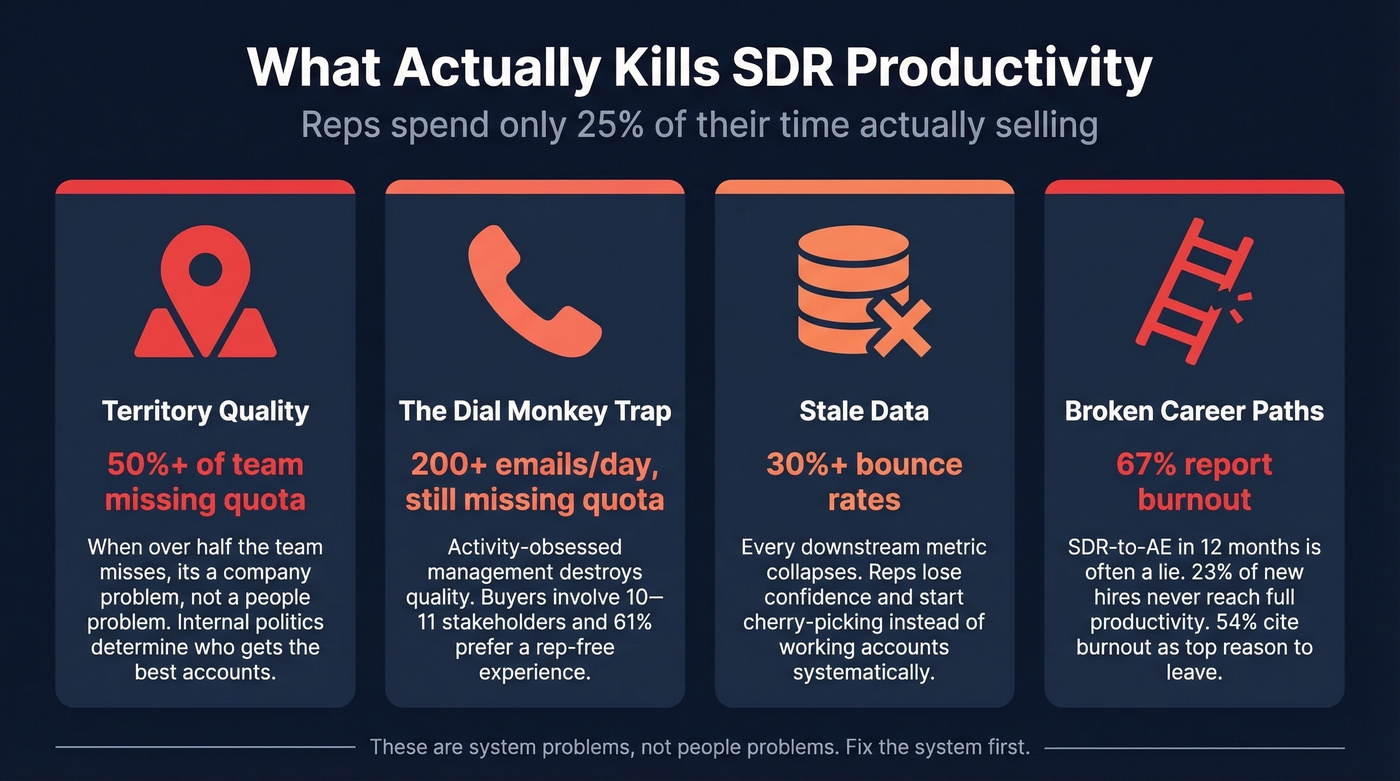
The consensus on r/techsales is blunt: results depend heavily on territory quality and timing, not just effort. If over half the team misses quota, it's a company problem. Internal politics can determine who gets the best accounts, and PIP threats after one bad month are a red flag - not a management strategy.
The "Dial Monkey" Trap
Activity-obsessed management destroys quality. A Chili Piper case study documented reps sending 200+ emails/day across 600-700 accounts without hitting quota consistently. That's not a motivation issue - it's an operational failure.
Let's be honest about the buyer side of this equation: deals now involve 10-11 stakeholders, and 61% of B2B buyers prefer a rep-free experience. Every outbound touch needs to deliver genuine insight - not another "just checking in" email. In mature markets, you need competitive context, a trigger event, or a real reason to call. "Dial monkey" behavior doesn't cut it when buyers are actively trying to avoid you.
Stale Data Is the Silent Killer
When 30%+ of your emails bounce, every downstream metric collapses. Connect rates tank. Sequences burn through domains. Reps lose confidence in their lists and start cherry-picking instead of working accounts systematically.
We've seen this pattern repeatedly: teams blame reps for low meeting numbers when the real problem is that a third of their contact data is dead on arrival. Snyk's team of 50 AEs saw bounce rates drop from 35-40% to under 5% after switching to verified data - and AE-sourced pipeline jumped 180%. GreyScout cut rep ramp time from 8-10 weeks to 4 weeks by giving new hires clean, verified lists from day one.

Compare Prospeo's 98% email accuracy and 7-day data refresh cycle to the industry average of 6 weeks between refreshes. Bad data is a hidden variable that most teams never diagnose because they're staring at activity dashboards instead of deliverability reports. (If you want the benchmarks and fixes, start with bounce rates and a proper email deliverability guide.)
Broken Career Paths
SDR-to-AE in 12 months is often a lie. Reddit's r/techsales puts it plainly: "SDR purgatory is real." When reps realize the promotion timeline is fiction, motivation craters.
Average tenure sits at 1.9 years (about 23 months), and the 14-18 month turnover cycle means most SDR teams are perpetually replacing and ramping reps. 23% of new sales hires never reach full productivity - they leave within 12 months. Meanwhile, 67% of sales reps report burnout, and 54% of SDRs cite it as a top reason they'd leave. That's not a coaching problem. That's a structural one.

Stale data is the silent killer of SDR performance. Snyk's 50 AEs dropped bounce rates from 35-40% to under 5% and grew AE-sourced pipeline 180% with Prospeo's 98% accurate emails, refreshed every 7 days - not the 6-week industry average.
Stop blaming reps for what bad data broke.
How to Improve SDR Performance
The Chili Piper team that was drowning in 200+ daily emails ended the year at 118% of their closed-won goal. The fix wasn't a new tool - it was a process redesign. Real improvement starts with systems, not motivational speeches.
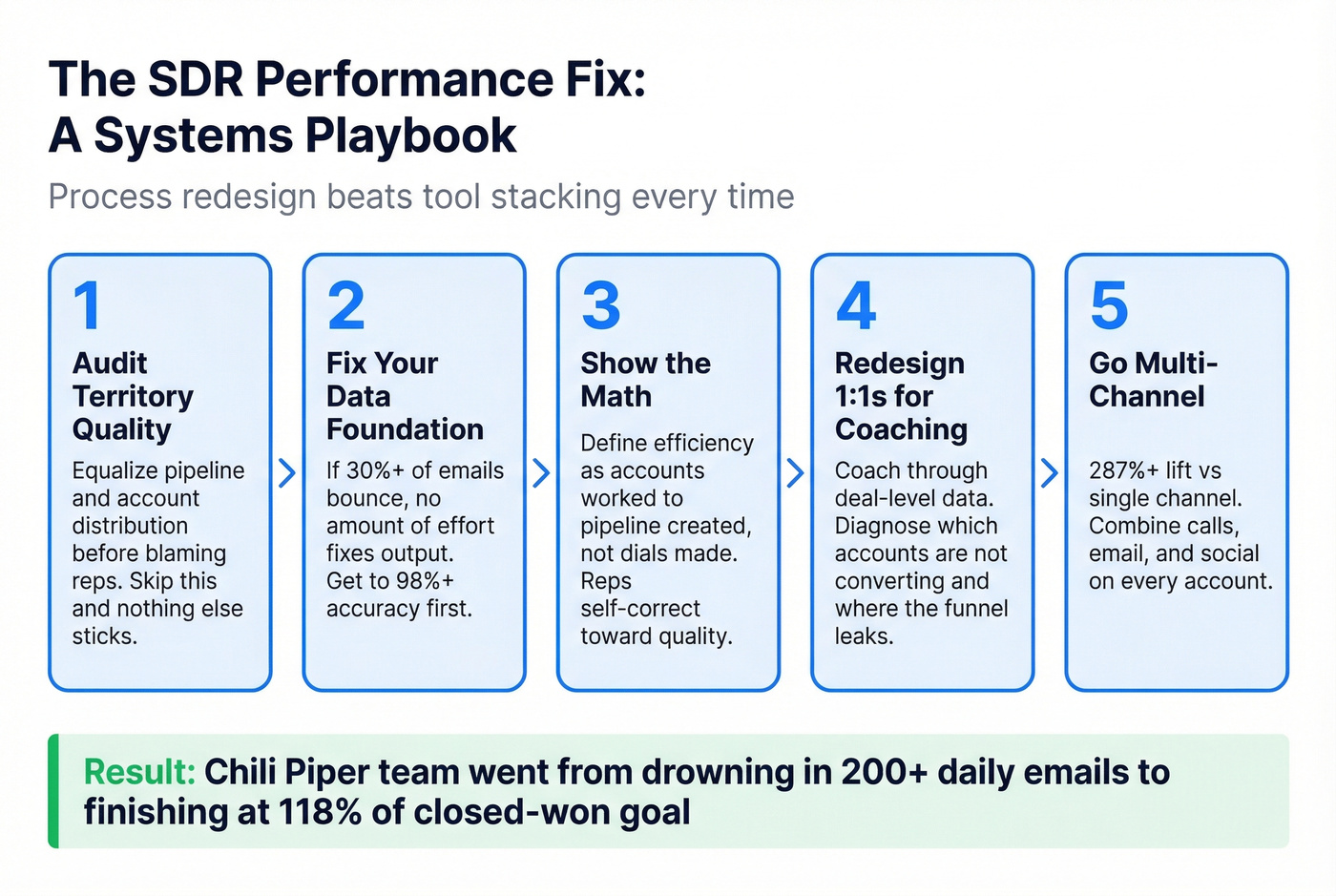
1. Audit territory quality first. Equalize pipeline and account distribution before blaming reps. New SDRs shouldn't inherit the worst territories while tenured reps sit on the best accounts. Skip this step and nothing else you do will stick.
3. Show the math. Define efficiency as accounts worked to pipeline created, not dials made. When reps see the conversion math, they self-correct toward quality.
4. Redesign 1:1s around coaching. Teach reps to diagnose a bad month early - which accounts aren't converting, which channels are dead, where the funnel is leaking - instead of just reporting activity numbers. Managers who use 1:1s to coach through deal-level data rather than interrogate activity logs see faster course corrections. (This is also where sales performance management systems help, if you implement them well.)
5. Go hybrid channel. Single-channel outbound is dead. The 287%+ lift from multi-channel isn't a nice-to-have; it's the difference between quota and PIP. Combine calls, email, and social touches on every account. If you need a starting point, use proven sales prospecting techniques and tighten your sequence management.
Process redesign beats tool stacking. Bain found that applying AI or any new tool to existing broken processes yields only "micro-productivity" gains. Meaningful improvement requires rethinking the workflow itself.
The Tech Stack That Moves Numbers
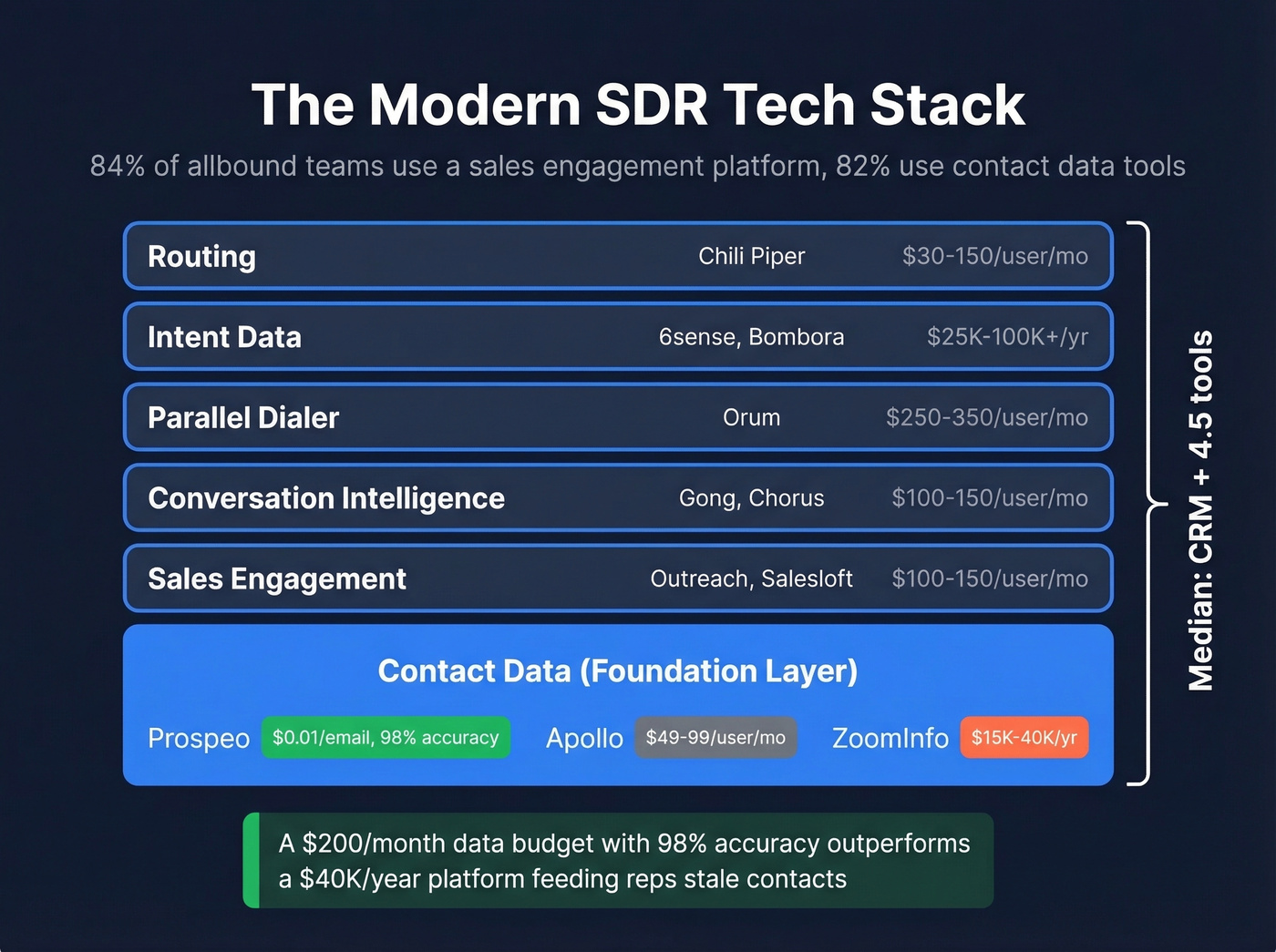
McKinsey research shows B2B companies adopting advanced sales tech grow revenue 2-3x faster than those that don't. The 351-company study shows 84% of allbound teams use a sales engagement platform and 82% use contact data tools. Here's what a modern stack looks like:
| Category | Tools | Typical Cost |
|---|---|---|
| Contact data | Prospeo, Apollo, ZoomInfo | $0-$40K/yr |
| Sales engagement | Outreach, Salesloft | $100-150/user/mo |
| Conversation intel | Gong, Chorus | $100-150/user/mo |
| Parallel dialer | Orum | $250-350/user/mo |
| Intent data | 6sense, Bombora | ~$25K-100K+/yr |
| Routing | Chili Piper | $30-150/user/mo |
At the foundation layer, the cost gap is enormous. Apollo starts around $49-99/user/mo for paid plans. ZoomInfo runs $15K-40K/year depending on seats and modules. Prospeo sits at roughly $0.01/email with a free tier - and in our testing, the accuracy gap favors it over both.
Most SDR teams don't have a tool problem. They have a data-quality-and-process problem wearing a tool-shaped disguise. A $200/month data budget with 98% accuracy will outperform a $40K/year platform feeding reps stale contacts every time. If you're evaluating vendors, start with B2B company data providers and data enrichment services.
GreyScout cut SDR ramp time from 8-10 weeks to 4 by giving new hires clean, verified lists from day one. With 300M+ profiles, 30+ search filters, and $0.01/email, Prospeo turns territory quality from a political problem into a solved one.
Ramp faster. Book more meetings. Start with better data.
AI and Sales Development
The AI SDR market is projected to grow from $4.1B to $15B+ by 2030. Gartner predicts AI agents will outnumber human sellers 10:1 by 2028 - but fewer than 40% of sellers will say those agents actually improved their productivity.
That gap between investment and impact is the real story. Bain's research shows 30%+ win-rate improvement is possible when AI is paired with process redesign. But bolting AI onto broken workflows - bad data, wrong territories, activity-obsessed management - just automates the dysfunction faster. If you're experimenting here, pair it with generative AI sales tools and a clear data-driven selling approach.
The Cost of Getting It Wrong
Every SDR departure costs $115,000-$195,000 when you add up replacement costs, lost pipeline during vacancy, ramp productivity loss, and institutional knowledge drain. With average tenure at 1.9 years, most teams are perpetually ramping.
That's not a recruiting problem - it's a system design problem. Fixing SDR performance at the structural level is cheaper than replacing reps every 18 months. (If you want to quantify the downstream impact, track pipeline health and common sales pipeline challenges.)
FAQ
How many meetings should an SDR book per month?
15 per month is the average across 150 SDRs in the Operatix study. After a 20% no-show rate, expect about 12 attended. Top performers consistently hit 18-20 booked, but the number that matters is meetings held that advance to a next step.
What's a good SDR ramp time?
3.0 months is the current average across 351 B2B companies - the lowest reading since 2010. Teams with clean data and equalized territories ramp faster. GreyScout cut ramp from 8-10 weeks to 4 weeks by giving new hires verified contact lists on day one.
How many dials should an SDR make per day?
44 dials/day is the current average. But dials alone don't predict outcomes - pipeline created per rep is the metric that matters. A rep making 30 targeted dials with research behind each one will outperform a rep making 80 cold dials every time.
What's the average SDR salary in 2026?
$55K base, $80K OTE, with a 68:32 base-to-variable split across 351 companies surveyed. Compensation varies significantly by market and segment - enterprise SDRs in major metros can see $65K+ base.
Why do SDR teams underperform?
Usually a system problem, not a people problem. The top culprits: bad territory distribution, stale contact data driving 30%+ bounce rates, activity-obsessed management that rewards volume over quality, and broken career paths that kill motivation before reps hit their stride.