

How to Sell the Solution, Not the Product (and Actually Mean It)
Your rep opens the demo with a 12-minute feature walkthrough. Slide after slide - integrations, dashboards, AI-powered this, real-time that. The prospect goes quiet. Two days later, the deal stalls. A competitor who asked better questions wins the business without ever showing a product screen.
This pattern kills more pipeline than bad leads do. It's the core reason the mantra "sell the solution, not the product" exists. In a HubSpot survey of 1,000 sales pros, the #1 deal-killer was "no product fit" at 37% - which really means the rep never connected the product to the buyer's actual problem.
Solution selling isn't a mindset. It's a process. It starts with research, lives in discovery, and dies the moment reps revert to feature-dumping under pressure. What follows is the 5-step framework, the discovery benchmarks, the scripts, and the operational foundation to do it for real - not as a buzzword, but as a system.
What Solution Selling Actually Means
Frank Watts coined "solution selling" in the 1970s, and Michael Bosworth systematized it into a repeatable methodology in 1983. The core idea hasn't changed: diagnose the prospect's pain first, then position your product as the tailored answer. Features still matter, but they're evidence, not the opening argument. You're selling results, not products - translating capabilities into measurable business impact.
Here's the thing: 87% of business buyers expect sales reps to act as trusted advisors, not product demonstrators. The rep who shows up ready to pitch gets tuned out. The rep who shows up ready to listen gets a second meeting.
As one founder put it on r/Entrepreneur: "If you can't summarize the problem you solve in one sentence, you have a problem."
There's a legitimate backlash against the word "solutions," too. A thread on r/manufacturing nailed it - slapping "solutions" on your services page doesn't make you a solution seller. It makes you a marketer who read a blog post. Real solution selling is structural. It changes how you research, how you ask questions, and how you present. If you're just renaming your product page, skip this article and go fix your positioning first.
Why Selling an Experience Matters More in 2026
Buyers don't need your rep to explain what your product does. 57-70% of their research happens before they ever contact sales. By the time they're on a call, they've read your docs, watched your competitor's demo, and formed an opinion. The rep who recites features is redundant. The rep who reframes the problem is valuable.
73% of B2B buyers actively avoid sellers who send irrelevant outreach. 57% of sales professionals say cycles are getting longer. And 35% of teams are actively shifting toward solution-based selling, per HubSpot's latest report.
Now, a contrarian take worth internalizing: don't sell the solution first either. Sell the problem. Gong's research found that stating the reason for your call at the start increases cold call success by 2.1x. Lead with the specific problem your uniqueness solves, make the prospect feel it, then introduce your differentiator. Problem, then solution, then product. That's the sequence.
Solution Selling vs. Product Selling
Let's break down the actual differences, because they're more nuanced than "one is good and one is bad."
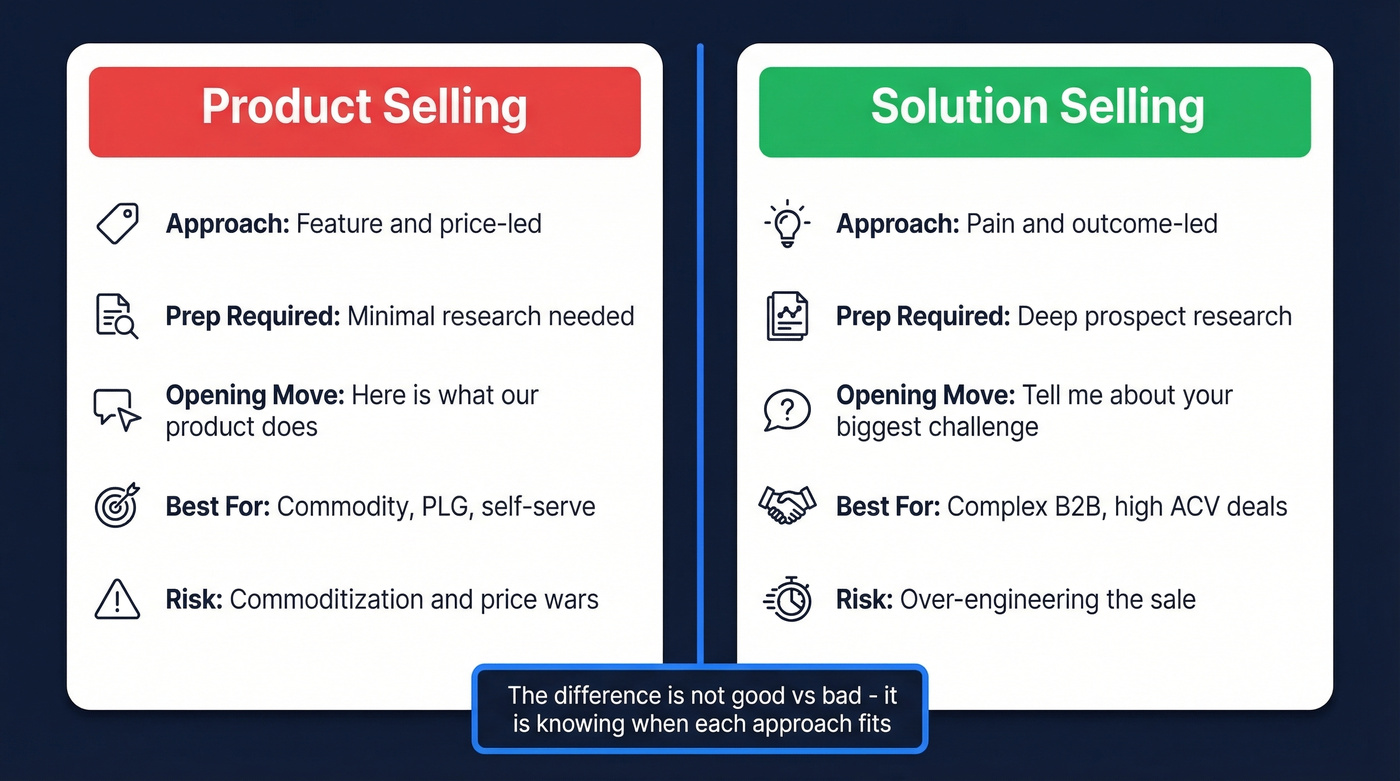
| Dimension | Product Selling | Solution Selling |
|---|---|---|
| Approach | Feature/price-led | Pain/outcome-led |
| Prep required | Minimal | Significant |
| Cycle length | Shorter | Longer |
| Best for | Commodity, PLG, self-serve | Complex B2B, high ACV |
| Risk | Commoditization | Over-engineering the sale |
The scripts make the difference concrete:
Product-led: "Our platform has three modules - analytics, automation, and reporting. Plans start at $49/seat. Want me to walk you through the dashboard?"
Solution-led: "How much time does your team spend on manual data entry each week? What's the downstream impact when that data's wrong? Let me show you how other teams in your space have cut that by 60%."
A practitioner-tested cold email format from r/SaaS follows the same logic: who you are, how you help, why they should believe you, what's next. Four sentences, zero feature-dumping. The solution-led pitch ties automation to outcomes - if your reps save a prospect 30 seconds per call, that's 75 more calls per day across a team, and you can translate that directly into revenue impact. That's the conversation buyers remember.
Product selling isn't always wrong, though. If you're selling a $29/mo self-serve tool, a PLG motion with clear feature differentiation will outperform a 45-minute discovery call. Solution selling earns its keep in software, industrial equipment, IT consulting, healthcare tech, and regulated industries like pharma and finance - anywhere the buyer needs help understanding their own problem.

Solution selling starts with research - and research starts with data you can trust. Prospeo gives you buyer intent signals across 15,000 topics, verified emails at 98% accuracy, and 30+ filters to find prospects by tech stack, funding, and headcount growth. Walk into every discovery call knowing the problem before you ask.
Diagnose the pain before the call. Prospeo makes it possible for $0.01 per lead.
The 5-Step Solution Selling Process
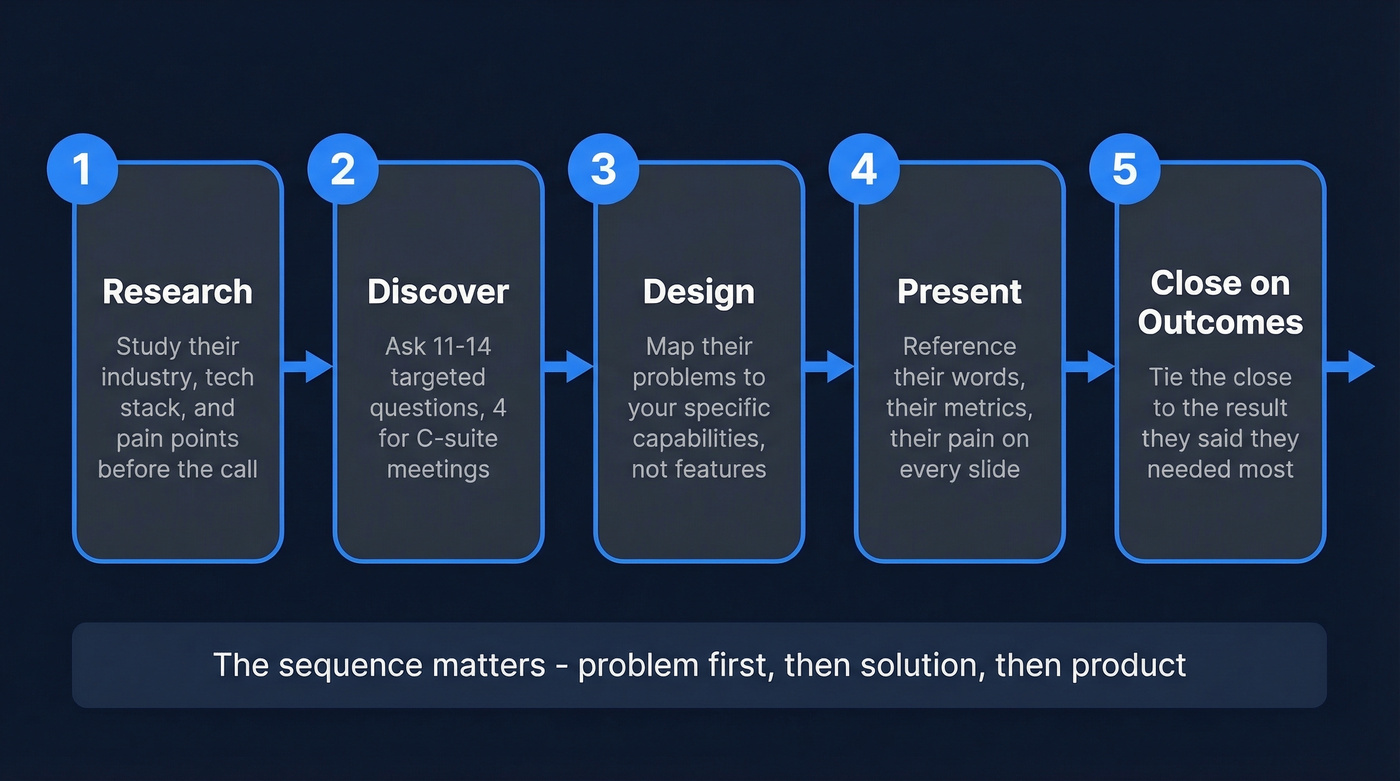
The cleanest framework we've seen comes from DealHub's breakdown: Needs discovery, solution design, presentation, customization, close. Let's make each step operational.
Research Your Prospect
Discovery starts before the call. You need to understand the prospect's industry, their likely pain points, their tech stack, and who else is involved in the decision. We've watched reps walk into calls cold and try to "wing" discovery - it never works. The questions sound generic, the prospect disengages, and the deal dies in the first five minutes.
Tools like Prospeo let you pull verified emails, mobile numbers, and buyer intent signals across 15,000 topics, so you spend prep time on strategy instead of data hunting. (If you're rebuilding your outbound data layer, start with a sales prospecting database and a solid data enrichment workflow.)
Run Discovery Right
The sweet spot for discovery questions is 11-14. Fewer and you're guessing. More and you're interrogating. For C-suite meetings, dial it back to about 4 - Gong's data shows unsuccessful executive meetings average 8 questions, which means the rep was fishing instead of being precise.
Strong discovery questions to build from:
- What's your biggest priority this quarter?
- What obstacles are in the way?
- What have you already tried?
- What happens if you don't fix this?
- What does success look like?
If you want a deeper bank of prompts and structure, use a dedicated set of discovery questions and keep a discovery call script handy for new reps.
Design the Solution
Take what you learned in discovery and map it to specific capabilities. Not features - capabilities that solve the problems they just told you about. This is where most reps fall apart. They default to the standard demo instead of building a custom narrative. Learning how to sell concepts, not products, is the skill that separates order-takers from trusted advisors.
Customize and Present
Your presentation should feel like a response to their conversation, not a canned deck. Reference their words. Use their metrics. Show them their problem on screen and walk through how it disappears.
Every slide that doesn't connect to something they said in discovery is a slide that loses attention. (If your team is still feature-walking, tighten up your product demo checklist and your sales deck storytelling.)
Close on Outcomes
Don't close on features or pricing. Close on the outcome they told you they needed. "You said reducing onboarding time from 8 weeks to 4 was the priority - here's how we get there, and here's what the first 30 days look like." That's a close that sticks.
Translating Features Into Outcomes
Most reps stop at features. Good reps get to benefits. Great reps land on outcomes. The "So what?" ladder is the simplest framework for making this translation: state the feature, then keep asking "so what?" until you reach a business result the buyer cares about.
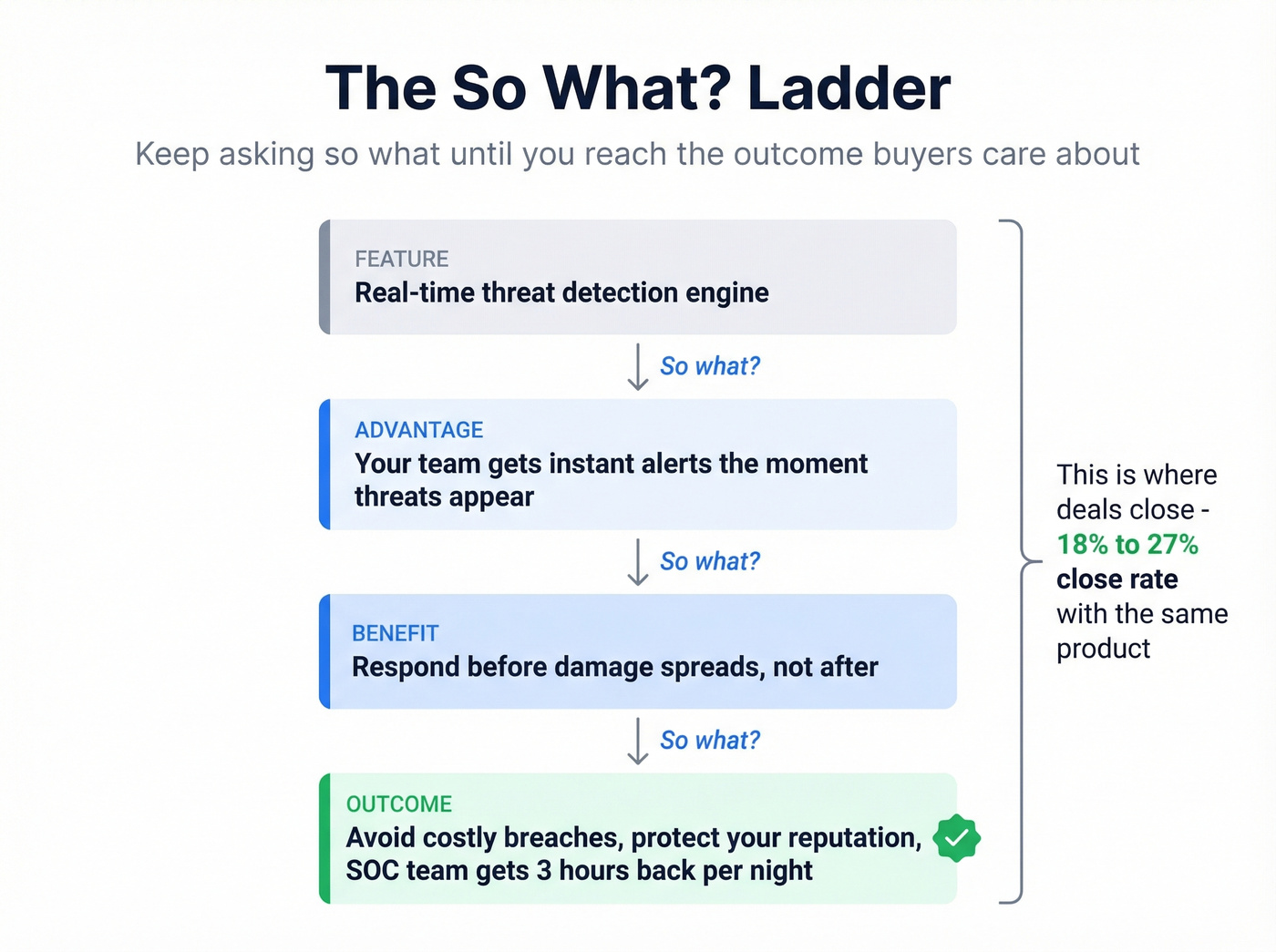
Here's a worked example: "Real-time threat detection engine" becomes instant alerts when threats appear, which means your team responds before damage spreads, which means you avoid costly breaches and protect your reputation. The feature is technical. The outcome is financial and emotional.
| Feature | Benefit | Outcome |
|---|---|---|
| Automated data sync | No manual entry | 15 hrs/week back for selling |
| Real-time alerts | Faster response | Breaches caught before damage |
| Custom reporting | See what matters | Board-ready metrics in minutes |
A cybersecurity vendor we know stopped leading with "AI-powered threat detection" and started leading with "your SOC team gets 3 hours back per night." Close rate went from 18% to 27%. Same product. Different conversation.
According to a Demand Gen Report, 77% of B2B buyers want more data and research in the content they consume. Outcomes backed by numbers - "reduce audit prep by 80%," "cut onboarding from 8 weeks to 4" - are what close deals. Vague benefits like "save time" don't move anyone.
Why Solution Selling Fails (and How to Fix It)
It fails more often than the methodology books admit. In our experience, the reps who struggle most aren't lazy - they're under-researched and under-supported. Making solutions attractive to buyers requires organizational commitment, not just individual effort.
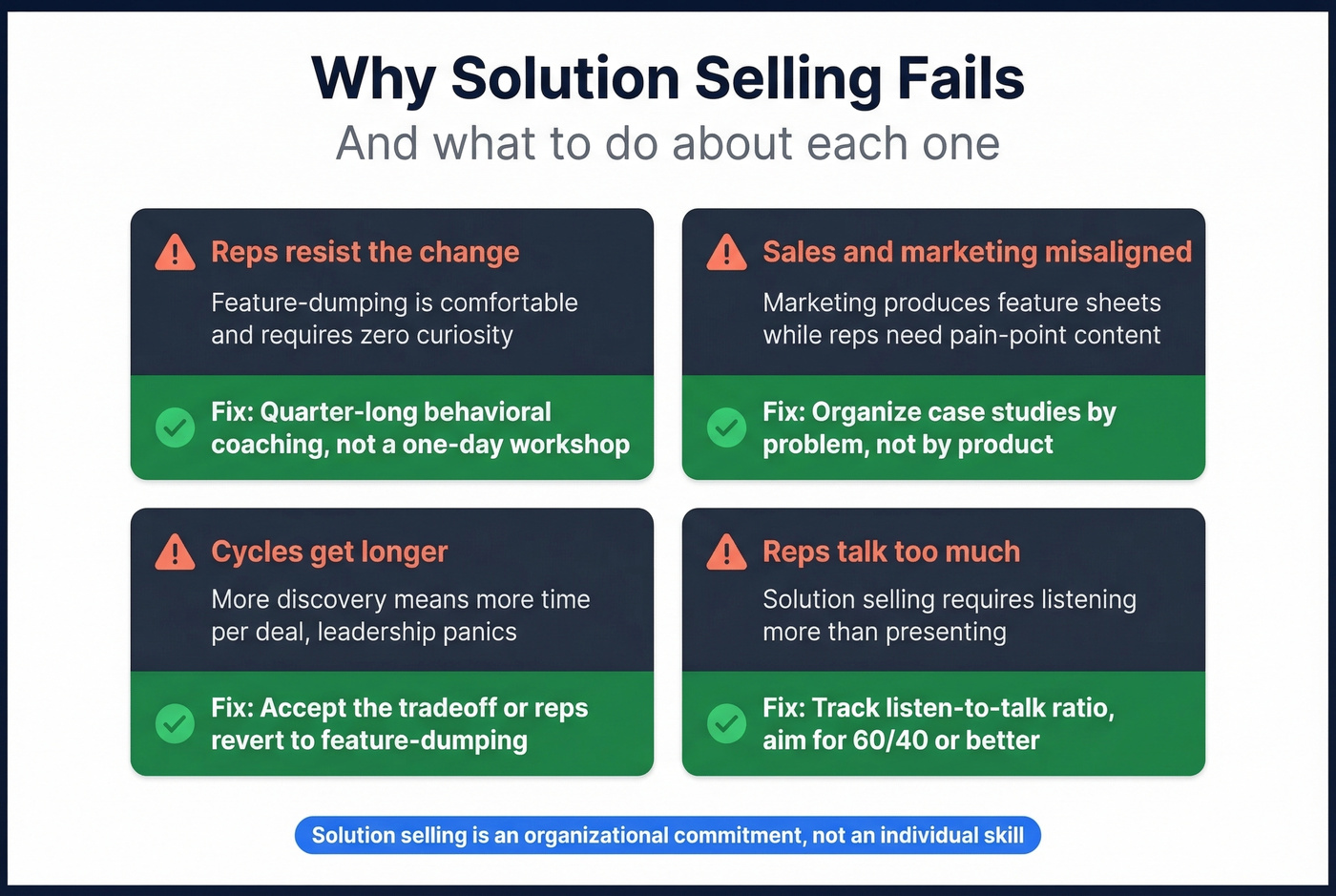
Reps resist the change. Product-centric selling is comfortable. You memorize features, run the demo, quote a price. Solution selling requires genuine curiosity and deeper product knowledge. Not every rep wants to do that work.
The transition is genuinely complex. You're retraining active listening, consultative questioning, and customization skills. That's not a one-day workshop - it's a quarter-long behavioral shift.
Sales and marketing aren't aligned. Solution selling needs pain-point content, case studies organized by problem instead of product, and enablement materials that map features to outcomes. If marketing is still producing feature sheets, your reps are fighting with the wrong ammunition. (This is where marketing enablement and better sales enablement systems pay off.)
Cycles get longer. More discovery and customization means more time per deal. Leadership needs to accept this tradeoff or they'll pressure reps back into feature-dumping to hit monthly numbers.
Reps talk too much. Research on common sales mistakes highlights the listen-to-talk ratio problem. Solution selling requires listening more than talking. Reps who treat discovery as a checklist instead of a conversation lose trust fast. Buyers know the difference - if your discovery questions are clearly scripted and you pivot to the same demo regardless of answers, you're product selling in a solution-selling costume.
How It Compares to Other Methodologies
Solution selling isn't the only game in town.
| Methodology | Research Base | Core Approach | Best For |
|---|---|---|---|
| Solution Selling | Bosworth (1983) | Diagnose pain, build vision, map | Complex B2B, consultative |
| Challenger | 6,000 reps (CEB) | Teach, tailor, take control | Disrupting status quo |
| SPIN | 35,000 calls (12 yrs) | Situation, Problem, Implication, Need-payoff | Large enterprise deals |
| MEDDIC | PTC origins | Metrics, economic buyer, decision criteria, process, pain, champion | Qualification-heavy orgs |
| Sandler | Sandler Training | Relationship + qualification | Relationship-driven sales |
| ValueSelling | ValueSelling Assoc. | Differentiators + benefits | Competitive displacement |
The Challenger approach deserves special attention. Xerox reported a 17% increase in sales and $65M in contract value after implementing Challenger. It works - but it requires reps who can teach buyers something new about their own business. That's a higher bar than solution selling's "ask good questions" foundation.
Look, here's my honest take: if your average deal size is under five figures, you probably don't need a formal solution-selling methodology at all. A tight PLG motion with smart follow-up will outperform a heavyweight discovery process. Solution selling is for deals where the buyer genuinely doesn't understand the full scope of their problem. If they already know what they need, get out of the way and let them buy.
For teams adopting a methodology for the first time, start here. Solution selling builds the foundational muscle - research, discovery, outcome-mapping - that every other methodology assumes you already have. SPIN and Challenger are upgrades you layer on once the basics are solid.
The Operational Foundation
Sales reps spend 60% of their time on non-selling tasks. If your reps are burning hours hunting for contact data, cleaning lists, and guessing at email addresses, they don't have time for the deep research that solution selling demands. The methodology collapses before it starts.
We've seen teams cut discovery prep from 30 minutes to 5 by automating the data layer. Prospeo's database covers 300M+ professional profiles with 98% email accuracy, 125M+ verified mobile numbers, and intent data tracking 15,000 topics via Bombora - all on a 7-day refresh cycle. Self-serve, no contracts, free tier available. You don't need a $40k data platform to sell the solution, not the product.

A mid-market SaaS team we worked with was spending 25 minutes per prospect on manual research. After automating their data layer, reps redirected that time into writing custom discovery agendas. Within a quarter, their win rate on deals past discovery jumped from 31% to 44%. The methodology didn't change. The time to execute it did.
The operational stack matters as much as the methodology. Get the data layer right, and your reps actually have time to prepare, ask better questions, and sell the way buyers want to be sold to. (If you're building this as a system, start with sales process optimization and track pipeline health so the behavior sticks.)
The best solution sellers never wing discovery. They show up with verified direct dials, intent data, and technographic signals that make every question precise. Prospeo's 7-day data refresh means your prep reflects reality - not a 6-week-old snapshot your competitor is still using.
Sell outcomes, not features. Start with data that's refreshed every 7 days.
FAQ
What's the difference between solution selling and consultative selling?
Solution selling follows a structured five-step process - research, discovery, design, present, close - while consultative selling is a broader philosophy of acting as an advisor. In practice, most high-performing teams blend both: the structure of solution selling with the relationship depth of consultative selling.
When should you lead with the product instead?
Lead with the product when it's self-serve, under $50/mo, or commodity-priced. PLG motions where the buyer already knows what they need don't benefit from a 45-minute discovery call. If your differentiation is price or simplicity, a clear feature comparison closes faster than a consultative conversation.
How many discovery questions should you ask?
The sweet spot is 11-14 for most calls, based on Gong's analysis of thousands of recorded conversations. For C-suite meetings, keep it to about 4 - unsuccessful executive meetings average 8 questions. Quality and precision beat volume every time.
What tools help with pre-call research?
You need verified contact data, company context, and buyer intent signals. Prospeo covers all three with 300M+ profiles, 30+ search filters, and Bombora-powered intent data - free tier included. Pair it with your CRM and a sequencing tool, and pre-call research takes minutes instead of hours, giving reps time to focus on selling an experience instead of reciting specs.