

How to Sell High Ticket Services: Benchmarks, Scripts, and the Playbook Nobody Shares
You just finished a discovery call. The prospect said "let me think about it" and ghosted. You don't have a script for this, no follow-up system, and no idea if your close rate is normal or terrible.
If you're selling high ticket services, every guide you've read tells you to "build trust" and "establish expertise" without giving you a single number, a single script, or a single funnel blueprint you can actually use. That ends here.
Why Premium Services Beat Volume Every Time
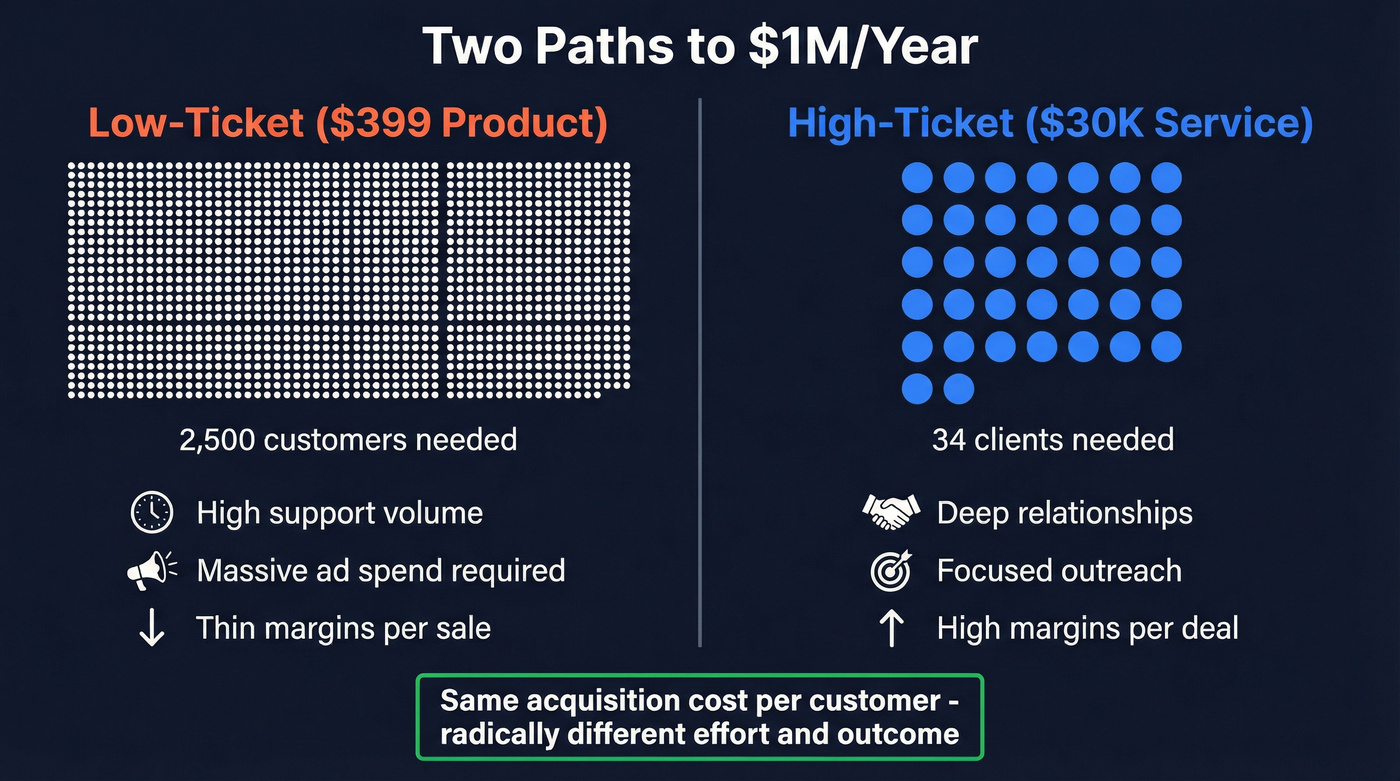
To hit $1M/year selling a $399 product, you need roughly 2,500 customers. To hit the same number selling a $30K service, you need 34 clients. The cost to acquire each customer is roughly the same - the outreach, the ads, the sales time. That's why the conventional "start low, build a value ladder" advice is backwards for service businesses. Sell high-ticket first.
| Dimension | Low-Ticket | High-Ticket |
|---|---|---|
| Decision type | Impulse | Trust-based |
| Sales process | Automated | Conversation-driven |
| Timeline | Instant to hours | Days to months |
| Outcome | Transactional | Transformational |
| Volume needed | High | Low |
The difference isn't just price - it's the entire relationship. Low-ticket buyers compare features. High-ticket buyers evaluate whether you understand their problem deeply enough to solve it. That's a different sales motion entirely.
In one popular Reddit thread from an auto glass operator, the question wasn't "how do I close high-ticket?" - it was "how do I move from a lower-ticket local service to something with a $1K+ average sale?" That shift is almost always the same move: reframe around stakes, not deliverables. An auto glass operator charging $300 per windshield is selling a commodity. The same operator offering a fleet uptime and maintenance contract is selling peace of mind. Same skills, different frame, radically different revenue.
The High-Ticket Sales Process
Define Your Lighthouse Client
Stop trying to serve everyone. Your lighthouse client is the person with a $100K problem who'll gladly pay $20K for the solution. Define them precisely: industry, company size, decision-maker role, budget range, and the specific pain that keeps them up at night. High-ticket pricing isn't about what your service costs to deliver - it's about the stakes.
If you need a fast way to document this, start with an ideal customer profile and score it.
Research Before the Call
74% of customers feel frustrated when communication isn't personalized. In high-ticket sales, that frustration kills deals before they start. Bad contact data is even worse - you spend 45 minutes preparing for a discovery call only to realize you've been emailing the wrong person or a dead address.
Before you invest time in a call, verify you've got the decision-maker's direct email and phone number. We use Prospeo for this - 300M+ professional profiles with 98% email accuracy and 125M+ verified mobile numbers, all refreshed on a 7-day cycle. Upload a list or search by filters, get verified contacts, and know you're reaching the actual buyer before you block out your calendar. (If you're comparing vendors, start with data enrichment services.)
Run Discovery with SPIN
Rigid scripts kill premium deals. SPIN Selling remains the gold standard for high-ticket discovery because it turns a pitch into a conversation. Situation questions establish the current state ("Walk me through how you're handling X today"). Problem questions surface pain ("What's the biggest bottleneck in that process?"). Implication questions raise the stakes ("What does it cost you when that bottleneck delays a launch by two weeks?"). Need-Payoff questions let the prospect sell themselves ("If we could cut that timeline in half, what would that mean for Q3?").
Teams using personalized, flexible scripts see 20-30% higher conversion rates than those reading from a rigid playbook. If you want more prompts, pull from a bank of discovery questions.
Qualify or Disqualify Fast
Here's the thing: disqualification matters as much as qualification. If a prospect doesn't have the budget, authority, timeline, or genuine need, the kindest thing you can do - for both of you - is end the conversation early. Watch for timing triggers like a new funding round, a key hire, or a product launch that signal a prospect is ready to invest. Buying cycles are longer than the easy-money years; prospects research more and decide slower. That makes your qualification process even more critical.
Skip this step and you'll burn weeks chasing deals that were never going to close. (If you sell complex deals, you may prefer MEDDIC sales qualification over BANT.)
Follow Up Like It's Your Job
Most high-ticket deals close after five or more touchpoints. Those touchpoints don't happen by accident.
For B2B deals with multiple stakeholders, build a mutual action plan - a shared document outlining every step from discovery to signed contract, with owners and deadlines for both sides. You're equipping your champion to sell internally by giving them the exact assets, timelines, and talking points they need to get sign-off from their CFO or board.
If you want plug-and-play sequences, use these sales follow-up templates and adapt them to your voice.
Close Rate Benchmarks by Deal Size
Most people selling premium services have no idea whether their close rate is good or terrible. These benchmarks, pulled from an industry report covering 25 verticals, give you a baseline.
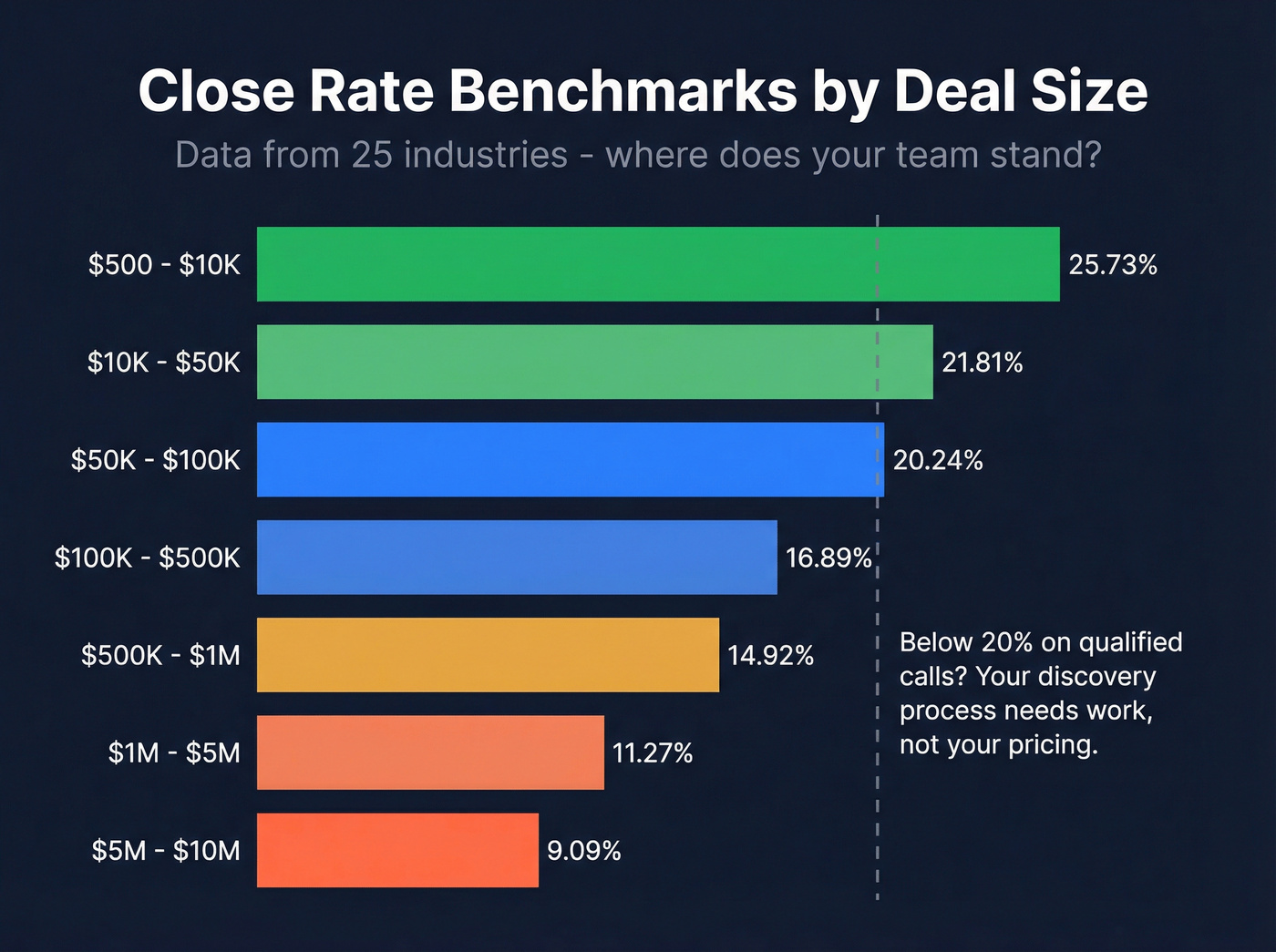
Close Rates by Deal Size
| Deal Size | Close Rate |
|---|---|
| $500-$10K | 25.73% |
| $10K-$50K | 21.81% |
| $50K-$100K | 20.24% |
| $100K-$500K | 16.89% |
| $500K-$1M | 14.92% |
| $1M-$5M | 11.27% |
| $5M-$10M | 9.09% |
Close Rates by Acquisition Channel
| Channel | Close Rate |
|---|---|
| Referrals | 25.56% |
| Email marketing | 22.83% |
| SEO | 21.22% |
| PPC | 15.73% |
| Events/trade shows | 13.59% |
| Social | 11.56% |
| Cold calling | 9.38% |
If you're closing less than 20% of qualified calls on $10K-$50K services, your discovery process is broken - not your pricing. Look at the channel data: referrals close at 25.56%, cold calling at 9.38%. Your referral engine deserves as much investment as your cold email sequences. In our experience, teams that track these benchmarks monthly improve close rates fast because they stop guessing and start diagnosing. (For more baselines, see sales conversion rate and average B2B lead conversion rate.)

Every high-ticket deal starts with reaching the actual buyer. Prospeo gives you 300M+ profiles with 98% email accuracy and 125M+ verified mobile numbers - refreshed every 7 days. Stop prepping discovery calls for contacts who've already changed roles.
Verify your prospect's contact data before you block the calendar.
Scripts That Save High-Ticket Deals
Every objection follows the same pattern: Validate, Isolate, Reframe. Acknowledge the concern, figure out if it's the real blocker, then shift the frame.
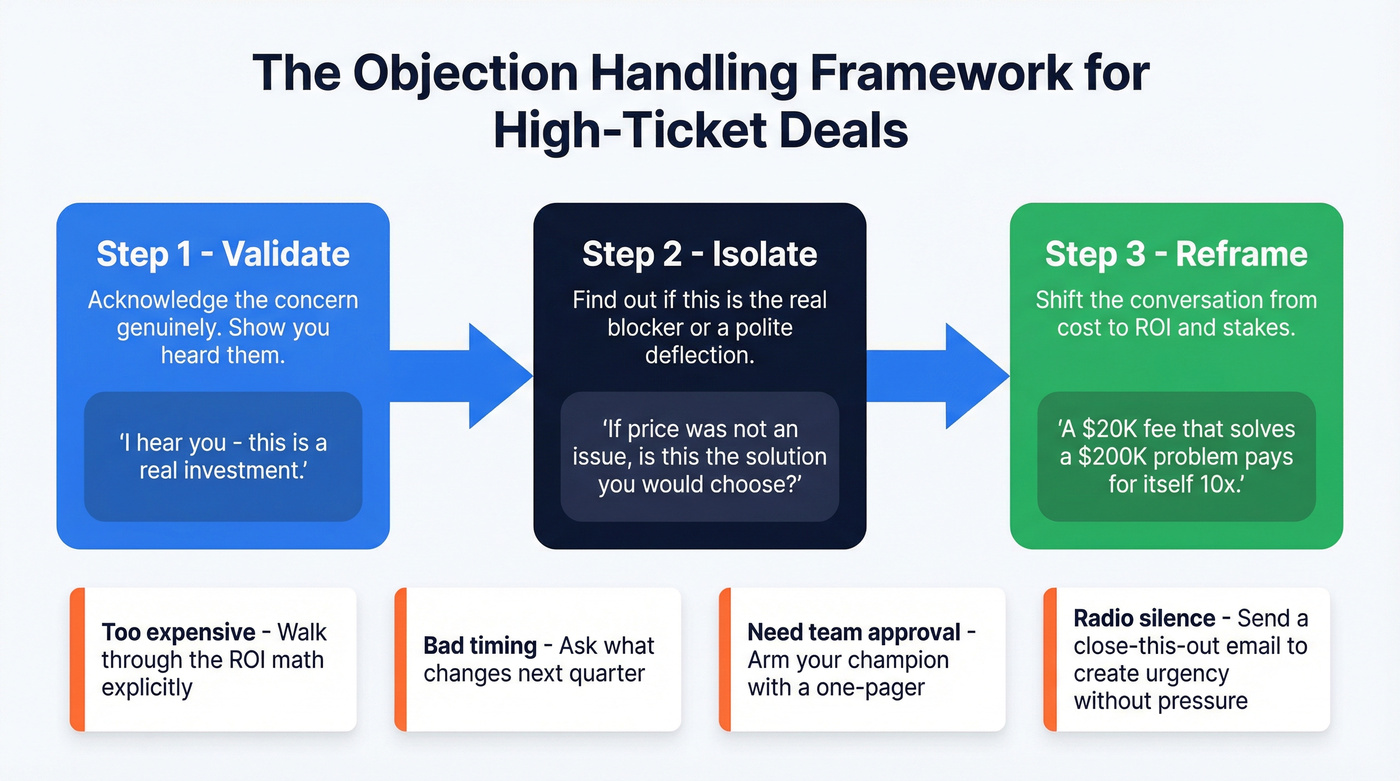
"It's too expensive." "I hear you - this is a real investment. If price wasn't an issue, is this the solution you'd choose to solve [specific problem]?" If yes, walk through the ROI. A $20K fee that solves a $200K problem pays for itself 10x. Make that math explicit.
"The timing isn't right." "What changes between now and next quarter that makes this a better time?" This forces the prospect to articulate whether the delay is real or just a polite no. Usually, nothing changes - and they realize it.
"I need to run this by my team." "Absolutely. Let me put together a one-pager - the problem, the solution, the expected ROI, and the timeline. What questions do you think they'll ask?" You're not fighting the process; you're arming your champion.
Radio silence (the ghost). This is the objection that isn't an objection, and it kills more high-ticket deals than any spoken "no." Here's the exact email we send when a prospect goes dark:
Hey [Name], I know things get busy. I want to respect your time - if the timing isn't right, just let me know and I'll close this out. No hard feelings.
The "close this out" language creates urgency without pressure. It works because it gives the prospect permission to say no, which paradoxically makes them more likely to re-engage.
Teams using flexible frameworks like this report up to 50% shorter sales cycles and 10-15% larger average deal sizes. If you want more closing frameworks, keep a set of talk track examples handy.
How to Present Your Price
Let's be honest: most service providers don't have a pricing problem - they have a presentation problem. You're charging $2,000 for a service that solves a $200,000 problem. You know you should charge more. We've tested all five of these tactics, and anchoring plus investment framing produce the most consistent results.
Anchor high first. "Most firms charge $25K for this kind of engagement - we offer it for $10K because of our delivery model." The prospect's reference point is now $25K, not $0. (If you want the psychology behind it, study anchor in negotiation.)
Use decoy pricing. Offer three tiers - say $5K, $10K, and $25K. Most buyers pick the middle option. This isn't a trick; it's how human decision-making works when people are presented with a range.
Create exclusivity. "We take on five clients per quarter for this program." Scarcity isn't manipulation when it's real - and if you're delivering high-touch services, capacity constraints are real.
Frame as investment, not cost. "What's the cost of NOT solving this for another six months?"
Lean into identity. Premium buyers are motivated by prestige, certainty, and transformation. They don't want the cheapest option - they want the best option. Position your service accordingly.
Pick Your Funnel Architecture
Two architectures dominate when you're selling high ticket services. The right one depends on your price point.
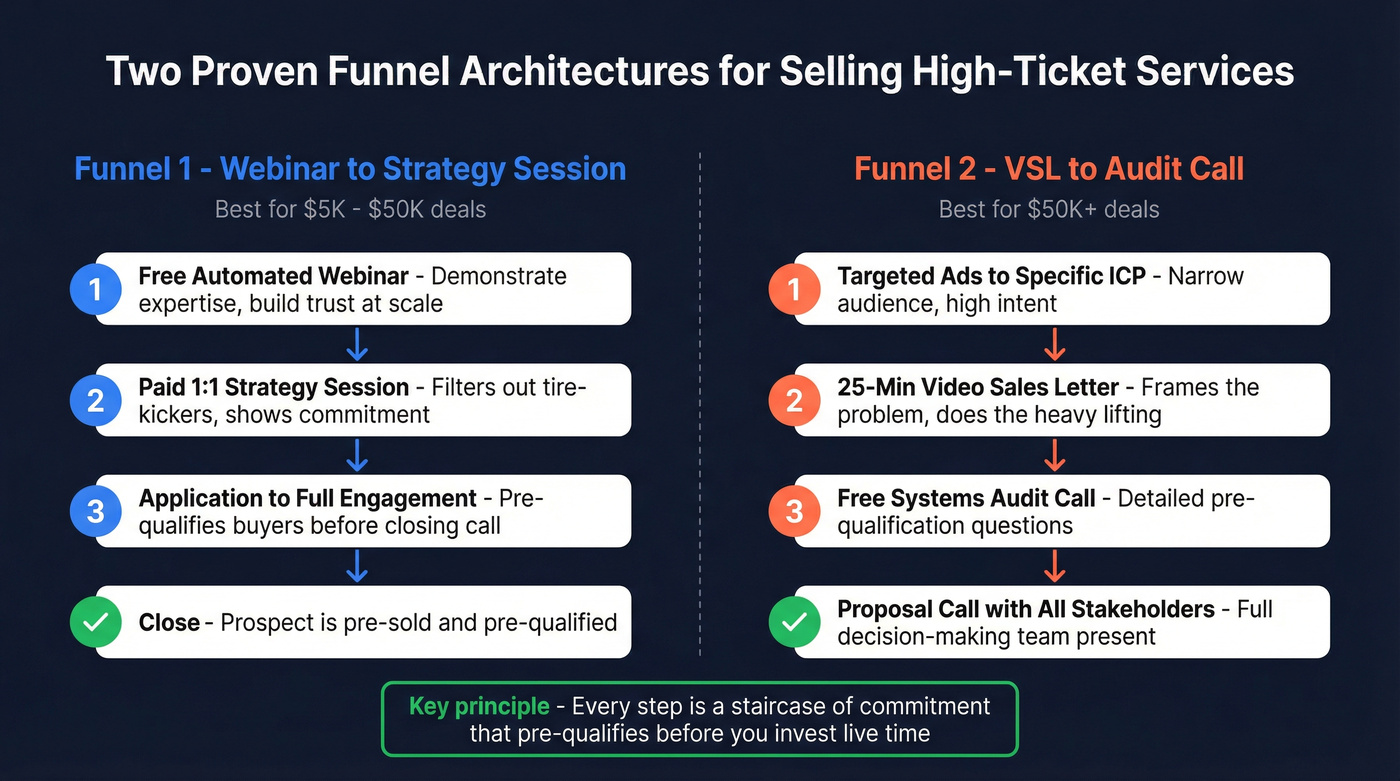
Funnel 1: Webinar to Strategy Session to Application (best for $5K-$50K). Run a free automated webinar that demonstrates expertise. Offer a paid 1:1 strategy session as the next step - this filters out tire-kickers. Then invite qualified prospects to apply for your full engagement. Each step is a "staircase of commitment" that pre-qualifies buyers before you ever get on a closing call.
Funnel 2: Targeted Ads to VSL to Audit Call to Proposal (best for $50K+). Run targeted ads to a specific ICP. Send them to a 25-minute video sales letter that frames the problem. Offer a free "Systems Audit Call" with detailed pre-qualification questions. Follow up with a proposal call that includes all stakeholders. The VSL does the heavy lifting before you invest any live time.
For proof these work: Todd Brown breaks down live-event funnel math - selling 300 tickets at $100 ($30,000) and then converting 10 buyers into a $5,000 mastermind for $80,000 in total revenue that night. Growbo's ExcelHelp case study showed a 30% revenue boost within six months after switching to a structured high-ticket funnel. The right architecture, matched to the right offer, produces outsized returns. (If you want a measurable model, start with an AIDA sales funnel or a B2B sales funnel template.)
If you're running outbound as part of either funnel, don't waste time on unverified contact lists. One of our customers, Stack Optimize, built from $0 to $1M ARR using Prospeo for their outbound data - maintaining 94%+ deliverability and under 3% bounce rates across all client campaigns. If you're rebuilding your outbound motion, use these sales prospecting techniques to keep activity tied to pipeline.
Referrals close at 25.56%. Cold calls close at 9.38%. The gap shrinks when you reach the right decision-maker on the first attempt. Prospeo's 30+ search filters - buyer intent, funding, headcount growth - help you build lists of prospects with $100K problems ready to spend $20K on solutions.
Close more high-ticket deals by starting with better data.
FAQ
What counts as a high-ticket service?
Any service priced at $1,000+ where the buyer's decision hinges on trust and expected ROI, not impulse. Consulting, done-for-you services, coaching programs, masterminds, and retainers all qualify. A coffee roastery charging $200 for a premium tasting experience or an interior designer at $1,500 per room both count - it's defined by the transformation delivered, not just the invoice total.
How long does a high-ticket sales cycle take?
For $5K-$25K services, expect 2-8 weeks from first contact to signed contract. Complex B2B engagements above $50K typically run 2-6+ months, especially with multiple stakeholders. Founder-led sales tend to close faster early on because the buyer is talking directly to the person who'll deliver the work.
How do I find decision-makers for premium outbound?
Use a B2B data platform to search by role, company size, and industry filters, then verify emails and direct dials before outreach. With 98% email accuracy and a 7-day data refresh cycle, you avoid wasting your most expensive resource - time spent preparing for calls that never happen because the contact data was stale.
How do I start selling high ticket services?
Pick one problem you solve exceptionally well, price it based on the outcome's value (not your hours), and build a pipeline around the benchmarks and funnel architecture above. Start with referrals - they close at 25.56% - and add outbound once your process is proven. Most people overthink the offer and underthink the sales process. Nail discovery, follow up relentlessly, and the close rate takes care of itself.