

Selling SaaS in 2026: Benchmarks, Tactics, and Frameworks That Work
A ~$300-$370 billion market. 106 SaaS apps per average company. And every founder thinks the hard part is building the product. It's not. Building is maybe 10% of the work. Selling SaaS is the other 90% - and it's where most companies stall, plateau, or die quietly.
This is the playbook we wish someone had handed us before we learned everything the expensive way.
The Short Version
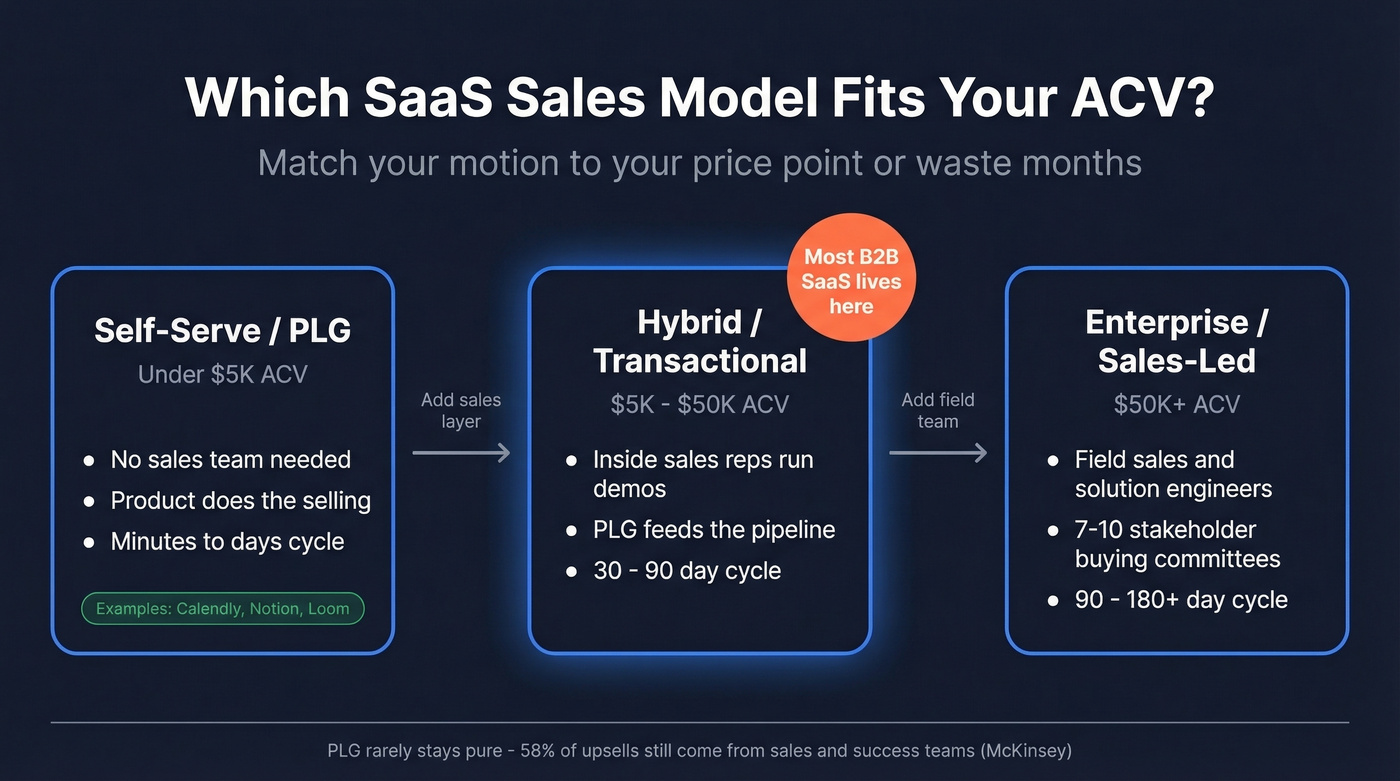
- Match your sales model to your ACV. Self-serve for deals under $5K, hybrid for $5K-$50K, full sales-led for $50K+. Getting this wrong wastes months.
- Expect an 84-day median sales cycle. But SMB deals close in 14-30 days if you multi-thread across contacts and send proposals within 24 hours of demos.
- Your outbound only works if your data does. A 35% bounce rate will wreck deliverability fast. Fix the data first, then worry about messaging.
What Makes SaaS Sales Different
SaaS selling is selling subscription software - usually B2B sales - where the revenue model depends on customers staying and expanding, not just signing. That single distinction changes everything about how you sell.
Traditional software was a one-time transaction. Close the deal, ship the license, move on. Software as a service flips that: the initial sale is just the entry point, and retention, expansion, and net revenue retention are where the real economics live.
Here's what's structurally different:
- Revenue is recurring, so a churned customer costs you more than a lost prospect.
- Buyers expect to try before they talk to sales. 97% of buyers want hands-on experience before engaging a rep.
- The product itself is a sales channel. Usage data, activation metrics, and product-qualified leads create signals that traditional sales never had.
Your sales motion isn't "convince someone to buy." It's "get them using, prove value fast, and make expansion feel obvious."
SaaS Sales Models - Pick the Right One
The biggest strategic mistake in any SaaS sales motion is running the wrong model for your price point. A founder doing enterprise demos for a $29/month product is burning cash. A PLG-only approach for a $100K platform deal? That's leaving money on the table.
| Model | ACV Range | Sales Team? | Typical Cycle |
|---|---|---|---|
| Pure PLG / Self-Serve | Under $5K | No | Minutes to days |
| Hybrid (PLG + Sales) | $5K-$50K | Inside sales | 30-90 days |
| Sales-Led / Enterprise | $50K+ | Field sales | 90-180+ days |
Self-Serve (Under $5K ACV)
No sales team. Marketing and product do the heavy lifting. Freemium or free trial gets users in, onboarding converts them, and the product retains them. Think Calendly, Notion, or Loom in their early days. Your "sales team" is your pricing page, your activation emails, and your in-app upgrade prompts. Free offers at this tier drive 20-30% more signups - lead with generosity, then gate the features that matter.
Transactional ($5K-$50K ACV)
Inside sales reps run demos, handle objections, and close. Cycles run 30-90 days. This is where most B2B SaaS companies live - complex enough to need a human, simple enough to close without a six-month procurement process. The rep's job is to compress the cycle, not just manage it.
Enterprise ($50K+ ACV)
Field sales, solution engineers, multi-stakeholder buying committees, and cycles that stretch 90-180+ days. Legal reviews, security questionnaires, and procurement approvals are standard. The deal isn't closed until the contract is signed, and the contract isn't signed until 7-10 people agree.
PLG Rarely Stays Pure
A McKinsey analysis of 107 publicly listed B2B SaaS companies found that most PLG adopters don't automatically outperform - a small subset of outperformers drives the advantage. The rest need sales layered on top. In hybrid motions, sales and success teams drive 58% of upsells, while product-driven upsells account for just 10%.
The best hybrid teams build cross-functional growth squads of 7-9 people focused on activation and conversion experiments, tracking product-qualified accounts instead of just MQLs. PQLs convert 5-10x faster than traditional marketing-qualified leads, which is why the smartest teams are rebuilding their lead scoring around product usage signals rather than form fills.
Sales Cycle Benchmarks
The median B2B SaaS sales cycle is 84 days. That number has lengthened 22% since 2022, driven by larger buying committees and increased security diligence.
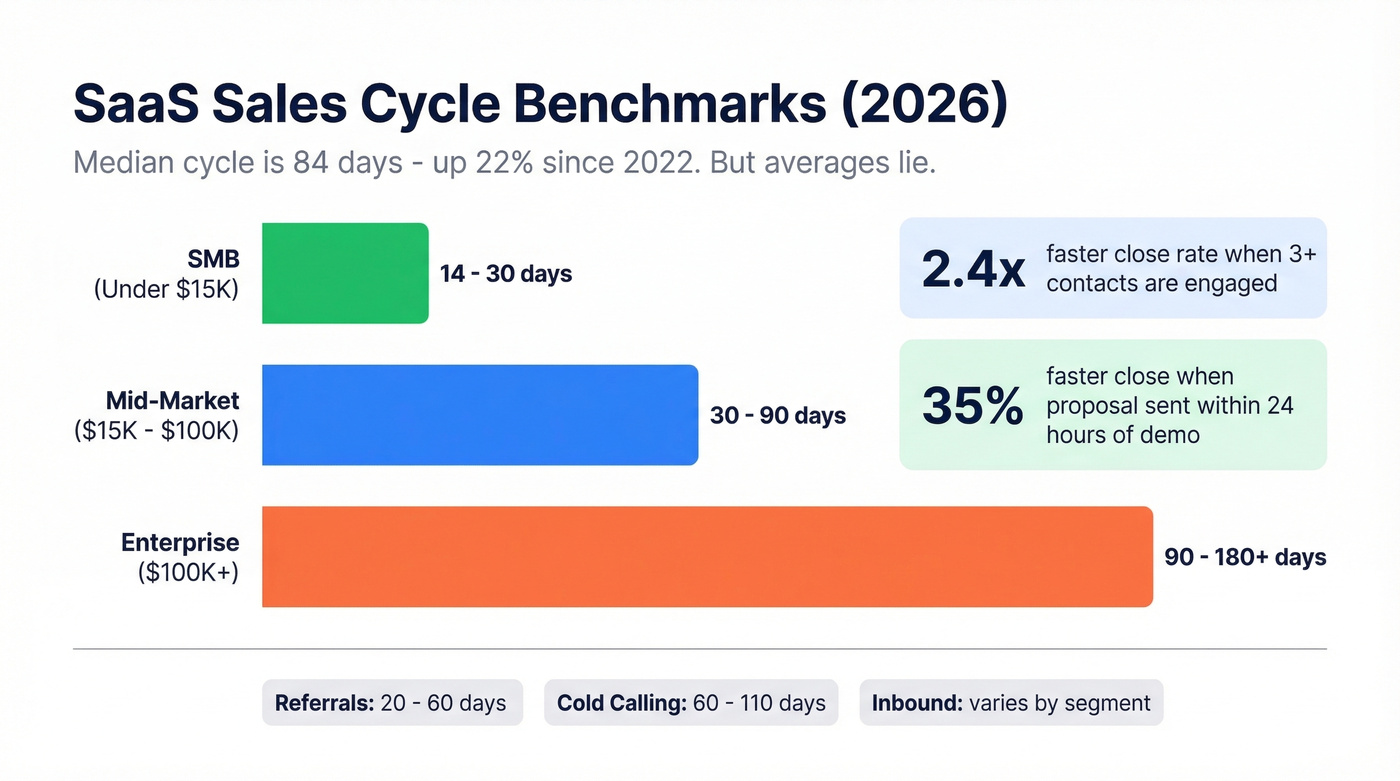
But averages lie.
| Segment | ACV | Cycle Length | Discovery to Demo | Negotiation to Close |
|---|---|---|---|---|
| SMB | Under $15K | 14-30 days | 3-5 days | 2-5 days |
| Mid-Market | $15K-$100K | 30-90 days | 5-10 days | 10-20 days |
| Enterprise | $100K+ | 90-180+ days | 10-20 days | 30-60 days |
Two data points that should change how you operate: deals with 3+ contacts engaged close 2.4x faster, and sending a proposal within 24 hours of a demo closes deals 35% faster. Speed signals confidence and competence.
Referrals close in 20-60 days depending on complexity. Cold calling runs 60-110 days. If you're not investing in referral programs alongside outbound, you're leaving the fastest pipeline source underfunded.
What a $30K Mid-Market Deal Actually Looks Like
Week 1: Inbound demo request from a Head of Revenue Ops who found your comparison page. You run the demo Tuesday, send the proposal Wednesday morning. Week 2: She loops in her VP of Sales and their IT lead for a second call. You multi-thread - sending each stakeholder a tailored follow-up addressing their specific concerns. Week 3: Security questionnaire lands. You return it in 48 hours because you had it pre-filled. Week 5: Legal redlines two clauses. You concede one, hold firm on the other. Week 6: Signed. Total cycle: 38 days. The speed came from multi-threading early and never letting the deal sit idle.
Free Trial and Freemium Benchmarks
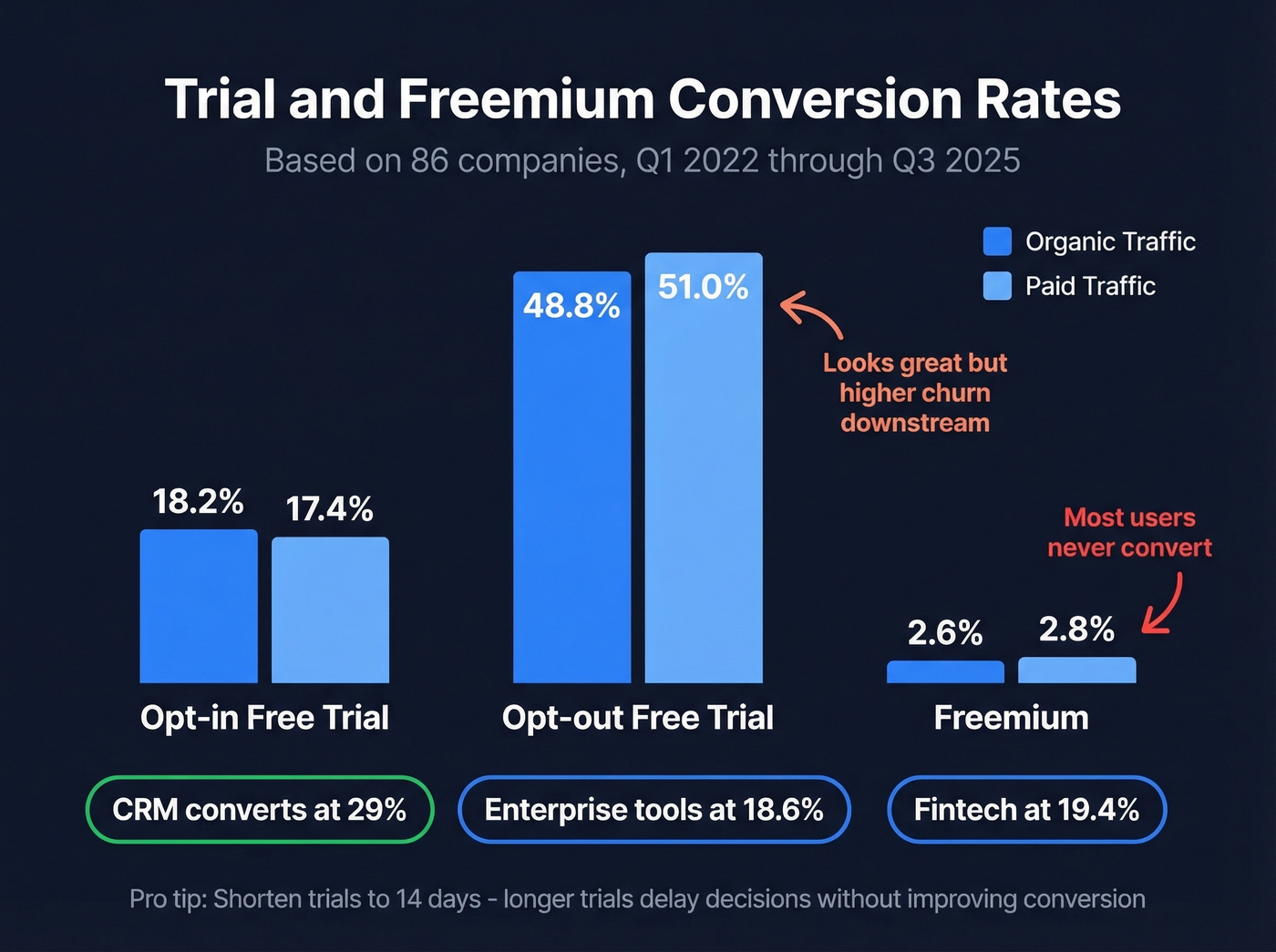
If you're running a PLG or hybrid motion, these are the numbers that matter. Based on an 86-company dataset spanning Q1 2022 through Q3 2025:
| Model | Trial to Paid (Organic) | Trial to Paid (Paid Traffic) |
|---|---|---|
| Opt-in Free Trial | 18.2% | 17.4% |
| Opt-out Free Trial | 48.8% | 51.0% |
| Freemium | 2.6% | 2.8% |
The opt-out trial numbers look incredible - nearly 49% conversion - but they come with higher churn downstream. You're converting people who forgot to cancel, not people who chose to stay. Opt-in trials produce stickier customers.
Industry variance is significant: CRM products convert at 29%, enterprise tools at 18.6%, and fintech at 19.4%.
Tactical moves that shift these numbers:
- Shorten your trial to 14 days. Longer trials don't convert better - they just delay the decision.
- Limit your free tier aggressively. If users can get full value without paying, they won't pay. Halve your free allocation and measure what happens.
- Test reverse trials with 10% of new signups. Give them the paid experience first, then downgrade. Screenapp moved from $3-5 pricing tiers to $9-19 and saw conversions increase. Underpricing hurts more than overpricing.

You just read that deals with 3+ contacts engaged close 2.4x faster. Multi-threading only works when you have verified contact data for every stakeholder. Prospeo gives you 300M+ profiles with 98% email accuracy and 125M+ direct dials - so you can reach the VP, the IT lead, and legal without a single bounce.
Stop losing SaaS deals to bad data. Start multi-threading with contacts you can trust.
Qualifying Deals
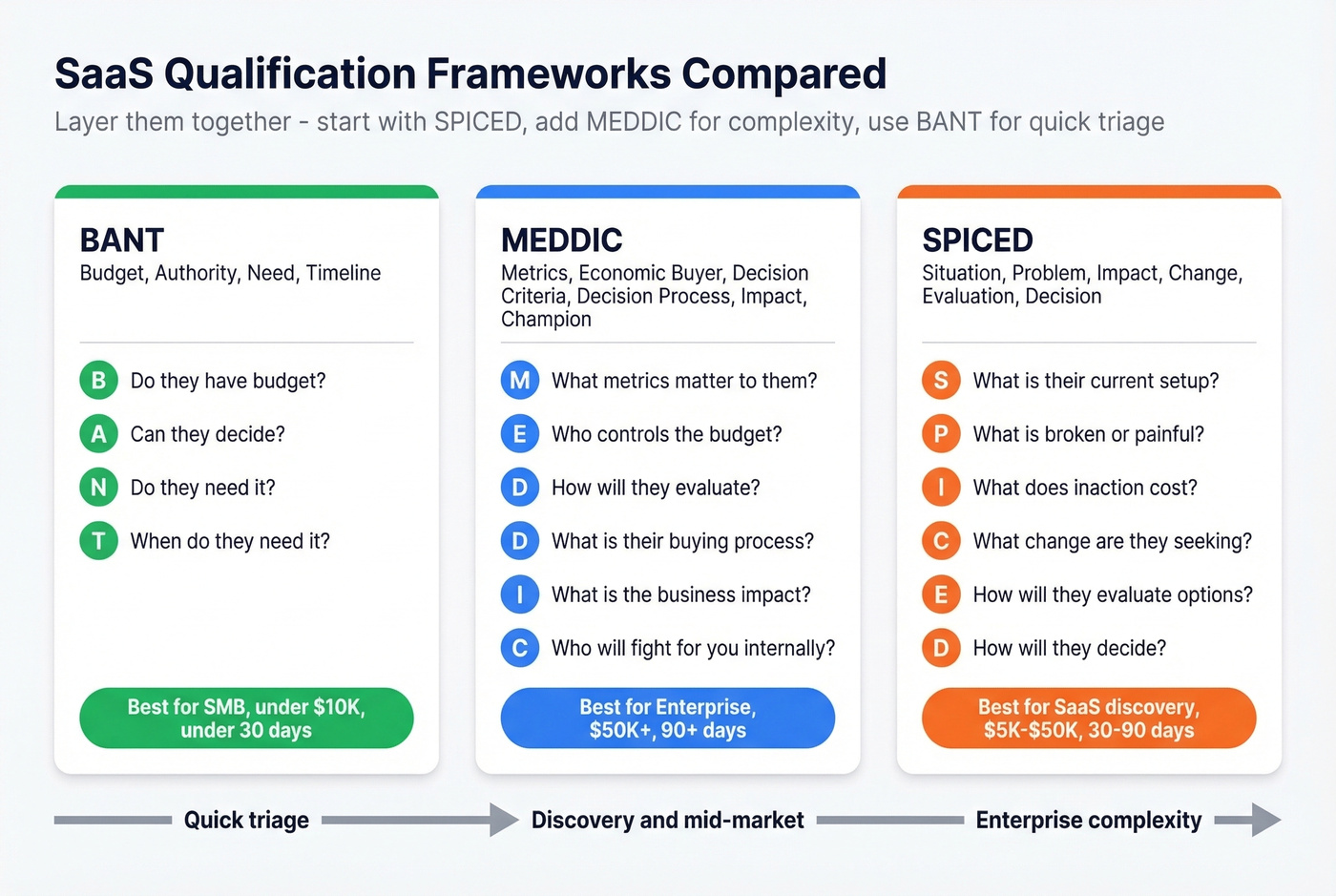
Not every opportunity deserves your time. Match your qualification framework to deal complexity.
| Framework | Best For | Deal Size | Cycle Length |
|---|---|---|---|
| BANT | SMB / transactional | Under $10K | Under 30 days |
| MEDDIC | Enterprise / complex | $50K+ | 90+ days |
| SPICED | SaaS discovery / mid-market | $5K-$50K | 30-90 days |
BANT (Budget, Authority, Need, Timeline) is fast triage. Does the prospect have money, can they decide, do they need it, and when? It works for shorter cycles where you need to qualify or disqualify quickly.
MEDDIC (Metrics, Economic Buyer, Decision Criteria, Decision Process, Impact, Champion) is built for enterprise complexity. When buying committees run 6-10+ stakeholders, you need to map the decision process, identify the economic buyer, and find a real champion - someone who shares internal information, maps the org for you, and engages procurement. If they're just enthusiastic but passive, they're a fan, not a champion.
SPICED (Situation, Problem, Impact, Change, Evaluation, Decision) is purpose-built for SaaS discovery, focusing on the customer's current situation and the impact of change - which maps perfectly to subscription economics.
The smart play is to layer them. Start with SPICED for discovery, add MEDDIC elements as deals get complex, and use BANT for quick triage on inbound leads. Operationalize this by building framework-specific fields in your CRM and scoring opportunities against them.
A qualification framework that lives in a slide deck but not in Salesforce isn't a framework - it's a suggestion.
Outbound Tactics That Work
Outbound is where most SaaS teams either build pipeline or burn money. The difference comes down to execution details, not strategy decks.
Cold Email Benchmarks
Compiled benchmarks for cold email performance right now:
| Metric | Average | Top Quartile |
|---|---|---|
| Reply Rate | 1-3% | 4-8% |
| Meeting Booked | 0.3-0.8% | 1-2% |
| Bounce Rate | 2-5% | Under 2% |
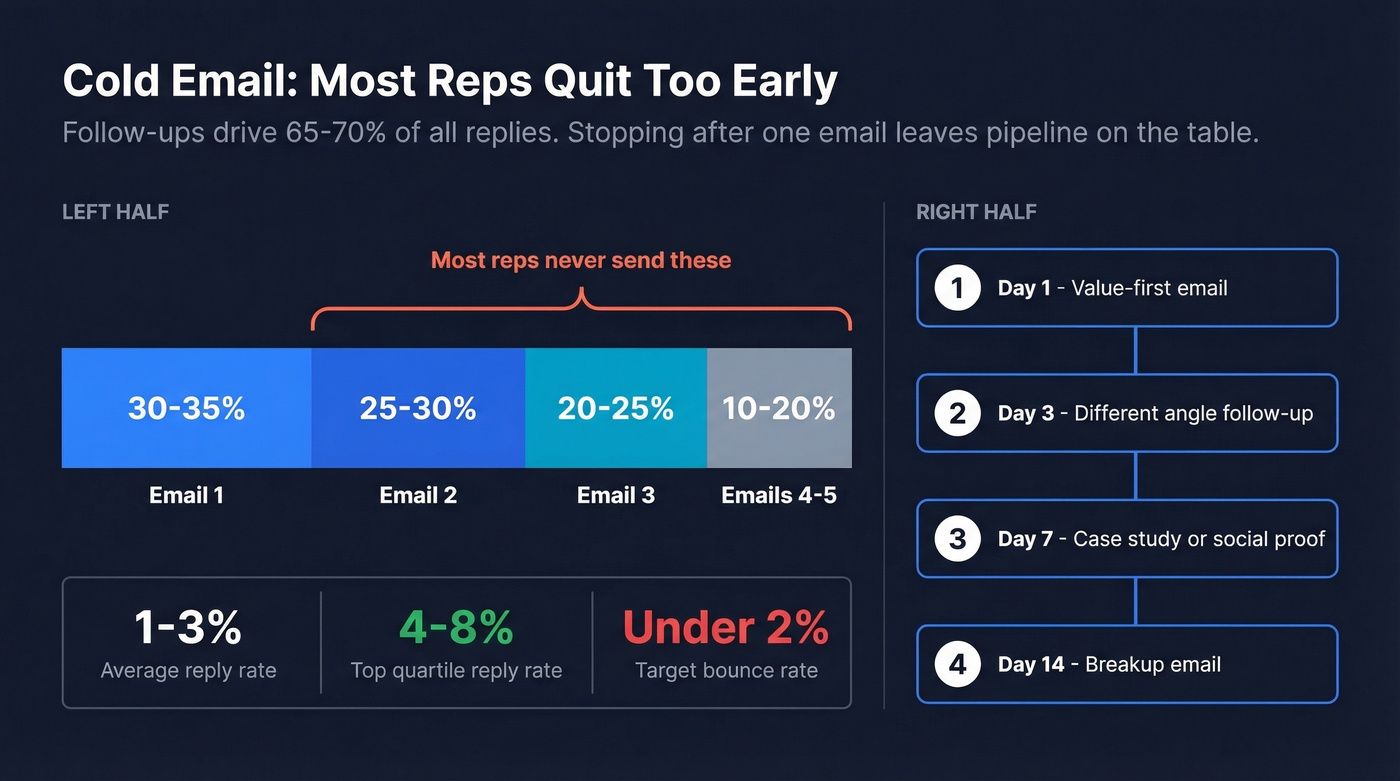
Follow-ups do the heavy lifting. Email 1 drives 30-35% of replies. Email 2 adds 25-30%. Email 3 contributes 20-25%. Most reps give up after one email - leaving 65-70% of potential replies on the table.
A cadence that works: Day 1 (value-first email), Day 3 (follow-up with a different angle), Day 7 (case study or social proof), Day 14 (breakup email). Three to five touches minimum. And don't forget dead leads - a time-limited offer to a stale list is low-effort and often overlooked, but it consistently reactivates pipeline. If you need copy, start with proven sales follow-up templates.
On deliverability: SPF, DKIM, and DMARC are table stakes. Warm up new domains for 4-6 weeks. Keep volume under 50 emails per day per domain initially. Keep your bounce rate under 2%. (If you want the full checklist, see our email deliverability guide.)
AI-Personalized First Lines
The workflow producing results right now: scrape a prospect's recent posts or activity, run it through an LLM to generate a personalized first line, and inject it as a custom variable in your cold email tool. A thread in r/SaaS documented roughly 3x response rate uplift from this approach versus generic templates.
Nobody reads a cold email that starts with "I hope this finds you well." But "Saw your post about migrating from Salesforce to HubSpot - we helped three companies navigate that exact switch last quarter" gets attention.
Multi-Channel Outreach
Cold email alone isn't enough. Combine channels: messages to top ICP contacts on professional networks, niche content posts focused on the customer's problem, and cold calling after email plus social touches. One founder on r/microsaas rated that sequence an "8/10 unfair advantage" - by the time you call, they've seen your name twice.
Intent-led omnichannel - where you prioritize prospects showing buying signals like competitor research, hiring patterns, or tech stack changes - triples reply and conversion rates versus broader outreach. To systematize this, use a simple ideal customer profile plus a lightweight model for identifying buying signals.
Data Quality as Infrastructure
Here's where most outbound programs silently fail. You can write perfect copy, build a flawless cadence, and nail your ICP targeting - and still get zero results because 35% of your emails bounce.
It's a compounding problem. Bounces damage your sender reputation, which tanks deliverability on the emails that are valid, which kills reply rates across the board. By the time you notice, the damage is done.
This is why contact data quality isn't a nice-to-have - it's infrastructure. We've seen this firsthand: Meritt switched to Prospeo and saw their pipeline triple from $100K to $300K per week while their bounce rate dropped from 35% to under 4%. That's not a marginal improvement. That's the difference between a working outbound program and a broken one. If you're troubleshooting, start with email bounce rate fundamentals.
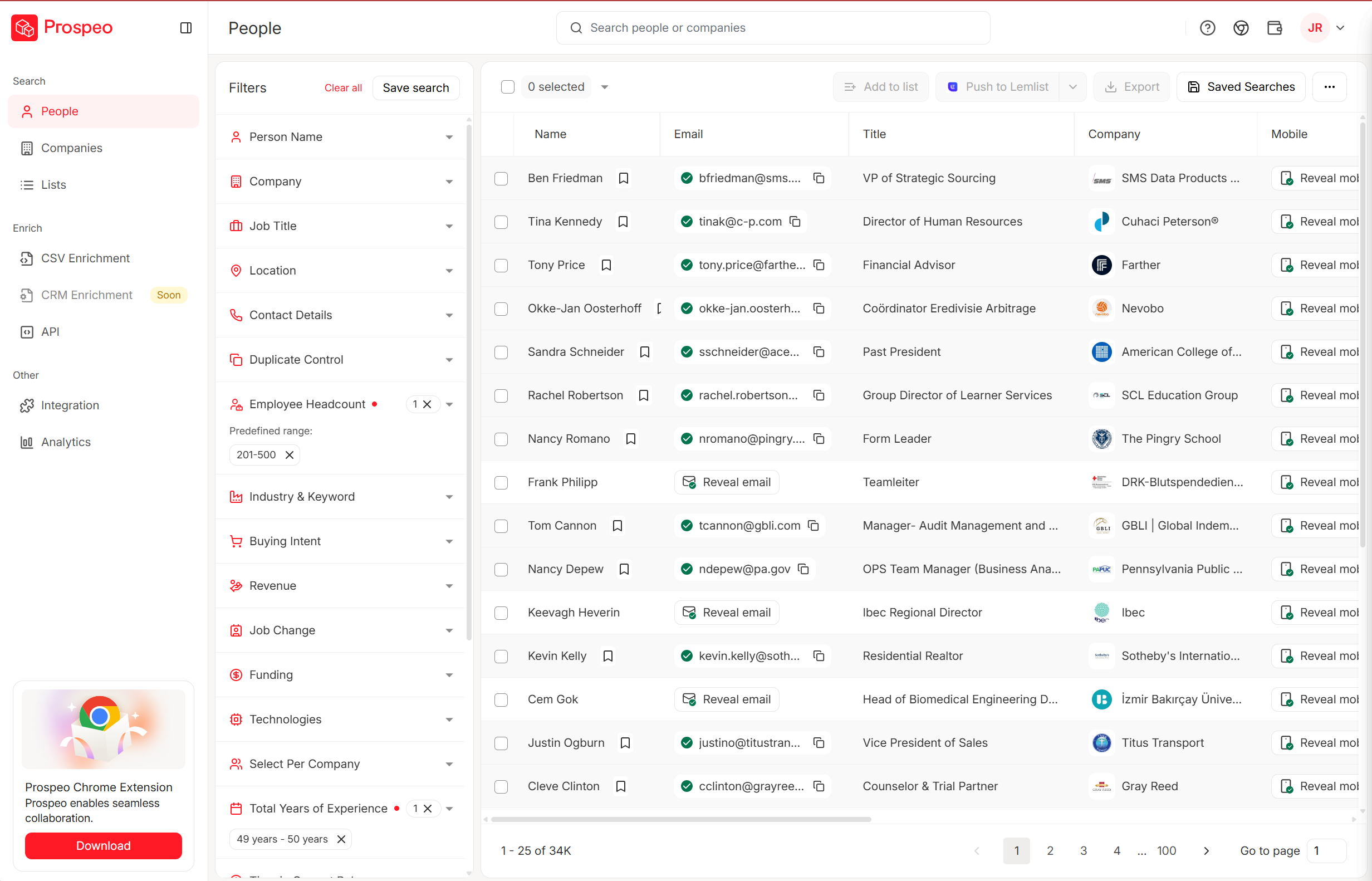
A 35% bounce rate doesn't just kill one campaign - it wrecks your domain reputation and every outbound motion after it. Prospeo's 5-step verification and 7-day data refresh keep bounce rates under 4%, so your SaaS outbound actually lands. At $0.01 per email, fixing this costs less than one lost deal.
Your SaaS sales cycle is already 84 days. Don't let stale data make it longer.
Enterprise SaaS Sales Tactics
Enterprise deals are a different sport. The average enterprise deal involves 7-10 stakeholders, and each one has a different priority, a different objection, and a different timeline.
Signal-based prioritization separates productive enterprise reps from busy ones. Instead of working a static account list, prioritize based on tech installs, job changes (new VP of Sales means new budget), funding rounds (fresh capital means buying mode), and hiring surges. Skip accounts that show none of these signals - your time is better spent elsewhere.
Multi-threaded outreach is non-negotiable. If you're single-threaded into one champion and they leave, your deal dies. Engage 3-5 contacts across the buying committee: the economic buyer, the technical evaluator, the end user, and the internal champion.
Mutual Action Plans should be shared early, not after the demo. A MAP tracks every stakeholder, every milestone, and every deadline. It turns a vague "we'll get back to you" into a concrete timeline with accountability on both sides.
Let's be honest about what actually stalls enterprise deals: procurement, legal, and security reviews consume 35-40% of total cycle time. The best enterprise reps start the security questionnaire and legal review in parallel with the evaluation - not after the verbal "yes." If you wait, you'll add 30-60 days to every deal.
SaaS Sales Metrics That Matter
You can't improve what you don't measure. But you can drown in dashboards. Focus on these:
| Metric | What It Tells You | Target |
|---|---|---|
| MRR / ARR | Revenue run rate | Track month-over-month growth |
| CAC | Cost to acquire a customer | 12-18 month payback |
| LTV | Lifetime revenue per customer | 3x+ CAC |
| LTV:CAC | Unit economics health | 3:1 minimum |
| Monthly Churn | Revenue retention | Under 2% for SMB |
| GRR | Retention without expansion | 85%+ (90%+ for enterprise) |
| NRR | Expansion vs contraction | 110%+ is strong |
| Win Rate | Pipeline efficiency | 20-25% typical |
| Pipeline Coverage | Forecast reliability | 3x minimum |
CAC formula: Total sales + marketing spend divided by new customers acquired in the period. Include salaries, tools, ad spend - everything. (If you want a deeper breakdown, see cost to acquire customer.)
LTV formula: Average revenue per account multiplied by gross margin %, divided by monthly churn rate. If your LTV:CAC ratio is below 3:1, you're either spending too much to acquire or not retaining long enough. Fix retention before you scale acquisition.
Win rates across B2B SaaS typically run 20-25%. If you're significantly below that, your qualification is too loose. Significantly above? Your pipeline is probably too narrow - you're only pursuing sure things and missing upside.
Common Mistakes That Kill Momentum
We've seen these patterns stall growth at dozens of companies. Every one is avoidable.
1. Pricing too low. Founders default to cheap because they're afraid of rejection. Screenapp moved from $3-5 tiers to $9-19 and conversions actually increased. Low prices signal low value. Test higher prices before you assume the market won't pay.
2. Free tier too generous. If users can get meaningful value without paying, they won't upgrade. Halve your free allocation. Test reverse trials - give them the paid experience first, then downgrade. You'll learn fast whether your free tier is a funnel or a crutch.
3. Skipping founder-led sales. If you haven't personally closed 20-50 deals, you don't understand your sales process well enough to hire someone to run it. Founder-led sales isn't optional - it's how you build the playbook that reps will follow.
4. Bloated roadmap. Early customers will ask for everything. Choose 2-3 design partners who match your ICP and build for them. Everyone else gets a "noted, not now."
5. Ignoring early customers. Block a weekly one-hour customer success slot. Build a "first believers" group. These customers will become your case studies, your referral sources, and your product feedback loop. Ignoring them is the most expensive mistake on this list.
Here's a strong opinion: if your deal size is under $10K, you probably don't need a sales team at all. You need a better onboarding flow, a tighter free-to-paid gate, and an email sequence that nudges trial users at the right moments. Most early-stage founders hire reps to compensate for a product experience that doesn't convert on its own. Fix the product first.
Essential Tools for SaaS Sales Teams
You don't need 15 tools. You need the right stack for your motion.
CRM: Salesforce (~$25-$330/user/mo depending on edition), HubSpot (free CRM; Sales Hub paid tiers ~$20-$150+/seat/mo), or Pipedrive (~$15-$100/seat/mo). Pick based on your team size and integration needs.
B2B Data & Email Verification: Prospeo stands out here - 143M+ verified emails, 125M+ verified mobile numbers, intent data across 15,000 topics, and pricing that starts at roughly $0.01 per email with a free tier. For teams running outbound at scale, accurate contact data is the single highest-leverage investment you can make. In our experience, nothing else moves the needle as fast as going from 65% deliverability to 98%. If you're evaluating vendors, compare options in data enrichment services and sales prospecting databases.
Cold Email Platforms: Instantly, Smartlead, or Lemlist for sequencing and warm-up. Budget ~$30-120/mo per sender account. (If you're building a modern stack, start with an SDR tools shortlist.)
Sales Automation: Outreach or Salesloft for enterprise teams (~$100-$200/user/mo). Skip these if your team is under 10 reps - they're overkill at that size.
Intent Data: Bombora (standalone or via integrated platforms), 6sense, or Demandbase for enterprise ABM ($30-100K+/year for standalone intent platforms).
FAQ
How long is the average SaaS sales cycle?
The median B2B SaaS sales cycle is 84 days. SMB deals close in 14-30 days, mid-market deals take 30-90 days, and enterprise deals run 90-180+ days depending on ACV and the number of stakeholders involved.
What's a good free trial conversion rate?
Opt-in free trials convert at roughly 18%, opt-out trials at roughly 49%, and freemium models at about 2.6% based on an 86-company dataset. CRM products convert at 29% while enterprise tools average closer to 19%.
How do I shorten a SaaS sales cycle?
Multi-thread across 3+ contacts in the buying committee (deals close 2.4x faster), send proposals within 24 hours of demos (35% faster close), and start security and legal reviews in parallel with the evaluation instead of after the verbal yes.
What qualification framework should I use?
BANT works for transactional deals under $10K with short cycles. MEDDIC is built for enterprise deals over $50K with 90+ day cycles and multiple stakeholders. SPICED fits SaaS-specific discovery in the mid-market. Layer them as deals progress.
What's the best tool for SaaS outbound data?
Prospeo delivers 98% email accuracy across 300M+ profiles with a 7-day refresh cycle, starting at ~$0.01 per email. For comparison, ZoomInfo averages 87% accuracy at roughly $1 per lead, and Apollo sits at 79%. Clean data is the foundation - everything else is noise without it.