

Follow-Up Email After No Response: 10 Proven Samples That Get Replies in 2026
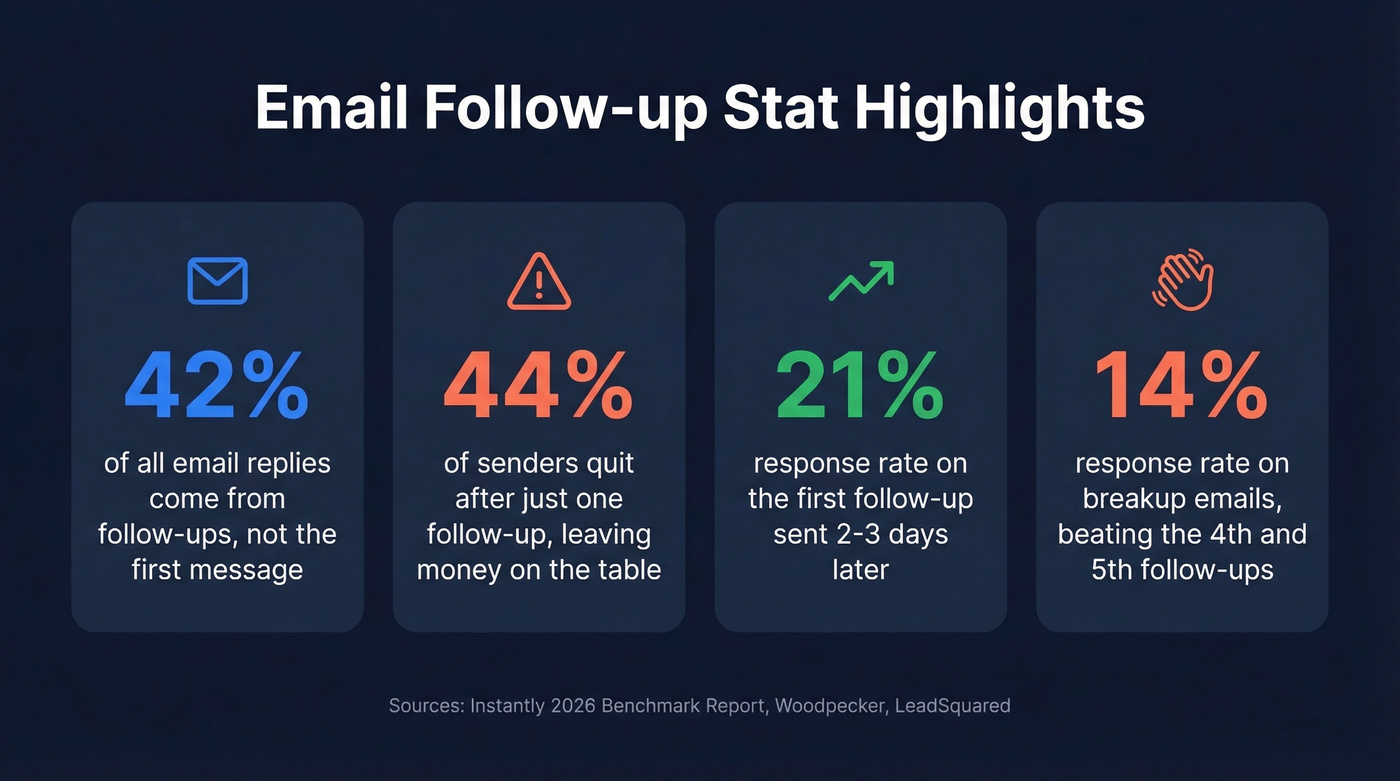
Sending a follow-up email after no response feels awkward. You wonder if you're being pushy, if they saw it, if the whole thing landed in spam. Here's what the data says: stop worrying and hit send. 42% of all email replies come from follow-ups, not the first message. Your initial email was the opening act. The follow-up is where deals happen.
Yet 44% of senders quit after a single follow-up. Nearly half the field walks away right when persistence starts paying off. 80% of prospects say no four times before saying yes - and if you're hearing silence email after email, the problem usually isn't your message. It's that you stopped too soon.
The Quick Version
- Send 3-5 follow-ups. Space touches about 3-4 days apart. The first follow-up, sent 2-3 days later, hits a 21% response rate.
- Every follow-up must add new information. Never "just checking in." Add a resource, a data point, a deadline, or a question. (If you need more options, use these sales follow-up templates.)
- End with a breakup email. It pulls a 14% response rate - higher than your 4th or 5th follow-ups. Loss aversion is real.
Do Follow-Ups Actually Work?
Dramatically. Woodpecker's data shows experienced outbound teams jump from a 16% reply rate with no follow-ups to 27% with just one. That's nearly double the responses from a single additional email. And 70% of sales emails need at least one follow-up to receive any response at all.
A LeadSquared campaign to 26,000 subscribers found the first follow-up actually outperformed the intro email - 23.6% open rate vs 20.1%. The follow-up beat the original by 17%.
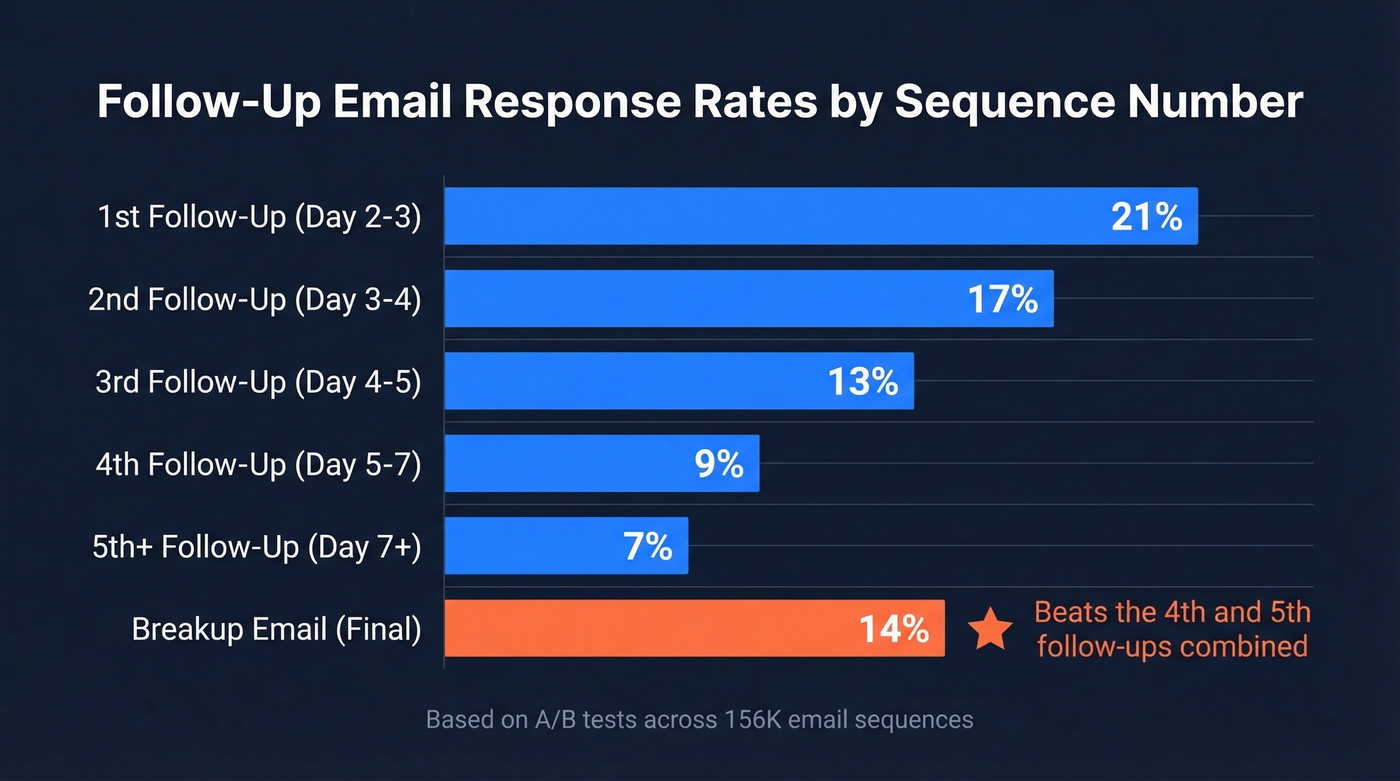
Here's how response rates break down by follow-up number, based on A/B tests across 156K email sequences:
| Follow-Up | Timing | Response Rate |
|---|---|---|
| 1st | 2-3 days | 21% |
| 2nd | 3-4 days | 17% |
| 3rd | 4-5 days | 13% |
| 4th | 5-7 days | 9% |
| 5th+ | 7+ days | 7% |
| Breakup | Final | 14% |
Notice the breakup email. It beats the 4th or 5th follow-up on its own. We'll get to that.
When to Send Each Follow-Up
Timing matters more than most people think. Waiting three business days before your first follow-up yields a 31% increase in replies compared to following up immediately. Patience signals confidence, not desperation.
If you want a deeper timing breakdown, see our guide on when to follow up on an email.
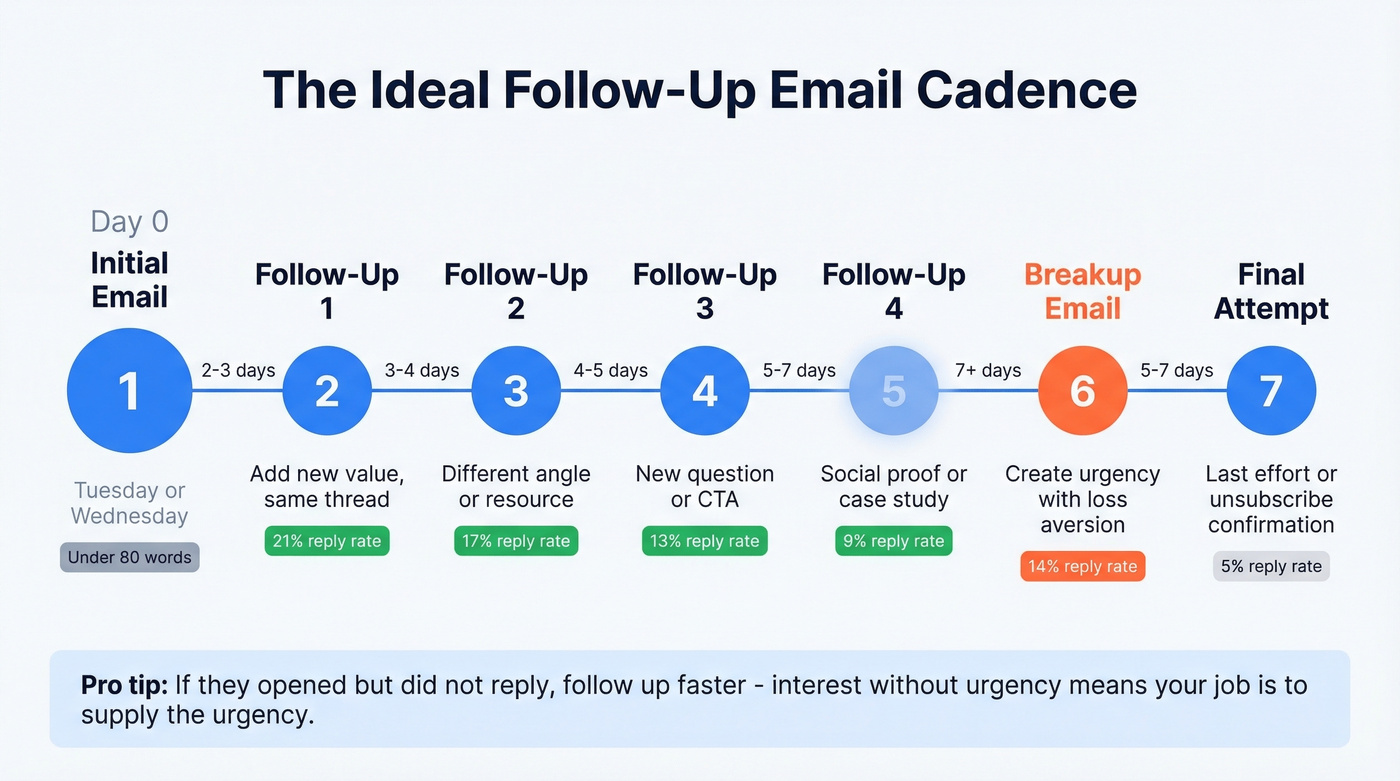
Here's a cadence that's easy to run and matches what most benchmarks recommend: send your initial email on a Tuesday or Wednesday, then follow up around Day 3 in the same thread with new value. A few days later, send another message with a different angle - a new resource, a new question, or a clearer CTA. Keep going until you've sent 3-5 follow-ups, then close the loop with a breakup email.
Instantly's 2026 benchmarks show emails under 80 words hit the sweet spot for reply rates. Tuesday and Wednesday consistently outperform other days, with Wednesday pulling the highest response rates across billions of cold email interactions. (For more deliverability and performance benchmarks, use this cold email marketing guide.)
One underused tactic: adding a short video to your follow-up can boost click-through rates by 65%. Even a 30-second Loom walkthrough outperforms a wall of text - and almost nobody does this. (More ideas here: Loom video cold email.)
Behavioral signals matter too. If your email tool shows the prospect opened your message but didn't reply, follow up fast while you're top of mind. An open without a reply usually means interest without urgency - your job is to supply the urgency. (If you're tracking opens/clicks, make sure you understand how an email tracking pixel works.)
Job Interview Follow-Ups: Different Rules
Don't send a "follow-up" one day after the interview - send a thank-you email instead. If you haven't heard back, following up after 4-5 days is a solid move. Hiring processes routinely take 1-2 weeks depending on scheduling and interview volume. If you send a second email, keep it short and gracious, then stop.

Your follow-up sequence is only as good as the email address it lands on. A 35% bounce rate kills your domain reputation and makes every subsequent follow-up harder to deliver. Prospeo's 98% verified emails and 7-day data refresh mean your 3-5 follow-up cadence actually reaches the inbox - not a dead address.
Stop following up with ghost inboxes. Start with verified data.
10 No-Response Follow-Up Samples
Below you'll find a sample for nearly every situation - sales, interviews, networking, freelance, and internal stakeholders. Use these as starting points, not copy-paste templates.
After a Sales Demo or Call
Sample 1: Warm follow-up referencing a specific pain point
Subject: Re: [Acme] demo - the pipeline visibility issue
Hi [Name],
Great talking Thursday. You mentioned your reps spend ~3 hours/week manually updating pipeline stages - that's roughly 150 hours/quarter across your team.
We helped [Similar Company] cut that to under 20 minutes with automated stage progression. Want me to send the case study?
Worth a 15-minute call next week?
This works because it quantifies a pain point from the actual conversation and adds proof. The CTA is low-commitment - a 15-minute call, not a contract review. (If you want a tighter post-call flow, use a sales meeting follow-up email framework.)
Sample 2: Follow-up after sending a proposal
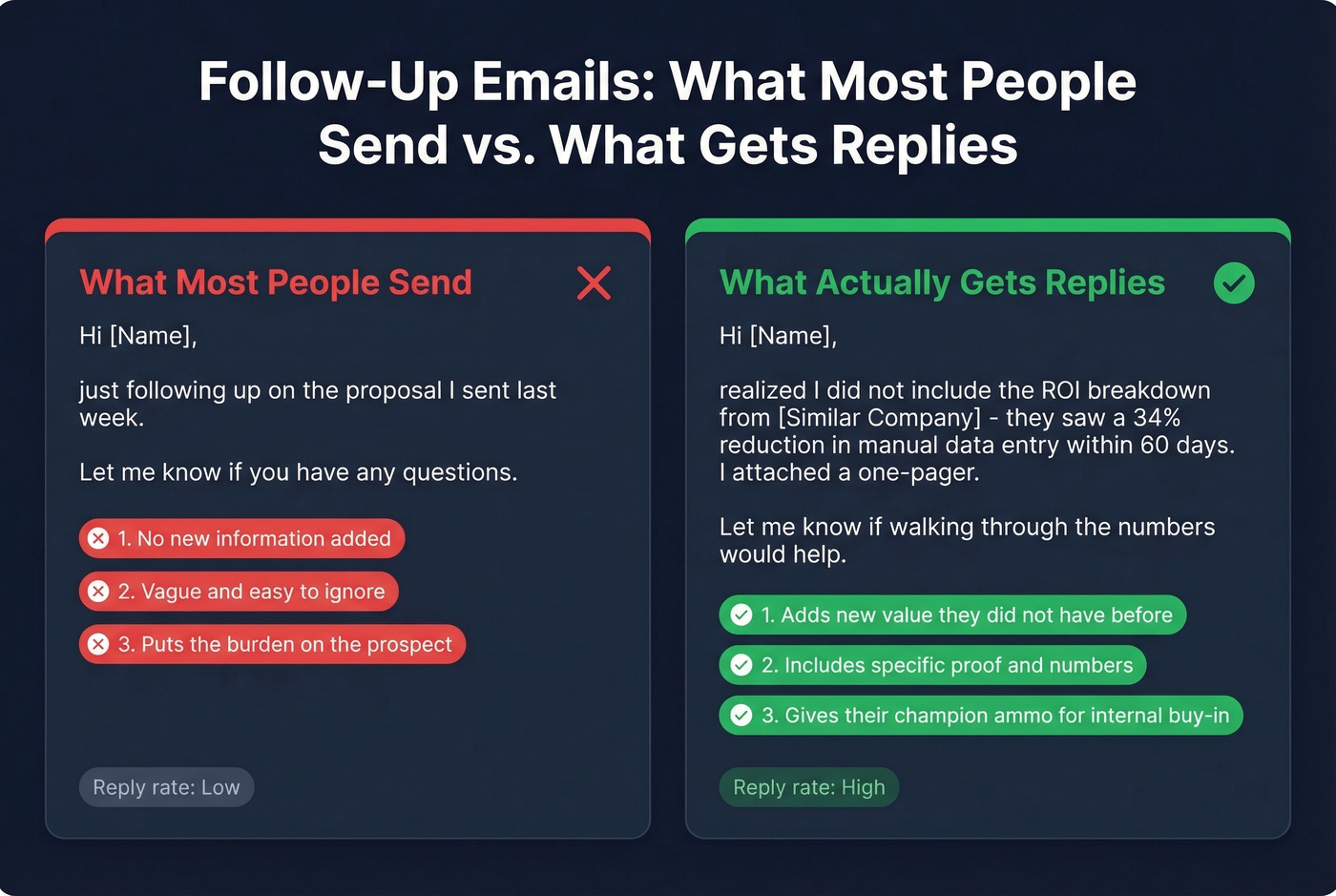
Here's a before/after to show how small changes make a big difference:
What most people send:
Hi [Name], just following up on the proposal I sent last week. Let me know if you have any questions.
What actually gets replies:
Hi [Name], realized I didn't include the ROI breakdown from [Similar Company]'s rollout - they saw a 34% reduction in manual data entry within 60 days. I've attached a one-pager. Let me know if walking through the numbers would help move things forward.
The difference: "one thing I missed" creates curiosity, and the case study gives your champion ammunition for internal conversations.
Cold Prospect Who Went Silent
When you're reaching out to a cold prospect who never replied, the stakes are different from a warm lead. They never asked to hear from you, so every message needs to justify its existence with standalone value. (If you’re building sequences from scratch, start with a B2B cold email sequence.)
Sample 3: Re-engagement with a new resource
Subject: [Name], thought of you when I saw this
Hi [Name],
Just published a breakdown of how [industry] teams are cutting outbound costs by 40% without shrinking pipeline. Figured it's relevant given [Acme]'s growth this year.
[Link to resource]
No pitch - just thought you'd find it useful.
The "no pitch" line actually increases reply rates because it removes pressure. Lead with value, not a request.
Sample 4: Curiosity-driven follow-up
Subject: Quick question, [Name]
Hi [Name],
Totally understand if the timing wasn't right last month. One quick question: is [specific problem] still on your radar for Q3, or has the priority shifted?
Either way, I'm around when it makes sense.
Short. Direct. Gives them an easy out. Asking about priority shifts shows you understand their world changes, and it's a strong template because it respects the prospect's time while keeping the door open.
After a Job Interview
Sample 5 vs. Sample 6: First and second interview follow-ups compared
| First Follow-Up | Second (Final) Follow-Up | |
|---|---|---|
| Timing | ~4-5 days after the interview (or after their stated timeline passes) | A few days after the first follow-up |
| Tone | Enthusiastic, specific | Gracious, flexible |
| Subject | Re: [Role Title] - checking in | Re: [Role Title] - still enthusiastic |
| Key line | "You'd mentioned a decision by end of last week - wanted to check in on timing." | "I know hiring timelines shift - just wanted to reiterate my interest." |
| Closer | "I'm still excited about the [specific project discussed]. Let me know if any additional info would help." | "I'm flexible on timing and happy to accommodate whatever works. Thanks for keeping me in the loop." |
| After this | Wait for response | Stop. Two is the limit for interviews. |
The key in both: reference a specific project or initiative from the conversation. Generic enthusiasm reads as desperation. Specific enthusiasm reads as genuine fit.
Networking and Introductions
Sample 7: Follow-up after a conference or mutual introduction
Subject: Great meeting you at [Event] - the [topic] conversation
Hi [Name],
Really enjoyed our conversation about [specific topic] at [Event] last week. Your point about [specific insight they shared] stuck with me.
I mentioned [resource/article/intro] - here's the link: [URL]. Would love to continue the conversation over coffee sometime.
Specificity proves you actually remember the conversation. Delivering on something you mentioned shows follow-through, which is the whole point of networking.
Freelance and Invoice Follow-Ups
Sample 8: Follow-up after sending a freelance proposal
Subject: Re: [Project Name] proposal - quick question
Hi [Name],
Following up on the proposal for [Project Name]. I've since worked on a similar project for [Other Client] and have ideas that could shorten the timeline by about two weeks.
Open to a 10-minute call to walk through the updated approach?
"Two weeks faster" gives them a concrete reason to re-engage. Vague "just checking in" proposals get ignored; specific new value gets replies.
Sample 9: Overdue invoice reminder
Subject: Invoice #[Number] - 15 days past due
Hi [Name],
Friendly heads-up that Invoice #[Number] for $[Amount] was due on [Date] and is now 15 days past due. I've reattached it for convenience.
Could you confirm when I can expect payment? If there's an issue, let's discuss.
Firm but professional. States the facts without being aggressive. The "if there's an issue" line opens the door for honest conversation rather than avoidance - you want to get paid and keep the client.
Internal Stakeholder Follow-Up
Sample 10: Waiting on a colleague for input
Subject: Need your input by Friday - [Project Name] approval
Hi [Name],
Following up on the [deliverable] I sent Monday. I need your sign-off by Friday EOD to keep us on track for the [Date] launch.
Specifically, I need a yes/no on the budget allocation in Section 3. If you'd prefer, I can swing by your desk for a 5-minute walkthrough.
Clear deadline, specific ask, and an alternative path. Internal follow-ups fail when they're vague - this one makes it easy to act.
The Breakup Email
The most underused tool in follow-up sequences. After 3-4 unanswered follow-ups, most people either keep sending increasingly desperate messages or silently give up. The breakup email is the third option - and it pulls a 14% response rate, outperforming your 4th and 5th follow-ups combined.
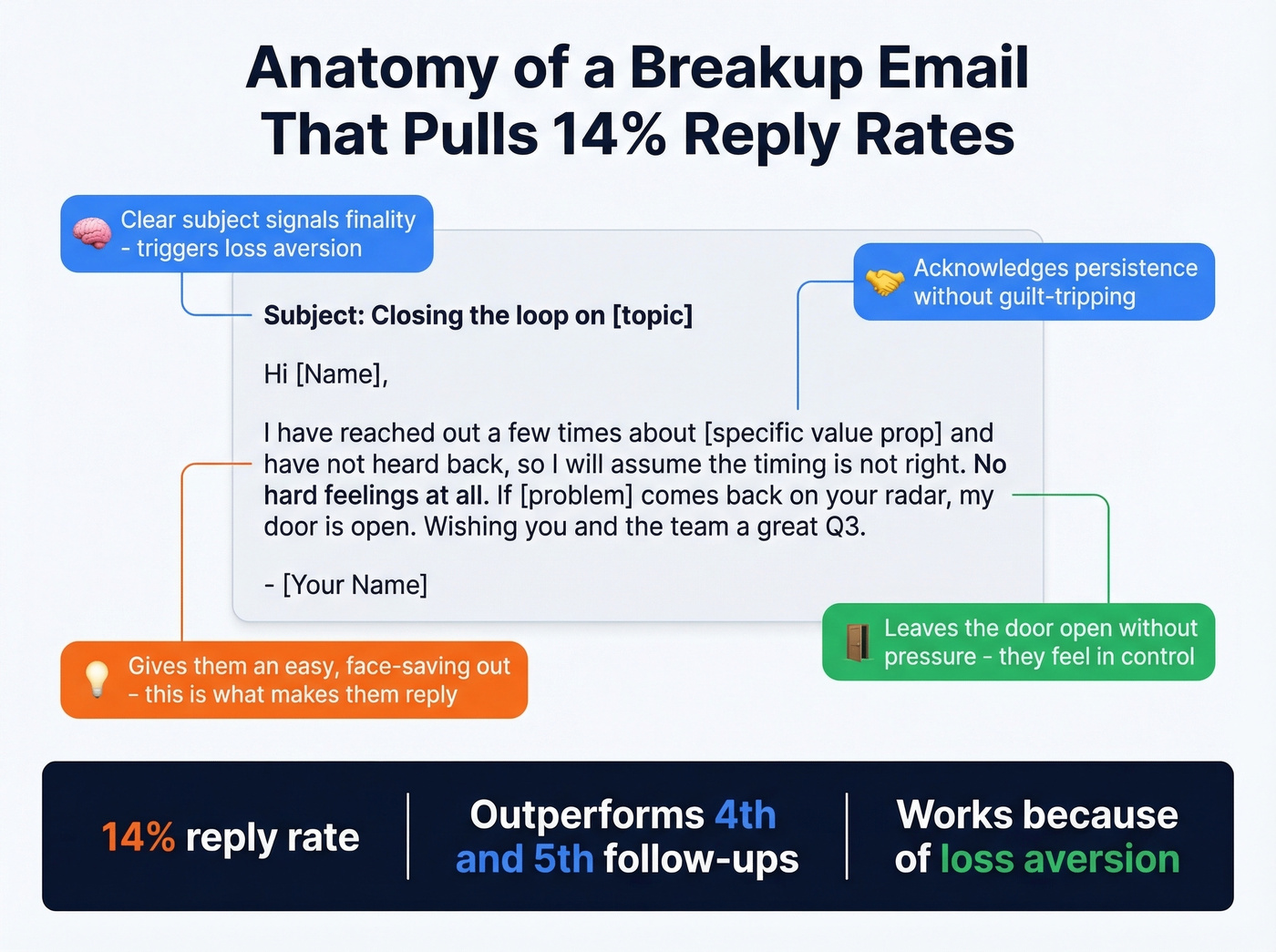
It works because of loss aversion. In our experience, the breakup email pulls replies from prospects we'd completely written off. If you've been sending message after message and hearing nothing back, this is the one that finally breaks through.
Subject: Should I close your file?
Hi [Name],
I've reached out a few times about [specific topic] and haven't heard back - totally understand if the timing isn't right.
I'll assume this isn't a priority right now and close out your file on my end. If anything changes down the road, my door's open.
Wishing you and the [Acme] team a great Q3.
Let's be honest: the breakup email isn't a trick. It's genuine respect for their time and yours. If they don't reply, you've freed up bandwidth for prospects who will.
5 Mistakes That Kill Reply Rates
Mistake 1: "Just checking in" with no new information. Every follow-up needs to earn its place in someone's inbox. Add a resource, a stat, a case study, or a question. "Checking in" is a wasted send. Each follow-up should also address a different potential objection - if your first email pitched value, your second should address urgency or trust. The five objection categories worth rotating through: no perceived need, cost concerns, no urgency, lack of desire, and lack of trust. Hit a different one each time and you'll cover the full spectrum of why people don't reply. (More on this in our guide to how to say just checking in professionally.)
Mistake 2: Writing a novel. Best-performing cold emails clock in under 80 words. If your follow-up has more than one paragraph, cut it in half. (If you want a repeatable system, use an email copywriting checklist.)
Mistake 3: Weak subject lines. Using "Follow-up" or "Checking in" as your subject line is the email equivalent of a blank stare. Reply in the same thread whenever possible - it preserves context. If you're starting fresh, reference something specific: "Re: the pipeline issue" or "[Name], quick question about Q3 plans." (Need ideas? Steal from these email subject line examples.)
Mistake 4: Robotic, automated tone. "Per my previous correspondence, I wanted to follow up regarding the aforementioned proposal" - nobody talks like this. Write like a human. Contractions, casual phrasing, and a conversational tone consistently outperform formal language.
Mistake 5: Following up with a dead email address. Here's the thing - before you blame your copy, check your data. We've seen teams optimize sequences for weeks when the real problem was a 15% bounce rate on their contact list. If you're sending follow-ups to an address that bounces or routes to a catch-all domain that silently drops messages, every send is wasted. Prospeo verifies emails in real time - including catch-all domains - with 98% accuracy, and the free tier covers 75 verifications per month. (If you’re diagnosing list issues, start with email bounce rate benchmarks and fixes.)
Checklist Before You Hit Send
Run through this before every follow-up:
- Verify the email address is still valid - a single bounced email can damage your sender reputation (use an email deliverability guide if you’re troubleshooting)
- Add new information (resource, data point, question, or deadline)
- Keep it under 80 words
- Include a single, clear CTA (one ask, not three)
- Reply in-thread when possible
- Reference your prior interaction specifically
- Send Tuesday or Wednesday for peak reply rates
- Wait at least 3 business days since your last touchpoint
- Read it out loud - if it sounds stiff, rewrite it
One more thing: if your average deal size is under $5K, you probably don't need a 7-touch sequence with custom videos and personalized landing pages. Three well-timed follow-ups with genuine value will outperform an elaborate sequence that takes you 30 minutes per prospect. Save the heavy artillery for deals that justify the effort.
Sending five perfectly crafted follow-ups to the wrong person wastes your best copy. Prospeo's 300M+ profiles with 30+ filters - buyer intent, job changes, technographics - let you target decision-makers who actually have the problem you solve. At $0.01 per email, rebuilding your list costs less than one bad bounce.
Great follow-ups deserve the right recipients. Find them in seconds.
FAQ
How many follow-up emails should I send before giving up?
Three to five for sales outreach, ending with a breakup email. For job interviews, cap at two. 44% of senders quit after one follow-up - persistence pays, but each message must add new value. Use the no-response samples above as a starting framework, then customize with details from your actual conversation.
Is it rude to follow up after no response?
No. 42% of all email replies come from follow-ups. Recruiters, buyers, and partners all expect it. What's rude is being pushy or adding zero value with each send. Graceful persistence is a core professional skill.
What should I write in a follow-up subject line?
Reply in the same thread whenever possible - it preserves context and boosts open rates by 20-30%. If you're starting a new thread, reference something specific: a meeting date, a shared resource, or a deadline. Avoid generic subjects like "Checking in."
Why am I not getting replies to any of my follow-ups?
Often it's not your copy - it's your data. If the email address is invalid or the contact changed roles, your messages go nowhere. A pattern of zero replies across your entire list signals a data quality problem, not a messaging problem. Verify addresses before optimizing your sequences.
What's the best follow-up email sample after no response?
There's no single best template - it depends on context. For sales, lead with a new data point or case study. For job interviews, keep it short and reference a specific conversation topic. For networking, deliver on something you promised. The common thread across every sample in this guide: each follow-up must add new value to earn a reply.