

Signal-Based Sales Strategy: The 2026 Playbook
You just pulled your Q2 pipeline report and half the "qualified" opportunities went dark - they'd already picked a vendor before your SDR sent the first email. That's not a rep problem. It's a timing problem, and a signal-based sales strategy is how you fix it.
Signal-based selling means acting on buyer behavior data - pricing page visits, funding events, hiring surges - instead of cold-calling static lists. Teams that do it well close at 33-41% win rates vs. 18-25% for reactive selling. What follows is the scoring model, the signal-to-play mapping, and the tool stack to build it this quarter.
Why Signals Matter Now
The buying process has shifted underneath us. A 6sense study of nearly 4,000 B2B buyers found that the average point of first contact is now 61% through the buying journey. That's an improvement from 69% the prior year - buyers are engaging slightly earlier - but they're still well past the halfway mark before a rep ever hears from them.
Here's the stat that should keep every sales leader up at night: 95% of the time, the winning vendor is already on the buyer's Day One shortlist. Four out of five deals are won by the pre-contact favorite. If you're not on that shortlist before the buyer raises their hand, you're fighting for scraps.
A signal-driven approach flips the sequence. You detect buying behavior early, reach out while the buyer is still forming opinions, and earn a spot on that shortlist before it solidifies. The old model - wait for an inbound lead, qualify it, work it - simply doesn't hold up for most B2B sales anymore.
What Signal-Based Selling Actually Is
Let's be precise. Signal-based selling isn't a strategy. It's an execution layer. You're using real-time behavioral and contextual data to decide who to contact, when to contact them, and what to say. That's it.
You'll hear "intent-based selling" and "trigger-based selling" used interchangeably. They're not the same thing. Signal-based selling is the umbrella. intent data - meaning topic-level research behavior - is one signal type. Job changes are another. Funding rounds, tech installs, pricing page visits, ad clicks - all signals. HubSpot's CEO posted: "RIP cold outreach. Welcome, signal-based prospecting." That was premature, but the direction is right: outreach without signals is increasingly just noise.
The distinction matters because teams that only buy an intent data tool and call it "signal-based selling" miss half the picture. You need multiple signal types, a scoring model, and mapped plays.
The Performance Case
The data here isn't subtle.
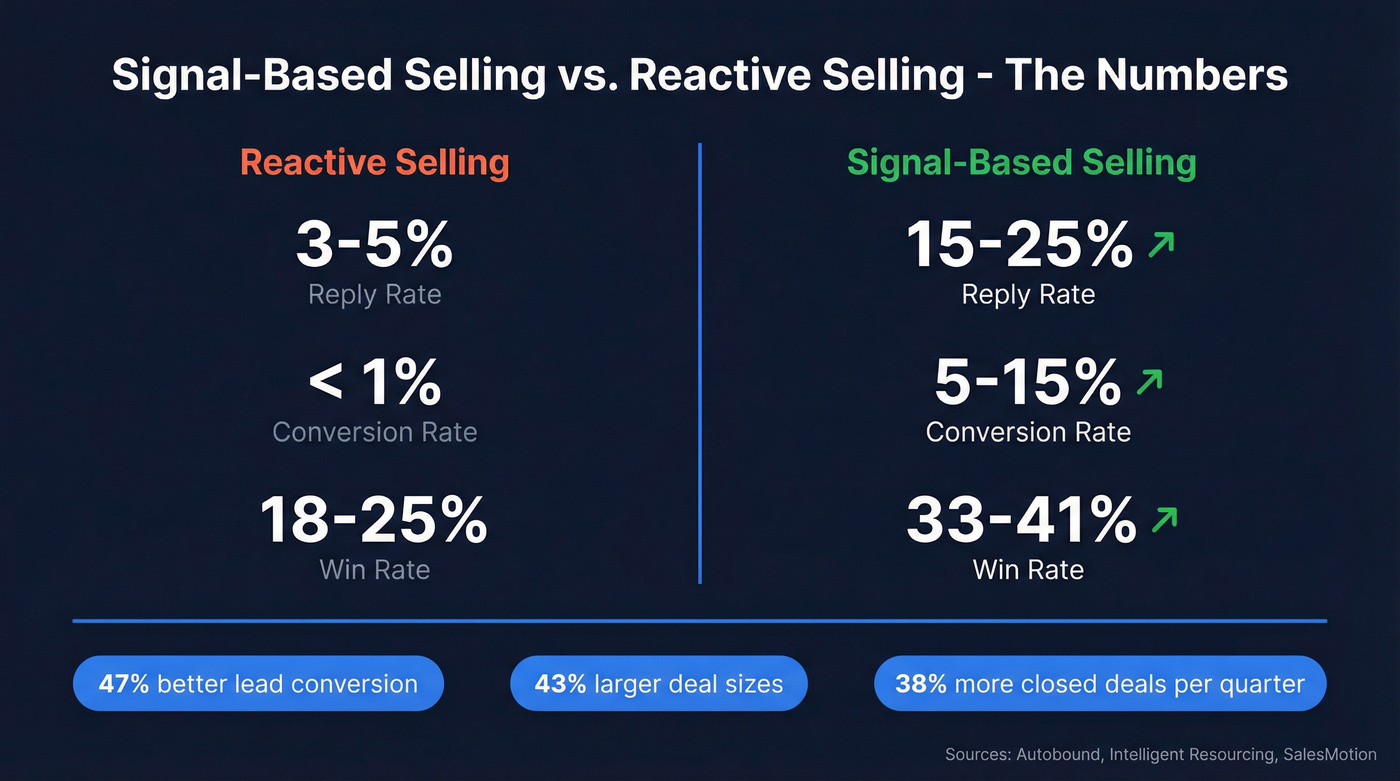
Signal-personalized outreach hits 15-25% reply rates vs. 3-5% for generic cold email. Signal-based outreach converts at 5-15% vs. less than 1% for cold email. That's not a marginal improvement - it's a fundamentally different motion. Proactive opportunities close at 33-41% win rates while reactive deals close at 18-25%, and proactive sellers generate 19-30% higher annual revenue.
Signal-qualified leads convert 47% better, produce 43% larger deals, and generate 38% more closed deals per quarter. Accounts with 3+ active signals convert at 2.4x the rate of single-signal accounts, which is why stacking signal types matters more than perfecting any single one. Frontify's case study is the most concrete example we've found: they grew self-sourced revenue 4x and increased sales velocity by 42% after implementing a signal-driven revenue motion.
Signal Types and Why Granularity Matters
Not all signals are created equal, and the biggest mistake teams make is treating them as interchangeable.
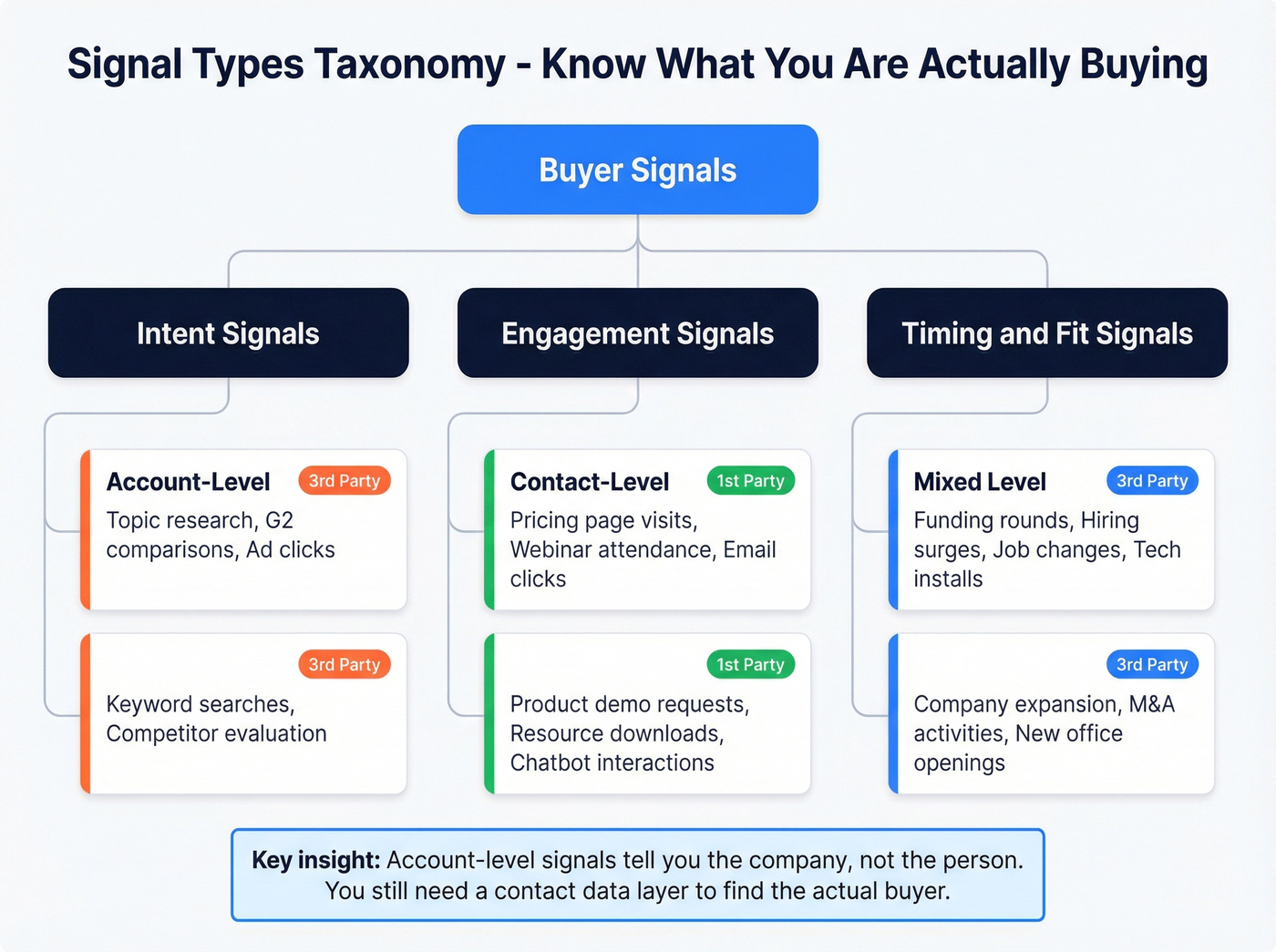
| Category | Example Signals | Level | Source |
|---|---|---|---|
| Intent | Topic research, G2 comparisons, ad clicks | Mostly account | 3rd party |
| Engagement | Pricing page visit, webinar, email clicks | Contact or account | 1st party |
| Timing/Fit | Funding, hiring surge, job change, tech install | Account or contact | 3rd party |
The account-level vs. contact-level distinction is critical and most vendors gloss over it. When Bombora tells you "someone at Acme Corp is researching CRM software," that's account-level. You know the company, not the person. You still need to figure out who the economic buyer is, find their contact info, and reach out.
Contact-level signals are rarer and more valuable. Your own website analytics, webinar attendance, and ad engagement platforms tell you which person took an action. First-party signals from your CRM and marketing automation are often contact-level, which is why they're so useful even if volume is lower.
Don't buy an account-level intent tool and expect reps to know who to call. You need a sales prospecting platforms data layer to bridge the gap between "Acme Corp is in-market" and "here's the VP of Engineering's verified email and direct dial."
Why Most Programs Fail
We've seen teams buy expensive intent platforms and get zero pipeline lift. It's almost always one of three failure modes.
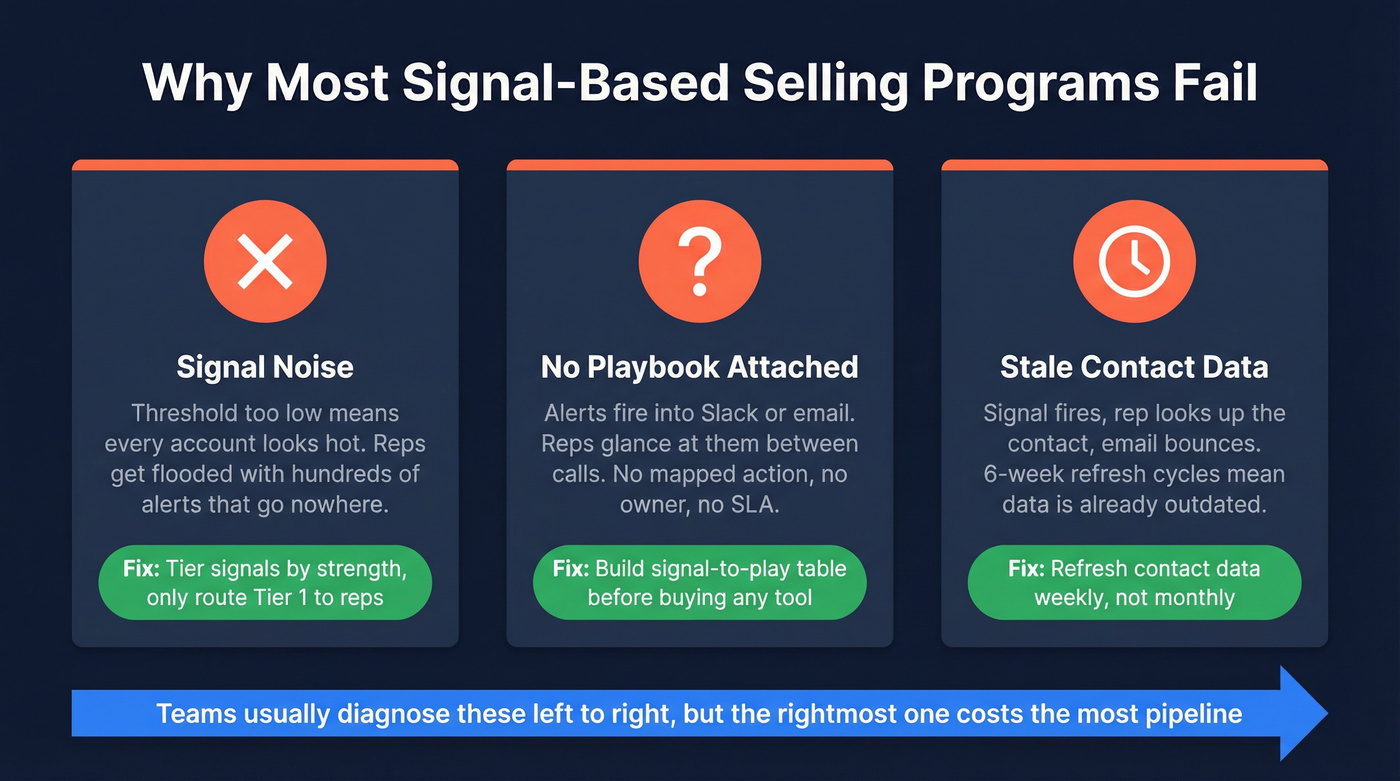
Signal noise drowns out real buying behavior. Demandbase CEO Gabe Rogol put it bluntly: buying weak intent signals gives you "a list of businesses that basically have a pulse." If your threshold is too low, you'll flood reps with hundreds of "hot" accounts that aren't actually buying anything. The fix is simple: tier your signals by strength and only route Tier 1 signals to reps. Everything else goes into nurture sequences.
Signals arrive with no playbook attached. This is the most common failure we see. The intent tool fires alerts, they land in Slack or email, and reps glance at them between calls. There's no mapping of signal to action to owner to SLA. Without that mapping, signals are just interesting data points, not revenue drivers. Build the signal-to-play table before you buy any tool.
Stale data kills execution at the last mile. Here's the thing - a Tier 1 signal fires, the rep looks up the contact, and the email bounces. The phone number is disconnected. The industry average data refresh cycle is six weeks, which means by the time a signal fires and a rep acts, the contact data is already outdated. In our experience, this is the failure mode teams diagnose last but that costs them the most pipeline. You need contact data refreshed weekly, not monthly. (If you want the benchmarks behind this, see B2B contact data decay.)

Your intent signals are only as good as the contact data behind them. Prospeo bridges the gap between account-level signals and real conversations - 143M+ verified emails at 98% accuracy, 125M+ verified mobiles, all refreshed every 7 days. No more bounced emails when a Tier 1 signal fires.
Stop losing signal-qualified deals to stale contact data.
How to Score and Prioritize Signals
Most articles on signal-based selling get vague at this point. Let's get specific. You need a point-based scoring model that separates Tier 1 (act now) from Tier 2 (nurture) from Tier 3 (monitor). Below is a composite model drawn from Belkins' HubSpot implementation and LeadsAtScale's scoring criteria.
| Signal | Points | Tier | Notes |
|---|---|---|---|
| Demo request | +50 | Tier 1 | Highest intent, route immediately |
| Pricing page (repeat) | +30 | Tier 1 | Multiple visits = active evaluation |
| Decision-maker title | +30 | Tier 1 | VP/C-suite at ICP company |
| ICP employee band | +25 | Tier 2 | Right company size |
| Content download | +15 | Tier 2 | Interest, not intent |
| 10+ email clicks | +10 | Tier 2 | Engaged but not buying |
| Pricing page (single) | +10 | Tier 2 | Could be research |
| Intern/student title | -20 | Disqualify | Not a buyer |
| Email bounced | -25 | Disqualify | Bad data, remove |
| Competitor domain | -30 | Disqualify | Competitive intel, not a lead |
Tier 1 (75+ points) gets routed to an AE immediately with a 1-3 hour SLA. These are active buyers. Tier 2 (30-74 points) enrolls in an SDR sequence - multi-touch over 2 weeks while they warm up. Tier 3 (under 30 points) goes to marketing nurture only. Don't waste rep time.
Review your scoring monthly. If high-scoring leads aren't converting, audit the criteria. If low-scoring leads are converting, you're missing a signal. Belkins explicitly de-emphasizes email opens now due to Apple Mail Privacy Protection - shift weight toward on-site behavior and deeper engagement signals instead. (For a deeper build, use this lead scoring system guide.)
Signal-to-Action Mapping
This section separates teams that talk about signal-based selling from teams that actually execute it. Every signal type needs a mapped play with a clear owner and SLA.
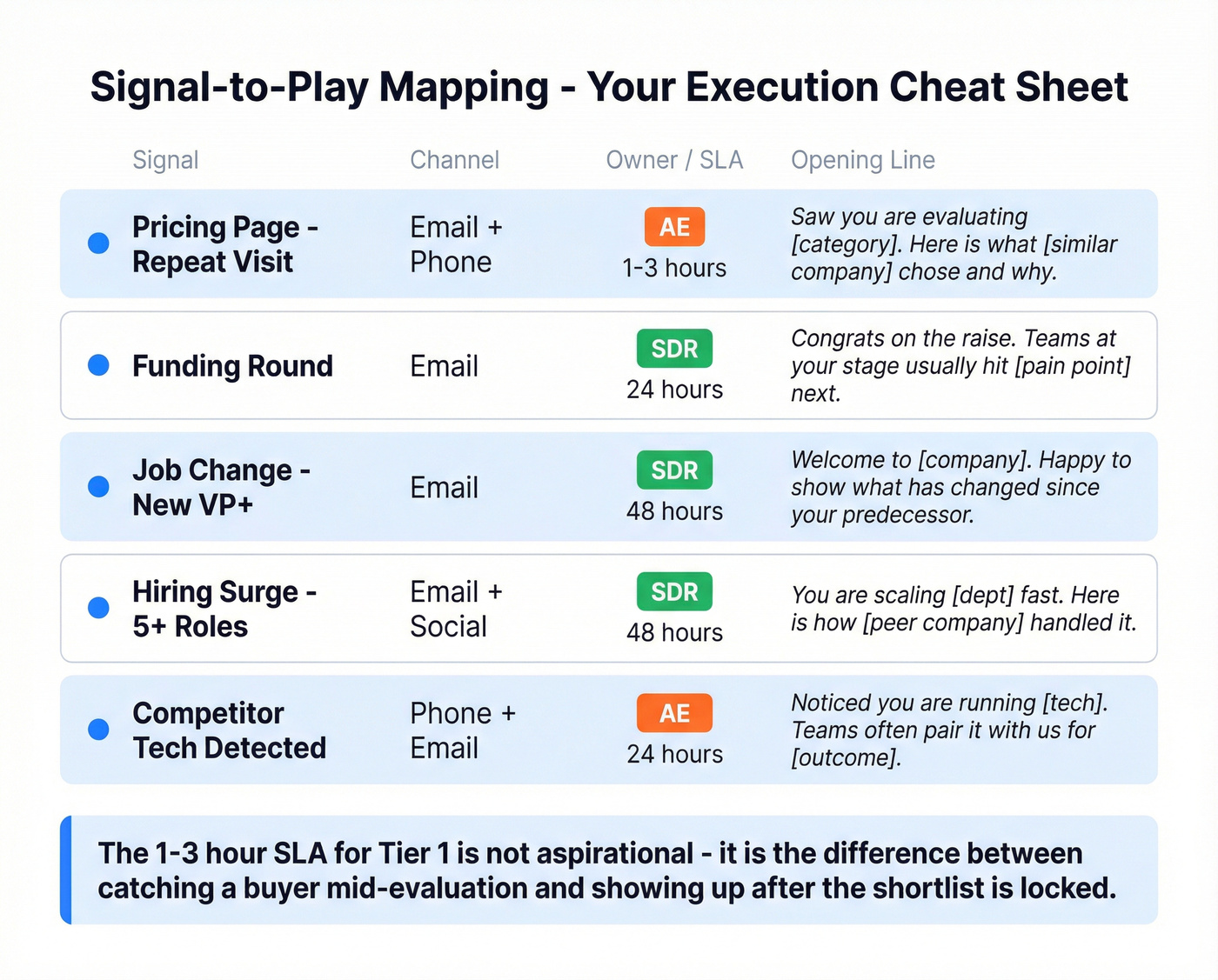
Pricing Page (Repeat Visit in 7 Days)
Channel: Email + phone. AE owns, 1-3 hour SLA. "Saw you're evaluating [category]. Here's what [similar company] chose and why."
Funding Round Announced
Channel: Email. SDR owns, 24-hour SLA. "Congrats on the raise. Teams at your stage usually hit [pain point] next."
Job Change (New VP+ at ICP)
Channel: Email. SDR owns, 48-hour SLA. "Welcome to [company]. Your predecessor used [competitor] - happy to show what's changed."
Hiring Surge (5+ Open Roles in Dept)
Channel: Email + social. SDR owns, 48-hour SLA. "You're scaling [dept] fast. Here's how [peer company] handled [challenge] at your stage."
Tech Install (Competitor Detected)
Channel: Phone + email. AE owns, 24-hour SLA. "Noticed you're running [tech]. Teams often pair it with [your product] for [outcome]."
The 1-3 hour SLA for Tier 1 signals isn't aspirational. It's the difference between catching a buyer mid-evaluation and showing up after they've already shortlisted. A pricing page visit from three days ago is stale. One from two hours ago is a live opportunity. If you want the operational setup, map this to your RevOps lead scoring and routing rules.
Crawl, Walk, Run
Don't try to automate everything on day one. Common Room's maturity framework maps this well.
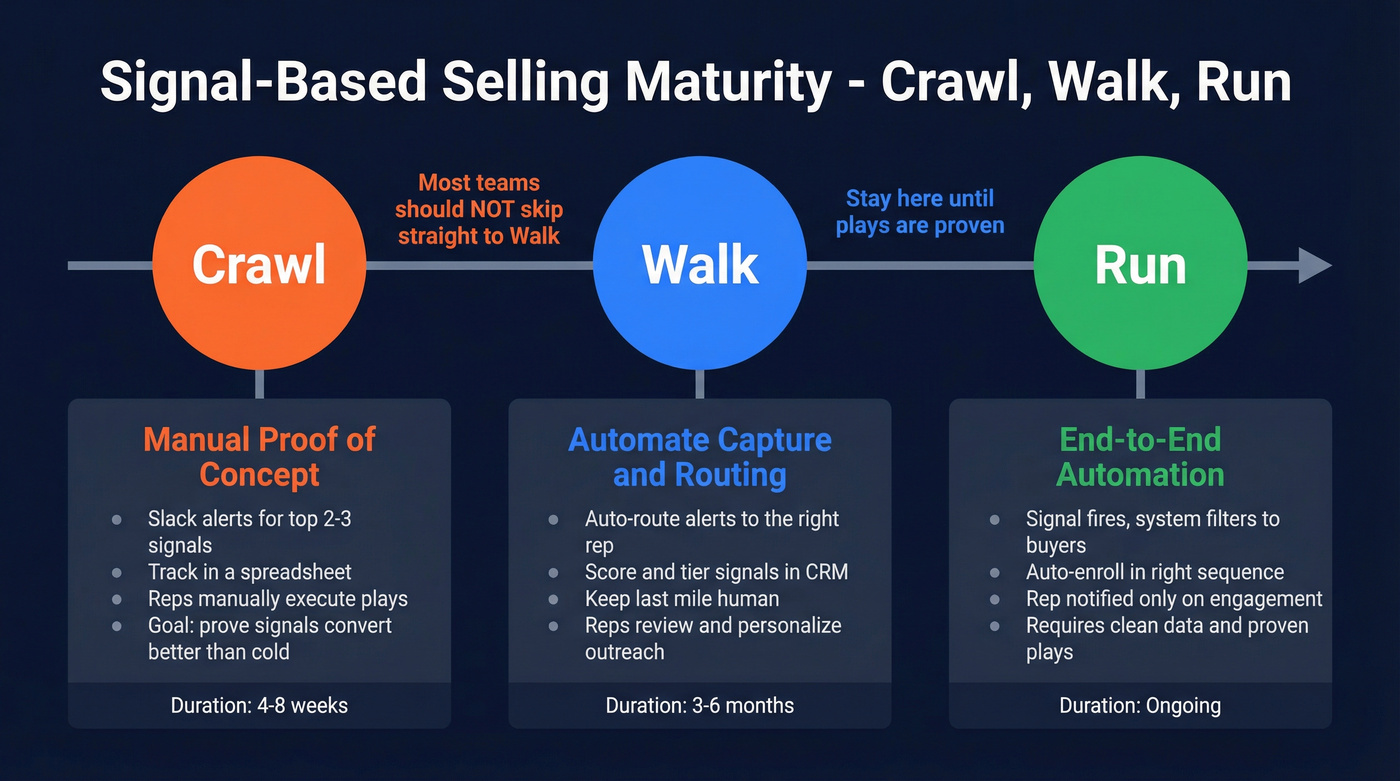
Crawl: Manual proof-of-concept. Set up Slack alerts for your top 2-3 signals. Track them in a spreadsheet. Have reps manually execute plays. The goal is to prove that signal-triggered outreach converts better than cold - and to learn which signals actually correlate with pipeline. Teams that skip this phase and jump straight to automation waste 2-3 months debugging workflows built on unproven assumptions.
Walk: Automate signal capture and segmentation. Route alerts to the right rep automatically. Score and tier signals in your CRM. But keep the last mile human - reps still review signals and personalize outreach. This is where most teams should live for 3-6 months.
Run: End-to-end automation. Signal fires, system filters to economic buyers, auto-enrolls in the right sequence, rep gets a notification only if the prospect engages. This requires clean data, proven plays, and confidence in your scoring model. Don't skip to this stage.
Our honest take: most teams should stay in "Walk" permanently. Full automation sounds great in a vendor demo, but the best signal-driven teams we've seen keep a human in the loop for Tier 1 signals. The personalization lift from a rep who actually reads the signal context before writing the email is worth more than the time savings from full automation. The consensus on r/sales tends to agree - reps who blindly trust automated signal routing end up spamming accounts that looked hot on paper but weren't actually buying. (If you're building this end-to-end, start with a prospecting workflow that enforces SLAs.)
What It Actually Costs
Intent data isn't cheap, and vendors make it deliberately hard to compare pricing.
| Tool | Annual Cost | Notes |
|---|---|---|
| Bombora | $25K-$80K | Standalone intent, Co-op model |
| 6sense | $35K-$150K+ | Full ABM platform |
| Demandbase | $40K-$120K | ABM + intent + advertising |
| ZoomInfo Intent | $7.2K-$36K | Add-on to ZoomInfo contract |
| G2 Buyer Intent | $10K-$87K+ | Scales with features |
A single intent data source can cost more than your entire SDR team's base salary. That's why most teams don't need the $100K+ platforms to start. Budget an additional 15-25% above license cost for implementation, configuration, and ongoing optimization. These tools don't work out of the box. (To pressure-test spend, use a cost of sales tech stack model.)
The Minimum Viable Tool Stack
You don't need 6sense AND Bombora AND Demandbase. You need four tools, not fourteen: one intent source, one contact data platform, a CRM, and a sales engagement tool.
For intent, Bombora is the most flexible standalone option at $25K+. For the full ABM suite, 6sense is the market leader but you're looking at $35K minimum. ZoomInfo's Streaming Intent add-on is the cheapest entry point if you're already a ZoomInfo customer. (If you're comparing platforms, see 6sense vs ZoomInfo.)
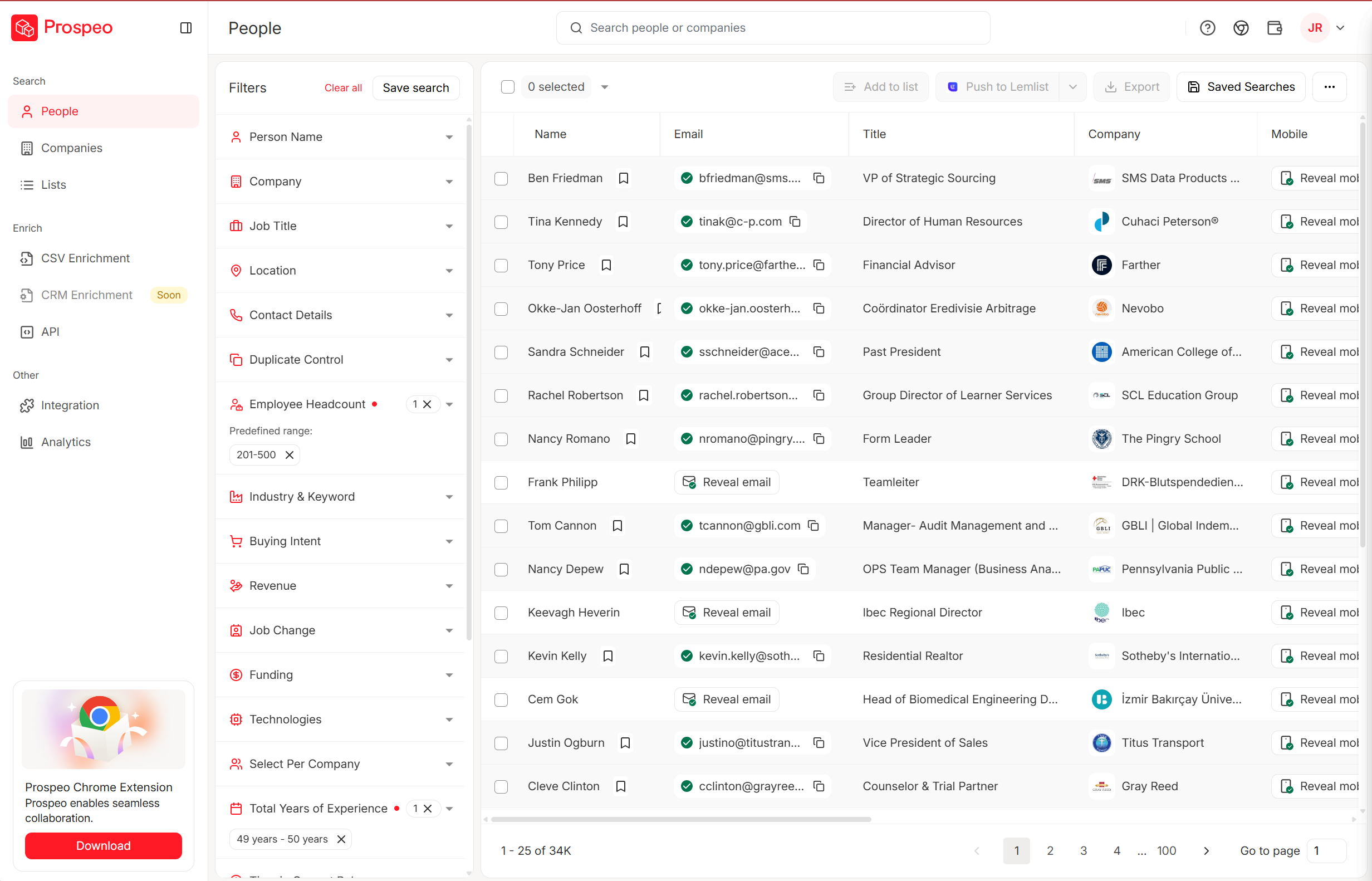
For contact data - and this is where most signal programs actually break - you need verified emails and mobile numbers that are fresh enough to act on when signals fire. Prospeo handles this with 98% email accuracy and a 7-day data refresh cycle, so when a Tier 1 signal fires, the email you send actually lands instead of bouncing. It also includes Bombora-powered intent data across 15,000 topics, which means you can layer buying signals directly into your prospecting workflow without a separate intent contract.
For EMEA-heavy teams, Cognism is worth evaluating - they've got strong European mobile coverage and GDPR-first data practices, with custom pricing that typically lands around $15K-$25K annually for small teams.
Skip this if you're a team of 2-3 reps doing fewer than 500 outbound touches per month. At that volume, you can manually monitor signals through free tools like Google Alerts, Crunchbase news feeds, and your own website analytics. The investment in paid signal tools only makes sense when you've got enough rep capacity to act on what the tools surface.
For CRM, you already have one. For sales engagement, Instantly, Smartlead, or Outreach - pick based on your volume and budget. (If you're shopping, start with these cold email marketing tools.)
You just read that teams need contact-level data to act on account-level intent signals. Prospeo gives you exactly that: 300M+ profiles with 30+ filters including buyer intent powered by Bombora, technographics, job changes, and hiring surges - all in one platform at $0.01 per email.
Stack signals and verified contacts in a single search. No enterprise contract required.
FAQ
What's the difference between signal-based selling and intent-based selling?
Signal-based selling is the umbrella term covering all buyer behavior data - intent signals, engagement signals, timing signals, and fit signals. Intent-based selling focuses specifically on topic-level research behavior like Bombora surge data. The most effective programs combine 3+ signal types rather than relying on intent data alone, converting at 2.4x the rate of single-signal approaches.
How many signals should we track to start?
Start with 2-3 high-conversion signals, not 15. Common Room's framework points to a "golden zone" of moderate volume with high conversion. Pricing page visits and demo requests are the obvious starting pair. Add one third-party signal like funding or hiring once you've proven the first two plays convert.
Can I build a signal-based sales strategy without a huge budget?
Start with first-party signals from your CRM and website analytics - these are free and contact-level. Pair with a contact data tool for verified emails and direct dials when signals fire, then add standalone third-party intent platforms only after you've validated your plays with first-party data. Many teams get 80% of the value from first-party signals alone.