

SMB vs Mid-Market: What Actually Changes (With 2026 Benchmarks)
Your best rep just crushed quota selling to 50-person companies. Now the VP wants the team "moving upmarket." Everyone nods. Nobody asks what that actually means - operationally, structurally, or financially.
The SMB vs mid-market question isn't about definitions. It's about what changes in your sales motion, your data needs, and your unit economics when the buyer gets more complex. Most teams figure this out the hard way, two quarters into a missed number.
The Short Version
Forget headcount cutoffs. The real dividing line is buyer complexity - how many stakeholders, how much procurement friction, and who holds budget authority.
Win rates compress as you move up. SMB and mid-market deals close at roughly 39% opportunity-to-close (combined benchmark). Enterprise drops to 31%. That 8-point gap compounds across your entire pipeline.
Your prospecting motion must change by segment. Finding one founder's email is a completely different problem than reaching 2-6 stakeholders across departments in a mid-market org. (If you’re rebuilding outbound for this shift, start with proven sales prospecting techniques.)
Definitions That Actually Matter
Employee and Revenue Thresholds
Ask five people to define "mid-market" and you'll get five different answers. One widely shared compilation from La Growth Machine summarizes common mid-market revenue ranges:
| Authority | Mid-Market Revenue |
|---|---|
| Gartner | $50M-$1B |
| NCMM | $10M-$1B |
| Harvard Business Review | $50M-$1B |
| IDC (Tech) | $100M-$999.9M |
| Deloitte | $100M-$1B |
Employee bands are slightly more consistent: SMB runs 1-99 employees, mid-market 100-1,000, enterprise 1,000+. For context, SMB stands for "small and medium-sized business," though the exact boundaries shift depending on who you ask.
But even here, ZoomInfo's own framework puts mid-market at 500-2,000 employees - nearly double the lower bound most others use. Some frameworks also carve out a "prosumer" or solopreneur tier below SMB, which matters if you're selling dev tools or PLG products where individual buyers convert before the company does.
Then there's the revenue-headcount mismatch. A 40-person fintech doing $200M in revenue is "SMB" by headcount and "mid-market" by revenue. GTMnow flags this edge case explicitly, and it's more common than you'd think.
Why the Definition Debate Is a Distraction
What actually changes between segments isn't headcount - it's buyer complexity. How many people need to say yes? Does procurement get involved? Is there in-house legal reviewing your contract?
99.9% of US businesses are SMB. The EU uses entirely different bands (micro under 10, small 10-49, medium 50-249). If you're waiting for a universal definition before building your segmentation strategy, you'll be waiting forever. Pick a framework, commit, and move on.
Why Mid-Market Sales Matter
Mid-market companies contribute roughly $10 trillion to US GDP - about 33% of the total. They employ 47.9 million people and drive 40% of job creation. Yet most B2B vendors treat mid-market as a layover between SMB and enterprise.
That's backwards. Mid-market is the destination for most B2B companies. The deals are large enough to build real revenue on, the sales cycles are manageable, and the buyers are accessible. Enterprise gets the glamour. Mid-market pays the bills.
How SMB and Mid-Market Differ in Practice
| Dimension | SMB | Mid-Market | Enterprise |
|---|---|---|---|
| Revenue | <$50M | $50M-$1B | $1B+ |
| Employees | 1-99 | 100-1,000 | 1,000+ |
| Avg deal size | $5K-$15K | $25K-$75K | $100K-$500K+ |
| Sales cycle | 1-3 months | 4-6 months | 12-18+ months |
| Stakeholders | 1-2 | 2-6 | 8-15+ |
| Win rate | ~39% | ~39% | ~31% |
| Decision-maker access | Direct (founder) | Accessible C-suite | Gated (procurement) |
| Data needs | Find the founder | Map 2-6 stakeholders | Map 10+ buying committee |
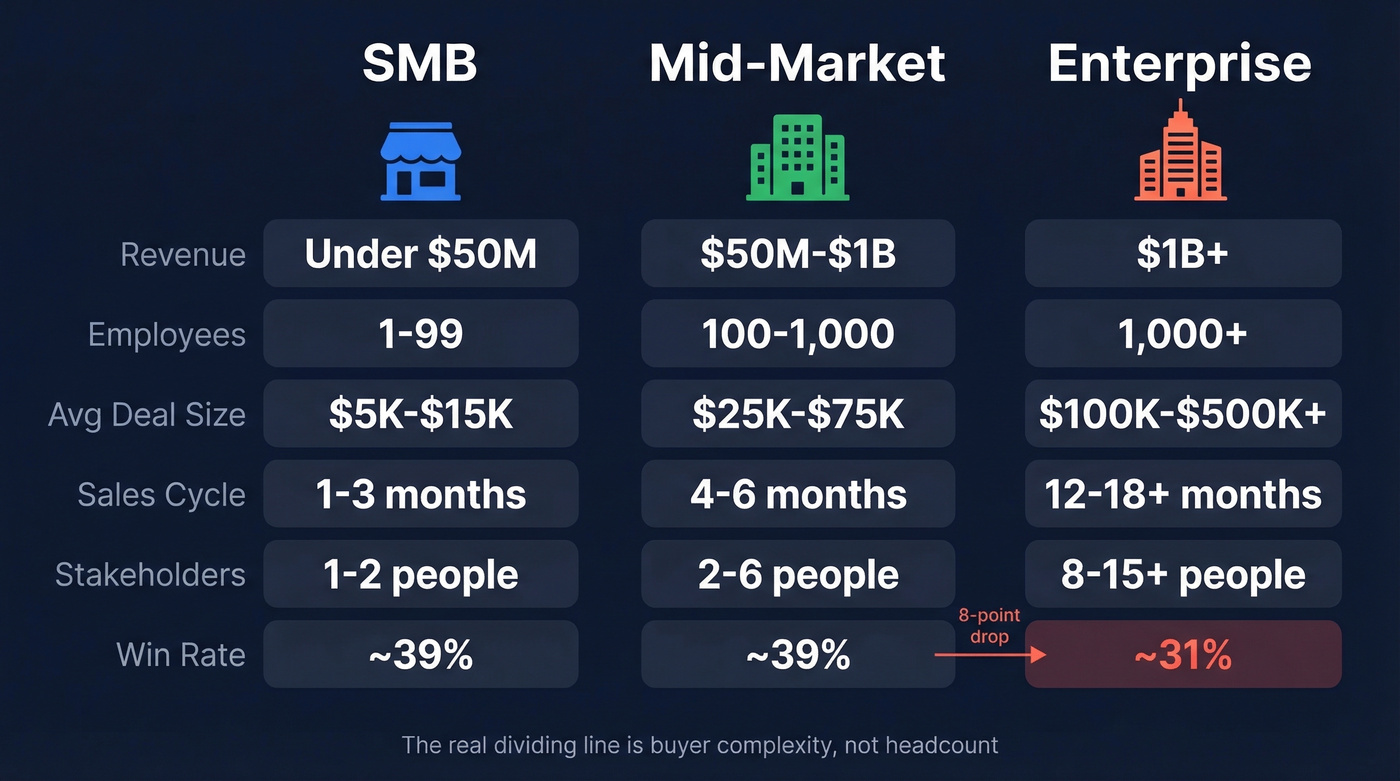
The win-rate row is where your eyes should land. Both SMB and mid-market convert at roughly the same rate, but enterprise drops 8 points. That doesn't sound dramatic until you model it across pipeline - a hundred opportunities per quarter at enterprise means 8 fewer closed deals, at a cycle length that's 3-4x longer than mid-market. (To sanity-check your funnel math, compare against sales pipeline benchmarks.)
The real cost isn't just longer cycles. It's the deals that stall because you're using an SMB motion on a mid-market account, or burning enterprise-level resources on a deal that can't support the cost of sales.
Unit economics shift meaningfully too. As you move upmarket, CAC rises but churn typically drops - which is why the longer payback period can still pencil out. Mid-market sits in the sweet spot: CAC is manageable, deal sizes justify dedicated reps, and retention rates are strong enough to build predictable revenue. (If you’re modeling this, use a clean cost to acquire customer framework.)

Mid-market deals live or die on multi-threading. Losing even one thread to a bounced email can stall a $50K deal for weeks. Prospeo gives you 98% accurate emails and 125M+ verified mobiles across 2-6 stakeholders - refreshed every 7 days, not 6 weeks.
Stop losing mid-market threads to bad data.
Sales Cycle Benchmarks
By ACV Band
| ACV | Median Days | Top Quartile | Drag Signal |
|---|---|---|---|
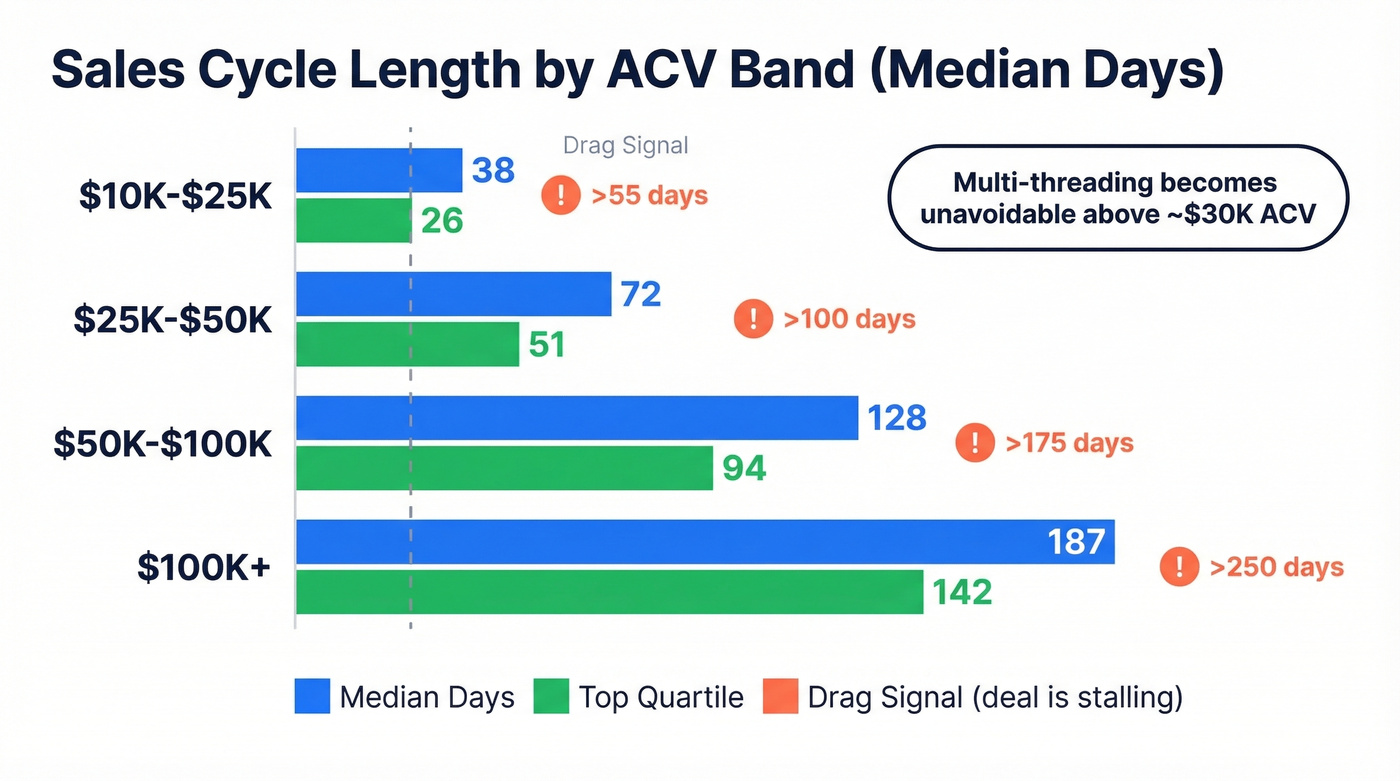
| $10K-$25K | 38 | 26 | >55 |
| $25K-$50K | 72 | 51 | >100 |
| $50K-$100K | 128 | 94 | >175 |
| $100K+ | 187 | 142 | >250 |
By Company Size
| Employees | Cycle (Days) |
|---|---|
| 1-10 | 38 |
| 11-50 | 57 |
| 51-200 | 77 |
| 201-500 | 95 |
| 501-1,000 | 115 |
| 1,001-5,000 | 135 |
| 10,001+ | 185 |
Multi-threading becomes unavoidable above ~$30K ACV. That's the threshold where a second stakeholder reliably appears in the deal. Procurement, legal, and security reviews add 30-45 days in the $50K-$100K band.
The broader trend isn't encouraging: 58% of B2B professionals report sales cycles got longer over the past year, and the average buying committee now runs 6.3 stakeholders. If you're selling into mid-market without a multi-threading strategy, you're at a measurable disadvantage. (This is also where tighter sequence management starts to matter.)
Mistakes That Kill Mid-Market Deals
1. Running your SMB playbook. The founder-to-founder, one-call-close motion that works at 20-person companies stalls the moment a deal hits committee review. Mid-market buyers need business cases, not just demos. (If your discovery is still SMB-style, rebuild it with better discovery questions.)
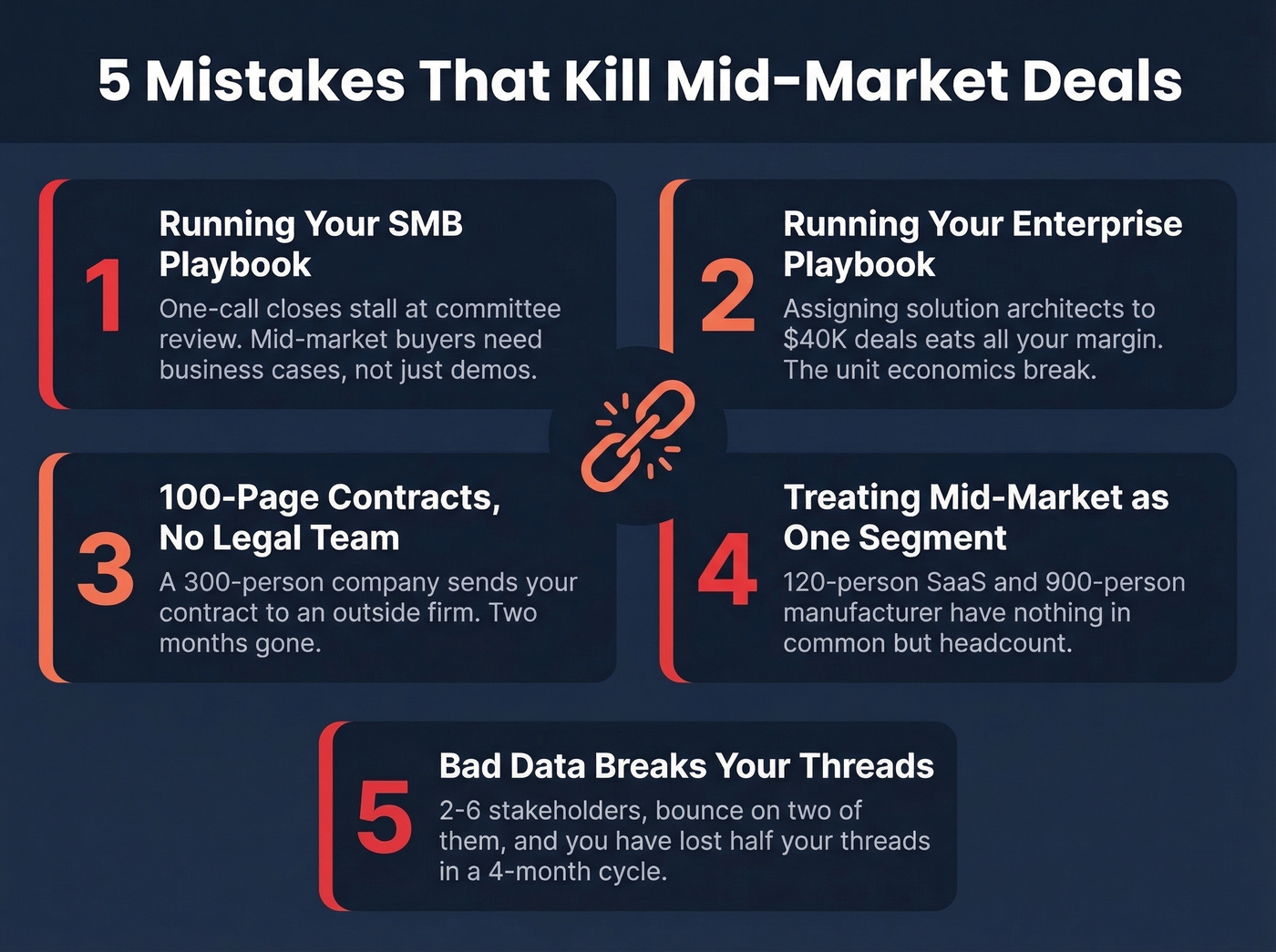
2. Running your enterprise playbook. Equally fatal in the other direction. Enterprise GTM applied to mid-market accounts is unprofitable - the cost of sales eats the margin. We've seen teams assign dedicated solution architects to $40K deals. The unit economics just don't work. (If you’re truly going big-logo, study the mechanics of enterprise B2B sales.)
3. Sending 100-page contracts to companies without legal. Mid-market companies often have small or outsourced IT teams and no in-house legal. A contract that takes a Fortune 500 company two weeks to redline takes a 300-person manufacturer two months - because they're sending it to an outside firm that bills hourly. Right-size your paperwork.
4. Treating mid-market as homogeneous. A 120-person SaaS company and a 900-person manufacturer have nothing in common except falling in the same headcount range. Segment within the segment. Selling cybersecurity to a small business requires a completely different value proposition than selling the same product to a mid-market healthcare system with compliance mandates.
5. Letting bad data break your threads. Mid-market deals involve 2-6 decision-makers. Bounce on two of them and you've lost a huge chunk of your threads in a 4-month cycle. This is where data quality becomes a deal-level risk, not just a deliverability metric. Meritt saw bounce rates drop from 35% to under 4% after switching to Prospeo's verified email infrastructure - when you're multi-threading into a VP of Engineering, a CFO, and a Head of IT simultaneously, every invalid email is a broken thread you can't afford. (If you’re diagnosing this, start with email bounce rate benchmarks and causes.)
When to Move Upmarket
There's a concept called the "Inbound Wall" that explains why mid-market GTM breaks in enterprise. Tactics that generate 500 MQLs per month at $10K-$50K ACV produce fewer than 50 above $100K. MQL volume collapses, SDR burnout spikes, and CAC inflates as teams try to buy volume with paid channels. (This is also why a tighter ideal customer profile becomes non-negotiable.)
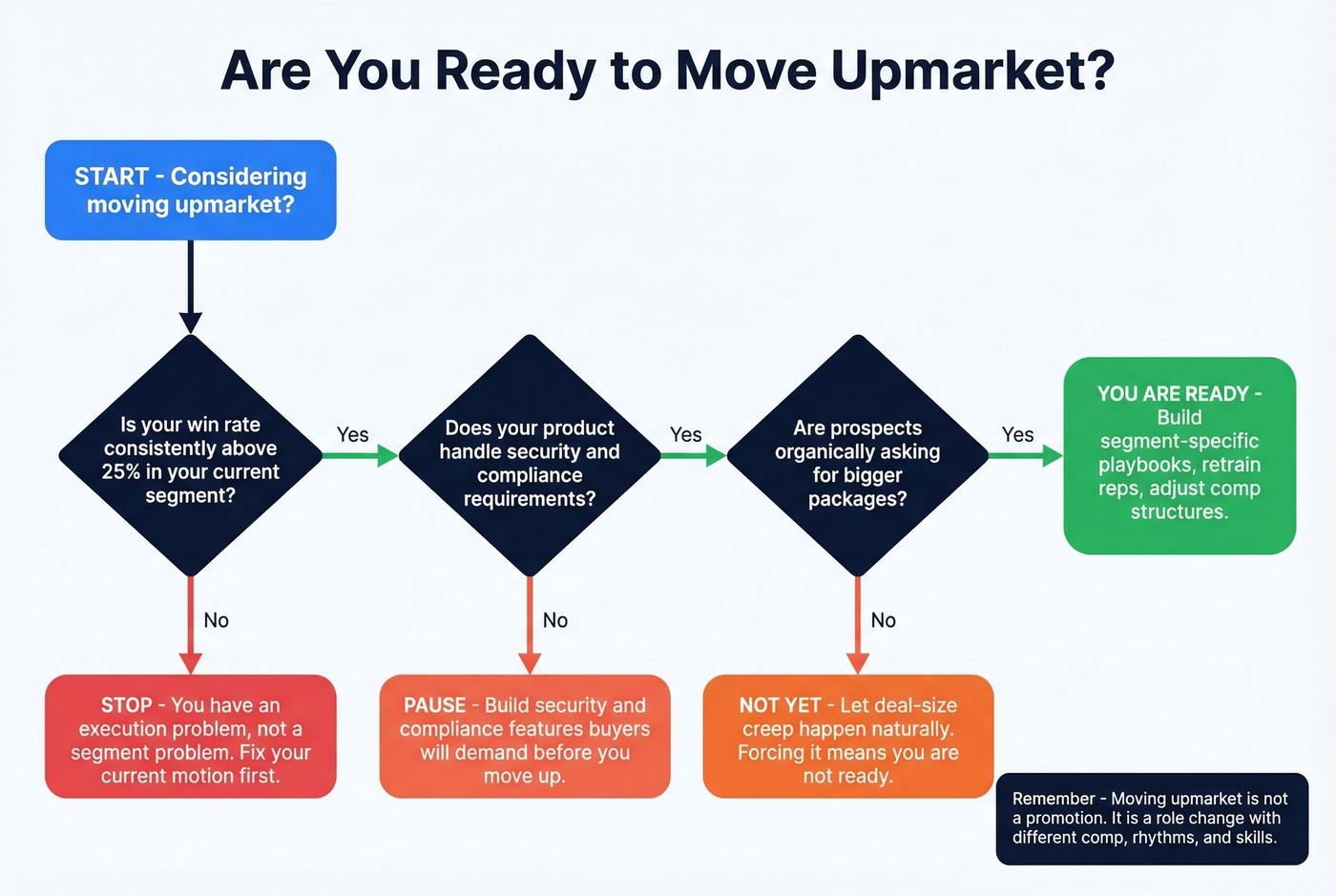
Enterprise buyers don't fill out forms. They rely on peer networks, analyst briefings, and warm introductions. The motion is fundamentally different.
The most common mistake we see: promoting the top SMB rep into an enterprise role without retraining. Here's the thing - sales reps who've made the jump consistently say the hardest adjustment isn't the deal size. It's the stakeholder navigation. Great transactional sellers often struggle with 6-month discovery cycles, multi-stakeholder consensus building, and territory planning at the enterprise level. It's not a promotion. It's a role change, with different comp structures, different daily rhythms, and a completely different definition of "productive."
You're ready to move upmarket when:
- Your win rate is consistently above 25% in your current segment
- Your product handles security and compliance requirements buyers will demand
- Deal-size creep is happening organically - prospects are asking for more, not being pushed into bigger packages
If you're forcing it, you're not ready.
Let's be honest: most teams move upmarket too early. If your ACV is under $25K and your close rate is below 30%, you don't have a segment problem - you have an execution problem. Fix your current motion before adding complexity. This is especially true for B2B startup sales teams that haven't nailed product-market fit in their initial segment. Learning how to land customers profitably should come before chasing larger logos.
How to Operationalize Segmentation
Defining segments is the easy part. Operationalizing them is where most teams stall.
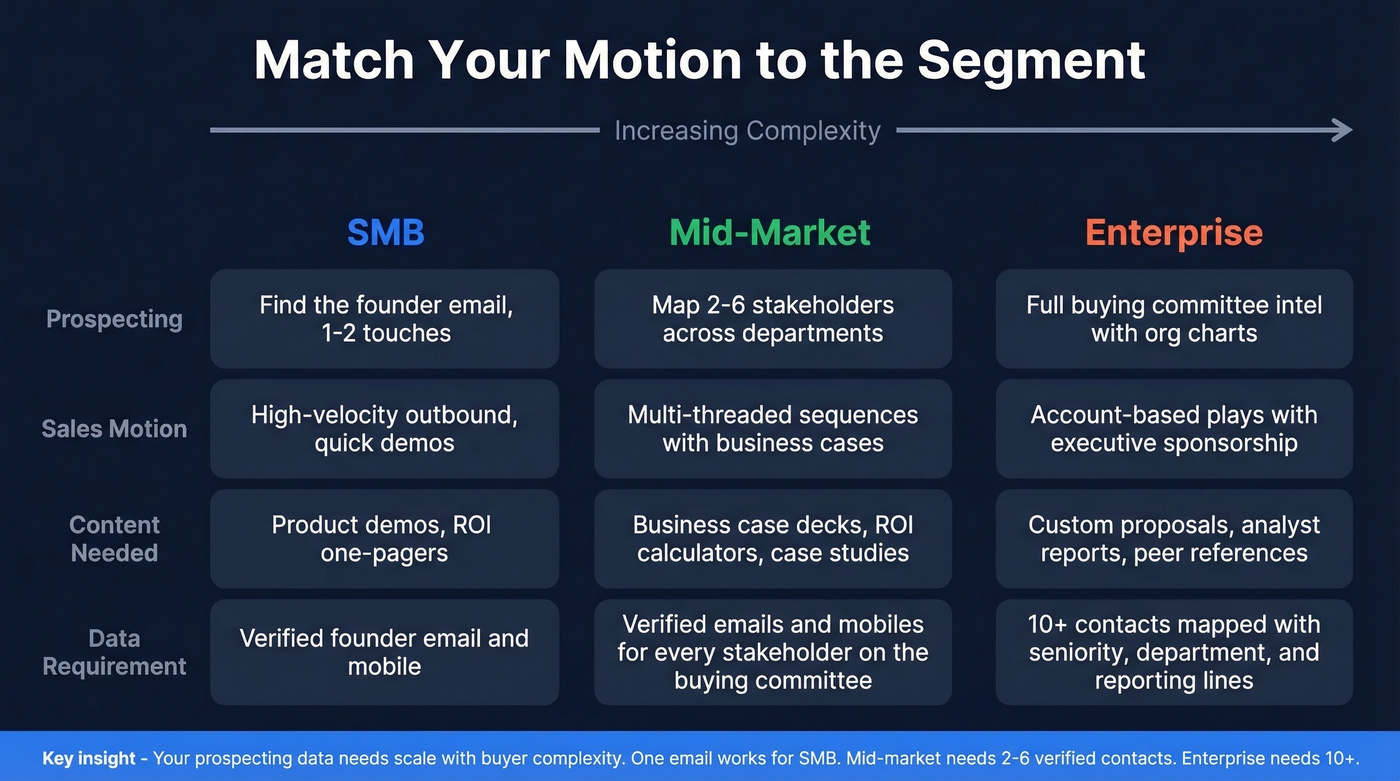
1. Pick a framework and commit. Whether you use $50M revenue or 100 employees as your mid-market floor, consistency matters more than precision. Tag every existing account in your CRM with a segment label - SMB, mid-market, enterprise. Revisit the tags quarterly as companies grow. A fast-scaling startup can jump from SMB to mid-market in a single funding round.
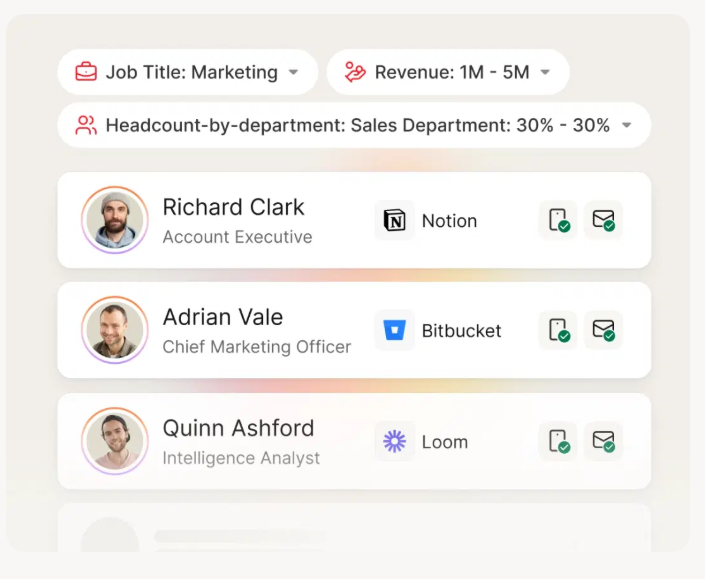
2. Build segment-specific prospect lists. SMB prospecting means finding the founder's email and getting a response in one or two touches. Mid-market means mapping 2-6 stakeholders across departments - finance, IT, operations, the executive sponsor. Enterprise means full buying committee intelligence with org chart context. Prospeo's 30+ search filters let you segment by headcount, revenue, funding stage, department headcount, and buyer intent, then pull verified emails and mobile numbers for every stakeholder on the buying committee. (If you’re tightening list quality, use firmographic and technographic data correctly.)
3. Match your motion to the segment. SMB gets high-velocity outbound with quick demos. Mid-market gets multi-threaded sequences with business-case content. Enterprise gets account-based plays with executive sponsorship. For teams that sell across verticals, the motion needs further tuning - selling to healthcare or education requires messaging that addresses regulatory and budget-cycle realities those buyers live with daily. (For the enterprise side of this, lean on account-based selling best practices.)
4. Track segment-level metrics separately. Blended pipeline metrics hide problems. A 35% win rate that combines 45% SMB and 20% enterprise tells you nothing useful. Break out conversion rates, cycle length, and CAC by segment so you can see where the motion is working and where it's broken. Skip this step if you're pre-revenue or running fewer than 20 deals per quarter - you won't have enough data to draw meaningful conclusions. (If you need a clean dashboard spec, start with pipeline health.)

Moving upmarket means mapping buying committees, not just finding one founder. Prospeo's 30+ search filters - including department headcount, funding, and buyer intent - let you segment SMB from mid-market and reach every decision-maker at $0.01 per email.
Build mid-market pipeline without enterprise-grade pricing.
FAQ
What's the difference between mid-market and enterprise?
Mid-market companies have 100-1,000 employees and $50M-$1B in revenue; enterprise means 1,000+ employees and $1B+ revenue. Operationally, mid-market deals involve 2-6 stakeholders and close in 4-6 months, while enterprise deals involve 8-15+ stakeholders and take 12-18+ months with heavier procurement and legal review.
How many employees is considered SMB?
Most frameworks define SMB as under 100 employees with revenue below $50M, though some vendors set the ceiling at 500. The defining characteristic isn't size - it's that one or two decision-makers hold direct budget authority and can move quickly without committee approval.
What is considered mid-market revenue?
The most common range is $50M-$1B. The NCMM uses a broader $10M-$1B definition, while IDC and Deloitte start at $100M for tech companies. For practical B2B segmentation, $50M is the most widely accepted floor.
How do you segment accounts in your CRM?
Tag accounts using firmographic data - employee count and annual revenue are the most reliable fields. Then layer in behavioral signals: number of stakeholders engaged, deal size, and cycle length. A "mid-market" account that closes in one call with one buyer is behaving like SMB regardless of headcount.
What tools work best for mid-market prospecting?
Mid-market prospecting requires multi-stakeholder mapping - verified contact data for 2-6 people per account, not just the CEO. Prospeo handles this with 30+ filters across headcount, revenue, and intent signals, with 98% email accuracy across 300M+ profiles. For enterprise-only needs with deep org chart mapping, ZoomInfo offers that capability but starts around $15K/year.