

SNAP Selling: What It Is, How It Works, and How to Actually Use It
Your prospect opened your email, clicked through to the case study, replied asking for a call - then went completely dark. Two follow-ups later, nothing. They didn't choose a competitor. They chose to do nothing, because doing nothing was easier than processing another vendor pitch.
That's the exact problem Jill Konrath built the SNAP selling framework to solve. The methodology dates to 2010, but the buyer behavior it addresses - decision fatigue, overwhelm, defaulting to inaction - has only gotten worse. Here's the full framework, the scripts, and a modern execution playbook so you can actually put it to work.
The Short Version
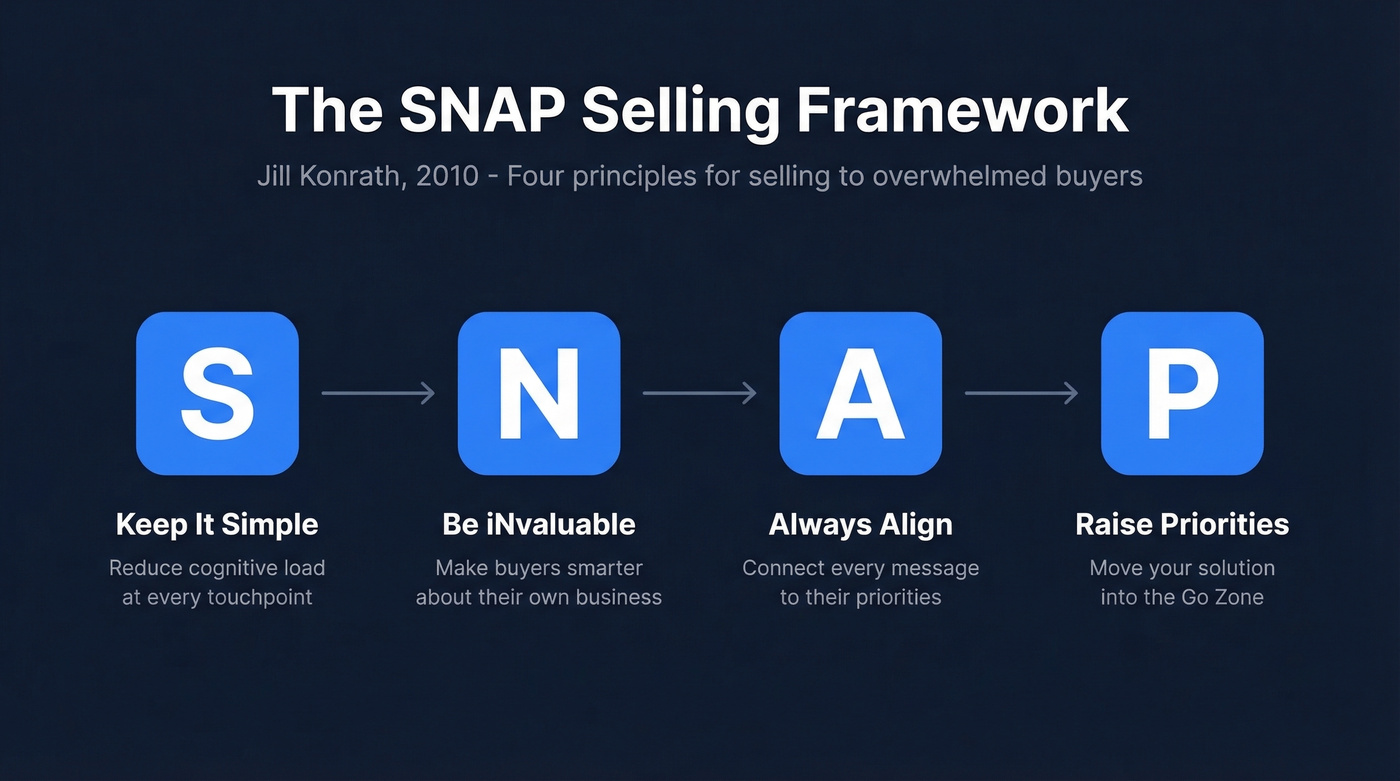
SNAP Selling is Jill Konrath's four-principle framework for selling to overwhelmed buyers: keep it Simple, be iNvaluable, always Align, raise Priorities. The book runs 320 pages; the actionable framework fits on one page. We've distilled the framework, the scripts, and a 2026 execution playbook below - no book purchase required.
What Is SNAP Selling?
Jill Konrath's SNAP Selling: Speed Up Sales and Win More Business with Today's Frazzled Customers was first published in 2010. She coined the term "Frazzled Customer Syndrome" to describe what happens when decision-makers juggle too many priorities, too many vendors, and too many internal stakeholders to evaluate anything properly.
The core insight is simple: your biggest competitor isn't another vendor. It's your buyer's status quo and their instinct to defer decisions that feel complicated.
The book carries a 3.88 rating on Goodreads. A common criticism is that it's repetitive and longer than it needs to be if you only want the core framework. Fair enough - that's why guides like this one exist.
Here's the thing: the problem SNAP addresses has gotten dramatically worse since 2010. Gartner's research shows that enterprise B2B buying groups typically involve 5-11 stakeholders, and every one of those people is overwhelmed, distracted, and defaulting to "let's revisit this next quarter." If your sales approach adds complexity to their lives, you lose before you even pitch.
The Four SNAP Principles
Keep It Simple
Here's a test: take your last outbound email and ask, "Would a busy VP read this in 30 seconds?" If the answer is no, cut it.
Three sentences is the sweet spot. One sentence on why you're reaching out, one on the specific value, one clear ask. That's it. Simplicity isn't about dumbing down your product - it's about reducing the cognitive load your buyer faces at every touchpoint. Overwhelmed buyers don't evaluate complex pitches. They delete them. The path of least resistance is always "ignore this and deal with it later," which in practice means never.
Discovery questions that embody this principle:
- "What's the one metric your team is measured on this quarter?"
- "If you could fix one thing about your current process, what would it be?"
Be iNvaluable
Your buyer can Google product features. What they can't Google is how those features map to their specific situation.
Being invaluable means showing up as someone who understands their world - not a rep who recites a feature list. Buyers grant time to people who make them smarter. If every interaction teaches them something about their own business, you earn the next meeting. The key is specificity: generic "thought leadership" doesn't count. You need to reference their industry, their company size, or their tech stack.
Discovery questions: "How are you handling [specific challenge] right now - manually or with a tool?" and "What changed in the last 6 months that made this a priority?" (If you want more options, pull from these discovery questions and open-ended questions.)
Email snippet: "Teams in [their industry] are seeing [specific result] by changing [specific thing]. Happy to share what's working - 15 minutes?"
Always Align
Every message, every meeting, every proposal needs to connect directly to what your buyer already cares about - their stated objectives, their boss's priorities, their company's public goals. The moment you drift into features that don't map to their world, you've lost alignment and they mentally check out.
Alignment isn't a one-time exercise. You re-align at every stage of the deal because the priorities your champion stated in the first call may have shifted by the third.
| Alignment Move | Example |
|---|---|
| Discovery question | "What did your CEO highlight in the last all-hands as the top priority?" |
| Follow-up question | "How does solving this problem connect to your team's goals this quarter?" |
| Outbound email | "Saw [company] just announced [initiative]. We help teams executing on [related goal] - worth a quick conversation?" |
Raise Priorities
This is where SNAP gets tactical. Konrath introduces the concept of the "Go Zone" versus the "D-Zone." The Go Zone is the narrow window where your buyer's problem feels urgent enough to act on. The D-Zone is everything else - important but not urgent, which means it gets deferred indefinitely.
Your job is to move your solution into the Go Zone by connecting it to trigger events: a missed quarter, a competitor launch, a leadership change, a funding round. (More on building urgency without being pushy: create urgency in sales.)
Look, if you can't identify a trigger event, you probably don't have a deal. You have a conversation. The methodology is honest about that distinction. Test urgency with questions like "What happens if this doesn't get solved by end of quarter?" and "Is there a specific event driving the timeline here?"
The Three Buyer Decisions
Konrath's framework breaks every B2B purchase into three sequential decisions. Miss any one of them and the deal stalls - not because you lost, but because the buyer never progressed. In our experience, understanding these three decisions is what separates reps who use the framework from reps who just read about it.
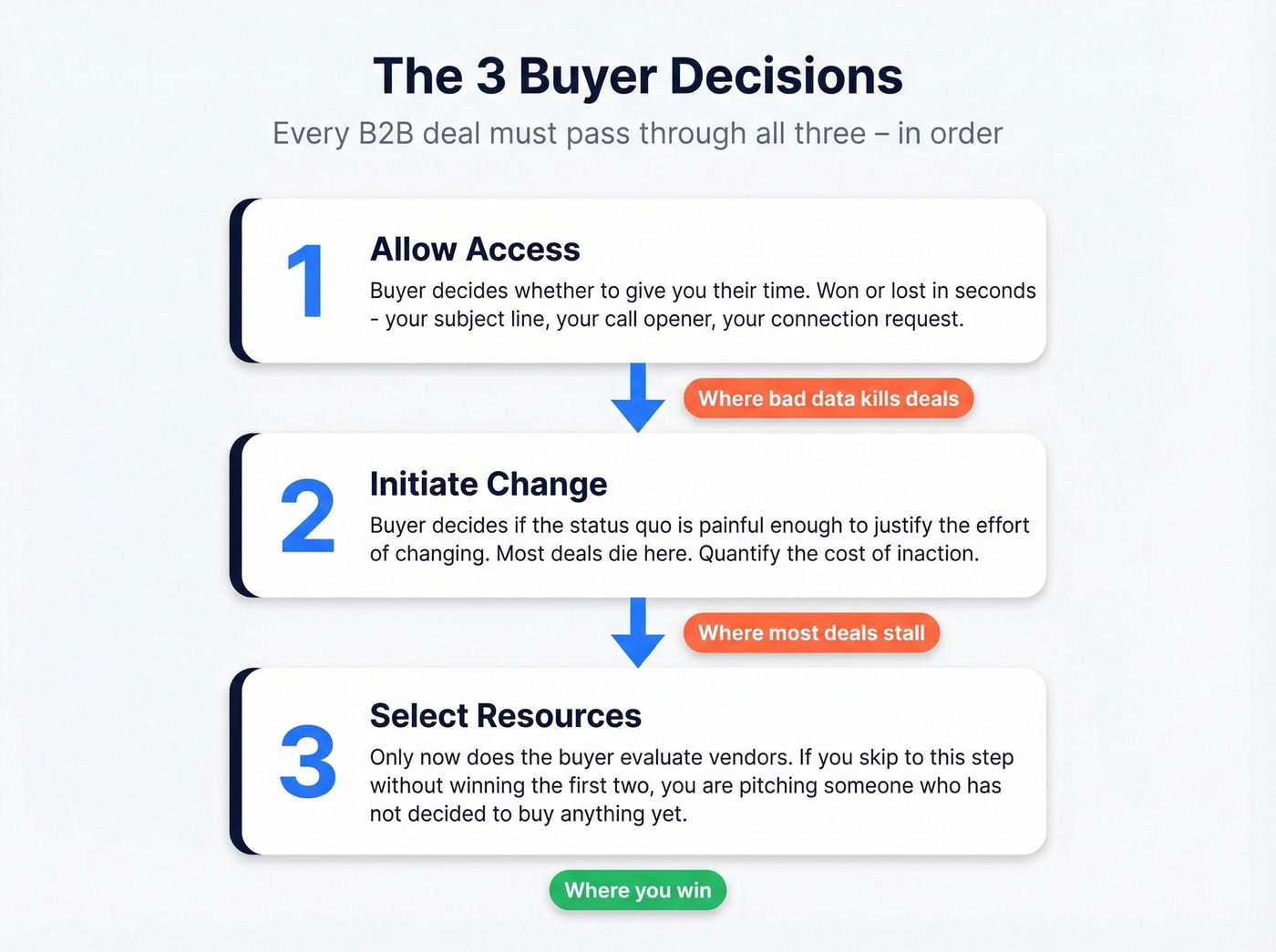
Decision 1: Allow Access
Before anything else, your buyer decides whether to give you their time. This decision happens in seconds - when they see your email subject line, when they pick up an unknown call, when they glance at your connection request.
Winning this decision starts with reaching the right person at a verified email address. Bad data kills this step before your messaging even matters. We've seen teams craft beautiful SNAP-aligned sequences that bounce at 35% because their contact data was stale - and that domain reputation damage compounds fast. (If this is a recurring issue, start with bounced email address and mailbox verification.)
Decision 2: Initiate Change
Once you have access, the buyer decides whether their current situation is painful enough to justify the effort of changing. This is where most deals die.
Your job at this stage is to quantify the cost of inaction. Not "you could save time" but "your team is spending 10 hours a week on manual data entry - that's $800/week at an $80/hour loaded rate - going to a task a tool handles in minutes." Specificity is what makes the status quo feel expensive.
Decision 3: Select Resources
Only after the buyer commits to change do they start evaluating vendors. This is where most sales methodologies begin - and that's the problem. If you skip straight to a feature comparison without winning the first two decisions, you're presenting to someone who hasn't decided to buy anything yet.
At this stage, align your differentiators to the specific priorities the buyer articulated during the "Initiate Change" phase. Don't introduce new value props. Reinforce the ones that got you here. (If you need a broader comparison, see B2B sales methodologies.)

Decision 1 - Allow Access - dies when your emails bounce. Prospeo delivers 98% email accuracy with a 7-day refresh cycle, so your SNAP-aligned outreach reaches real inboxes, not dead addresses.
Stop crafting perfect sequences for contacts that don't exist.
The Buyer's Matrix
Konrath's Buyer's Matrix is one of the most practical tools in the book. It forces you to map each stakeholder's business drivers, personal wins, and the approach you'll use with them.
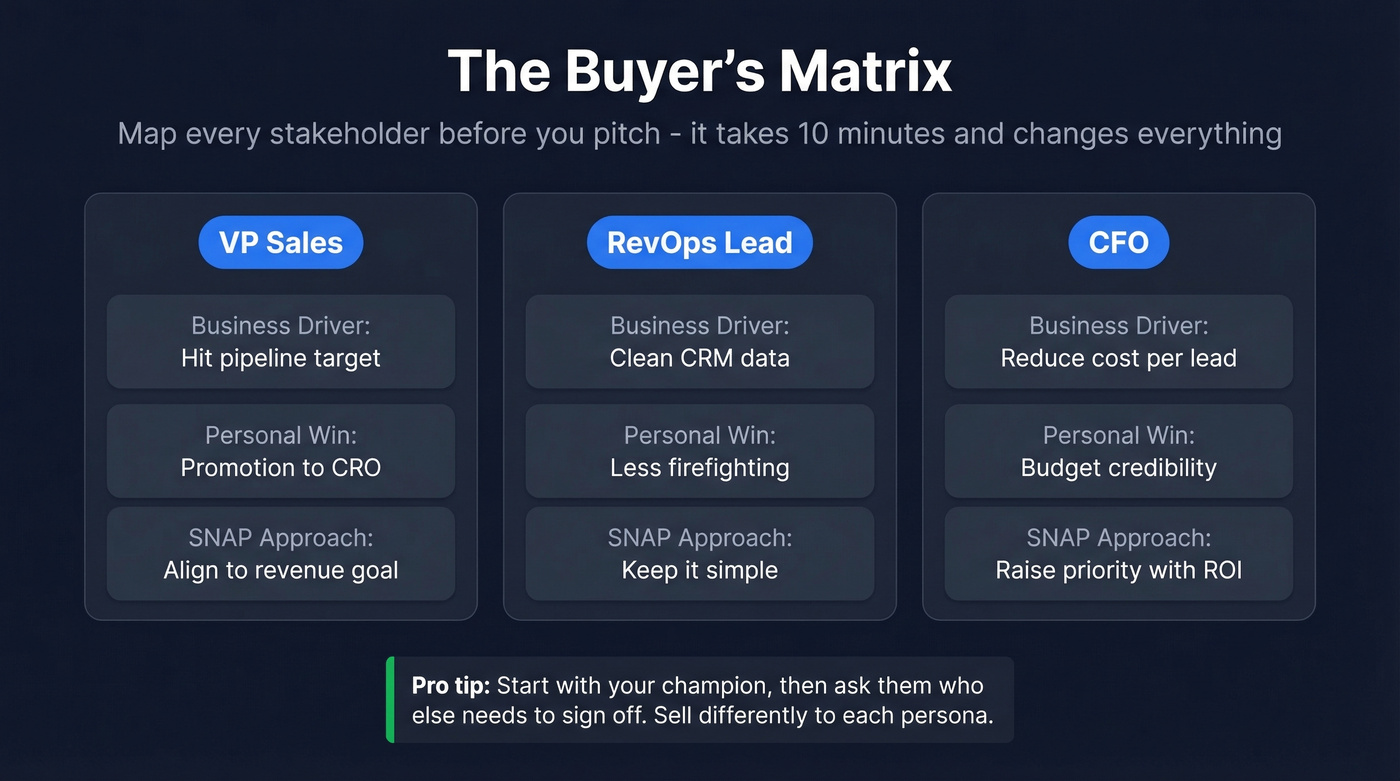
| Stakeholder | Business Drivers | Personal Wins | SNAP Approach |
|---|---|---|---|
| VP Sales | Hit pipeline target | Promotion to CRO | Align to revenue goal |
| RevOps Lead | Clean CRM data | Less firefighting | Keep it simple |
| CFO | Reduce cost per lead | Budget credibility | Raise priority (ROI) |
Build one of these for every deal with two or more stakeholders. Start with your champion, then ask them who else needs to sign off. It takes 10 minutes and prevents the classic mistake of selling the same way to every persona - the VP cares about revenue, the CFO cares about cost, and the RevOps lead just wants fewer broken workflows. Your messaging should reflect that. (If you're selling into finance, this sell to a CFO guide helps.)
Scripts and Templates
Cold Email Template
Subject: Quick question about [specific metric]
Hi [Name],
[Company] just [trigger event - e.g., opened a new office, announced a funding round].
Teams in [their industry] going through similar transitions typically struggle with [specific challenge]. We helped [similar company] cut [metric] by [result].
Worth 15 minutes this week to see if it's relevant to [their stated initiative]?
Cold Call Opener
"Hi [Name], this is [You] from [Company]. I'll be quick - I know you're busy. [Trigger event at their company] caught my attention. We work with [similar companies] on [specific outcome]. Is that on your radar right now, or is the timing off?"
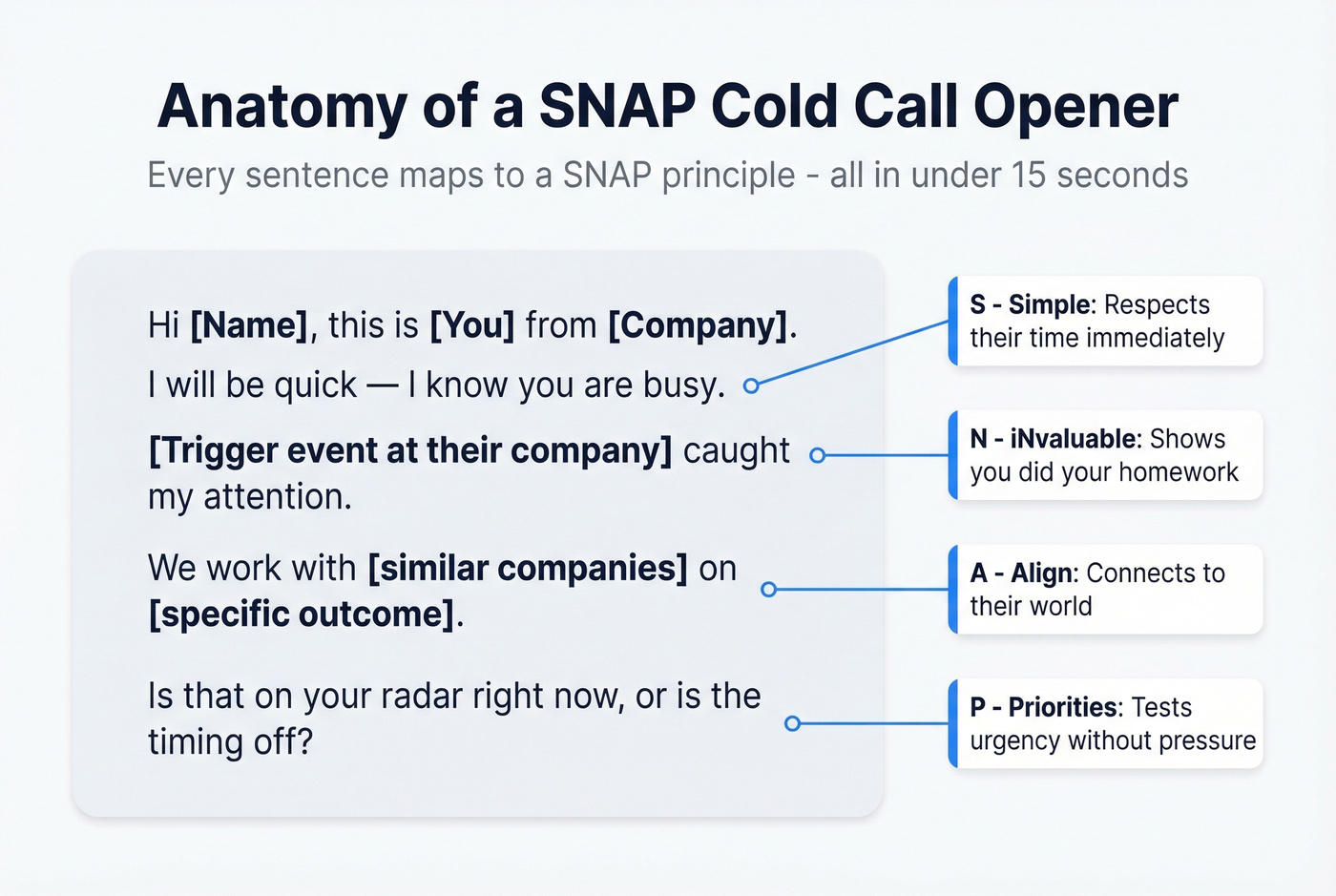
This opener respects their time (Simple), demonstrates knowledge (iNvaluable), connects to their world (Align), and tests urgency (Priorities) - all in under 15 seconds. (For more talk tracks, use this cold call checklist.)
Follow-Up Voicemail
"[Name], quick voicemail. We spoke [date] about [specific challenge]. Since then, [new trigger event or data point]. Wanted to share what we're seeing - I'll send a one-paragraph email with the details. Talk soon."
Keep voicemails under 20 seconds. The goal isn't to sell - it's to earn the email open.
Applying the Framework in 2026
The SNAP framework is from 2010. The execution layer needs to be from 2026. Here's how we've seen teams adapt these principles with modern tools and workflows.
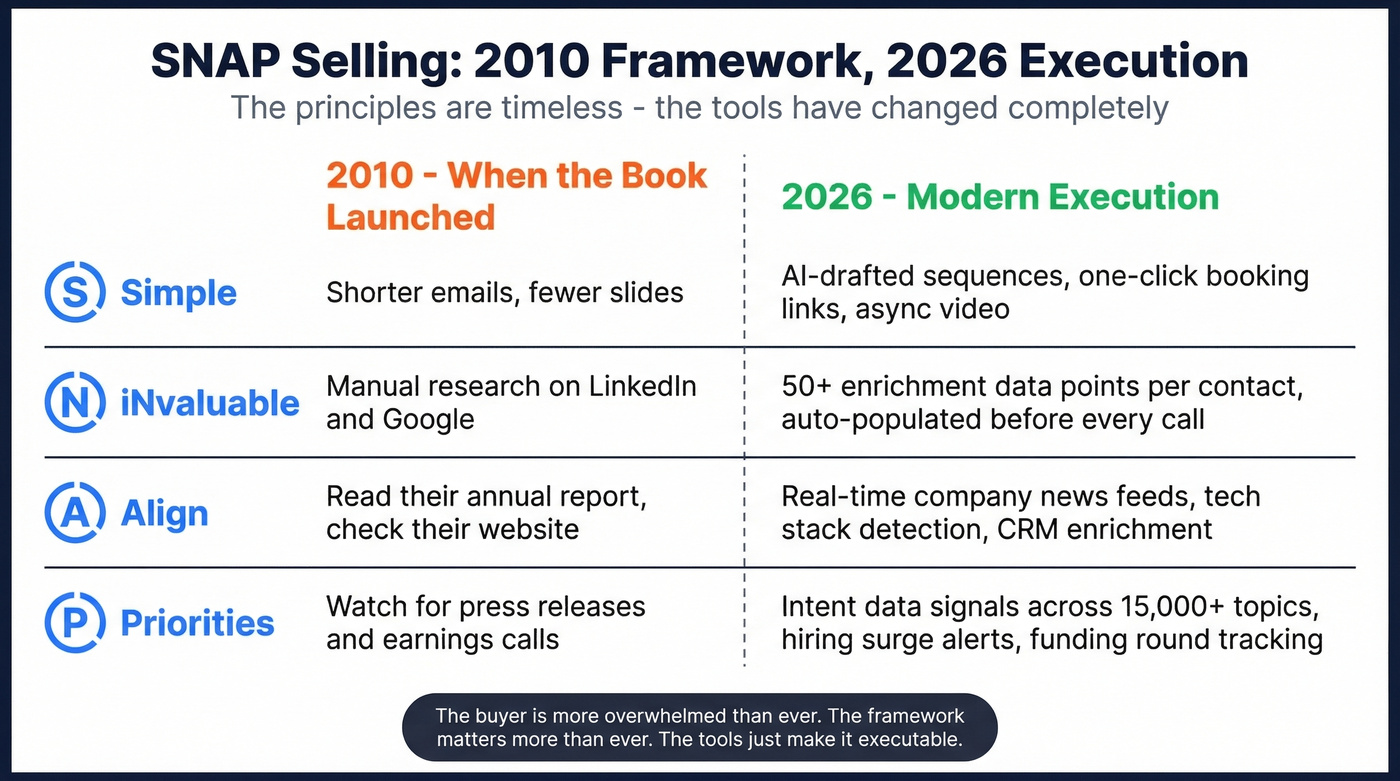
Raise Priorities now means using intent data to identify companies actively researching your category - not guessing which accounts might be in-market. Trigger events aren't just press releases anymore; they're hiring surges, tech stack changes, and funding rounds you can track programmatically. Bombora-powered intent signals across 15,000 topics, for example, let you filter prospects who are already in the Go Zone before you ever pick up the phone. (To operationalize this, see how to track sales triggers.)
Allow Access requires verified contact data. Sending a perfectly crafted, SNAP-aligned email to a bounced address is worse than not sending it at all, because it damages your domain reputation. Prospeo's B2B database covers 300M+ professional profiles at 98% email accuracy with a 7-day data refresh cycle, which means your simplified message actually reaches the inbox that matters.

Always Align means enriching your CRM so reps see the buyer's context before every touchpoint - company news, tech stack, headcount changes, recent funding. That context turns a generic follow-up into an aligned one. Tools that return 50+ data points per contact make this practical at scale, not just aspirational. (If you're building the workflow, start with lead enrichment tools.)
Raising priorities means reaching buyers during trigger events - before the window closes. Prospeo tracks 15,000 intent topics, job changes, and funding signals across 300M+ profiles so you land in the Go Zone.
Identify in-market buyers and reach them at $0.01 per email.
SNAP vs. Other Sales Methodologies
I'll say it plainly: this is the most underrated sales methodology on the market. It's not as prestigious as Challenger or as enterprise-credentialed as MEDDIC, but for a huge chunk of B2B teams running mid-market deals, it's the right framework - and the fastest to implement.
| Methodology | Best For | Core Mechanism | Deal Complexity | Typical Cycle Length |
|---|---|---|---|---|
| SNAP | Mid-market, transactional | Simplify buyer decisions | Lower-medium | Short |
| SPIN | Consultative sales | Structured questioning | Medium-high | Medium |
| Challenger | Teaching-led sales | Reframe buyer thinking | Medium-high | Medium-long |
| MEDDIC | Enterprise | Qualification rigor | High | Long |
| Sandler | Relationship-driven | Pain-based discovery | Medium | Medium |
For teams running mid-market deals with one to three decision-makers and cycles under 90 days, SNAP is the right fit. For enterprise deals with formal procurement, MEDDIC gives you the qualification rigor SNAP lacks. For deals where you need to reshape how the buyer thinks about their problem, Challenger is the better choice. The consensus on r/sales tends to agree - SNAP gets recommended most often for SMB and mid-market outbound, while Challenger and MEDDIC dominate enterprise threads.
The frameworks aren't mutually exclusive. Teams often use SNAP principles for outbound messaging and MEDDIC for deal qualification - the combination works surprisingly well for companies selling into both mid-market and enterprise. (If you're implementing qualification, use this MEDDIC sales process guide.)
When SNAP Doesn't Work
Use SNAP if: you're selling to mid-market buyers, your deal involves one to three decision-makers, your cycle runs under 90 days, and your biggest enemy is buyer inaction rather than a specific competitor.
Skip SNAP if: you're navigating complex enterprise procurement with 11+ stakeholders, responding to formal RFPs with rigid evaluation criteria, or selling deeply technical products that require extended proof-of-concept phases. When your deal requires a formal security review, legal redline, and procurement committee approval, the "keep it simple" principle will frustrate stakeholders who need depth and thoroughness.
The best approach for enterprise teams? Pair SNAP's simplicity principles with MEDDIC's qualification framework. Use SNAP to earn access and initiate change, then switch to MEDDIC to navigate the buying committee and close.
FAQ
Is SNAP Selling still relevant in 2026?
Yes. Buyer overwhelm has only intensified since 2010, with more stakeholders, more vendors, and more internal complexity per deal. The four principles are more applicable now than when Konrath wrote the book. The execution tools have changed; the psychology hasn't.
What is SNAP Selling in simple terms?
It's a four-principle sales framework - Simple, iNvaluable, Aligned, Priorities - designed to help reps sell to overwhelmed, time-starved buyers. Instead of adding complexity, it teaches you to reduce friction at every buying stage so prospects move forward instead of defaulting to inaction.
What's the difference between SNAP and SPIN Selling?
SNAP focuses on simplifying the buyer's decision process to overcome inaction. SPIN uncovers latent needs through structured questioning (Situation, Problem, Implication, Need-Payoff). SNAP is faster and better for transactional sales with short cycles; SPIN goes deeper for complex, consultative deals. HubSpot's methodology comparison breaks this down further.
Do I need to read the book?
The framework is straightforward enough to learn from a guide like this one. The book adds context and anecdotes, but many readers feel it's longer than necessary for the core ideas. Read it if you want the full backstory; skip it if you just need the playbook. Goodreads reviews echo this sentiment.
How do I find the right decision-makers for SNAP outreach?
The "Allow Access" decision starts with reaching the right person at a verified address. Prospeo lets you filter by job title, seniority, buyer intent signals, and company size across 300M+ profiles at 98% email accuracy - so your simplified, aligned message actually lands where it matters. Gartner's B2B buying research confirms that reaching the right stakeholder early is the single biggest predictor of deal velocity.