

Software Sales: The Data-Backed Guide to Careers, Comp, and What It Actually Takes in 2026
A RevOps lead we know ran a three-tool bake-off last quarter to find the "best" prospecting platform. The tool that won wasn't the one with the biggest database - it was the one whose data actually connected reps to live humans. That distinction matters more than ever in software sales, where only 41.2% of reps are hitting quota and the margin for error has evaporated.
The Short Version
Software sales still offers a six-figure ceiling without a degree. That hasn't changed. What's changed is the floor. The latest RepVue data pegs quota attainment in software at 41.2% - dead last among major sales verticals. The easy-money era where any SDR could stumble into a $120K AE role within 18 months is over.
But the career path itself remains one of the highest-leverage moves you can make without a four-year degree, especially if you go in with realistic expectations, learn the right frameworks, and treat selling as a craft rather than a lottery ticket.
What Is Software Sales?
It's the process of selling technology products - typically SaaS platforms, enterprise applications, or developer tools - to businesses. The on-prem vs. SaaS distinction still technically exists, but in 2026, the field overwhelmingly means SaaS. You're selling subscriptions, not perpetual licenses. That changes everything about how deals work, how comp is structured, and how long customers stick around.
The traditional split is inside sales (remote - calls, video, email) versus outside sales (field - in-person meetings, dinners, conferences). Most SDR and mid-market AE roles are inside sales. Enterprise AEs often blend both, flying out for QBRs and executive briefings while running the rest of the cycle remotely.
But the more relevant axis in 2026 isn't inside vs. outside - it's product-led vs. sales-led. Some products sell themselves through free trials and self-serve onboarding. Others require a six-month enterprise cycle with procurement, legal, and a champion who'll fight for budget internally. Where your product falls on that spectrum determines your day-to-day more than any other variable.
The 2026 Market Reality
This field is simultaneously one of the best career paths available and one of the most stressful industries to work in right now. The numbers tell both stories.
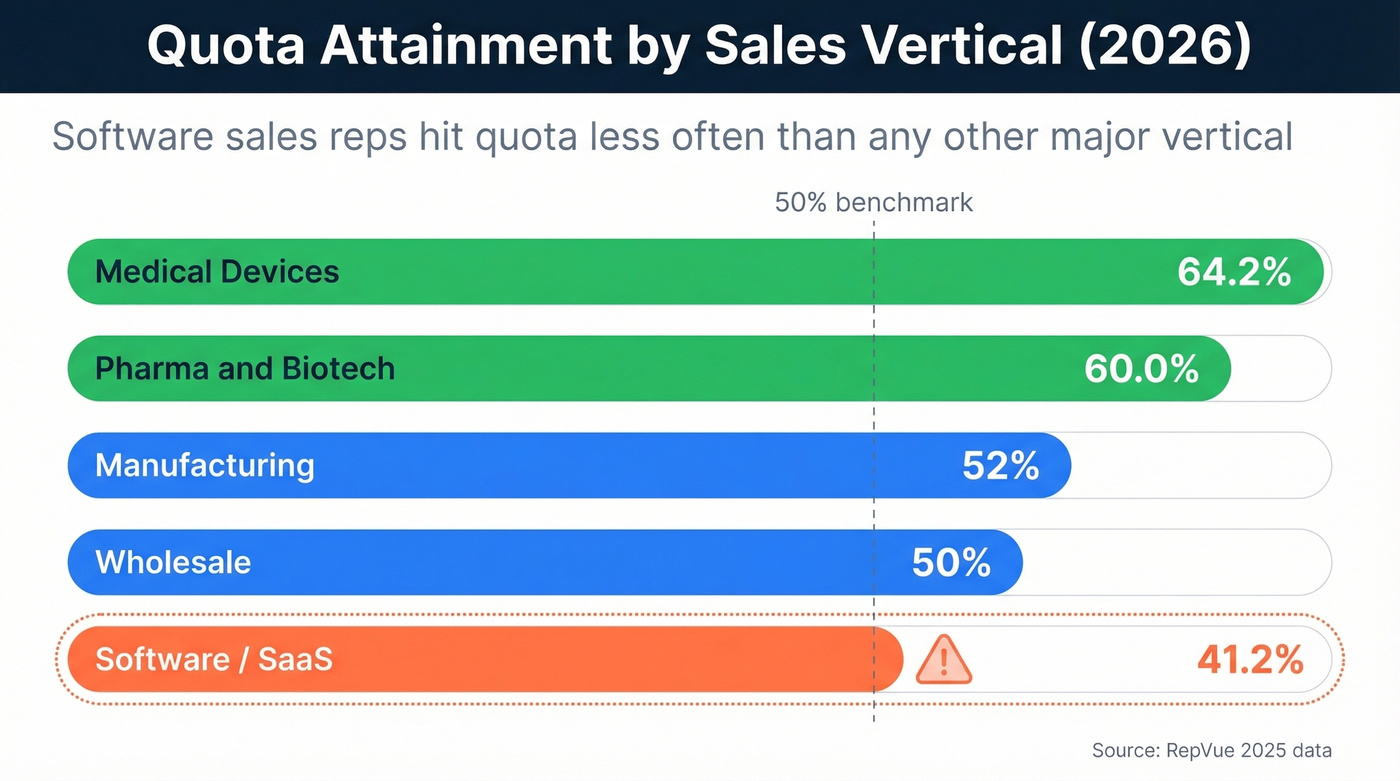
That 41.2% quota attainment figure isn't just bad - it's the worst among tracked verticals. Medical device reps hit 64.2%. Pharma and biotech sit at 60%. Manufacturing and wholesale both clear 50%. Software is scraping the bottom.
The job market has stabilized somewhat. Tech layoffs dropped from roughly 152,000 in 2024 to about 123,000 in 2025, a 20% improvement. But AI is changing the job in ways that go beyond headcount. Challenger, Gray & Christmas tracked AI as a contributing factor to nearly 55,000 U.S. layoffs in 2025. Salesforce's CEO announced the company cut 4,000 support workers after AI handled 50% of their workload - a concrete preview of how automation reshapes headcount decisions. Mercer's Global Talent Trends 2026 survey found employee concerns about AI-driven job loss jumped from 28% in 2024 to 40% in 2026, and 62% of employees feel their leaders underestimate AI's emotional and psychological impact on the workforce.
The sentiment on r/sales matches the data. One AE described 2024 as "one of the worst" job markets they'd faced, with months of unemployment before landing a role - and the role itself was "beyond stressful," with constant product changes and evaporating work-life balance.
Here's my hot take: selling software is still the best career you can start without a degree - but only if your ACV is above $25K. Below that, product-led motions are eating sales-led ones alive, and the rep's role shrinks to glorified customer support. If you're choosing where to start, aim for companies selling $25K+ contracts where the human seller is genuinely irreplaceable.
None of this means the field is a bad bet. It means anyone entering needs to understand what they're walking into.
Roles Explained: SDR to CRO
SDR / BDR
The Sales Development Representative (or Business Development Representative - the titles are interchangeable) is where almost everyone starts. Your job is to fill the pipeline: cold calling, sending personalized emails, qualifying inbound leads, and booking meetings for Account Executives. You don't close deals. You open doors.
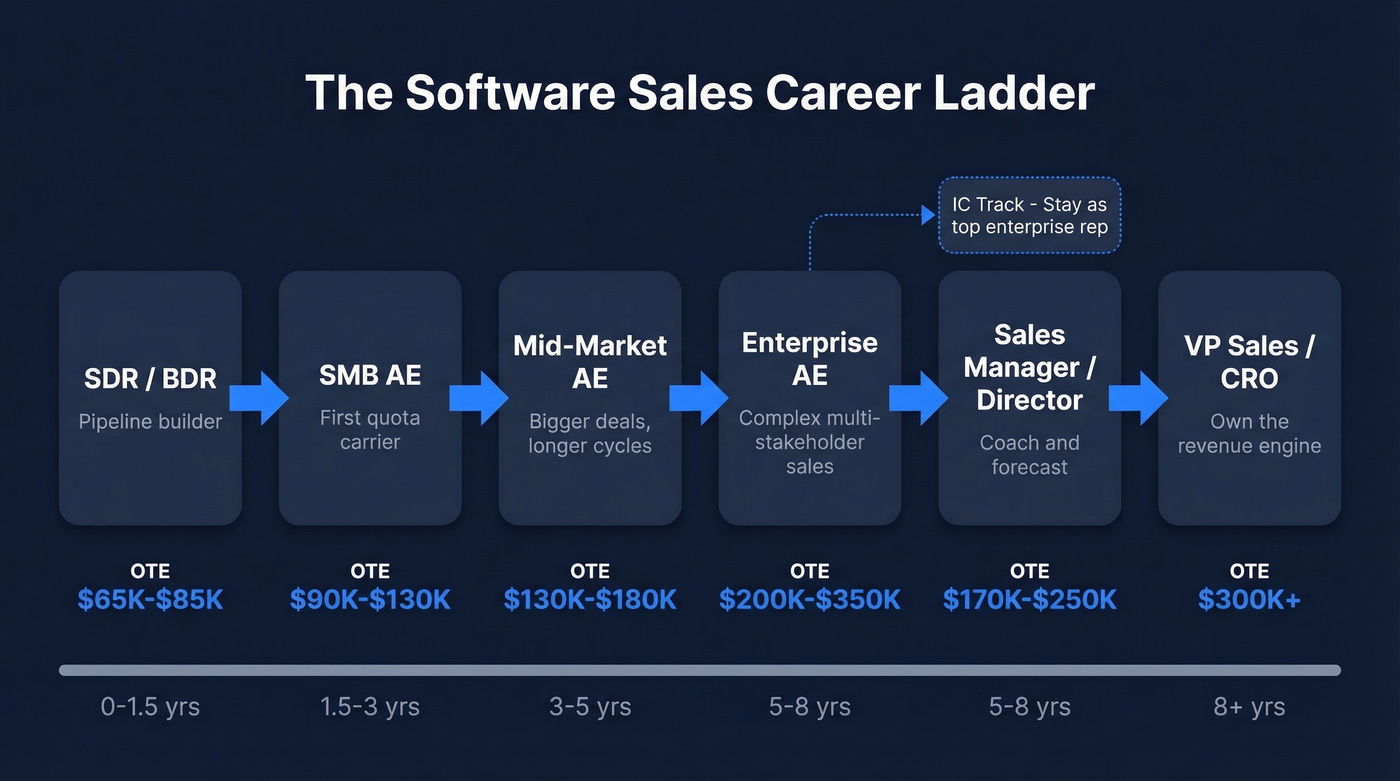
A typical SDR day looks like 50-80 calls, 30-50 personalized emails, a handful of discovery calls, and a lot of CRM updates. The tools you'll live in: Salesforce or HubSpot, a sequencing platform like Outreach or Salesloft, and a prospecting tool for finding contact data. The comp structure leans heavily toward base salary - usually a 70:30 or 80:20 base-to-variable split - because you're measured on activity and meetings booked, not closed revenue.
Hit your numbers consistently for 12-18 months and you'll promote to AE. Stay longer than 18 months without a promotion and it's a red flag - either you're underperforming or your company doesn't have a clear path up. Both are problems.
Account Executive (SMB to Enterprise)
AEs own the full sales cycle: running demos, building business cases, negotiating contracts, and closing deals. The segmentation matters enormously. SMB tends to mean shorter cycles and higher volume. Mid-market means fewer deals, higher ACV, and longer cycles. Enterprise is fewer accounts, longer cycles, and more stakeholders with competing priorities who all need to say yes before anything moves forward.
Enterprise cycles commonly run 6-12 months with multi-stakeholder buying committees involving procurement, legal, IT, and executive sponsors. The progression from SMB to mid-market to enterprise often spans 3-5 years total.
Enterprise is where the real money lives - but it's also where deals die in committee and a single lost champion can crater six months of work.
Sales Engineer, Manager, VP, CRO
Sales Engineers run deep product demos, handle technical objections, and build proof-of-concept environments. It's a strong path for people who love the product side but don't want to carry a full quota. Sales Managers lead teams and spend most of their time coaching, forecasting, and hiring. VP of Sales owns the revenue function for a segment or region. CRO sits at the executive table and owns the full go-to-market strategy. Top operators can reach VP in under a decade after starting as an SDR.
How Compensation Actually Works
OTE - On-Target Earnings - is simple math: annual base salary plus the commission you'd earn at exactly 100% quota. An AE with a $75K base and a $75K variable target has a $150K OTE with a 50:50 pay mix.
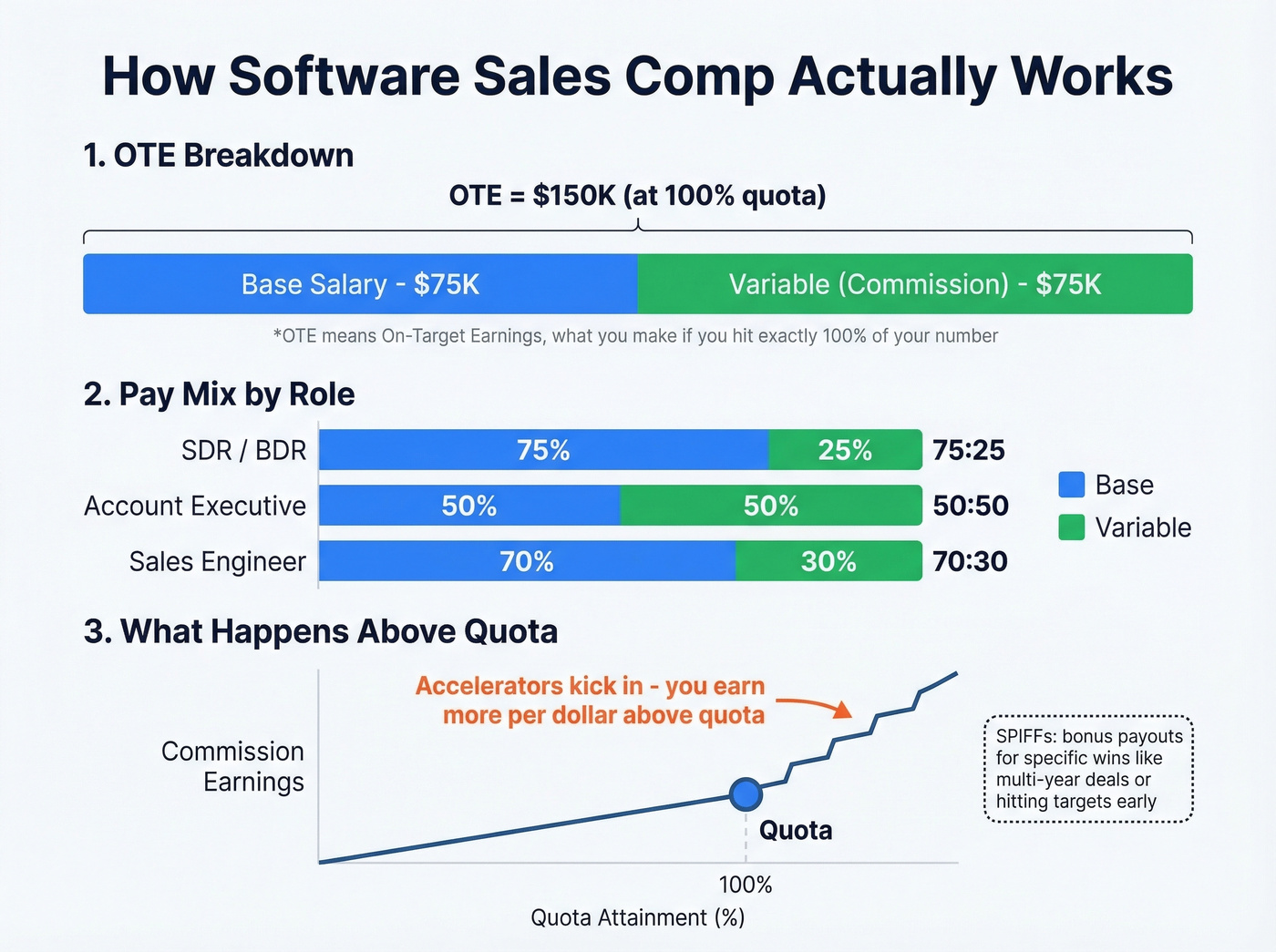
The pay mix shifts by role. AEs sit at 50:50 because they directly control revenue. SDRs and Sales Engineers land at 70:30 or 80:20 because their influence on closed revenue is indirect. Companies that put SDRs on aggressive variable plans create perverse incentives to book unqualified meetings.
Quota-to-OTE ratios in mid-market SaaS typically run 1x to 3x. A $150K OTE AE carrying a $300K-$450K annual quota is standard. Beat it, and accelerators kick in - you get paid more per dollar above quota. Then there are SPIFFs: short-term incentive bonuses for specific behaviors like closing multi-year deals or hitting quarterly targets early.
The ceiling is real. Enterprise reps at top vendors earn serious money. Microsoft total comp for senior sales roles runs $221K-$369K. Oracle lands at $198K-$336K. Cisco sits at $203K-$341K. These Glassdoor-reported ranges include base, commission, and equity. Geography still matters - an SDR in San Francisco earns roughly 19.9% above the national average, New York about 11.2% higher - though remote roles have compressed these differentials without eliminating them.
| Role | Base Range | Typical OTE | Pay Mix | Quota:OTE |
|---|---|---|---|---|
| SDR/BDR | $45K-$65K | $65K-$85K | 70:30-80:20 | N/A (activity) |
| SMB AE | $55K-$75K | $90K-$130K | 50:50 | 2-3x |
| Mid-Market AE | $70K-$100K | $130K-$180K | 50:50 | 2-3x |
| Enterprise AE | $100K-$150K | $200K-$350K | 50:50 | 1-2x |
| Sales Engineer | $90K-$130K | $130K-$180K | 70:30-80:20 | Varies |
| Sales Manager | $110K-$150K | $170K-$250K | 60:40 | Team roll-up |
Career Path With Timelines
The ladder is well-defined. What separates people who climb it from people who stall is consistency and self-awareness about when to move.
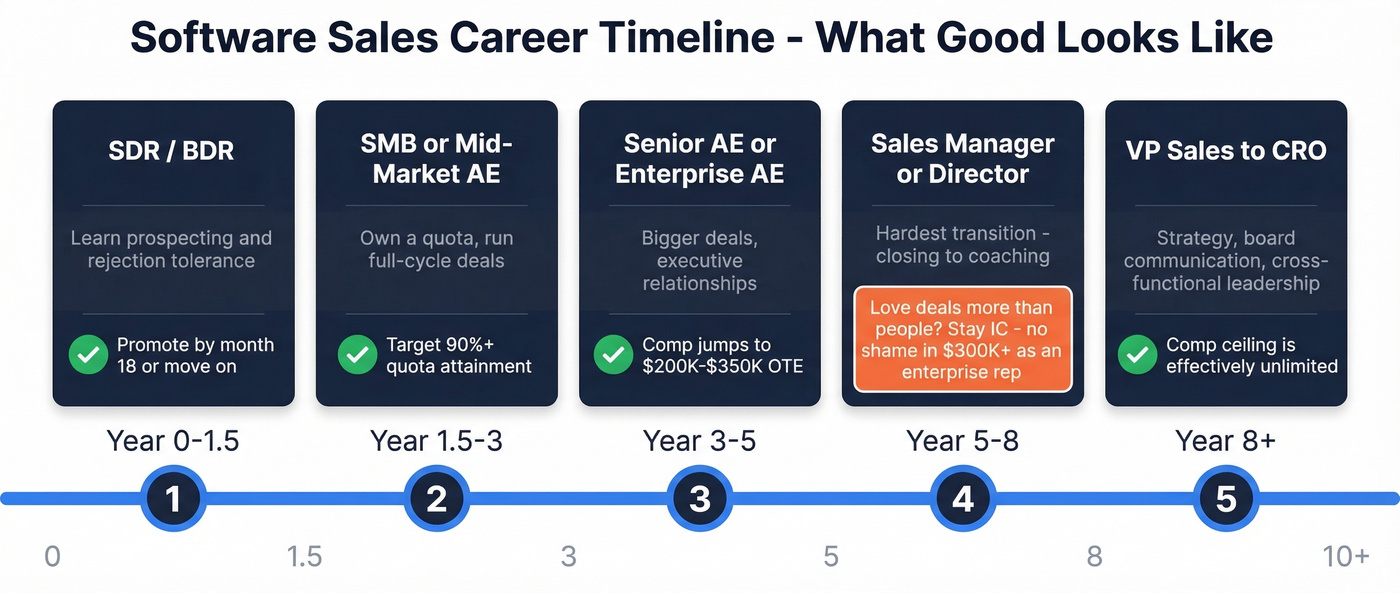
Year 0-1.5: SDR/BDR. Learn prospecting, qualification, CRM discipline, and rejection tolerance. The goal is simple - hit your meeting targets consistently and demonstrate you can run a discovery call without a script. Promotion to AE should happen within 12-18 months. If you're at 18+ months with no clear path, start interviewing externally.
Year 1.5-3: SMB or Mid-Market AE. Now you own a number. The learning curve is steep - running full-cycle deals, managing a pipeline, forecasting accurately, and handling objections without an SE in the room. "Good" at this stage means consistently hitting 90%+ of quota and building repeatable deal patterns.
Year 3-5: Senior AE or Enterprise AE. Bigger deals, longer cycles, more stakeholders. Enterprise AEs need to multi-thread across organizations, build executive relationships, and navigate procurement. The comp jumps significantly, but so does the complexity.
Year 5-8: Sales Manager or Director. The shift from individual contributor to leader is the hardest transition in the entire path. Great closers don't automatically make great coaches. If you love the deal itself more than developing people, stay on the IC track - there's no shame in being a $300K+ enterprise AE.
Year 8+: VP Sales to CRO. These are executive roles that require strategic thinking, cross-functional leadership, and board-level communication. The comp ceiling is effectively unlimited, but so is the accountability.

That RevOps bake-off at the top of this article? The tool that won connected reps to live humans. Prospeo delivers 98% email accuracy and 125M+ verified mobile numbers with a 30% pickup rate - so your SDRs spend time selling, not chasing bounced emails and dead numbers.
Stop burning dials on bad data. Start connecting with real buyers.
How SaaS Is Changing the Game
Companies are spending $2 in sales and marketing for every $1 of new ARR, and that ratio has climbed 14% since 2024. Selling SaaS is getting more expensive, which means the pressure on individual reps to be efficient has never been higher.
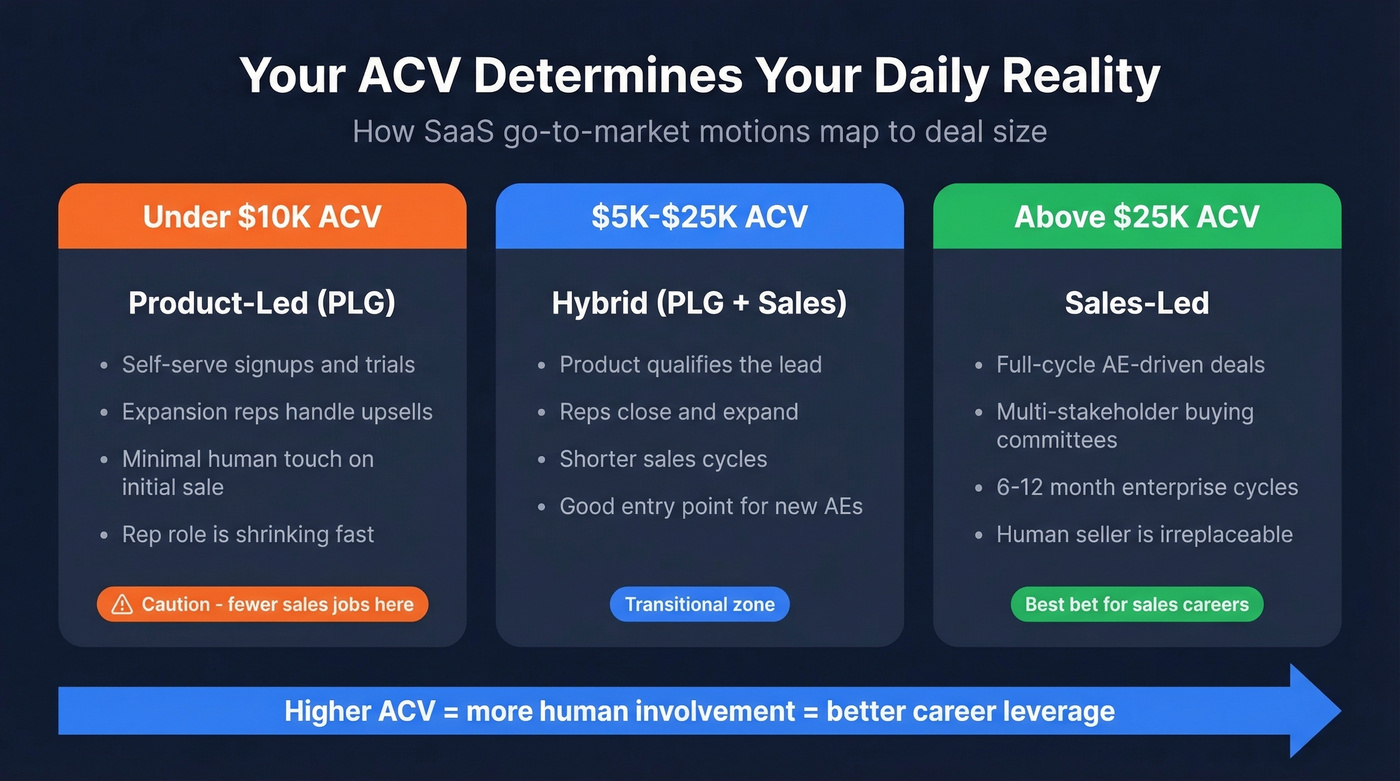
The go-to-market motion your company runs determines your daily reality more than your title does.
| ACV Range | Recommended Motion | What It Means for Reps |
|---|---|---|
| Under $10K | Product-led (PLG) | Self-serve + expansion reps |
| $5K-$25K | Hybrid (PLG + sales) | Product qualifies; reps close |
| Above $25K | Sales-led | Full-cycle AE-driven deals |
ProductLed's 2025 benchmark survey found 91% of SaaS companies plan to increase PLG investment - yet McKinsey's analysis of 107 publicly listed B2B SaaS companies shows most won't see a performance boost without layering in sales-assisted conversion. A small subset of outperformers skews the average. The winning model that's emerged is product-led sales (PLS): use the product to generate qualified accounts, then deploy sales teams to convert and expand them.
For reps, this means the job is shifting. You're less likely to cold-call someone who's never heard of your product and more likely to engage someone already using a free tier or trial. The skill set changes accordingly - you need to read product usage data, identify expansion signals, and time your outreach to moments of value realization rather than arbitrary cadence schedules.
When evaluating SaaS companies to join, look for LTV:CAC ratios above 3:1 and CAC payback under 12 months. These signal a healthy go-to-market engine where reps can actually hit quota.
Sales Methodologies That Matter
Frameworks aren't academic exercises. They're the difference between winging a discovery call and systematically qualifying a deal. Let's break down which ones matter and when.
| Framework | Best For | Deal Size | Cycle Length | Key Strength |
|---|---|---|---|---|
| BANT | SMB/transactional | Under $10K | Under 30 days | Speed, simplicity |
| MEDDIC | Enterprise/complex | Over $50K | Over 90 days | Risk identification |
| SPICED | SaaS/subscription | $10K-$50K | 30-90 days | Customer-centric |
| SPIN | Any consultative | Any | Any | Deep discovery |
| Challenger | Status-quo deals | Mid-to-enterprise | 60+ days | Teaching/reframing |
BANT (Budget, Authority, Need, Timeline) is the starter framework. It works for deals under $10K with short cycles where you need to qualify fast and move on.
MEDDIC (Metrics, Economic Buyer, Decision Criteria, Decision Process, Identify Pain, Champion) isn't optional for enterprise. If you're running deals over $50K with 90+ day cycles and multiple stakeholders, MEDDIC is how you avoid getting surprised by a "no" in month five. It was developed at PTC in the 1990s and remains the gold standard for complex B2B sales. We've seen teams adopt it halfway through a quarter and immediately start catching dead deals earlier - which frees up time for the ones that'll actually close.
SPICED (Situation, Pain, Impact, Critical Event, Decision) is the SaaS-native framework. It works well in mid-market subscription deals where understanding the customer's timeline and pain severity matters more than mapping a buying committee.
SPIN Selling deserves special mention. Research across 35,000 sales calls showed that a structured questioning strategy (Situation, Problem, Implication, Need-Payoff) improves close rates by roughly 20%. It's not a qualification framework - it's a conversation framework. Layer it on top of MEDDIC or BANT.
The Challenger Sale rounds out the toolkit. It's built for situations where the buyer doesn't know they have a problem - you're teaching them something new about their business and reframing how they think about a category. Powerful in competitive markets where differentiation is thin.
Skip Challenger if you're selling into a well-defined category where buyers already know what they need. It shines when you're creating demand, not capturing it.
The Modern Sales Tech Stack
The tools you use matter less than the data feeding them. A perfectly sequenced cadence hitting bad email addresses is just expensive noise.
CRM
Salesforce dominates enterprise. HubSpot is a common pick in SMB-to-mid-market and has a genuinely useful free tier. If you're breaking into the field, learn Salesforce - it's on a huge share of job descriptions.
Sequencing and Engagement
Outreach and Salesloft handle multi-step email and call sequences, A/B testing, and analytics. The differences between them are marginal for most teams. Master whichever your company uses - the skill transfers.
Conversation Intelligence
Gong records, transcribes, and analyzes sales calls. It's table stakes for any team that takes coaching seriously. The insights on talk-to-listen ratio, competitor mentions, and next-step commitment are genuinely useful.
Data and Prospecting
Here's the thing: this is where most stacks break down. Your sequences, calls, and demos are only as good as the data behind them. Bad emails bounce. Bad phone numbers waste hours. Stale data means you're pitching people who left the company six months ago.
One team - Meritt - cut bounce rates from 35% to under 4% just by switching to verified data. That's the difference between a healthy domain reputation and one that's flagged as spam. If you want to go deeper on list quality, email bounce rate benchmarks are a good place to start.
Prospeo covers 300M+ professional profiles with 143M+ verified emails at 98% accuracy and 125M+ verified mobile numbers delivering a 30% pickup rate. The data refreshes every 7 days, compared to the industry average of 6 weeks. With 30+ search filters covering buyer intent, technographics, job changes, headcount growth, funding, and revenue, you can build targeted lists fast. It starts free with 75 verified emails per month, and pricing runs about $0.01 per verified email with no contracts.

Apollo is the other major player in the self-serve tier - solid database, generous free plan, and paid plans from roughly $49/user/mo with a built-in sequencer. ZoomInfo remains the enterprise default with the deepest U.S. database, but the $15K-$40K/year price tag puts it out of reach for most individual reps and early-stage teams.
Intent Data
Intent data tells you which accounts are actively researching topics related to your product. Prospeo includes intent data across 15,000 topics powered by Bombora, so you can prioritize accounts showing buying behavior rather than spraying cold outreach at everyone in your TAM. If you’re building a system around this, identifying buying signals is the skill to master.
Scheduling and Routing
Chili Piper ($45/mo) handles inbound lead routing and meeting scheduling. For outbound-heavy teams, Calendly or HubSpot's built-in scheduling works fine.
When quota attainment sits at 41.2%, every meeting matters. Prospeo's 7-day data refresh means your contact data is current - not six weeks stale. At $0.01 per verified email, even SDRs on SMB teams get enterprise-grade prospecting without the enterprise price tag.
The reps hitting quota aren't working harder - they have fresher data.
How to Break In (No Experience)
The SDR role is designed for people without experience. Companies prefer hiring coachable candidates they can train from scratch over experienced reps with bad habits. In our experience, the reps who break in fastest show up to interviews with a prospecting plan already built.
Months 1-2: Build the foundation. Plan for 5-10 hours per week of focused study. Learn Salesforce basics (Trailhead is free). Understand what a sales sequence looks like in Outreach or Salesloft. Read "Fanatical Prospecting" by Jeb Blount. Study one qualification framework - BANT is the easiest starting point. If you want a tighter system for day-one execution, a 30-60-90 day plan helps.
Month 2-3: Practice before you're hired. Build a sample prospect list for a mock territory. Pick an industry, define an ICP, pull 50 contacts with verified emails, and write a 3-step cold email sequence targeting them. This is the kind of initiative that gets you hired - showing up to an interview with a prospecting plan beats any certification.
Month 3: Apply aggressively. Target mid-market SaaS companies with 50-500 employees. They're big enough to have structured SDR programs but small enough that you'll get real reps and mentorship. Starting OTE for SDR roles averages around $68K, with the base portion typically landing $45K-$55K.
Mistakes That Kill New Reps
Every one of these is fixable. The reps who flame out aren't the ones who make mistakes - they're the ones who don't recognize the pattern.
Talking more than listening. The best discovery calls have the rep talking 30-40% of the time. If you're above 60%, you're pitching, not qualifying. If you need a structure, keep a bank of discovery questions.
Selling on price instead of value. The moment you lead with "we're cheaper than X," you've commoditized yourself. Lead with the problem you solve and the cost of not solving it. (More on how to add value in sales if this is a recurring issue.)
Pitching to the wrong stakeholders. An enthusiastic champion who can't sign a check is a dead end. Identify the economic buyer early and build a path to them. This gets easier when you understand the technical buyer vs economic buyer split.
Skipping lead qualification. Not every inbound lead deserves a demo. Spending 45 minutes with someone who has no budget, no authority, and no timeline is the most expensive mistake in sales.
Not preparing for objections. If "we're happy with our current solution" catches you off guard, you haven't done your homework. Map the top 5 objections for your product and rehearse responses until they're automatic.
Ignoring CRM hygiene. If it's not in Salesforce, it didn't happen. Sloppy CRM data kills forecasting accuracy, makes handoffs messy, and eventually gets you managed out. NetSuite's research on common sales mistakes consistently highlights this as a career-limiting habit. If you want to level up here, start with sales operations metrics.
Is It Still Worth It in 2026?
Software sales remains the highest-ceiling career you can enter without a degree. A top enterprise AE at a major vendor earns $300K+ in total comp. A VP of Sales at a growth-stage company clears $500K. A CRO at a public company is in seven-figure territory. No other career path offers that kind of upside with a 12-month on-ramp.
But the floor has dropped. That 41.2% quota attainment number means more than half of reps are missing their targets. AI is automating pieces of the role - initial outreach drafts, lead scoring, data entry - which means the bar for what a human rep needs to bring is rising. The teams that win will lean harder into data-driven selling, not vibes.
The counterpoint is equally real: tech layoffs are trending down, AI is creating new roles (AI sales specialists, PLS strategists, RevOps engineers), and enterprise deals still require human judgment, relationship-building, and the ability to navigate a room full of stakeholders with competing priorities. No AI is closing a $500K platform deal over a handshake at dinner.
The verdict: software sales is absolutely worth it in 2026 - if you go in with eyes open, learn the frameworks, invest in your tools and skills, and treat it as a craft. The reps who thrive aren't the ones who got lucky with territory. They're the ones who out-prepared, out-prospected, and out-learned everyone around them.
FAQ
Do you need a degree for software sales?
No. Most SDR roles prioritize coachability and communication skills over credentials. A degree helps at some enterprise vendors and can accelerate management-track promotions, but it's not required to break in or earn six figures.
How long does it take to make six figures?
Typically 2-3 years. Top-performing AEs in mid-market SaaS hit $100K+ OTE within their first year after promoting from SDR. Exceptional SDRs at well-paying companies can touch six figures in year one with accelerators and SPIFFs.
What's the best first role?
SDR at a mid-market SaaS company with 50-500 employees, a structured SDR-to-AE promotion path, and a 12-18 month timeline. Avoid companies without a clear advancement track - you'll stall.
What tools should I learn before applying?
Salesforce (or HubSpot), a sequencing tool like Outreach or Salesloft, and a prospecting platform for building targeted lead lists. Free tiers on tools like Prospeo let you practice real list-building before day one - showing hands-on tool experience in interviews sets you apart immediately.
Is AI going to replace sales reps?
AI is automating repetitive tasks like data entry, initial outreach drafts, and lead scoring - but complex B2B deals still require human judgment, relationship-building, and multi-stakeholder navigation that AI can't replicate. The role is evolving, not disappearing. Reps who layer AI tools into their workflow will outperform those who ignore them.