

SPIN Selling Book Summary: What It Actually Says (And What Still Works in 2026)
Neil Rackham started with a question nobody could answer: the top 10% of salespeople outsell the bottom 10% by 3:1, and no one knew why. So he spent 12 years studying it - 35,000 sales calls across 23 countries. The SPIN Selling book he published in 1988 is still a frequent recommendation on r/sales when someone asks "what should I read first?"
But most summaries online just restate the four question types and stop there. The actual insight is deeper, and some of it needs updating.
The Two-Minute Version
- SPIN stands for Situation, Problem, Implication, Need-payoff - four question types top performers use more often and in a specific sequence during complex sales.
- The real breakthrough isn't the acronym. It's Rackham's finding that closing techniques often backfire in major sales. The harder you push, the worse the outcome.
- Implied vs. explicit needs is the mechanism. Buyers who say "yeah, that's annoying" don't buy. Buyers who say "we need to fix this" do. SPIN questions move buyers between those two states.
- Situation questions feel productive but bore your prospect. Rackham warned about this; most SPIN training ignores the warning.
- SPIN alone isn't enough in 2026. Pair it with MEDDIC for qualification and modern pre-call research.
About the Book and Author
Neil Rackham was a research fellow at Sheffield University studying negotiation behavior. When he heard that top sellers dramatically outperformed average ones and nobody could explain why, he pivoted to sales research. Xerox funded the early work, which grew into a massive study: 35,000+ calls, 10,000 salespeople, 23 countries, 12 years.
The book runs about 250 pages, organized in four parts - preliminary considerations, the SPIN strategy, giving benefits, and obtaining commitment. It's a focused weekend read and remains one of the most research-backed sales books ever written. Rackham founded Huthwaite International to commercialize the methodology.
Why Traditional Selling Fails
Rackham's central argument: small sales and major sales operate by different rules. In a small sale - one call, one decision-maker, low risk - classic techniques work fine. Push for the close, handle objections, pitch features. The buyer's downside is minimal.
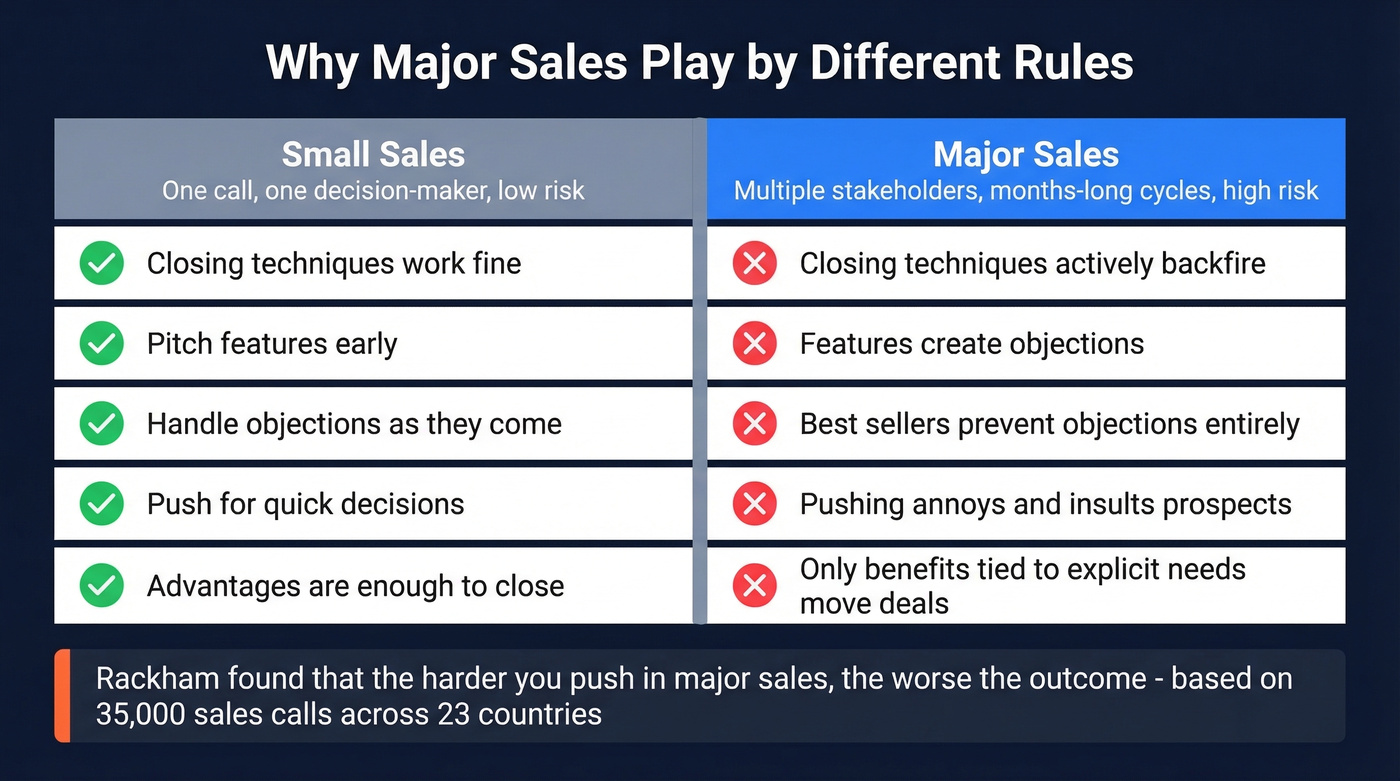
Major sales reverse everything. Multiple stakeholders, months-long cycles, significant financial risk. Rackham's research shows that closing techniques don't just stop working in this environment - they actively backfire by annoying or insulting prospects. Objection handling? Also overrated. The best sellers didn't handle objections better; they prevented them by building need before presenting solutions.
He also introduced a distinction most summaries skip: features describe what a product does, advantages describe how it helps generally, and benefits describe how it solves a specific problem the buyer has acknowledged. Here's the difference in practice:
- Feature: "Our software has automated reporting."
- Advantage: "This saves time on reporting."
- Benefit: "You mentioned your team spends 5 hours a week on manual reports - this eliminates that entirely."
Only benefits - tied to explicit needs - move major deals forward. (If you want a deeper breakdown, see feature-benefit selling.)
The SPIN Framework Explained
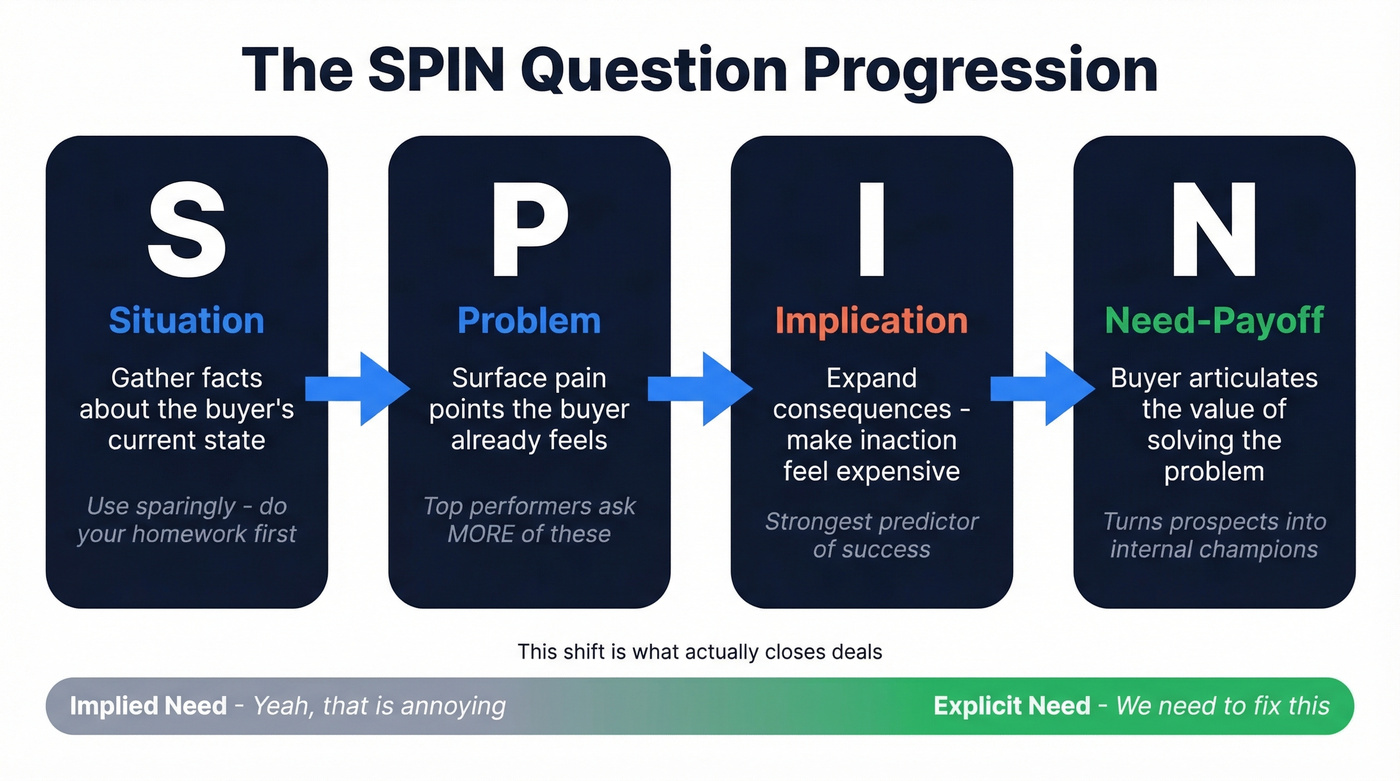
The four question types aren't a script. They're a progression, and each builds on the last to move a buyer from vague discomfort to urgent, articulated need.
Situation Questions (Minimize These)
Situation questions gather facts: "What CRM are you using?" "How's your team structured?" Necessary but dangerous. Rackham's research shows successful calls involve fewer Situation questions than failed calls, and inexperienced sellers ask more of them.
The fix: do your homework. Reference a company's Q2 earnings call or EMEA expansion initiative to validate your research rather than asking what a quick search could answer. Walk in knowing the answers.
Problem Questions
Here's where most reps underperform. Problem questions identify pain, and top performers ask more of them than average reps. Instead of defining the category, let's look at what a strong Problem question actually sounds like:
- "When a lead comes in and your team takes more than three minutes to respond, what happens to that conversion rate?"
- "How much time does your team spend on manual CRM updates each week?"
- "What's the biggest bottleneck in your outbound process right now?"
You're not pitching. You're surfacing a problem the buyer already knows exists but hasn't quantified. (More examples: good discovery questions.)
Implication Questions
Implication questions take a problem and expand its consequences. In major sales, they're among the strongest predictors of success in Rackham's research. They're also the hardest to ask well because they require genuine understanding of the buyer's business.
- "If your reps are spending 10 hours a week on manual data entry, what does that mean for pipeline coverage?"
- "When leads slip through because of slow response times, how does that affect your quarterly targets?"
- "What happens to your CAC when half those leads go cold before anyone calls them back?"
The goal is to make the cost of inaction feel real and urgent - not hypothetical. We've seen reps transform their close rates just by getting better at this one question type.
Need-Payoff Questions
The common mistake with Need-payoff questions: reps skip them entirely and jump to pitching. That's backwards. Need-payoff questions make the buyer articulate the value, turning them into an internal champion who's rehearsed the story in their own words.
- "If you could cut that data entry time in half, what would your team do with those hours?"
- "What would it mean for your pipeline if leads got a response in under 60 seconds?"
This is where implied needs become explicit needs. The buyer isn't just acknowledging a problem - they're describing what solving it would look like. That's the moment a deal moves forward.

Rackham proved that doing homework before the call separates top reps from average ones. Prospeo gives you 30+ filters - buyer intent, technographics, funding, headcount growth - so every Situation question you ask proves you've done the research. 300M+ profiles, 98% email accuracy, refreshed every 7 days.
Walk into every SPIN call already knowing the answers.
Four Stages of a Sales Call
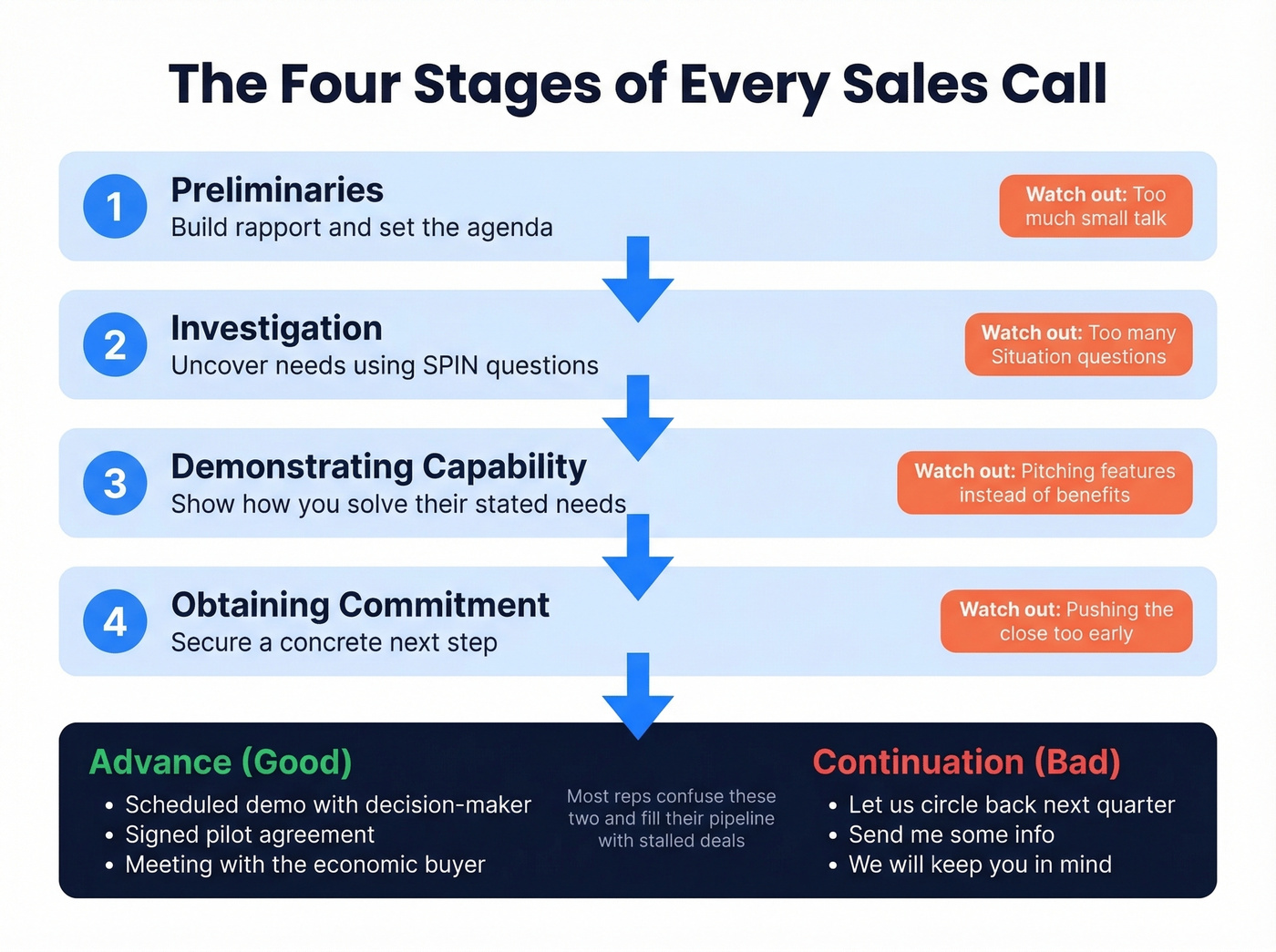
Rackham mapped every sales call into four stages:
| Stage | Purpose | Common Mistake |
|---|---|---|
| Preliminaries | Build rapport, set agenda | Too much small talk |
| Investigation | Uncover needs via SPIN | Too many Situation Qs |
| Demonstrating Capability | Solve stated needs | Pitching features |
| Obtaining Commitment | Secure a clear next step | Pushing close too early |
The most underrated concept here is Rackham's distinction between Advances and Continuations. An Advance is a concrete next step - a scheduled demo, a meeting with the economic buyer, a signed pilot agreement. A Continuation is "let's circle back" or "send me some info." Most reps confuse the two and end up with pipelines full of deals that aren't actually moving. In our experience, teams that adopt SPIN's structured approach to next-step commitments see roughly a 17% boost in sales productivity, mostly because they stop wasting time on stalled deals. (Related: discovery call structure and deal stages.)
Where the Methodology Falls Short
Look, we recommend this book to every new SDR we onboard. But it has real gaps.
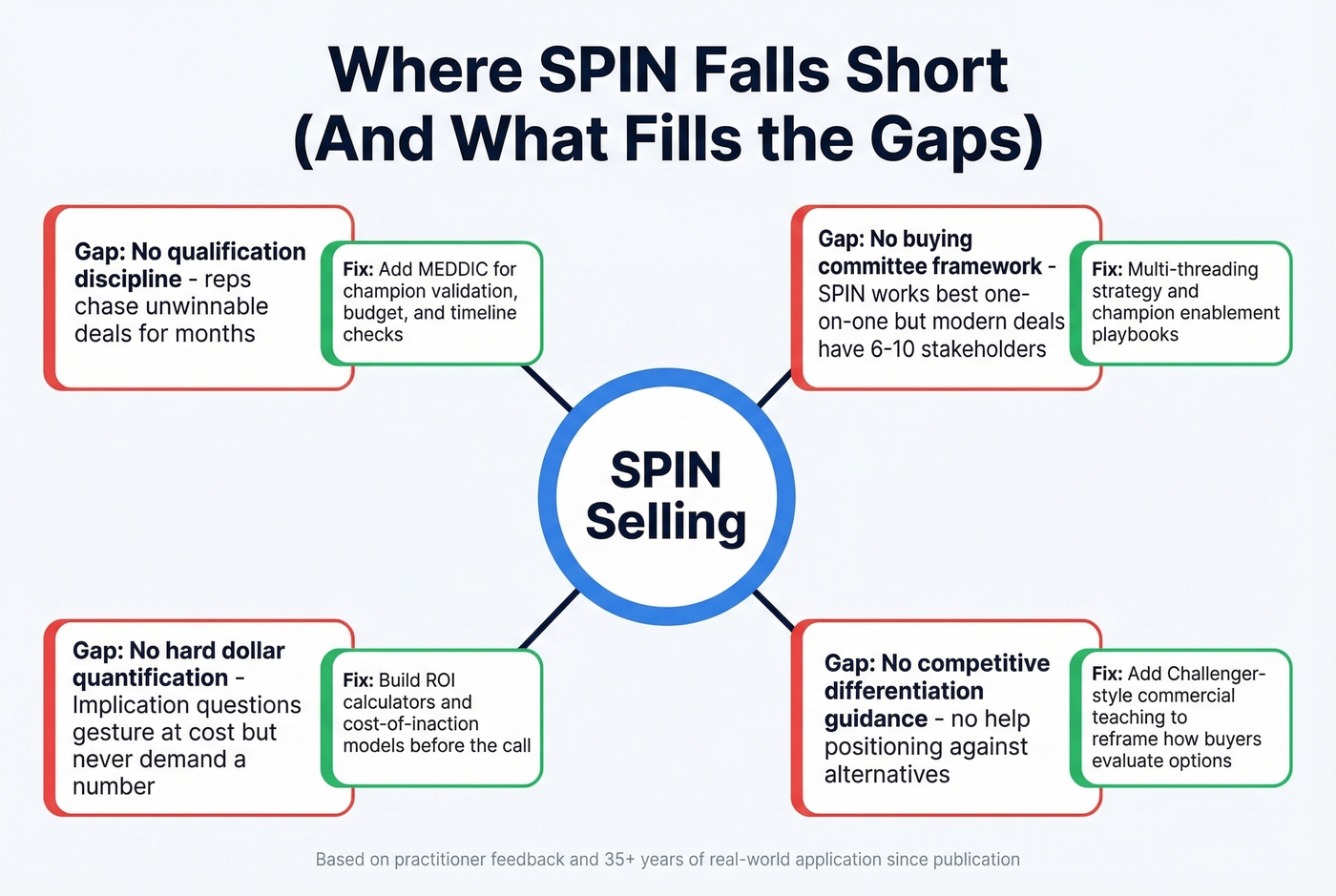
The biggest structural weakness: no qualification discipline. SPIN tells you how to uncover needs but gives you no mechanism to determine whether a deal is actually winnable. Reps can spend months running beautiful discovery calls with no executive sponsor, no budget, and no decision timeline. MEDDIC exists precisely because SPIN doesn't solve this. (If you need a practical system, start with how to qualify sales leads.)
SPIN also doesn't address buying committees well. Modern B2B deals involve 6-10 stakeholders, and SPIN is easiest to run in one-on-one conversations. There's no framework for champion enablement, multi-threading, or consensus-building across a committee. (See: B2B decision making and multi-threading.)
Two more gaps worth naming. SPIN has no hard dollar-quantification requirement - Implication questions gesture at cost but don't demand a number. And there's no guidance on competitive differentiation. The correlation-vs-causation critique from practitioners on r/sales deserves attention too: Rackham observed that top performers asked more SPIN-style questions, but that doesn't definitively prove the questions caused the success. Skip SPIN as your only methodology if you're selling into enterprise accounts with 6+ month cycles - you'll need MEDDIC alongside it.
Running SPIN Discovery in 2026
Here's the thing: SPIN is still the best discovery framework ever published. But if you're using it the way Rackham described in 1988 - opening with Situation questions and working your way down - you're already behind. Buyers now complete 70-80% of their purchase journey before talking to sales. Showing up and asking "Tell me about your company" signals you haven't done the work.
Rackham himself evolved his thinking. In Rethinking the Sales Force (2007), he argued that sales must generate value, not merely communicate it. Your discovery call needs to teach the buyer something they didn't already know.
The fastest way to eliminate most Situation questions is to already have the answers. A B2B data platform like Prospeo gives you verified contact data and company intel before the call - so you can open with a Problem or Implication question instead of "So, what does your company do?" When you know what tools a prospect recently added to their stack and that they're hiring aggressively, you skip straight to: "You've been scaling the SDR team - is your current data quality keeping up with that growth?"
AI takes this further. Tools can now pre-calculate dollar-cost-of-inaction narratives - hours wasted, revenue leaked, pipeline gaps - before the call even starts, making your Implication questions sharper and more specific. The reps who win in 2026 rarely need to ask Situation questions at all.
The hybrid approach we recommend: SPIN for discovery structure, MEDDIC for qualification rigor, and Challenger for the insight that makes buyers rethink their assumptions. You need at least two. One methodology alone leaves blind spots. (If you’re choosing what to implement, use how to choose a sales methodology.)
SPIN vs. Challenger vs. MEDDIC
These three solve different problems. Choosing between them is the wrong question - the right question is which combination fits your deal complexity.
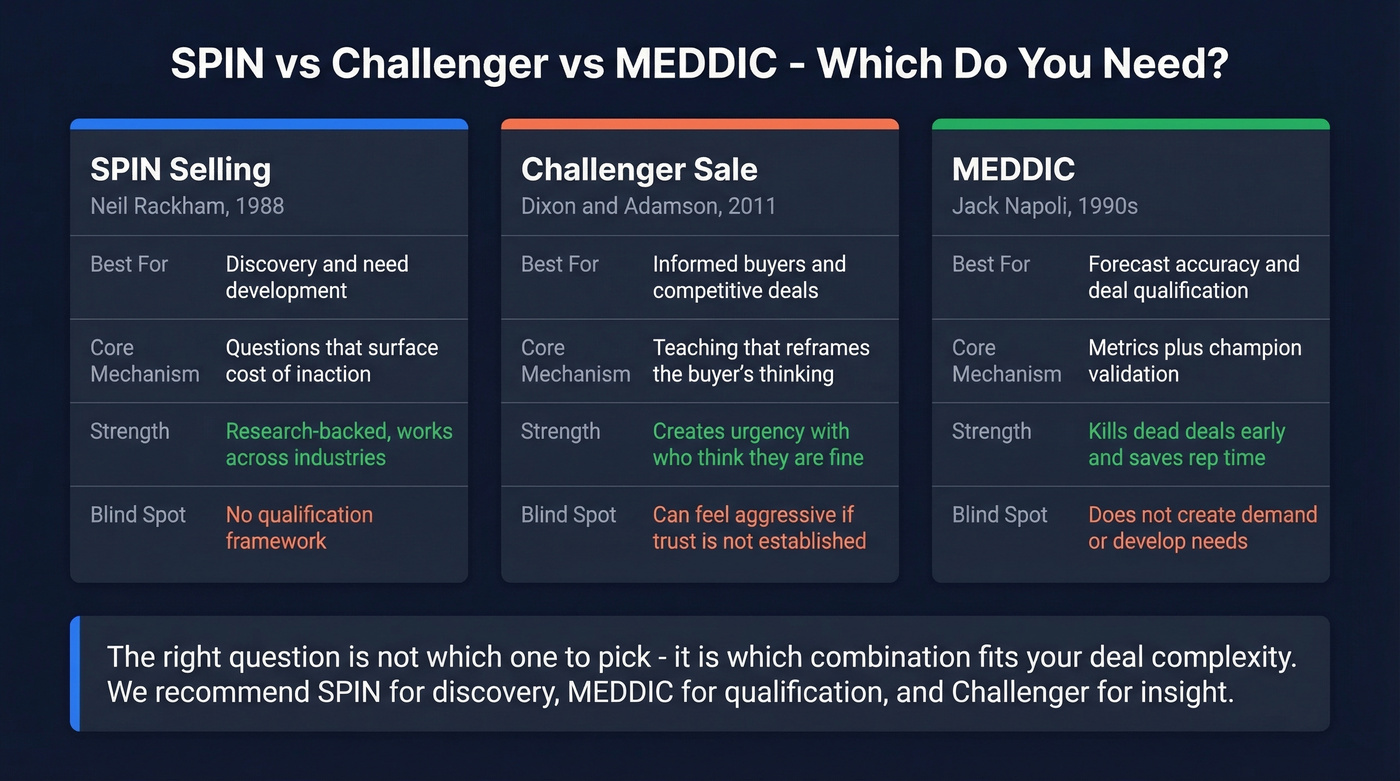
| Methodology | Best For | Core Mechanism | Blind Spot |
|---|---|---|---|
| SPIN | Discovery, need development | Questions surface cost of inaction | No qualification |
| MEDDIC | Forecast accuracy, qualification | Metrics + champion validation | Doesn't create demand |
| Challenger | Informed buyers, competitive deals | Teaching makes comfort expensive | Easy to misapply |
A $20K chatbot deal where SPIN connects lead response delays to wasted ad spend? Perfect fit. A $72K ITSM deal that keeps slipping? MEDDIC exposes the missing economic buyer. A $350K billing platform sale where the prospect thinks their homegrown system "works fine"? That's Challenger territory - you need to reframe their worldview, not just surface their pain.
SPIN works when you reach real decision-makers. Bad data means your carefully crafted Implication questions land in dead inboxes. Prospeo delivers 98% verified emails and 125M+ direct dials with a 30% pickup rate - so your discovery calls actually happen.
Stop perfecting questions for prospects you'll never reach.
FAQ
What does SPIN stand for?
Situation, Problem, Implication, Need-payoff - four question types that top performers use more frequently and deliberately in complex B2B sales. The sequence matters: each type builds on the previous one to move buyers from vague discomfort to articulated urgency.
Is SPIN Selling outdated?
The core insight - asking better questions beats pitching - is timeless, but the 1988 playbook needs modernizing. Pair it with MEDDIC for qualification and pre-call research tools to eliminate Situation questions. The principles hold; the execution needs a 2026 upgrade.
What's the main idea of SPIN Selling?
Traditional closing techniques backfire in complex sales. Top performers use a specific sequence of questions to move buyers from vague discomfort to explicit, self-articulated need - which is what actually drives purchase decisions in high-stakes deals.
Does SPIN work for small sales?
Rackham was clear: for low-risk, single-call transactions under a few thousand dollars, traditional techniques work fine. SPIN's value shows up in deals with multiple stakeholders, longer cycles, and higher stakes - where pressure tactics reliably backfire.