

SQL vs SQO: The Difference That Fixes Your Pipeline
You've got 150 opportunities in Salesforce. Your forecast says $400K this quarter. But you won't hit it - half those "opportunities" are SQLs that never passed a real qualification gate. They're leads with a heartbeat, not deals with momentum.
Understanding the difference between SQL and SQO isn't academic. It's the line between a pipeline you can trust and one that lies to your face every Monday morning.
Here's the short version: an SQL is a lead sales has accepted as worth pursuing. An SQO is an SQL that cleared a real gate - ICP fit, pain, budget, decision-maker, next step scheduled - and earned a slot in your pipeline as a trackable opportunity. Most teams skip the SQO gate entirely and wonder why their forecast is fiction.
SQL and SQO Defined
What's an SQL?
An SQL (Sales Qualified Lead) is a lead that sales has reviewed and agreed is worth pursuing. The bar isn't high - it's directional. A lead has indicated intent to purchase, can afford the offering, and has met with a rep who confirmed basic fit.
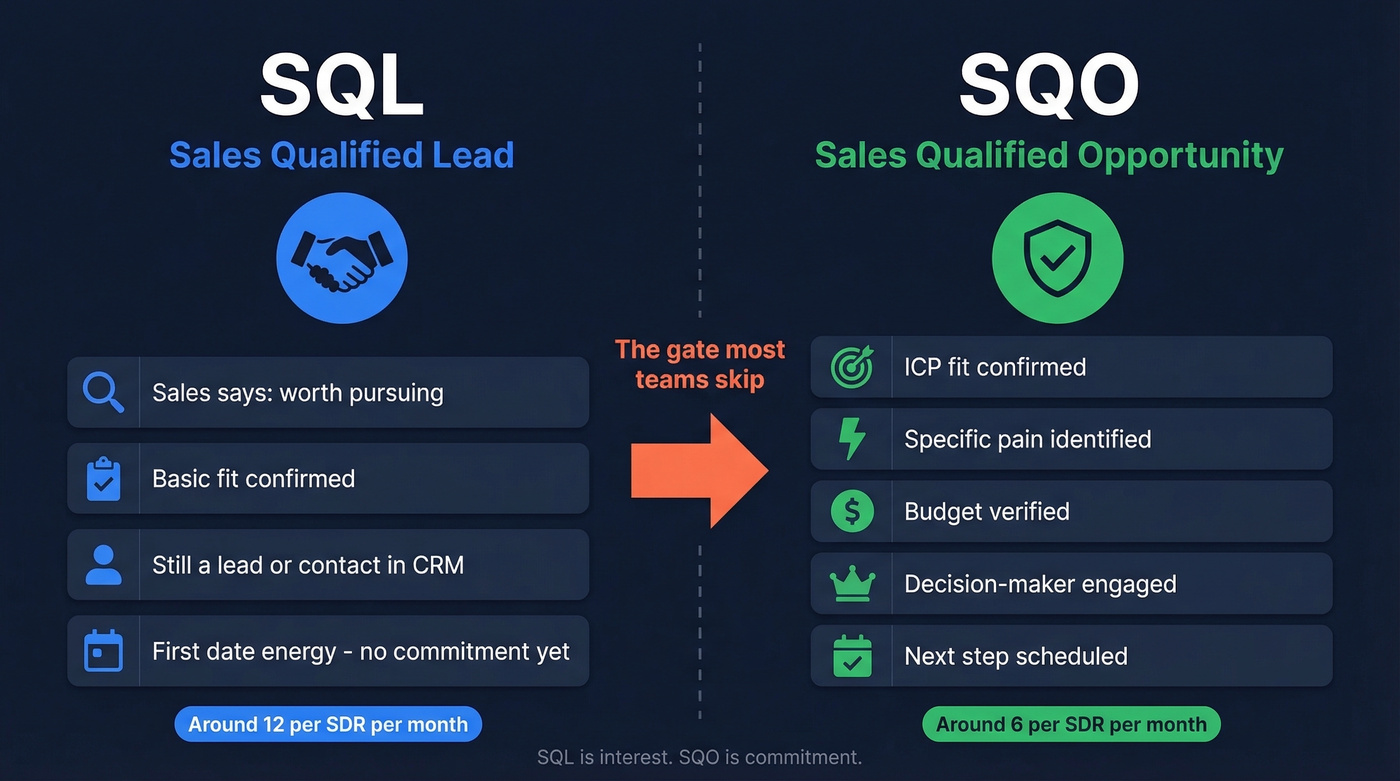
In your CRM, an SQL is usually still treated as a lead or contact stage, often a lead status like "Sales Qualified" or "Working," not yet a forecastable opportunity. Think of it as a first date. Sales is saying "yes, I'll spend time on this," not "yes, this will close."
What's an SQO?
An SQO (Sales Qualified Opportunity) is the next gate. It's an SQL that's been vetted through direct engagement and converted into an active, trackable opportunity. All five criteria must be true:
- ICP fit confirmed - they match your ideal customer profile (see an ICP template + scoring rubric)
- Pain identified - a specific problem they need solved
- Budget verified - they can actually pay
- Decision-maker engaged - you're talking to someone with authority (here’s how to handle the technical buyer vs economic buyer split)
- Next step scheduled - a demo, trial, or proposal is on the calendar (use a product demo checklist to standardize this)
An SQO represents real commitment from both sides. The CRM record gets created or converted into an opportunity, and that's what your forecast is built on. If you're creating opportunities without all five boxes checked, your pipeline is inflated by definition.
Side-by-Side Comparison
| Dimension | SQL | SQO |
|---|---|---|
| Funnel stage | Mid-funnel | Late mid-funnel |
| Owner | SDR / BDR | AE |
| Qualification | Initial fit check | 5-point gate |
| CRM object | Lead/contact stage | Opportunity (created/converted) |
| Typical quota | ~12/month per SDR | ~6/month per SDR |
| What it signals | "Worth pursuing" | "Real deal in motion" |
Every company calls these stages something different - SQO, SAO (Sales Accepted Opportunity), "Qualified Opportunity." The label varies, but the concept is the same: a defined gate between "sales is interested" and "this is a real deal."
Where SAL and PQL Fit In
The full lifecycle runs: MQL → SAL → SQL → SQO → Closed Won. SAL (Sales Accepted Lead) sits between MQL and SQL - sales has reviewed the lead and accepted it as worth engaging but hasn't qualified it yet. SAL is the handoff acknowledgment. SQL is initial qualification. SQO is the real gate. (If you need to standardize this in your CRM, start with a clean lead status setup.)
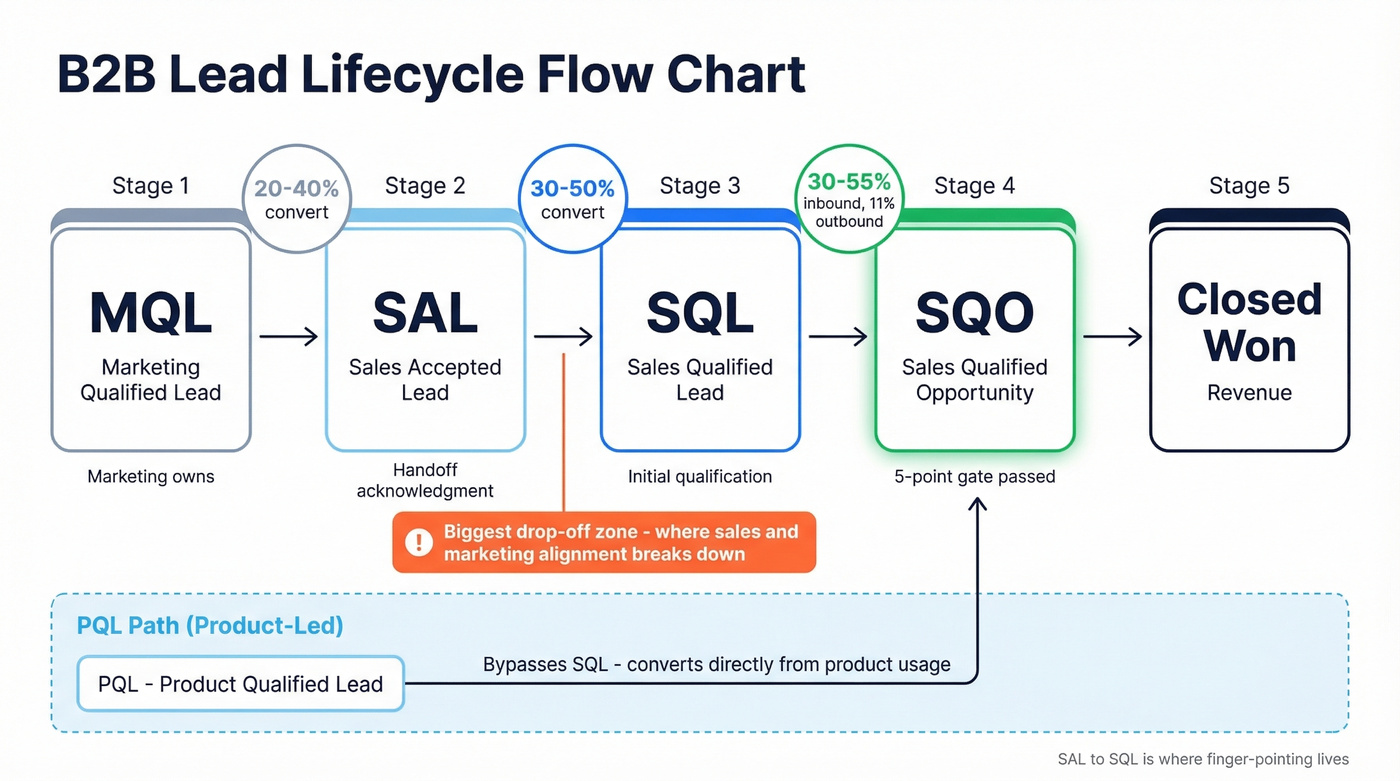
For product-led companies, PQLs (Product Qualified Leads) - users who've hit activation milestones in-product - often bypass the SQL stage entirely and convert directly to SQOs.
Benchmark ranges for each transition: Lead→MQL 20-40%, MQL→SAL 70-90%, SAL→SQL 30-50%. That SAL→SQL drop-off is exactly where sales-marketing alignment breaks down, and it's the most common source of finger-pointing we've seen across B2B orgs. If your team can't agree on what qualifies as an SQL, the SQO conversation is premature.

Your SQL-to-SQO conversion rate tanks when reps waste discovery slots on bad contact data. Prospeo delivers 98% email accuracy and 125M+ verified mobile numbers - so every SQL your SDRs qualify actually picks up the phone.
Stop losing qualified leads to bounced emails and dead numbers.
Conversion Benchmarks Worth Knowing
SQL→Opportunity conversion - the closest proxy for the SQL-to-SQO transition - runs 30-55% for inbound-sourced leads. (To pressure-test your own numbers, track funnel metrics consistently.)
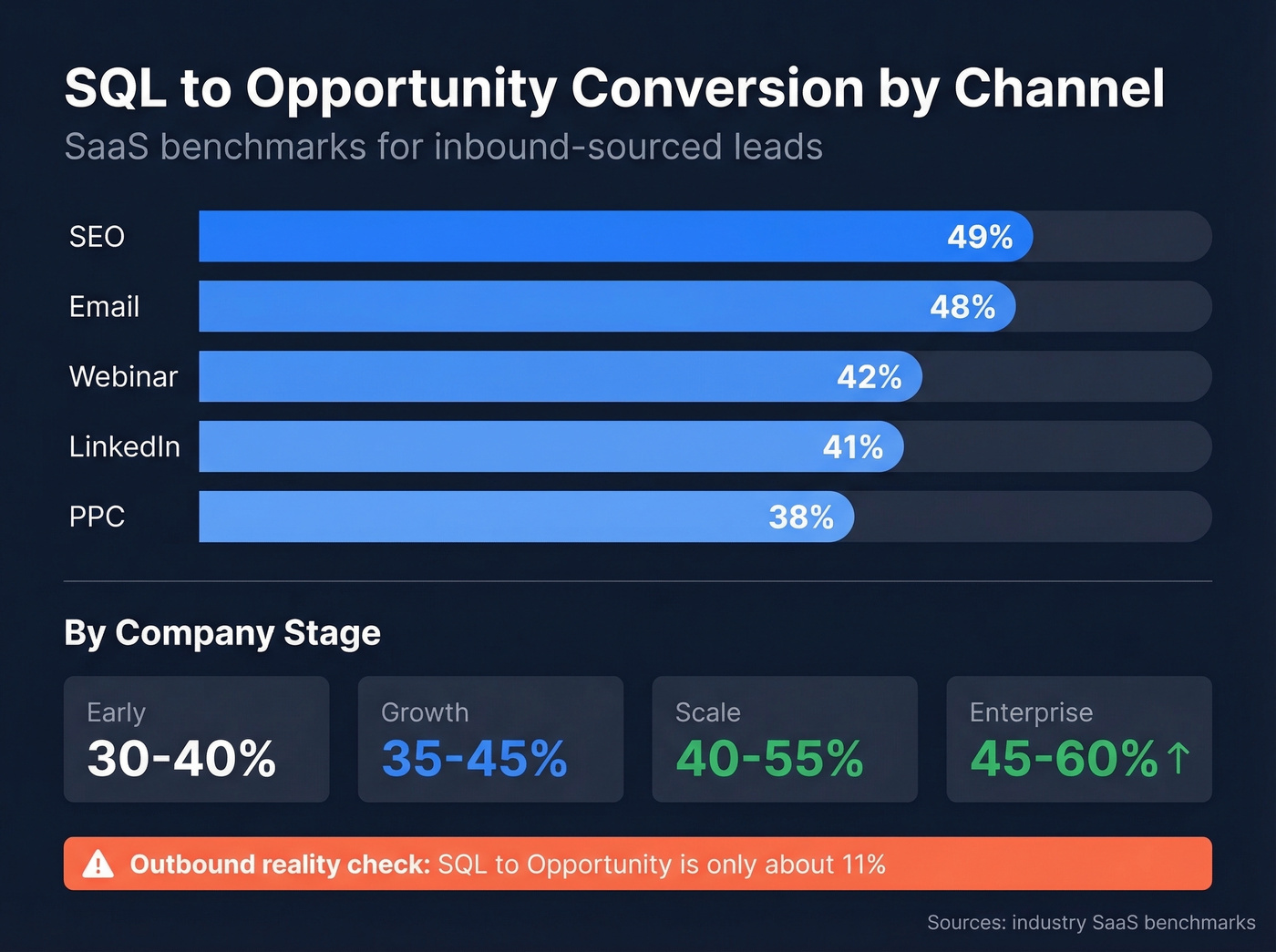
By channel (SaaS):
| Channel | SQL→Opportunity |
|---|---|
| SEO | 49% |
| 48% | |
| Webinar | 42% |
| 41% | |
| PPC | 38% |
By company stage:
| Stage | SQL→Opportunity |
|---|---|
| Early | 30-40% |
| Growth | 35-45% |
| Scale | 40-55% |
| Enterprise | 45-60% |
Outbound-sourced leads tell a different story: SQL→Opportunity sits at roughly 11%. That's the floor, not the target. For B2B SaaS cost benchmarks, expect about $25 per MQL, $250 per meeting booked, $450 per SQO, and $1,200 per acquisition. Downstream, SQL→Closed Won rates vary by industry - B2B SaaS averages 12%, IT & Managed Services hits 20%, and HVAC comes in at 29%. (If your pipeline math is consistently off, it’s usually one of these sales pipeline challenges.)
Qualification Frameworks for the SQO Gate
BANT works for velocity deals with short cycles and single decision-makers. Budget, Authority, Need, Timing - fast, effective, transactional.
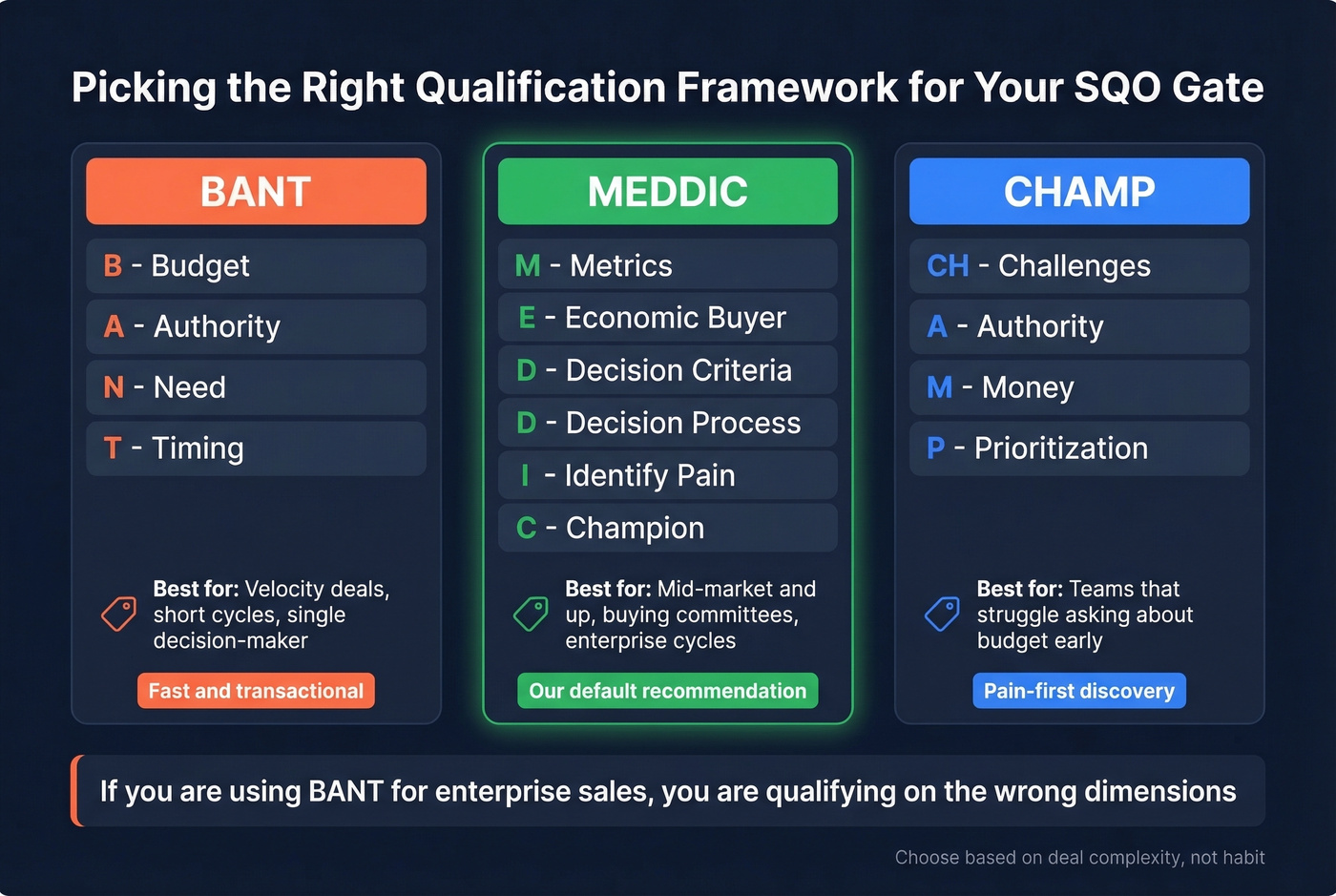
MEDDIC or MEDDPICC is what you want for buying committees or enterprise cycles. MEDDIC covers Metrics, Economic Buyer, Decision Criteria, Decision Process, Identify Pain, and Champion. It's heavier than BANT, but it catches deals BANT lets slip through - and in our experience, those slipped deals are the ones that haunt your forecast for months. (If you want to operationalize it, use MEDDIC discovery questions.)
CHAMP leads with Challenges instead of Budget, reframing discovery around the buyer's pain. It produces better qualification conversations when reps struggle with the "so what's your budget?" question early in the relationship.
Our default recommendation: MEDDIC for mid-market and up, BANT for transactional deals. If you're using BANT for enterprise sales, you're qualifying on the wrong dimensions. (This is also where enterprise B2B sales process discipline matters most.)
Why the SQO Gate Matters
Let's be honest: most B2B teams don't have a lead gen problem. They have a qualification problem.
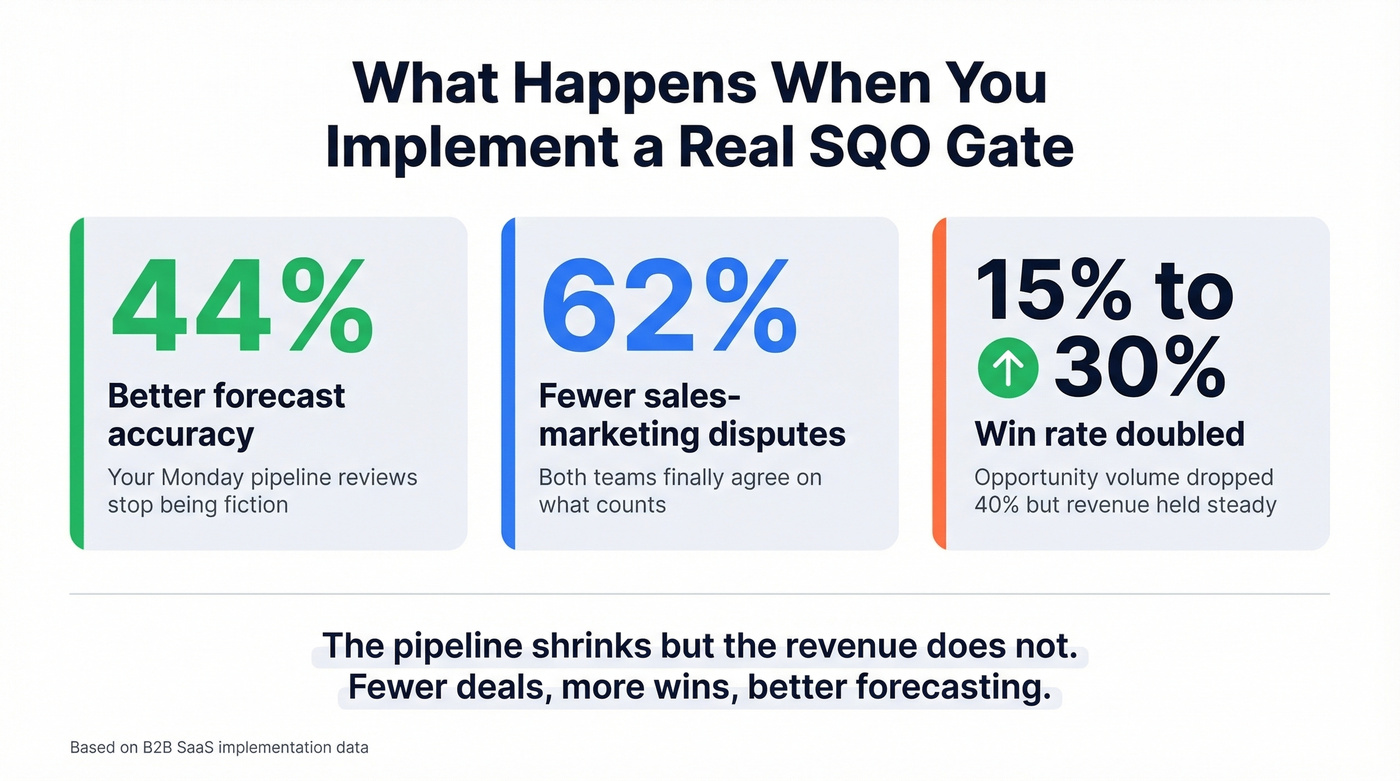
Implementing a consistent SQO definition drives roughly 44% improvement in forecast accuracy and 62% fewer sales-marketing disputes. Those aren't small numbers - they're the difference between a revenue team that trusts each other and one that spends every pipeline review pointing fingers. (If forecasting is the pain point, compare sales forecasting solutions built for RevOps teams.)
Sales leaders commonly expect 20% MQL→SQL conversion and blame marketing when actuals fall short. That conflict disappears when both teams agree on what qualifies as a real opportunity.
We've seen teams implement strict SQO gates and watch opportunity volume drop 40%. Sounds terrible. Then win rates doubled from 15% to 30%. Fewer deals, more wins, better forecasting. The pipeline shrinks, but the revenue doesn't.
How to Improve SQL-to-SQO Conversion
Implement the 5-point SQO gate. Process before technology. If your reps can't articulate the five criteria from memory, no tool will save you.
Measure SQO-based quotas, not just SQL volume. Tracking 12 SQLs per month means nothing if only 3 convert to qualified opportunities. Shift comp and reporting to SQO creation and you'll change behavior overnight. The consensus on r/sales is that SDR teams measured on raw SQL volume produce garbage pipeline - and the data backs that up.
Set an SLA for SQL follow-up. Same-day for inbound, within a few hours for outbound. Speed kills stale leads. (If you need copy you can deploy today, use these sales follow-up templates.)
Fix your contact data. Here's the thing: if 20% of your emails bounce, your SDRs are burning discovery slots on ghosts. Prospeo's real-time verification - 98% email accuracy, 30% mobile pickup rate - ensures your SQL list is reachable before a rep spends 30 minutes prepping for a call that never happens. (Start by monitoring your email bounce rate and cleaning lists proactively.) Snyk cut bounce rates from 35-40% to under 5% and saw AE-sourced pipeline jump 180% after switching to verified contact data.

Review SQO criteria quarterly. Get sales and marketing in the same room. Look at the last 50 SQOs - which ones closed, which stalled, and why. Adjust the gate based on what you learn, not what you assumed six months ago. Gartner's research on B2B buying and Forrester's demand management framework both reinforce that static qualification criteria decay fast in changing markets.
Skip this step if your team has fewer than 10 SQOs per quarter - you won't have enough data to draw meaningful conclusions. Focus on nailing the gate definition first.
Snyk's 50 AEs cut bounce rates from 35% to under 5% and grew AE-sourced pipeline 180%. When your SQL list is actually reachable, the SQO gate does its job - and your forecast stops lying to you.
Fewer ghosts in your pipeline. More deals that actually close.
FAQ
Is an SQO the same as a sales opportunity?
Not quite. An SQO has passed a defined qualification gate - ICP fit, budget, pain, decision-maker, and next step confirmed. A generic "sales opportunity" in most CRMs can be created without any criteria, which is exactly why pipelines get bloated. If your team creates opportunities on a whim, you don't have SQOs. You have wishful thinking.
What's a good SQL-to-SQO conversion rate?
30-55% for inbound, closer to 11% for outbound. Below 30% on inbound consistently? Audit your SQL criteria - you're letting unqualified leads through too early. Tightening the gate usually lifts win rates enough to offset lower volume.
How many SQOs should SDRs generate per month?
Most teams benchmark around 6 SQOs per SDR per month, though this varies by deal size and cycle length. Measuring qualified pipeline creation rather than raw SQL volume keeps SDRs focused on quality conversations instead of checkbox handoffs.
How does data quality affect conversion between stages?
Wrong contact data means discovery calls don't happen and SQLs stall before reaching the SQO gate. A HubSpot study on data decay found that B2B contact databases degrade roughly 30% per year - which means if you aren't actively verifying records, nearly a third of your SQL list is dead weight by year-end.