

Strategic Planning Sales: Benchmarks, Frameworks, and the Math Most Teams Skip
Average quota attainment in 2026 sits at 43%. More than half your team's capacity is evaporating somewhere between the plan and the pipeline. The problem isn't effort - it's that most sales plans are PowerPoint decks, not operating systems. They set targets without connecting those targets to the daily math that actually produces revenue.
Companies with structured strategic planning sales processes are 4x more likely to achieve their objectives and 1.7x more likely to hit quotas. The gap between teams that build a deliberate sales strategy plan and teams that wing it has never been wider.
Why Most Sales Plans Fail
A sales plan that says "hit $10M this year" without explaining how each rep gets there isn't a plan. It's a wish with a deadline.
40% of reps fail to hit targets, and McKinsey found that half of sales leaders say their reps lack the capabilities needed to succeed. That's not a talent problem - it's a planning problem. When reps don't know which accounts to prioritize, how many conversations they need per week, or what "qualified" actually means at your company, they default to gut instinct. Gut instinct at scale produces a 43% quota attainment rate.
Here's the failure pattern we see most often: leadership builds the plan in a conference room, hands it to managers as a slide deck, and expects execution to follow. Nobody runs the capacity math. Nobody pressure-tests whether the territory assignments are realistic. Then Q2 arrives, pipeline is thin, and everyone scrambles.
A rigorous strategic sales plan fixes this by connecting revenue targets to daily activities through a chain of math that's auditable, adjustable, and grounded in real benchmarks.
What Your Plan Actually Needs
Most guides skip the three things that matter:
- Segment-level benchmarks to set realistic targets - not industry averages that blur enterprise and SMB together
- A capacity model that reverse-engineers revenue goals into daily activity math, including the reality that reps spend only 28-30% of their time actually selling (28-30% of their time actually selling)
- An operating rhythm that keeps the plan alive past January with weekly, quarterly, and annual review cadences (track pipeline health weekly)
2026 Sales Benchmarks
Planning without benchmarks is guessing with confidence. These segment-level numbers give you a baseline to calibrate your targets against.
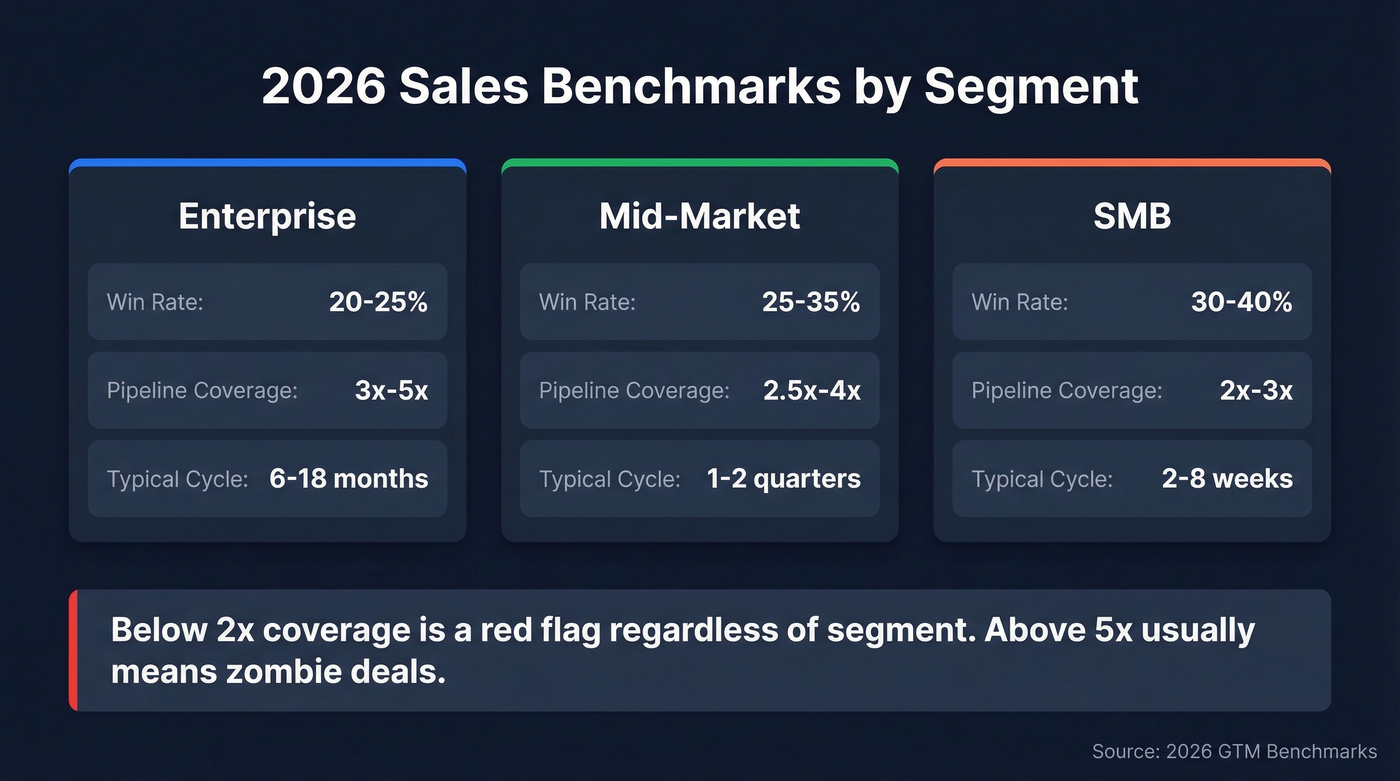
| Segment | Win Rate | Pipeline Coverage | Typical Cycle |
|---|---|---|---|
| Enterprise | 20-25% | 3x-5x | 6-18 months |
| Mid-Market | 25-35% | 2.5x-4x | 1-2 quarters |
| SMB | 30-40% | 2x-3x | 2-8 weeks |
Win rates also vary by vertical. Professional services teams close at roughly 28%, while manufacturing hovers around 19%. If you're using blended averages across verticals, you're lying to yourself about what's achievable.
The coverage math is straightforward: coverage needed = 1 / win rate. If your enterprise team wins 25% of deals, you need 4x pipeline coverage to hit target.
The pipeline coverage sweet spot is 3x-5x. Below 2x is a red flag regardless of segment. Above 5x usually means you're hoarding zombie deals that inflate the number without producing revenue.
Deals closed within 50 days carry a 47% win rate. Stretch past 50 days and that drops to 20%. This doesn't mean you should rush enterprise deals - it means velocity within each stage matters enormously. A deal sitting in discovery for six weeks isn't "progressing." It's dying quietly.
The 7-Step Sales Strategy Process
1. Set Revenue Targets Using Capacity Math
Start at the end and work backward. Annual target of $5M with a $50K average deal size means 100 closed deals. At a 25% win rate, you need 400 qualified opportunities. If each rep manages 80 per year, you need 5 quota-carrying reps - before accounting for ramp time or attrition.
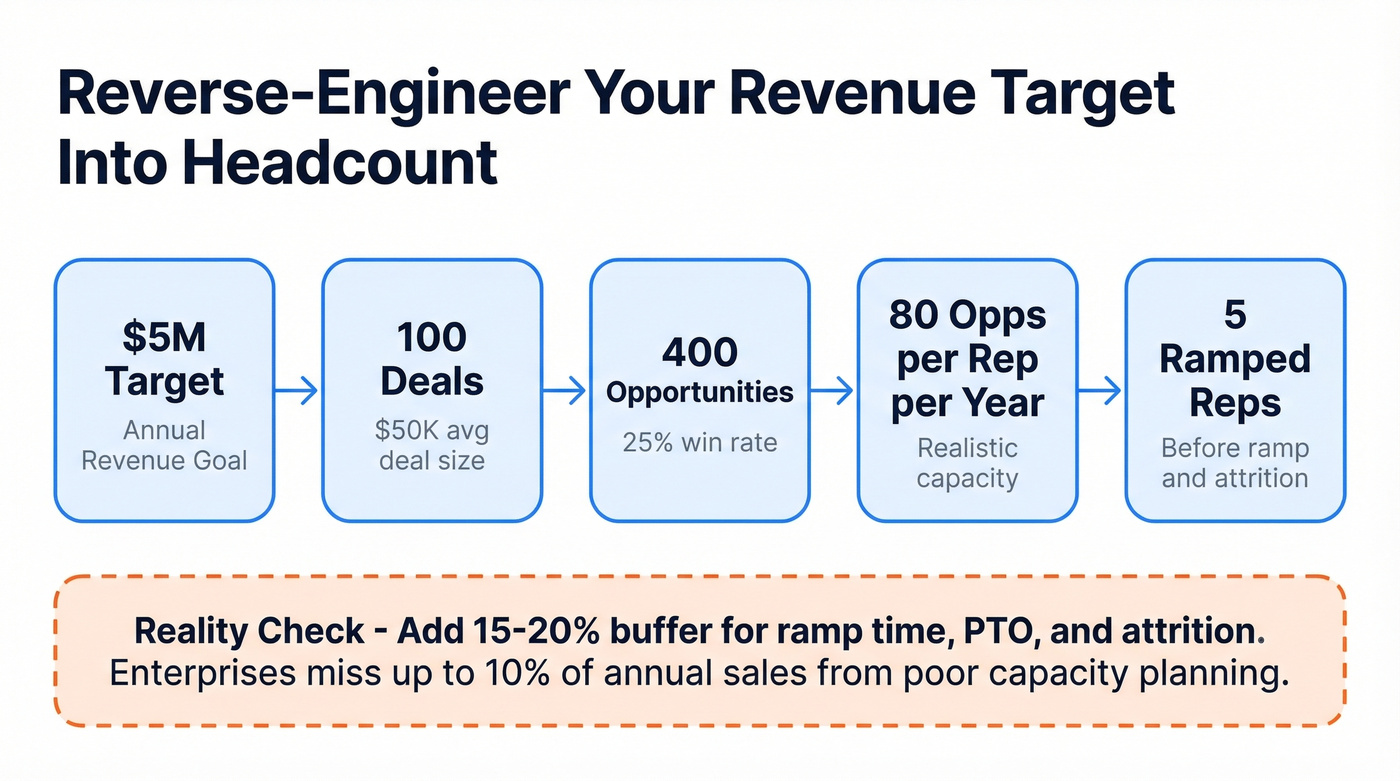
If the math says you need 8 reps but you have 4, you don't have a motivation problem. You have a math problem.
2. Define Your ICP by Segment
TAM, SAM, SOM isn't just a fundraising exercise - it's the foundation of territory planning. Start broad, narrow by geography and vertical fit, then get specific using technographics, headcount, funding stage, and intent signals (use firmographic and technographic data to tighten fit).
The best ICP definitions include negative criteria. If you're selling $80K ACV deals, a 5-person startup isn't your buyer no matter how enthusiastic the founder sounds. Codify this. Write it down. Make sure every SDR has it memorized (a simple ideal customer profile template helps).
3. Choose Your Methodology
MEDDIC for enterprise deals where multiple stakeholders and procurement dominate (see MEDDIC sales qualification). SPIN Selling for consultative environments where the buyer doesn't fully understand their own problem. Challenger for commoditized markets where reps need to lead with insight.
Real talk: most teams pick a methodology, train on it once, and never reinforce it. The methodology only works if it's embedded in your CRM stages, deal reviews, and coaching conversations. Otherwise it's a binder on a shelf.
4. Build Territory Plans
Territory models break into four types: geographic, vertical, account-based, and hybrid. ZoomInfo's territory planning research lays out the selection criteria well. Whichever model you choose, tier your accounts. A-tier gets multi-threaded outreach and executive engagement. B-tier gets structured sequences. C-tier gets automated nurture (this is where account-based selling gets practical).
Data quality is a capacity variable here that most people underestimate. Assign 500 accounts to a rep and 30% of the contact data is wrong - that's a 30% capacity cut before a single call. A 7-day refresh cycle and 98% email accuracy, like what Prospeo provides, prevent this kind of silent capacity erosion. If your territory plan runs on stale data, you're planning with phantom accounts.

5. Run the Capacity Model
Your target is $2M per quarter. Average deal size: $40K. That's 50 deals. At a 30% win rate, you need ~167 qualified opportunities. Each rep can realistically work 40 per quarter when they're only selling 28-30% of their time. You need at least 4-5 ramped reps.
Now factor in reality. One rep is ramping at 50% productivity. Another takes two weeks of PTO. Enterprises miss up to 10% of annual sales due to poor capacity planning. Build a 15-20% buffer into your headcount model.
How AI changes this math: AI SDR tools are compressing research-per-prospect time dramatically. 100% of teams using AI SDR tools report saving time, with 40% saving 4-7 hours per week. That's a meaningful capacity unlock - a rep who reclaims 5 hours weekly can work 15-20% more opportunities per quarter. Already, 45% of high-performing teams have adopted hybrid human-AI SDR models. If your capacity model still assumes 20 minutes of manual research per prospect, you're underestimating what your team can produce (compare stacks in our guide to the best SDR tools).
6. Set KPIs and Scoring
Use OKRs to translate the plan into measurable weekly work. Structure: 3-5 objectives, each with 2-5 key results, scored 0.0-1.0 at quarter end. A score of 0.7-1.0 means excellent execution. Below 0.4 means the objective needs rethinking.
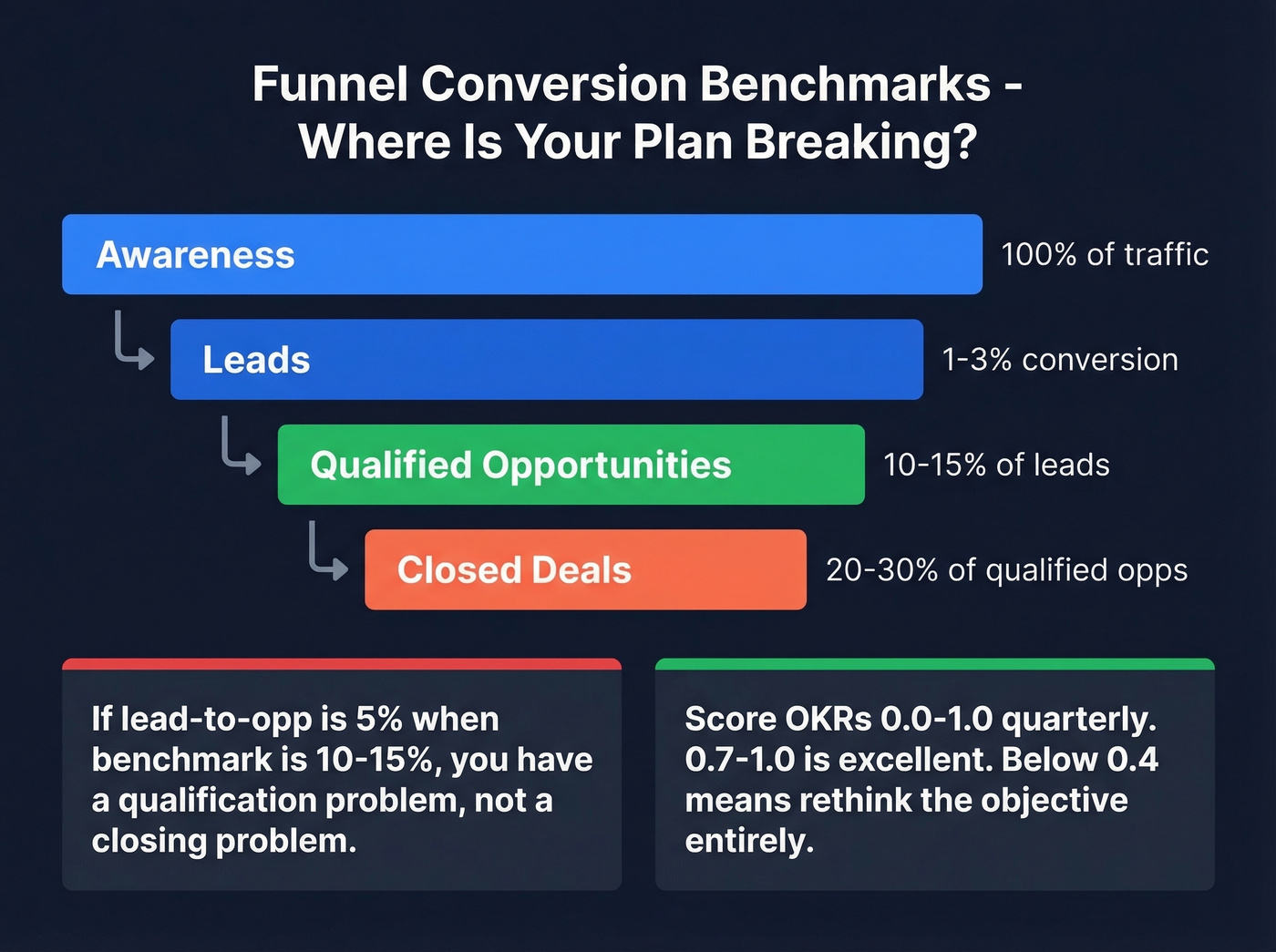
Anchor KPIs to funnel conversion benchmarks so you can diagnose where the plan is breaking (more benchmarks: funnel metrics):
- Awareness to Lead: 1-3%
- Lead to Qualified Opportunity: 10-15%
- Qualified Opportunity to Closed Deal: 20-30%
If your lead-to-opportunity conversion is 5% when the benchmark is 10-15%, you don't have a closing problem. You have a qualification problem.
7. Align Compensation
Compensation is a planning lever, not an afterthought - yet only 30% of companies say their comp strategy is prepared for economic shifts, and just 27% have fully automated commissions. Your comp plan should reinforce the behaviors your strategic plan requires. If the plan prioritizes new logos, weight comp toward new business. Misaligned comp is the fastest way to watch a perfectly designed plan get ignored (tie this into sales performance management early).
Frameworks That Work
OKRs for Sales Teams
Objective: Build $2M qualified pipeline in Q2.
- KR1: Generate 400 MQLs from outbound and inbound combined
- KR2: Convert 15% of MQLs to qualified opportunities
- KR3: Maintain average deal size above $35K
Run 15-20 minute weekly check-ins to score progress. The discipline isn't in setting the OKRs - it's in the weekly rhythm of actually reviewing them.
Balanced Scorecard for Larger Orgs
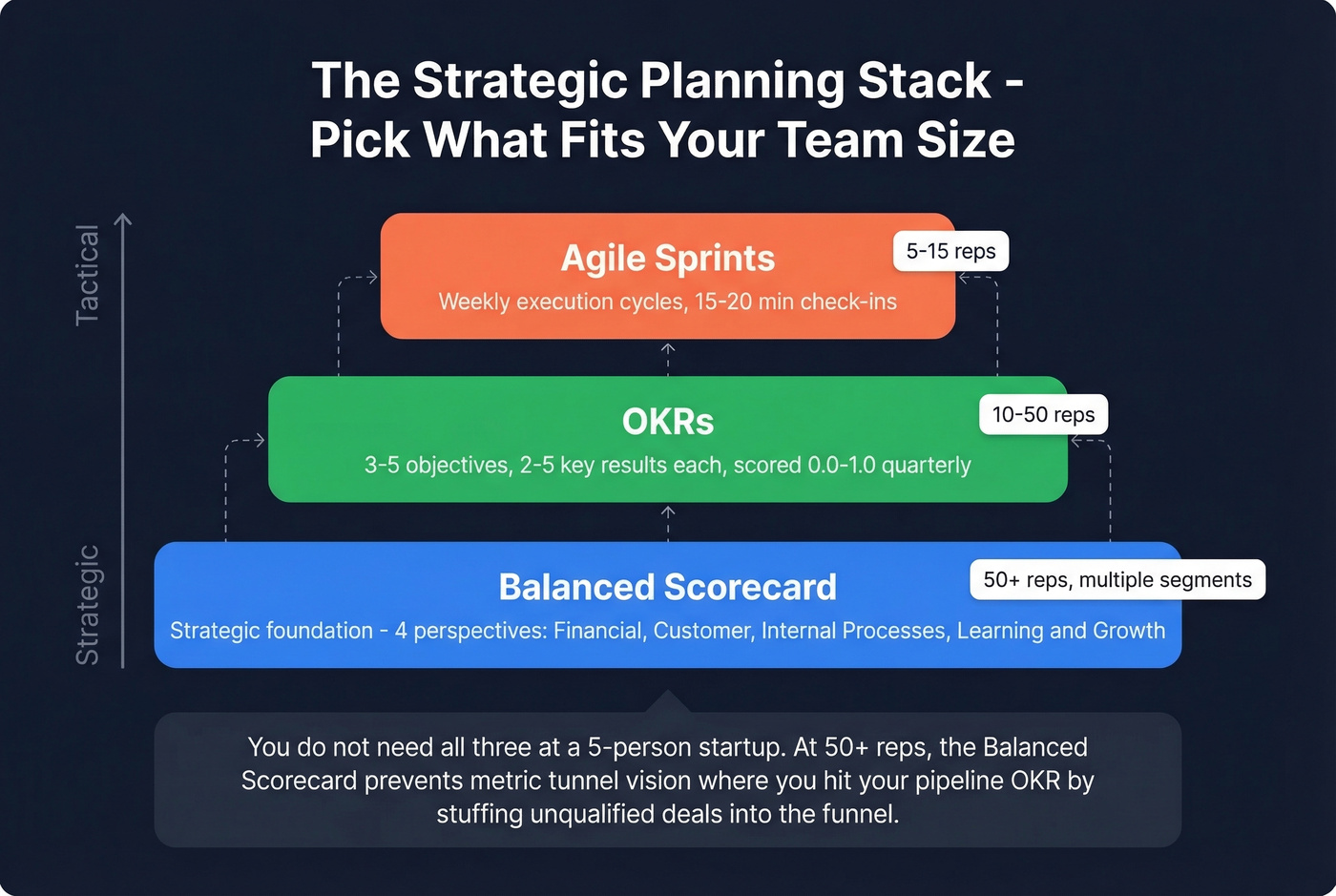
Once you're past 20 reps with cross-functional dependencies, a Balanced Scorecard adds the strategic layer OKRs alone can't provide. The four perspectives - Financial, Customer, Internal Processes, Learning & Growth - force you to plan beyond revenue numbers.
Think of it as a stack: the Balanced Scorecard provides the strategic foundation, OKRs handle tactical goal-setting, and agile sprints drive weekly execution. You don't need all three at a 5-person startup. At 50+ reps with multiple segments, the Balanced Scorecard prevents "metric tunnel vision" where you hit your pipeline OKR by stuffing unqualified deals into the funnel.

Your capacity model is only as good as your contact data. If 30% of emails bounce, you just cut rep capacity by 30% before a single dial. Prospeo's 7-day refresh cycle and 98% email accuracy eliminate the silent capacity erosion that kills strategic sales plans.
Stop planning on phantom accounts. Build your territories on verified data.
The Operating Rhythm
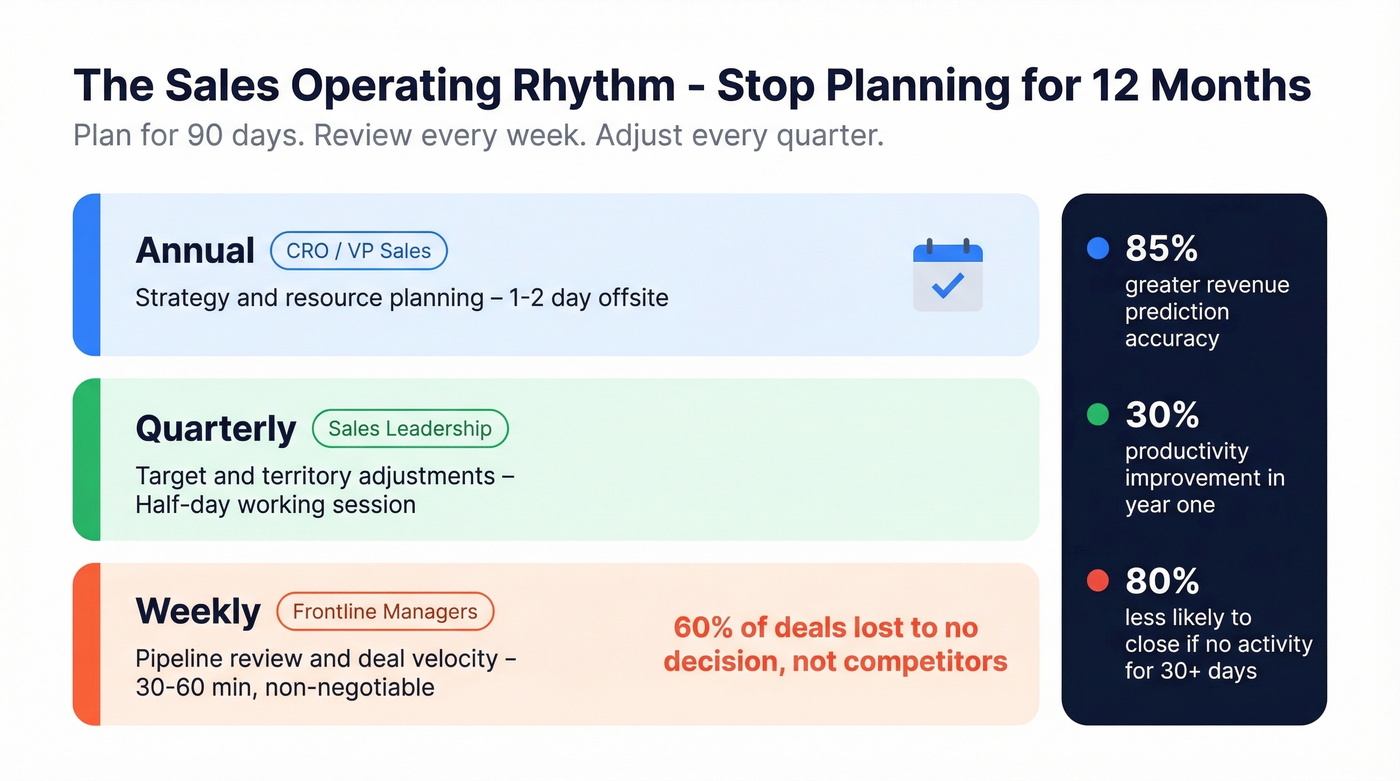
Stop planning for 12 months. Plan for 90 days.
| Cadence | Focus | Duration | Owner |
|---|---|---|---|
| Annual | Strategy + resource plan | 1-2 days | CRO/VP Sales |
| Quarterly | Target + territory adjust | Half-day | Sales leadership |
| Weekly | Pipeline + deal velocity | 30-60 min | Frontline managers |
The weekly review is non-negotiable. 60% of deals are lost to "no decision" - not to competitors. Deals with no activity for 30+ days are 80% less likely to close, which means your biggest enemy is stalled opportunities nobody's pushing forward. A weekly pipeline review with teeth - not a status update, but a "what's the next action and when" conversation - is the single highest-leverage activity in your operating rhythm (common failure modes: sales pipeline challenges).
Teams that commit to this cadence predict quarterly revenue with 85% greater accuracy and see 30% productivity improvements within the first year.
Sales and Marketing Alignment
In long-cycle industries, the planning failure mode is predictable: quarterly pressure applied to 9-18 month deal realities. The plan says "hit number this quarter" but the deals won't close for three more quarters. Pipeline collapses because nobody invested in early-stage opportunities six months ago.
We've seen this play out dozens of times. Marketing fills the top of the funnel with leads that sales ignores, and sales blames marketing for "low quality" while marketing points to volume metrics that look great on paper. The fix isn't a meeting - it's shared definitions of pipeline stages, agreed-upon SLAs for lead handoff, and joint accountability for coverage ratios.
Plan velocity within stages, not compression of the overall cycle. Every stage should have a defined timeline, and deals that stall beyond it get flagged immediately. For new enterprise reps, a 30-60-90 day structure keeps ramp time from destroying your capacity model: days 1-30 for foundation, 30-60 for guided execution, 60-90 for independence with tracked metrics (use a 30-60-90 day plan for sales reps).
One concrete example: GreyScout cut rep ramp time from 8-10 weeks to 4 weeks by formalizing this structure and running outbound with verified contact data.
Why Sales Plans Break Down
Five anti-patterns that kill strategic sales plans:
Planning in silos. Sales builds the plan without marketing, finance, or CS input. Targets don't align with lead gen capacity. By Q2, everyone's working from different assumptions.
Inconsistent definitions. "Qualified lead" means three different things across your SDR team, AE team, and marketing team. Every conversion metric downstream is unreliable. Define terms once, in writing, before planning starts (a formal lead scoring model helps).
Bad data. 36% of compensation professionals cite lack of access to quality data as a top challenge. Your territory plan is only as good as the contact data feeding it. Stale emails and wrong numbers silently destroy capacity (see data enrichment services options).
Moment-in-time snapshots. A plan built on January data is fiction by April. Markets shift, reps leave, products launch. 47% of companies cite market uncertainty as their top challenge. Without quarterly recalibration, you're executing against outdated assumptions.
Ignoring capacity utilization. This is the most common math error in sales planning. Planning for 100% selling time when reality is 28-30% guarantees you'll miss. Your reps aren't selling 8 hours a day. They're in internal meetings, updating CRM, doing admin. Plan for the real number.
Your Sales Plan Template
A strategic sales plan doesn't need to be 40 pages. It needs seven sections:
- Revenue targets with capacity math backing them up
- ICP definition with negative criteria
- Territory model with account tiering
- Methodology selection embedded in CRM stages
- Capacity model with headcount buffer
- KPIs anchored to funnel conversion benchmarks
- Operating cadence with weekly, quarterly, and annual rhythms
If your plan doesn't address all seven, you have gaps. Those gaps will surface as missed targets in Q2. Skip the fancy formatting - a Google Doc that covers these seven sections beats a 50-slide deck that covers three.
Tools for Sales Planning
The sales planning software market was estimated at $15B in 2025 and is projected to reach $45B by 2033. That growth reflects a simple truth: spreadsheets break at scale, and the cost of bad planning math exceeds the cost of dedicated tooling.
Here's the thing, though - most teams under 50 reps don't need a $100K planning platform. They need a CRM they actually use, a verified data source, and the discipline to run weekly pipeline reviews. The tool doesn't fix the process. The process makes the tool useful.
For most growth-stage teams, Prospeo plus your CRM covers the majority of planning data needs. In our experience, the data accuracy piece is where teams underinvest and overpay the most (more options: best sales prospecting databases).
| Tool | Best For | Pricing | Key Strength |
|---|---|---|---|
| Prospeo | Verified prospect data | From ~$0.01/email; free tier | 98% accuracy, 7-day refresh |
| Salesforce Sales Cloud | CRM-native planning | $25-$500/user/mo | Ecosystem depth, forecasting |
| Anaplan | Enterprise capacity modeling | $30K-$100K+/yr | Complex scenario modeling |
| Pigment | Mid-market planning | $50K-$150K+/yr | Visual planning interface |
| Varicent | Sales performance mgmt | $50K-$200K+/yr | Territory + comp + quota |
| Xactly | Forecasting + incentives | $30-$100/user/mo | Comp plan modeling |
| HubSpot Sales Hub | SMB/startup CRM | Free-$150/user/mo | Low barrier, quick setup |
Salesforce Sales Cloud is the default for teams already in the Salesforce ecosystem - native forecasting, territory management, and pipeline visibility without another vendor. Anaplan handles complex capacity and territory modeling for organizations with hundreds of reps. Pigment offers a more visual, mid-market-friendly alternative. Varicent combines territory, compensation, and quota planning in a single SPM platform. Xactly focuses on forecasting and incentive compensation. HubSpot gives startups a CRM with basic planning features at a price point that doesn't require board approval.
If you're already running Anaplan or Varicent and it's working, don't switch. But if you're a 15-person sales team evaluating six-figure planning software before you've nailed your weekly pipeline review cadence, skip it. Fix the process first.

Territory plans built on stale data produce the 43% quota attainment you're trying to escape. Prospeo gives your reps 300M+ verified profiles with 30+ filters - intent signals, technographics, headcount growth - so every account in your plan is real and reachable at $0.01 per email.
Turn your strategic plan from a slide deck into a pipeline machine.
FAQ
What's the difference between a sales plan and a strategic sales plan?
A sales plan sets targets. A strategic sales plan connects those targets to capacity math, territory models, methodology, and a quarterly operating cadence. It answers "how" and "with what resources" - not just "how much."
How often should you update a strategic sales plan?
Quarterly for targets, territories, and headcount. Weekly for pipeline and deal velocity. Annual for overall direction and resource allocation. Plans that sit untouched past Q1 are fiction by Q2.
What pipeline coverage ratio should I target?
Enterprise needs 3-5x, mid-market 2.5-4x, SMB 2-3x. Below 2x in any segment means you'll almost certainly miss target. Above 5x usually signals zombie deals inflating the number.
How do I build a sales capacity model?
Divide your revenue target by average deal size to get deals needed. Divide deals by win rate for pipeline required. Divide pipeline by per-rep capacity for headcount. Then add a 15-20% buffer for ramp, attrition, and the 28-30% selling-time reality.
How does data quality affect strategic planning sales outcomes?
If 30% of your contact data is stale, you've lost 30% of planned capacity before reps make a single call. Weekly data refreshes and verified emails prevent the silent erosion that makes territory plans look solid on paper but collapse in execution.