

How to Build a Targeted Marketing List That Actually Converts
You loaded 2,000 purchased contacts into your sequencer and watched the bounce rate climb past 15% before lunch. Your domain reputation took a hit that'll take weeks to repair, and you've got nothing to show for it.
A targeted marketing list isn't a spreadsheet of names. It's a curated set of contacts who match your buyer profile, have verified data, and are actually reachable. Here's the thing: most teams get this wrong not because they lack tools, but because they skip the fundamentals and jump straight to volume.
What You Need (Quick Version)
Don't buy email lists. If you need direct mail lists, buying is standard practice - but email is a different game entirely. Build your own list using a data platform with built-in verification.
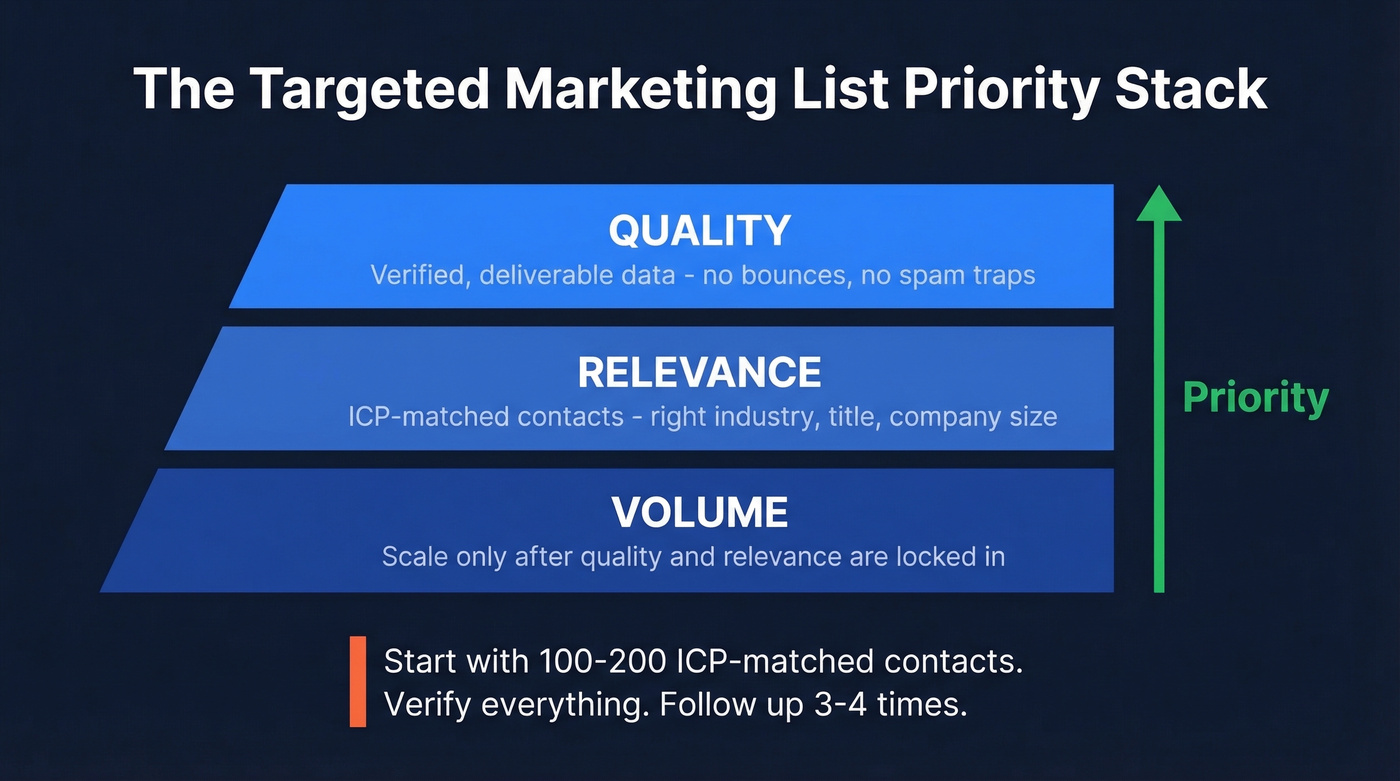
The priority stack: Quality first (verified, deliverable data), then Relevance (ICP-matched contacts), then Volume (scale only after the first two are locked). Start with 100-200 ICP-matched contacts, verify everything, and follow up 3-4 times.
Types of Marketing Lists
The term "targeted marketing list" covers both email and direct mail. Before you build or buy anything, know what you're working with.
| List Type | Channel | Description |
|---|---|---|
| House list | Both | Your existing customers and past buyers |
| Prospect list | Both | People who haven't interacted with you |
| Compiled list | Both | Aggregated from public records and directories |
| Response list | Direct mail | People who responded to a previous offer |
| Consumer list | Both | Filtered by demographics and interests |
| B2B list | Both | Filtered by firmographics and job title |
| New mover list | Direct mail | People who recently relocated |
| Homeowner / renter list | Direct mail | Filtered by housing status |
The performance gap between list types is real. House lists pull 5-9% response rates in direct mail, while prospect lists average 2-5%. That delta matters when you're planning campaign economics.
Buy vs. Build
The answer depends entirely on the channel.
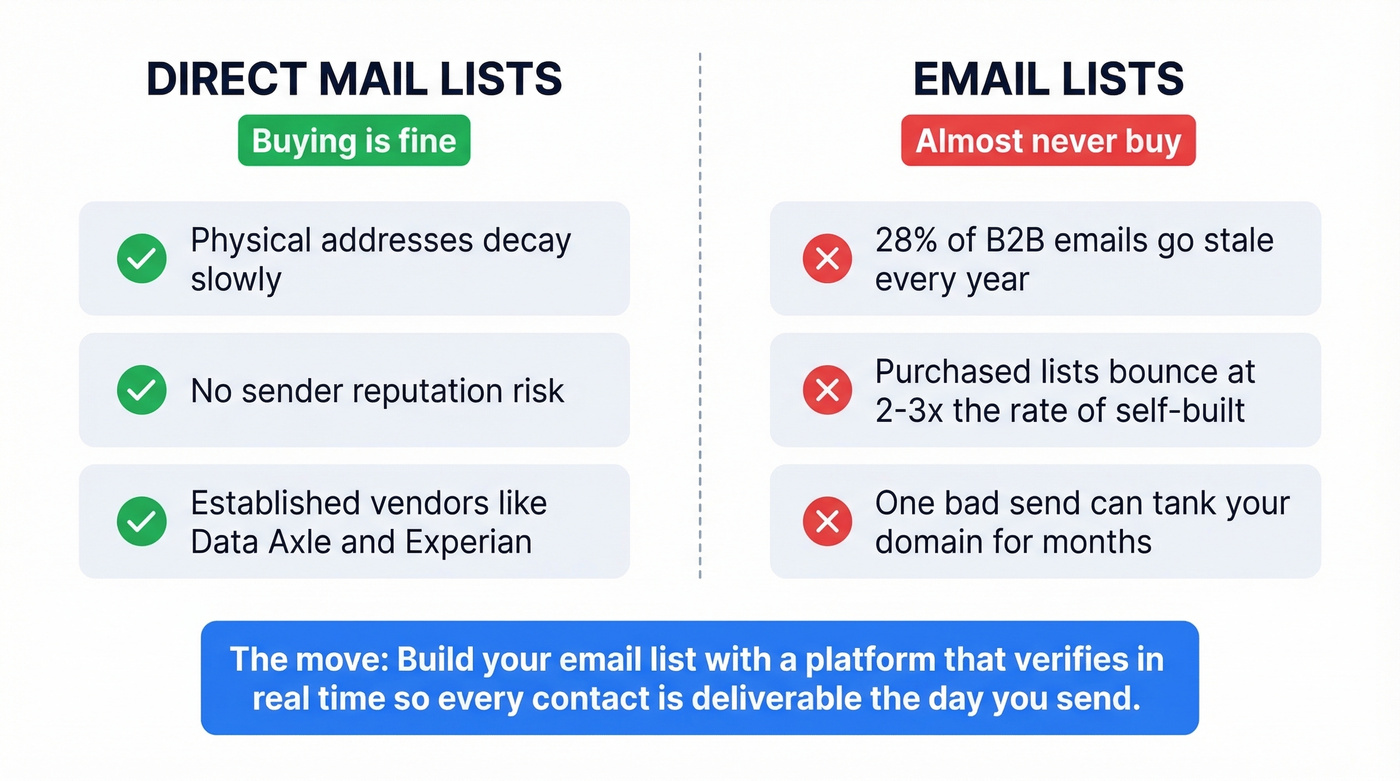
Direct mail lists - buying is fine. Vendors like Data Axle, Experian, and Focus USA have been selling compiled and response lists for decades. Physical addresses decay slower than email, and there's no sender reputation to destroy.
Email lists - almost never buy. The practitioner consensus is blunt: you'll tank your sender reputation instantly. About 28% of B2B email addresses go stale annually. A purchased list that was 90% accurate in January is around 71% by October. In our experience, even "premium" purchased lists bounce at 2-3x the rate of self-built ones.
Build your email list using a platform that verifies in real time, so every contact you export is deliverable the day you send.
How to Build a Targeted List
1. Define your ICP tightly. Don't target "marketing agencies." Target "US SMB marketing agencies with 10-50 employees doing local SEO." We've watched teams waste months blasting broad lists when 200 well-researched contacts would've outperformed 5,000 random ones by a wide margin. (If you need a structure, use an ICP template.)
2. Source and verify contacts simultaneously. This is where most workflows break. You pull contacts from one tool, verify in another, and lose 30% in the gap. Poor data quality costs organizations an average of $12.9M per year in lost productivity and misallocated budget - most of that waste happens right here, in the handoff between sourcing and verification. Use a platform that collapses both steps so every email you export is already verified. (More options: data enrichment services.)

3. Segment before you send. Don't dump everyone into one sequence. Group by persona, pain point, or buying stage. If you want a deeper framework, start with firmographic filters and layer in firmographic and technographic data.
4. Follow up. Most replies come after the 2nd or 3rd email. Use 4 touches over roughly 2 weeks. First email should be plain text, no links, one question as the CTA. Giving up after one send is the single most common mistake we see. (If you need copy, steal these sales follow-up templates or use cold email follow-up templates.)
5. Maintain the list. Set a quarterly cleaning cadence at minimum. With 28% annual decay on B2B email addresses, a list you built in January is roughly 14% inaccurate by July without a refresh. (If bounces are already creeping up, see email bounce rate.)

You just read why sourcing and verifying in separate tools kills your list quality. Prospeo collapses both steps into one workflow - 300M+ profiles, 30+ ICP filters, and 5-step email verification built in. Every contact you export is already verified at 98% accuracy, so your targeted marketing list is deliverable the day you hit send.
Build a 200-contact targeted list in minutes, not days. Free tier included.
Segmentation That Moves Numbers
Segmentation isn't optional - it's the difference between a 2% reply rate and a 5% one. Segmented campaigns get 14% more opens and 101% more clicks compared to non-segmented sends.
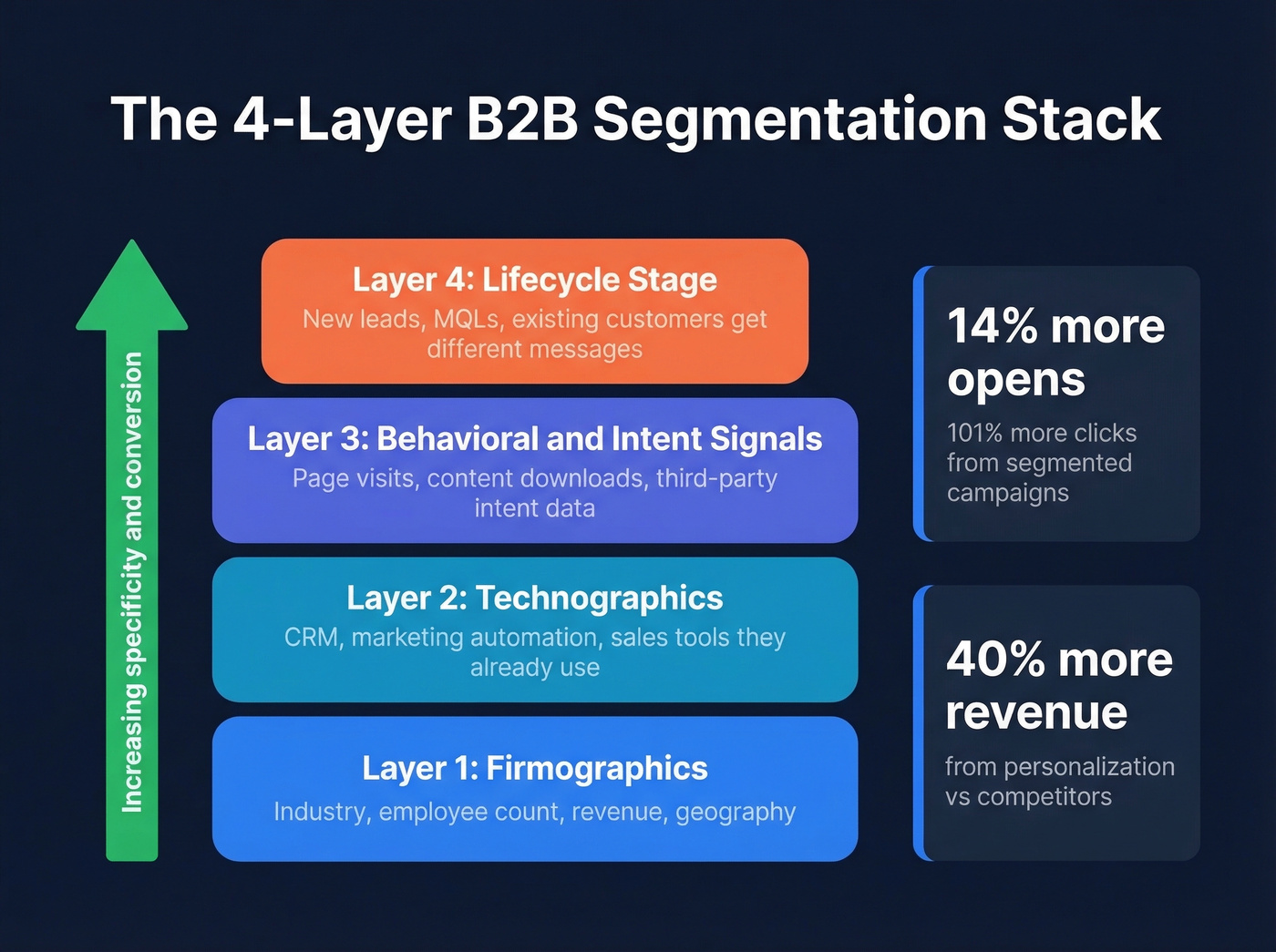
For B2B lists, you need four layers working together. Start with firmographics - industry, employee count, revenue, geography - as your baseline filter. Then add technographics: what CRM, marketing automation, or sales tools they run, which tells you what they've already bought and what they might replace. Layer in behavioral and intent signals like page visits, content downloads, and third-party intent data to find people actively researching your category. Finally, segment by lifecycle stage so new leads, MQLs, and existing customers get different messages. (For a full playbook, see intent based segmentation.)
Firmographic-only segmentation is table stakes at this point. If you're not layering intent data on top, you're five years behind the teams eating your pipeline. Businesses driving rapid growth pull 40% more revenue from personalization than their competitors.
Tools and Pricing
| Tool | Best For | Starting Price | Free Tier? | Key Stat |
|---|---|---|---|---|
| Prospeo | Verified email lists | ~$0.01/email | 75 emails/mo | 300M+ profiles, 98% accuracy |
| Apollo.io | Volume prospecting | ~$49/mo | 1,200 credits/mo | 275M+ contacts |
| Lusha | EU direct dials | ~$49/mo | 40 credits/mo | Strong EMEA coverage |
| Cognism | Enterprise B2B (EU) | ~$1,000-3,000/mo | No | Diamond-verified mobiles |
| ZoomInfo | Full GTM platform | ~$15-40K/yr | No | Deepest US database |
| D&B | Company data + credit | $49/mo (300 credits) | No | Dun & Bradstreet lineage |
| Data Axle | Direct mail lists | ~$99/mo | No | Consumer + business lists |
| Experian | Direct mail + credit | ~$0.03-0.10/record | No | Demographic overlays |
Prospeo is the pick for teams that need accuracy without enterprise budgets. Its 5-step verification process - including catch-all handling, spam-trap removal, and honeypot filtering - means 98% of exported emails are deliverable. Data refreshes every 7 days versus the 6-week industry average, so your targeted marketing list stays current between quarterly cleanings. With 30+ search filters covering buyer intent, technographics, job changes, and headcount growth, you can build a hyper-specific list and export verified contacts in one workflow. (If you're comparing databases, start with best sales prospecting databases.)
Apollo's free tier (1,200 credits/month) is generous for volume prospecting, but email accuracy trails behind at roughly 79% - expect more bounces. Lusha is the pick for European direct dials and GDPR-first workflows, though the 40-credit free tier runs out fast.
Skip ZoomInfo unless you're running a large enterprise team. $15K+/year for data that refreshes around every 6 weeks is a bad deal for SMBs and mid-market companies. I've watched startups sign annual ZoomInfo contracts and use 10% of the platform.
For direct mail specifically, Data Axle and Experian are the established players - built for physical address targeting with demographic overlays, a different use case than B2B email prospecting.
Compliance Quick Reference
Getting this wrong is expensive.
| Regulation | Scope | Max Penalty | Key Rule |
|---|---|---|---|
| GDPR | EU residents' data | EUR 20M or 4% global turnover | Explicit opt-in required |
| CCPA | California consumers | $2,500-$7,500/violation | Must offer opt-out link |
| TCPA | US phone/SMS | $500-$1,500/violation | Prior consent for calls |
| CAN-SPAM | US email | Up to $53,088/email | Opt-out within 10 days |
Let's be honest: 1,000 contacts without proper consent under TCPA can mean $500K-$1.5M in penalties. Always include an unsubscribe mechanism and a physical address in your emails. This isn't optional.
Mistakes That Kill List Performance
Buying email lists and blasting them. Your sender reputation is fragile. One bad send to a purchased list can land you in spam folders for months. A founder on r/EntrepreneurRideAlong laid out a simple playbook: build a small list of 100-200 good prospects (not 5,000 random ones), validate emails, and follow up - most replies came after the 2nd or 3rd email. (If you're scaling outbound, use these sales prospecting techniques.)
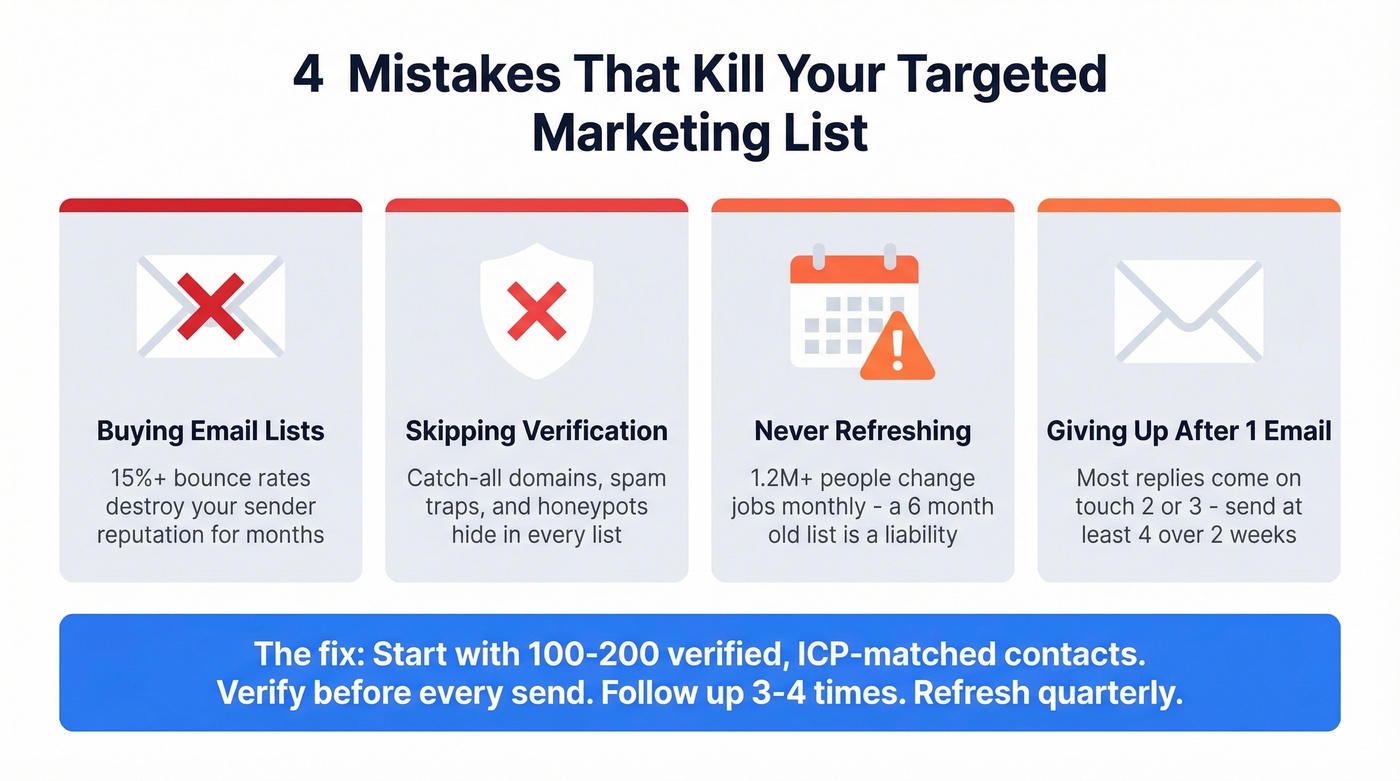
Skipping verification. Even "fresh" data from a reputable source needs verification before you send. Catch-all domains, spam traps, and honeypots don't announce themselves. (If you suspect traps, start with spam trap removal.)
Never refreshing your data. Over 1.2 million people change jobs or relocate every month. A list that's six months old is a liability, not an asset.
Giving up after one email. Most replies come on the 2nd or 3rd touch. If you're sending one email and moving on, you're leaving the majority of your potential responses on the table. Four touches over two weeks is the minimum we'd recommend for any cold outreach sequence.
A targeted marketing list decays 28% per year - unless your data refreshes faster than it rots. Prospeo refreshes every 7 days versus the 6-week industry average, with catch-all handling, spam-trap removal, and honeypot filtering baked in. At ~$0.01 per verified email, keeping your list current costs less than one bounced campaign.
Your list is only as good as your last refresh. Make it weekly.
FAQ
House list vs. prospect list?
A house list contains existing customers and past buyers - it pulls 5-9% response rates in direct mail versus 2-5% for prospect lists. House lists always outperform because there's an existing relationship and higher trust.
How often should I clean my list?
Quarterly at minimum. With 28% of B2B email addresses going stale annually, a January list is roughly 14% inaccurate by July without a refresh. Platforms with weekly data refresh cycles catch decay before it tanks deliverability.
Where can I buy targeted leads?
For direct mail, vendors like Data Axle and Experian sell compiled lists filtered by demographics, geography, and purchase behavior. For email outreach, don't buy - build instead. Self-serve data platforms let you filter by ICP criteria and export verified addresses in one step, skipping the bounce-rate disaster of purchased lists.
What's the fastest way to build a B2B list?
Use a self-serve data platform. Define your ICP with filters (industry, headcount, tech stack, intent), export verified contacts, and start outreach the same day. Most teams build a 200-contact list in under 30 minutes with tools like Prospeo or Apollo.