

Targeted Prospecting: How to Build a Pipeline That Actually Converts
91% of cold outreach emails get zero response](https://martal.ca/sales-statistics-lb/). That's not a rounding error - it's the baseline for teams still spraying lists and hoping something sticks. Meanwhile, 80% of deals require five or more touches, yet 44% of reps quit after one. Targeted prospecting isn't a nice-to-have. It's the only way the math works.
What You Need (Quick Version)
Three things separate teams that close deals from teams that just stay busy. First, build a scored ICP - not a vague description, but a 100-point rubric that ranks every account. Second, verify contact data before you sequence. Bad emails tank your sender reputation and waste every hour you spent targeting. Third, measure Tier A vs. Tier B win rates, not activity volume.
These fundamentals drive outbound lead quality more than any single tool purchase.
What It Actually Means
Targeted prospecting is identifying and engaging specific high-fit accounts and buyers rather than blasting a broad list. Your ICP defines the company type - industry, size, tech stack, growth signals. Your buyer persona defines the decision-maker inside that company. Bain research shows companies tightly aligned around an ICP grow revenue up to 2.5x faster than peers.
Here's the thing: if your average deal size is under $10k, you probably don't need a $15k/year data platform. But you absolutely need a scoring model. The framework matters more than the tooling.
Build an ICP Scoring Model
Analyze your last 50-100 closed-won deals. 70-80% of those wins will share 3-5 common traits. Those traits become your scoring categories.
Build a 100-point rubric across four weighted categories:
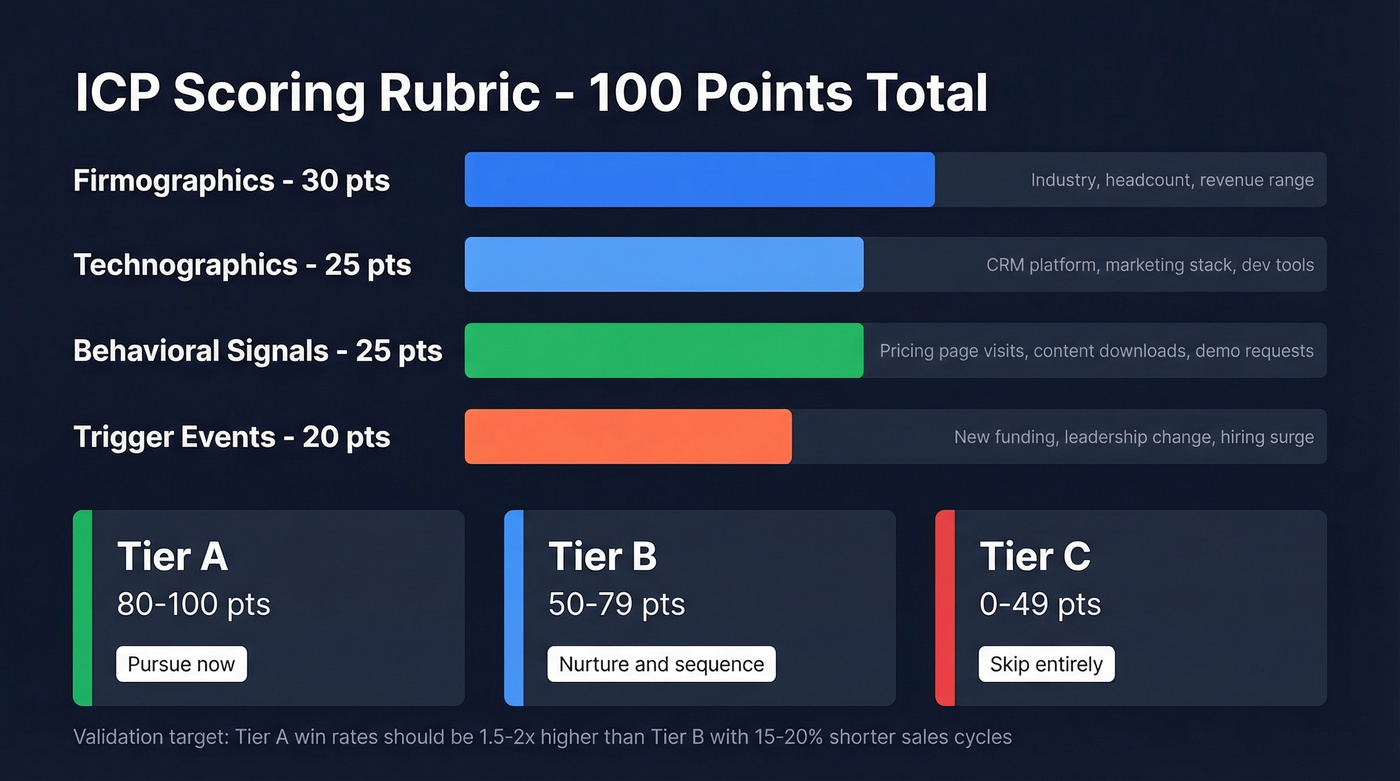
| Category | Weight | Example Signals |
|---|---|---|
| Firmographics | 30 pts | Industry, headcount, revenue |
| Technographics | 25 pts | CRM, marketing stack |
| Behavioral | 25 pts | Pricing page visits, downloads |
| Trigger Events | 20 pts | Funding, leadership change |
Then tier your accounts:
- Tier A (80-100): Pursue now. These match your best customers.
- Tier B (50-79): Nurture. Worth sequencing but lower priority.
- Tier C (0-49): Skip entirely.
We've seen teams over-weight firmographics and under-weight behavioral signals. Don't make that mistake - a 200-person company actively researching your category beats a 2,000-person company that's never visited your site. Your support team talks to customers daily, too. Feed their insights back into your scoring criteria. They'll surface patterns your CRM can't.
Validation target: Tier A win rates should run 1.5-2x higher than Tier B, with 15-20% shorter sales cycles. If they don't, recalibrate.
Use Intent Data to Prioritize Prospects
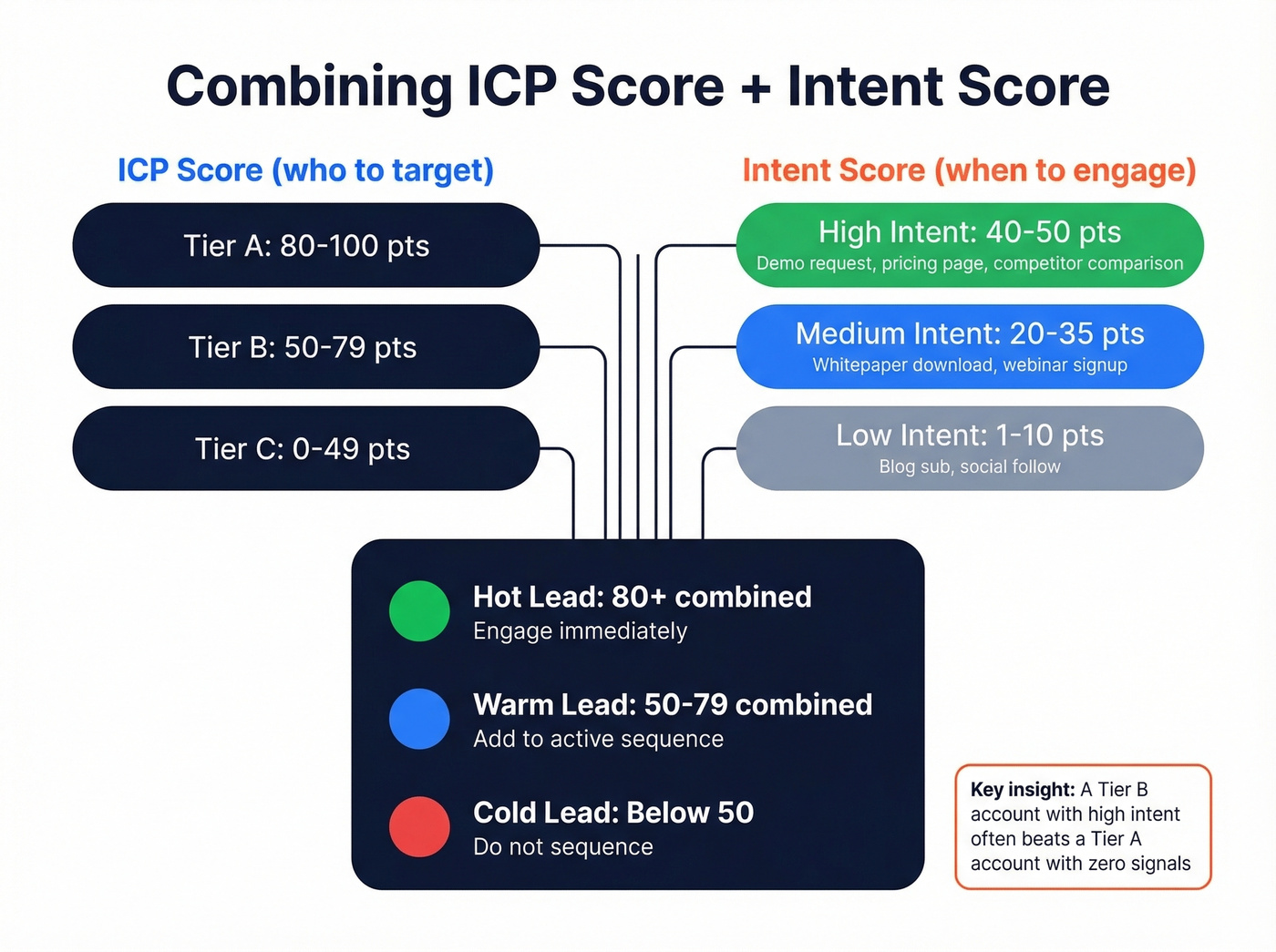
A scored ICP tells you who to target. Intent data tells you when. The combination is what makes this approach actually work.
First-party signals come from your own properties - website visits, pricing page views, content engagement. Third-party signals come from external behavior across publications, review sites, and forums. Both matter, but weight them differently:
- High intent (40-50 pts): Demo request, pricing page visit, competitor comparison page
- Medium intent (20-35 pts): Whitepaper download, webinar registration
- Low intent (1-10 pts): Blog subscription, social follow
Set thresholds. Hot leads cross 80 points when you combine ICP and intent scores, warm leads sit at 50-79, cold leads stay below 50. The goal is to engage prospects showing genuine buying behavior, not just casual interest. The consensus on r/sales is pretty clear on this: reps who chase "interest" instead of "intent" burn out fast and close less.

Your ICP scoring model is only as good as the contact data behind it. Prospeo gives you 98% email accuracy from 300M+ profiles, refreshed every 7 days - so your Tier A accounts never bounce. Layer 30+ filters including buyer intent, technographics, and headcount growth to build lists that match your scoring rubric exactly.
Stop feeding stale data into a perfect scoring model.
The 5-Step Prospecting Workflow
1. Score accounts with your ICP rubric. Run every account through the 100-point model. Without scoring, you're just making a list and calling it "targeted." If you need a starting point, use an Ideal Customer Profile Template and adapt it to your closed-won data.
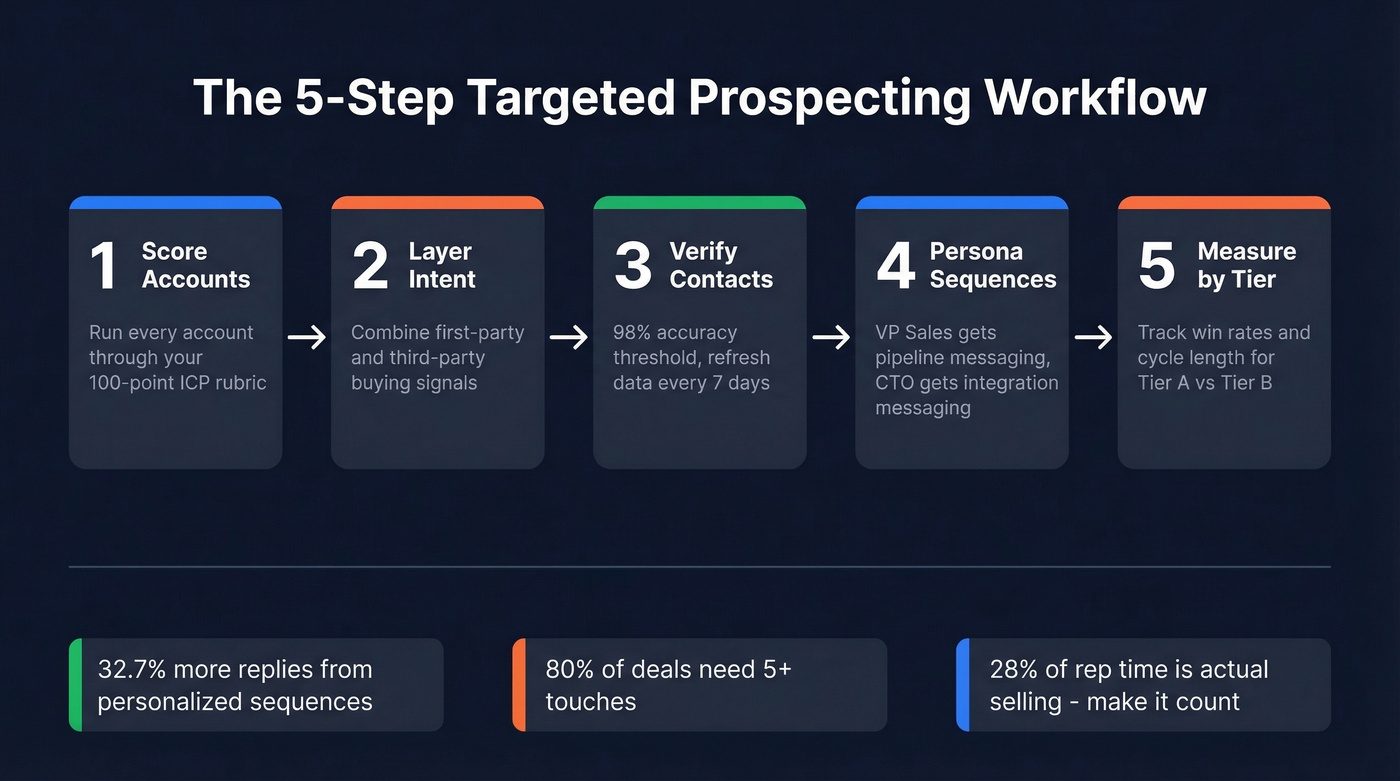
2. Layer intent signals. A Tier B account showing high intent often deserves attention before a Tier A account with zero signals. Let the data sequence your outreach order, not your gut. (More on identifying buying signals if you want a scoring guide.)
3. Enrich with verified contact data. Before you launch any sequence, verify your contacts. Roughly 17% of cold emails get blocked or land in spam - bad data doesn't just waste time, it poisons deliverability for your entire domain. Prospeo returns 98% accurate emails from 300M+ profiles, refreshes data every 7 days, and integrates with HubSpot, Salesforce, Instantly, and Lemlist. The free tier gives you 75 verified emails per month, enough to test your scoring model before committing budget.

4. Build persona-specific sequences. Personalized messages receive 32.7% more replies than generic outreach. The VP of Sales cares about pipeline velocity; the CTO cares about integration complexity. Different pain points, different sequences. If you want plug-and-play copy, start with these sales follow-up templates.
5. Measure Tier A vs. Tier B performance. Track win rates, cycle length, and reply rates by tier. If Tier A isn't outperforming Tier B by at least 1.5x, revisit your scoring criteria. That gap is your proof the model works. For a broader playbook, see these sales prospecting techniques.
Mistakes That Kill Your Pipeline
The same prospecting failures show up everywhere: reps burning through massive lists with nothing to show for it, then blaming "the market." The real culprits are more specific.
No scored ICP. If you can't assign a numerical score to an account, you're guessing which ones to prioritize. A feeling isn't a strategy. This is exactly what modern lead scoring is designed to fix.
Stale data. Bounced emails don't just waste time - they actively erode your sender reputation. One bad batch can tank deliverability for weeks. I've watched a team lose an entire sending domain over a single unverified import of 3,000 contacts. If you're troubleshooting, start with email bounce rate benchmarks and root causes.
Quitting after one touch. 80% of deals need five or more touches. The rep who sends one email and moves on is leaving pipeline on the table. (If you need the data to coach this, see the importance of follow-up in sales.)
Optimizing for activity, not conversion. In our experience, the teams that obsess over "emails sent" consistently underperform teams tracking Tier A win rates and pipeline-to-quota ratio. Reps spend only 28% of their time actually selling - focused prospect targeting is how you make that 28% count.
Your 2026 Prospecting Stack
Stacks are consolidating. Teams are moving from 8-12 point solutions down to 4-6 integrated platforms, and 45% of high-performing teams now run hybrid human-AI SDR models. Research time has dropped up to 90% - from 20 minutes to 2 minutes per prospect.
| Layer | Tool | Starting Price |
|---|---|---|
| CRM | HubSpot | $15/seat/mo |
| CRM | Salesforce | $25/user/mo |
| Data + Verification | Prospeo | Free / ~$0.01/email |
| Enrichment | Clay | $149/mo |
| Sequencing | Instantly | $47/mo |
| Sequencing | Lemlist | ~$91/user/mo |
Enterprise platforms like ZoomInfo run $15k+/year. Self-serve tools start under $60/month or free. For most teams running targeted sales prospecting, the self-serve stack outperforms - you're paying for precision, not a bloated feature set you'll never touch. If you're comparing options, start with these data enrichment services and sales prospecting databases.

Let's be honest: if you're a 5-person sales team spending $30k/year on data tools, something's wrong. Start lean, validate your ICP scoring model, then scale tooling to match pipeline growth.
One unverified import can torch your sending domain for weeks. Prospeo's 5-step verification with catch-all handling and spam-trap removal keeps bounce rates under 4% - exactly what targeted prospecting demands. At ~$0.01 per email with 75 free credits to start, test your Tier A list before committing a dime.
Verify every contact before it enters your sequence.
Benchmarks to Measure Against
| Metric | Benchmark | Context |
|---|---|---|
| Cold email reply rate | 1-5% | Targeted prospects hit the high end |
| Cold call success rate | 2.3% avg, 6.7% with quality data | Targeting + data quality = 3x lift |
| Pipeline-to-quota ratio | 3:1 | Below this, you're undercovering |
| Deal win rate (within 50 days) | 47% | Drops to 20% beyond 50 days |
| Tier A vs. Tier B win rate | 1.5-2x gap | Smaller gap = recalibrate ICP |
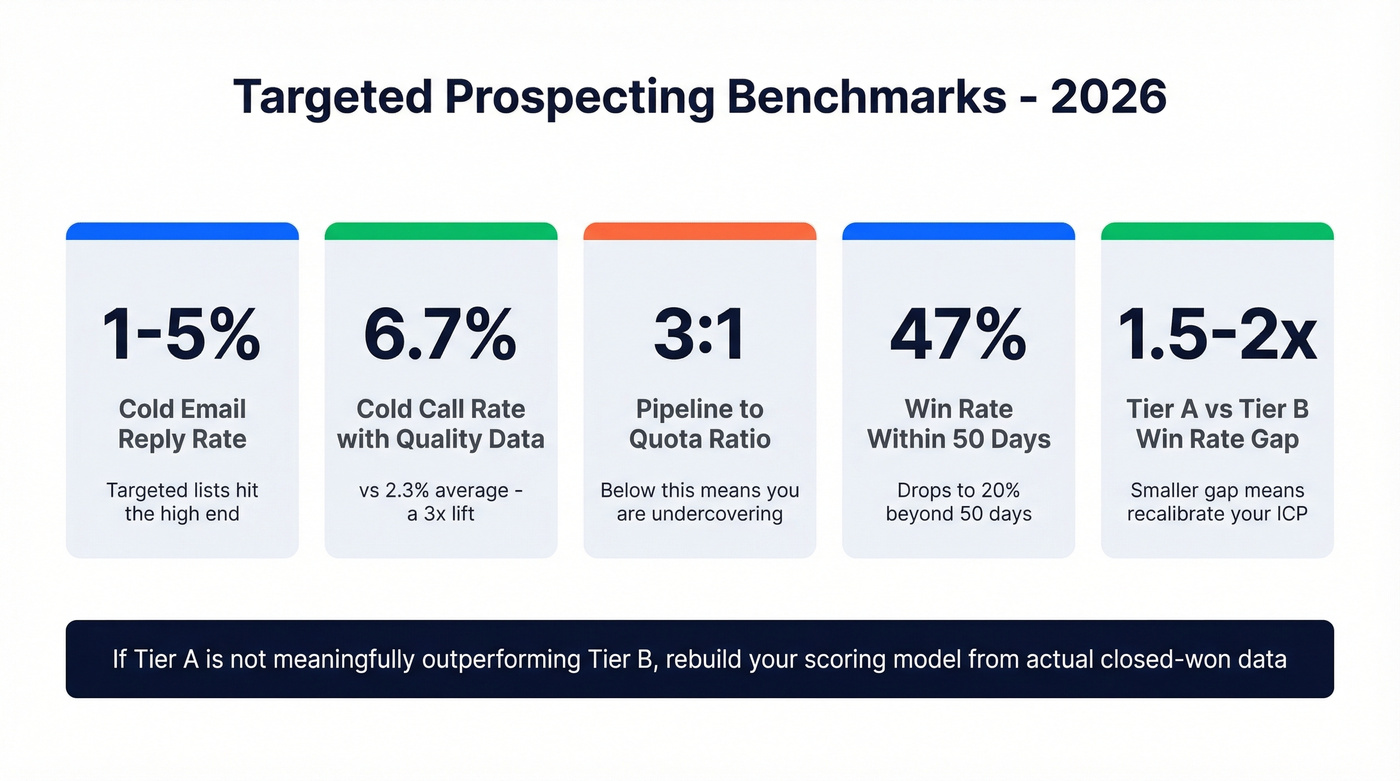
If your Tier A win rate isn't meaningfully higher than Tier B, the problem isn't your outreach - it's your scoring model. Rebuild it from your actual closed-won data.
FAQ
What's the difference between targeted prospecting and ABM?
Targeted prospecting identifies high-fit prospects using ICP scoring and intent signals, then sequences outreach individually. ABM coordinates marketing and sales around named accounts with multi-channel campaigns. You can't run ABM without knowing which accounts to target first - targeted sales prospecting is the foundation ABM is built on.
How many prospects should I target at once?
Start with 50-100 Tier A accounts. Teams that narrow their lists see 1.5-2x higher win rates and 15-20% shorter cycles. Scale up only after your scoring model is validated against actual closed-won data. Skip the temptation to "just add more names" - volume without scoring is how you end up back at that 91% no-reply rate.
What tools do I need to get started?
At minimum: a CRM, a verified data source for accurate emails and direct dials, and a sequencing tool like Instantly or Lemlist. Add enrichment orchestration with Clay or Zapier as you scale beyond 100 target accounts.