

Team Selling: The Framework That Turns Complex Deals Into Wins
A $200K deal looks healthy until your champion quits. Suddenly nobody on your side has a relationship with the CFO, procurement goes dark, and the "next step" turns into a slow-motion stall.
That's the moment team selling either saves you or exposes you.
This approach isn't "putting bodies on a call." It's a coordinated operating model where multiple specialists run a single deal plan - clear roles, timing, and internal handoffs - so the account doesn't collapse when one relationship disappears. A solid framework treats selling as a team sport: everyone has a position, everyone knows the play. The real killer isn't buyer complexity, though. It's internal friction. Comp disputes, unclear ownership, and ego collisions sink more collaborative selling efforts than any buying committee ever will.
What you need (quick version):
- A RACI for every deal over $50K
- A 5-minute exec briefing template so leadership never walks in cold
- Verified contact data for every stakeholder in the buying committee
Why Team Selling Matters in 2026
Buying committees didn't get a little bigger - they got structurally harder to cover. The widely cited benchmark trendline runs from 5.4 stakeholders to 6.8 to 8-13 as deals grew more cross-functional, based on CEB/Gartner-era benchmarks and later buying group research summarized by Attainment Labs. That's finance, IT, security, legal, ops, and an exec sponsor before you even hit procurement.
Meanwhile, 86% of B2B purchases stall somewhere in the process, per Forrester data compiled by Corporate Visions. And 57% of sales pros say cycles are getting longer, per Salesforce's State of Sales (see more in our State of Sales breakdown).
The buyer is already a team. You're just deciding whether you'll match that reality or keep single-threading and hoping.
When It Pays Off (and When It Doesn't)
Here's the thing: more people on a deal doesn't automatically help. Outreach's research makes this painfully clear. Multiple sellers assigned without coordination? A measly +2% win-rate lift. Coordinated engagement? +6.2 points and -16 days on cycle time. Director-level or higher involvement at the right moment? +29 points. Over-collaboration on small deals? A -7.9 point penalty.
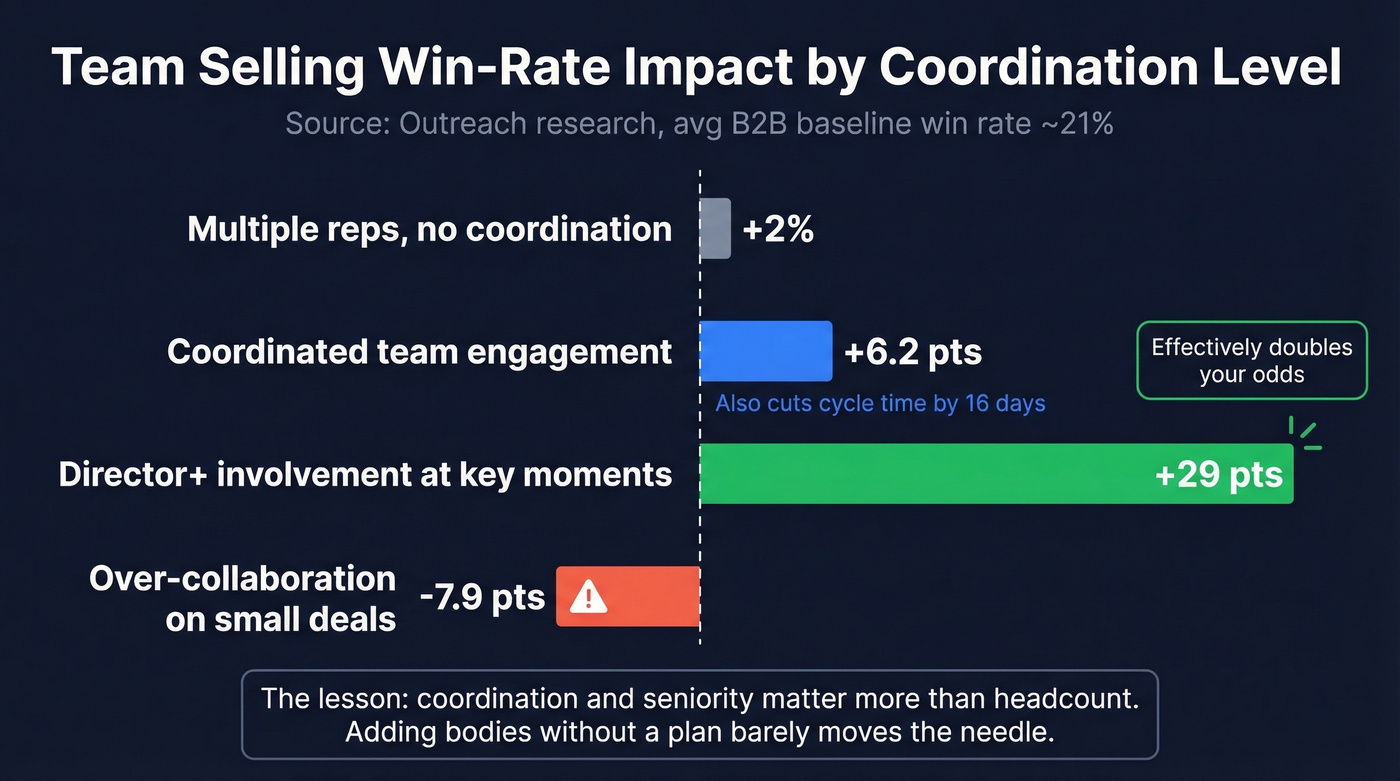
For context, benchmark roundups put the average B2B win rate around 21%, so a +29 point lift from senior involvement effectively doubles your odds. That's not incremental. That's a different business.
But reps already spend 60% of their time on non-selling tasks, and adding coordination overhead on a $10K deal makes that worse. We've found a clean decision rule works best: use a team-based approach for $20K+ deals or outbound enterprise motions. Below that, a single AE can run the full cycle - Avoma pegs typical SMB inbound SaaS at $3K-$20K ACV, where the coordination tax just isn't worth it. (If you're trying to compress cycle time, see how to shorten your sales cycle.)
| Approach | Win-Rate Impact | Best For |
|---|---|---|
| Multiple reps, no coord | +2% | Not recommended |
| Coordinated engagement | +6.2 pts, -16d | $20K-$50K |
| + Director+ involvement | +29 pts | $50K+ deals |
| Over-collab small deals | -7.9 pts | Avoid under $20K |
Five Roles Every Selling Team Needs
Most team selling failures aren't strategy failures. They're role failures. Two people think they own next steps, nobody owns the mutual action plan, and the buyer gets duplicate emails. We've seen that kill trust faster than a bad demo.
- AE (quarterback): owns the deal plan, the close, and the internal cadence (tie this into your sales operating rhythm)
- SE (technical validator): earns technical trust, runs validation, de-risks security and IT concerns (more on sales engineering)
- CSM (post-sale bridge): proves the adoption path, sets expectations, reduces churn fear (see account management best practices)
- Sales leadership (barrier remover): unblocks pricing, terms, resourcing, and urgency (build the muscle with sales leadership strategies)
- Executive sponsor (credibility): peer-level alignment, risk reduction, political cover (use a tighter approach to presenting to C-level executives)
Match seniority. Your most experienced person should face their most senior evaluator. A junior AE paired against a CFO creates an asymmetry the buyer notices immediately, and it signals you don't take the deal seriously enough to send your best.
Stage-by-Stage Matrix
Use this as a lightweight RACI. "A" is accountable, "R" is responsible, "C" contributes. Executive sponsors are most valuable once the deal is real and stakes are high - don't waste exec air cover too early.
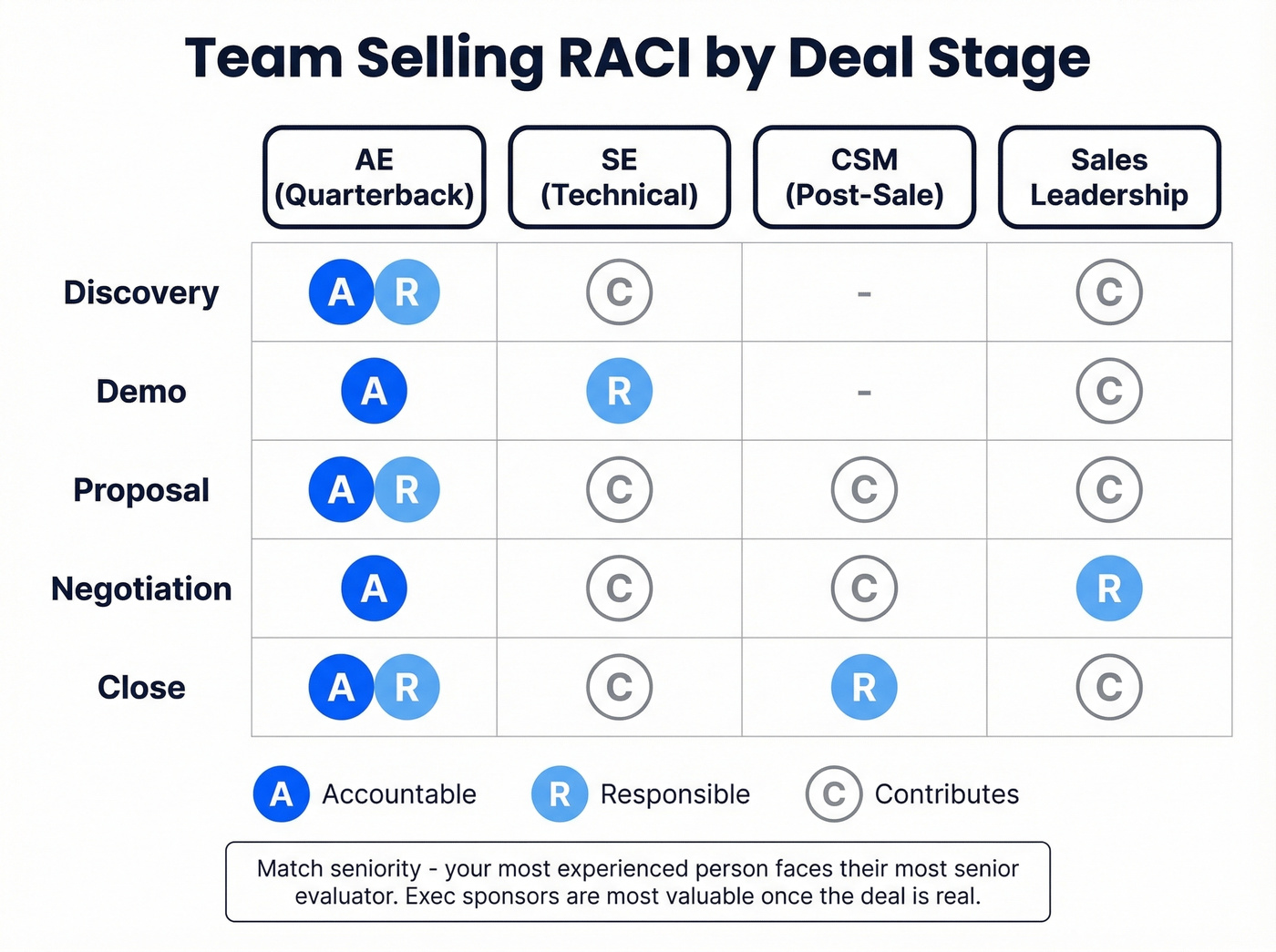
| Stage | AE | SE | CSM | Leadership |
|---|---|---|---|---|
| Discovery | A/R | C | C | |
| Demo | A | R | C | |
| Proposal | A/R | C | C | C |
| Negotiation | A | C | C | R |
| Close | A/R | C | R | C |

Your RACI matrix is useless if your SE can't reach the technical evaluator and your exec sponsor is emailing a bounced address. Prospeo gives your entire selling team verified contact data for every stakeholder in the buying committee - 300M+ profiles, 98% email accuracy, 125M+ verified mobile numbers, all refreshed every 7 days.
Stop single-threading because you only have one valid email.
The 3-Phase Operating Model
Michael Dalis' "Sell Like a Team" framework - the basis of Richardson's program - is simple for a reason: pre-meeting, meeting, regroup. The teams that win big don't wing it with more people. They run a repeatable rhythm that turns coordination into discipline.
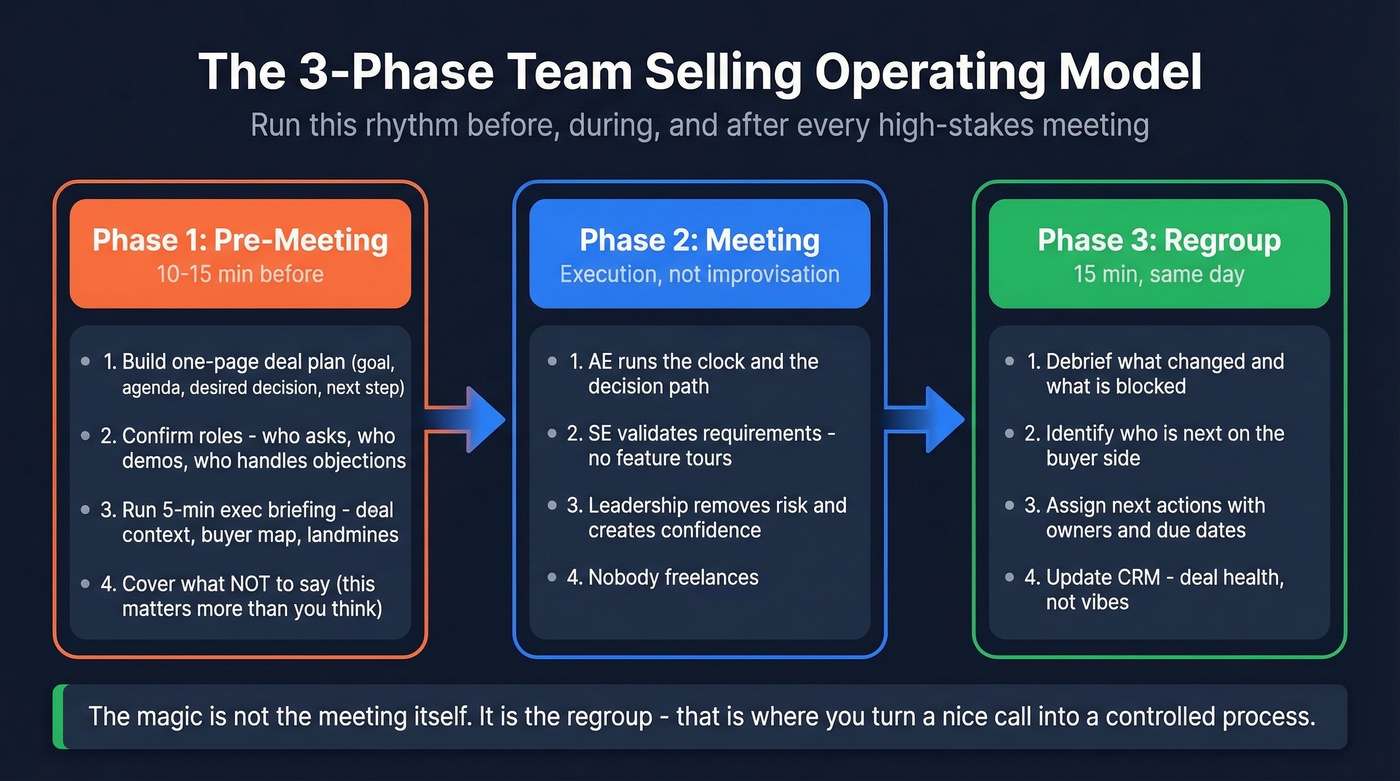
Pre-meeting (10-15 minutes before every high-stakes meeting)
Build a one-page deal plan covering the goal, agenda, desired decision, and next step. Confirm roles: who asks, who demos, who handles objections. Then run the 5-minute exec briefing - deal context, buyer map, landmines, and what NOT to say. That last part matters more than you'd think. I once watched a VP casually mention a competitor's pricing in a negotiation call because nobody told him the buyer had already eliminated that vendor. Awkward doesn't begin to cover it. (If you need a tighter structure for the meeting itself, use these sales meeting agenda templates.)
Meeting (execution, not improvisation)
The AE runs the clock and the decision path. The SE validates requirements and avoids feature tours. Leadership shows up with a single job: remove risk and create confidence. Nobody freelances. (For a cleaner flow, borrow from our product demo framework.)
Regroup (15 minutes, same day)
Debrief what changed, what's blocked, and who's next on the buyer side. Assign next actions with owners and due dates. Update CRM so the whole team sees deal health, not vibes. The magic isn't the meeting itself. It's the regroup - because that's where you turn a "nice call" into a controlled process.
The Multi-Threading Problem
Collaborative selling breaks the moment you can't actually reach the team on the other side. You can't coordinate specialists against an 8-13 person buying committee when half your contact data is wrong, your emails bounce, and your "direct dials" go to dead ends.
Buyers now engage sellers at 61% of their journey, down from 69%, meaning your window to influence the committee is shrinking. By the time you're looping in the SE, the technical stakeholders have already shaped the evaluation criteria without you.
This is where verified data stops being a nice-to-have. Prospeo turns multi-threading from aspiration to execution: 300M+ profiles, 98% email accuracy, and 125M+ verified mobile numbers on a 7-day refresh cycle. Map finance, IT/security, ops, legal, and the exec layer with 30+ search filters, then run coordinated outreach without torching deliverability or wasting cycles on wrong records. (If you're evaluating vendors, start with our guide to B2B leads database providers.)

Best Practices (and Mistakes That Kill Deals)
1. Role confusion and duplicated outreach. Two people emailing the same stakeholder with different asks makes you look disorganized. One owner per thread, always - and verify you actually have the right contact data before anyone hits send. (To protect inbox placement, follow email deliverability best practices.)
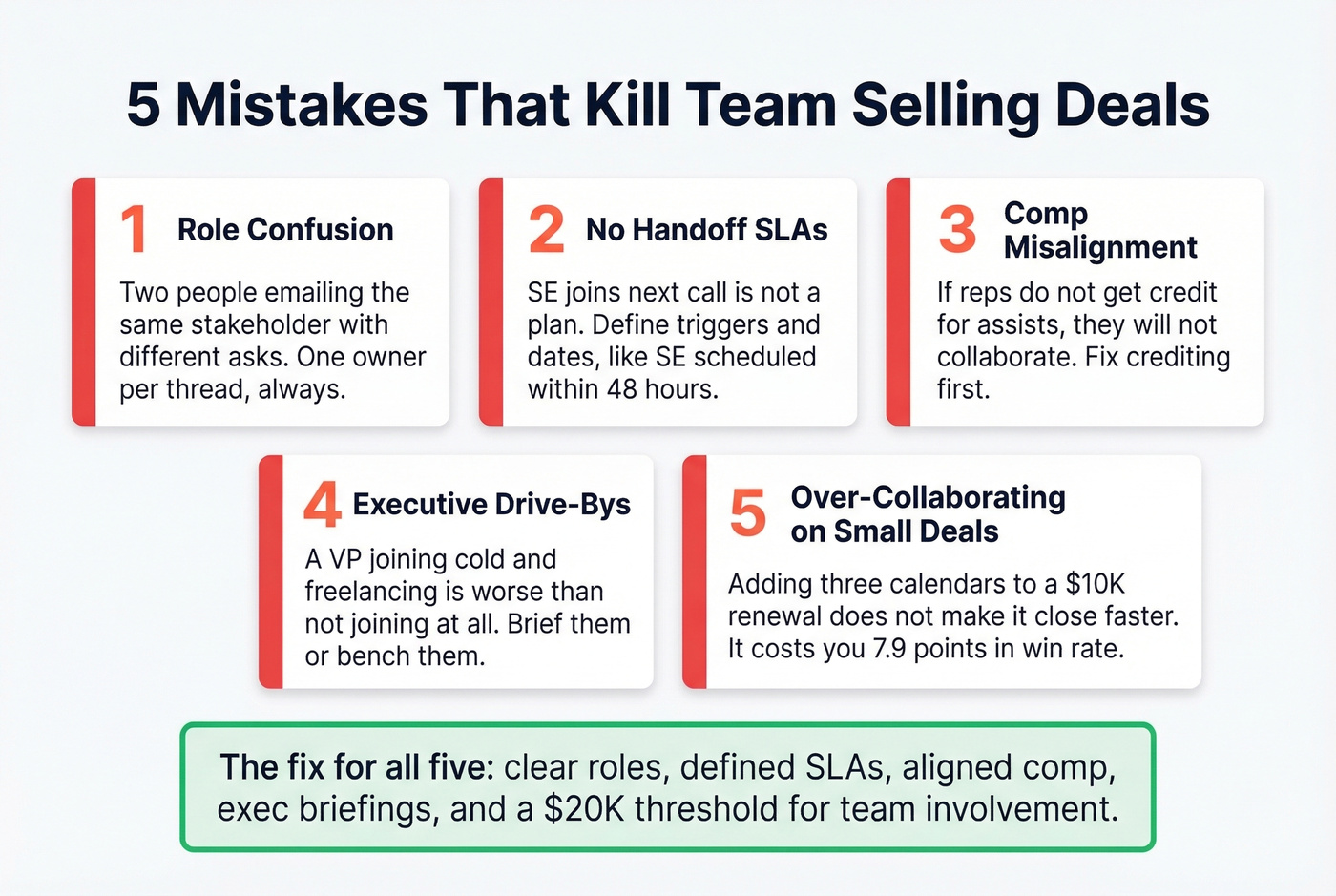
2. No handoff SLAs. "SE joins next call" isn't a plan if it's not tied to a trigger and a date. Define SLAs like "SE scheduled within 48 hours after technical validation request."
3. Comp misalignment. Let's be honest: if reps don't get credit for assists, they won't collaborate. Period. Fix crediting before you roll out any team selling process. The consensus on r/sales is pretty clear on this - reps will optimize for whatever the comp plan rewards, and everything else is just a suggestion.
4. Executive drive-bys. A VP joining cold and freelancing is worse than not joining at all. Leadership needs the 5-minute briefing and a single job to do in the meeting.
5. Over-collaborating on small deals. That -7.9 point hit is real. For deals under $20K, skip the team approach and let the AE run solo. Adding three calendars to a straightforward renewal doesn't make it close faster - it makes it close slower.
Buying committees hit 8-13 stakeholders. Your team needs direct access to every one of them - not just the champion. Prospeo's 30+ search filters let you map entire org charts by department, seniority, and job function, then pull verified emails and direct dials at $0.01 per contact. No bounces. No dead ends.
Cover the full committee before your competitor does.
FAQ
What's the difference between team selling and individual selling?
Team selling coordinates multiple specialists against one deal plan for complex, multi-stakeholder purchases. Individual selling is one rep running the full cycle on simpler, lower-value deals. The collaborative approach shines when buying committees exceed five stakeholders and no single rep can credibly cover every domain.
When should you NOT use team selling?
Skip it for deals under $20K or straightforward inbound transactions - the coordination overhead costs roughly 7.9 points in win rate. It only pays off when deal complexity and contract value justify the extra people and process.
How do you find contact data for an entire buying committee?
Use a B2B data platform to pull verified emails and direct dials for all stakeholders before your first team call. With filters for department, seniority, and intent signals, you can map the full committee in minutes instead of days.