

The Sales Cycle: Every Stage, Benchmark, and Tactic You Need in 2026
Every pipeline review includes the same question: "How long should this deal take?" And every time, someone answers with a useless range like "3-6 months." That's not a benchmark - that's a shrug. 58% of B2B professionals report the sales cycle has gotten longer over the past year, and most teams can't pinpoint where the drag is coming from.
Your cycle length is measurable and trackable. If you don't know yours by deal size and industry, you're guessing.
What Is the Sales Cycle?
The sales cycle is the repeatable sequence of stages a deal moves through, from first contact to closed-won. Every B2B organization has one, whether it's documented or not. The real question is whether yours is measured and managed, or just something that happens to you.
Three terms get confused constantly. The sales cycle describes the stages a single deal passes through - prospecting, qualifying, presenting, closing. The sales pipeline is your internal view of where all active deals sit across those stages right now (and it’s worth tracking against sales pipeline benchmarks). The sales funnel is the buyer's journey, often mapped to AIDA, shaped wide at the top and narrow at the bottom because prospects drop off at every step.
The cycle is what you optimize. The pipeline is what you manage. The funnel is what the buyer experiences. Conflating them leads to bad reporting and worse decisions.
7 Stages of the Sales Cycle
Every deal follows some version of these seven stages. The specifics vary by industry and deal complexity, but the structure holds.
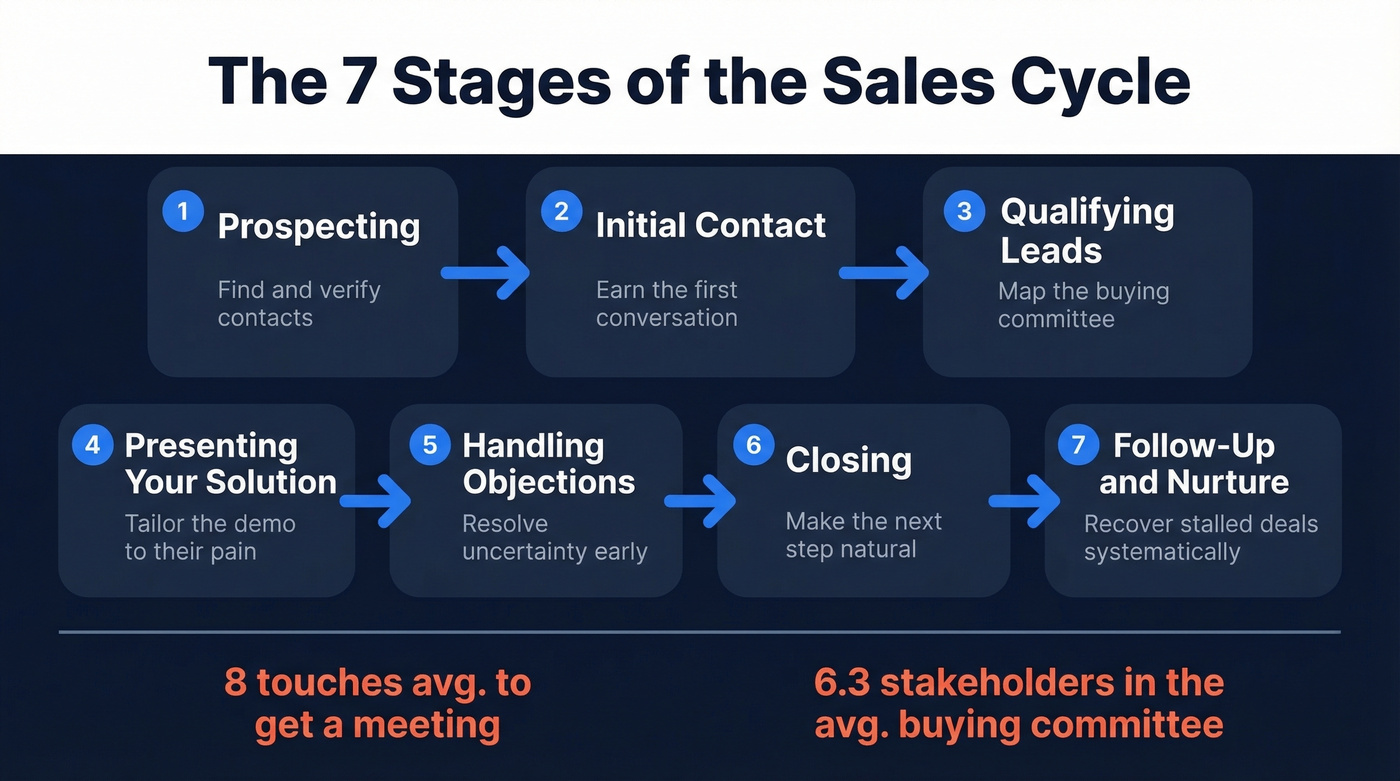
Prospecting
This is where most cycles get inflated before real selling even begins. It takes an average of 8 touches to generate a meeting with a buyer - and that's when your contact data is accurate. When emails bounce and phone numbers are dead, those 8 touches become 20, and your "90-day cycle" quietly becomes 120.
Data quality pays for itself here. Prospeo delivers 98% verified email accuracy across 143M+ emails, which means reps spend time selling instead of chasing bad contact info. If your bounce rate is high, it doesn't just hurt deliverability - it adds weeks to your cycle before a single conversation happens (see email bounce rate benchmarks and fixes).
Initial Contact
Whether it's a cold email, a warm intro, or an inbound response, the goal is the same: earn the right to a discovery conversation. The biggest mistake is pitching too early. Your first touch should demonstrate relevance - the prospect's industry, tech stack, or recent company news - not product knowledge. If you need a tighter outbound motion, use these sales prospecting techniques to increase meeting rates without bloating touches.
Qualifying Leads
This stage separates efficient pipelines from bloated ones. The average B2B buying committee includes 6.3 stakeholders. If you're qualifying based on a single champion's enthusiasm without mapping the committee, you're qualifying a deal that doesn't exist yet. For enterprise motions, align your qualification to MEDDIC sales qualification so you don’t “advance” deals that can’t close.
Presenting Your Solution
Discovery should drive your presentation, not the other way around. The best reps listen more than they talk during discovery calls, then tailor the demo to the specific pain points they uncovered. If you're running the same slide deck for every prospect, you're killing your conversion rate. If your demos are stalling late-stage deals, tighten the flow with a product demo checklist.
Handling Objections
Objections aren't roadblocks - they're buying signals wrapped in uncertainty. The most common ones (price, timing, internal buy-in, competitor comparison) are predictable. If your team isn't prepping objection responses before every call, deals stall here unnecessarily. Build an objection library and update it quarterly. If this stage is your bottleneck, use a structured approach to reduce sales objection rate.
Closing
Closing isn't a single moment. It's the culmination of everything before it. If discovery was thorough, qualification was honest, and objections were handled, the close feels like a natural next step. Deals that stall here usually have an unresolved issue from an earlier stage - a stakeholder who wasn't looped in, a budget question that was glossed over, or a competitor evaluation that's still running. If you want a tighter endgame, map your close motion to these steps to close a sale.
Follow-Up and Nurture
Not every deal closes on the first pass. Systematic nurture sequences - not random check-ins - keep you in the conversation. We've seen teams recover 15-20% of stalled deals with structured follow-up cadences over 90 days. If your follow-ups are inconsistent, standardize them with sales follow-up templates.
Which Qualification Framework to Use
Picking the right framework directly impacts how long deals sit in your pipeline and how many actually close.
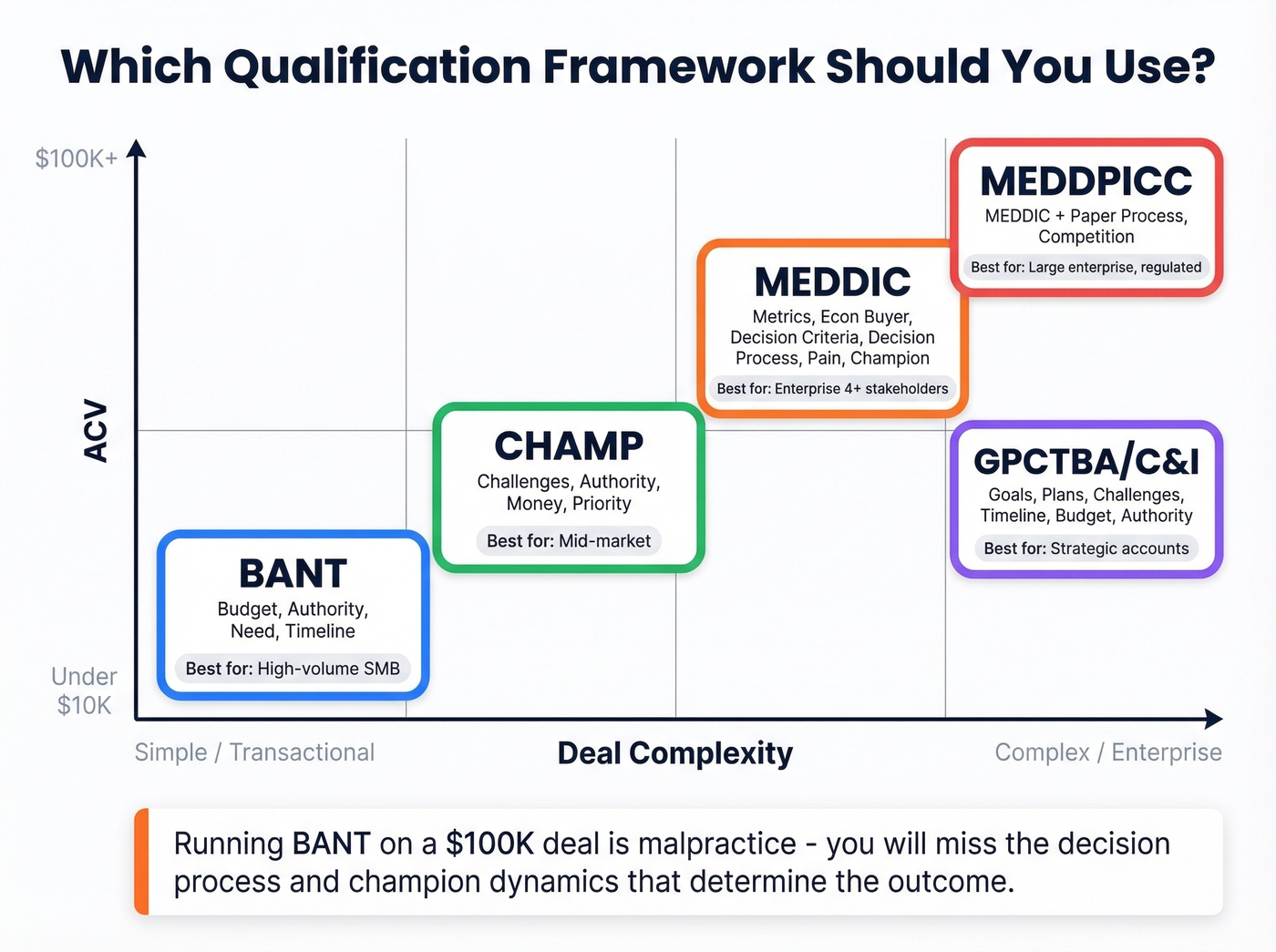
| Framework | Best For | When It Fails |
|---|---|---|
| BANT (Budget, Authority, Need, Timeline) | High-volume SMB, inbound triage | Complex enterprise deals |
| CHAMP (Challenges, Authority, Money, Priority) | Mid-market, buyer-centric teams | Low-touch transactional sales |
| MEDDIC (Metrics, Econ. Buyer, Decision Criteria/Process, Pain, Champion) | Enterprise, 4+ stakeholders | Fast-cycle SMB deals |
| MEDDPICC (MEDDIC + Paper Process, Competition) | Large enterprise, regulated industries | Overkill below $50K ACV |
| GPCTBA/C&I (Goals, Plans, Challenges, Timeline, Budget, Authority, Consequences) | Strategic/consultative selling | High-volume pipelines |
Here's the thing: use BANT for high-volume deals under $10K where speed matters more than depth. Use MEDDIC or MEDDPICC for enterprise deals above $50K with four or more stakeholders. Running BANT on a $100K deal is malpractice - you'll miss the decision process, the paper process, and the champion dynamics that actually determine whether the deal closes.
CHAMP is the underrated middle ground. It starts with the buyer's challenges rather than your budget question, which builds trust faster in mid-market conversations. GPCTBA/C&I is powerful but heavy - reserve it for strategic accounts where the cycle length justifies the investment in deep discovery.
Sales Cycle Length Benchmarks
This is the section you'll screenshot for your next pipeline review.
By Industry
According to Focus Digital's industry analysis, cycle lengths vary dramatically:
| Industry | Avg. Days |
|---|---|
| Retail | 70 |
| Software | 90 |
| Financial Services | 98 |
| Consulting | 103 |
| Technology | 121 |
| Healthcare | 125 |
| Education | 126 |
| Insurance | 127 |
| Manufacturing | 130 |
| Pharmaceuticals | 153 |
| Energy | 155 |
| Non-Profit | 162 |
The averages hide the real story. Here's where those days actually go for two representative industries:
| Industry | Initial Contact | Proposal | Negotiation | Closing | Total |
|---|---|---|---|---|---|
| Software | 14 days | 30 days | 25 days | 21 days | 90 days |
| Manufacturing | 18 days | 45 days | 35 days | 32 days | 130 days |
Most benchmark roundups skip this stage-level breakdown, and it matters. If your software deals are spending 45 days in negotiation instead of 25, you don't have a "long cycle" - you have a negotiation problem. Diagnose the stage, not the total.
By Company Size
| Employees | Avg. Days |
|---|---|
| 1-10 | 38 |
| 11-50 | 57 |
| 51-200 | 77 |
| 201-500 | 95 |
| 501-1,000 | 115 |
| 1,001-5,000 | 135 |
| 5,001-10,000 | 158 |
| 10,001+ | 185 |
The pattern is linear and predictable: more employees means more stakeholders, more procurement layers, and more legal review. A 10-person startup can sign a contract in a week. A Fortune 500 company needs months just to clear security review.
If your ACV is under $15K, you probably shouldn't be selling to companies with 5,000+ employees. The cycle length will eat your unit economics alive. Target the 51-500 employee range where deal velocity and contract value actually balance.
By Deal Size (ACV)
This is where the data gets most actionable. The TechGrowthInsights 2026 benchmarks add two critical columns most benchmark reports skip: top-quartile performance and the "structural drag" threshold - the point where your cycle length signals a process problem, not a rep problem.
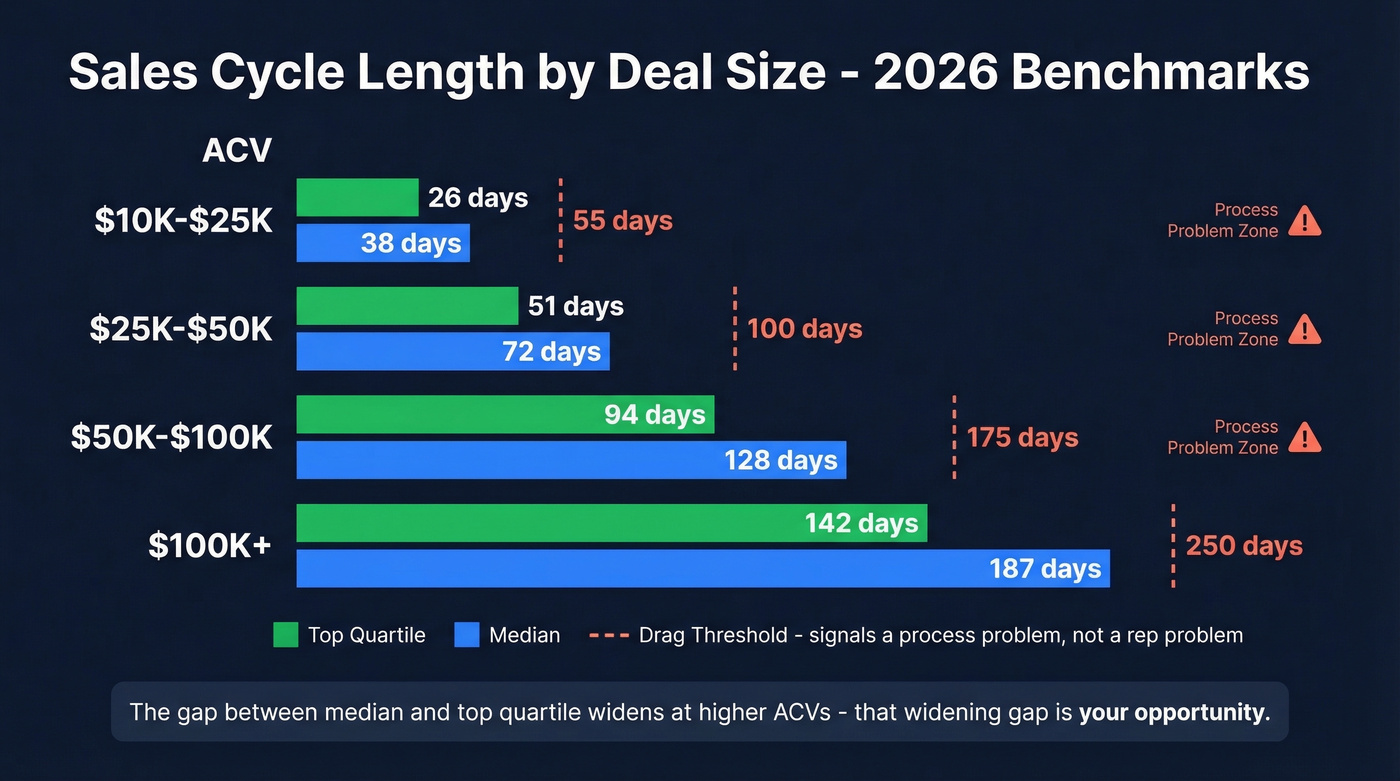
| ACV Range | Median Days | Top Quartile | Drag Threshold |
|---|---|---|---|
| $10K-$25K | 38 | 26 | >55 days |
| $25K-$50K | 72 | 51 | >100 days |
| $50K-$100K | 128 | 94 | >175 days |
| >$100K | 187 | 142 | >250 days |
For deals under $10K, cycle length is typically 25 days (<$1K), 40 days ($1K-$5K), and 55 days ($5K-$10K).
If your $50K-$100K deals are taking more than 175 days, you have a process architecture problem. Procurement, legal, and security reviews add 30-45 days to enterprise deals - top-quartile teams front-load those steps instead of running them sequentially at the end.
The gap between median and top-quartile performance widens at higher ACVs. That widening gap is your opportunity.
Multi-threading becomes structurally necessary above ~$30K ACV. Single-threaded deals at this level die when your champion goes on vacation, changes roles, or loses internal momentum.
By Lead Source
| Source | Low Complexity | Medium | High |
|---|---|---|---|
| Referrals | 20 days | 35 | 60 |
| Cold Calling | 60 days | 85 | 110 |
| Trade Shows | 80 days | 100 | 150 |
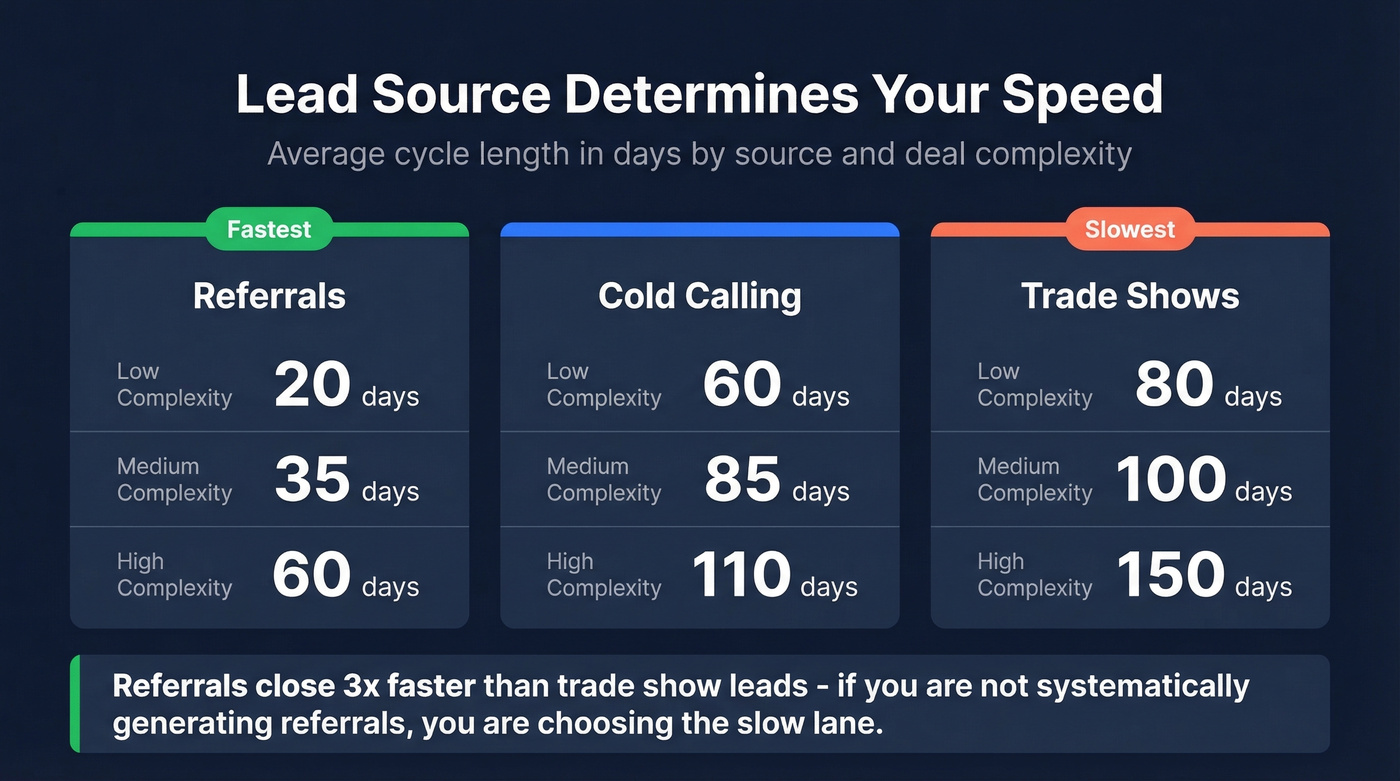
Referrals close in 20 days. Cold outbound takes 60. If you're not systematically generating referrals, you're choosing the slow lane - warm introductions carry built-in trust that cold outreach has to earn over weeks.

Every bounced email adds days to your sales cycle before a real conversation even starts. Prospeo delivers 98% verified email accuracy across 143M+ contacts - so your 8 touches actually reach someone. At $0.01 per email, cleaning up your prospecting stage is the fastest cycle compression you'll find.
Stop inflating your cycle with dead data. Start with verified contacts.
Stage Conversion Benchmarks
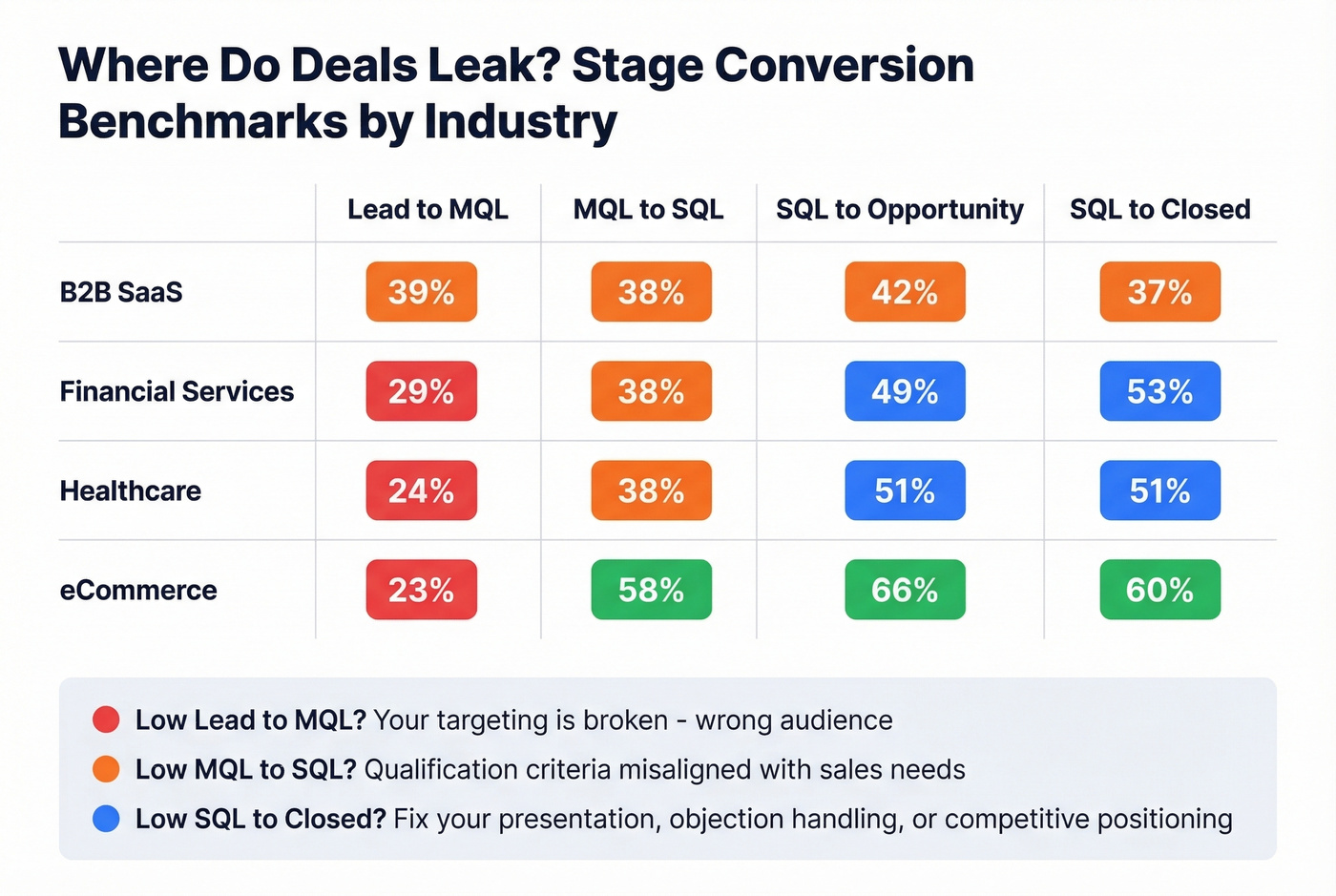
Knowing your cycle length is half the picture. The other half is where deals leak. FirstPageSage's conversion data across their 2017-2025 dataset gives us stage-by-stage benchmarks:
| Industry | Lead-MQL | MQL-SQL | SQL-Opp | SQL-Closed |
|---|---|---|---|---|
| B2B SaaS | 39% | 38% | 42% | 37% |
| Cybersecurity | 24% | 40% | 43% | 46% |
| Financial Svcs | 29% | 38% | 49% | 53% |
| Manufacturing | 26% | 41% | 46% | 51% |
| Healthcare | 24% | 38% | 51% | 51% |
| Higher Education | 45% | 46% | 61% | 66% |
| eCommerce | 23% | 58% | 66% | 60% |
The diagnostic is straightforward. If your Lead-MQL rate is significantly below your industry average, your targeting is broken - you're attracting the wrong people. If MQL-SQL is the bottleneck, your qualification criteria are misaligned with what sales actually needs. If SQL-Closed is lagging, look at your presentation, objection handling, and competitive positioning.
Higher Education's numbers are the outlier worth studying - the highest conversion rates across every stage, driven by well-defined buyer personas and long-standing institutional relationships. B2B SaaS often has strong top-of-funnel conversion but a lower close rate, a classic symptom of broad marketing feeding a complex sales motion.
A useful rule of thumb: maintain 3-4x pipeline coverage relative to your quota. If your SQL-Closed rate is 37% (B2B SaaS average), you need roughly $2.70 in qualified pipeline for every $1 of target. Teams that run below 3x coverage often miss quota, regardless of rep quality. To operationalize this, track pipeline health metrics alongside conversion rates.
The Biggest Cycle Killer: "No Decision"
44% of sales leaders report that opportunities lost to "no decision" have increased. Not lost to competitors - lost to the status quo. Up to 40% of pipeline can evaporate this way.
Look, this is the one that drives sales managers crazy. You did the demo, the champion loved it, the business case was solid - and then nothing. Radio silence. Four causes drive most of these losses.
Status quo inertia. The buyer doesn't feel enough urgency to change. Your discovery didn't surface a compelling cost of inaction. A simple "cost of delay" calculation works: multiply the monthly cost of the problem by the number of months until the next budget cycle. When a buyer sees they're burning $40K/month on a problem they could solve in 60 days, inertia gets harder to justify.
Discovery gaps. The rep pitched instead of consulting. The buyer never felt understood, so they never felt confident. Restructure discovery around the buyer's priorities, not your demo script. If you want a tighter structure, use these discovery questions to surface urgency and decision criteria earlier.
ROI fog. The champion can't build an internal business case because you didn't give them the ammunition. Deliver ROI calculators, case studies with specific numbers, and implementation timelines they can present to their CFO.
Bad buying experience. Slow follow-ups, disorganized proposals, too many handoffs. Assign a single point of contact and build a mutual action plan with clear dates for both sides.
If "no decision" is your biggest loss category, the problem isn't your product or your pricing. It's your discovery and your ability to create urgency.
How to Shorten Your Sales Cycle
Six tactics, each backed by data.
Fix your data before you dial. Bad contact data inflates the prospecting and connecting stages silently. When Meritt switched to Prospeo, their bounce rate dropped from 35% to under 4%, and pipeline tripled from $100K to $300K per week. Snyk saw similar results - 50 AEs prospecting 4-6 hours per week went from 35-40% bounce rates to under 5%, with AE-sourced pipeline up 180%. Every bounced email and dead phone number adds days to your cycle before real selling starts.
Multi-thread above $30K ACV. With 6.3 stakeholders in the average buying committee, single-threading is a structural risk. Map the committee during qualification, build relationships with at least 3 contacts, and make sure your champion isn't the only person who understands your value prop. In our experience, single-threaded deals above $30K have a dramatically higher no-decision rate - often 2x the rate of multi-threaded deals at the same ACV.
Front-load procurement and security. Enterprise deals lose 30-45 days to legal, security, and procurement review - usually at the end, when momentum is lowest. Top-quartile teams send security questionnaires and procurement requirements in parallel with the evaluation, not after the verbal "yes." This alone compresses $50K+ deals by 3-6 weeks.
Build mutual close plans. A consistent pattern in the TechGrowthInsights benchmarks is building mutual action plans with the buyer early. Specific dates, specific deliverables, specific owners on both sides. This turns a vague "we'll get back to you" into a shared commitment with accountability.
Systematize referrals. Referrals close in 20 days versus 60 for cold outbound - a 3x compression. Yet most teams treat referrals as happy accidents. Build a formal referral program with triggers at post-onboarding, post-renewal, and post-expansion, and make asking for referrals a standard step in your process.
Use AI to compress admin and follow-up. AI-powered deal scoring, automated follow-up sequencing, and real-time coaching during calls are cutting cycle time in measurable ways. Sales automation tools shorten cycles up to 15%, and Digital Sales Rooms compress them up to 28%. The biggest AI wins aren't in replacing reps - they're in eliminating the 3-5 day gaps between touches where deals lose momentum (see AI sales follow-up tactics that actually work).
No tool fixes bad data or bad process. Start with the fundamentals.
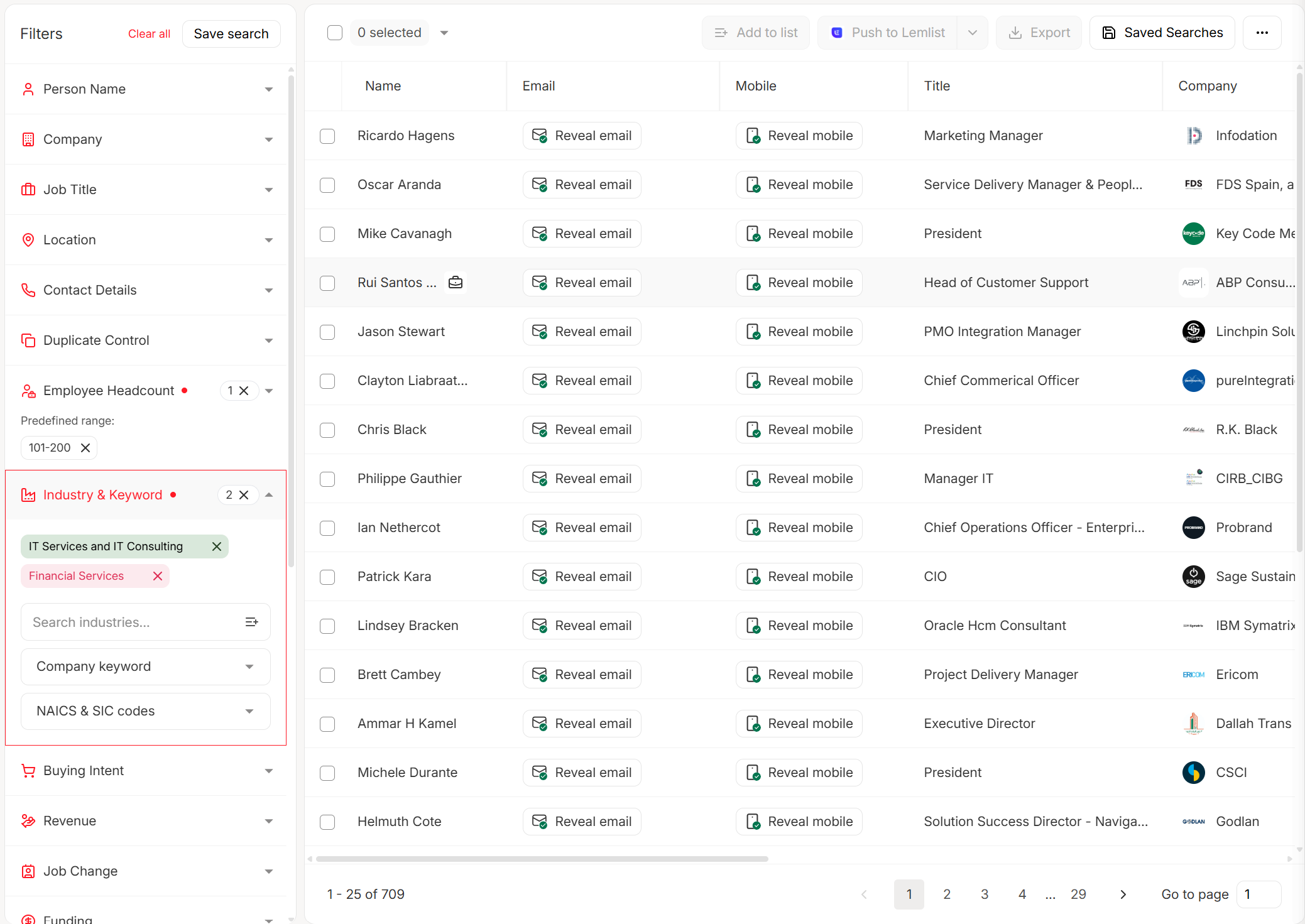
Deals with 6+ stakeholders don't close faster with better pitches - they close faster when reps reach the right people on the buying committee. Prospeo's 30+ search filters let you map entire committees by job title, department, and seniority, then pull verified emails and direct dials in one search.
Map the full buying committee in minutes, not weeks.
5 Mistakes That Silently Extend Your Cycle
Failing to qualify leads. Every unqualified deal in your pipeline consumes rep time, manager attention, and forecast accuracy. Bloated pipelines feel productive but deliver fewer closed deals per quarter. Skip this step if you want to spend Q4 explaining why your forecast was fiction.
Talking more than listening during discovery. When reps dominate discovery calls, they miss the information needed to tailor proposals. The result: generic presentations that require additional rounds of revision, adding weeks. Listening more than talking during discovery isn't soft advice - it's a cycle compression tactic.
Single-threading enterprise deals. Your champion leaves the company, takes a new role, or loses political capital. If they're your only contact, the deal dies. Multi-threading isn't optional above $30K ACV.
Skipping objection prep. Unaddressed objections don't disappear; they surface at the worst possible moment - during final negotiations or legal review. Prep for the top 5 objections before every call, and address them proactively rather than reactively.
Selling on price instead of value. Leading with discounts invites procurement to squeeze harder and longer. Value-based selling shortens negotiation stages because the conversation centers on outcomes, not line items. Every discount you offer without being asked trains the buyer to ask for more.
Turning Benchmarks Into Action
Knowing your benchmarks is useless if you don't operationalize them. Let's be honest - most teams run a benchmarking exercise once, put it in a slide deck, and never look at it again. Sales lifecycle management is the discipline of measuring, diagnosing, and improving each stage on an ongoing basis, not just during quarterly reviews. If you want a structured approach, use a sales process optimization framework to turn benchmarks into repeatable changes.
Start by mapping your current cycle against the benchmarks in this guide. Identify the one or two stages where your numbers deviate most from top-quartile performance, then build targeted interventions: new qualification criteria, restructured discovery calls, or front-loaded procurement workflows. Revisit monthly. The teams that compress their sales cycle fastest treat it as a continuous improvement loop, not a one-time project.
FAQ
What is the average sales cycle length?
Retail averages 70 days, SaaS 90 days, and enterprise deals above $100K ACV take a median of 187 days. Blended averages are misleading - segment by deal size and industry using the benchmark tables above for numbers you can actually act on.
What's the difference between a sales cycle and a sales process?
The sales cycle is the repeatable sequence of stages a deal moves through from first contact to closed-won. The sales process is the broader methodology - playbooks, tools, training - your team uses to execute those stages. You can have a defined cycle without a mature process, but not the reverse.
How do I calculate my sales cycle length?
Add total days from first contact to closed-won for all deals in a period, then divide by the number of deals. Segment by deal size, industry, and lead source - a blended average mixing $5K self-serve deals with $100K enterprise contracts is meaningless. Most CRMs generate this report with basic filters.
How does bad data extend the sales cycle?
Bad contact data inflates early stages invisibly - bounced emails and dead numbers waste weeks before real selling starts. Teams using real-time email verification routinely cut bounce rates from 30%+ down to under 5%, recovering weeks of cycle time that were previously invisible in their reporting.