

The Tim Ferriss Cold Email Template: Exact Wording, Principles, and a Modern Playbook
A 17-year-old on Reddit sent 100 personalized cold emails and got zero responses. The template wasn't the problem. The approach was. The Tim Ferriss cold email template has been circulating for over a decade, and it still outperforms most outbound playbooks - but only if you understand the principles behind it and nail the infrastructure underneath.
Most free cold email templates floating around LinkedIn follow a predictable formula: flattery, pitch, hard CTA. Ferriss flipped that model by removing the pitch entirely and leading with empathy. Here's the thing - that shift sounds simple, but almost nobody actually does it.
The Exact Template
This structure comes from the Alex Banayan breakdown of the Ferriss framework, published on Daniel Pink's Pinkcast. Four paragraphs, each with a specific job.
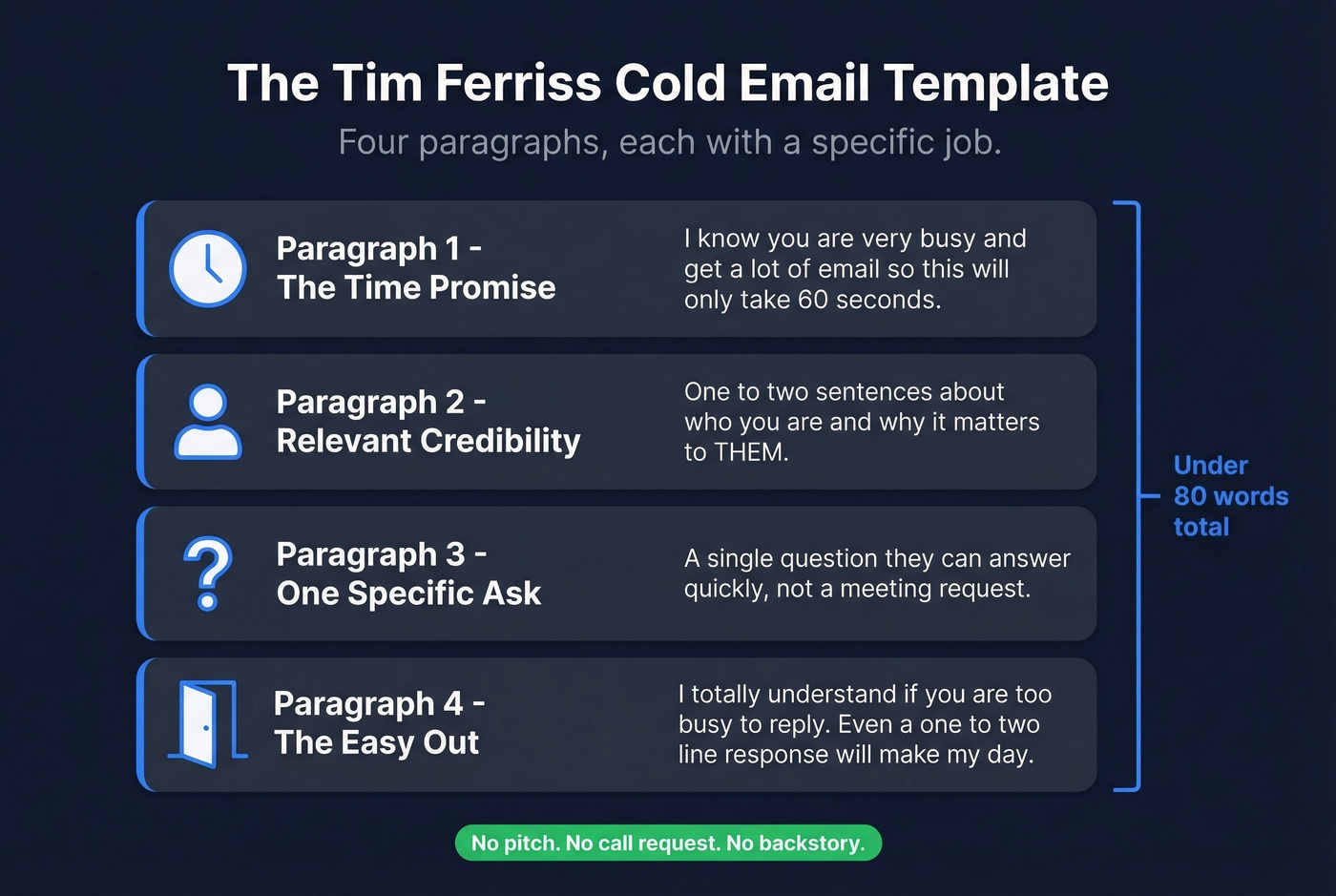
Paragraph 1: "I know you are very busy and get a lot of email so this will only take 60 seconds."
Paragraph 2: 1-2 sentences about who you are and why it's relevant to them.
Paragraph 3: 1-2 sentences with a specific question that can be answered quickly.
Paragraph 4: "I totally understand if you're too busy to reply. Even a 1- to 2-line response will make my day."
No pitch deck. No "quick 15-minute call." No three-paragraph backstory. Keep it under one screen - right in the zone that 2026 benchmark data shows performs best at under 80 words.
Subject Line Rules
Banayan adds specific guidance here that most articles skip:
- Keep it short - two words is ideal, five words maximum
- Make it a question
- Make it personal
Example: "Mr. XYZ - your advice?"
The subject line isn't where you sell. It's where you earn the open. (If you want more options, pull from these cold email subject line examples and subject lines that get opened.)
Why This Template Works: 5 Core Principles
The template is just the surface. The principles underneath it are what make it convert. Ferriss laid these out on his blog in 2008, and they haven't aged a day.
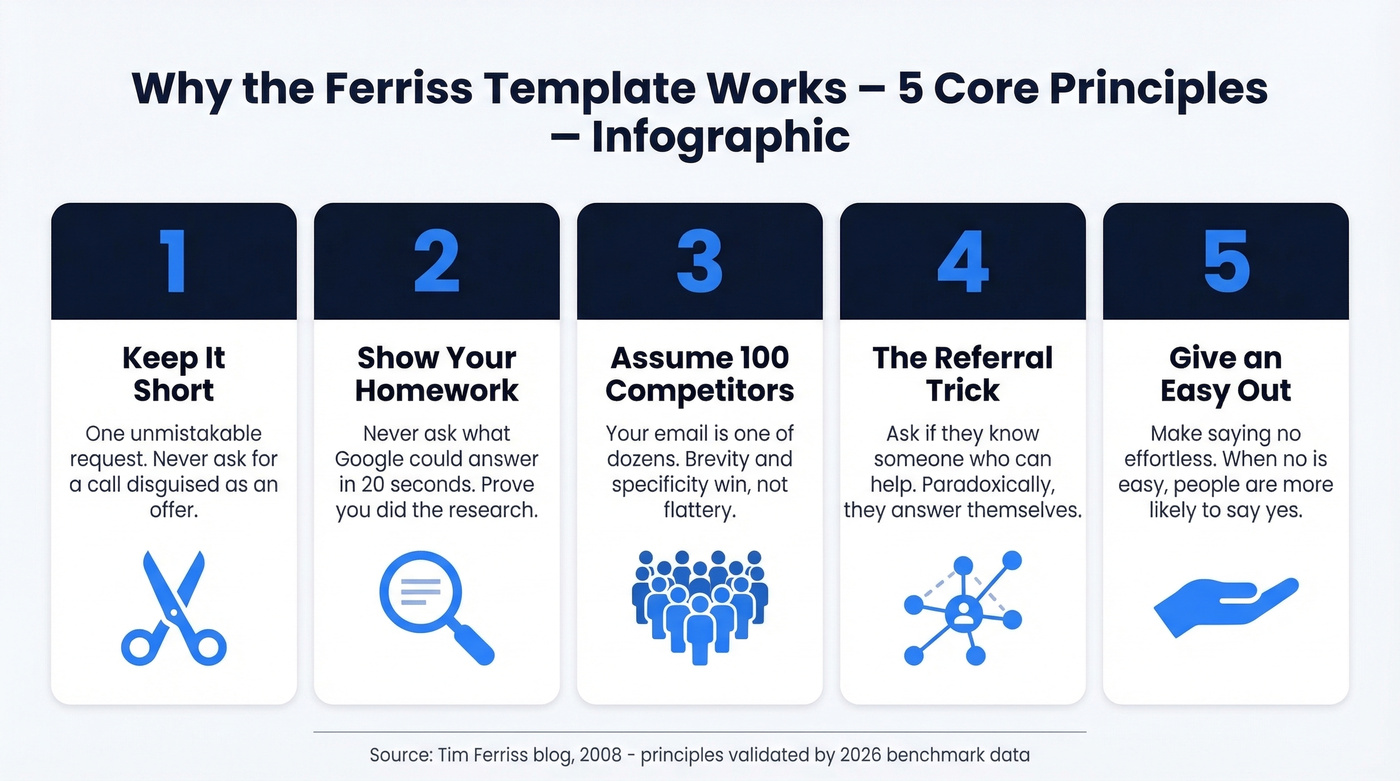
1. Keep it short and make the request unmistakable. Never write "let's jump on the phone for 10 minutes; it'll be worth your time." That's a demand disguised as an offer. Ask one specific question instead. (More on email copywriting if you want a deeper framework.)
2. Show your homework. Don't ask for answers "Google could provide in 20 seconds." If you haven't done basic research before emailing, you're signaling that your time matters more than theirs. This is also why personalized outreach consistently beats token personalization.
3. Assume you're competing against 100 similar requests. If someone appears in media regularly, your email is one of dozens. Brevity and specificity are how you stand out - not flattery, not length.
4. Use the executive recruiter referral trick. Instead of asking directly, ask "do you know anyone who might be able to help with X?" This gives the recipient a comfortable decline path. Paradoxically, it increases the chance they'll answer themselves.
5. Make it clear it's OK if they can't help. The "easy out" - Ferriss's phrase "I understand if you're too busy" - reduces the psychological cost of replying. When saying no is easy, people are more likely to say yes.
These aren't theoretical. Chris Beresford-Hill used a version of this approach to cold email Mark Cuban - a very short, concise email with a specific ask and a PDF attached. Cuban replied within about an hour: "Go for it. -M."
The Story Behind It
Ferriss didn't develop this framework in a vacuum. He used it to land his first real job. As he told Banayan, he emailed a CEO a dozen times and got rejected every time. Then he sent a "Hail Mary" email saying he'd be in the neighborhood the following week - despite being in New York while the CEO was in San Francisco.
The CEO replied: "All right... I can meet you on Tuesday." Ferriss flew standby to SF and got the job. In sales, naturally.
He borrowed credibility too. He volunteered with the Silicon Valley Association of Startup Entrepreneurs so he could email as "an event producer" rather than "recent college graduate." And he was careful about boundaries - not six emails a week, just enough to stay present without becoming a nuisance. That restraint is the part most people miss when they copy the template but ignore the philosophy.
Does It Still Work? 2026 Data Says Yes
The Ferriss approach is built around brevity, a single ask, and an easy out. The 2026 data from Instantly validates every one of those mechanics: short first-touch emails under 80 words and sequences that don't stop after one send. (If you're building a full system, use a B2B cold email sequence instead of one-off sends.)
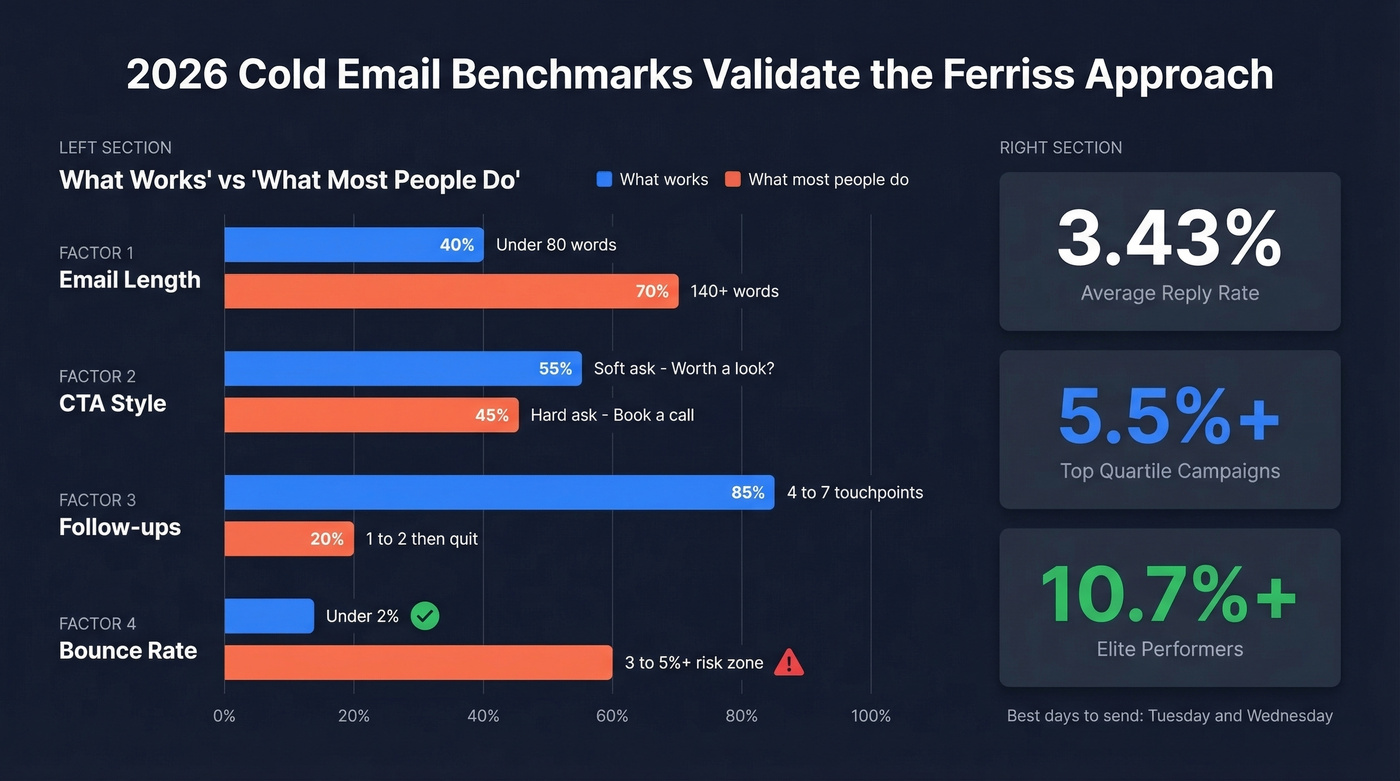
The average cold email reply rate sits at 3.43%. Top-quartile campaigns hit 5.5%+, and elite performers break 10.7%. Peak send days are Tuesday and Wednesday, with Wednesday pulling the highest reply rates.
| Factor | What works | What most people do |
|---|---|---|
| Email length | Under 80 words | 140+ words |
| CTA style | Soft ("Worth a look?") | Hard ("Book a call") |
| Follow-ups | 4-7 touchpoints | 1-2, then quit |
| Bounce rate | Under 2% | 3-5%+ (risk zone) |
A popular r/b2b_sales breakdown mirrors this: short emails beat long pitches, context-based personalization beats first-name tokens, and soft CTAs outperform hard asks. Ferriss was ahead of the data by about 18 years. Other well-known practitioners - from Alex Hormozi's philosophy of leading with value to Sam Parr's direct, no-fluff outreach style - echo the same core insight. Shorter wins.

The Ferriss cold email template only works if your email actually reaches the inbox. With bounce rates above 2% killing deliverability, 98% email accuracy isn't optional - it's the foundation. Prospeo verifies every address through a 5-step process so your carefully crafted cold emails don't end up in spam.
Write like Ferriss. Send to emails that actually exist.
3 Adapted Templates for Real Scenarios
Each of these follows the Ferriss four-paragraph structure. They're filled-in examples you can modify and send today.
Sales: VP or Director Outreach
The hardest part of a business development email is resisting the urge to pitch. This version doesn't sell anything - it asks one question that's impossible to ignore if the problem is real. (If you need more variations, see these emails that get responses.)
Subject: Quick question, Sarah?
Hi Sarah - I know you're busy, so this will take 30 seconds.
We help B2B marketing teams cut list-building time by 70%. Noticed Acme just expanded the demand gen team - congrats.
Curious: how are you sourcing verified contacts for outbound right now?
Totally fine if the timing's off. Even a one-line reply helps.
One question. One easy out. It centers the recipient's problem, not your product.
Partnerships: Cold Brand Pitch
Subject: Your podcast - a thought?
Hi Marcus - I'll keep this to 60 seconds.
I run content at a B2B data company (15,000+ customers). Your episode on outbound infrastructure was the best breakdown I've heard this year.
Would you be open to a guest who can share real deliverability benchmarks from 2026 campaigns?
No worries at all if the calendar's full. Appreciate what you're building either way.
The compliment in paragraph two needs to reference a specific episode, post, or project - not a generic "love your work." If you can't name something specific, you haven't done enough homework to send this email.
Career or Mentorship Ask
This is the closest to Banayan's original use case. Notice how the question in paragraph three is narrow enough to answer in one sentence. "What advice do you have for someone in my position?" is too broad. "What's the one metric you'd obsess over?" is answerable.
Subject: Ms. Chen - your advice?
Hi Ms. Chen - I know you get a lot of these, so this will only take 60 seconds.
I'm a product manager at a Series A startup, two years in. Your talk at SaaStr on PLG pricing changed how I think about expansion revenue.
If you had to pick one metric to obsess over in your first PM role, what would it be?
I completely understand if you're too busy to reply. Even a one-line answer would mean a lot.
Creative Approaches Beyond the Framework
The Ferriss template is a starting point, not a ceiling. Some of the best cold outreach we've seen layers creative techniques on top of the same principles. (For a modern, tool-assisted approach, compare with AI cold email outreach.)
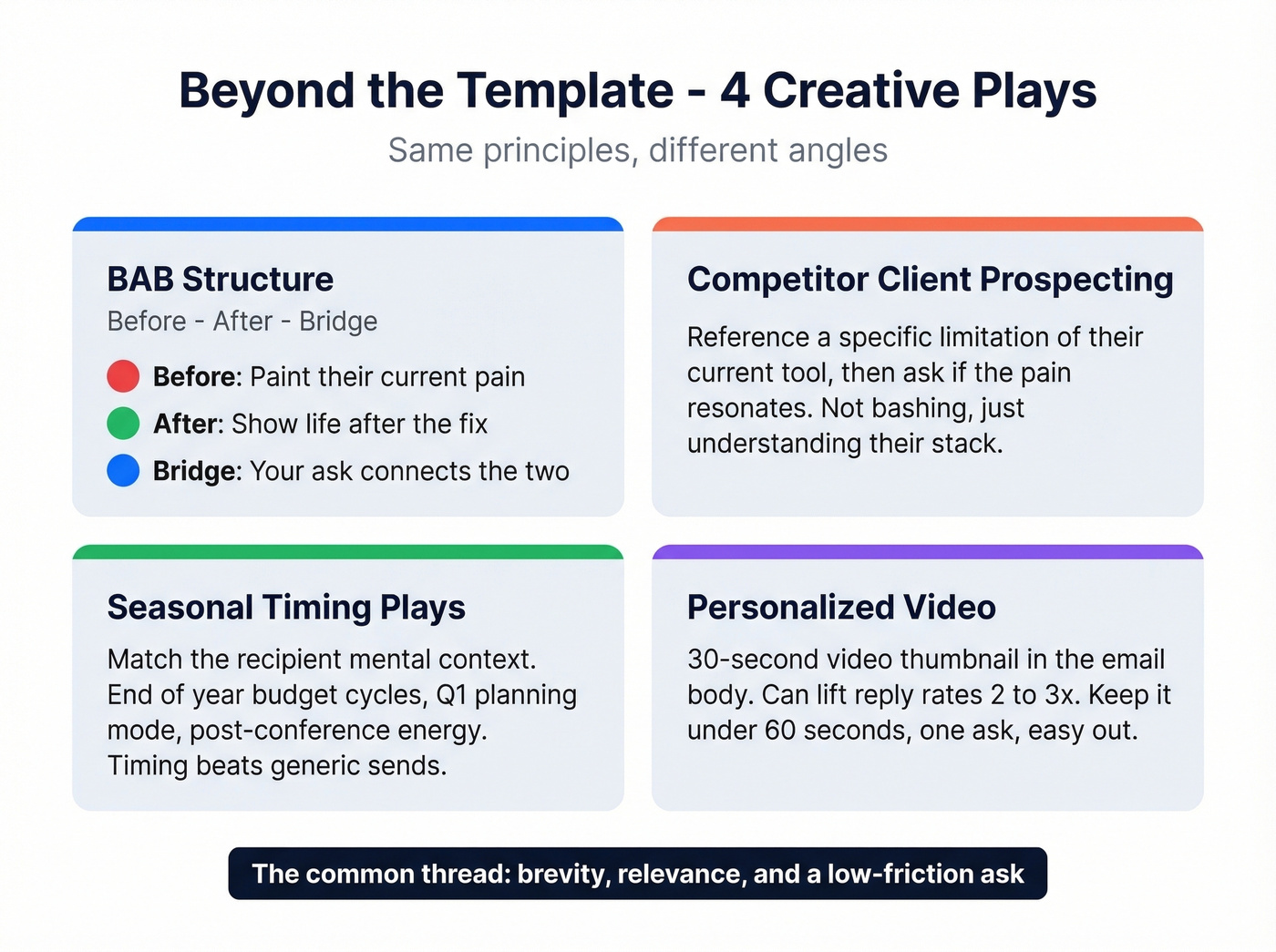
The BAB structure (Before-After-Bridge) paints the prospect's current pain, shows the after-state, then bridges with your ask. It works especially well for competitor displacement - showing how life looks after switching from a rival tool.
Competitor client prospecting references a specific limitation of the tool they're using today, then asks whether that pain point resonates. This isn't bashing. It's showing you understand their stack.
Seasonal timing plays can outperform generic sends because they match the recipient's mental context. An end-of-year email that acknowledges budget cycles ("wrapping up Q4 planning?") hits differently than the same pitch in July.
Personalized video - a 30-second video thumbnail in the email body - can lift reply rates 2-3x. Keep the video under 60 seconds and follow Ferriss's rule: one ask, easy out. (If you're doing this at scale, this Loom video cold email guide helps.)
The common thread: brevity, relevance, and a low-friction ask.
Before You Hit Send
The Ferriss template is short. It takes two minutes to write. But none of it matters if the email bounces or lands in spam.
Finding Verified Emails
The best outreach template in the world is worthless if it goes to a dead inbox. Guessing email formats - firstname@company.com, f.lastname@company.com - is how you end up with bounce rates above 3-5% and a torched domain. (If you're troubleshooting, start with email bounce rate.)
Prospeo finds and verifies professional emails with 98% accuracy across 143M+ verified addresses. Paste a URL or upload a CSV, and you get verified addresses in seconds - with catch-all handling, spam-trap removal, and honeypot filtering built in. The free tier gives you 75 verified emails per month, enough to test your Ferriss-style campaign before scaling.

Deliverability Checklist
Even with verified addresses, your sending infrastructure needs to be right:
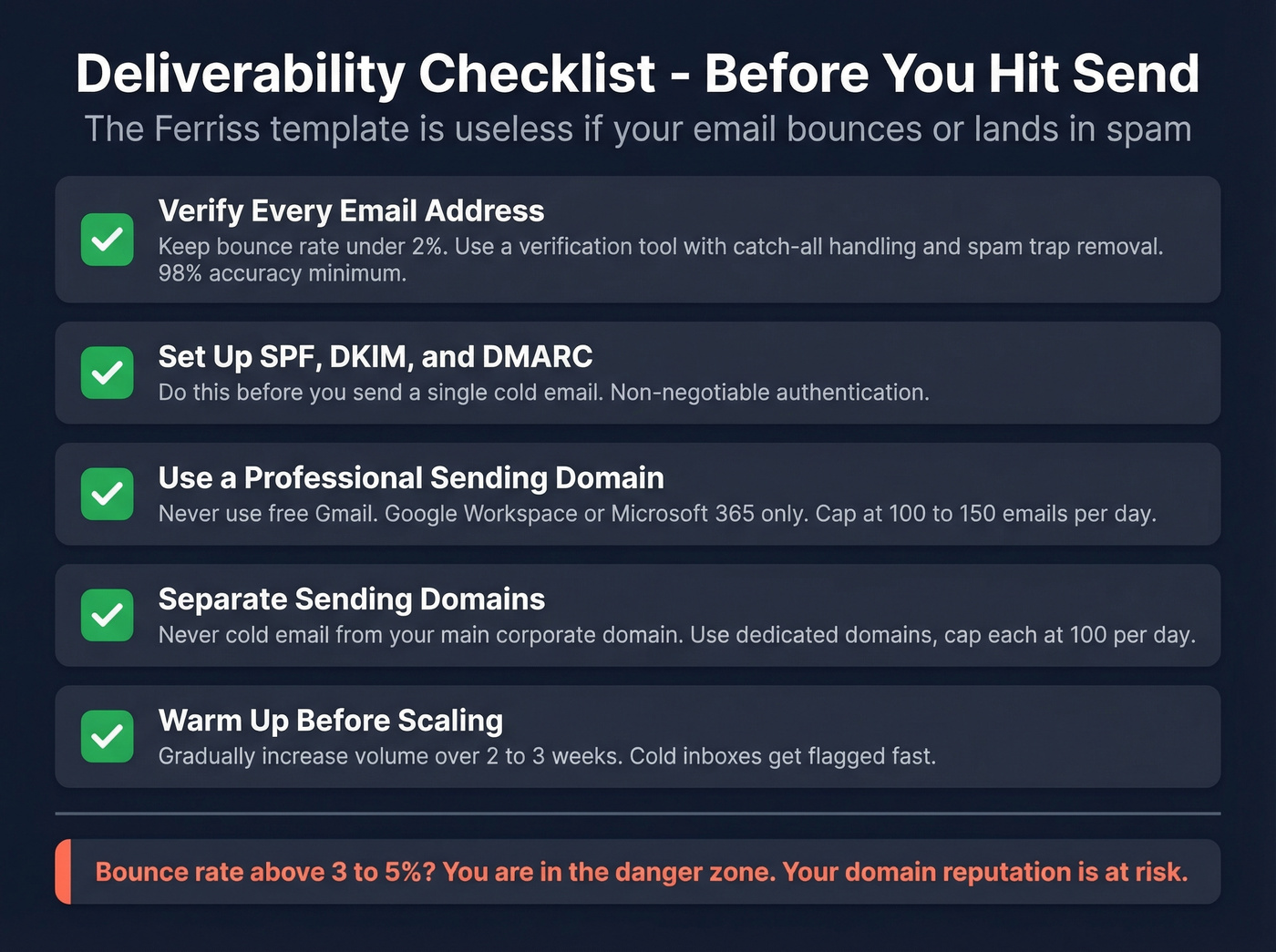
- SPF, DKIM, and DMARC - set these up before you send a single cold email. Do this first. (Use this email deliverability guide and double-check DMARC alignment.)
- Never use free Gmail for cold outreach. Use Google Workspace or Microsoft 365. Google Workspace caps safe cold sending at 100-150 emails per day.
- Multi-domain strategy - don't send cold email from your main corporate domain. Use dedicated sending domains and cap each at 100/day.
- Keep bounce rate under 2%. Verify every address before you send.
Tools like Lemlist, Klenty, and other cold email platforms offer built-in warmup and sequence features, but the fundamentals above apply regardless of which tool you choose.
One Reddit practitioner documented doubling their reply rate from 3% to 6% by cutting email length from 141 words to under 56, going from 3 sending domains to 7 (capped at 26 emails/day each), and cleaning their lists. Total stack cost: about $420/month. Their bounce rate dropped from 11% to under 2%. We've seen these numbers hold across hundreds of campaigns - the bounce rate threshold is the single biggest factor most teams ignore.
| Week | Daily volume | Notes |
|---|---|---|
| 1 | 10-20 | Warm replies only |
| 2 | 20-40 | Mix warm + cold |
| 3 | 40-60 | Monitor bounce rate |
| 4 | 60-80 | Steady state |
A spam complaint rate as low as 0.1% - that's 1 complaint per 1,000 emails - can trigger reputation damage. The warmup schedule above isn't optional. It's insurance.
Let's be honest: most people who say "cold email doesn't work anymore" have a deliverability problem, not a copywriting problem. If your bounce rate is above 3%, it doesn't matter how good your template is. Fix the pipes before you polish the words.
Short emails, soft CTAs, and 4-7 follow-ups - the 2026 data is clear. But none of it matters if you're emailing outdated contacts. Prospeo refreshes 300M+ profiles every 7 days, so the VP you're targeting today gets your email today, not a bounce notification.
Stop crafting perfect cold emails for dead addresses.
Follow-Up Sequence That Doesn't Annoy
58% of replies come from the first email. That means 42% come from follow-ups. The sweet spot is 4-7 touchpoints, spaced 3-5 days apart, sent Tuesday through Thursday between 8-11 AM in the recipient's timezone. (If you want plug-and-play options, use these cold email follow-up templates and sales follow-up templates.)
Ferriss's own rule applies here: don't push the density. Each follow-up should add a new angle or piece of value - not just "bumping this to the top of your inbox." The best follow-up sequences we've analyzed treat each message as a standalone that works even if the prospect never saw the original.
Skip the follow-up sequence entirely if you're reaching out to someone for a personal favor or mentorship ask. In that context, one thoughtful email and maybe one gentle nudge two weeks later is the ceiling. Anything more and you've crossed from persistent to pushy.
In our experience, email plus another channel - a brief comment on their post, a mutual connection intro - can deliver 3x the reply rate of email alone.
FAQ
Does the Tim Ferriss cold email template work for sales?
Yes. The core principles - brevity, a single ask, and an easy out - map directly to B2B outreach. 2026 benchmark data confirms emails under 80 words consistently outperform longer pitches. The adapted sales example above shows how to apply the framework without pitching.
How long should a cold email be?
Under 80 words for the first touch. Instantly's 2026 data shows this is the performance sweet spot - emails above 140 words see reply rates drop by roughly 50%.
How do I find verified emails before sending?
Use a verified email finder like Prospeo, which delivers 98% accuracy across 143M+ addresses and offers a free tier of 75 credits per month. Never guess formats or use unverified scraped lists - bounce rates above 3% damage sender reputation and can get your domain flagged.
How many follow-ups should I send?
Between 4 and 7, spaced 3-5 days apart. Data shows diminishing returns after 7 touchpoints, but stopping at 1-2 means you're leaving 42% of potential replies on the table.
Can I use this template for re-engaging cold leads?
Absolutely. Swap paragraph two for a brief reminder of your last interaction, keep paragraph three to one specific question, and always include the easy out. The same brevity principles apply - possibly even more so, since these contacts have already decided once that you weren't worth a reply.