

Trigger Events: The Playbook for Acting Before the Window Closes
A Series C company announces $85 million in funding on Tuesday morning. By Wednesday, your SDR sends a personalized email to the new VP of Engineering. It bounces - the contact data is three months old, and the VP left six weeks ago. Meanwhile, 84% of reps missed quota last year. The gap between knowing about a trigger event and actually reaching someone because of it is where most sales teams lose.
The Short Version
Only 3% of your market is actively buying at any given time. Another 7% intends to change soon. Trigger events catch that 7% as they tip over the edge.
Craig Elias's framework breaks every trigger into three categories: Bad Experience, Change/Transition, and Awareness. Every signal you'll ever track falls into one of these buckets.
Here's the thing most sales blogs won't tell you: detecting the trigger isn't hard. Crunchbase surfaces funding rounds in minutes. The hard part is reaching the right decision-maker with a verified email before the 7-14 day window slams shut. That's where trigger-based selling actually breaks down.
What Is a Trigger Event?
A trigger event is a specific, observable change in a company or decision-maker's world that creates a new reason to buy. Not a vague "they might be interested" signal - a concrete event that shifts priorities, budgets, or urgency.
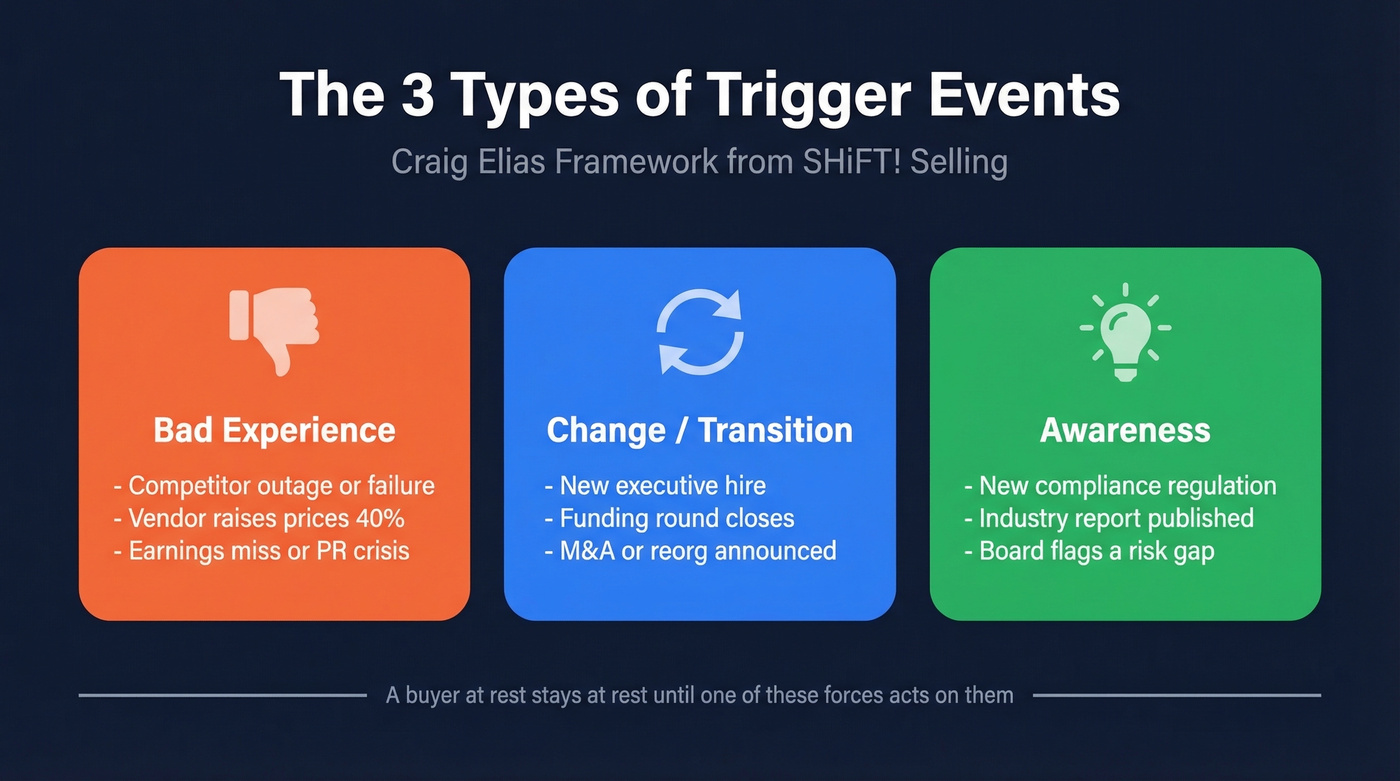
Craig Elias, who wrote the book on this in SHiFT! Selling, organizes them into three categories:
Bad Experience. The decision-maker has a negative experience with their current vendor or product. A competitor's platform goes down during a product launch. A key vendor raises prices 40% at renewal. The status quo suddenly feels painful.
Change/Transition. Something shifts in people, places, or priorities. A new CTO joins. The company relocates headquarters. A reorganization creates a new department with its own budget. Change breaks inertia - and inertia is the real enemy in B2B sales, far more than any competitor.
Awareness. The decision-maker realizes they need to change for legal, economic, or risk reasons. New compliance regulations hit their industry. A board member flags a security gap. They read a report showing competitors adopted a technology they haven't touched.
Think of Newton's first law: a buyer at rest stays at rest until an unbalanced force acts on them. These moments are that force.
Triggers vs. Intent Data vs. Signals
These terms get used interchangeably. They shouldn't be.
| Trigger Event | Intent Data | Signal | |
|---|---|---|---|
| What it is | A specific moment | Behavioral pattern | Any observable action |
| Example | Company raises Series B | 5 people research your category on G2 | VP downloads your whitepaper |
| What it tells you | Why they care now | Interest is building | Something happened |
| Shelf life | 7-14 days | Weeks to months | Varies widely |
Triggers give you a reason to reach out that doesn't sound like every other cold email. Intent data confirms the 3% that's already buying is real. You need both, but triggers are what make your outreach feel relevant instead of random. (If you want the operational side, see Identifying Buying Signals.)
Why Trigger-Based Outreach Works
Cold outreach reply rates sit at 1-3%. Trigger-based outreach consistently hits 15-25%. That's not a tweak. It's a fundamentally different conversion curve.
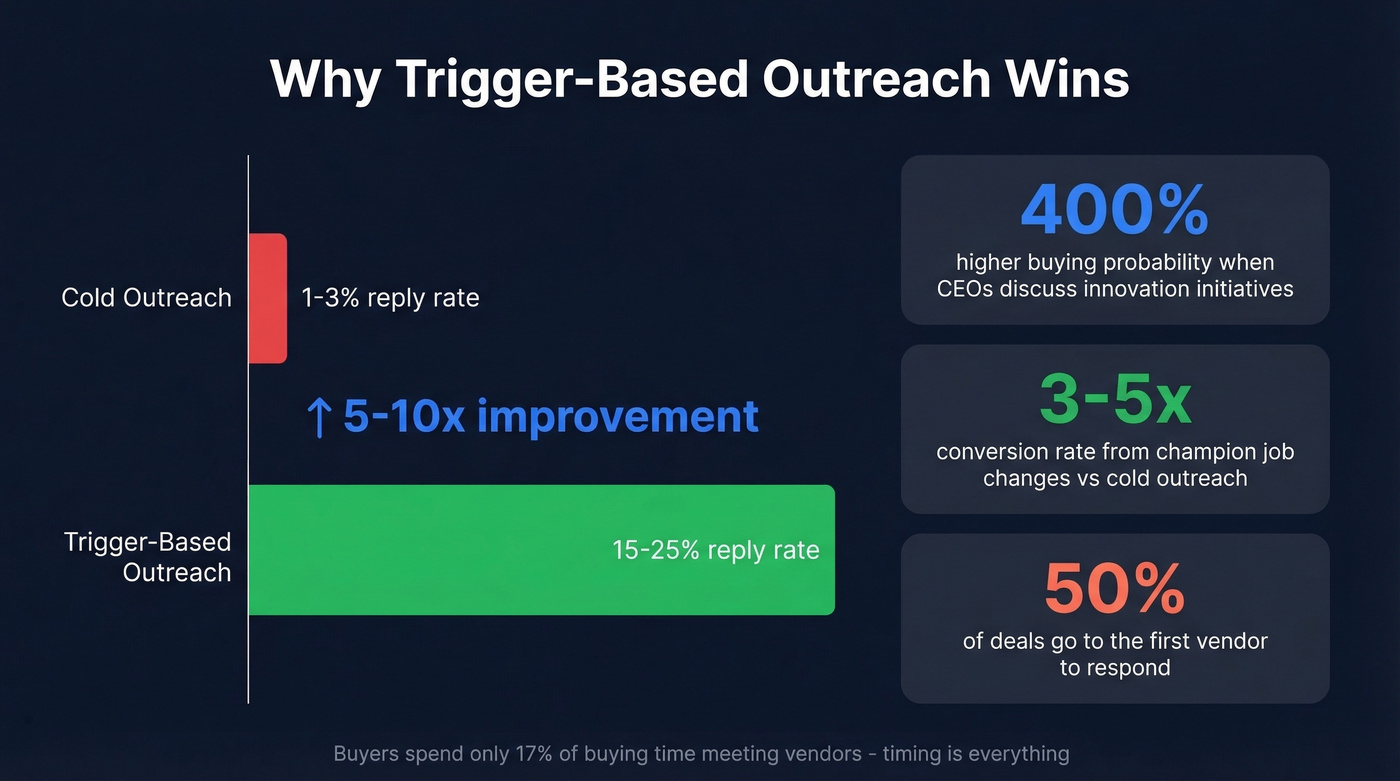
One SaaS company tracked CEOs publicly discussing "innovation" initiatives and found those accounts had 400% higher buying probability than accounts without that signal. Champion job changes convert at 3-5x the rate of cold outreach. And up to 50% of deals go to the first vendor to respond - speed isn't a nice-to-have, it's half the game.
Buyers spend just 17% of their buying time meeting with potential suppliers, with the rest going to independent research across an average of 10 channels. If you're not reaching them at the moment their priorities shift, you're competing for a sliver of attention against every vendor who eventually finds the same opening.

Trigger-based outreach only works if you reach someone real. Prospeo's 7-day data refresh and 98% email accuracy mean your message lands before the window closes - not bouncing off a contact who left six weeks ago.
Stop losing trigger events to stale data.
The B2B Trigger Event List
Most guides give you 20+ examples and zero framework for deciding which ones matter. Here's the list organized by Elias's categories - with prioritization built in.
Bad Experience Triggers
A competitor's outage, a vendor price hike at renewal, a public PR incident - these all create doubt in the status quo. Earnings misses work the same way: a public company reporting below expectations is suddenly open to efficiency plays. When you spot these, reference the disruption without being slimy about it. Lead with ROI, not features. And if you catch a pricing page visit on your site or a competitor's, act within hours - they're actively comparing, and the window is measured in hours, not days. (More on the mechanics in Data-Driven Selling.)
Change & Transition Triggers
These are the bread and butter of trigger-based selling:
| Trigger | Why It Matters | Action Window |
|---|---|---|
| Funding round | New capital = new priorities | 48 hours |
| Executive hire | New leaders bring new vendor preferences | First 30 days |
| Champion job change | Your best customer at a new company | 24 hours |
| M&A activity | Integration headaches, duplicate stacks | 1 week |
| Hiring surge (SDR/BDR) | They're about to need tools | 1 week |
| Tech stack change | Adjacent tech = integration needs | 1 week |
| Product launch | New GTM needs | Align to launch |
Let's be honest: champion job changes are the single most underused trigger in B2B. They convert at 3-5x cold outreach, yet most teams don't systematically track them. We've seen this pattern over and over - teams invest in expensive intent platforms while ignoring the simplest, highest-converting signal sitting right in their CRM. If you do nothing else from this article, build a system for tracking when your best customers change companies. (If you need a process, use this 30-60-90 Day Plan for Sales Reps to implement it.)
Awareness Triggers
New legislation or regulatory changes create urgency that didn't exist last quarter - lead with the regulation, not your product. Industry reports from Gartner or McKinsey shift how leadership thinks about a category. Contract renewal windows 60-90 days out are gold: get in before the auto-renewal kicks in.
First-party signals like content downloads and webinar attendance round out the picture. Follow up within hours with context about what they consumed, not a generic "saw you downloaded our guide" message. (For messaging, see Personalized Outreach.)
Prioritization Tiers
| Tier | Triggers | Window |
|---|---|---|
| Tier 1: Act in 48 hrs | Pricing page visit, champion change, funding | Hours to 2 days |
| Tier 2: Act in 1 week | Exec hire, hiring surge, tech change, renewal | 3-7 days |
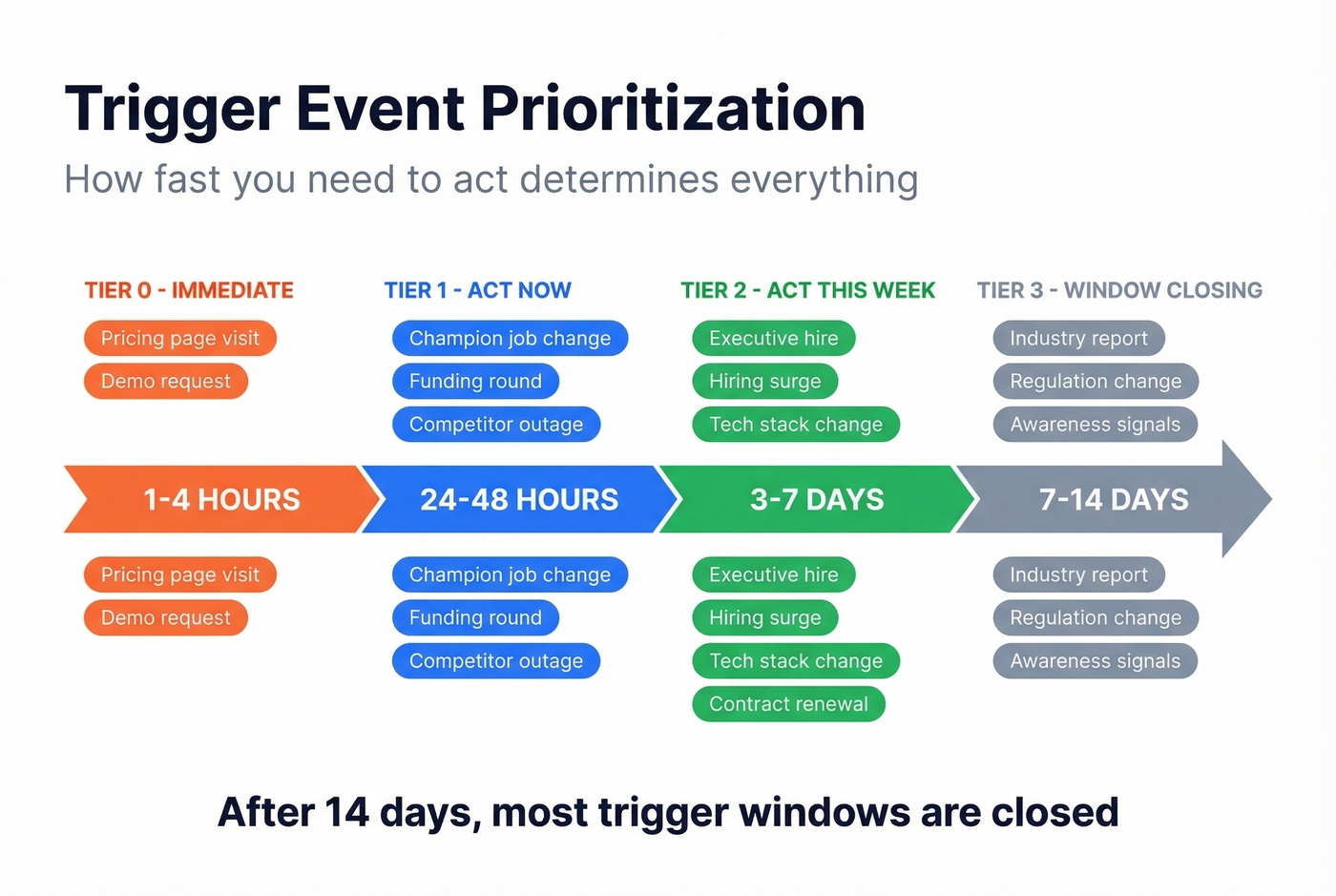
Windows typically close in 7-14 days. For behavioral signals like pricing page visits, the window is 1-4 hours. After that, the buyer has moved forward with someone else or the urgency has faded.
Why Most Trigger Strategies Fail
Here's the contrarian take nobody wants to hear: trigger events are the most overhyped and underexecuted concept in B2B sales.
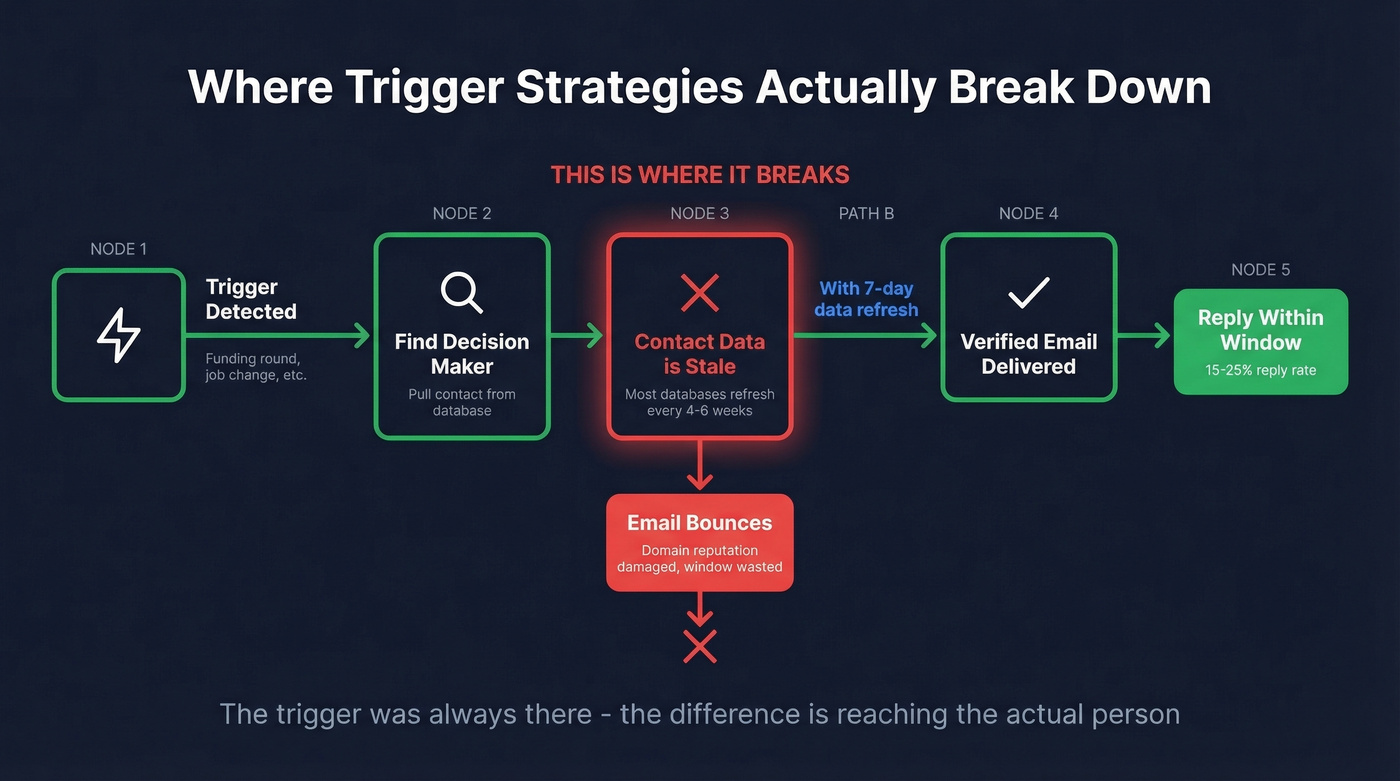
Every sales blog tells you to "monitor buying signals." Almost none tell you what to do when your trigger-based email bounces because the contact data is six weeks old. The r/sales consensus is blunt - reps report that many trigger and intent tools surface generic signals that aren't truly insightful. Worse, intent data gets misattributed: an assistant researching software gets flagged as buying intent from the VP.
The problem isn't the triggers. It's that B2B contact data decays fast, and most databases refresh every 4-6 weeks. By the time you detect a trigger and pull the contact, the email is dead. We ran into this ourselves when testing trigger workflows - the signal was perfect, the timing was right, and the email bounced. Frustrating doesn't begin to cover it. (If you're diagnosing this, start with Email Bounce Rate and Email Deliverability Guide.)
For teams with deal sizes below $10K, you probably don't need a $50K intent platform. What you need is accurate contact data that's fresh when the trigger fires. Prospeo's 7-day refresh cycle and 98% email accuracy mean the contact you pull after detecting a trigger is actually reachable. Meritt, an outbound agency, saw their bounce rate drop from 35% to under 4% after switching, and their pipeline tripled from $100K to $300K per week. The trigger was always there - the difference was reaching the actual person.

Tracking Triggers by Budget
$0/Month (Bootstrap)
Google Alerts monitors news mentions, funding announcements, and exec changes for your target accounts. Pair it with Crunchbase's free tier for funding and company data. This stack costs nothing and covers what early-stage teams need.
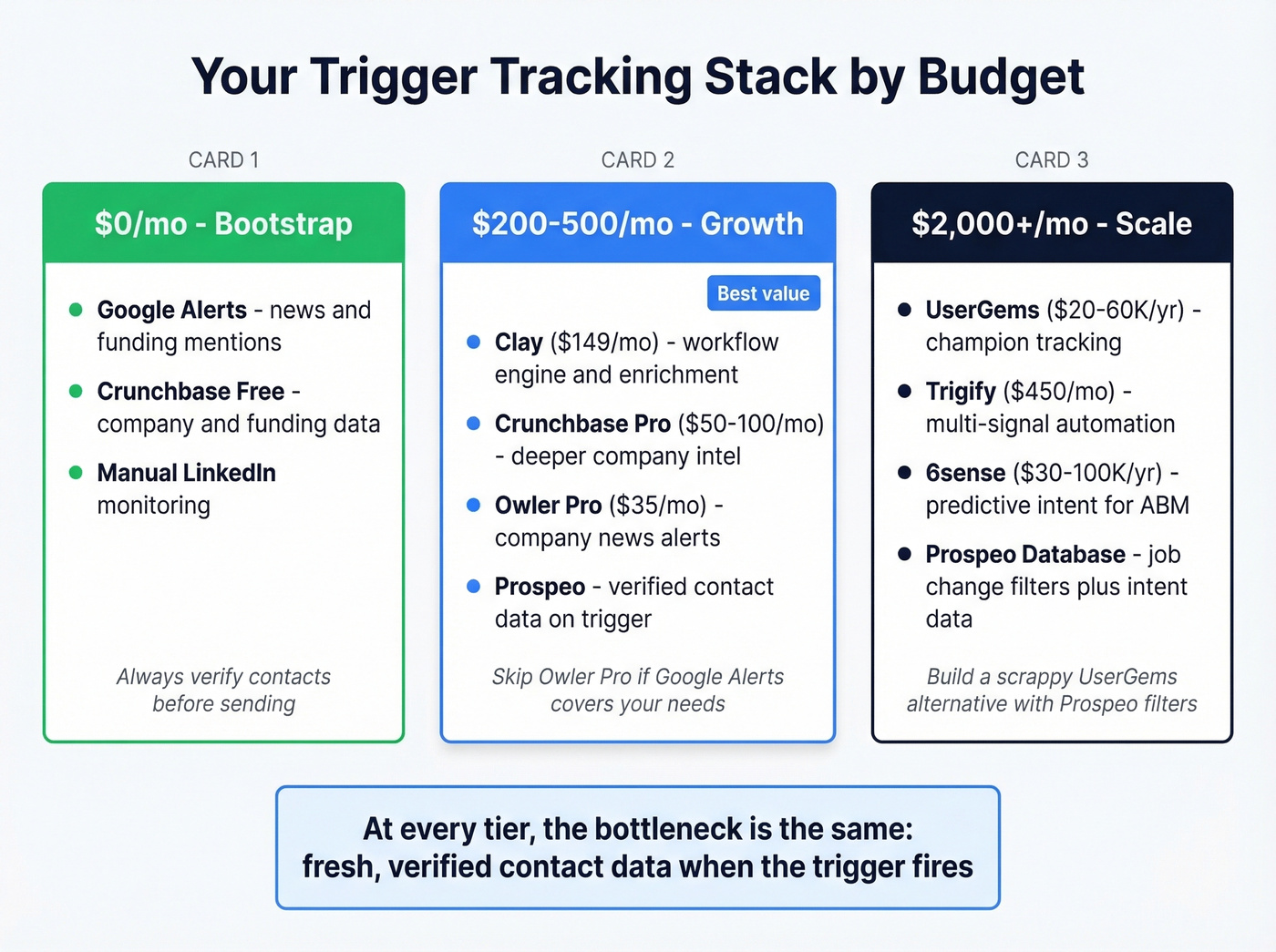
One rule: when a trigger fires, verify the contact before you send. A bounced email on a hot trigger is worse than no email at all - it burns your domain reputation and wastes the window. (If you’re building the stack, start with Free Lead Generation Tools.)
$200-500/Month (Growth)
Clay starts around $149/month and works as a workflow engine that chains triggers from multiple sources, enriches them with contact data, and pushes to your sequencer. The learning curve is real, but for complex workflows, it's worth it. Owler Pro runs about $35/month for company news alerts. Crunchbase Pro costs around $50-100/month for deeper company intelligence.
Skip Owler Pro if you're already getting good coverage from Google Alerts and Crunchbase - the overlap is significant at this tier. (Related: Lead Enrichment and Data Enrichment Services.)
$2,000+/Month (Scale)
UserGems runs $20K-60K+/year and is the gold standard for champion job-change tracking. It monitors when your customers and prospects change roles and surfaces those as triggers directly in your CRM. Trigify starts at $450/month for multi-signal automation. 6sense runs $30K-100K+/year for predictive intent modeling in enterprise ABM plays.
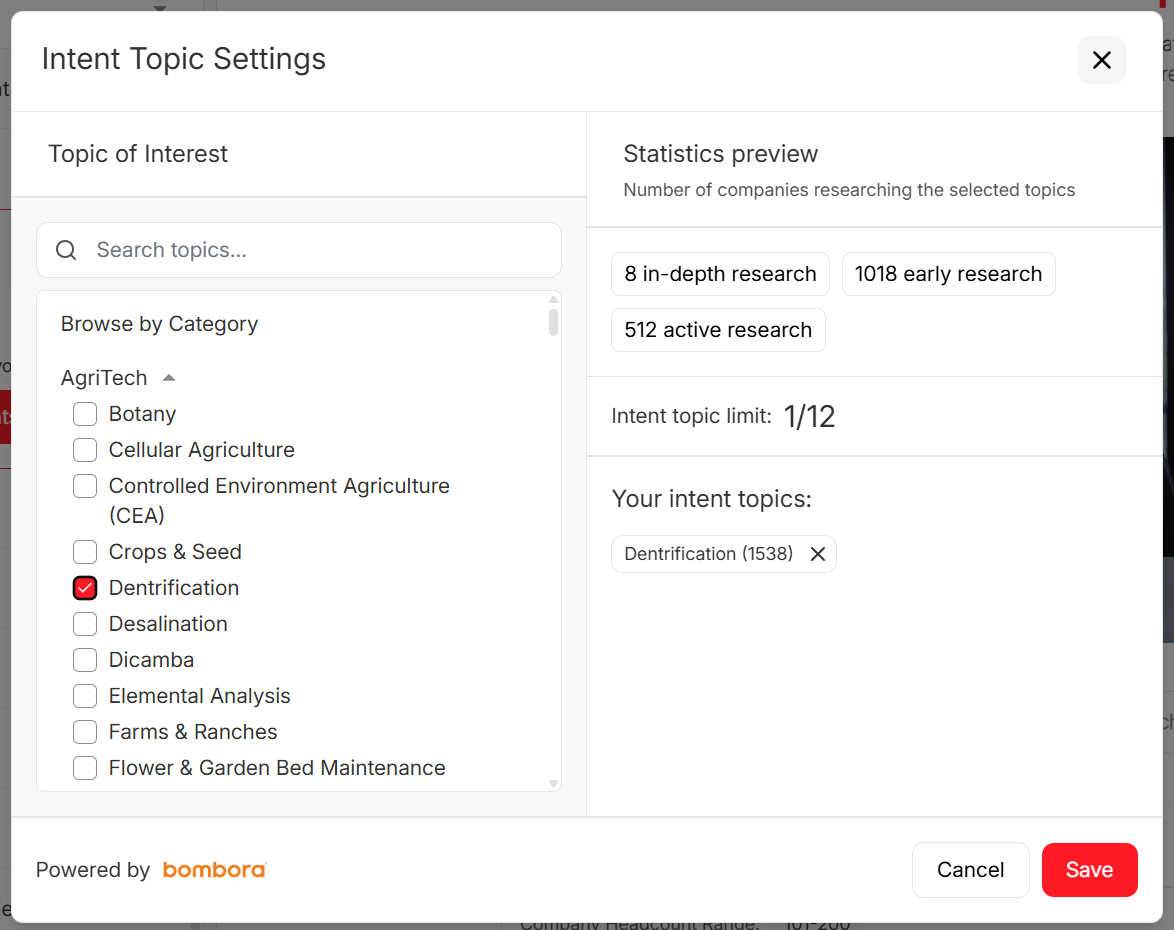
For teams that aren't ready for UserGems pricing, you can build a scrappy version using Prospeo's database filters - filter by job change signals and layer in intent data across 15,000 Bombora topics to catch accounts showing buying behavior. (If you’re evaluating sources, compare options in Best Sales Prospecting Databases.)
Trigger-Based Outreach Templates
Three templates tied to specific trigger types. Each assumes you've verified the contact first. (For more variations, see Sales Follow-Up Templates.)
Funding Round (send within 48 hours):
Subject: [Company]'s Series B - quick thought on [specific initiative]
Congrats on the round. If [specific use case tied to their funding announcement] is on the roadmap, we helped [similar company] do exactly that - [one-line result]. Worth 15 minutes this week?
Champion Job Change (send within 24 hours):
Subject: Welcome to [New Company]
Saw you just joined [New Company]. At [Old Company], you used [your product] for [specific outcome]. If [New Company] is facing similar challenges, happy to pick up where we left off.
Tech Stack Change (send within 1 week):
Subject: Noticed [Company] adopted [new technology]
Teams that add [technology] usually hit [specific integration challenge] within the first quarter. We solve that for [number] companies in [their industry]. Want me to send over how [similar company] handled it?
For behavioral triggers like pricing page visits, compress the timeline to 1-4 hours. Before you hit send on any of these, run the address through Prospeo's email verification - upload a CSV and know which emails are live before you burn a single send.
Champion job changes convert 3-5x better than cold outreach, but only if you have the new email on day one. Prospeo tracks 300M+ profiles with weekly refresh - so when your best buyer moves, you already have their verified contact at the new company.
Catch every champion move before your competitors do.
FAQ
What is a trigger event?
A trigger event is a specific, observable change - like a funding round, executive hire, or competitor outage - that creates a new reason for a prospect to buy. It shifts a buyer from passive to open, giving sales teams a timely and relevant reason to reach out instead of cold-calling into indifference.
How quickly should I act on a trigger?
Tier 1 triggers like champion job changes and funding rounds need action within 48 hours. Behavioral signals like pricing page visits require 1-4 hour response times. After 14 days, most windows have closed - up to 50% of deals go to the first vendor who responds.
Do I need expensive tools to track triggers?
No. Google Alerts plus free Crunchbase plus a free email verification tier covers most signals for early-stage teams. Prospeo's free plan includes 75 email credits per month with 98% accuracy - enough to act on triggers without burning your domain. Paid tools add automation, not fundamentals.
What are the highest-converting trigger events?
Champion job changes convert at 3-5x cold outreach - the single highest-converting trigger in most B2B playbooks. Funding rounds and pricing page visits are close behind. The common thread: urgency plus available budget plus a decision-maker open to new vendors.
Why isn't my trigger-based outreach working?
Almost always a data quality problem. If your contact database refreshes every 4-6 weeks, the action window closes before your email lands. Fix the data before you fix the messaging - in our experience, that single change accounts for most of the improvement teams see when they switch to trigger-based selling.