

What Are Enterprise Clients? Definition & Data (2026)
Your CEO just told the board you're moving upmarket. Now what?
"Enterprise" gets thrown around in every sales playbook, pricing page, and job description, and it means something different every time. Here's a practical framework backed by actual benchmarks so you can stop guessing and start building a strategy that holds up when the board asks follow-up questions.
The Short Version
Three things define enterprise clients:
- Enterprise is a buying behavior, not a headcount. If there's a procurement department, security reviews, and PO requirements, you're in enterprise territory - regardless of employee count.
- Expect 6-25 stakeholders and 90-270 day sales cycles. The average B2B buying committee has grown to 25 stakeholders, up from 16 in 2017. These deals don't move fast.
- The economics favor enterprise - if you survive the cycle. Higher ACV deals show lower CAC ratios and better gross retention. But you need verified contact data for every stakeholder on the committee, not just the person who filled out your demo form.
Enterprise Client Definition
Most articles define enterprise by company size. That's the wrong lens.
Gartner defines "midsize enterprises" as companies with $50M-$1B in annual revenue or 100-1,000 employees. Anything above that band is generally considered enterprise. Salesforce frames enterprise sales as deals involving multiyear contracts, complicated implementation, and higher risk - multiple bids, cross-departmental decision-makers, and sales cycles running from months to over a year.
Karl Sakas, an agency consultant, offers the most useful shorthand: "If there's a purchasing department, it's an enterprise client." The enterprise customer meaning really comes down to procurement complexity - not whether a company has 1,000 or 5,000 employees, but whether buying your product requires procurement approval, security reviews, legal redlines, and a PO number. Procurement complexity is the defining trait, not a number on a Wikipedia page.
Here's our position: if your ACV is under $50K, enterprise probably isn't worth the CAC. The data below shows why.
SMB vs. Mid-Market vs. Enterprise
Here's the segmentation framework most sales orgs actually use:
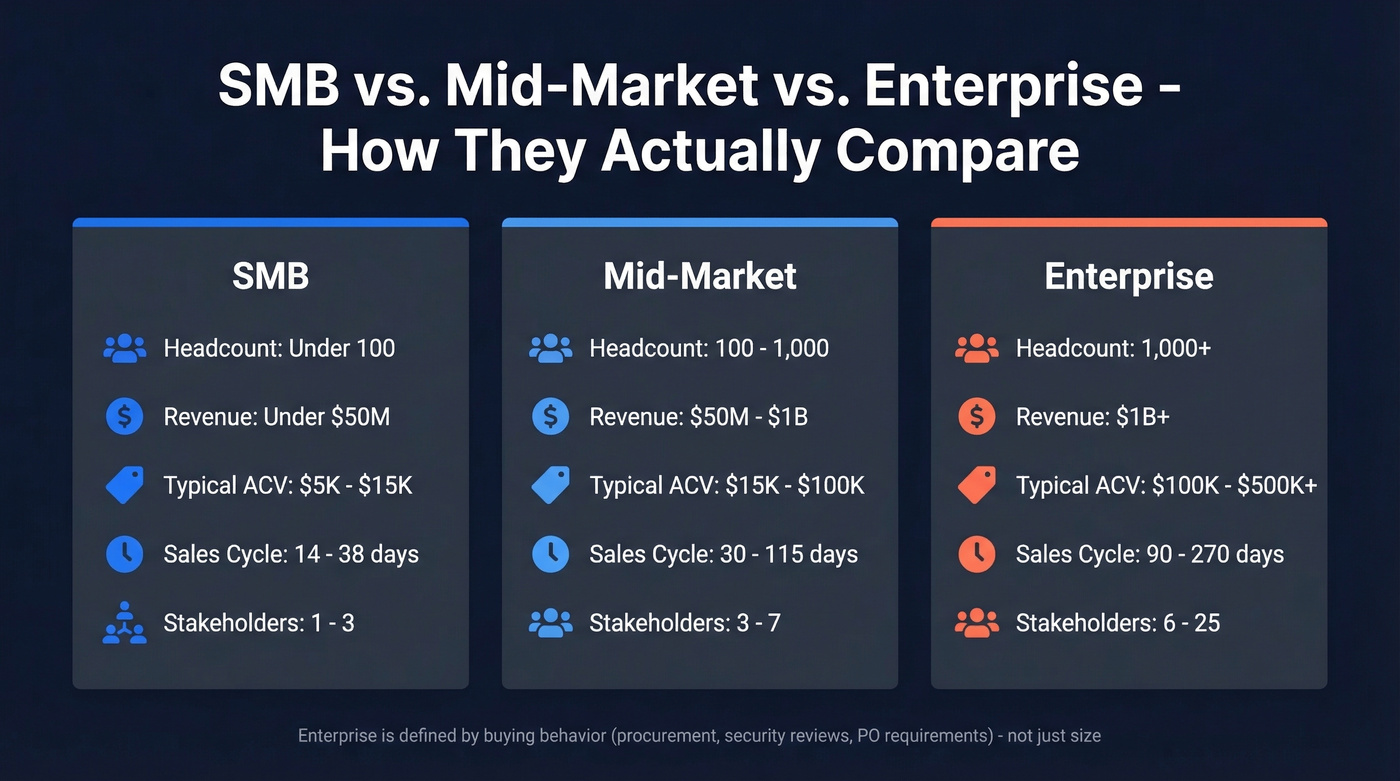
| Segment | Size (Headcount / Revenue) | Typical ACV | Sales Cycle | Stakeholders |
|---|---|---|---|---|
| SMB | <100 / <$50M | $5K-$15K | 14-38 days | 1-3 |
| Mid-Market | 100-1,000 / $50M-$1B | $15K-$100K | 30-115 days | 3-7 |
| Enterprise | 1,000+ / $1B+ | $100K-$500K+ | 90-270 days | 6-25 |
These bands are guidelines, not gospel. A Reddit thread on r/sales shows just how wildly definitions vary - one poster's ERP company defined enterprise as 200+ employees, while another poster's HR platform didn't consider an account "enterprise" until 40,000+ employees. Same word, completely different thresholds.
You'll need to calibrate to your product's complexity, price point, and buyer profile. A $50K/year security tool and a $5K/year project management app draw the enterprise line in very different places.

Enterprise buying committees average 25 stakeholders - and the ones you can't reach are the ones who kill your deal. Prospeo gives you verified emails (98% accuracy) and direct dials (125M+ mobile numbers) for every decision-maker on the committee, not just the champion who booked the demo.
Stop single-threading enterprise deals. Multi-thread with verified data.
What Makes Enterprise Deals Different
The Buying Process
B2B buying committees now average 25 stakeholders, up from 16 in 2017. You're not selling to a person. You're selling to an organism.
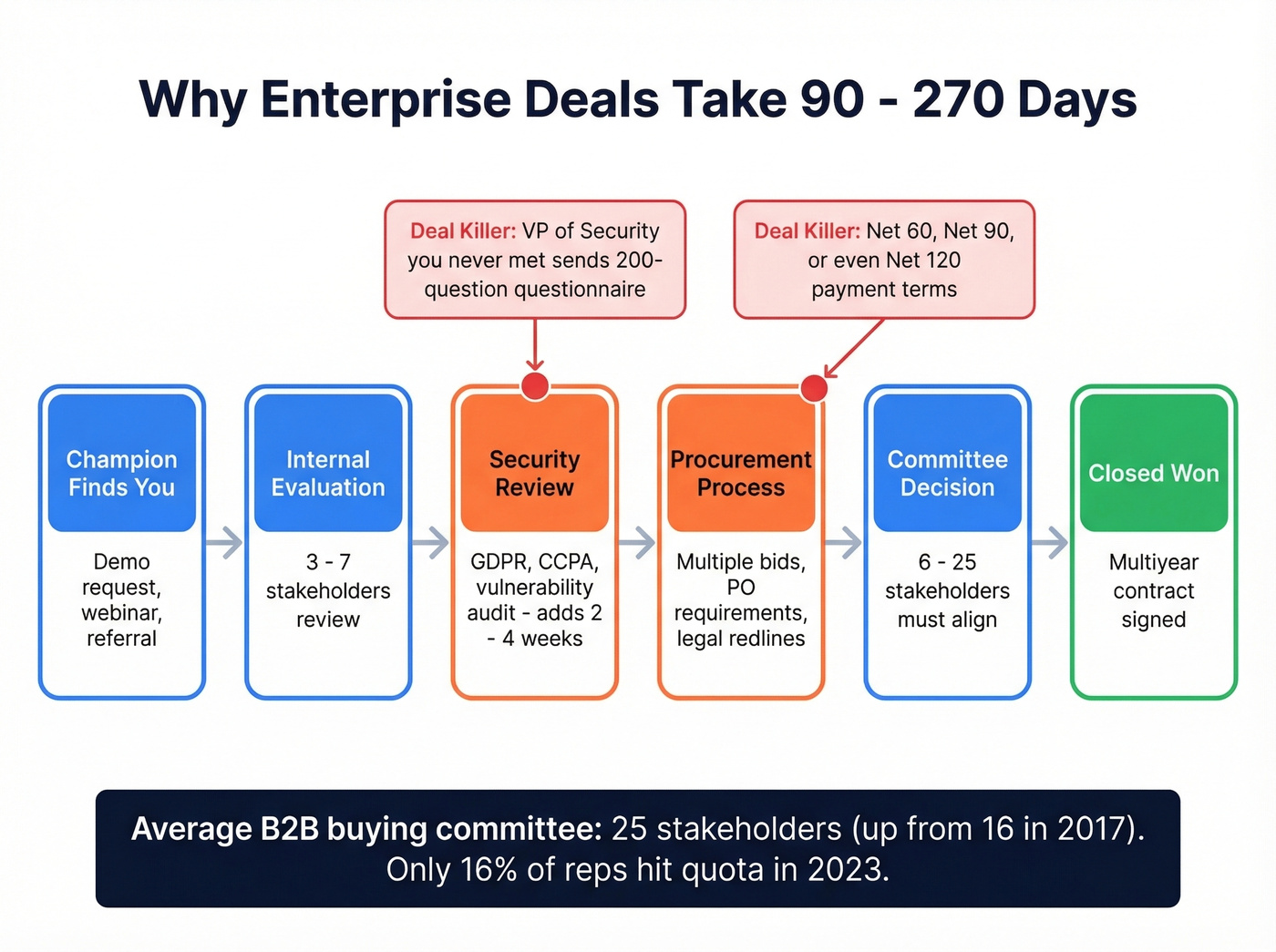
And the stakeholders you don't know about are the ones who kill your deal. We've watched this play out dozens of times: a champion is enthusiastic, the demo goes well, and then a VP of Security you've never met sends back a 200-question questionnaire that stalls everything for six weeks.
Single-threaded enterprise deals are dead on arrival. If only one person inside the account is advocating for you, the deal dies the moment that person goes on vacation, changes roles, or gets overruled. (If you want the playbook, start with a multi-threading approach.)
Enterprise prospects routinely send security questionnaires covering GDPR/CCPA compliance, incident response, and vulnerability management. As you scale, expect volume to grow from 3-5 per month to 40+. Then there's procurement itself: multiple bids are standard, PO requirements mean expanding into a new department often requires a brand-new purchase order, and payment terms can be brutal - Net 60, Net 90, even Net 120. Keurig Dr Pepper's RFP once stipulated 360-day payment terms, and an agency agreed to it. That's a year of float on your balance sheet. If you're navigating formal bids, read our guide on the RFP process.
Feature & Compliance Requirements
Enterprise clients expect a specific feature stack before they'll even consider your product:
- Role-based access control (RBAC) and SSO via Azure AD or Okta
- A published security whitepaper with SLAs and uptime guarantees
- Audit logs and compliance reporting
- Native integrations with their existing stack
- Change management and update communication
Enterprise software is rarely priced below $10K/year, and $50K/year is common for products delivering real value at this tier. On top of license fees, expect professional services revenue - typical ranges run $50K-$75K for integration projects and $5K-$10K per training engagement.
If you can't pass a security questionnaire today, you're not enterprise-ready. Skip this segment until you can.
Enterprise Sales Cycle Benchmarks
The data here is stark. Sales cycles scale almost linearly with company size:
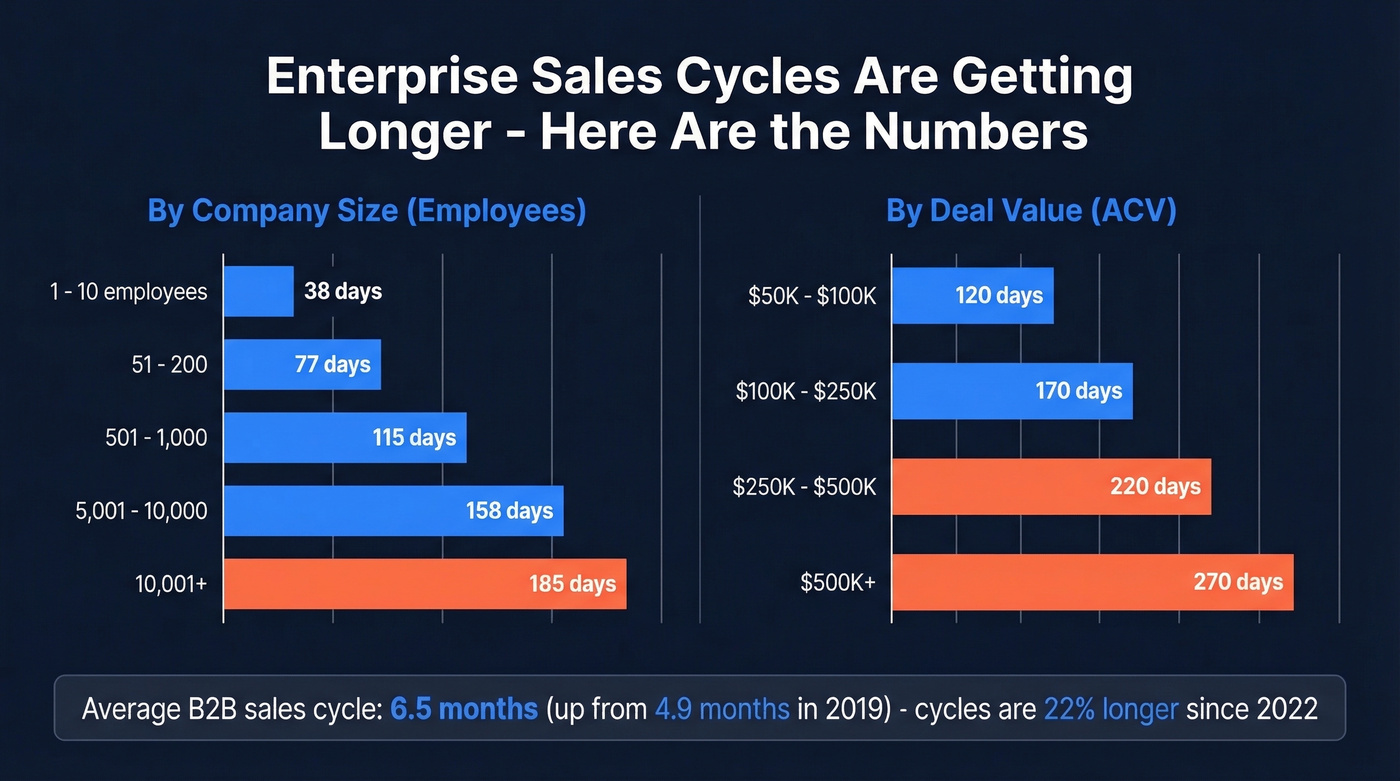
| Prospect Size | Avg. Cycle (Days) |
|---|---|
| 1-10 employees | 38 |
| 51-200 | 77 |
| 501-1,000 | 115 |
| 5,001-10,000 | 158 |
| 10,001+ | 185 |
And when you slice by deal value, the picture stretches even longer:
| ACV Range | Avg. Cycle (Days) |
|---|---|
| $50K-$100K | 120 |
| $100K-$250K | 170 |
| $250K-$500K | 220 |
| $500K+ | 270 |
The average B2B sales cycle has grown to 6.5 months, up from 4.9 months in 2019. Cycles are 22% longer since 2022, driven by larger buying committees and security due diligence that adds 2-4 weeks on its own. Only 16% of reps hit quota in 2023.
In our experience, deals above $250K rarely close in under six months regardless of how strong the champion is. B2B sales overall is getting slower and more complex - plan accordingly. To pressure-test your timeline, use a sales cycle framework and track deal velocity by segment.
Economics of Selling Upmarket
Enterprise clients cost more to acquire. Here's what CAC looks like across SaaS verticals:
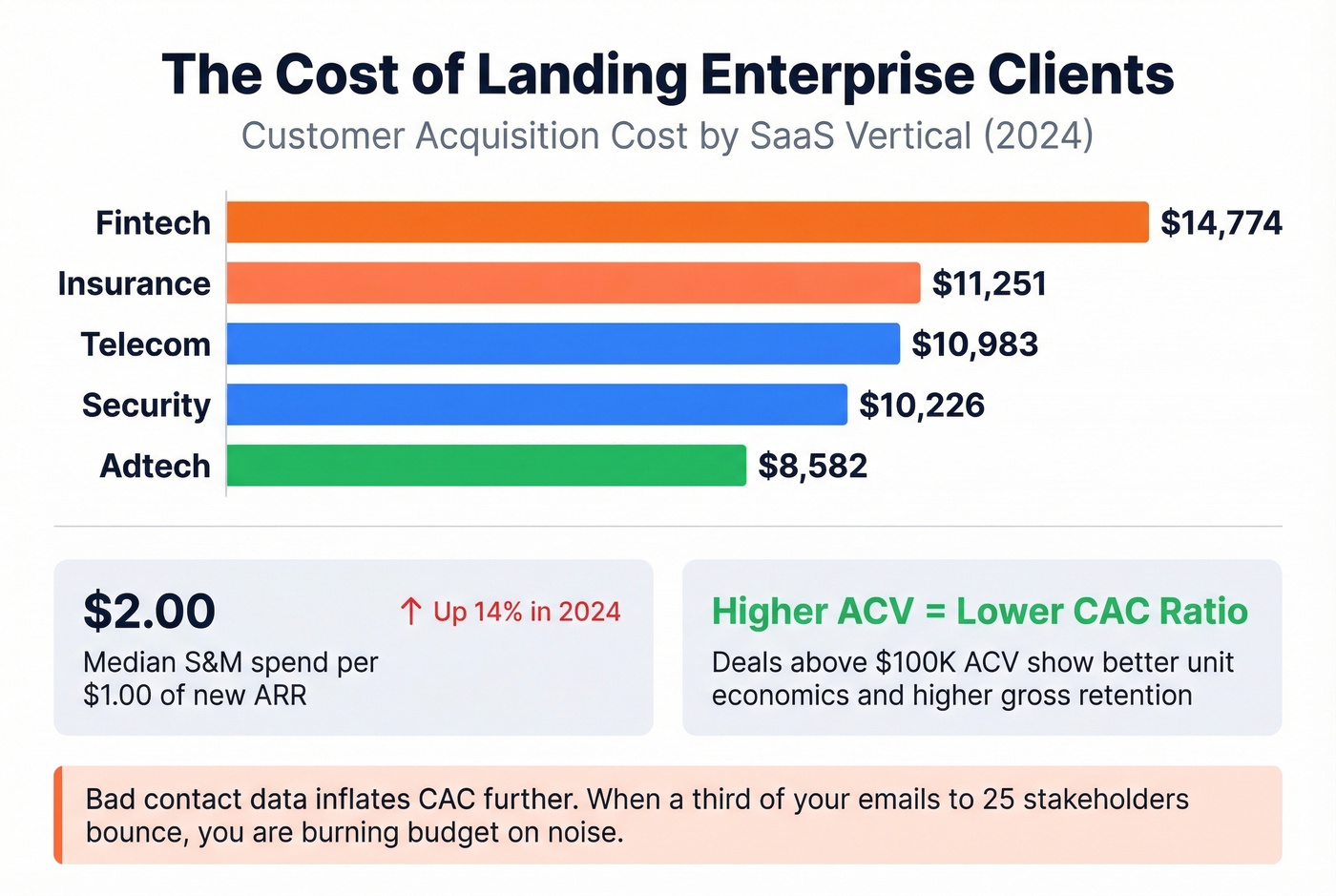
| SaaS Vertical | Enterprise CAC |
|---|---|
| Fintech | $14,774 |
| Insurance | $11,251 |
| Telecom | $10,983 |
| Security | $10,226 |
| Adtech | $8,582 |
The median New Customer CAC Ratio sits at $2.00 in S&M spend per $1.00 of new ARR, up 14% in 2024. That's expensive. But larger ACV deals above $100K actually show lower CAC ratios than many mid-ACV ranges, and gross revenue retention increases as ACV increases - these accounts cost more to land but stay longer and pay more. (If you're modeling deal size, start with average selling price and TCV.)
Here's the thing: bad contact data inflates those CAC numbers further. When you're reaching out to 25 stakeholders per deal and a third of your emails bounce, you're burning budget on noise. That's not a data quality problem - it's a pipeline problem wearing a data quality mask. Run a regular sales pipeline audit and enforce pipeline hygiene to keep CAC from creeping.
How to Reach Enterprise Decision-Makers
The core problem with enterprise outbound is simple: buying committees have 6-25 stakeholders, and you need verified contact data for all of them. Not just the VP of Engineering who attended your webinar - the CISO, the procurement lead, the CFO, and the directors who'll actually use the product daily. Multi-threading across the full committee isn't optional. It's how enterprise deals get done.
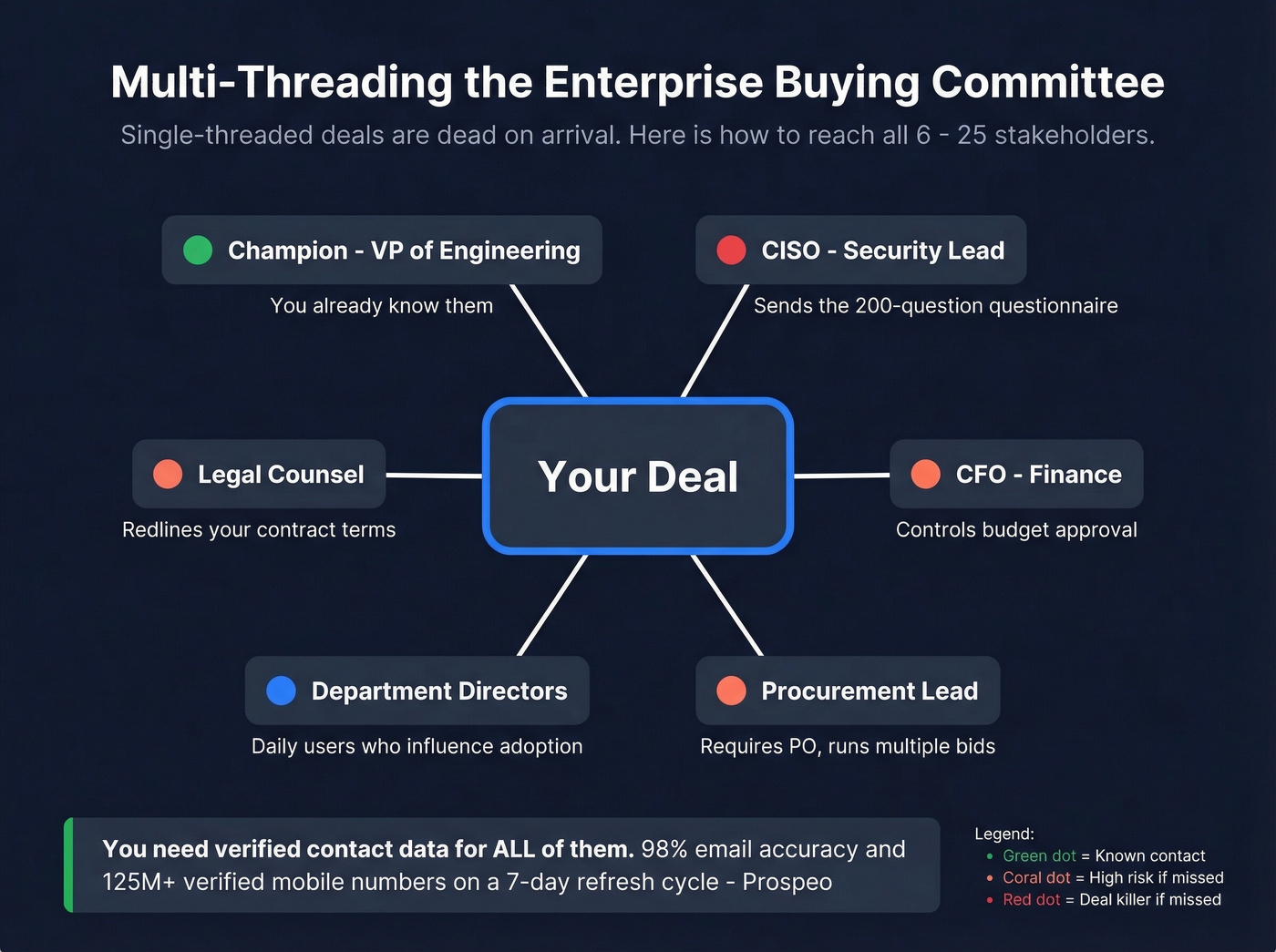
Prospeo covers 300M+ professional profiles with 98% email accuracy and 125M+ verified mobile numbers on a 7-day data refresh cycle. You can search by company size, department, and seniority using 30+ filters, layer in intent data to identify accounts actively researching your category, then push verified contacts straight to your CRM or sequencer.

Let's be honest - most teams moving upmarket underestimate how much their data infrastructure needs to change. SMB outbound with 70% email accuracy is annoying. Enterprise outbound with 70% accuracy is a domain reputation disaster that takes months to recover from. If you're seeing bounces climb, fix email deliverability and protect your spam domain reputation before scaling volume.
With enterprise sales cycles stretching to 270 days and CAC running $8K-$15K per deal, bad contact data is money you literally cannot afford to waste. Prospeo's 7-day data refresh means you're never reaching out to someone who changed roles two months ago - a deal-killer when you're navigating 6-month cycles.
Enterprise deals are too expensive to build on stale data.
FAQ
How many employees makes a company "enterprise"?
Common frameworks start enterprise at 1,000+ employees, but thresholds vary dramatically by industry - an ERP vendor might set the bar at 200+, while an HR platform doesn't consider an account "enterprise" until 40,000+. Buying behavior (procurement teams, security reviews, PO requirements) matters more than headcount alone. Define enterprise by how a company buys, not how many people work there.
How long is the average enterprise sales cycle?
For companies with 10,001+ employees, expect roughly 185 days. Deals over $500K ACV average 270 days. The overall B2B sales cycle has grown from 4.9 months in 2019 to 6.5 months today, driven by larger buying committees and security due diligence that adds 2-4 weeks on its own.
How do you find enterprise buying committee contacts?
Use a B2B data platform that lets you search by company size, department, and seniority to build verified contact lists across all 6-25 stakeholders. Layer in intent signals to prioritize accounts actively in-market, and verify every email before outreach - bounce rates above 5% will damage your domain reputation and tank deliverability for months.
What's the difference between enterprise and mid-market clients?
Mid-market companies typically have 100-1,000 employees and $50M-$1B in revenue, with 3-7 stakeholders and 30-115 day cycles. Enterprise accounts exceed 1,000 employees and $1B in revenue, involve 6-25 stakeholders, require procurement and security approval, and run 90-270 day cycles. The jump in deal complexity - not just deal size - is what separates the two segments.