

The Sales Cycle in 2026: Stages, Benchmarks, and How to Shorten Yours
The average B2B sales cycle now runs 6.5 months - up from 4.9 months in 2019. That's not a blip. Buying committees have ballooned, procurement reviews have multiplied, and 58% of B2B professionals say their cycles got longer in the past year alone. If your pipeline feels like it's moving through wet concrete, you're not imagining it.
The short version: Your sales cycle has 7 stages, but what matters is the exit criteria between them, not the labels. The average B2B cycle is 6.5 months - check the benchmark tables below to see if yours is normal or broken. The fastest lever to shorten it? Get the economic buyer involved by meeting two, not meeting six.
What Is a Sales Cycle?
A sales cycle is the repeatable sequence of stages a deal moves through from first contact to closed-won. It's the seller's view of the deal. The sales process is the playbook - the methodology, scripts, and activities reps follow within each stage. And the buying cycle is the customer's side of the same coin: how they evaluate, compare, and decide.
Here's the thing: these three rarely line up. Gartner described the modern B2B buying journey as a "spaghetti bowl" - buyers loop back, revisit stages, stall, restart, and involve new stakeholders at random intervals. Your clean seven-stage funnel is a useful internal model. Just don't confuse it with how your buyer actually experiences the purchase.
Track your pipeline by stages, but design your engagement around buyer phases. When a deal "regresses" from Proposal back to Discovery, that's not a failure - it's a new stakeholder catching up. Expect it.
The 7 Stages of a Sales Cycle
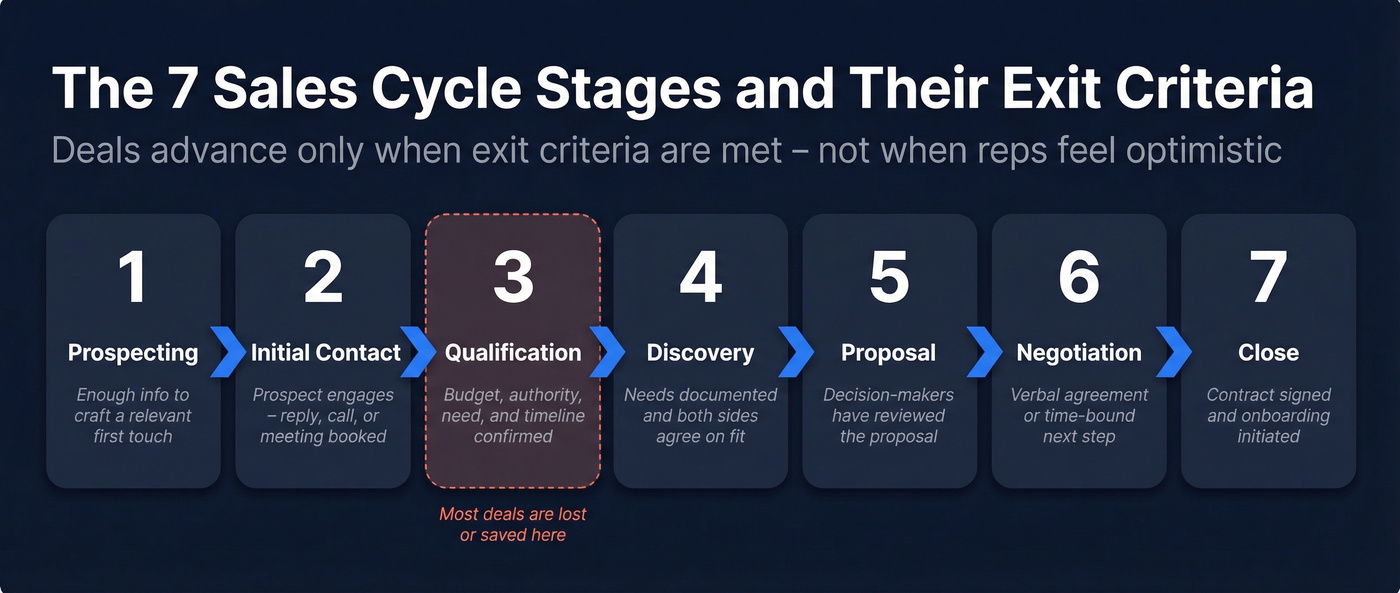
Every sales org labels these differently, but the underlying structure is consistent. What separates high-performing teams isn't the labels - it's having explicit exit criteria that a deal must meet before advancing. Without them, your pipeline is fiction.
Prospecting
Finding leads that match your ICP and generating enough signal to start outreach. The exit criterion: you've got enough information about the prospect - role, company fit, potential need - to craft a relevant first touch.
Research and prospecting aren't sequential; they're concurrent. You research as you prospect, refining your ICP with every conversation. What you can't do is skip research entirely and spray generic outreach at a bought list.
The window is tighter than most teams realize. Outreach's data shows sellers have roughly 14 days to engage a buyer before the opportunity goes cold, and the most successful reps reach out nine times across channels within that window. RAIN Group's research corroborates this, finding it takes an average of 8 touches to generate a meeting. The biggest mistake? Prospecting without qualification criteria, which fills your pipeline with deals that stall at stage three.
If you want a tighter playbook for this stage, start with these sales prospecting fundamentals.
Initial Contact
First outreach across email, phone, social, or warm intro. The exit criterion: the prospect engages - a reply, a call booked, a meeting accepted.
"I'd love to learn about your challenges" doesn't earn a response from a VP who gets 40 of those a week. Reference a specific trigger - a job change, a funding round, a tech stack signal - and connect it to a problem you solve. 71% of buyers want to hear from sellers early in the buying process. The issue isn't timing; it's relevance.
Qualification
This is where most teams lose weeks they'll never get back. Confirming the deal is real means applying frameworks like BANT or MEDDIC rigorously and being willing to disqualify. The exit criterion: budget exists, you're talking to someone with authority, there's a genuine need, and there's a timeline that isn't "someday."
If you're using MEDDIC, these MEDDIC discovery questions help you enforce real exit criteria.
The fastest way to shorten your selling timeline is to kill deals here that won't close. Skipping qualification to "save time" is the most expensive mistake in sales - you'll spend three months nurturing a deal that was never real.
Discovery / Needs Analysis
Understanding the prospect's pain deeply enough to map your solution to it. The exit criterion: needs are documented, and both sides agree your solution addresses them.
The classic mistake is talking too much. Discovery isn't a product demo - it's an interview. The best discovery calls have the prospect talking 60-70% of the time. If you're presenting features before you've mapped pain, you're guessing, and guessing extends deal timelines by weeks.
If you need a tighter structure, use a discovery call script and a bank of discovery questions.
Proposal / Presentation
Presenting your solution and pricing to the people who can actually say yes. The exit criterion: the proposal has been reviewed by decision-makers, not just your champion.
Here's the mistake that silently adds weeks to every deal: presenting to non-decision-makers. If your champion says "I'll share this internally," you've lost control of the narrative. Push for a live presentation with the economic buyer in the room. Every time.
Negotiation / Objection Handling
Map the three most likely objections before the call. Have data, case studies, and concessions ready. Reactive negotiation is slow negotiation - it's what turns a two-week stage into a two-month one. The exit criterion: verbal agreement on terms or a clear, time-bound next step toward signature.
If you want a clean way to set terms early, use an anchor and define your walk away point before you negotiate.
Close + Follow-Up
Contract signed, onboarding initiated, handoff to customer success complete. This stage isn't just about the signature - it's about setting up the expansion motion. The best closers already have a 90-day check-in scheduled before the ink dries.
Don't forget nurturing for deals that close-lost. A "not now" isn't a "never." Thirty percent of closed-lost deals reopen within 12 months if you stay relevant.
Sales Cycle Benchmarks for 2026
Benchmarks are only useful if they're specific enough to diagnose a problem. "3-6 months" doesn't help you. Let's break it down.
By Industry
| Industry | Total Days | Initial Contact | Proposal | Negotiation | Closing |
|---|---|---|---|---|---|
| Software | 90 | 14 | 30 | 25 | 21 |
| Financial Svcs | 98 | 15 | 33 | 27 | 23 |
| Retail | 70 | 11 | 23 | 19 | 17 |
| Healthcare | 125 | 19 | 42 | 34 | 30 |
| Manufacturing | 130 | 18 | 45 | 35 | 32 |
| Energy | 155 | 23 | 54 | 42 | 36 |
| Pharma | 153 | 22 | 53 | 41 | 37 |
| Non-Profit | 162 | 24 | 56 | 44 | 38 |
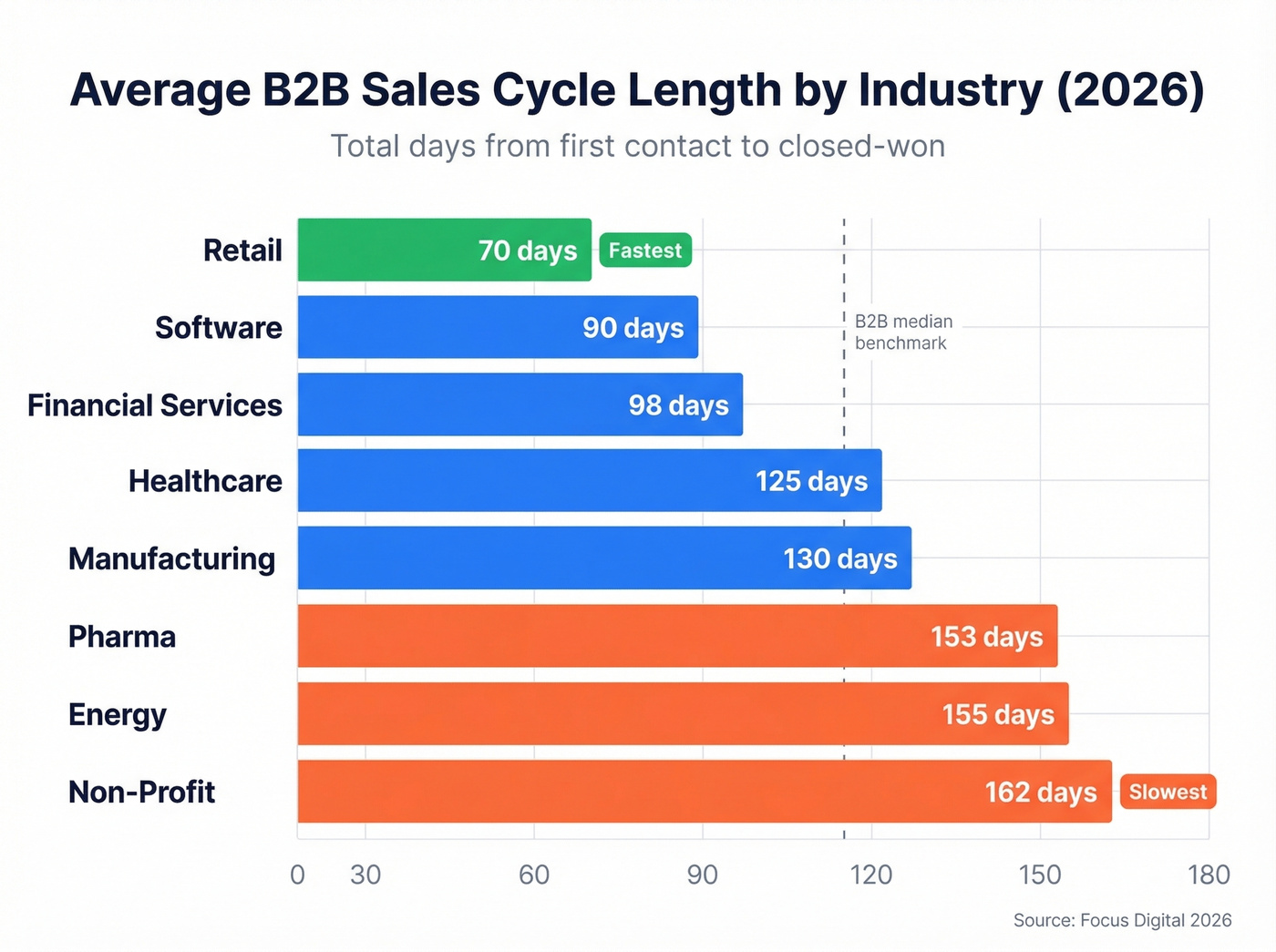
Data from Focus Digital's industry benchmarks.
Software closes fastest at 90 days. Non-profits and energy take longest at 155-162 days, driven by committee-heavy procurement and budget cycle dependencies. If you're selling into healthcare or manufacturing and expecting software-speed closes, recalibrate your forecast.
By Deal Size
| ACV Band | Median Days | Top Quartile | Structural Drag Threshold |
|---|---|---|---|
| $10K-$25K | 38 | 26 | >55 days |
| $25K-$50K | 72 | 51 | >100 days |
| $50K-$100K | 128 | 94 | >175 days |
| >$100K | 187 | 142 | >250 days |
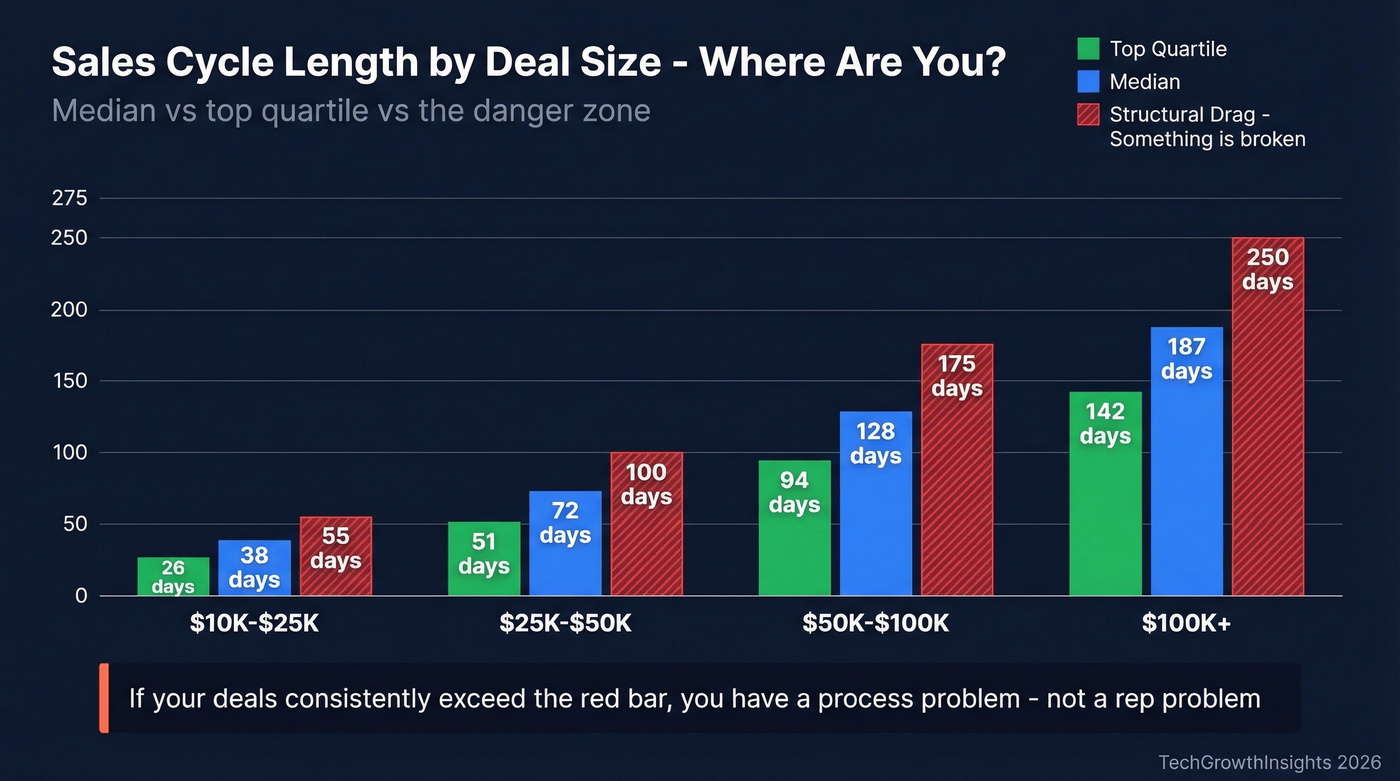
Data from TechGrowthInsights 2026 benchmarks.
The "Structural Drag Threshold" column is the one to watch. If your $25K deal consistently takes 100+ days, you've got a structural problem - not a rep problem. Something in your process is broken, whether it's qualification, stakeholder access, or proposal timing.
A Norwest survey of 195 B2B sales and marketing leaders found that mid-market companies selling $50K-$100K deals average roughly 9 months to close. That's a reminder that "mid-market" can still behave like enterprise when procurement, security, and multi-stakeholder consensus kick in.
By Company Size
| Employee Count | Avg Cycle (Days) |
|---|---|
| 1-10 | 38 |
| 51-200 | 77 |
| 501-1,000 | 115 |
| 5,001-10,000 | 158 |
| 10,001+ | 185 |
Enterprise cycles are nearly 5x longer than SMB. The gap is widening as large organizations add more compliance, security, and procurement layers. If you're an SMB-focused team moving upmarket, don't just hire enterprise reps - rebuild your stage model to account for the additional 100+ days of stakeholder coordination.
Now the real question: are your numbers normal, or is something broken?

The prospecting stage eats weeks when you're chasing outdated contacts. Prospeo's 300M+ profiles refresh every 7 days - not every 6 weeks - so you reach the right buyer on the first try. At $0.01/email with 98% accuracy, you stop wasting the 14-day engagement window on bounced messages.
Kill dead leads before they stall your pipeline.
Structural Drag Signals
Not every long cycle is a broken one. But certain patterns indicate structural drag rather than normal complexity.
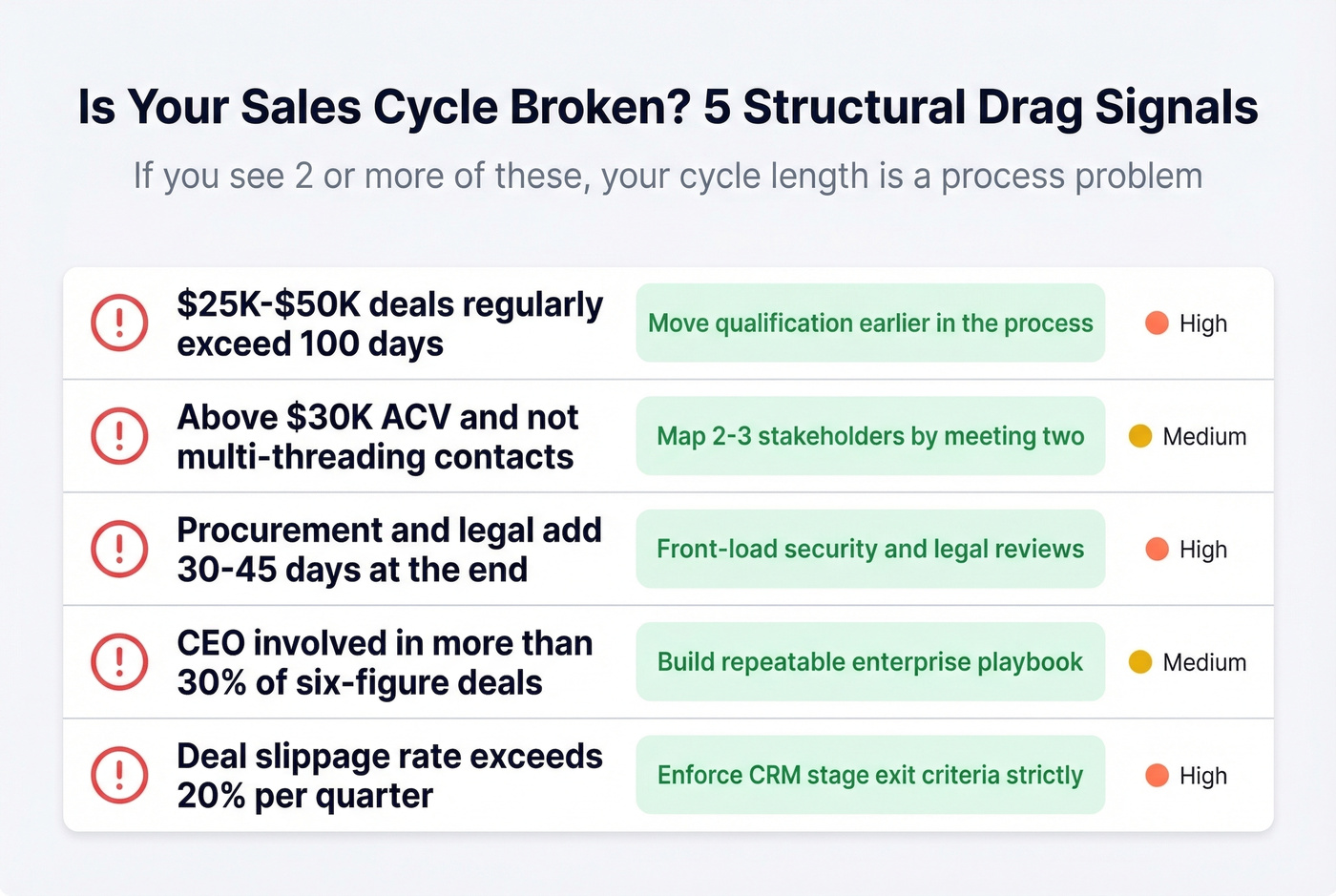
Deals in your $25K-$50K band regularly exceed 100 days. That's the drag threshold - investigate whether qualification is happening too late.
You're above $30K ACV and not multi-threading. At this price point, a second stakeholder almost always enters the deal. If you're single-threaded to a champion, you're one reorg away from a dead deal.
Procurement and legal add 30-45 days at the end. This is the most common - and most fixable - source of drag. Top-quartile teams front-load these reviews instead of treating them as a post-verbal-agreement surprise.
Your CEO is involved in more than 30% of six-figure deals. That's a founder-dependence signal. Your enterprise motion has a capacity ceiling, and it's one person's calendar.
Deal slippage rate exceeds 20%. If more than one in five forecasted deals push to the next quarter, your CRM stage exit criteria aren't enforced.
If you want to operationalize this, track pipeline health alongside cycle length.
Why Cycles Keep Getting Longer
Buying committees now average 25 people who touch the deal - up from 16 in 2017. That's not 25 decision-makers; it's 25 people who can say no, ask a question, or request another review. Each one adds friction. For SMB deals, you might face a single decision-maker. Enterprise deals routinely involve 8-12 stakeholders across procurement, legal, IT security, and the business unit.
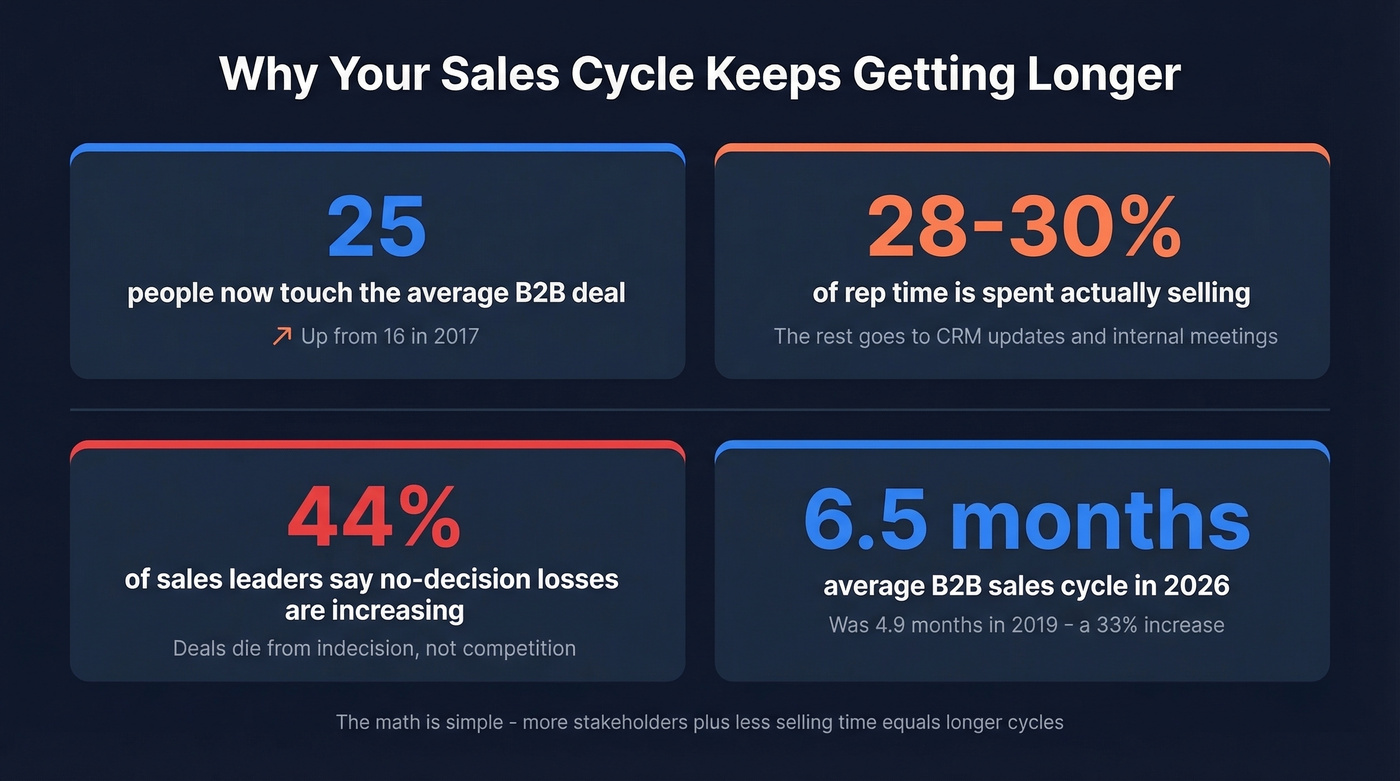
Reps spend only 28-30% of their time actually selling. The rest goes to CRM updates, internal meetings, and tool management. When your sellers have roughly 11-12 hours a week of actual selling time and each deal requires coordinating with a dozen buyer-side contacts, cycles stretch mathematically.
The no-decision problem is accelerating too. 44% of sales leaders report that opportunities lost to no decision have increased. Deals aren't just taking longer - they're more likely to die of indecision entirely. Seasonality and economic uncertainty compound the problem: budget freezes in Q4, reorgs in Q1, and summer slowdowns create dead zones that add weeks to any deal that touches them.
On r/agency, agency owners describe the shift viscerally: "More calls, more questions, more 'let me think about it.'" On r/SaaSMarketing, enterprise sellers report cycles stretching 12-28 months when deals start with mid-level users instead of economic buyers. The consensus across both threads: buyer skepticism - fueled by tighter budgets and bad past vendor experiences - is the root cause.
How to Shorten Your Sales Cycle
You can't control buying committee size or procurement timelines. But you can control where in the process you address them. Here are five tactics that compress timelines - backed by data showing sales automation tools shorten cycles up to 15% and digital sales rooms can cut them by up to 28%.
If you want a broader view of what "good" looks like across the funnel, see our B2B sales benchmarks.
Get the Economic Buyer in Early
This is the single highest-impact move you can make. As one enterprise seller on Reddit put it: stop staying "in the middle" with champions and users. By meeting two, ask explicitly: "Who else needs to be involved for us to move this forward?" Then get them on the next call.
The logic is simple. If the VP of Finance is going to kill the deal in month four, you want to know in week two. Early executive involvement doesn't just compress the timeline - it improves win rates because you're building the business case with the person who signs the check. We've seen teams cut 30+ days off their average cycle just by enforcing this one rule.
If you're struggling to identify who actually signs, this breakdown of the economic buyer helps.
Front-Load Procurement and Legal
For deals above $50K, procurement and legal reviews add 30-45 days. Most teams treat this as a sequential step after verbal agreement. Top-quartile teams run it in parallel - sharing security questionnaires, MSA redlines, and compliance documentation while the business case is still being built. This alone can shave a month off enterprise deals.
Qualify Ruthlessly
The fastest way to shorten your average cycle length is to stop working deals that won't close. Apply BANT or MEDDIC rigorously at stage three, and be willing to disqualify. A pipeline full of "maybes" is worse than a smaller pipeline of real opportunities - and it makes your cycle length metric meaningless.
Skip this advice if your pipeline is genuinely thin. Disqualifying aggressively only works when you have enough top-of-funnel volume to replace what you cut. If you don't, fix prospecting first.
Fix Your Contact Data
Look - bad emails and dead phone numbers silently destroy your prospecting stage. When 35% of your outbound emails bounce, you burn through that critical 14-day engagement window chasing invalid addresses instead of having conversations. One team, Meritt, saw their pipeline triple from $100K to $300K per week after fixing their bounce rate from 35% to under 4%. Prospeo's real-time email verification (98% accuracy, 7-day data refresh) is what we built specifically for this problem - so reps spend the engagement window selling, not troubleshooting deliverability.
If you're diagnosing this, start with email bounce rate benchmarks and fixes.
Use Mutual Close Plans
For deals above $100K, a mutual close plan is non-negotiable. Map every stakeholder, milestone, approval step, and deadline into a shared document. Include procurement timelines, security review windows, and budget approval dates. Top-quartile teams parallelize approvals - running legal, security, and finance reviews simultaneously rather than sequentially. In our experience, teams report cutting 40-60 days off enterprise cycles when they commit to this approach.
One caveat: If your ACV is under $25K, you probably don't need most of these tactics. A tight qualification bar and clean contact data will do more for your velocity than any enterprise sales methodology. Save the mutual close plans and multi-threading for deals where the complexity justifies the overhead.
Presenting to non-decision-makers silently adds weeks to every deal. Prospeo's 30+ search filters - including department headcount, job changes, and buyer intent across 15,000 topics - help you identify and reach the economic buyer by meeting two, not meeting six.
Get the right stakeholder's direct dial before your next proposal.
Sales Velocity: The Metric That Ties It Together
Every tactic above feeds into one formula that revenue leaders should track obsessively:
Sales Velocity = (Opportunities x Win Rate x Avg Deal Size) / Sales Cycle Length
Cycle length is the denominator. Shorten it, and every other variable gets amplified.
Say your team has 100 opportunities per quarter, a 25% win rate, and a $40K average deal size - with a 90-day cycle:
(100 x 0.25 x $40,000) / 90 = $11,111 in revenue per day
Shorten the cycle by 20% to 72 days:
(100 x 0.25 x $40,000) / 72 = $13,889 per day
That's a 25% increase in daily revenue velocity from cycle compression alone - no new pipeline, no higher win rate, no price increase. This is why cycle length is the most underrated lever in revenue operations. For context, healthy B2B benchmarks target 20-30% win rates, 3-4x pipeline coverage, and sub-20% deal slippage. If you're outside those ranges, fix the fundamentals before optimizing the cycle.
If you want to pressure-test your targets, compare against these sales pipeline benchmarks.
FAQ
What's a typical sales cycle length?
Most B2B companies close deals in 3-6 months. A $25K software deal averages roughly 38 days; a $100K+ enterprise deal averages 187 days. Retail cycles run about 70 days, while energy and non-profit sectors push past 155.
What are the 7 stages of a sales cycle?
Prospecting, Initial Contact, Qualification, Discovery, Proposal, Negotiation, and Close. The stages matter less than the exit criteria between them - each should have a documented threshold a deal must pass before advancing.
How do you calculate sales cycle length?
Count calendar days from first meaningful contact to closed-won, then average across all closed deals in the period. Exclude open opportunities - they skew the number downward and mask real performance.
Why is my sales cycle getting longer?
Buying committees have grown to 25 stakeholders per deal (up from 16 in 2017), procurement reviews add 30-45 days, and 44% of sales leaders report more deals lost to indecision. Budget scrutiny and buyer skepticism are the primary drivers across industries.
How does data quality affect the sales cycle?
Bad contact data extends the prospecting stage dramatically - when emails bounce and phone numbers are wrong, reps waste the critical 14-day engagement window on dead addresses instead of starting real conversations. Cleaning up your data is one of the fastest ways to compress the top of the funnel.