

What Are the Benefits of Intent Data? The Honest Guide for 2026
Only 5% of your total addressable market is actively buying right now. Intent data is how you find that 5% before your competitors do - and the B2B intent data space is projected at $4.5B in 2026, growing at nearly 16% annually. 40% of B2B companies now dedicate more than half their marketing budget to buyer-intent signals.
But here's the thing: up to 70% of the buyer journey happens in the dark funnel - content consumption, peer conversations, research your CRM never sees. So what are the benefits of intent data, and where does it actually fall short?
The Short Version
Intent data helps you find buyers who are actively in-market. The proven benefits: better lead prioritization, shorter sales cycles, higher outbound response rates. The catch? Account-level signals without verified contact data are an expensive guessing game. Start with first-party intent (it's free), layer third-party when you're ready, and always pair signals with verified decision-maker contacts.
Intent Data in 30 Seconds
There are three types of intent data, and most teams should use at least two.
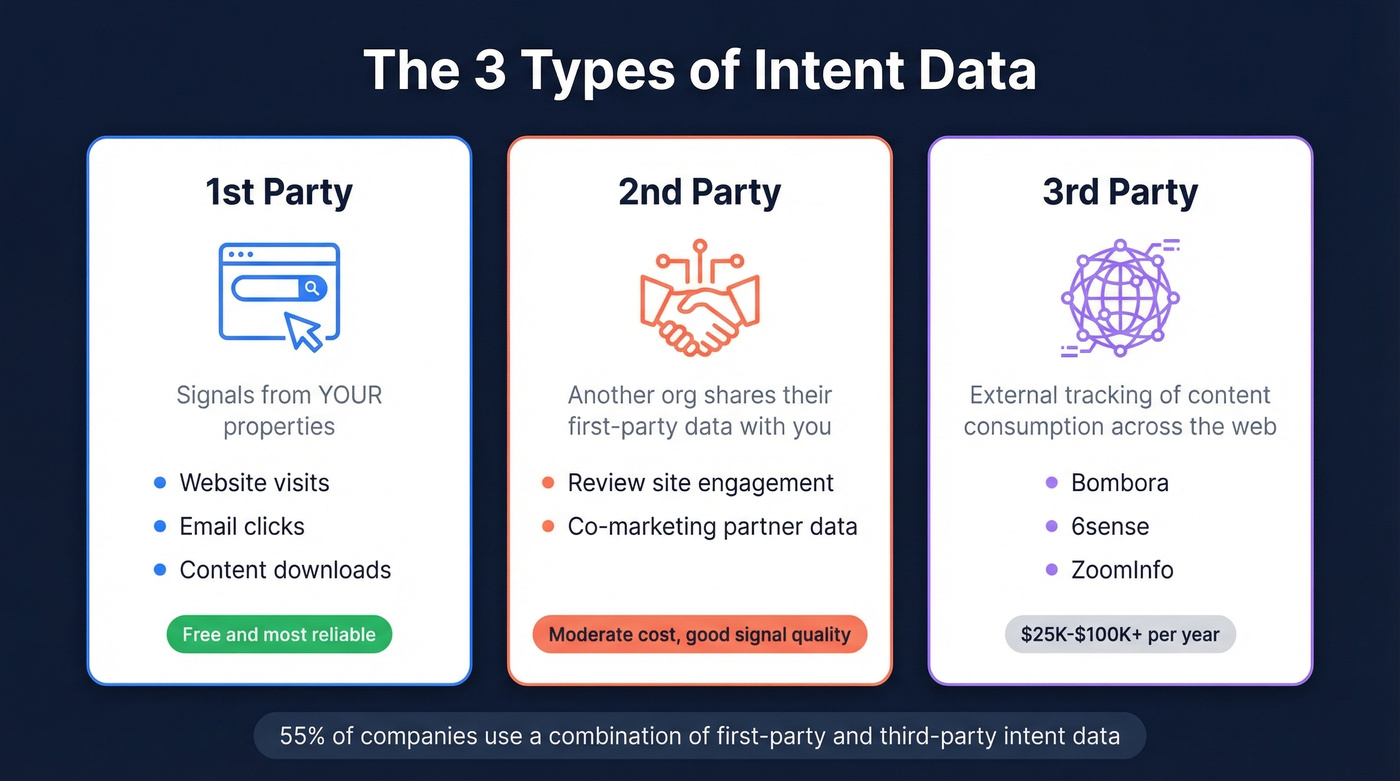
| Type | What It Is | Example |
|---|---|---|
| First-party | Signals from your own properties | Website visits, email clicks, content downloads |
| Second-party | Another org's first-party data, shared with you | Review site engagement, co-marketing partner data |
| Third-party | External tracking of content consumption across the web | Bombora, 6sense, ZoomInfo intent signals |
55% of companies use a combination of first- and third-party intent data, and most still rely mainly on first-party. That's the right instinct - your own data is the most reliable signal you have.
Seven Proven Benefits
1. Smarter lead prioritization. 85%+ of companies using buyer-intent signals report measurable business benefits, per Forrester. The biggest win isn't more leads - it's knowing which leads to work first. (If you need a practical model, start with a simple lead scoring framework.)
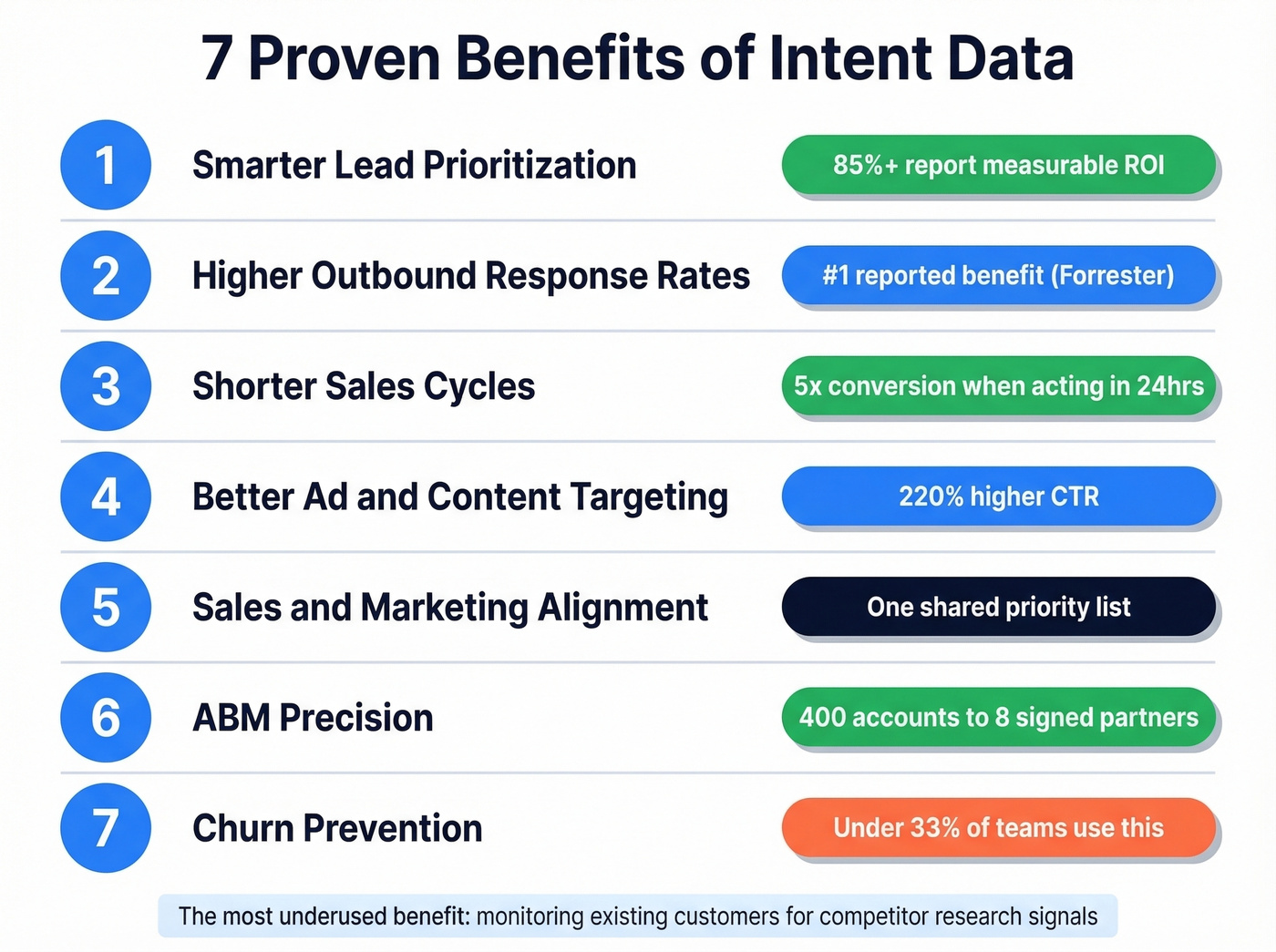
2. Higher outbound response rates. The most common benefit in that same survey: increased response rates from outbound marketing. When you reach out to someone already researching your category, you're arriving on time, not interrupting. That distinction changes everything about how prospects receive your message. (More tactics: sales prospecting techniques.)
3. Shorter sales cycles. Contacting leads within 24 hours of an intent signal increases conversion by 5x. Speed matters more than sophistication here. (Related benchmarks: sales pipeline benchmarks.)
4. Better ad and content targeting. Intent-based campaigns deliver 220% higher CTR compared to traditional targeting. You're reaching accounts actively consuming content in your category, not spraying ads at a TAM list. (If you're building the content engine behind this, see what is B2B content marketing.)
5. Sales and marketing alignment. When both teams work from the same signal source, they share a priority list instead of arguing about lead quality. One shared intent feed kills the "marketing sends us garbage" conversation. (This is also a RevOps problem - RevOps Manager teams usually own the workflow.)
6. ABM precision. NFON UK used intent data to identify 400 high-intent resellers in six months, signing 8 new channel partners. That's a massive TAM narrowed into a workable target list - exactly what in-market signals are supposed to do. (For the execution layer, use account-based selling best practices.)
7. Churn prevention - the benefit almost nobody uses. Most teams focus on acquisition. Fewer than 33% use intent for retention or expansion. That's a mistake. If your existing customers start researching competitor pricing pages or "alternatives to [your product]" topics, you want to know before the renewal conversation, not after. Early adopters here have a real edge in reducing churn because so few teams are watching for these signals at all. (To operationalize it, start with a basic churn analysis.)
What Can Go Wrong
The #1 complaint on Reddit? Intent alerts feel like ghost chasing. You reach out to a "high-intent" account and the contact has no idea what you're talking about - or they're already deep in a competitor deal.
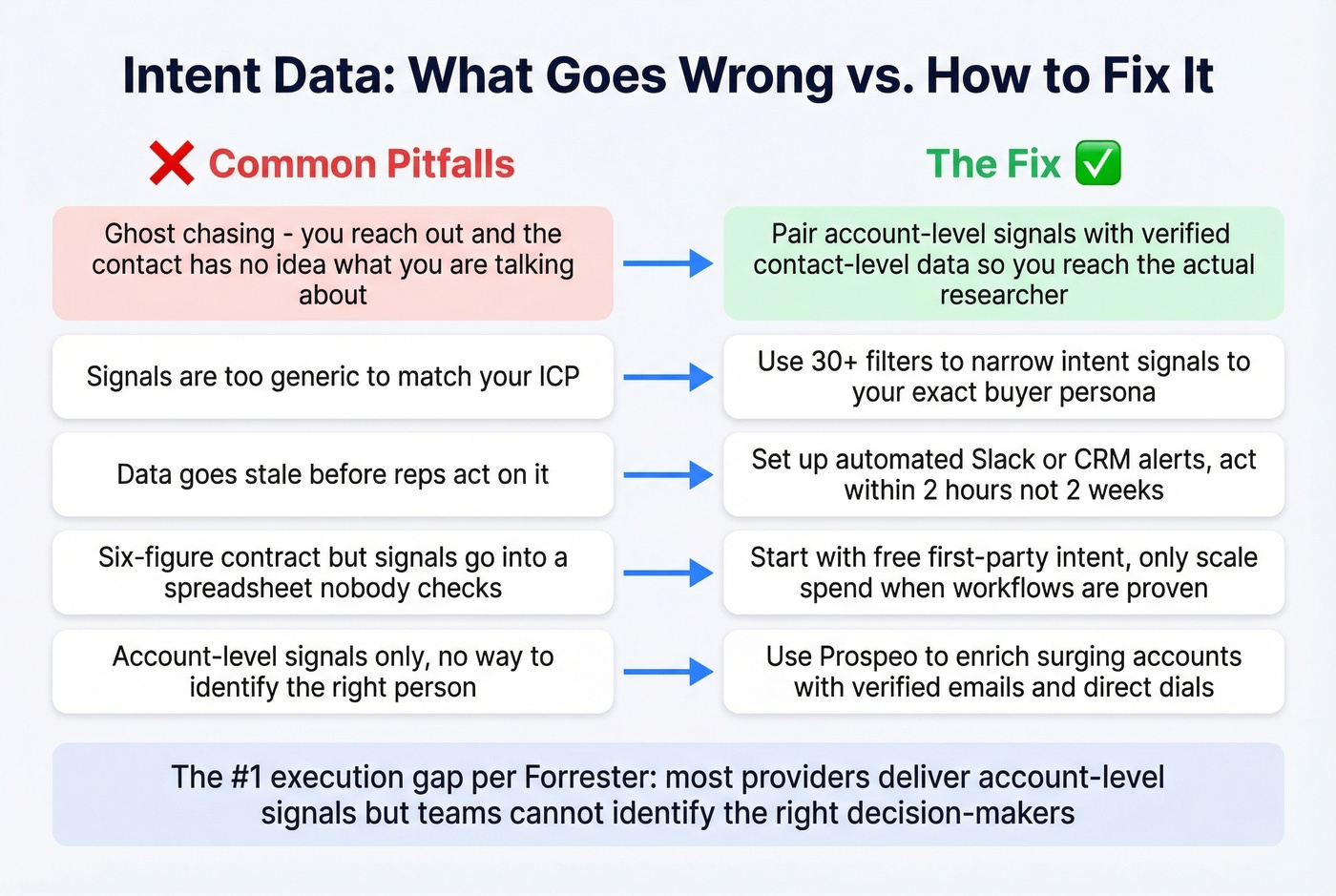
We've seen teams waste six figures on signals they couldn't operationalize because nobody built the workflow to act fast enough.
A meta-analysis of 1,100 community posts surfaced recurring themes: signals are too generic to match your ICP, data goes stale fast, and teams still need 3-4 tools for a full picture. Some practitioners bypass intent platforms entirely, relying on manual trigger events - new hires, funding rounds, job postings - as a lower-cost alternative. The core execution gap, confirmed by Forrester: most providers deliver account-level signals, but teams can't identify the right decision-makers at those accounts. Account-level intent alone isn't actionable.
How to Make Intent Data Work
Start with first-party intent. Your website visitors, email engagement, and content downloads are free, reliable, and already flowing through your stack. Build your intent muscle here before spending $25K+ on third-party data.
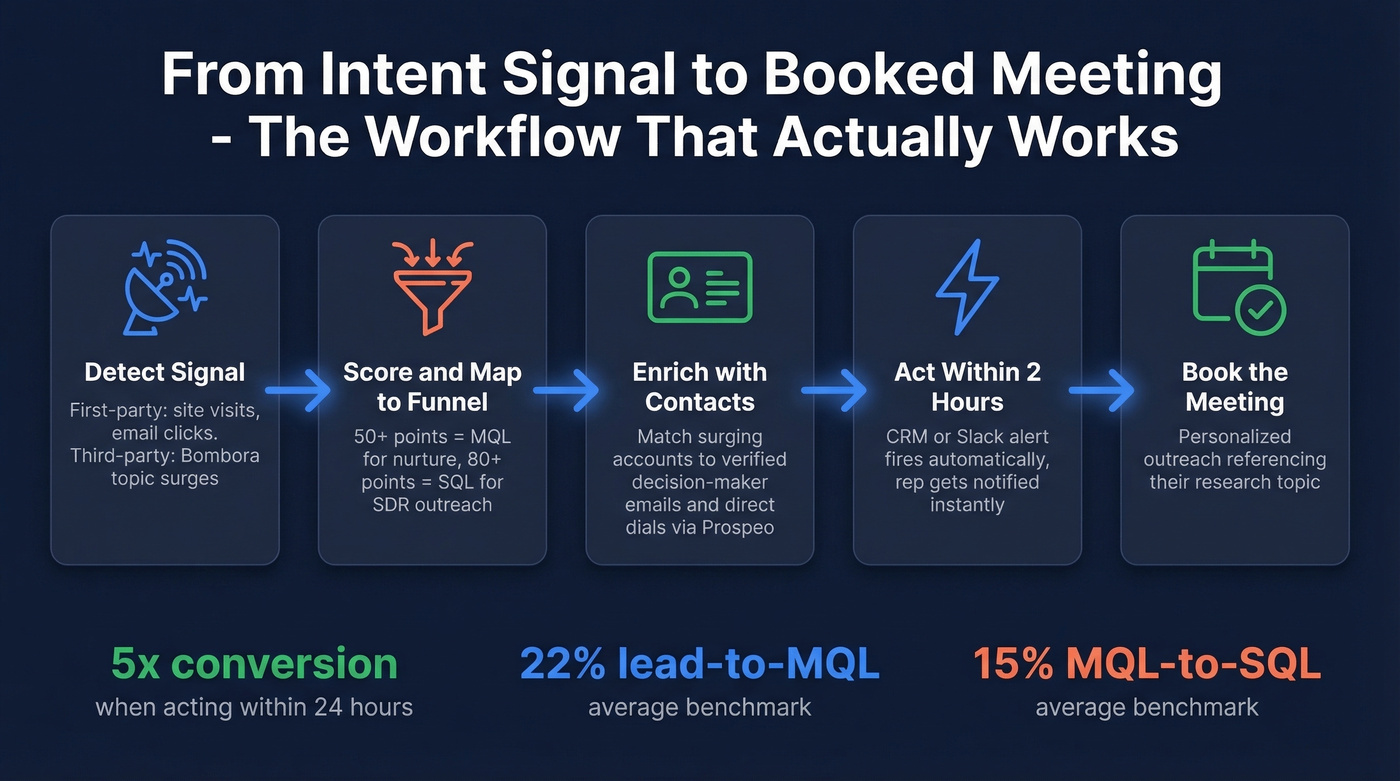
Map intent topics to funnel stage. Demandbase's framework gets this right: top-of-funnel intent triggers content and ads, mid-funnel intent triggers nurture sequences, bottom-of-funnel intent triggers SDR outreach. Don't send a BDR after someone reading a "what is" article. A simple scoring model: 50+ intent points = MQL for nurture, 80+ = SQL for SDR outreach. (If you want a full funnel view, use an AIDA sales funnel map.)
Act within 24 hours. In our experience, even 24 hours is generous - the best teams act within 2. Set up CRM or Slack alerts that fire when accounts cross your intent threshold. Average pipeline benchmarks to keep in mind: lead-to-MQL conversion sits around 22%, MQL-to-SQL around 15%. Intent signals can improve these numbers, but only if your workflow moves fast. (For workflow design, see lead generation workflow.)
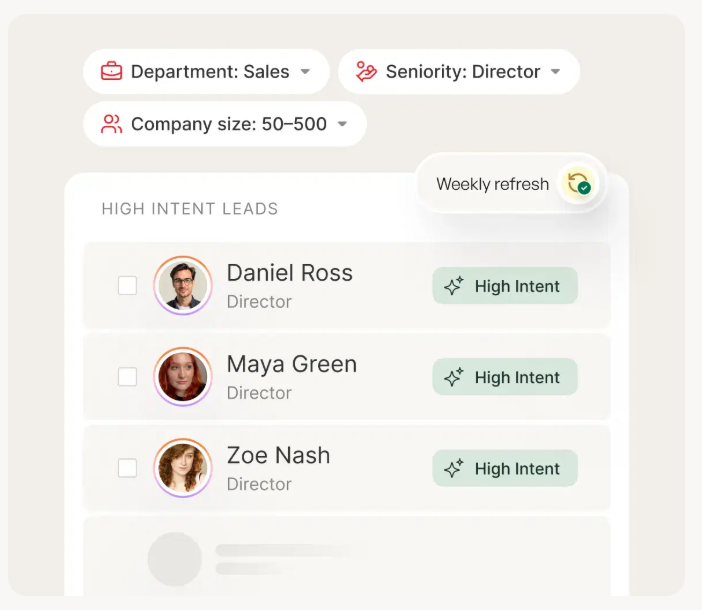
Bridge the contact gap. This is where most intent investments break down. You know Company X is surging on your topic - but who do you call? Prospeo tracks 15,000 intent topics via Bombora, and when an account surges, you get the right decision-maker's verified email and direct dial, not just a company name. With 98% email accuracy and data refreshed every 7 days, you're acting on current signals with current contacts. (If you're comparing vendors, start with data enrichment services.)
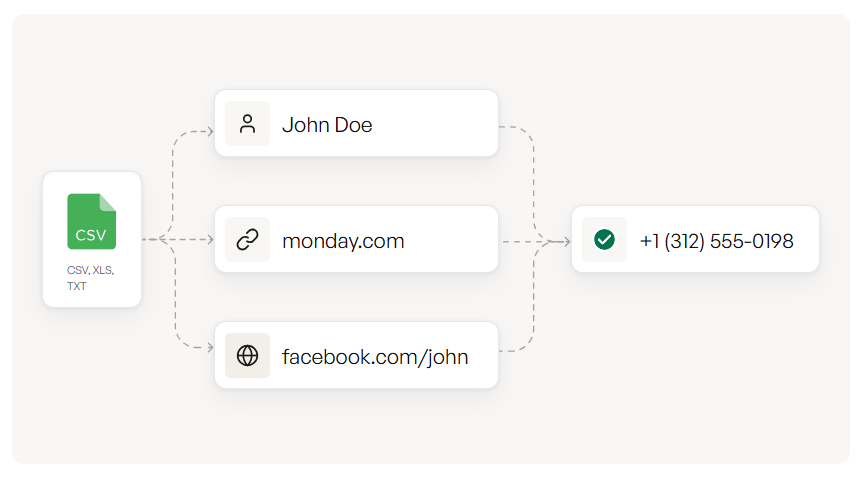

Account-level intent without verified contacts is an expensive guessing game. Prospeo bridges the gap - 15,000 Bombora intent topics paired with 98% accurate emails and 125M+ verified mobile numbers, refreshed every 7 days. When an account surges, you get the decision-maker, not just a company name.
Turn intent signals into booked meetings, not ghost chases.
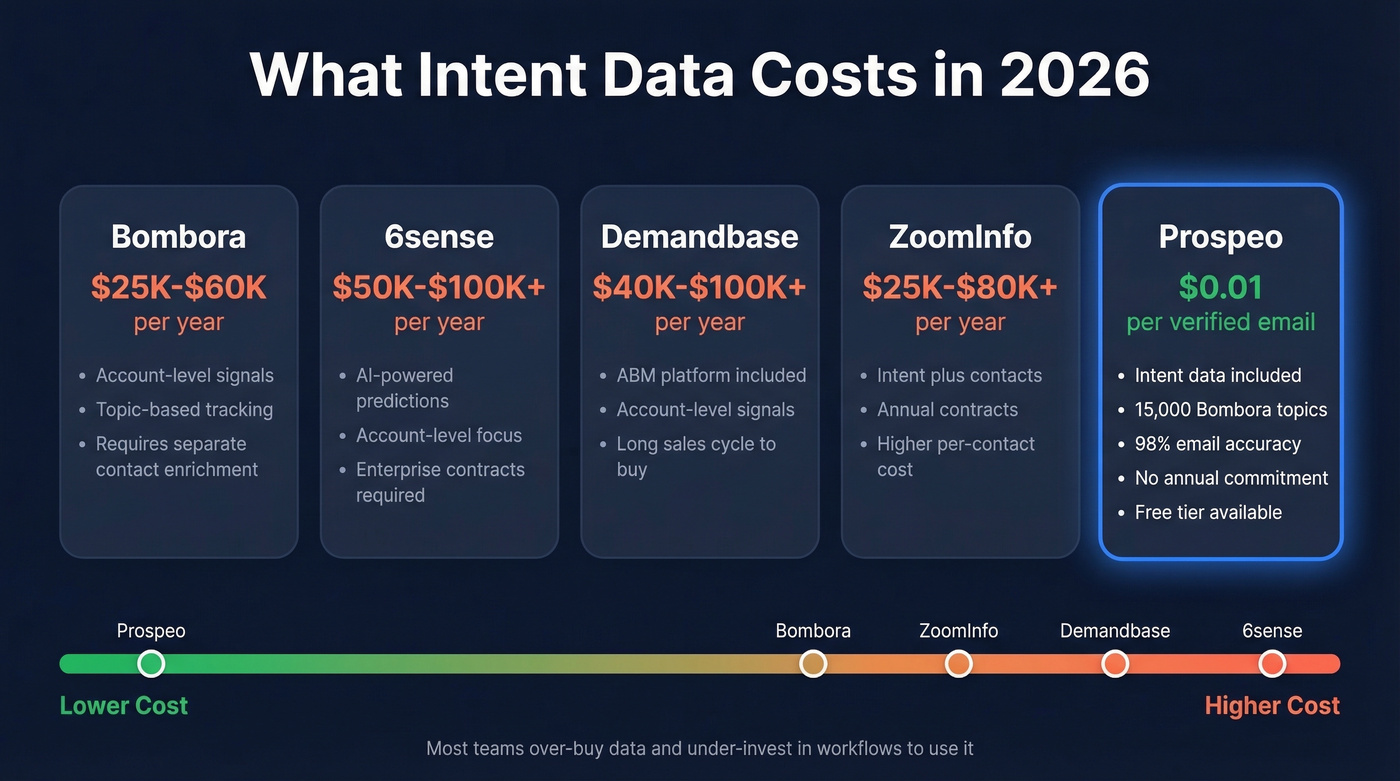
The #1 reason intent data fails: teams can't identify who to contact at surging accounts. Prospeo solves this at $0.01 per verified email - 90% cheaper than ZoomInfo - with 30+ filters to match intent signals to your exact ICP. No contracts, no sales calls, no stale data.
Act on buyer signals within hours, not weeks.
What Intent Data Costs
Major third-party providers - Bombora, 6sense, Demandbase, ZoomInfo - typically run $25K-$100K+/year depending on seat count and integration depth. Prospeo starts with a free tier and scales at roughly $0.01 per verified email, with intent data included and no annual commitment. For teams testing intent-driven outbound, that's a low-risk starting point.
Selling the Value Internally
One of the biggest barriers isn't the technology - it's getting buy-in from leadership. Let's be honest: "we identified 500 accounts showing intent" doesn't move a CFO. Pipeline velocity and conversion lift do.
Show a before-and-after: outbound response rates without intent signals versus with them, and tie the delta to revenue. That's the business case that gets budget approved. If you can show that intent-targeted outreach converts at even 2x the rate of cold outbound, the math sells itself.
Industry Trends for 2026
The market is maturing fast. Consolidation among providers, tighter integration with CRM and sales engagement platforms, and a shift from account-level to contact-level signal delivery are all accelerating. Teams that treated intent as a standalone dashboard in 2024 are now embedding signals directly into rep workflows - Slack alerts, CRM fields, sequencer triggers - so data drives action without requiring reps to log into yet another tool.
Privacy Considerations
Google decided not to deprecate third-party cookies in Chrome - the Privacy Sandbox is effectively dead. But that doesn't mean privacy rules stopped evolving. Enforcement in 2026 is shifting toward profiling, automated decision-making, inferred sensitive data, and youth privacy. Fourteen US states have data privacy regulations in place, and dozens more have legislation tabled.
For intent data buyers, the implication is clear: understand how your provider collects and models signals, or risk building on a foundation that regulators are actively scrutinizing.
Skip the Enterprise Stack If Your Deals Are Small
Look - if your average deal size is under $10K, you probably don't need a $50K intent platform. Start with first-party signals, layer in a self-serve tool for contact-level enrichment, and save the enterprise intent stack for when your deal sizes justify the spend. Most teams over-buy data and under-invest in the workflows to use it. We've watched companies sign six-figure intent contracts and then route the signals into a spreadsheet that nobody checks. Don't be that team.
FAQ
Is intent data worth the investment?
For most B2B teams, yes - 85%+ report measurable business benefits. ROI depends on pairing signals with verified contact data and acting within hours, not days. Without both, you're paying for a list of buildings, not buyers.
What's the difference between first-party and third-party intent?
First-party intent comes from your own properties - website visits, email clicks, content downloads. It's free and reliable. Third-party intent tracks content consumption across the web via providers like Bombora and typically costs $25K-$100K+/year.
How do I act on signals if I only get company-level data?
You need a contact-level enrichment source. Pair intent signals with a platform that can match surging accounts to verified decision-maker emails and direct dials - otherwise you're just staring at a list of company names with no way to reach anyone.
Can intent data help with customer retention?
Yes - and it's one of the most underused applications. Monitor whether existing customers are researching competitor categories or "alternatives to" topics. Fewer than 33% of teams use intent for retention, which means early movers here have a real advantage in reducing churn.
Intent data works when you pair signals with contacts and move fast. Everything else is noise.