

What Does a Business Development Representative Actually Do?
Your first Monday as a BDR, someone hands you a headset, a Salesforce login, and a list of 200 accounts you've never heard of. By Friday, you're expected to have booked three meetings. Nobody told you how to get from A to B.
So what does a business development representative do, exactly? There's a lot of vague advice floating around about BDR work. Let's make it concrete.
Quick Overview: The BDR Role
A business development representative fills the top of the sales funnel - finding, contacting, and qualifying potential buyers so account executives can close them.
- Median OTE: ~$85K (entry-level starts around $70K-$75K)
- Quota attainment reality: only about 55% of reps actually hit quota
- Promotion timeline: 15-16 months on average to move into an AE role
- The two skills that separate top BDRs: data quality discipline and AI fluency - activity volume matters, but working clean data and using automation is what compounds results
The Role Explained
A BDR is the outbound engine of a B2B sales team. Their job is to identify new business opportunities, initiate contact with potential buyers, qualify whether there's a real fit, and hand warm prospects to account executives who close the deal.
About 80% of BDR teams report into Sales rather than Marketing, and 85% focus primarily or exclusively on outbound activities. That means cold calls, cold emails, and social touches - not sitting around waiting for inbound leads to trickle in. While this guide focuses on tech and SaaS BDRs, the role exists across industries from finance to manufacturing, though comp and tools vary.
Here's a number that should get your attention: BDRs generate 46%-73% of total pipeline depending on deal size. In many organizations, the BDR team is literally responsible for the majority of revenue opportunities entering the funnel.
One wrinkle worth knowing: roughly 60% of companies use "SDR" and "BDR" interchangeably. The textbook distinction - BDR for outbound, SDR for inbound - exists, but in practice, read the job description, not the title. The actual responsibilities listed will tell you far more about the work than whatever acronym HR picked.
What Do BDRs Do Every Day?
Core Responsibilities
The day-to-day breaks down into five core activities, roughly in order of time spent:
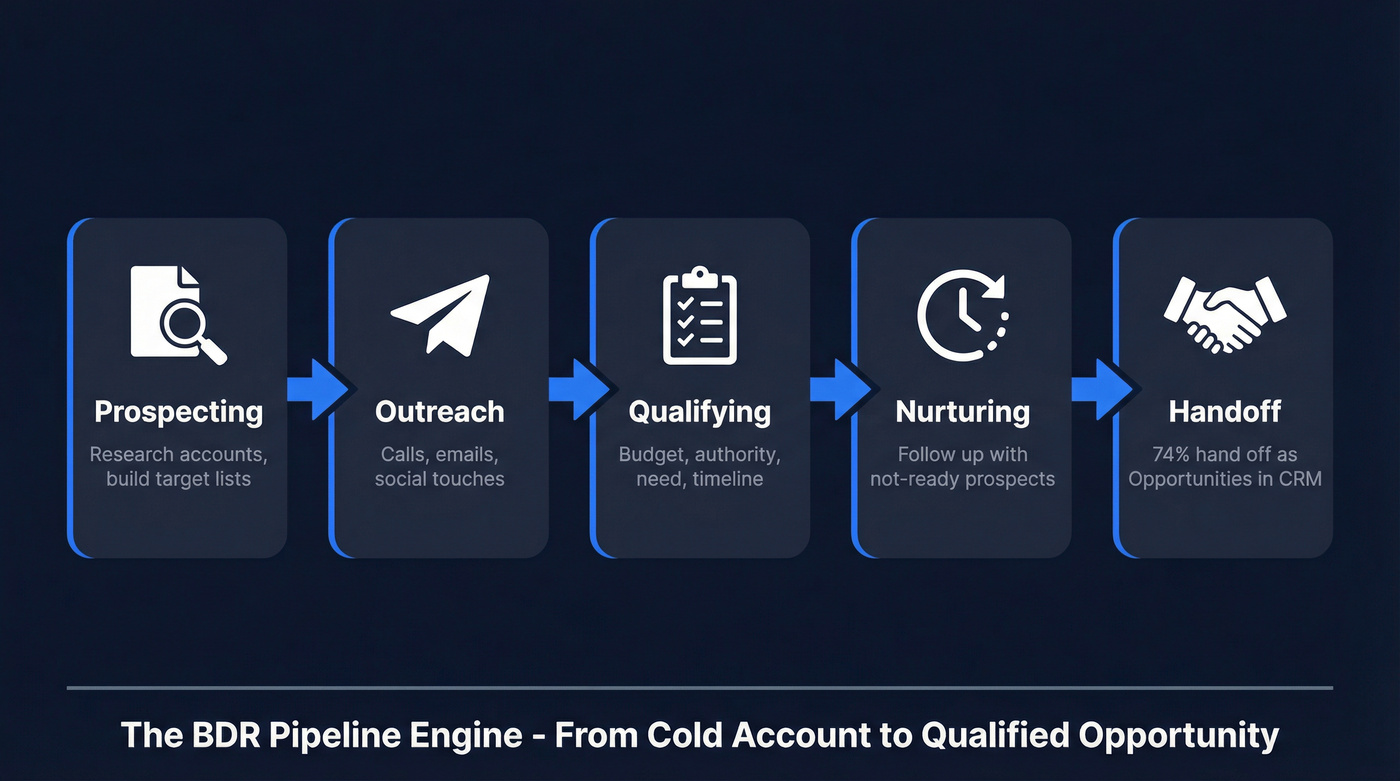
Prospecting - researching accounts, building target lists, identifying the right contacts within each company. This is where data quality makes or breaks you. (If you want a tighter system, start with proven sales prospecting techniques.)
Outreach - executing multi-channel sequences across phone, email, and social. The goal is booking a qualified meeting, not making a sale. (More on tooling in our guide to BDR software.)
Qualifying - asking the right questions to determine if a prospect has budget, authority, need, and timeline. Bad qualification wastes everyone's time, and AEs will let you know about it.
Nurturing - following up with prospects who aren't ready now but might be in 90 days. Most BDRs underinvest here. (Use a few battle-tested sales follow-up templates to stay consistent.)
Handoff - transferring qualified opportunities to AEs. About 74% of BDR teams hand off prospects as Opportunities in the CRM, not raw Leads. (If you need a clean process, see handoff email template examples.)
A Typical Day, Hour by Hour
8:00-10:00 AM - Morning call block. This is prime connect time. You're dialing through your prioritized list, aiming for 20-25 calls before the energy dips.
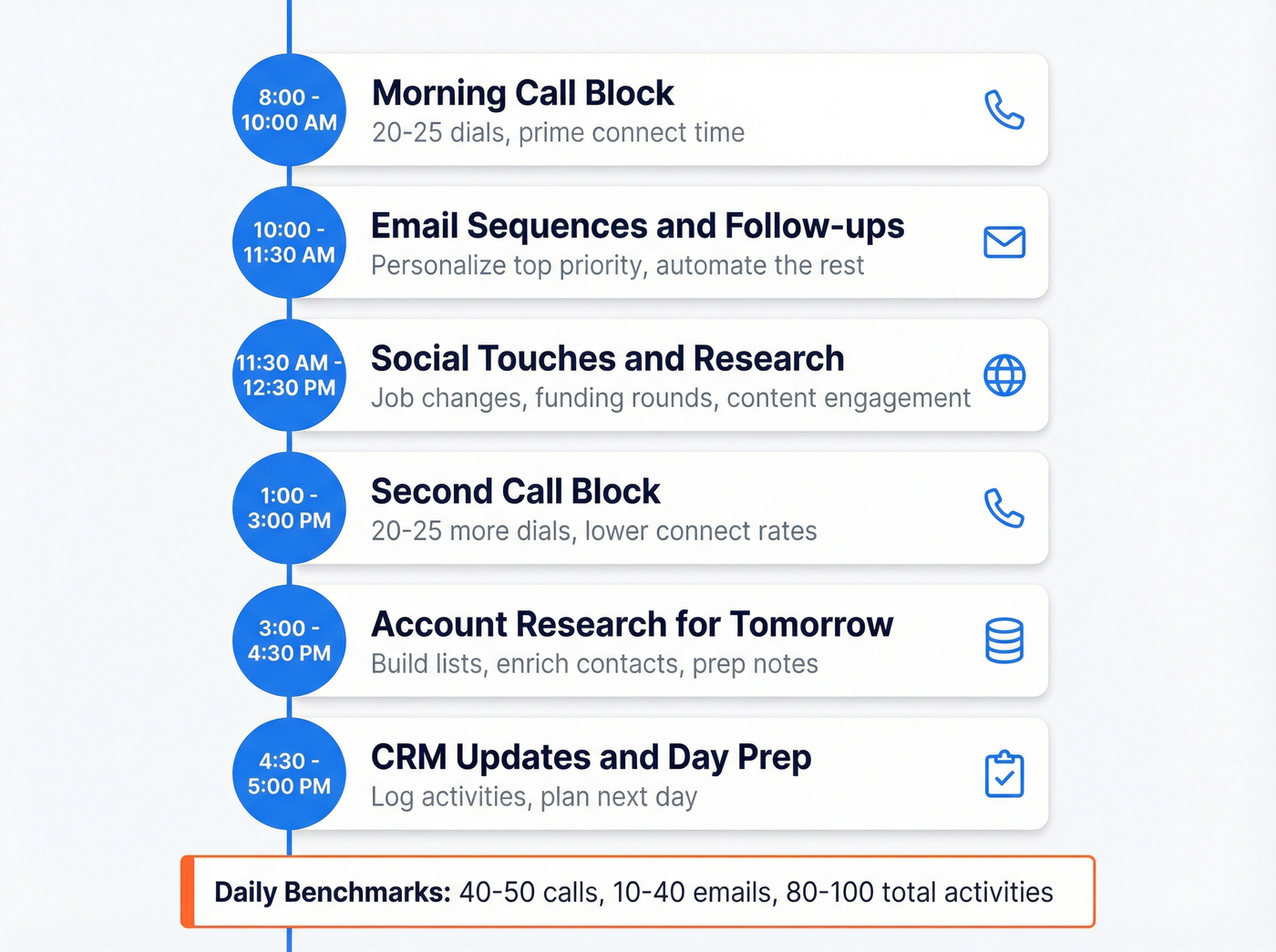
10:00-11:30 AM - Email sequences and follow-ups. Personalize the top-priority sends, let your sequencing tool handle the rest. (If you're stuck, borrow from these cold email follow-up templates.)
11:30 AM-12:30 PM - Social touches and research. Check who's engaging with content, who changed jobs, who just raised funding.
1:00-3:00 PM - Second call block. Another 20-25 dials. Afternoons tend to have lower connect rates, but you need the volume.
3:00-4:30 PM - Account research for tomorrow's outreach. Build lists, enrich contacts, prep personalization notes. (This is where data enrichment services can save hours.)
4:30-5:00 PM - CRM updates, logging activities, prepping for the next day.
The benchmark activity numbers: 40-50 calls per day, 10-40 emails, and 80-100 total activities. One poster on r/sales starting their first BDR role shared their quotas - 60 calls/day, 30 emails/day, and 30 social messages. That's aggressive, but not unusual.
What nobody tells you in the first week: three months in, you'll realize that the quality of your contact data matters more than your call volume. If 25-40% of your titles are outdated or wrong, you're burning hours dialing into dead ends.
BDR Performance Benchmarks in 2026
These are the benchmarks that separate "busy" from "productive."
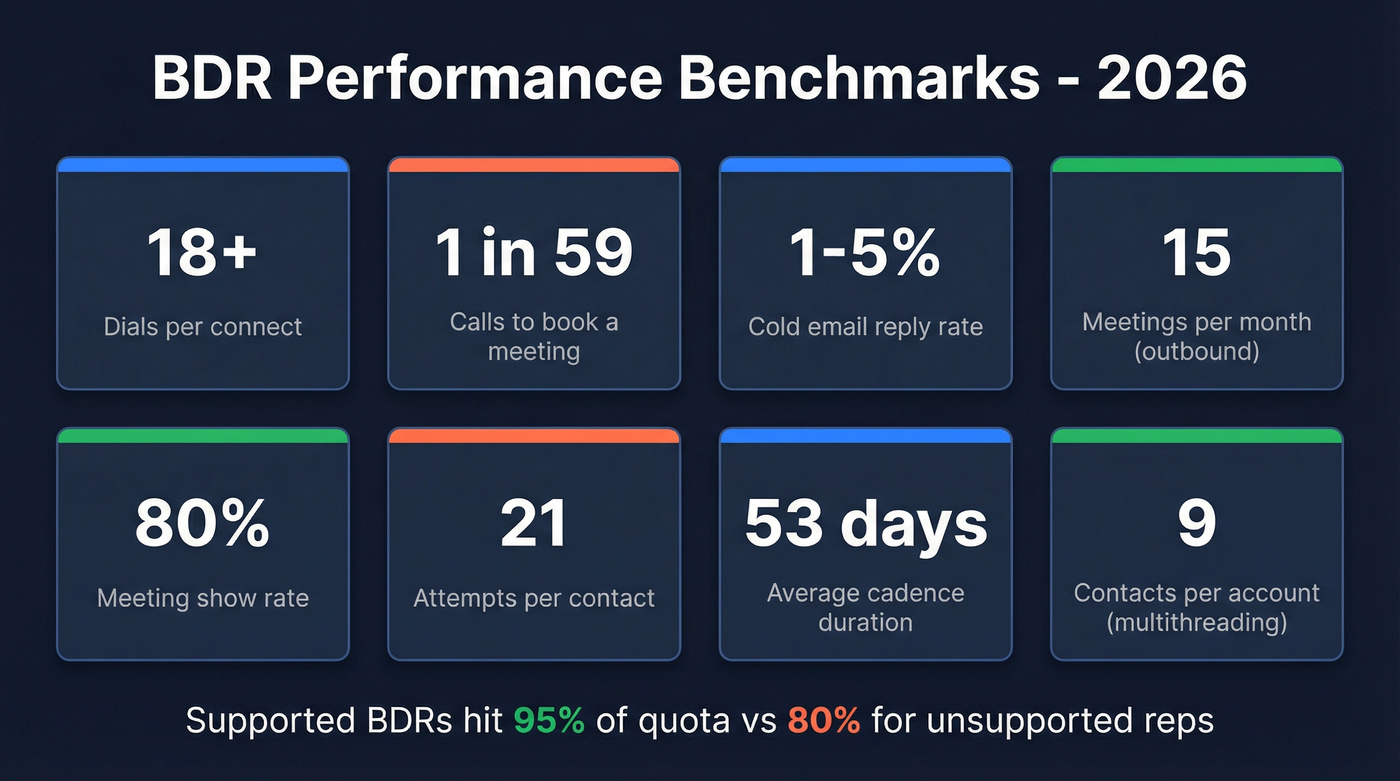
| Metric | Benchmark | Source |
|---|---|---|
| Calls to connect | 18+ dials | Gartner |
| Calls to meeting | 1 in 59 | Keller Center |
| Cold email reply | 1-5% | GMass |
| Meetings/month | ~15 (outbound) | Operatix |
| Show rate | 80% | Operatix |
| Attempts per contact | 21 | 6sense |
| Cadence duration | 53 days | 6sense |
| Contacts per account | 9 | 6sense |
| Avg quota attainment | ~88% | 6sense |
A few things jump out. First, 21 attempts per contact across roughly 8 calls, 8 emails, and 5 social touches. That's not "spray and pray" - that's a sustained, multi-channel cadence running 53 days before you move on.
Second, multithreading has become the norm. Ninety percent of BDR teams now contact multiple stakeholders per account, averaging 9 individuals - up from 6.4 the prior year. If you're only emailing one person per company, you're already behind.
Third, the math is brutal but honest. If it takes 59 calls to book one meeting and you need 15 meetings a month, you need roughly 885 calls per month, or about 44 calls every working day. That's why activity discipline isn't optional. (If you want a clearer view of what to track, use these sales activities examples.)
The 88% average quota attainment figure comes with a caveat: "supported" BDRs - those with proper enablement, tools, and coaching - hit 95% of quota versus 80% for unsupported reps. The tools and training your company provides aren't nice-to-haves. They're the difference between making your number and missing it.
BDR Salary and Compensation in 2026
The national average BDR base salary sits around $59,559. But base salary only tells half the story - OTE, your base plus commission when you hit quota, is what actually matters. (If you want the math, see OTE in sales.)
Median OTE runs about $85K. Entry-level BDRs with less than a year of experience typically land in the $70K-$75K OTE range with a 70/30 base-to-variable split. Mid-level reps with 1-3 years push $80K-$90K OTE at 65/35. Senior BDRs can clear $90K-$100K+ with a 60/40 split.
Compensation climbed 5-10% in 2025, and the healthy quota-to-OTE ratio is 4:1 to 6:1 - meaning if your OTE is $80K, your annual quota should be $320K-$480K in pipeline generated.
Salary by City
Geography still drives significant variance:
| City | Annual Salary |
|---|---|
| San Jose | $108,524 |
| San Francisco | $108,091 |
| Washington, DC | $96,070 |
| New York | $78,410 |
| Los Angeles | $74,050 |
| Seattle | $73,598 |
| Austin | $57,115 |
| Remote (avg) | $66,616 |
San Jose and San Francisco lead by a wide margin, though cost of living eats into that advantage. Remote roles averaging ~$67K represent a solid option for BDRs outside major hubs.
Evaluating a BDR Offer
When you're looking at an offer, three numbers matter more than the company's ping-pong table.
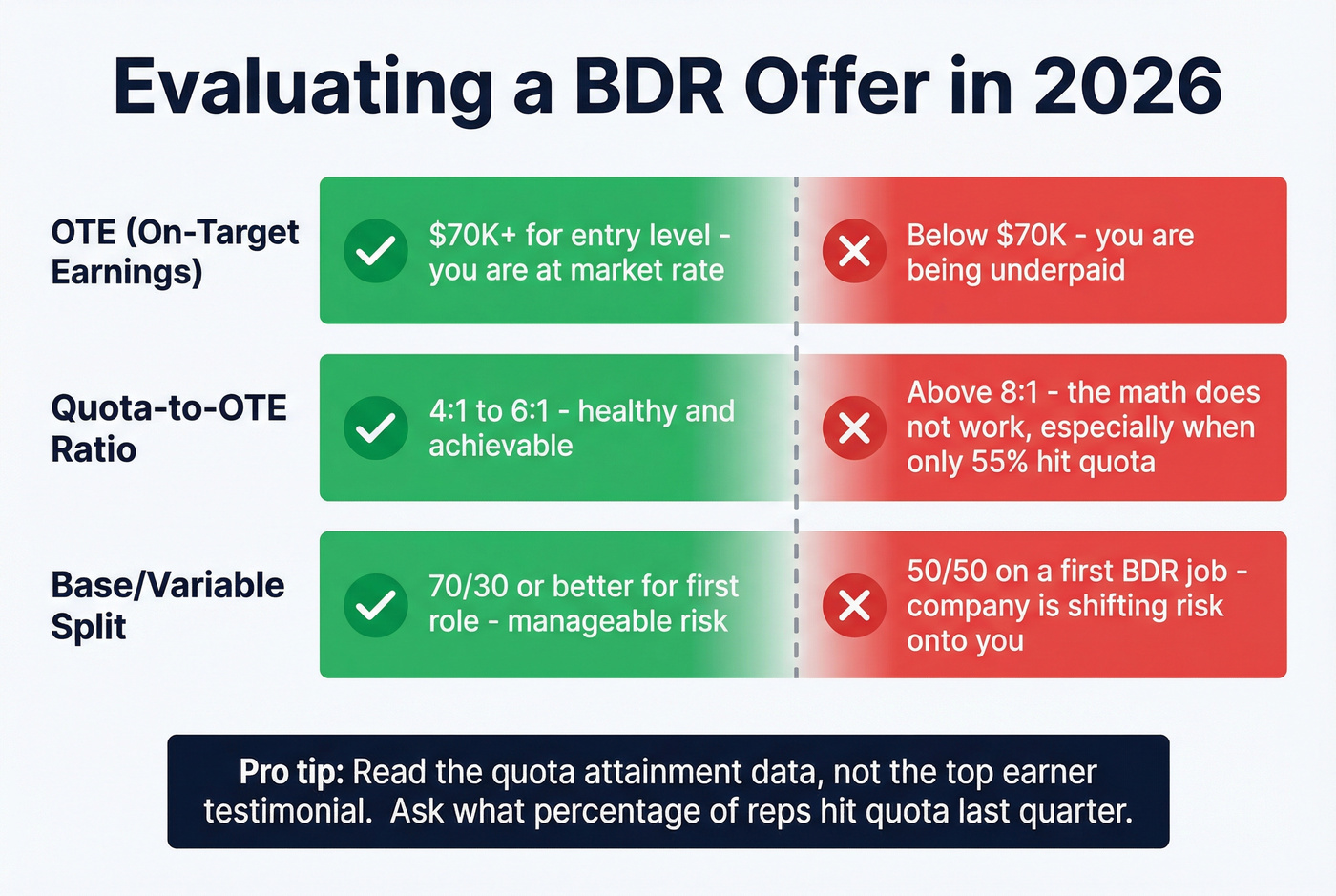
OTE should be $70K+ for entry-level in 2026. Below that, you're being underpaid relative to market.
Quota-to-OTE ratio of 4:1 to 6:1 is healthy. If they're asking you to generate $800K in pipeline on an $80K OTE, the math doesn't work - especially when only 55% of reps hit quota.
Base/variable split of 70/30 or better for your first role. A 50/50 split on a first BDR job is a red flag. It means the company is shifting risk onto the person least equipped to manage it.

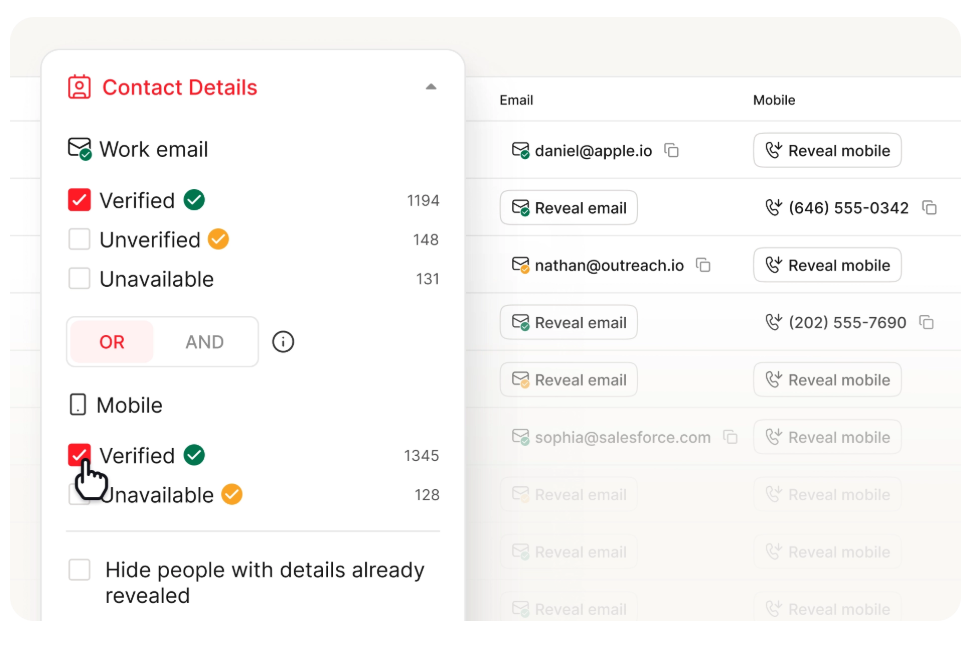
The article says it: 25-40% of contact data is outdated, and BDRs burn hours dialing dead ends. Prospeo refreshes every 7 days - not 6 weeks - so your call blocks actually connect. 300M+ profiles, 98% email accuracy, 125M+ verified mobiles with a 30% pickup rate.
Stop burning your morning call block on bad numbers.
The BDR Tech Stack
Your stack determines your ceiling. Here's what you actually need versus what's optional.
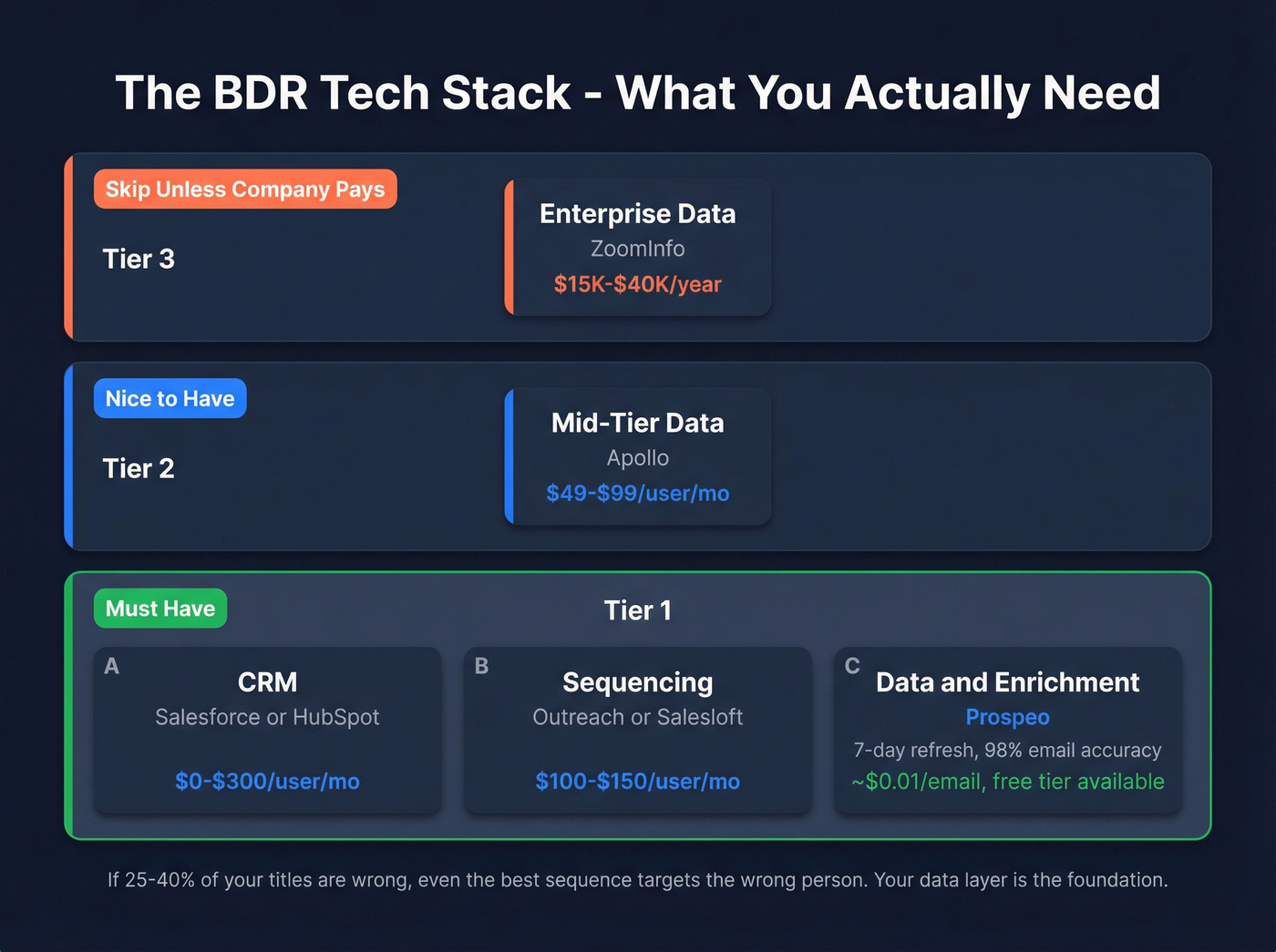
Must-have: CRM. Salesforce ($25-$300/user/mo) or HubSpot ($40-$1,200/mo). This is non-negotiable - if you're not logging activities, you don't exist to your manager. (If you need context on options, see examples of a CRM.)
Must-have: Sequencing tool. Outreach or Salesloft, typically $100-$150/user/mo. These automate your multi-step cadences so you're not manually sending every email.
Must-have: Data and enrichment. This is where most BDRs either thrive or waste hours. When 25-40% of job titles in your database are outdated or wrong, even the best sequence is targeting the wrong person. We've seen teams cut bounce rates from 35%+ down to under 4% just by switching to a provider with a faster refresh cycle. Prospeo runs a 7-day data refresh across 300M+ professional profiles with 98% email accuracy and 125M+ verified mobile numbers - the industry average refresh is 6 weeks, which is an eternity in B2B data. The free tier gives you 75 verified emails and 100 Chrome extension credits per month, enough for a new BDR to test whether cleaner data actually moves their numbers. (If you're comparing sources, start with best sales prospecting databases.)

Skip unless your company pays: ZoomInfo. At $15K-$40K/year, it's enterprise-grade pricing that most BDR teams don't need. The database is deep, but you're paying for intent data, chat widgets, and workflow features that a BDR will never touch.
One modern stack worth noting: Aleph runs Amplemarket + Clay + HubSpot and targets 6 qualified opportunities per month per rep. You don't need a $40K data contract to build pipeline.
| Tool Category | Example | Approx. Cost |
|---|---|---|
| CRM | Salesforce / HubSpot | $0-$300/user/mo |
| Sequencing | Outreach / Salesloft | $100-$150/user/mo |
| Data & Enrichment | Prospeo | ~$0.01/email, free tier |
| Data (enterprise) | ZoomInfo | $15K-$40K/year |
| Data (mid-tier) | Apollo | $49-$99/user/mo |
Here's the thing: if it takes 18+ dials to get a connect with good data, imagine what happens with bad data. The math becomes impossible. Your data provider is the foundation everything else sits on.
How AI Is Changing the Role
Sixty percent of BDRs are already using AI tools, and 62% say it enhances their productivity. But here's the contrarian take: AI isn't replacing BDRs. It's replacing the worst parts of the job.
Sellers currently spend only about 25% of their time actually selling. The rest is research, admin, CRM updates, and list building. AI can double that to 50%+ by offloading the grunt work - traditional BDRs burn 10-14 hours per week on manual research alone, and AI tools compress that to under an hour.
The results back this up. One team saw 40%+ conversion improvements when BDRs focused exclusively on accounts surfaced by AI signals. Prioritization, not automation, drove the lift. Across the board, teams are seeing 30%+ improvement in win rates when AI compounds small gains across each funnel step.
The failure mode is real too. One company's AI outbound system accidentally cold-emailed existing customers with generic prospecting messages - that's the context failure risk. AI doesn't know what it doesn't know. As GovWell CEO Troy LeCaire put it: "The point of BDR work is the people."
The emerging model is the BDR as "broadcaster." AI handles the preparation layer - research, enrichment, signal detection, ICP matching. The human handles the how: tone, timing, objection handling, relationship building. In our experience, the BDRs who lean into AI for prep work and double down on conversation quality are the ones pulling ahead. (For a practical playbook, see AI cold email outreach.)
The 58% of BDR teams that expanded over the past year tells you something important: companies aren't cutting BDR headcount because of AI. They're expanding it and expecting each rep to be more productive with better tools.
Our hot take: if your average deal size is under $10K, you probably don't need ZoomInfo-level data or a 12-tool stack. A CRM, a sequencer, a solid data provider, and disciplined execution will outperform a bloated tech stack every time. Most BDR teams are over-tooled and under-coached.
Multithreading 9 contacts per account means you need clean, verified data at scale - fast. Prospeo gives BDRs 30+ filters to build targeted lists, enriches contacts with 50+ data points, and costs roughly $0.01 per email. No contracts, no sales calls required.
Build tomorrow's outreach list in minutes, not hours.
BDR vs SDR vs AE
These titles cause more confusion than they should. Understanding what a business development representative does versus an SDR or AE comes down to funnel ownership.
| BDR | SDR | AE | |
|---|---|---|---|
| Focus | Outbound prospecting | Inbound qualification | Closing deals |
| Funnel stage | Top | Top | Mid-to-bottom |
| Comp range (OTE) | $70K-$100K | $55K-$85K | $100K-$200K+ |
| Key metric | Meetings booked | Leads qualified | Revenue closed |
In practice, 60% of companies use SDR and BDR interchangeably. The "BDR = outbound, SDR = inbound" framework is the textbook distinction, but your actual job will be defined by the responsibilities listed in the posting, not the title on your offer letter.
The real career distinction is between top-of-funnel roles and the closing role. That's the promotion you're working toward.
Career Path: Where BDRs Go Next
The most common path is BDR to AE, and the average promotion timeline sits at 15-16 months. That's up roughly 28% from pre-pandemic norms, when 12 months was standard. Companies are being more cautious about promoting reps who haven't proven sustained quota attainment.
Beyond AE, the branches include senior BDR or team lead, sales enablement, sales operations, and frontline management. Strong BDRs also move into RevOps roles where their understanding of outbound workflows and data quality becomes a strategic advantage.
The 55% quota attainment stat cuts both ways. If you're consistently in the top half, you'll move fast - hiring managers prioritize BDRs who've demonstrated they can hit a number. Two quarters in the bottom half, and the conversation shifts from "when do you get promoted" to "is this the right fit."
Demand looks healthy. Fifty-eight percent of BDR teams expanded over the past year, and the BLS projects about 142,100 sales openings per year across the broader sales category, mostly replacement-driven.
What Hiring Managers Actually Look For
After talking to dozens of sales leaders, we've found the pattern is clear. They care about three things: coachability, activity consistency, and curiosity about the prospect's business. Nobody expects a new BDR to close deals. They expect you to show up prepared, take feedback without ego, and maintain volume when motivation dips.
If you can articulate how you'd research an account and why you'd prioritize it over another, you'll outperform 80% of candidates who just talk about being "competitive" and "hungry."
Mistakes That Kill BDR Performance
Knowing what a business development representative does is one thing. Executing well is another. Here are the pitfalls that derail even motivated reps.
Spraying without targeting. Blasting 100 accounts that don't match your ICP is worse than working 30 that do. The average BDR conversion rate hovers around 10% - bad targeting pushes that toward zero.
Generic messaging. "I noticed your company is growing" isn't personalization. Reference a specific trigger - a funding round, a job posting, a tech stack change. The consensus on r/sales is that even 30 seconds of real research per prospect beats a templated "personalization" token every time. (If you want to improve opens, steal from these email subject line examples.)
Ignoring data quality. When 25-40% of titles in your database are outdated, you're burning a quarter of your activity on ghosts. Fix the data before you fix the messaging.
Weak follow-up cadence. Most BDRs give up after 3-5 touches. The benchmark is 21 attempts per contact over 53 days. Persistence isn't annoying - it's the job.
Not tracking what works. If you don't know your connect rate by time of day, your reply rate by subject line, or your show rate by meeting type, you're guessing instead of optimizing. I've watched reps double their booking rate in a single quarter just by analyzing which email subject lines actually got replies and which call windows produced conversations.
FAQ
Is BDR a good first job in tech sales?
Yes - it's the most common entry point into B2B sales, requiring no prior experience. Median OTE of $85K is strong for entry-level, with a clear promotion path to AE in 15-16 months. The tradeoff: high rejection volume, daily quota pressure, and a steep learning curve in the first 90 days.
How do BDR duties differ from an account executive's?
BDRs focus exclusively on the top of the funnel - prospecting, outreach, and qualifying leads. Account executives take over once a prospect is qualified and work to close the deal. BDR metrics center on meetings booked and pipeline generated, while AEs own revenue targets.
How long before a BDR gets promoted?
Fifteen to sixteen months on average. Top performers who consistently exceed quota can move faster, sometimes in under a year. The timeline has increased roughly 28% since pre-pandemic norms as companies raise the bar for AE readiness.
Are AI tools replacing BDRs?
No. Sixty percent of BDRs use AI tools, but primarily for research, enrichment, and admin - not relationship-building. AI eliminates manual grunt work, not the role itself. Fifty-eight percent of BDR teams actually expanded in the past year.
What tools should a new BDR learn first?
Master your CRM (Salesforce or HubSpot), your sequencing tool (Outreach or Salesloft), and a reliable data provider with verified contacts. Those three cover 90% of your daily workflow. Everything else is secondary until you've nailed the fundamentals.