

What Should Go in the Subject Line of an Email? Here's What 5.5 Million Emails Say
You've written the entire email. The body's tight, the CTA's clear, and you're ready to hit send. Then you stare at the subject line field for ten minutes. That blinking cursor is where most emails go to die - not because the message is bad, but because the envelope is wrong.
So what should go in the subject line of an email? Not what most people think. A study of 5.5 million emails by Belkins has a clear answer.
The Five Rules (Quick Version)
If you're in a rush:
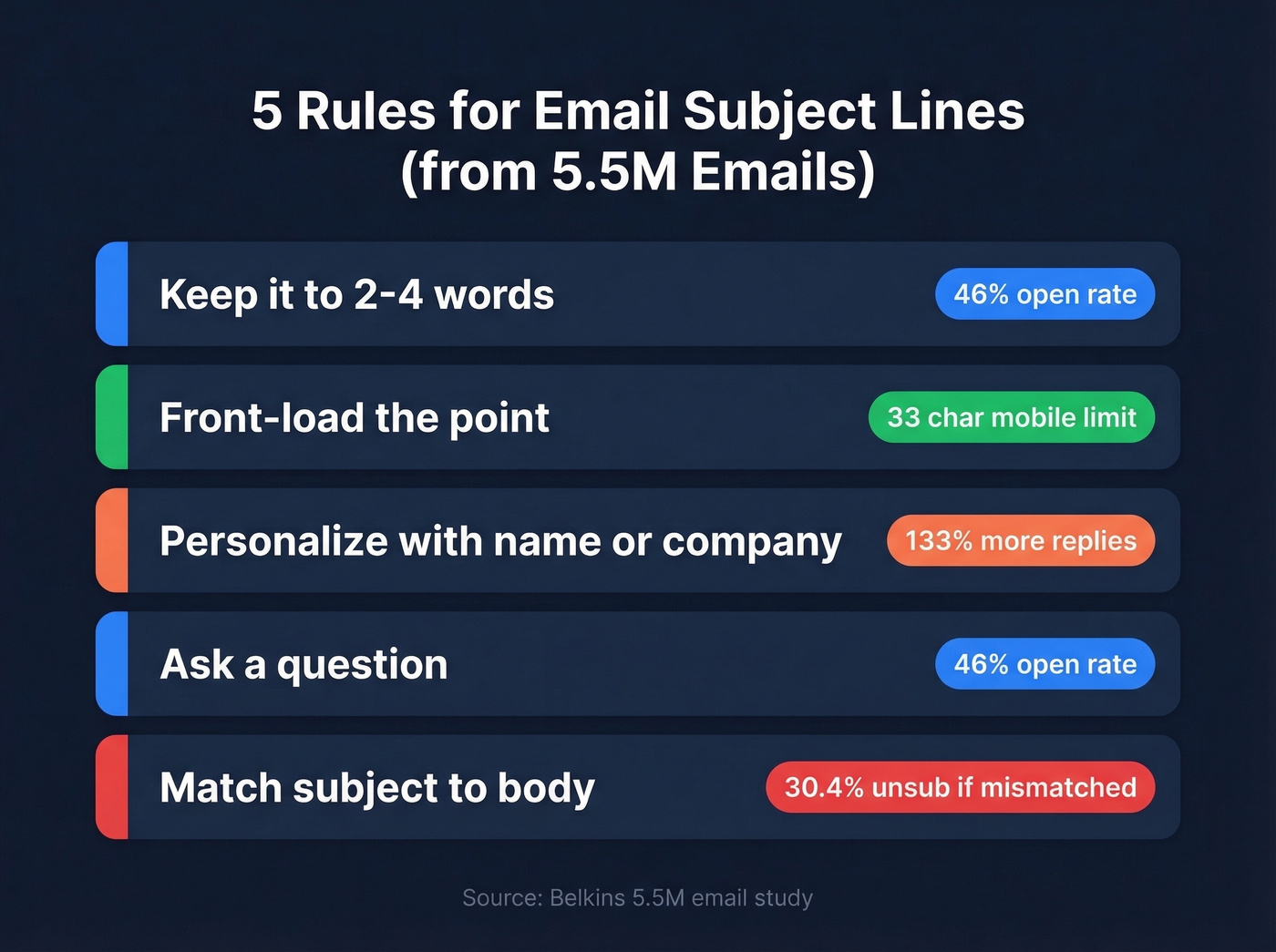
- Keep it to 2-4 words. That length hit a 46% open rate - the highest in the dataset.
- Front-load the point. Many mobile clients cut off around 33 characters. Put the important stuff first.
- Personalize with a name or company. Personalized subject lines pulled 46% opens vs. 35% without - a 31% lift.
- Ask a question. Question-based subject lines averaged 46% opens, the top-performing format.
- Match the subject to the body. Misalignment drives unsubscribes - Gartner pegs that rate at 30.4% when expectations don't match.
Five Data-Backed Subject Line Rules
Rule 1: Keep It to 2-6 Words
The 5.5M-email dataset is unambiguous. Subject lines of 2-4 words produced a 46% open rate - the sweet spot. Performance drops steadily after that: 9 words hit ~35%, 10 words ~34%. Anything under 6 words still outperforms longer alternatives, but 2-4 is the peak.
Every guide says "keep it short," then shows you a 12-word example. That's not short. Four words is short.
One more myth to kill: numbers in subject lines slightly underperformed in the dataset - 27% opens with numbers vs. 28% without. All those "use numbers!" tips? Overblown.
If you want more swipeable options, see these subject line examples and these cold email subject line examples.
Rule 2: Front-Load the Point
Mobile truncation is brutal. On a Gmail Android app, you get 33 characters before the cutoff. That's roughly five or six words. If your key message sits at the end of a long subject line, most of your audience never sees it. Lead with the verb or the value - every time.
If you're optimizing for deliverability too, it helps to understand email velocity and how it impacts inbox placement.
Rule 3: Personalize With Name or Company
This isn't just an open-rate play. Personalized subject lines drove a 7% reply rate vs. 3% without - a 133% increase. Even something as simple as "[First Name], quick question" outperforms generic alternatives. The lift is real, it's consistent, and it compounds when you're sending hundreds of emails a week.
For a deeper playbook, use these personalized drip campaigns and personalized outreach tactics.
Rule 4: Ask a Question
Question-based subject lines averaged 46% opens, tying with short-length subjects for the top spot. Questions create an open loop the reader wants to close. "Still using last year's playbook?" beats "New playbook available" every time.
Rule 5: Match Subject to Body
Here's the thing: a clever subject line that doesn't match the email body is worse than a boring one that does. Readers who feel misled don't just ignore you - they unsubscribe or mark you as spam. That 30.4% unsubscribe rate on misaligned emails isn't a rounding error. It's a trust problem that follows your domain around for months.
If you're building multi-touch outreach, align the whole B2B cold email sequence, not just the first subject line.
Character Limits by Device
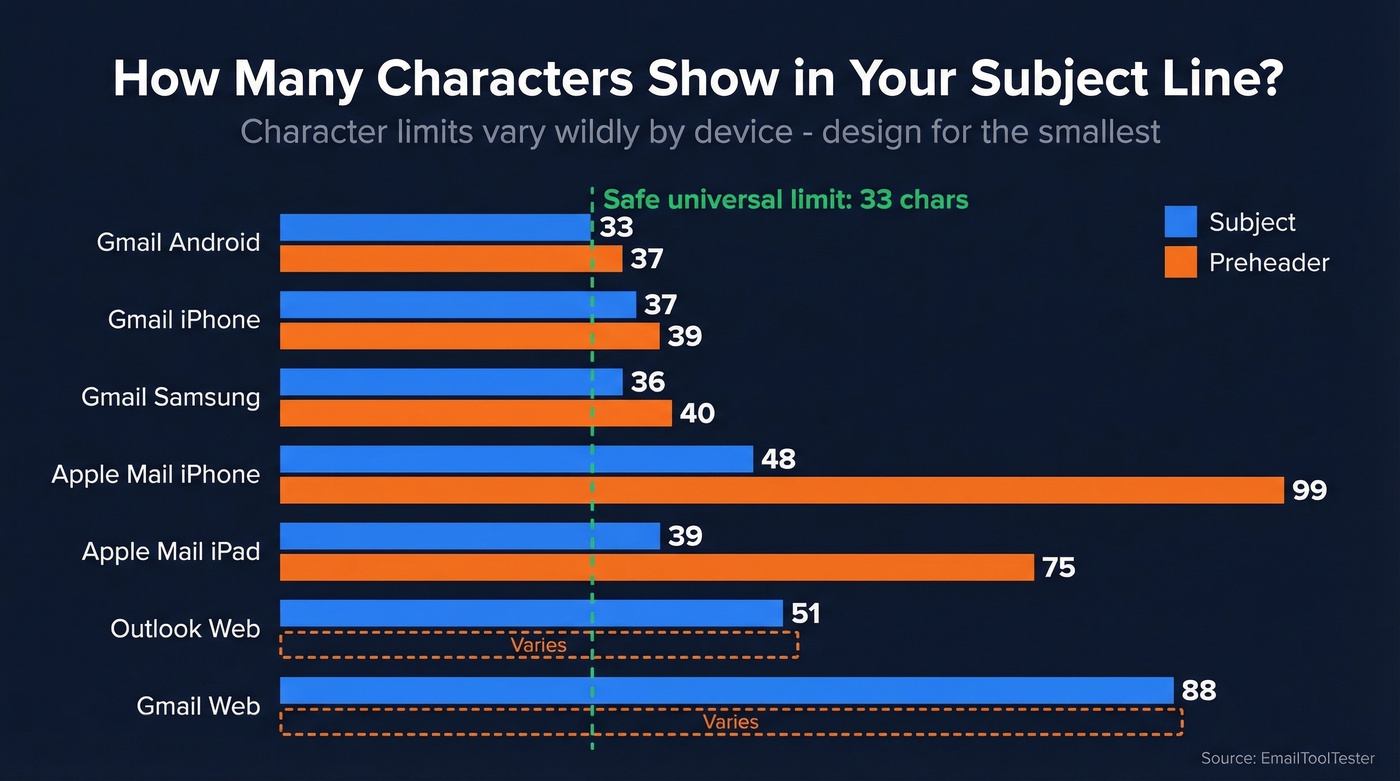
Not all inboxes are created equal. EmailToolTester ran device-by-device tests, and the differences are significant. Character width matters too - an "M" eats more space than an "i" - but these numbers give you a reliable planning baseline.
| Device / Client | Subject Chars | Preheader Chars |
|---|---|---|
| Gmail (Android) | 33 | 37 |
| Gmail (iPhone) | 37 | 39 |
| Gmail (Samsung) | 36 | 40 |
| Apple Mail (iPhone) | 48 | 99 |
| Apple Mail (iPad) | 39 | 75 |
| Outlook (web) | ~51 | Varies |
| Gmail (web) | ~88 | Varies |
The safe universal limit: 33 characters for the subject line, 37 for the preheader. If it fits on Gmail Android, it fits everywhere.
The preheader is the preview text that appears after the subject line on most devices. Use it to extend your subject line's message - don't just repeat it. Think of the subject line as the headline and the preheader as the subhead.

Personalized subject lines lift reply rates by 133%. But personalization requires accurate data - real names, real companies, real emails. Prospeo gives you 300M+ verified profiles with 98% email accuracy, so every carefully crafted subject line actually reaches a real inbox.
Stop perfecting subject lines for emails that bounce.
Good Subject Lines by Context
Cold Outreach
A popular post on r/b2bmarketing makes it clear: specificity wins. A subject line referencing something the prospect posted about pulls ~30-35% response rates. The "[Their Company] and [Your Company]" format runs ~20-25%. Both crush anything that sounds like marketing copy.
If you're doing outbound at scale, pair this with proven sales prospecting techniques.
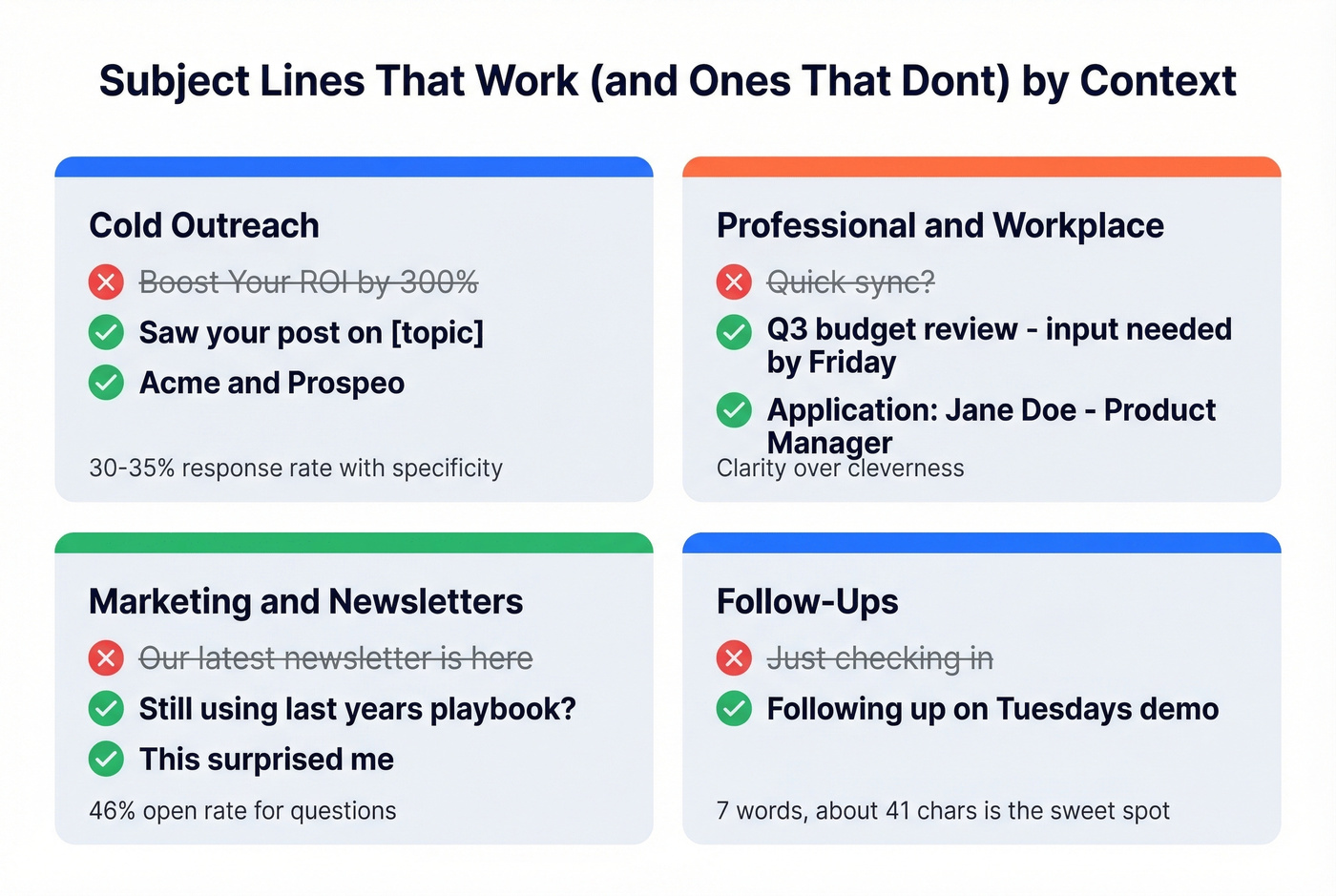
Bad: "Boost Your ROI by 300%" Good: "Saw your post on [topic]" Good: "Acme and Prospeo"
Professional & Workplace
Meeting requests, job applications, internal comms - these need clarity, not cleverness. The formula: [Topic] + [Action needed] + [Date if relevant].
"Q3 budget review - input needed by Friday" tells the reader exactly what you need and when. "Quick sync?" does not. For job applications, the same principle applies: "Application: Jane Doe - Product Manager" beats a vague "Interested in the role" every time, because hiring managers scan hundreds of subject lines and yours needs to be immediately parseable.
If you're writing the full message too, these email copywriting principles help keep the body as sharp as the subject.
Marketing & Newsletters
Question-based formats shine here. That 46% open rate for questions applies directly to newsletter subject lines where you're competing with 50 other emails in someone's morning inbox.
Hot take: Don't be afraid to test deliberate vagueness. A subject line like "This surprised me" can outperform descriptive alternatives in A/B tests - not because it's better writing, but because it exploits curiosity in a sea of over-optimized subject lines. It's a high-variance play. Test it once before dismissing it.
Follow-Ups
Follow-ups are where most people overthink. Research from Mixmax found 7-word subject lines (~41 characters) generate the highest engagement in follow-up contexts - slightly longer than cold outreach, because you're adding context the reader needs.
"Following up on Tuesday's demo" works. "Just checking in" doesn't - it signals you have nothing new to say.
For ready-to-send options, use these sales follow-up templates and cold email follow-up templates.
Mistakes That Kill Open Rates
Five patterns to eliminate immediately:
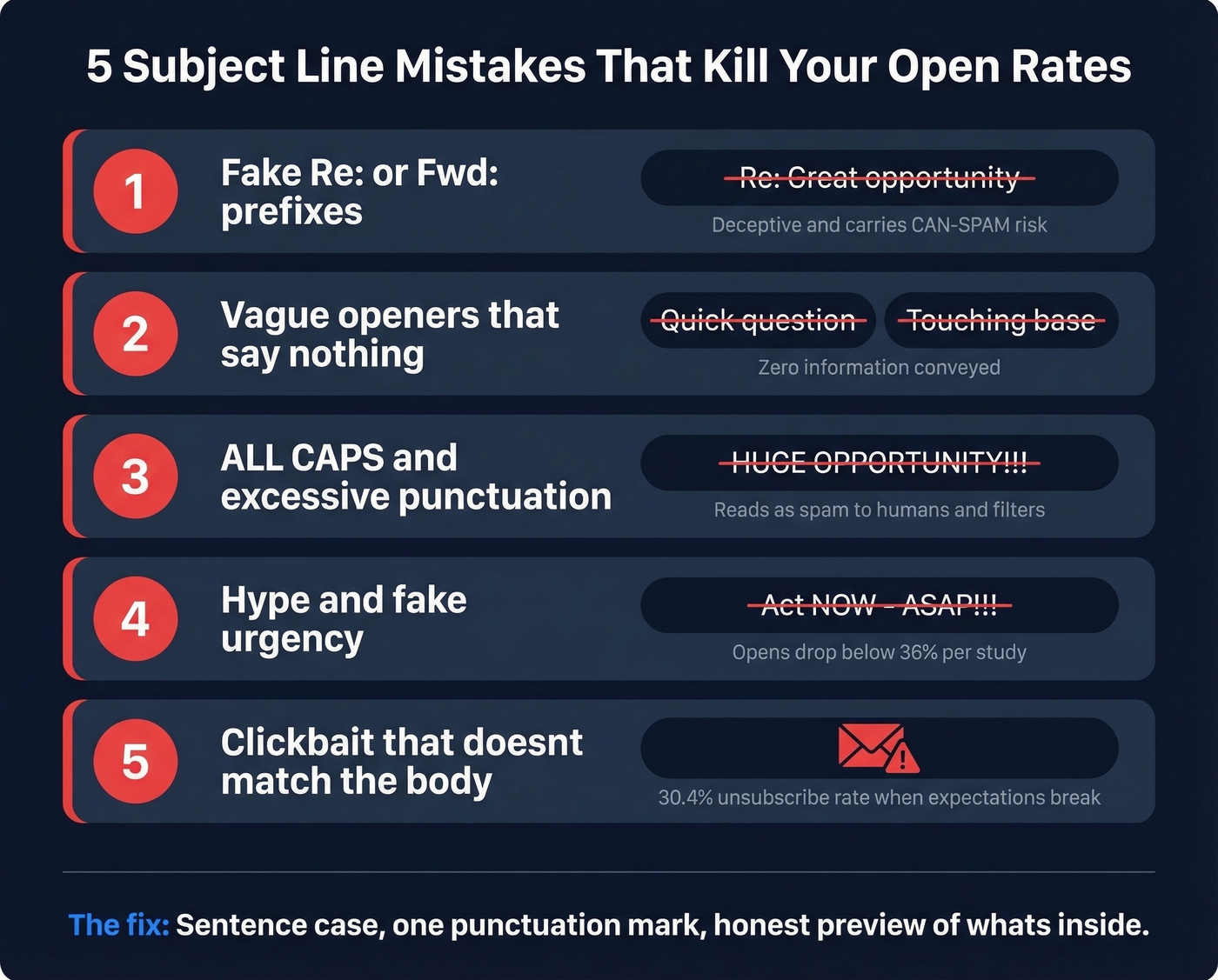
Fake Re:/Fwd: prefixes. Adding "Re:" to a first-touch email is deceptive. It also carries CAN-SPAM risk for misleading subject headings. Don't do it.
Vague openers. "Quick question," "Touching base," and "Checking in" convey zero information. They're the subject-line equivalent of clearing your throat.
ALL CAPS and excessive punctuation. "HUGE OPPORTUNITY!!!" reads as spam to humans and filters alike. Sentence case, one punctuation mark, done.
Hype and urgency language. The 5.5M-email study shows marketing hype, urgency, and generic greetings pull opens below 36%. Words like "ASAP" have been so overused they've become invisible.
Clickbait mismatch. You'll get the open, but you won't get the reply. And the spam complaints that follow will damage your sender reputation for every future email.
Stop Worrying About "Spam Trigger Words"
Those "150 words to avoid in subject lines" lists? They're based on 2010 filtering technology. Modern spam filters - Gmail, Outlook, all of them - evaluate sender reputation, engagement patterns, and authentication infrastructure, not individual words.
Deliverability is about whether your email reaches the inbox vs. spam, and it's driven by systemic signals. The word "free" in your subject line isn't what sends you to spam. Bounces from bad email addresses are. Litmus found that marketers who describe their email programs as successful are 22% more likely to actively monitor deliverability - because they know the real levers.
If you want the full technical breakdown, start with this email deliverability guide and then tighten list hygiene using email bounce rate benchmarks.

That's the real risk most people miss. Every bounced email chips away at your domain reputation, and once that reputation drops, even a perfectly crafted subject line lands in spam. We've seen bounce rates tank sender reputation faster than any subject line mistake ever could. Prospeo's 5-step email verification catches invalid addresses, spam traps, honeypots, and catch-all domains before you send - with 98% accuracy across 143M+ verified emails. If you're running any kind of outbound, verifying your list is the single highest-leverage thing you can do for deliverability.
How to Test Your Subject Lines
No amount of best practices replaces testing with your audience. Here's the minimum viable approach:
A/B test with a 20% sample. Send variant A to 10% of your list, variant B to another 10%. Wait 1-2 hours, then send the winner to the remaining 80%.
Track more than opens. Opens tell you the subject line worked. Clicks and replies tell you the email worked. Measure both - a subject line that drives opens but zero replies is a warning sign, not a win.
Retest periodically. What works changes. MailerLite's own tests showed emojis went from ineffective to consistently effective over time for their audience. Your audience will shift too. In our experience, quarterly retesting catches most of these shifts before they cost you meaningful open-rate points.
Let's be honest: knowing what should go in the subject line of an email comes down to brevity, relevance, and personalization - backed by clean data that actually gets you into the inbox.
You just learned what makes subject lines work. Now make sure the emails behind them land. Prospeo's 5-step verification and 7-day data refresh keep bounce rates under 4% - so your open-rate optimizations actually move pipeline, not spam folders.
Great subject lines deserve deliverability to match.
FAQ
How long should an email subject line be?
Two to six words, or under 33 characters for universal mobile visibility. The 5.5M-email study found 2-4 words produced a 46% open rate - the highest of any length bracket. Beyond 9 words, open rates drop below 35%.
Do emojis help email subject lines?
Results are entirely audience-dependent. MailerLite's A/B tests showed emojis had no effect initially, then became consistently effective as their audience shifted. Run a split test with your own list before committing to emojis in every send.
What makes a good professional email subject line?
Clarity over cleverness. Use the format [Topic] + [Action needed] + [Date if relevant]. For job applications: "Application: [Your Name] - [Role Title]." For meeting requests: "Q3 review - need input by Friday." The reader should know exactly what you need without opening the email.
How do I keep emails out of the spam folder?
Focus on sender reputation and list hygiene, not avoiding specific words. Bounces from invalid addresses are the fastest way to damage your domain reputation. Prospeo checks emails in real time with 98% accuracy, catching spam traps and catch-all domains before they hurt deliverability. Verify before every send.