

Why Your Cold Emails Don't Work (It's Not Your Copy)
You've rewritten your cold email 14 times. A/B tested subject lines, swapped CTAs, tried humor, tried blunt, tried everything. Reply rate still under 2%.
Here's what nobody on YouTube tells you: the problem isn't your words. The reason cold emails don't work for most teams has almost nothing to do with messaging - it starts upstream, with the data you're sending to and the infrastructure you're sending from.
Cold email works. Average reply rates run 3.43-5.8% across major 2026 studies, with top performers clearing 10%+. But most failures trace back to bad data and broken infrastructure. Fix your data first, then your DNS, then your domains, then your emails. Here's the priority order, with current numbers.
What "Working" Looks Like in 2026
Before diagnosing what's broken, let's calibrate expectations. Three large datasets paint a consistent picture:
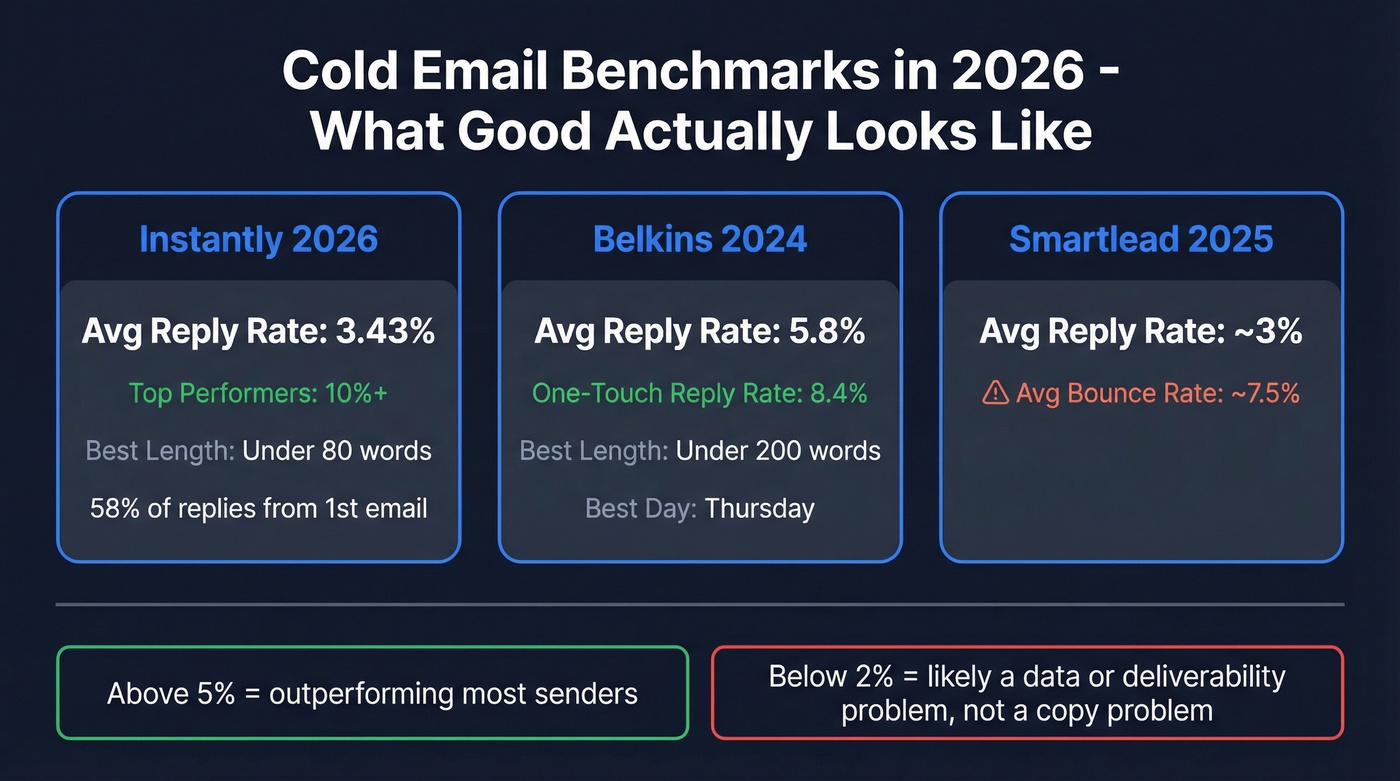
| Metric | Instantly (2026) | Belkins (2024) | Smartlead (2025) |
|---|---|---|---|
| Avg reply rate | 3.43% | 5.8% | ~3% |
| Top performers | 10%+ | 8.4% (one-touch) | - |
| Replies from 1st email | 58% | - | - |
| Best email length | <80 words | <200 words / 6-8 sentences | - |
| Best day | Tue-Wed | Thursday | - |
| Bounce rate | - | - | ~7.5% |
If you're hitting 5%+, you're outperforming most senders. Below 2%, the issue is almost always upstream of your copy - deliverability, data quality, or targeting.
Five Reasons Cold Outreach Fails
1. Your Emails Never Reach the Inbox
The average professional receives 120+ emails daily. Your cold email competes with all of them - assuming it arrives at all. One in six emails never reaches the inbox. Gmail places 87.2% of messages in the inbox; Microsoft only manages 75.6%. If you're emailing enterprise prospects on Outlook, nearly a quarter of your sends disappear into spam or go missing entirely, and you'll never know it happened.
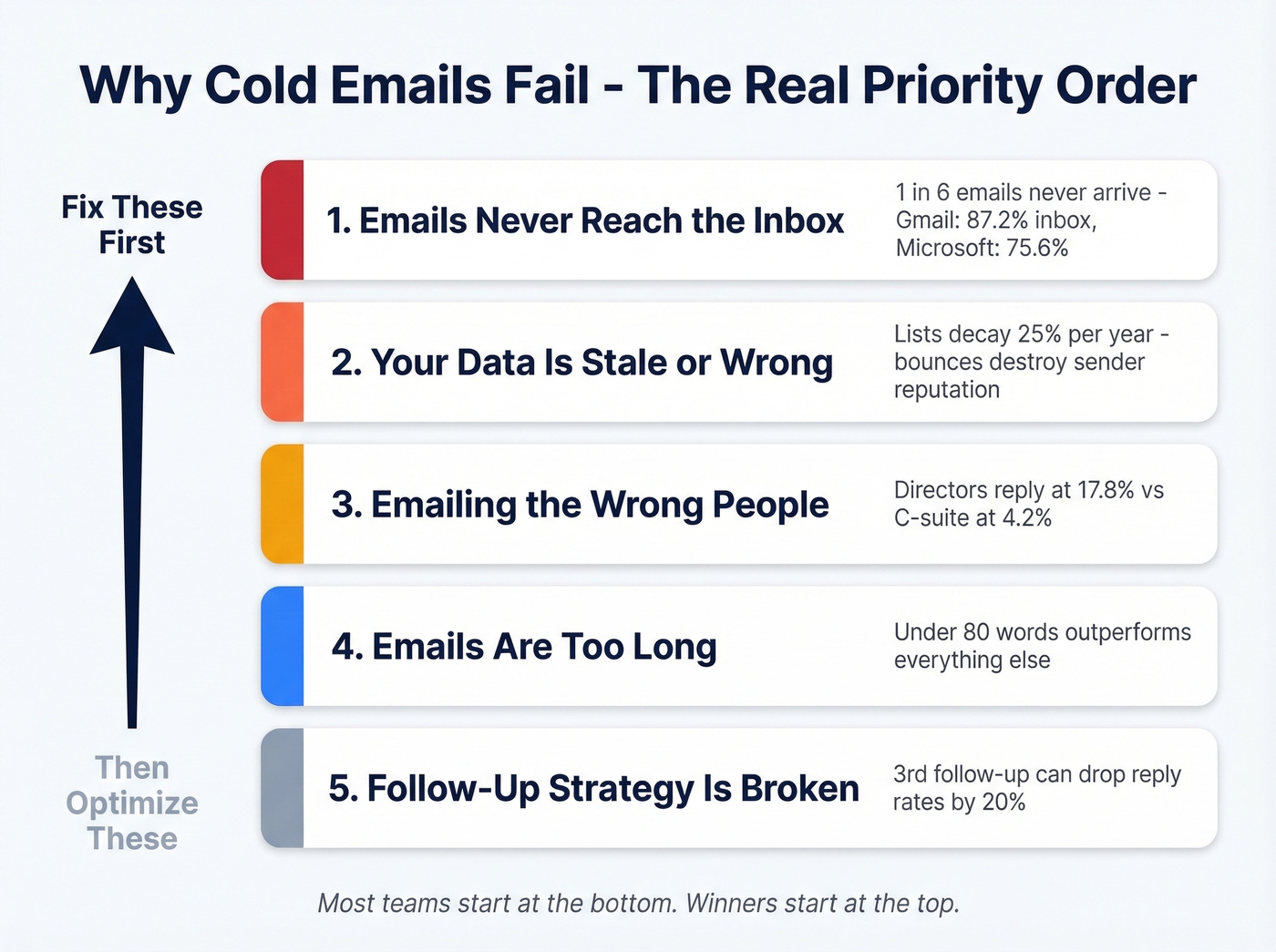
As of 2026, bulk sender rules are fully enforced by Google and Yahoo, with Microsoft aligning similarly: SPF, DKIM, and DMARC on every sending domain, spam complaints under 0.3%, bounces under 2%, plus one-click unsubscribe support. Miss any of these and you're filtered before a human sees your name.
A few things most senders get wrong:
- Open-tracking pixels - One large 2024 dataset found turning them off produced ~3% higher response rates. Pixels hurt deliverability. If you insist on tracking, a custom tracking domain can improve deliverability by 15-20% vs. generic tracking domains (see tracking domain).
- Domain warming - New domains need 8-12 weeks of gradual ramp. Start at 5-20 sends/day, increase weekly. Rushing this is the fastest way to torch a domain.
- Single-domain sending - One domain at 200 emails/day is a red flag. Five domains at 25-30/day each looks like normal business communication (manage safe email velocity).
2. Your Data Is Stale or Wrong
This is the real killer. It's the one most "fix your cold email" guides skip entirely.
Email lists decay roughly 25% per year - people change jobs, companies rebrand, domains expire. If you're buying lists or using data that hasn't been verified recently, you're sending to inboxes that don't exist. Those bounces aren't just wasted effort; they're actively destroying your sender reputation with every send (benchmarks: email bounce rate).
We've watched this pattern play out dozens of times. One practitioner on r/Entrepreneur shared their rebuild: bounce rate dropped from 11% to under 2% after switching from purchased lists to manually verified contacts. That single change - combined with infrastructure fixes - took their reply rate from 3% back to 6% in 62 days.

Prospeo's 5-step verification catches spam traps, honeypots, and catch-all domains before you ever hit send - 98% email accuracy on 143M+ verified addresses, refreshed every 7 days instead of the industry-standard 6 weeks. Real results back this up: Meritt cut their bounce rate from 35% to under 4%, and Stack Optimize maintains 94%+ deliverability across all client campaigns. When your bounce rate is destroying your sender reputation, verification isn't optional. It's step one (see email deliverability).
3. You're Emailing the Wrong People
Here's a stat that should change your targeting today: a Warmer AI study found Directors reply at 17.8% while C-suite executives reply at just 4.2%. One team shifted targeting from CMOs to Marketing Directors and watched reply rates jump from 3.1% to 16.4% in three weeks. That's not a copy improvement. That's a targeting improvement (build a tighter ideal customer profile).
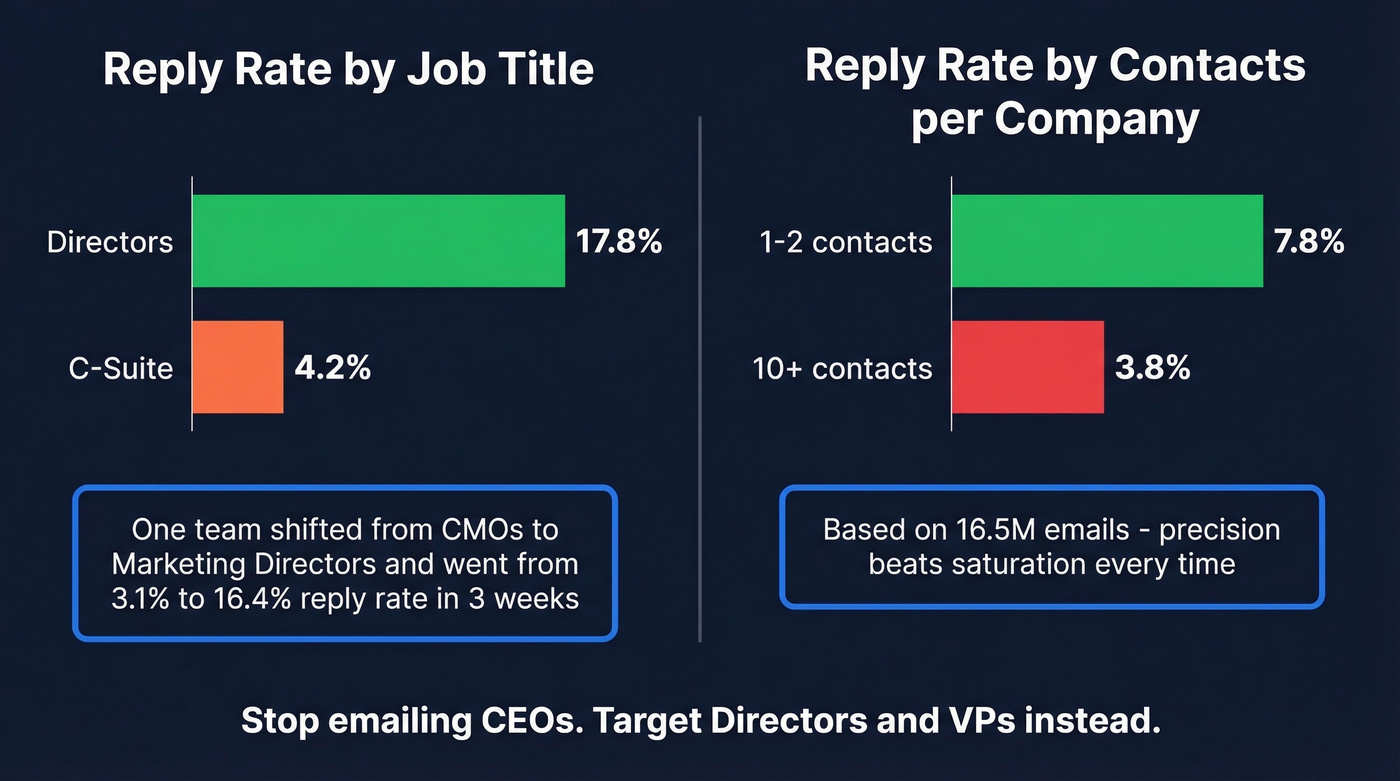
There's also a volume trap. A 16.5M-email dataset shows emailing 1-2 contacts per company yields a 7.8% reply rate. Blast 10+ contacts at the same company and that drops to 3.8%. Precision beats saturation every time (see account-based selling).
Hot take: If your average deal size is under $20k, you probably don't need to reach the C-suite at all. Directors and VPs have budget authority, respond faster, and are far less gatekept. Stop emailing CEOs.
4. Your Emails Are Too Long
Instantly's 2026 data is unambiguous: emails under 80 words outperform everything else. That practitioner who rebuilt their campaign cut email length from 141 words to 56. Another large dataset puts the sweet spot at 6-8 sentences (more guidance: email copywriting).
No links, no calendar invites, no PDFs in email #1. Every attachment and hyperlink is another signal for spam filters to flag. Your first email has one job: get a reply. That's it.
5. Your Follow-Up Strategy Is Broken
This one surprises people. 58% of replies come from the first email. And follow-ups can backfire - adding a third follow-up can drop reply rates by up to 20%. One-touch sequences (no follow-ups at all) actually had the highest reply rate at 8.4% in one major dataset from Belkins (2024).
Spam complaints tell the story: they rise from 0.5% on the first email to 1.6% by the fourth. Keep sequences in the 4-7 touchpoint range, and make sure each one adds a genuinely new angle. If you're just "bumping this to the top of your inbox," you're training recipients to report you (use proven cold email follow-up templates).
The exception: if someone replied positively but didn't book, keep following up with lower-friction asks. That's not cold outreach anymore - that's warm follow-up, and the rules are different.

You just read it: bounce rates above 2% destroy sender reputation. Prospeo's 5-step verification delivers 98% email accuracy across 143M+ verified addresses - refreshed every 7 days, not the 6-week industry standard. Meritt dropped their bounce rate from 35% to under 4%. Stack Optimize holds 94%+ deliverability across every client campaign.
Stop rewriting copy. Start fixing the data that's killing your campaigns.
The Fix-It Checklist
In our experience, this priority order matters more than any template swap. If your campaigns are underperforming, don't touch your copy until steps 1-5 are solid.
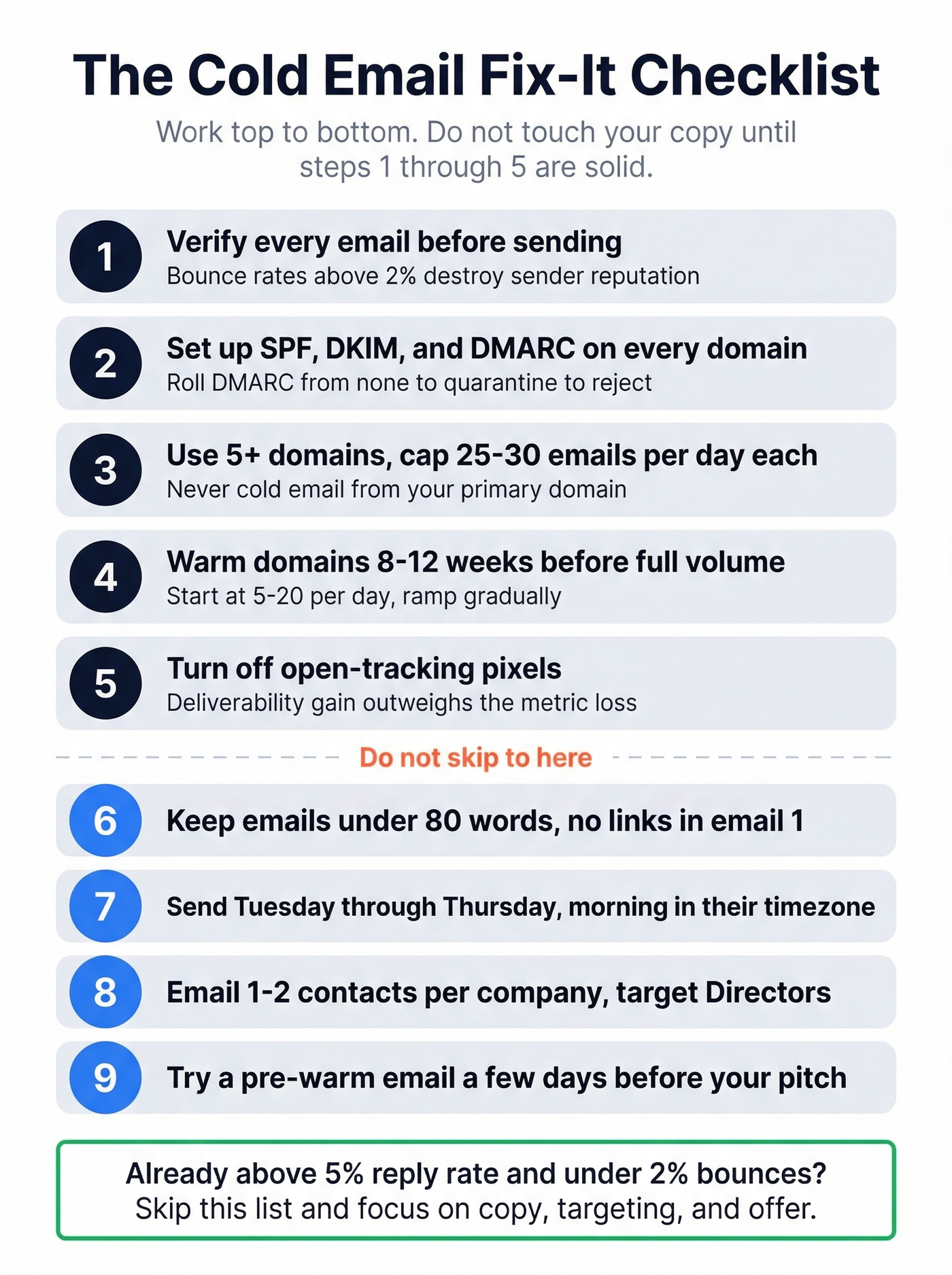
- Verify every email before sending. Bounce rates above 2% destroy sender reputation. Use real-time verification - you should only pay for valid addresses.
- Set up SPF, DKIM, and DMARC on every sending domain. No exceptions. Roll DMARC from p=none to quarantine to reject once reporting is clean (see DMARC alignment).
- Use 5+ domains, cap at 25-30 emails/day each. Protect your primary domain - never cold email from it.
- Warm domains 8-12 weeks before full volume. Start at 5-20/day, ramp gradually.
- Turn off open-tracking pixels. The deliverability gain outweighs the metric loss (details: email tracking pixel).
- Keep emails under 80 words, no links in email #1.
- Send Tue-Thu, morning in the recipient's timezone (timing data: best time to send cold emails).
- Email 1-2 contacts per company, target Directors not C-suite.
- Try a pre-warm email. Send a short, no-ask intro ("Saw your talk at SaaStr - great point on X") a few days before your pitch. It primes recognition and lifts reply rates.
Skip this list if you're already above 5% reply rates and under 2% bounces. In that case, your infrastructure is fine and you should focus on copy, targeting, and offer.
Compliance in 30 Seconds
Cold email is legal - but penalties for getting it wrong are steep. CAN-SPAM requires a physical address, honest headers, and unsubscribe honored within 10 business days. Violations run up to $50,120 per email. GDPR allows B2B outreach under legitimate interest, but fines reach EUR 20M or 4% of global revenue. Keep your opt-out process clean and your data sourcing defensible (see: Is It Illegal to Buy Email Lists?).
Targeting Directors over C-suite. Emailing 1-2 contacts per company. Keeping emails under 80 words. None of it matters if you're sending to dead inboxes. Prospeo gives you 300M+ profiles with 30+ filters - buyer intent, job changes, department headcount - so you reach the right person with a verified email for $0.01 each.
Precision targeting plus verified data. That's how teams clear 10% reply rates.
FAQ
Why don't my cold emails get replies?
Almost always bad data or broken infrastructure, not bad copy. Bounce rates above 2% tank sender reputation, which means Gmail and Outlook filter you before anyone reads a word. Fix verification, DNS records (SPF, DKIM, DMARC), and domain warming first - then optimize messaging.
What's a good cold email reply rate in 2026?
The average sits between 3.43% and 5.8% depending on the dataset. Above 5% means you're outperforming most senders. Top performers hit 10%+. Below 2% almost always points to deliverability or data quality problems, not weak copy.
How do I stop cold emails going to spam?
Set up SPF, DKIM, and DMARC on every sending domain. Keep bounce rates under 2% by verifying emails before sending. Warm new domains for 8-12 weeks, cap daily volume at 25-30 per domain, and turn off tracking pixels.
Should I follow up on cold emails?
Yes, but less aggressively than most guides suggest. Data shows 58% of replies come from the first email, and a third follow-up can drop reply rates by 20%. Limit sequences to 4-7 touches, and make each one add a genuinely new angle - don't just "bump" the thread.