

The Zero Moment of Truth in B2B Has Changed - Here's What Works Now
72% of B2B buyers now start vendor research in private peer communities, not Google. Only 9% begin with a search engine. The zero moment of truth in B2B - the concept Google coined in 2011 - is more relevant than ever, but the channels, tactics, and timing have fundamentally shifted.
Here's what that means in practice: ZMOT starts in peer communities, not search. 90% of buyers say social proof heavily influences shortlist decisions. And your strategy dies at execution if your contact data bounces.
What Is the Zero Moment of Truth?
Procter & Gamble coined the First Moment of Truth (FMOT) - the shelf decision - and the Second Moment of Truth (SMOT) - the product experience. In 2011, Google's Jim Lecinski added the Zero Moment of Truth: the research phase before a buyer ever touches a product or talks to a rep.
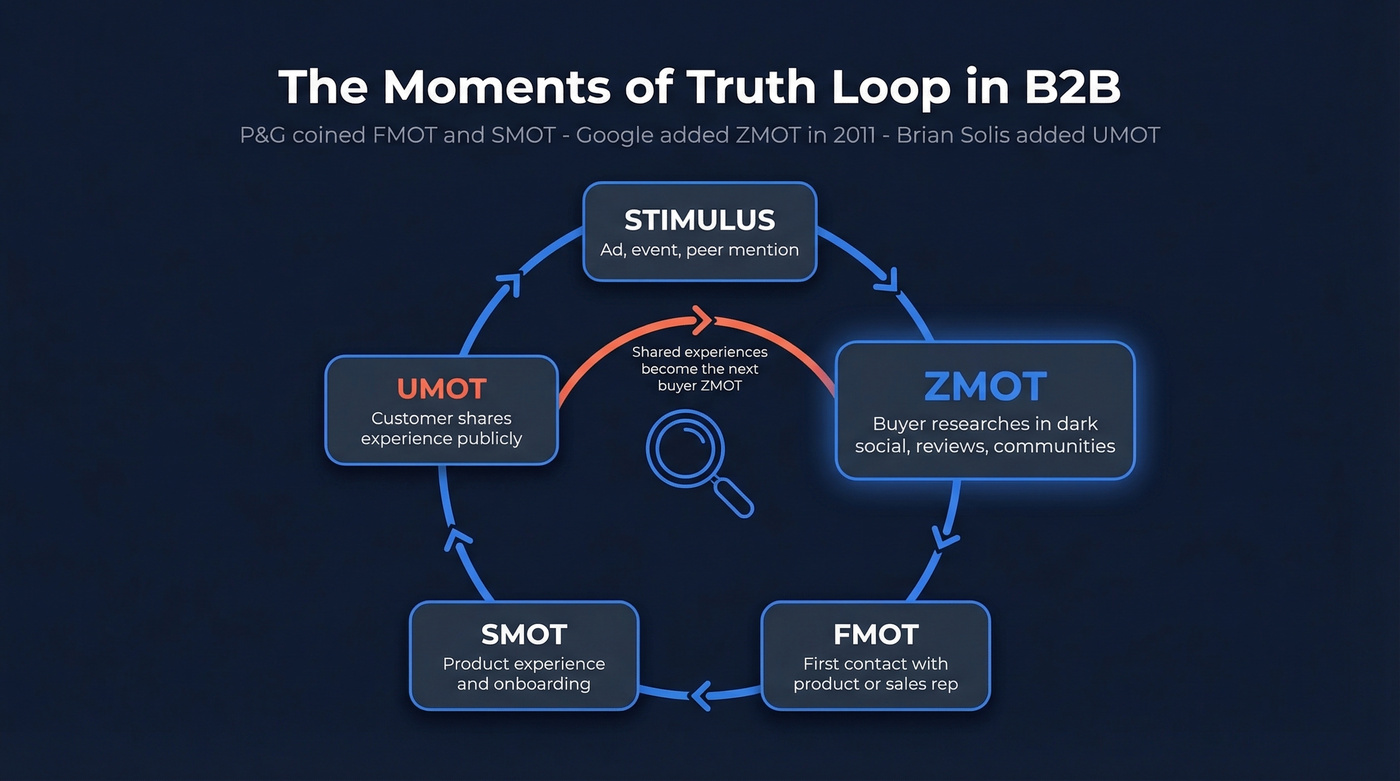
Brian Solis extended the model with the Ultimate Moment of Truth (UMOT), where a customer shares their experience and that shared experience becomes the next buyer's ZMOT. It's a loop: Stimulus → ZMOT → FMOT → SMOT → UMOT → back to ZMOT.
What 2026 B2B Buyer Data Shows
The 6sense 2026 Buyer Experience Report surveyed nearly 4,000 B2B buyers and found buying cycles shortened from 11.3 to 10.1 months year over year. First contact with sellers moved earlier - from 69% of the journey to 61%, roughly six weeks sooner. The critical finding: 95% of the time, the winning vendor is already on the Day One shortlist. The pre-contact favorite wins about 80% of deals.
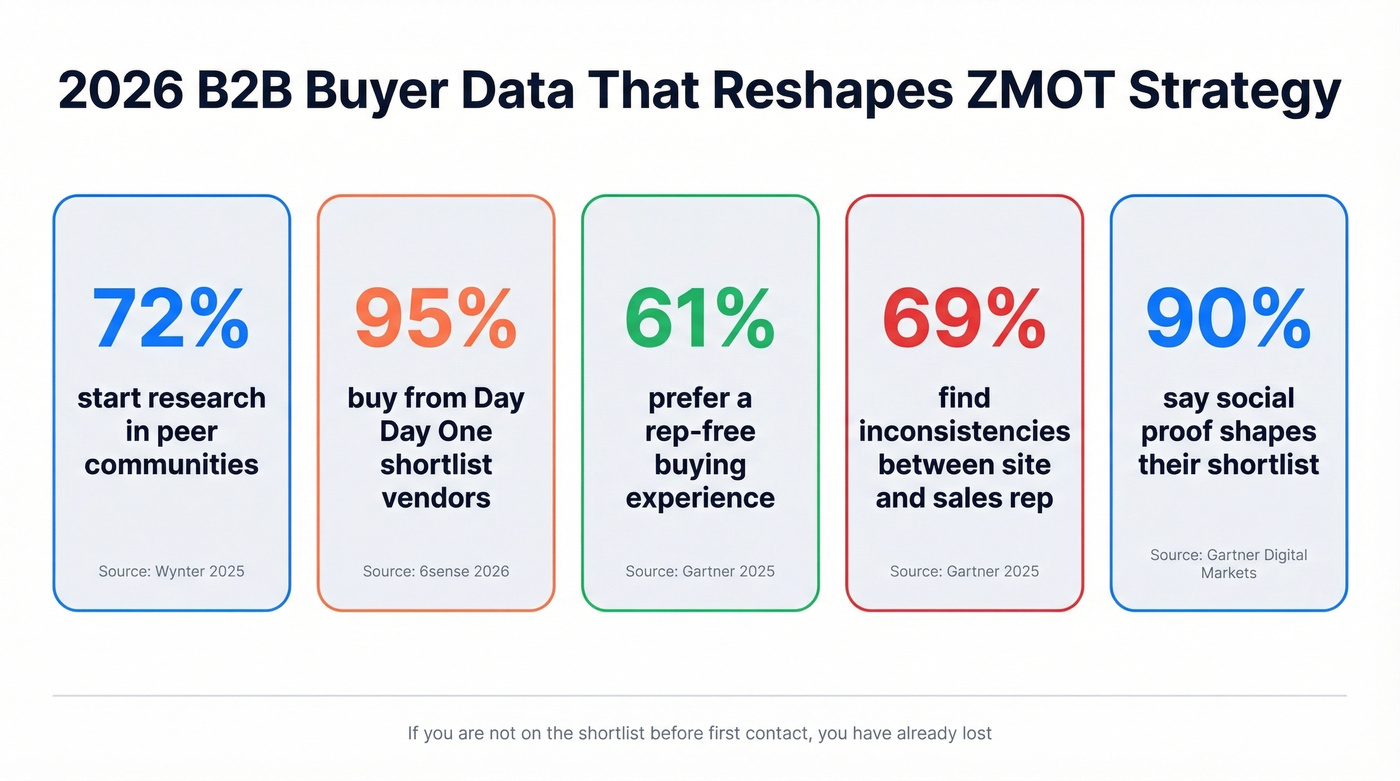
If you're not in the consideration set before a buyer picks up the phone, you've already lost.
Gartner reinforces this. 61% of B2B buyers prefer a rep-free buying experience. 73% actively avoid suppliers who send irrelevant outreach. And 69% report inconsistencies between what a vendor's website says and what the sales rep tells them - a trust killer during ZMOT.
One data point nobody's talking about: nearly 90% of buyers in the 6sense study said AI features were part of what they evaluated and purchased. AI isn't just changing how vendors sell - it's reshaping what buyers expect to see during pre-purchase research. If your product pages don't address AI capabilities, you're behind the evaluation curve before it even starts. (If you're building this into your motion, see AI in B2B marketing.)
On shortlists specifically, Gartner Digital Markets surveyed 3,500 decision makers and found 90% say social proof heavily influences their vendor lineup, while 83% alter their initial list during evaluation.
Dark Social Replaced Google
Google didn't lose relevance - it lost its position as the starting point. Wynter's research shows 72% of B2B SaaS buyers begin by asking peers in private groups: Slack communities, private Discord servers, closed LinkedIn groups, WhatsApp threads. Google's new role is validation. 51% still use it during the process, but they're confirming what peers already told them.
This is the UMOT loop in action. Previous customers' shared experiences in dark social become the next buyer's ZMOT. If your brand isn't present in the communities where buyers actually start, your SEO rankings matter less than you think. (This maps closely to the dark funnel.)

72% of buyers build shortlists in dark social before they ever Google you. When you spot those ZMOT signals, stale data kills the moment. Prospeo tracks intent across 15,000 Bombora topics and delivers 98% accurate emails on a 7-day refresh cycle - so you reach buyers while they're still in the messy middle.
Don't win ZMOT and lose at the inbox.
From ZMOT to the Messy Middle
Google introduced the "Messy Middle" model to describe what happens between trigger and purchase. Buyers loop between exploration (expanding options) and evaluation (narrowing them). Six cognitive biases shape which vendors survive:
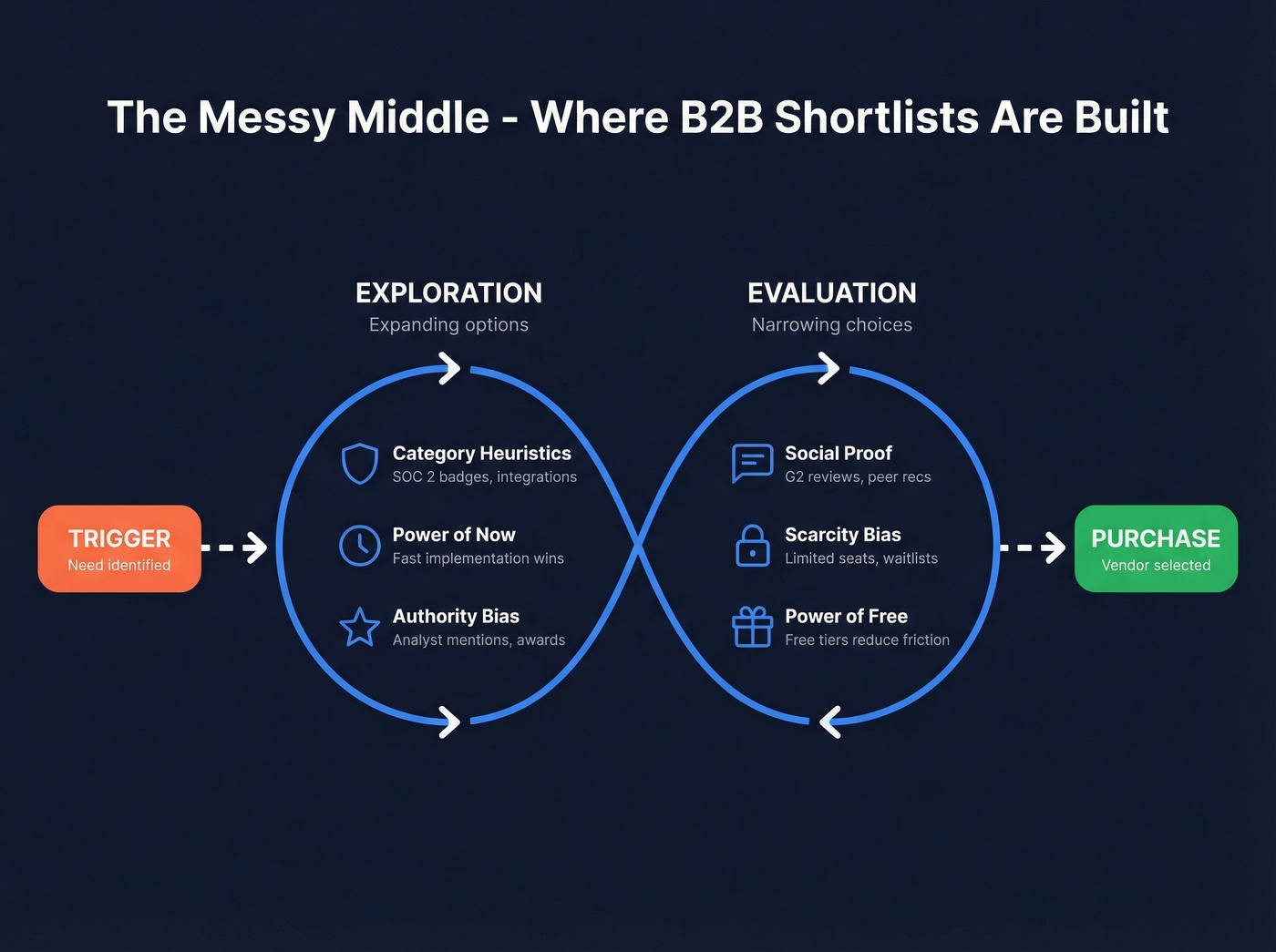
- Category heuristics - shortcut features that signal credibility like SOC 2 badges, enterprise tiers, and known integrations
- Power of now - faster implementation beats "schedule a demo in two weeks"
- Social proof - G2 reviews, case studies, peer recommendations
- Scarcity bias - limited seats, cohort-based onboarding, waitlists
- Authority bias - analyst mentions, industry awards, thought leader endorsements
- Power of free - free tiers and trials reduce evaluation friction dramatically
By the end of this messy middle, buyers narrow to a shortlist they tend to carry through to purchase. Your job is to be on it before the loop closes. (This is also why B2B buyer journey mapping matters more than channel-specific tactics.)
The 2026 B2B ZMOT Playbook
Five tactical moves, ranked by impact.
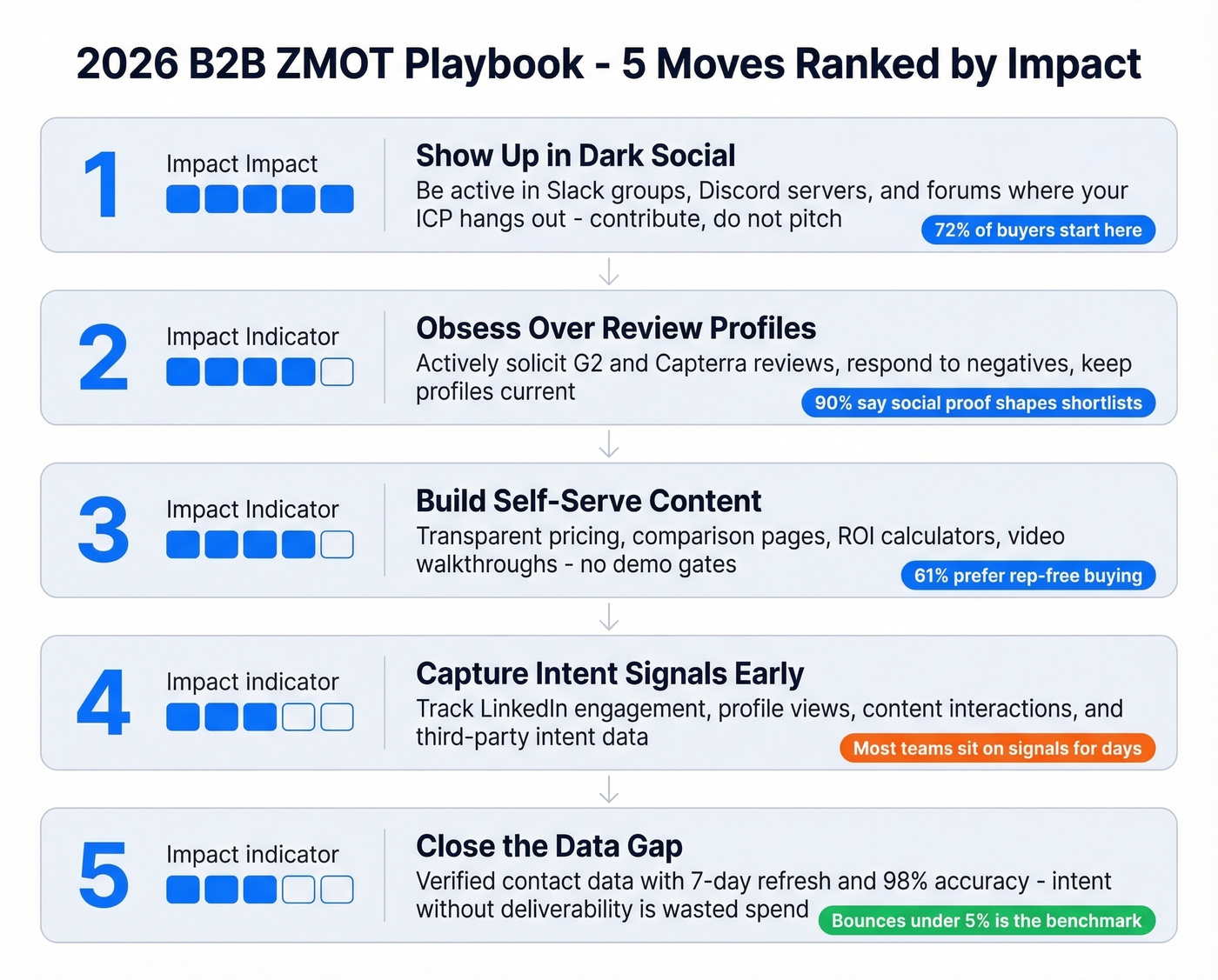
Show Up in Dark Social
Your buyers are in private communities before they ever Google you. Founders, AEs, and subject matter experts need to be active in the Slack groups and forums where your ICP hangs out - not pitching, but contributing and answering questions. The 72% stat isn't abstract. It's where shortlists get built, and if your team isn't there, someone else's is. (If you’re operationalizing this, pair it with B2B relationship marketing.)
Obsess Over Review Profiles
When 90% of buyers say social proof heavily influences their shortlist, your G2 and Capterra profiles aren't optional marketing - they're ZMOT infrastructure. We've watched companies invest months in content strategy while ignoring a low G2 rating that was silently killing every deal before it started. Solicit reviews actively, respond to negative ones, keep profiles current. This is table stakes now.
Build Self-Serve Content
61% of buyers prefer a rep-free experience, so give them what they want. Transparent pricing pages, comparison content, implementation guides, ROI calculators. If a buyer has to book a demo just to learn what your product does, you've already lost to the competitor who published a 3-minute walkthrough. Let's be honest - most B2B sites still gate basic product information behind a form. That's a ZMOT death sentence in 2026. (For a broader system, use a B2B content marketing funnel.)
Capture Intent Signals Early
A Reddit poster described closing a $72K deal that originated from a LinkedIn like. Profile views, content engagement, event attendance - these are ZMOT signals firing in real time. Connect first-party signals with third-party intent data and social interactions to catch buyers mid-loop. The consensus on r/b2bmarketing is that most teams sit on these signals for days or weeks, which is the same as ignoring them entirely. (If you want to systematize this, start with intent keywords and then layer in B2B predictive analytics.)
Close the Data Gap
Look, most B2B teams don't have a ZMOT problem - they have an execution problem. They identify intent, build content, show up in communities, and then outreach bounces because contact data is stale. We've seen this pattern dozens of times: a team does everything right upstream and then watches emails land in the void because their data provider refreshes records every six weeks. Prospeo tracks intent across 15,000 topics via Bombora, so when a signal fires, you're pulling verified emails at 98% accuracy on a 7-day refresh cycle. Intent without deliverability is just expensive awareness. (To compare options, see B2B data platforms.)
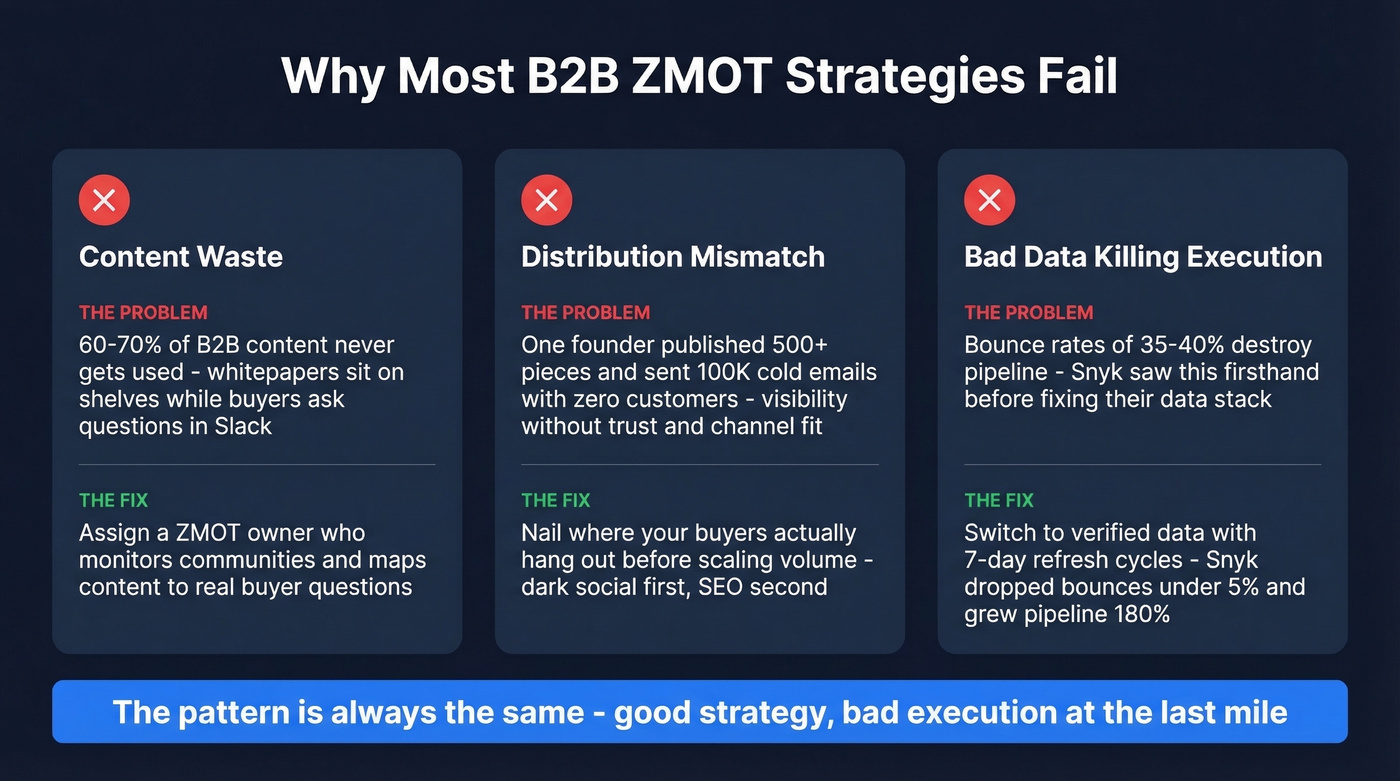
Why Most B2B ZMOT Strategies Fail
Three failure modes we see repeatedly.
Content Waste
The old stat that 60-70% of B2B content never gets used still rings true. Teams produce whitepapers that sit on a shelf while buyers ask questions in Slack communities nobody on the marketing team monitors. Assign someone to own ZMOT internally. Without clear ownership, these signals die in a dashboard nobody checks. (This is one of the most common B2B marketing mistakes.)
Distribution Mismatch
One SaaS founder on r/SaaS described publishing 500+ content pieces, sending 100,000 cold emails, and landing zero paying customers after six months. That's a brutal illustration of what happens when you have visibility without trust and channel fit. Skip the volume game if you haven't nailed where your buyers actually hang out first. (If you’re choosing channels, use this go-to-market channels framework.)
Bad Data Killing Execution
None of the upstream work matters if outreach doesn't land. Snyk's sales team was running bounce rates of 35-40% before fixing their data stack; after switching, bounces dropped under 5% and AE-sourced pipeline jumped 180%. That's not a marginal improvement - it's the difference between a ZMOT strategy that works and one that looks good in a slide deck. (If you’re diagnosing this, start with email bounce rate.)
95% of deals go to vendors already on the Day One shortlist. The gap between spotting buyer intent and landing a reply is where most teams fail - not strategy, but data. Prospeo gives you verified contacts at $0.01/email with 98% accuracy, so your outreach actually connects when the moment of truth hits.
Turn every intent signal into a conversation that lands.
FAQ
What does ZMOT stand for?
Zero Moment of Truth - the research phase where a buyer forms preferences before contacting any vendor. Google coined it in 2011, building on P&G's First and Second Moment of Truth framework. In B2B, it now spans dark social, review sites, and peer communities.
Is ZMOT still relevant in B2B?
More than ever. In 2026, 72% of B2B buyers start in private peer communities and 95% buy from a vendor already on their Day One shortlist. The concept holds - buyers form preferences before talking to sales. The channels have just shifted from search to dark social.
How do you win the zero moment of truth in B2B?
Show up in dark social, manage review profiles obsessively, create self-serve content, and monitor intent signals. Then make sure your contact data is accurate enough that outreach actually lands - a 7-day data refresh cycle and 98% email accuracy are the benchmarks to aim for, because stale data turns good strategy into wasted effort.