

ABM Social Media: The Tactical Playbook for 2026
ABM delivers an average 137% ROI according to a 771-marketer survey, and 49.7% of marketers plan to increase ABM budgets this year. Yet most teams running ABM social campaigns still burn money on stale data, missing impression caps, and vanity metrics that reveal nothing about pipeline. B2B deals now involve roughly 11 stakeholders, each consuming 5-7 assets before they'll talk to sales - social is where those stakeholders live between meetings, and it's the highest-leverage channel most ABM programs underuse.
Here's the thing: 65% of ABM marketers already use social media for account intelligence. But using it for intel and using it for targeted activation are two very different things.
What You Need (Quick Version)
Three steps separate account-based social campaigns that work from ones that waste budget:
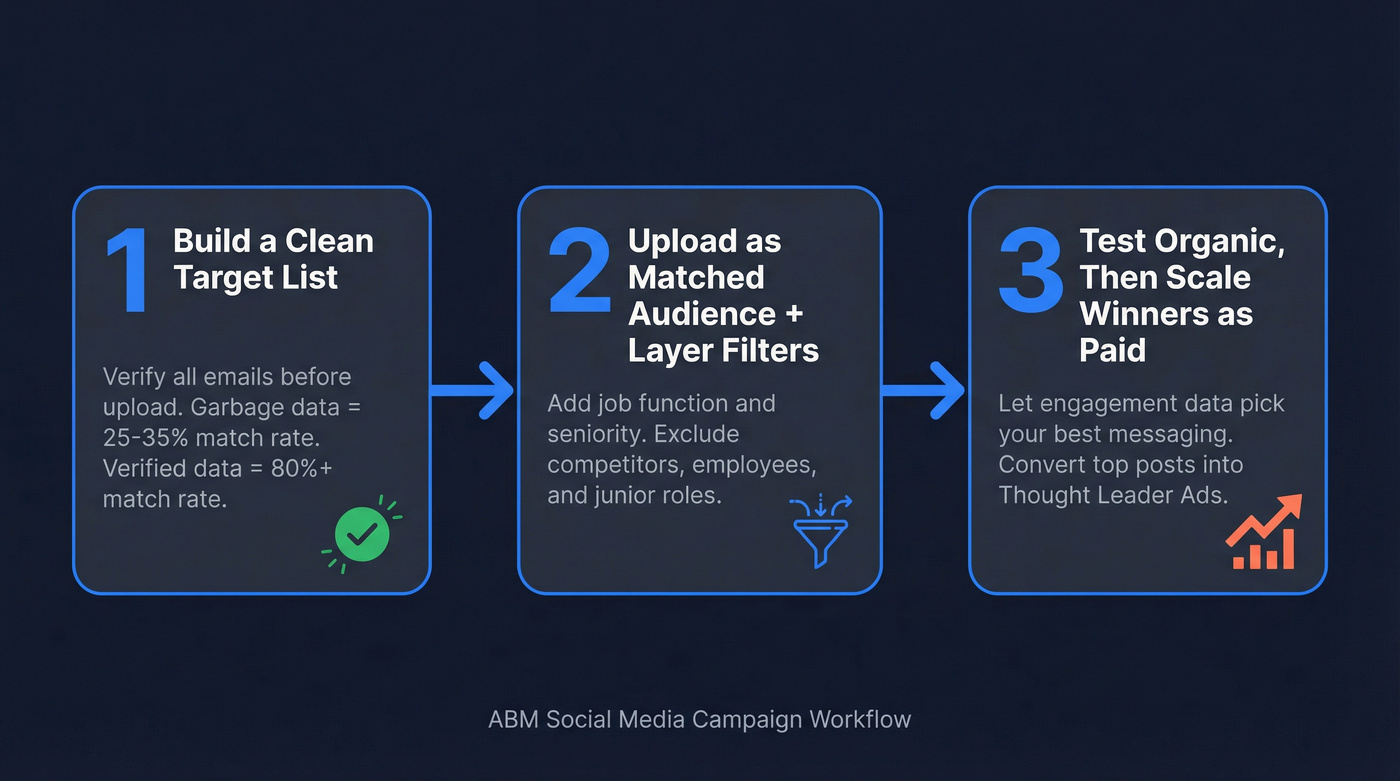
- Build a clean, verified target account list. Your matched audiences live or die on data quality. Upload garbage emails and you'll get a 25-35% match rate. Verify before anything touches an ad platform. (If you need a stack comparison, start with data enrichment.)
- Upload as a matched audience, then layer filters. On LinkedIn, add job function and seniority on top of your company list. Exclude competitors, employees, and junior roles.
- Test messaging organically, then scale winners as Thought Leader Ads. Let organic engagement tell you what resonates, then put paid behind what's already working.
Account-Based Marketing Foundations for Social
Nearly 80% of organizations say they run ABM, but only 29% measure with ABM-aligned metrics. That disconnect starts with mismatched tiering.
Map your accounts to the right tier before you touch an ad platform. 1:1 accounts - your top 10-20 - get custom content, personalized outreach, and dedicated ad creative. 1:few accounts, industry clusters of 50-200, get segment-specific messaging. 1:many accounts in the hundreds or thousands get scaled campaigns with lighter personalization.
The most common mistake? Running 1:1 plays on accounts that should be 1:many. That's how you burn out your team in six weeks.
Before launching, lock in a sales/marketing SLA. Define what a marketing-qualified account looks like, agree on response-time commitments, and set shared KPIs. Without this, your demand gen team runs campaigns and sales ignores every account they surface. (If you want the sales-side motion, use account-based selling best practices.)
The LinkedIn ABM Playbook
LinkedIn is the best social platform for account-based marketing at scale. It's also where budget should concentrate first - expect around $8-15 CPC and $30-60 CPM for ABM audiences, which sounds steep until you see the pipeline numbers. (To sanity-check your funnel math, track funnel metrics.)
Matched Audiences + Role Targeting
Upload your target company list as a matched audience. LinkedIn often needs at least 300 matched members to serve ads and recommends 50,000+ for Sponsored Content and 15,000+ for Message Ads to get reliable delivery. Before launching anything, install the LinkedIn Insight Tag - you need it for retargeting website visitors from target accounts and for proper attribution.
Once your company list is live, layer job function and seniority filters on top. This is more reliable than targeting by job title because titles vary wildly across companies, but "VP-level" in "Marketing" stays consistent. The most underused lever? Exclusions. Remove competitors, your own employees, junior roles, and irrelevant industries. Every excluded impression is budget redirected to someone who matters. (If your segmentation is messy, tighten your firmographic filters.)
Ad Formats by Funnel Stage
| Format | Stage | Best Use |
|---|---|---|
| Single Image | Awareness | Account list targeting |
| Video | Mid-funnel | Category education |
| Document Ads | Evaluation | Senior decision-makers |
| Carousel | Multi-role | Buying committee messaging |
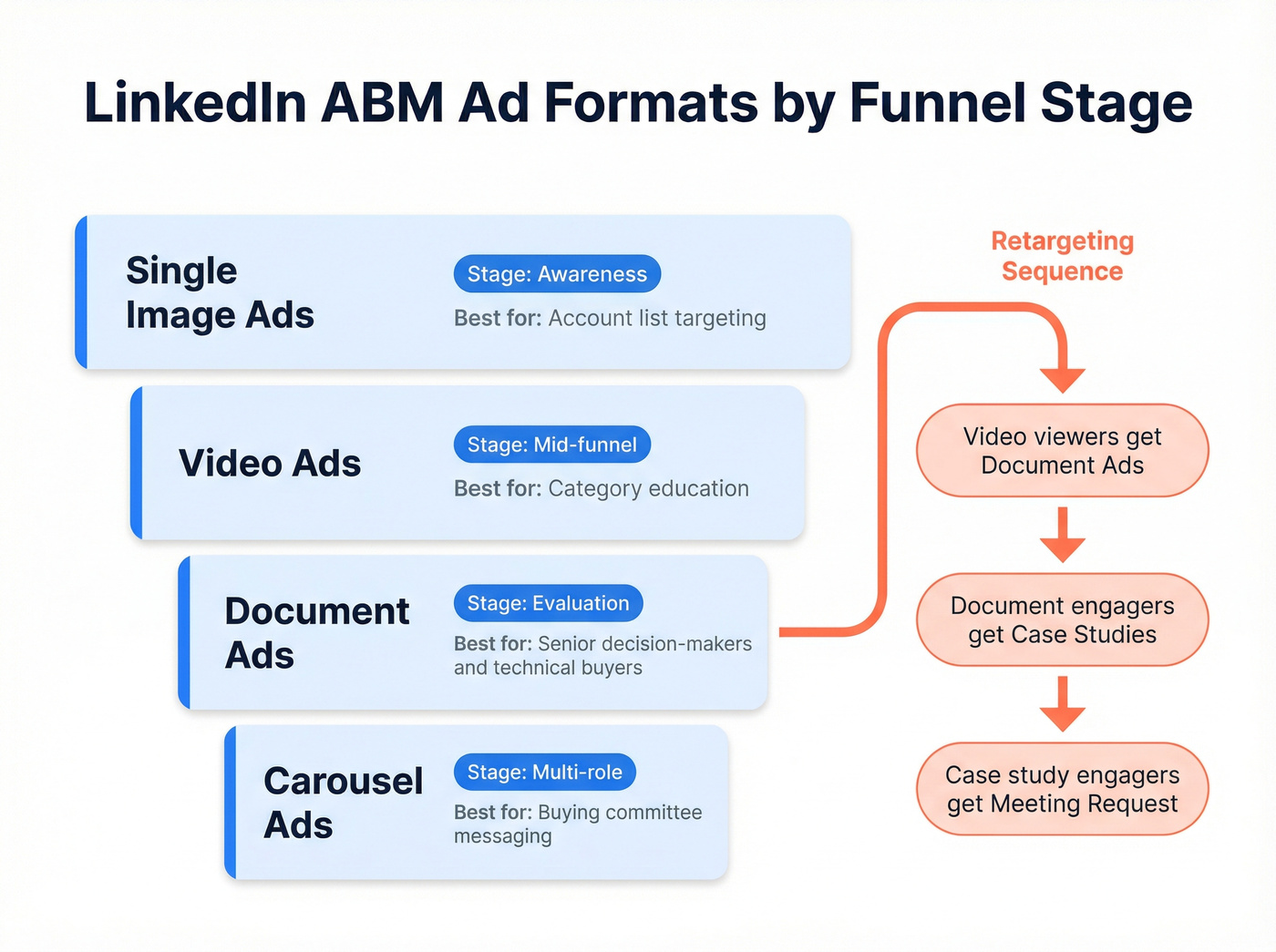
Video doesn't need to be polished - clarity beats production value. Document ads signal depth and work well for technical evaluators and economic buyers who want substance over sizzle. (If you’re aligning content to stages, map it to a B2B sales funnel template.)
Build retargeting sequences from these formats: video viewers get served Document Ads, document engagers get case studies, and case study engagers get the meeting request. Sequential exposure builds familiarity before you ever ask for a demo.
The Organic-to-Paid Workflow
Don't start with paid. Test your messaging organically first. When a post meaningfully outperforms your baseline engagement, that's your signal - convert it into a Thought Leader Ad targeting your account list. This approach scales credibility rather than brand ads, and ABM programs using this workflow yield up to 50% higher ROI. Personalization-driven campaigns see a 25% lift in revenue when the messaging is dialed in. (For the outreach layer that follows, use personalized outreach.)
Why Impression Capping Matters
Nobody talks about this enough, and it's the single tactic that matters most for ABM on LinkedIn. Without account-level impression capping, LinkedIn's algorithm concentrates roughly 70% of your budget on 10-15% of your accounts. You end up hammering the same small slice of companies while the rest of your target account list never sees an ad.
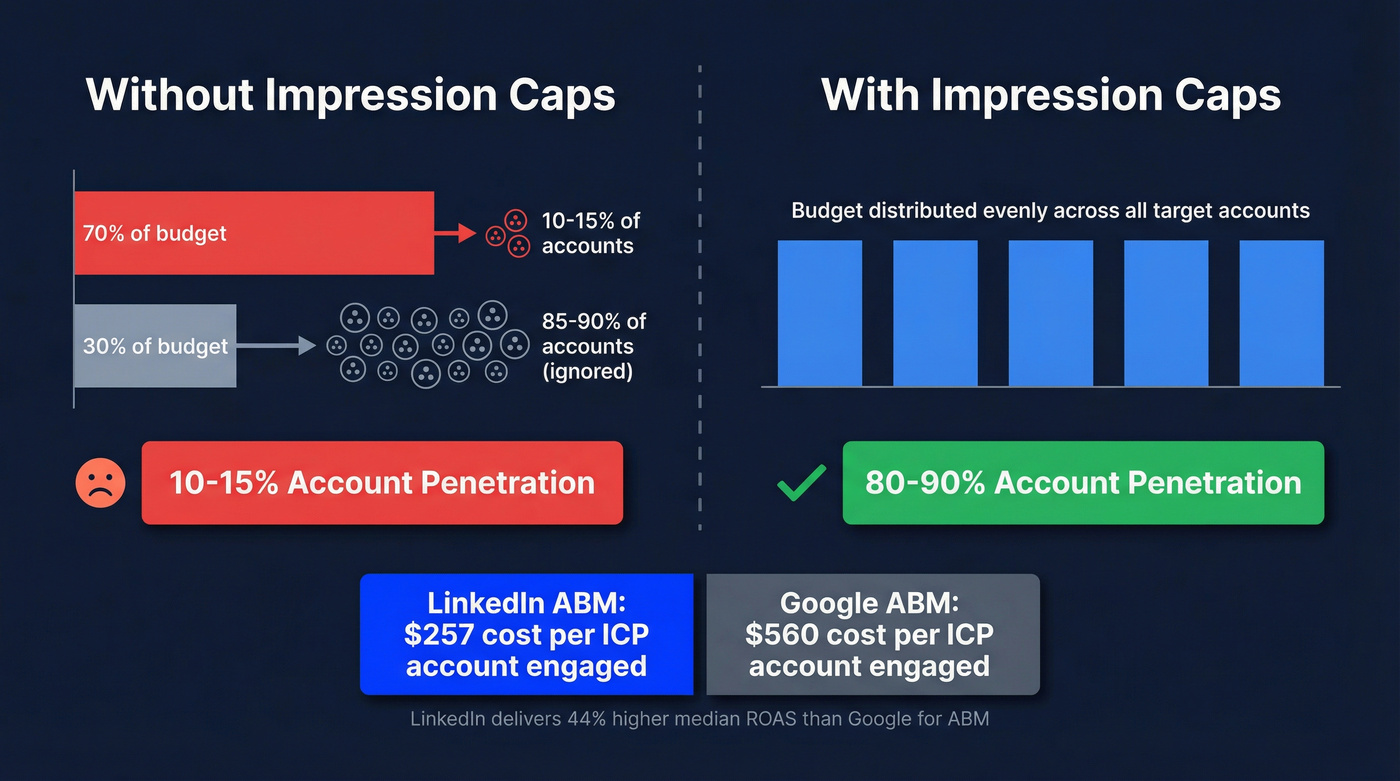
Setting impression caps raises account penetration from 10-15% to 80-90%. That's the difference between "we ran LinkedIn ads" and "we reached the buying committee at 180 target accounts."
Agency benchmarks show LinkedIn delivers 44% higher median ROAS than Google for ABM, with $257 cost per ICP account engaged versus $560 on Google. Deals sourced from LinkedIn also carry 28.6% higher ACV.
Our take: if you're spending more than $5K/month on LinkedIn ABM without impression caps, you're running brand awareness for a handful of accounts and calling it ABM. Fix the caps before you increase the budget.
One competitive intel move worth stealing: check the LinkedIn Ad Library and Facebook Ad Library to reverse-engineer what your competitors are running against your same target accounts. You'll often find their messaging gaps are your opportunity. (If you want a full system, build a competitive intelligence strategy.)
Facebook/Meta ABM Tactics
LinkedIn gets the headlines, but Meta plays a useful supporting role - especially for retargeting and staying visible outside work hours.
Create Custom Audiences by uploading your contact list with names, emails, and phone numbers. Business emails match poorly on Facebook because most users register with personal addresses. Adding phone numbers and additional identifiers can materially improve your match rate.
Facebook Lead Ads reduce friction for mid-funnel offers like webinar registrations or benchmark reports. If you're running HubSpot or 6sense, both have direct integrations to push intent data into Meta audience segments, saving your ops team from manual list uploads. (If you’re building the list from scratch, see how to generate an email list.)
Skip Meta as a primary ABM channel if your budget is under $10K/month. In that case, concentrate everything on LinkedIn and use Meta only for retargeting visitors who've already engaged with your LinkedIn campaigns.

A 34% match rate means 66% of your ABM ad spend targets nobody. Prospeo's 98% email accuracy and 7-day data refresh cycle mean your LinkedIn matched audiences actually match. Upload verified contacts and watch account penetration jump from 15% to 80%+.
Stop paying LinkedIn CPMs to reach empty seats in your target accounts.
Your ABM Data Is the Bottleneck
Picture this: your demand gen manager pulls the matched audience report and the match rate is 34%. Half your target contacts didn't match because the emails in your CRM are 18 months old. You just spent $8,000 on LinkedIn ads that reached a fraction of your target account list. When data isn't unified, 37% of touchpoints go unattributed - you can't even tell what's working. (If you’re fixing list quality, start with email deliverability basics.)

Measuring Campaign Performance
Stop measuring ABM by MQLs. They'll mislead you every time.
The metrics that matter are account-to-opportunity conversion (SaaS benchmark: 15-25%, manufacturing: 8-12%), touchpoints per account across channels, and CAC broken out by LinkedIn vs Meta vs organic. Mature programs track 150-200 touchpoints per account before a deal closes, which means your attribution model needs to capture social impressions alongside email opens and site visits. (If you need a clean definition and levers, use this cost to acquire customer guide.)
84% of buyers have already selected their preferred vendor before contacting sales. Your social campaigns need to influence that decision upstream - and your metrics should reflect whether that's happening.
ABM Social Mistakes That Kill Campaigns
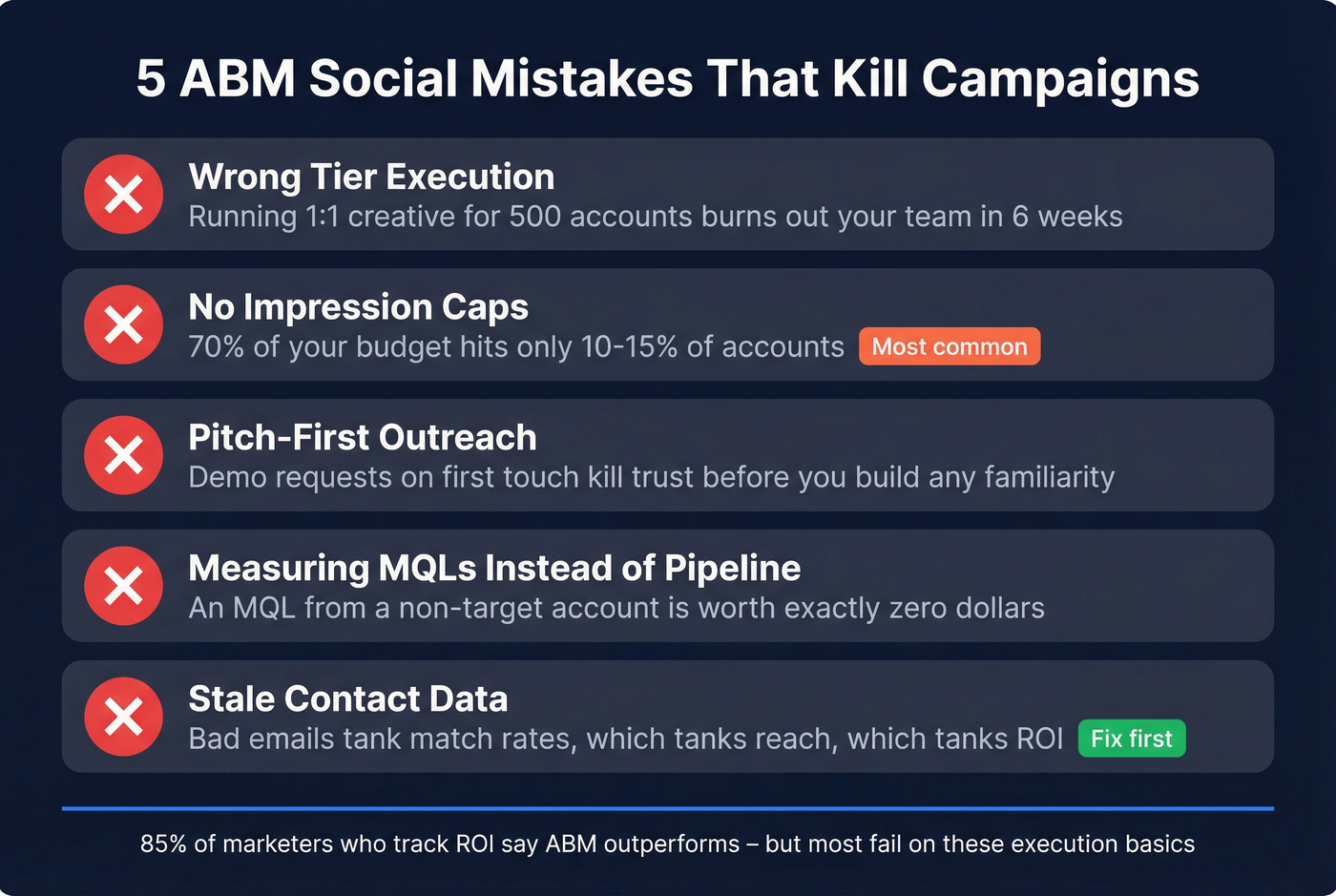
- Wrong tier execution. Running 1:1 personalized creative for 500 accounts is a recipe for burnout. Match the effort to the tier.
- No impression caps. LinkedIn will happily spend 70% of your budget on 10-15% of your accounts while ignoring the rest.
- Pitch-first outreach. Leading with a demo request on a cold account's first touchpoint kills trust. Build familiarity first.
- Measuring MQLs instead of pipeline. An MQL from a non-target account is worthless. Track account-to-opportunity conversion.
- Stale contact data. Bad emails tank match rates, which tanks reach, which tanks ROI. 85% of marketers who track ROI say ABM outperforms other investments - but most programs fail on execution basics like this.
Real Results
DocuSign built industry-tailored ABM content across social and web channels and saw 60% higher engagement, 300% more page views, and 22% pipeline growth. The key wasn't the platform - it was content specificity mapped to each industry vertical.
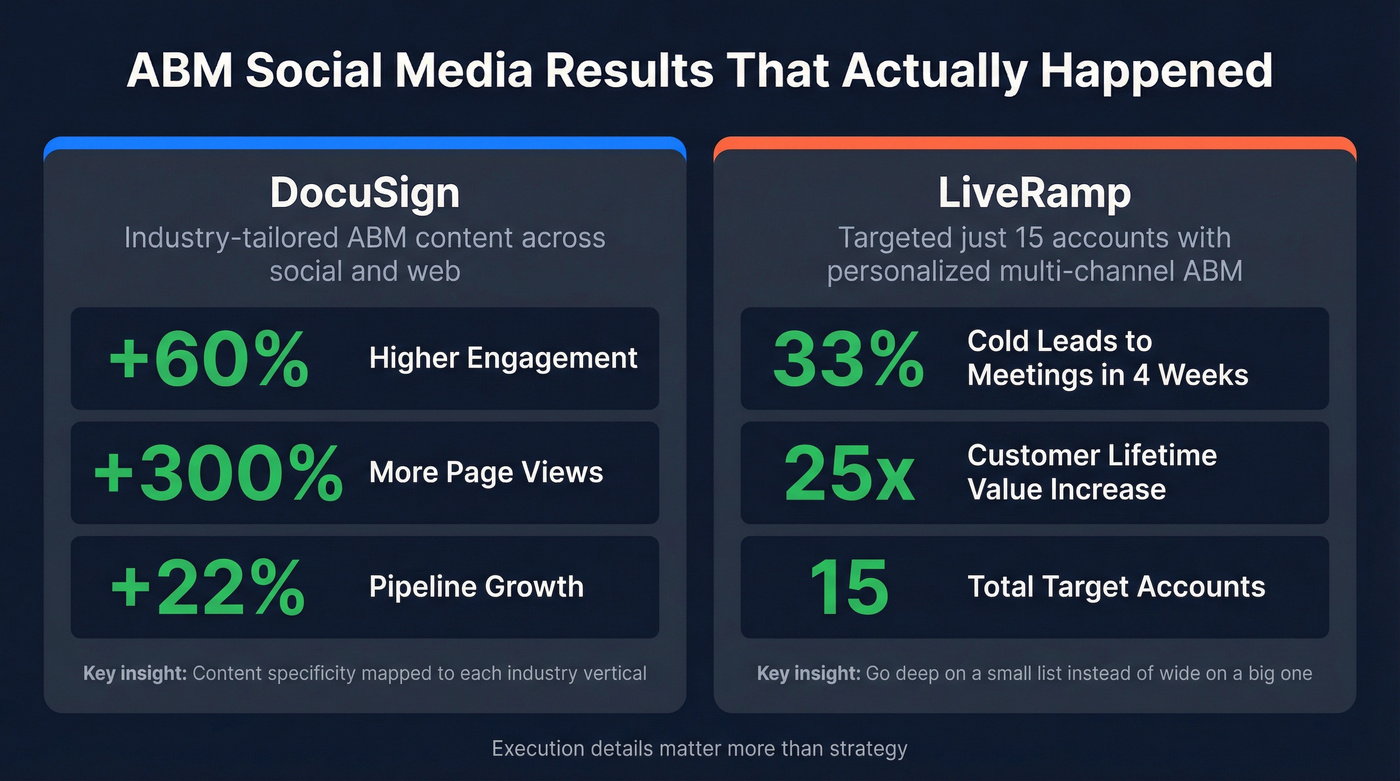
LiveRamp targeted just 15 accounts with personalized multi-channel ABM. They converted 33% of cold leads to meetings in four weeks and saw a 25x CLV increase over two years. That's what happens when you go deep on a small list instead of wide on a big one.
Let's be honest - most ABM social programs fail not because the strategy is wrong, but because the execution details (impression caps, data hygiene, tier alignment) get skipped. The teams that nail those basics are the ones posting case studies like these.
Your ABM buying committees have 11 stakeholders. Prospeo gives you verified emails, 125M+ direct dials, and 30+ filters - including buyer intent, job changes, and department headcount - so every member of the committee lands in your matched audience. At $0.01 per email, data quality stops being a budget conversation.
Reach the full buying committee, not just the 15% LinkedIn's algorithm picks.
FAQ
What social platform works best for ABM?
LinkedIn dominates for account-based marketing because it offers native matched audience targeting by company list, job function, and seniority. Facebook/Meta works as a retargeting supplement to stay visible outside work hours, but LinkedIn is where the majority of your budget should go first.
Do I need a platform like Demandbase or 6sense?
Not to start. LinkedIn's native tools plus clean, verified contact data get you 80% of the way there. Demandbase and 6sense typically require $500K+ annual budgets and dedicated ops teams - prove the motion works with lighter tooling first, then invest in a platform when you've outgrown manual workflows.
How do I improve my LinkedIn matched audience match rate?
Verify your contact data before uploading - stale emails are the top reason match rates crater below 40%. Use a bulk verification tool and include multiple identifiers (name, company, email) to maximize matches. Clean data routinely pushes match rates above 70%.