

7 ABM Strategy Examples With Real Metrics (Not the Same Recycled List)
A marketer on r/b2bmarketing described their "ABM program": a 500-company list on LinkedIn, same ads across every segment, leads dumped into a generic nurture, and sales getting crickets on follow-up. That's not ABM. That's demand gen with a smaller list.
Real ABM - the kind delivering 137% average ROI across 771 marketers - looks nothing like that. The seven examples below prove it, with actual metrics across all three tiers.
Before You Start
Three things matter more than any platform purchase:
Pick a tier. 1:1, 1:few, or 1:many ABM require different tactics, budgets, and team structures. Getting this wrong means you'll either over-invest in accounts that don't justify it or under-invest in whales that need white-glove treatment.
Start with 50-200 accounts and verified contacts. 56% of teams run ABM with a cobbled stack - CRM, enrichment, intent signals - not a six-figure platform. Verify contacts across the buying committee before you spend a dollar on ads. If you're evaluating vendors, start with a quick scan of data enrichment options.
Measure account engagement and pipeline velocity, not MQLs. If your dashboard still tracks marketing-qualified leads, you're measuring the wrong thing. (If you need a clean KPI setup, use a lead scoring model that rolls up to the account.)
The 3-Tier ABM Framework
Most teams should start with 1:few. It balances personalization with scale without requiring months of creative development per account.
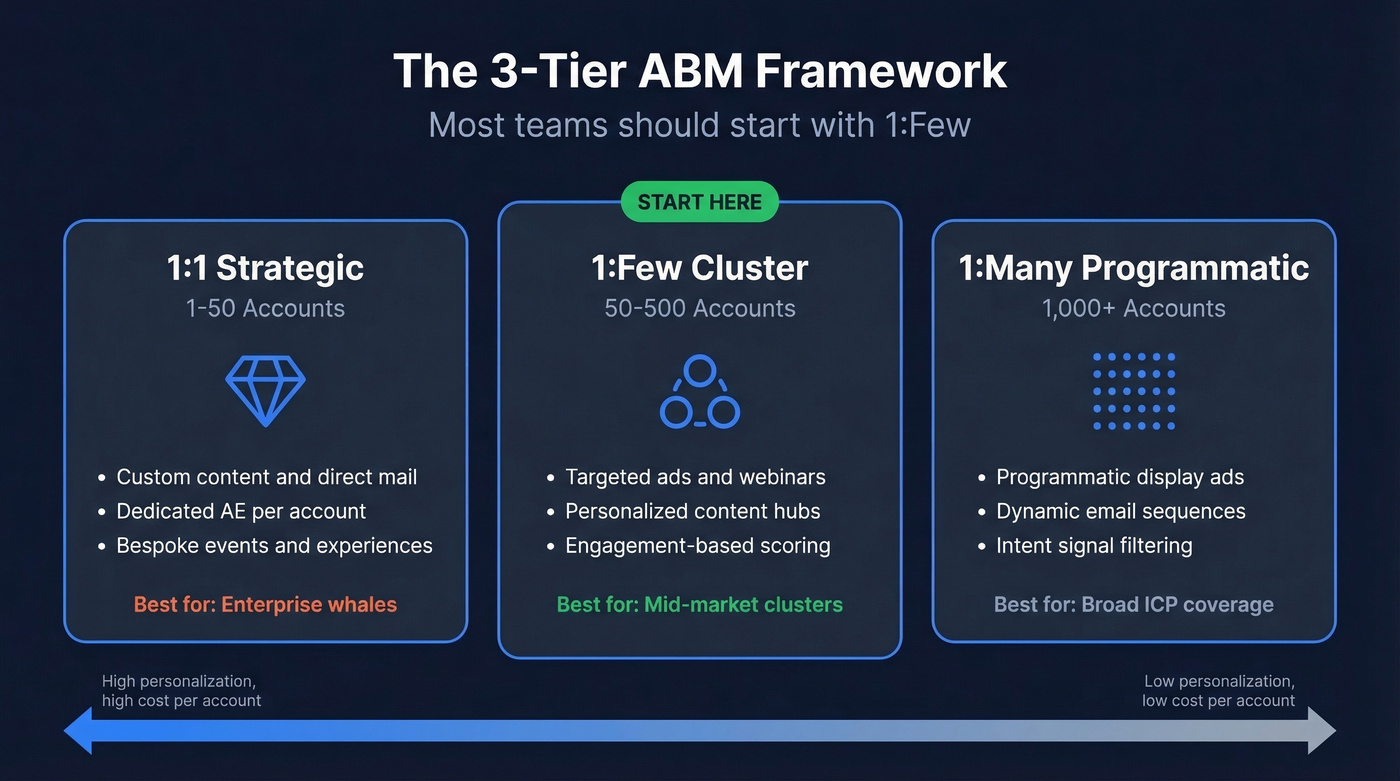
| Tier | Accounts | Tactics | Best For |
|---|---|---|---|
| 1:1 Strategic | 1-50 | Bespoke content, direct mail, custom events | Enterprise whales |
| 1:Few | 50-500 | Webinars, targeted ads, content hubs, email | Mid-market clusters |
| 1:Many | 1,000+ | Programmatic ads, dynamic emails, syndication | Broad ICP coverage |
The average buying committee includes 11 people with 17 interactions per member before a deal closes. That complexity is why tiering matters - you can't hand-craft 17 touchpoints for a thousand accounts. (If you're still defining who belongs in the committee, use an ideal customer profile and map roles from there.)
7 Real ABM Strategy Examples by Tier
1:1 Strategic ABM
GumGum x T-Mobile. They created a custom comic book called "T-Man and Gums" - editors, illustrators, the whole production - and shipped 100 copies to T-Mobile and its agencies. Within hours, CEO John Legere praised it on Twitter. Within days, a meeting was set. T-Mobile became a client.
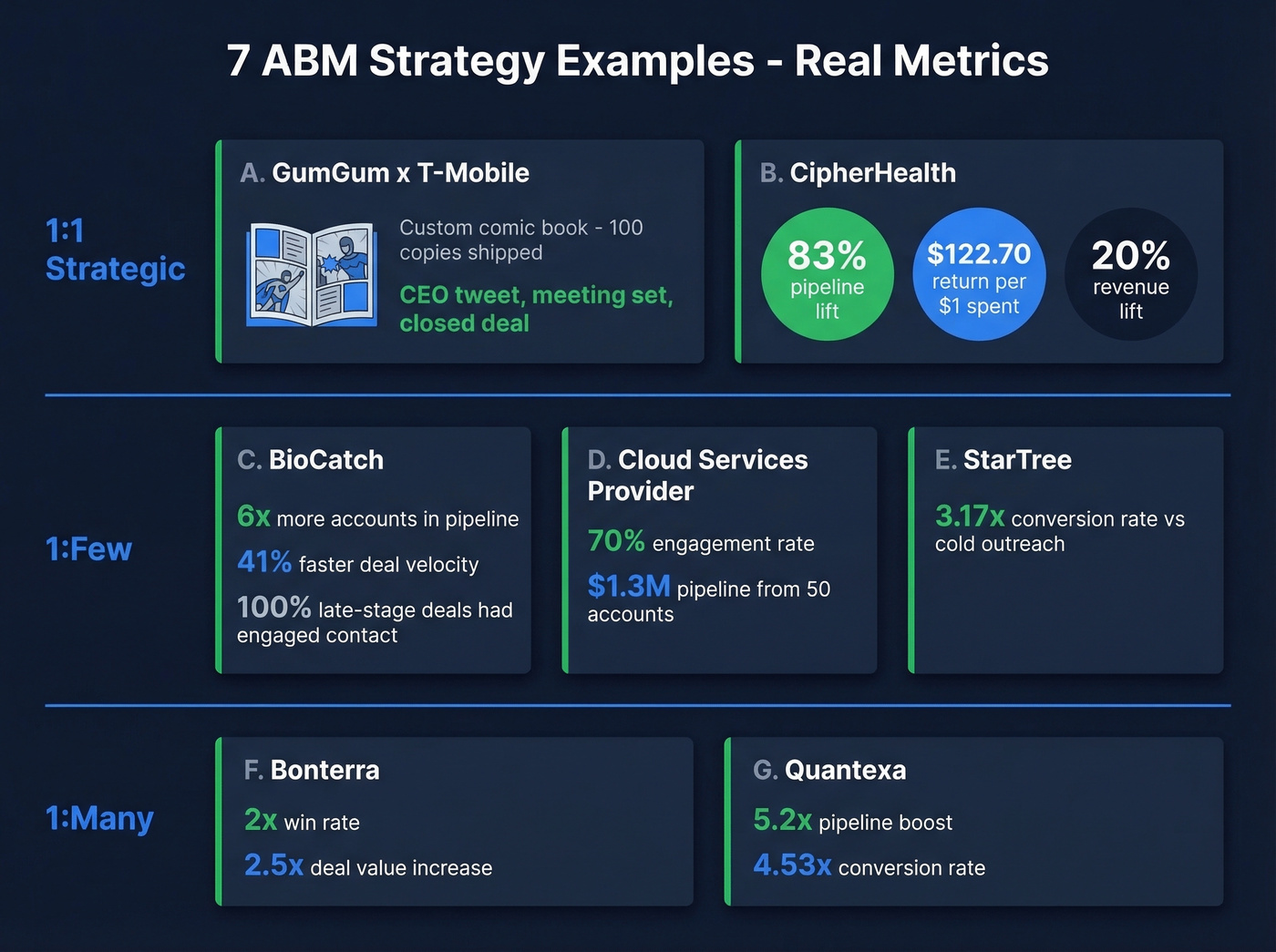
The takeaway isn't "make a comic book." It's that whale accounts justify creative investments you can't replicate at scale. A single high-conviction bet can outperform months of programmatic spend when the deal size warrants it. This is also where account-based selling needs to be tightly aligned with marketing.
CipherHealth's 83% pipeline lift. They ran contact-level ads targeting 51% of executive champions across their accounts and generated $122.70 in influenced revenue for every $1 spent, plus a 20% revenue lift. Here's what made it work: Slack and Salesloft notifications let SDRs act on ad clicks within hours, targeting specific people rather than company domains. Speed killed it. If your reps need a tighter process, standardize the sales follow-up motion.
1:Few ABM
BioCatch moved to engagement-based scoring and saw 6x more accounts enter pipeline, 41% faster deal velocity, and 100% of late-stage deals had at least one engaged contact. Not ad impressions. Not clicks. Engagement scoring triggers drove the acceleration. (If you're building the scoring model, start with funnel metrics and then weight activities.)
A cloud services provider [targeted 50 enterprise manufacturing accounts](https://www.inverta.com/resources/the-power-of-precision - building-effective-abm-campaigns-a-case-study) with personalized content hubs instead of one-off emails and hit a 70% engagement rate with $1.3M in pipeline. Content hubs beat drip campaigns because they let buyers self-direct - clicking what matters to them instead of waiting for your next scheduled send. This is one of the strongest examples for mid-market teams that lack the budget for fully bespoke 1:1 plays.
StarTree shifted from broad targeting to staged TOFU/MOFU/BOFU ad journeys synced with Salesforce contacts - 3.17x conversion rate versus cold outreach. Sales got alerts after 15 impressions or a click, turning ad engagement into live conversations. We've seen this pattern work repeatedly: the ad itself isn't the conversion event. The alert-to-SDR handoff is. If you're choosing tooling for that handoff, compare SDR tools before you buy.
1:Many Programmatic ABM
Bonterra scaled contact-level targeting across a large account list and doubled their win rate while increasing deal value 2.5x. Programmatic doesn't mean impersonal - they layered intent signals to prioritize which accounts got heavier investment. (If you want to operationalize that, start with intent based segmentation.)
Quantexa achieved a 5.2x pipeline boost and 4.53x conversion rate. Even at scale, signal-to-noise ratio determines results. Teams that filter aggressively on intent outperform those blasting the full list every time.

Every ABM example above has one thing in common: verified contacts across the buying committee before a single dollar was spent on ads. Prospeo gives you 300M+ profiles with 30+ filters - intent data, technographics, headcount growth - so you can build tiered account lists with 98% email accuracy at $0.01/lead.
Stop bouncing emails off stale data. Verify your buying committees first.
ABM Mistakes That Kill Pipeline
Measuring MQLs instead of account engagement. MQLs reward form fills. ABM rewards multi-threaded buying committee engagement. Different scoreboard entirely.
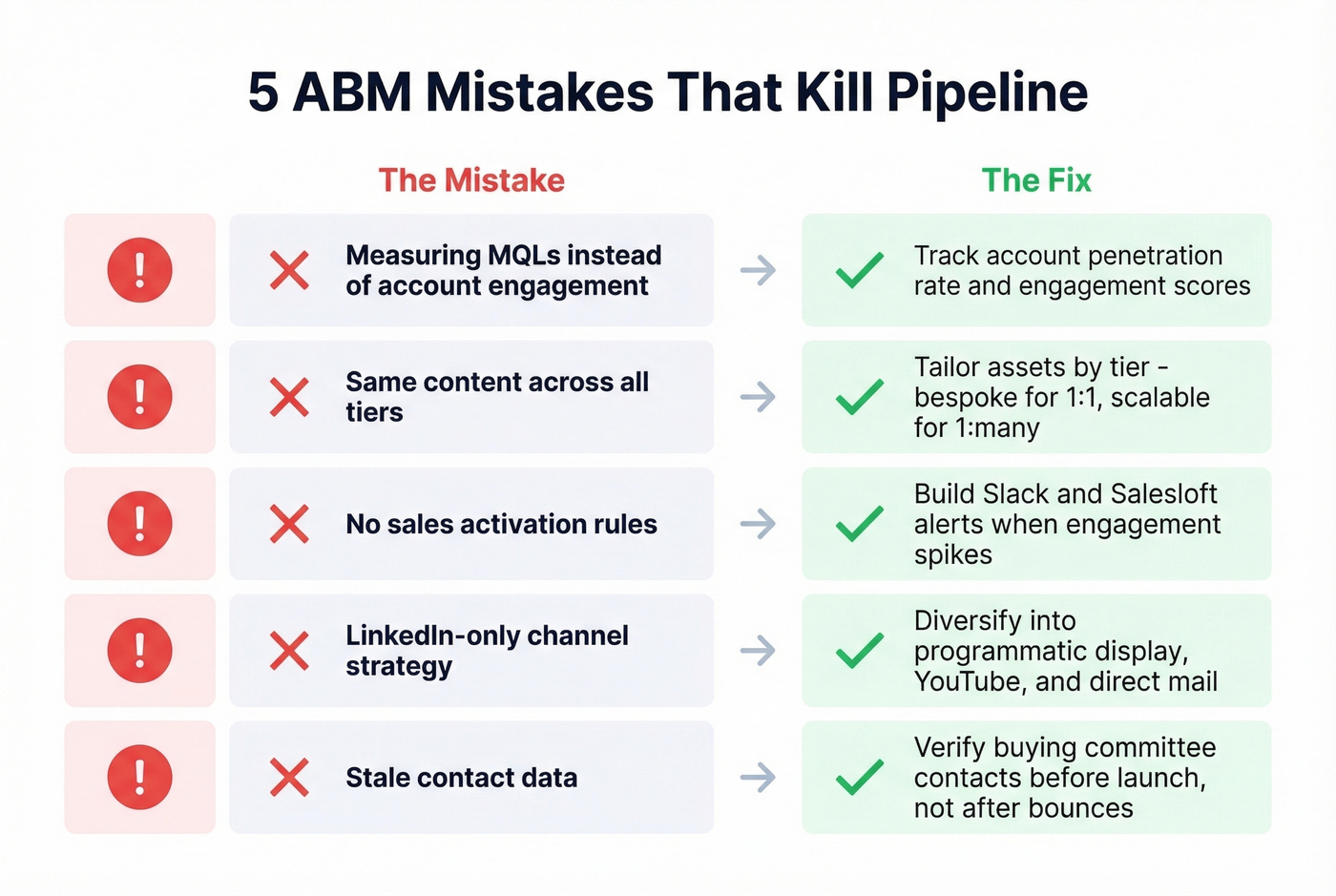
Same content across all tiers. A 1:1 whale and a 1:many target shouldn't receive the same whitepaper. If you're sending identical assets to both, you don't have a tiered program - you have a mailing list.
No sales activation rules. One practitioner on Reddit described getting "~50 submissions/month" with "sales typically getting little engagement" - because ad-engaged leads went into the same generic nurture as inbound. Build handoff triggers that route to SDRs immediately when engagement scores spike. If you're struggling to keep the process consistent, tighten your sequence management.
LinkedIn-only channel strategy. Look, LinkedIn Ads are expensive and underperform for awareness-stage ABM. We've watched teams waste months on LinkedIn-only strategies before diversifying into programmatic display, YouTube, and direct mail. Spread the budget.
Stale contact data. If half your buying committee contacts have changed roles, your sequences bounce and your domain reputation suffers. Verify before launching - not after your bounce rate hits 15%. (If you're seeing issues already, start with email bounce rate fixes.)
How to Measure ABM Results
Three formulas tell you whether your program is working:
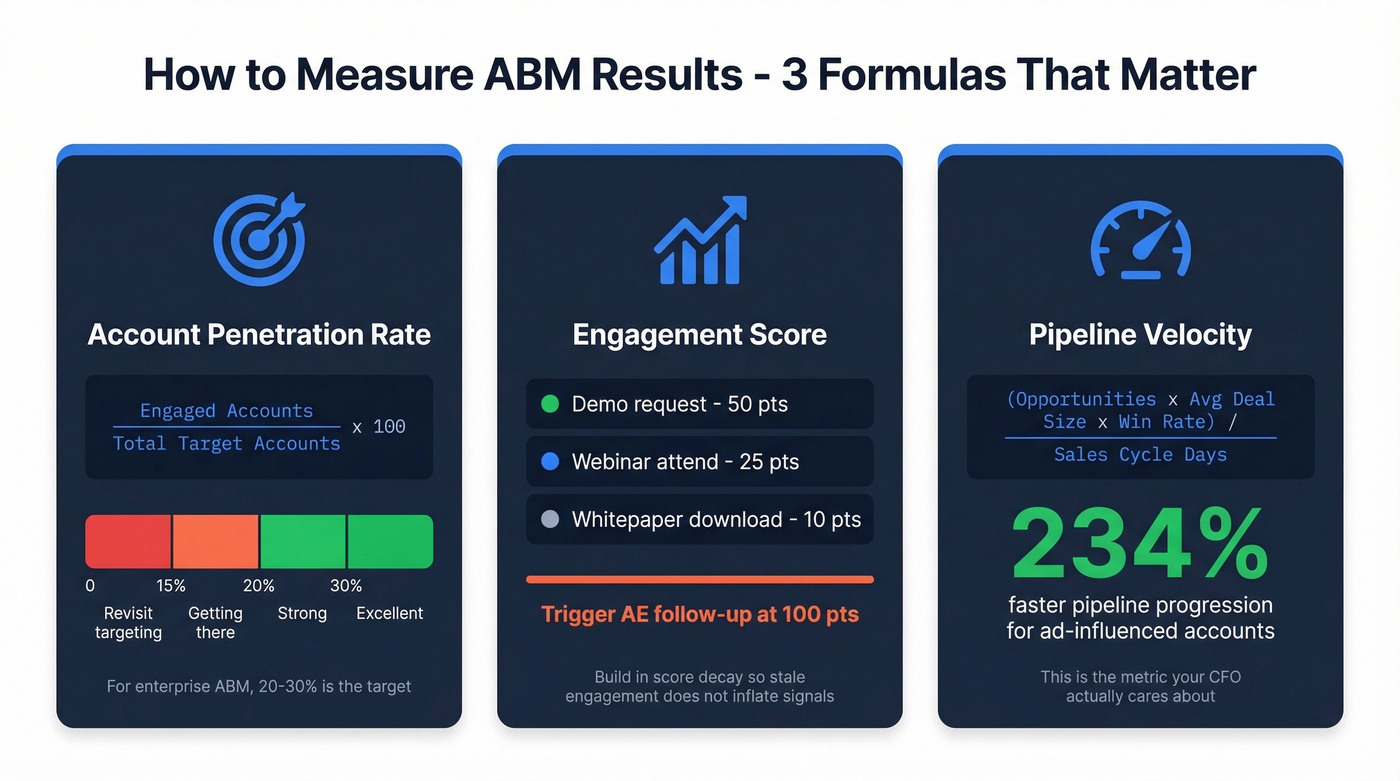
Account Penetration Rate: Engaged Target Accounts / Total Target Accounts x 100. For enterprise ABM, 20-30% is strong. Below 15%, revisit targeting or messaging.
Engagement Score: Weight activities across contacts - demo request at 50 pts, whitepaper at 10 pts, webinar at 25 pts. Trigger AE follow-up at 100 points. Build in score decay so last month's activity doesn't inflate today's signal. This is the metric most teams get wrong because they set it and forget it, letting stale engagement accumulate until the score means nothing.
Pipeline Velocity: (Opportunities x Avg Deal Size x Win Rate) / Sales Cycle Days. Ad-influenced accounts progress 234% faster through pipeline stages. This is the metric that connects marketing activity to revenue speed, and it's the one your CFO actually cares about. (To pressure-test your numbers, compare against sales pipeline benchmarks.)
Your ABM Stack Without a Six-Figure Budget
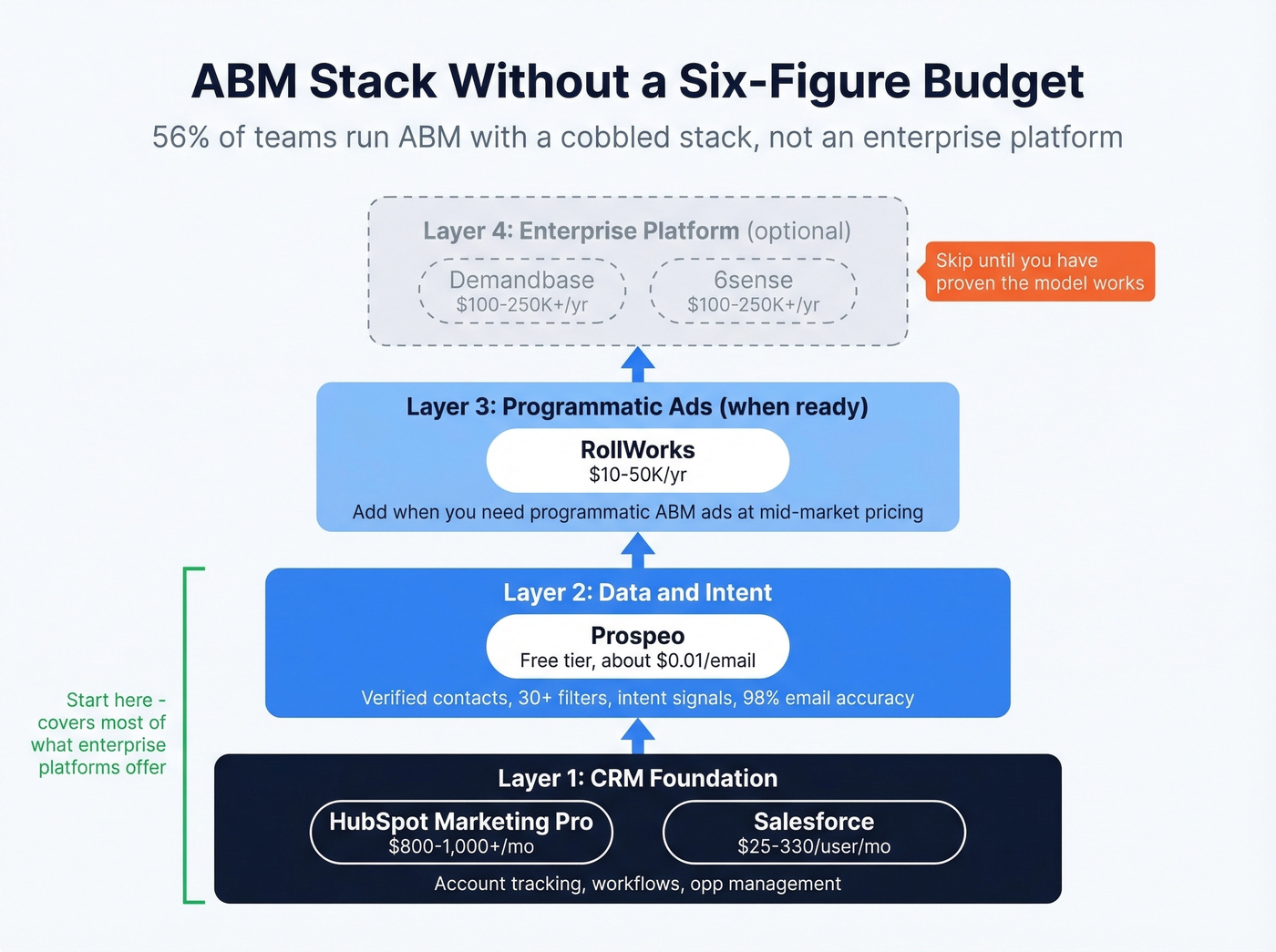
Let's be honest: if your average deal size is under $50K, you probably don't need Demandbase or 6sense. 48% of teams cite cost as the top barrier to dedicated ABM platforms. In our experience, four layers cover most of what those platforms offer:
| Stack Layer | Tool | Approx. Cost | What It Does for ABM |
|---|---|---|---|
| CRM | HubSpot Marketing Pro | ~$800-$1,000+/mo | Account tracking, workflows |
| CRM | Salesforce | ~$25-$330/user/mo | Account/opp management |
| Data + Intent | Prospeo | Free tier; ~$0.01/email | Verified contacts, 30+ filters, intent data |
| ABM Platform | RollWorks | ~$10-50K/yr | Programmatic ABM ads |
| ABM Platform | Demandbase | ~$100-250K+/yr | Full-suite intelligence |
| ABM Platform | 6sense | ~$100-250K+/yr | AI predictive analytics |
Skip Demandbase and 6sense evaluations until you've proven the model works. For most teams, CRM + verified contact data + your existing outbound tools get you running. Add RollWorks when you need programmatic ads at a mid-market price point. If you're still assembling the data layer, start with a sales prospecting database comparison.
Stale contact data doesn't just kill deliverability - it kills your entire ABM program. With a 7-day data refresh cycle (vs. the 6-week industry average), Prospeo ensures your buying committee contacts are current. Layer in Bombora intent signals across 15,000 topics to prioritize which accounts get 1:1 treatment.
Multi-thread every target account with contacts verified this week, not last quarter.
FAQ
What's the difference between ABM and demand gen?
Demand gen casts a wide net for lead volume. ABM targets specific accounts with personalized campaigns and measures account engagement, pipeline influence, and deal velocity - not individual lead counts. The two aren't mutually exclusive, but they need different metrics and handoff processes.
Can you run ABM without a dedicated platform?
More than half of ABM teams already do. A CRM, a data enrichment tool for verified contacts and intent signals, and your existing outbound stack cover the vast majority of what enterprise platforms offer. Start there, prove ROI, then evaluate platforms.
How do I build an ABM strategy for my team?
Select your tier (1:1, 1:few, or 1:many), define your ICP, and build a verified target account list with buying committee contacts mapped. Then choose channel tactics that match your budget and set measurement baselines using penetration rate, engagement score, and pipeline velocity. The examples in this article give you a template for each tier - adapt the one closest to your deal size and team capacity.
How long before ABM shows ROI?
Expect 3-6 months for early engagement signals and 6-12 months for measurable pipeline impact. Track leading indicators like account penetration rate weekly so you can optimize targeting and messaging before the pipeline numbers arrive.