

The ABM Campaign Playbook: From ICP to Pipeline in 2026
A RevOps lead we know spent three months building the perfect ICP model - win rates by geography, deal size, employee count, the works. Then she posted on Reddit: "I kind of don't know how to proceed." That gap between analysis and execution is where most account based marketing campaigns die. Demandbase's benchmark report, based on 300+ global marketers, found top B2B teams achieving 81% higher ROI with ABM. The difference between those teams and everyone else isn't budget or tooling - it's having an actual playbook.
Here's the thing: most teams don't need an ABM platform. They need a spreadsheet, verified contact data, and a sales team that actually follows up. The platform comes later.
What ABM Actually Means in Practice
A real ABM campaign is a coordinated, time-bound initiative targeting named accounts and orchestrating multi-channel experiences for buying committees. The key word is accounts, not leads. If your "ABM" program still reports on MQLs, you're running demand gen with a fancier label.
Demand gen optimizes for volume at the top of the funnel. ABM optimizes for depth within a defined set of accounts. Confusing them leads to misaligned goals, wrong KPIs, and frustrated sales teams who expected personalized air cover and got a webinar invite blast.
Which ABM Tier Should You Run?
| Tier | Accounts | Personalization Level | Best For | Key Metrics |
|---|---|---|---|---|
| 1:Few (start here) | 50-500 | Cluster-based | Mid-market, verticals | Engagement rate, pipeline |
| 1:1 Strategic | 1-50 | Fully custom | $100K+ ACV enterprise | Pipeline per account, velocity |
| 1:Many | Hundreds+ | Templated + dynamic | SMB, broad ICP | Account reach, conversion |
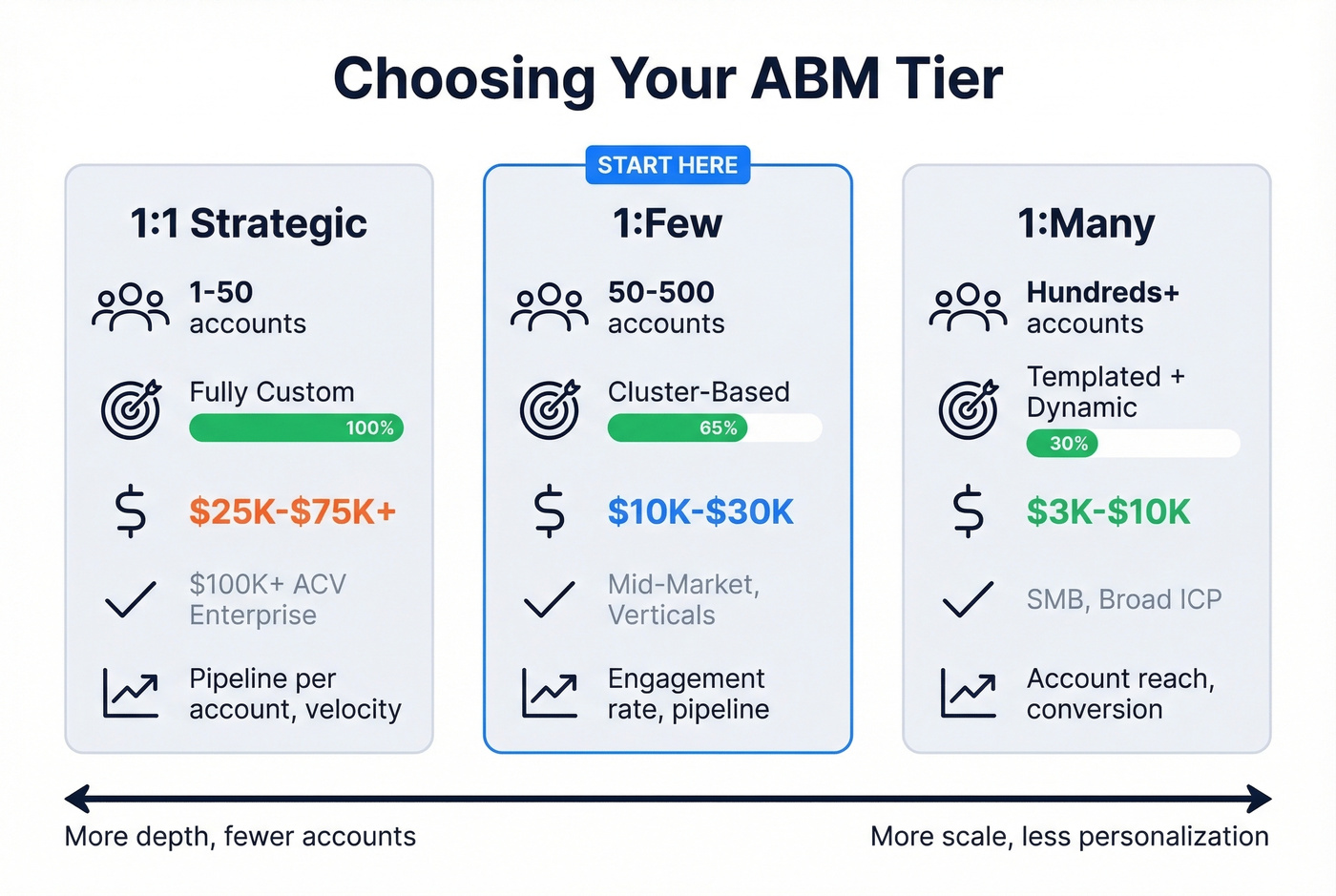
Start with 1:few. 1:1 requires dedicated resources most teams don't have yet, and 1:many is basically programmatic marketing with account filters - useful, but it won't teach you the ABM muscle of coordinating sales and marketing around specific accounts. The 1:few tier gives you enough volume to learn what works while keeping personalization meaningful.
How to Plan Your ABM Campaign
The biggest mistake teams make is planning front-to-back - ICP first, measurement last. Flip it.
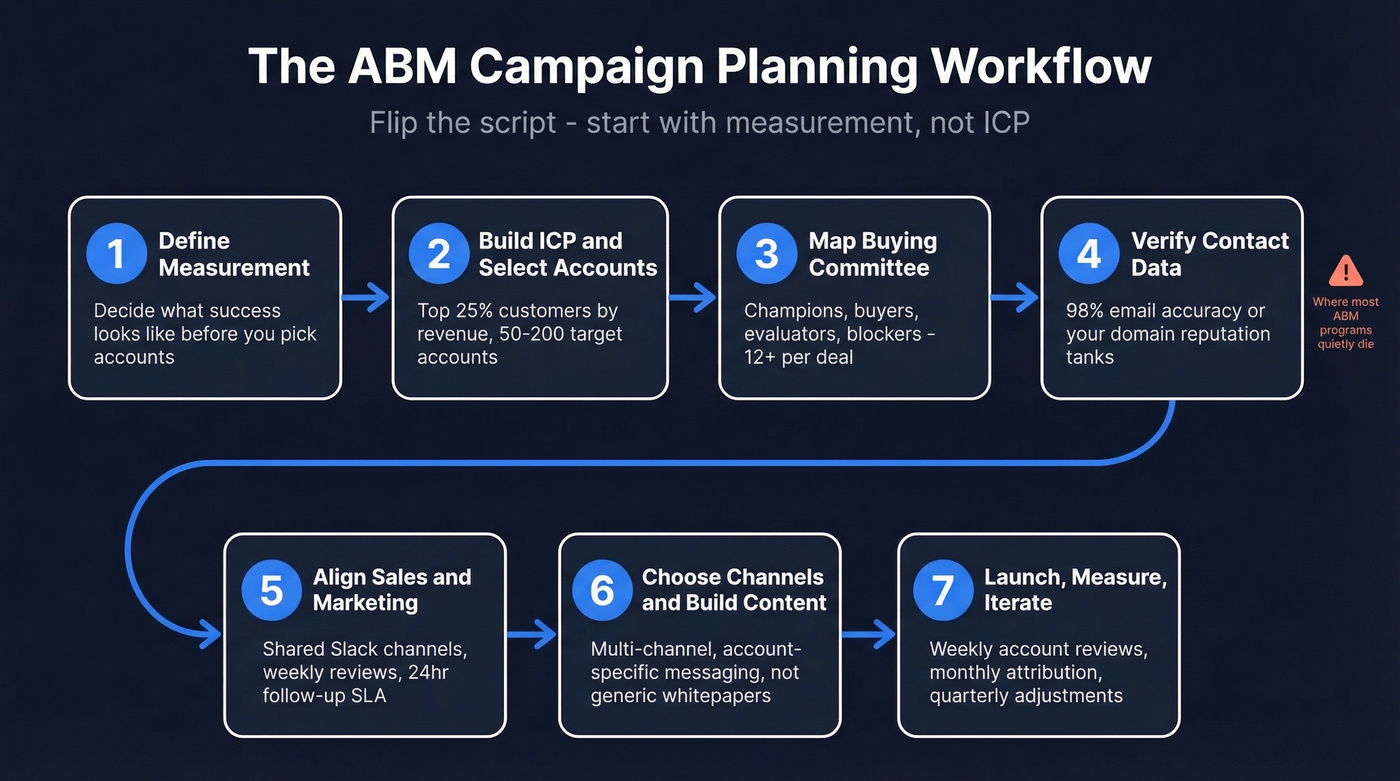
Step 1: Define your measurement framework first. Before you pick a single account, decide what "success" means at each stage. If you can't measure it, don't launch it.
Step 2: Build your ICP and select accounts. Pull your top 25% of customers by revenue. Analyze win rates by industry, company size, geography, and tech stack. The output is a target account list of 50-200 accounts. This is where that Reddit practitioner got stuck - the ICP work was solid, but translating it into an executable list with real contacts is a different skill entirely. If you need a starting point, use an Ideal Customer Profile template and score accounts consistently.
Step 3: Map the buying committee. Enterprise deals involve upwards of 12 people. Identify champions, economic buyers, technical evaluators, and blockers at each target account. A campaign that only reaches one persona isn't ABM - it's outbound with extra steps.
Step 4: Build your verified contact list. This is where ABM programs quietly die. If 30-40% of your emails bounce on the first sequence, your domain reputation tanks and the whole program stalls. We've seen this play out dozens of times. Snyk's 50-person AE team dropped bounce rates from 35-40% to under 5% and generated 200+ new opportunities per month after switching to Prospeo for their data layer - 98% email accuracy with a 7-day refresh cycle makes that kind of turnaround possible. (If you're troubleshooting bounces, see email bounce rate benchmarks and fixes.)

Step 5: Align sales and marketing operationally. Shared Slack channels for each account cluster, weekly joint pipeline reviews, and a clear SLA - marketing delivers engaged accounts with contact-level signals, sales follows up within 24 hours. Without this handshake, your campaign is two teams running parallel plays that never connect. If your handoff is messy, tighten sales execution and standardize sales operations metrics.
Step 6: Choose channels and build content. Multi-channel is non-negotiable. Paid display, personalized email sequences, direct mail for top-tier accounts, and coordinated SDR outreach all working in concert. Build content for accounts, not personas - industry-specific pain points, not generic whitepapers. This is where ABM digital marketing campaigns diverge from traditional demand gen: every channel reinforces the same account-level message rather than casting a wide net. For direct mail ideas and ops, use this direct mail for lead generation guide.
Step 7: Launch, measure, iterate. Weekly reviews of account progression, monthly pipeline attribution, quarterly program adjustments.
Steal-Worthy ABM Tactics
Strategy is necessary but insufficient. Here are specific campaign ideas that top-performing teams actually run.
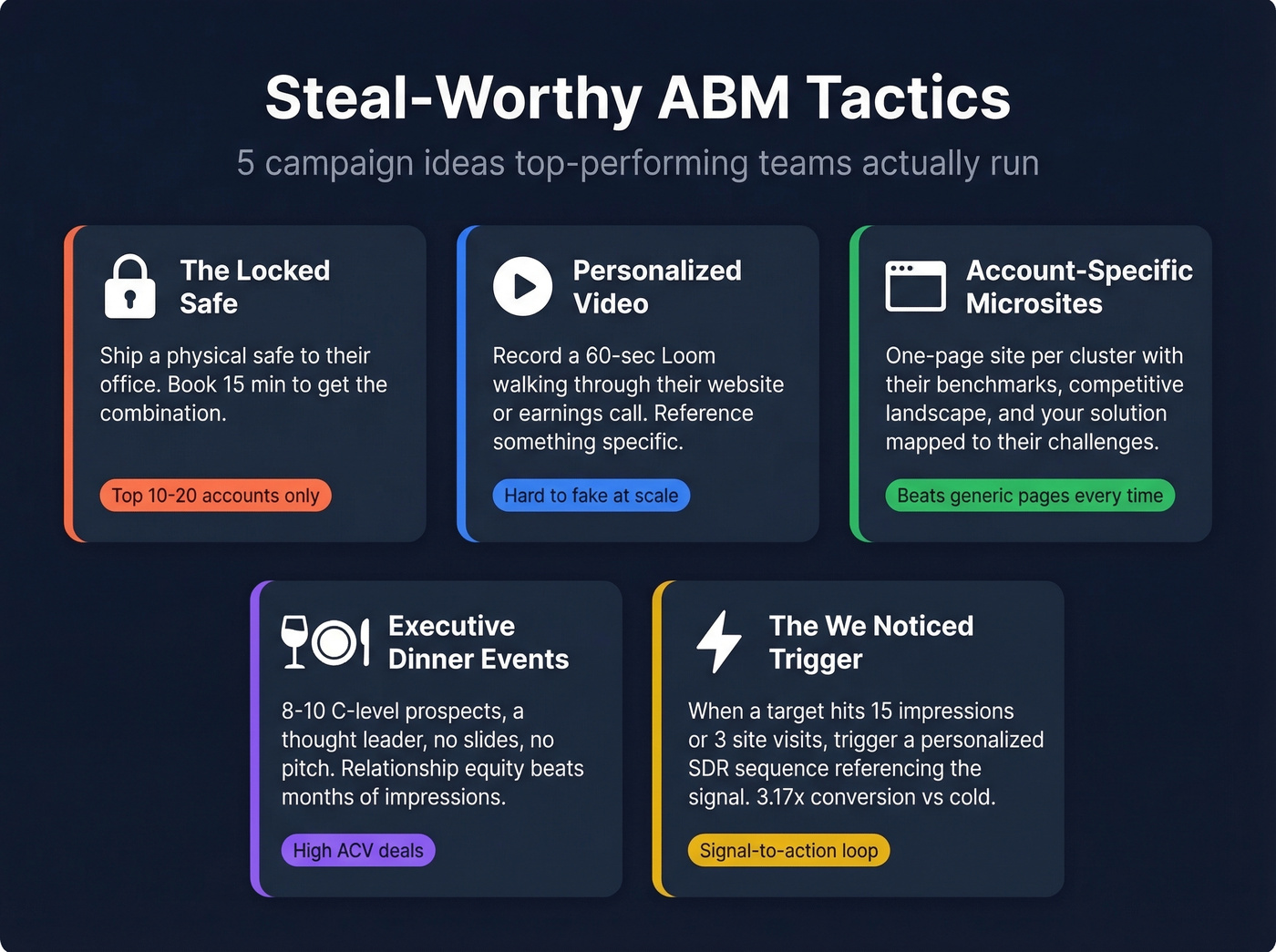
The locked safe. Ship a physical safe to a target account's office with a note: "Your competitive advantage is inside. Book 15 minutes and we'll send the combination." Expensive per unit, so reserve it for your top 10-20 accounts.
Personalized video outreach. Record a 60-second Loom walking through the prospect's website, product, or recent earnings call. Reference something specific - a job posting that signals a pain point, a recent product launch, a competitor move. In our experience, this consistently beats templated email because it's hard to fake at scale. If you want a tighter workflow, borrow this Loom video cold email approach.
Account-specific microsites. Build a one-page site for each target account cluster showing their industry benchmarks, competitive landscape, and how your solution maps to their specific challenges. Terminus and Mutiny make this easier, but even a simple landing page with the company's logo and tailored messaging outperforms generic pages by a wide margin.
Executive dinner events. Invite 8-10 C-level prospects from your target accounts to a private dinner with a thought leader or industry peer. No slides, no pitch - just conversation. The relationship equity from one dinner can accelerate deals more than months of impressions.
The "we noticed" trigger campaign. When a target account hits a signal threshold - 15 ad impressions, 3 website visits, a job posting for a role your product supports - trigger a personalized SDR sequence referencing the signal. StarTree used this exact mechanic and achieved a 3.17x conversion rate versus cold outreach. To operationalize this, build a system for identifying buying signals and how to track sales triggers.

ABM campaigns live or die on contact data quality. Prospeo gives you 30+ filters - buyer intent, technographics, department headcount, funding - to build target account lists with 98% verified emails and 125M+ direct dials. Snyk's 50 AEs dropped bounce rates from 35% to under 5% and generated 200+ opportunities per month.
Stop letting bad data kill your ABM campaigns before they start.
What ABM Campaigns Actually Cost
| Tier | Monthly Budget | What's Included |
|---|---|---|
| 1:Many | $3K-$10K/mo | Data tools, programmatic ads, email sequences |
| 1:Few | $10K-$30K/mo | Above + paid social, direct mail, SDR time |
| 1:1 Strategic | $25K-$75K+/mo | Above + custom content, events, executive engagement |
One practitioner on r/b2bmarketing shared their reality: $12K/month on LinkedIn ABM ads with an $18 average CPC. At that rate, roughly 3 clicks per day - barely enough volume to test creative variations, let alone drive pipeline.
You don't need a $50K platform to start. A CRM, a solid data provider at ~$0.01/email versus ~$1/lead with enterprise incumbents, coordinated SDR outreach, and a modest paid budget can run an effective 1:few program. The platform investment makes sense after you've proven the motion works. If you're building the outreach motion, keep a library of sales follow-up templates and proven sales prospecting techniques.
ABM Campaigns That Drove Pipeline
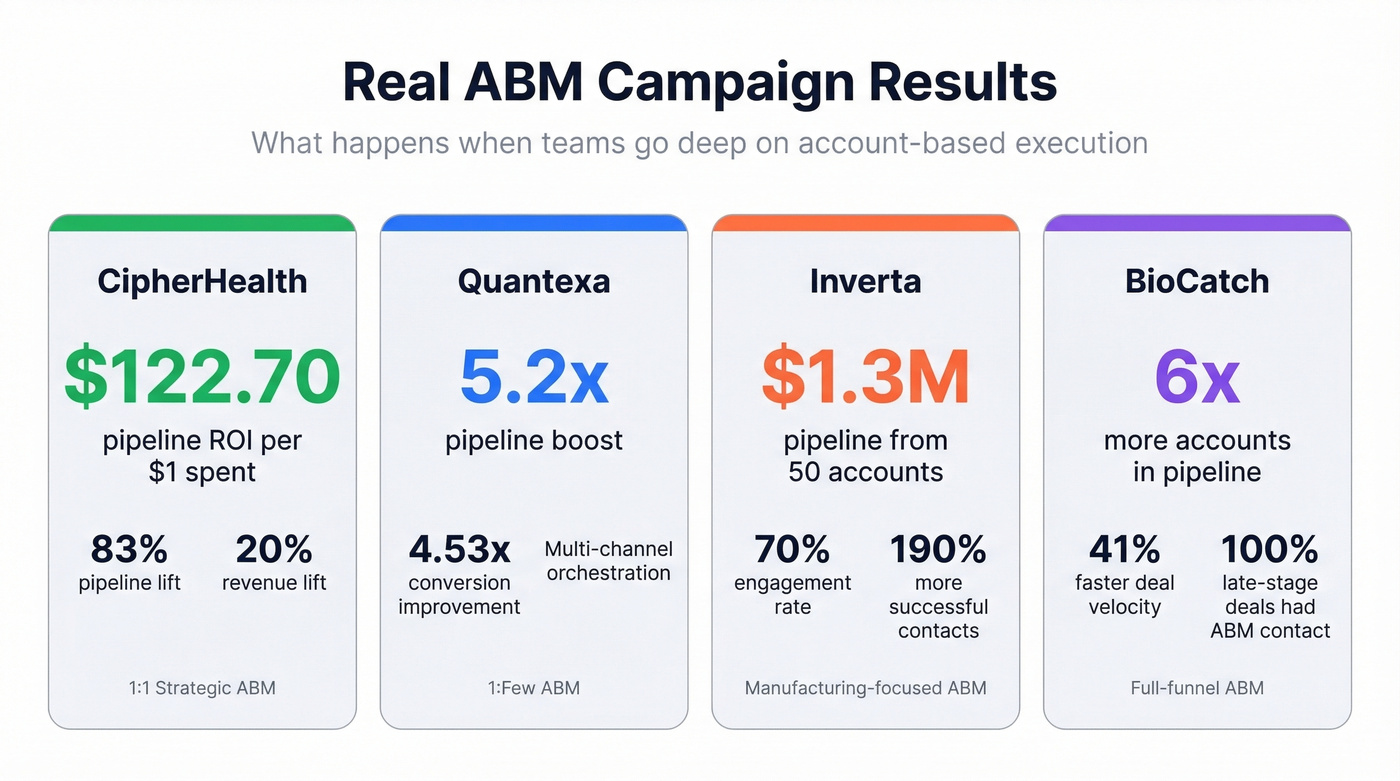
CipherHealth: $122 Back for Every $1
A 1:1 strategic program that delivered $122.70 in pipeline for every $1 spent, with an 83% pipeline lift and 20% revenue lift. The takeaway isn't the headline number - it's that this level of return required deep per-account investment that only pencils out for high-ACV enterprise deals. If your average contract value is under $50K, skip 1:1 and focus on 1:few.
Quantexa: Multi-Channel Compounding
Their program generated a 5.2x pipeline boost with a 4.53x conversion rate improvement. What made it work wasn't any single channel - it was tight account selection combined with orchestrated touches across the entire buying committee. Running ads at a target list alone would've produced a fraction of these results.
Inverta: 50 Accounts, $1.3M in Pipeline
This manufacturing-focused campaign targeting just 50 enterprise accounts hit a 70% engagement rate and a 190% increase in successful contacts. The constraint of a small list forced the team to go deep - every account got custom research, tailored messaging, and coordinated outreach. The $1.3M pipeline proved that depth beats breadth.
BioCatch: Speed Kills (In a Good Way)
BioCatch's ABM program put 6x more accounts into pipeline while accelerating deal velocity by 41%. The standout metric: 100% of their late-stage deals had at least one engaged contact from their ABM efforts. That's the clearest proof that marketing air cover directly influences close rates.
StarTree: Signal-to-Action in Real Time
When a targeted contact clicked an ad or accumulated 15 impressions, sales received an automated notification to reach out. That signal-to-action loop produced a 3.17x conversion rate versus cold outreach. The lesson isn't just about reaching accounts - it's about reaching them at the exact moment intent peaks.
The Measurement Framework Most Teams Skip
Let's be honest: attribution in ABM is structurally broken. Cookie loss from Safari ITP and ad blockers, UTM overwrites across touchpoints, redirect chains from link shorteners, and 90-day attribution windows that miss long sales cycles - these aren't bugs you can fix.
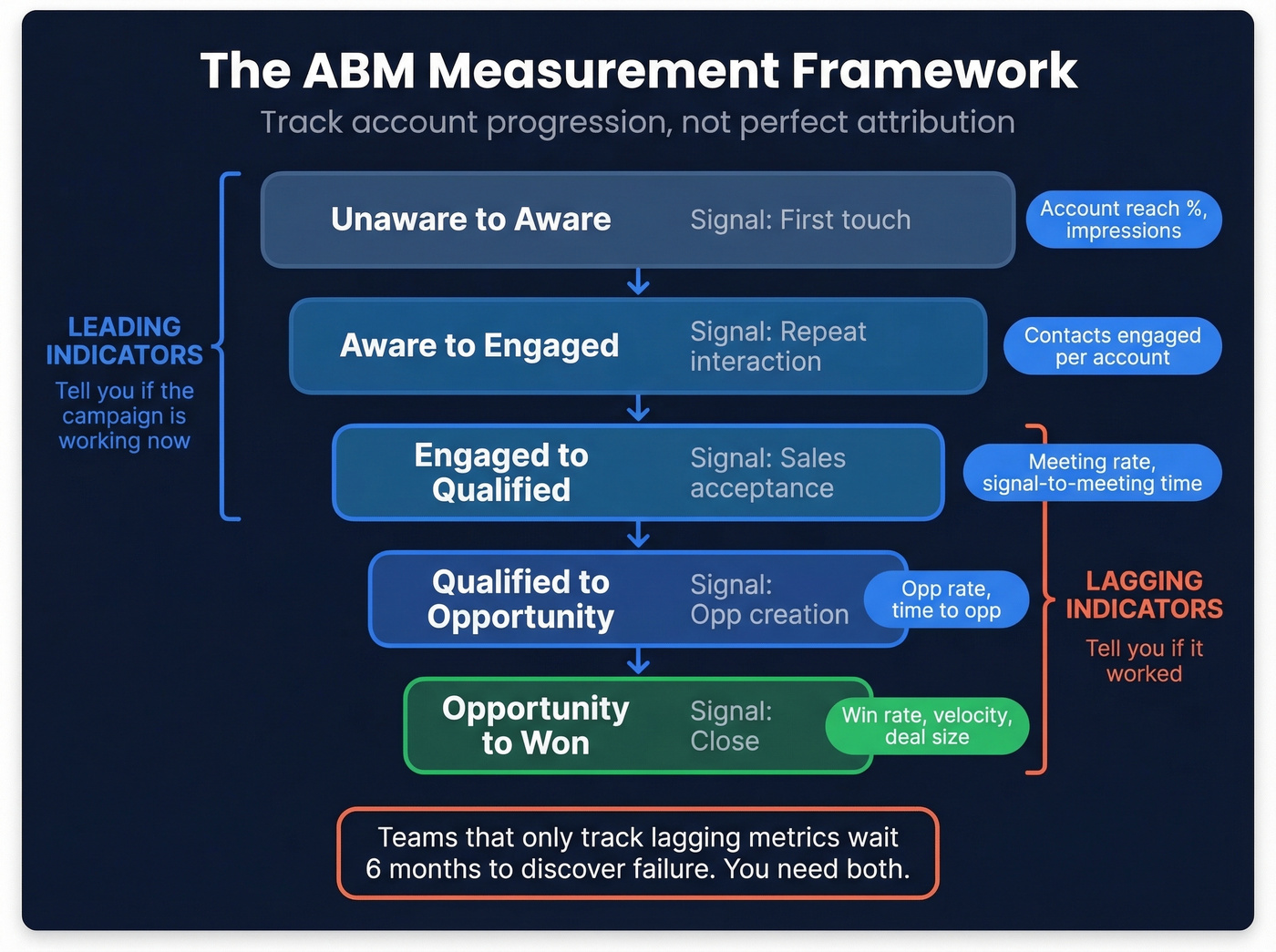
Instead of chasing perfect attribution, build a stage-based framework that tracks account progression.
| Stage | Transition Signal | Key KPIs |
|---|---|---|
| Unaware to Aware | First touch | Account reach %, impressions |
| Aware to Engaged | Repeat interaction | Contacts engaged per account |
| Engaged to Qualified | Sales acceptance | Meeting rate, signal-to-meeting time |
| Qualified to Opportunity | Opp creation | Opp rate, time to opp |
| Opportunity to Won | Close | Win rate, velocity, deal size |
The critical distinction is between leading and lagging indicators. Leading indicators - engagement scores, intent signals, account penetration rate - tell you if the campaign is working now. Lagging indicators - pipeline value, win rate, deal velocity - tell you if it worked. Teams that only track lagging metrics wait 6 months to discover their campaign failed. Teams that only track leading metrics celebrate engagement that never converts. You need both, reported separately. If you want a clean set of KPIs, start with funnel metrics and a simple view of pipeline health.
For benchmarks: 6sense reports that well-executed ABM programs drive 5x increases in pipeline velocity and 35% win rates from targeted accounts. If you're not in that range after two quarters, the problem is usually mid-funnel handoff, not top-of-funnel targeting.
Why ABM Programs Flatline
Most ABM programs don't fail dramatically. They stall quietly.
One-channel ABM. Running LinkedIn ads at a target list isn't ABM. It's paid social with a filter. Real ABM requires ads, email, SDR outreach, content, and sometimes direct mail working together.
Content built for leads, not accounts. Generic whitepapers gated behind forms don't move buying committees. Account-level content addresses specific business challenges of your target companies or industries - think a custom ROI model for a prospect's vertical, not a "State of B2B" PDF.
Confusing activity with progression. High engagement scores feel good. But if accounts aren't moving from "Aware" to "Engaged" to "Qualified," you're generating noise. Track stage transitions, not activity volume.
Mid-funnel drop-off. This is the most common failure point we see - the gap between first engagement and sales qualification. Accounts show initial interest, but nobody follows up with the right message at the right time. This is where signal-to-sales handoffs make or break the program.
ABM Tools Worth Evaluating
You need a minimum viable stack covering data, orchestration, and measurement.
| Category | Tools | Starting Price |
|---|---|---|
| Data & Enrichment | Prospeo, ZoomInfo, Clearbit | ~$39/mo to $15K-$40K/yr |
| Intent Data | Bombora, 6sense | ~$20K-$60K/yr |
| Orchestration | Demandbase, Terminus, RollWorks | ~$25K-$100K+/yr |
| Personalization | Mutiny, Influ2 | ~$10K-$40K/yr |
| Marketing Automation | HubSpot (best for SMB), Marketo (best for enterprise) | ~$800/mo to $2K+/mo |
For teams just getting started: pick one data provider, use your existing MAP and CRM for orchestration, and add intent data or a dedicated ABM platform only after you've proven the motion works. The minimum viable ABM stack is simpler than vendors want you to believe.
Mapping buying committees across 50-500 accounts means thousands of contacts that need to be accurate on day one. Prospeo's 7-day data refresh cycle keeps your ABM lists current - not 6 weeks stale like the industry average - at roughly $0.01 per verified email. No contracts, no sales calls required.
Get verified contacts for every buyer in your target accounts today.
FAQ
How long does an ABM campaign take to show results?
Expect measurable pipeline impact in 3-6 months for 1:few programs. Enterprise 1:1 campaigns often take 6-12 months due to longer sales cycles. Set stakeholder expectations before launch - ABM compounds over quarters, not weeks.
Can you run ABM without a dedicated platform?
Yes. A CRM, verified contact data, and coordinated SDR outreach can run effective 1:few campaigns. Add a dedicated orchestration platform only after you've proven the motion generates pipeline.
What's the minimum budget to get started?
A 1:many program starts at $3K-$5K/month covering data and basic paid media. Below that threshold, run outbound-only ABM with personalized sequences and no paid spend - still effective if your contact data is accurate.
How many accounts should you target first?
Start with 50-200 accounts in the 1:few tier. That's enough volume to generate statistically meaningful learnings but small enough to personalize messaging per cluster. Expand after the first quarter based on engagement and pipeline data.
What separates ABM from demand gen?
Demand gen casts a wide net and measures lead volume. ABM targets named accounts and measures account-level progression through pipeline stages. They're complementary strategies with different KPIs - most mature teams run both simultaneously.