

Best Automated Lead Generation Software in 2026
A RevOps lead we know ran a three-tool bake-off last quarter. Apollo, Seamless.AI, and Clay - all running simultaneously against the same ICP list. The "best" database by contact volume created 4,000 duplicate records in Salesforce within five days. The cheapest tool had better email deliverability. An r/LeadGeneration poster put it bluntly: they've tried Apollo, Seamless, Clay, and others, and there's no single clear winner. Most teams end up stacking two or three tools to cover the gaps.
The lead generation automation market hit $7.4B in 2025 and is projected to reach $16.2B by 2034. More tools, more noise, more confusion about what actually works. Most guides lump popup tools, CRMs, and prospecting databases into the same list - those are fundamentally different categories. We're separating them here so you can build a stack that delivers.
Our hot take: ZoomInfo is still the most complete all-in-one platform. But most teams don't need all-in-one. They need accurate emails, a sequencer, and a CRM. That stack costs 80% less and often outperforms the monolith.
We've tested, broken, and rebuilt stacks across dozens of sales orgs. Here's what's actually worth your time.
Our Picks at a Glance
| Use Case | Tool | Why |
|---|---|---|
| Best email accuracy | Prospeo | 98% email accuracy, 7-day refresh, free tier |
| Best free tier to start | Apollo.io | 275M+ contacts, free plan, built-in sequencing |
| Best custom workflows | Clay | AI agents + 50+ data sources, deep enrichment |
| Best for enterprise | ZoomInfo | Deepest feature set, 100M+ contacts, intent data |
| Best for EU/GDPR teams | Cognism | Phone-verified mobiles, strong European coverage |
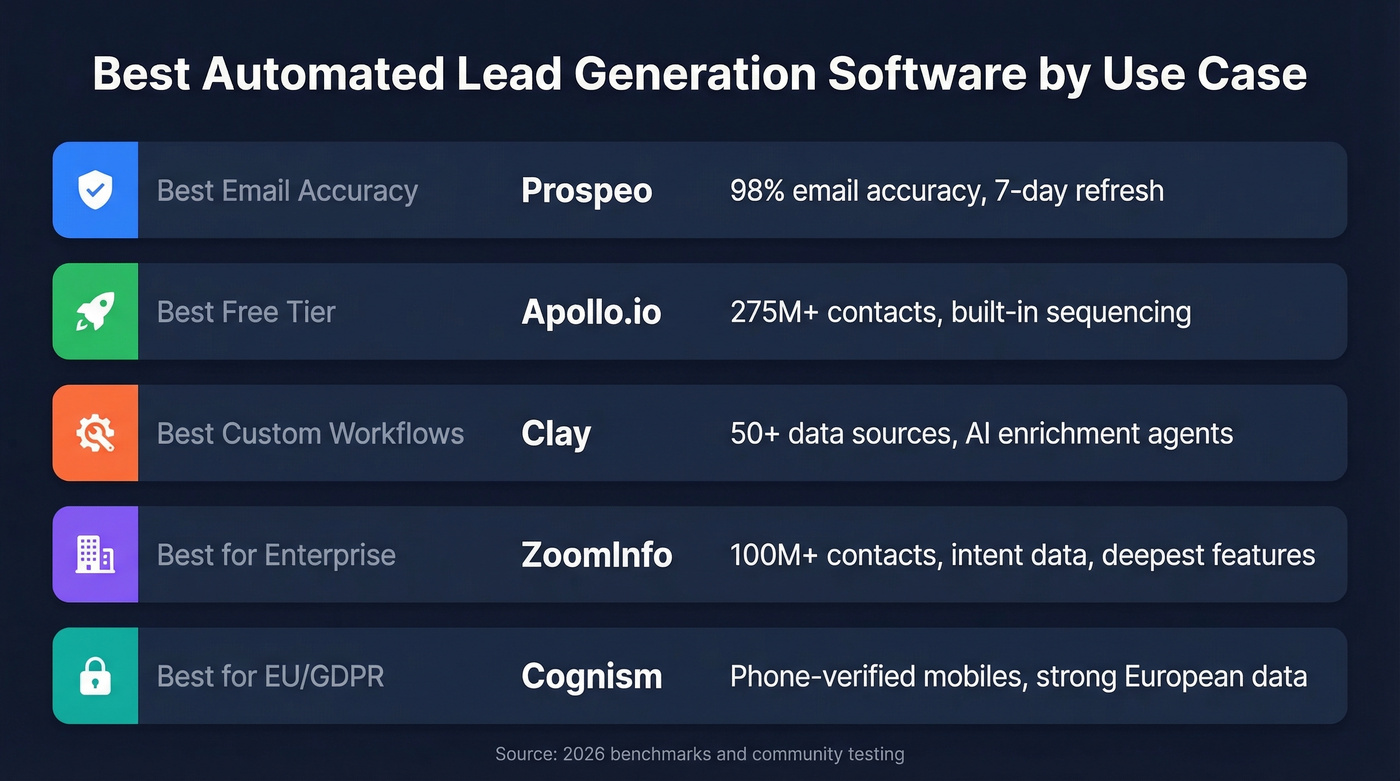
Apollo is the obvious starting point if you need a free plan with built-in sequencing. ZoomInfo remains the enterprise default when budget isn't a constraint. Clay is the power tool for RevOps teams building custom enrichment workflows. And Cognism owns the GDPR-compliant mobile number space.
What to Look For Before You Buy
Before you trial anything, nail down these criteria. They'll save you from a painful migration six months from now.
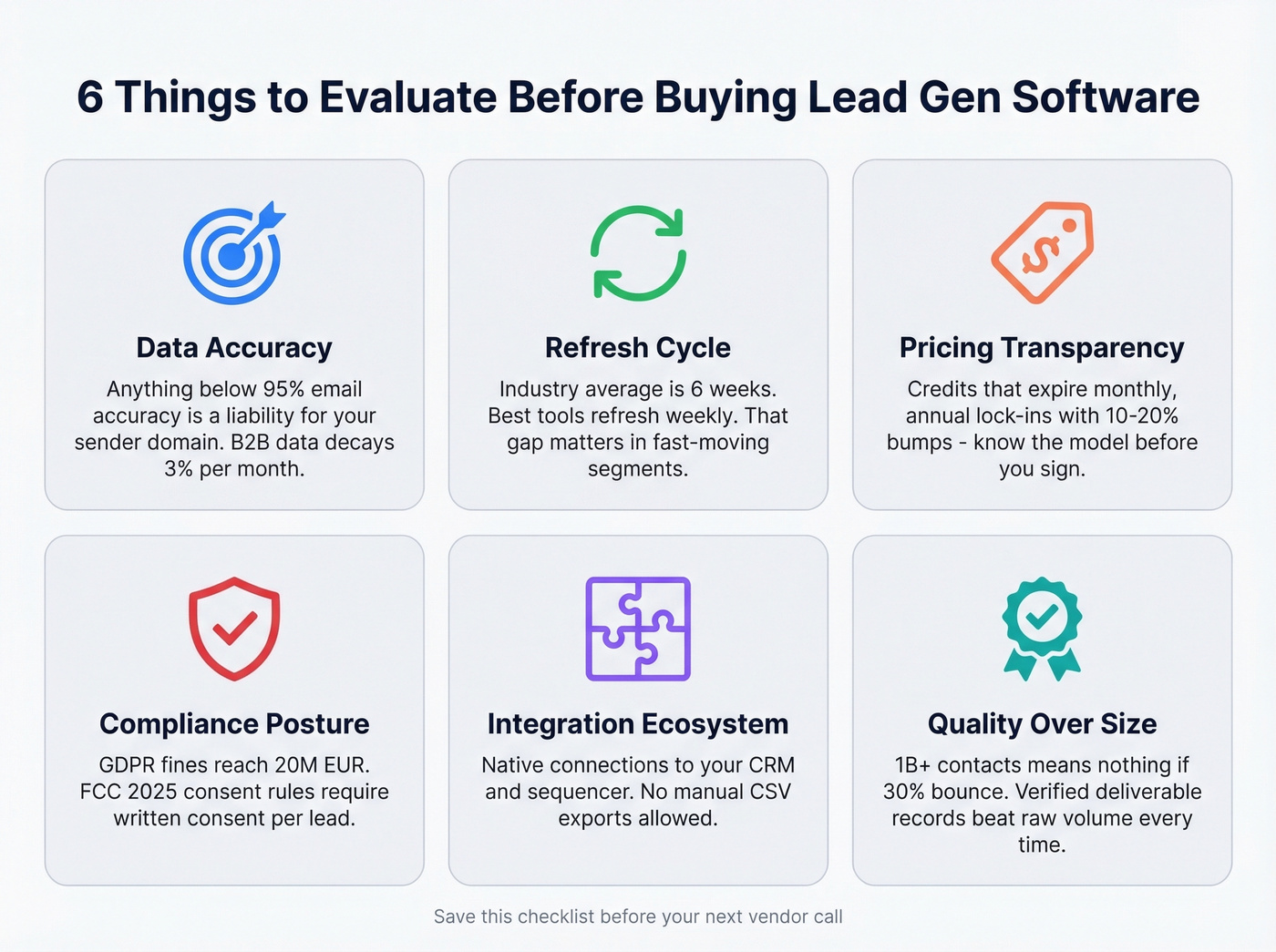
Data accuracy benchmarks. B2B contact data decays at roughly 3% per month - people change jobs, companies get acquired, emails go dark. Anything below 95% email accuracy is a liability for your sender domain. (If you want the operational playbook, start with an email deliverability audit.)
Refresh cycle. How often does the provider re-verify its database? The industry average is about six weeks. Some tools refresh weekly. That gap matters when you're prospecting into fast-moving segments like tech or startups.
Pricing model transparency. Credit-based, seat-based, and quote-based pricing all have different traps. Credits that expire monthly punish you for slow months. Annual contracts with 10-20% renewal bumps lock you in. Know the model before you sign.
Compliance posture. GDPR fines reach EUR 20M or 4% of global turnover. The FCC's January 2025 consent rule requires prior express written consent for every lead. If your tool can't demonstrate granular consent tracking and DSAR workflows, you're carrying regulatory risk. (Related: Is It Illegal to Buy Email Lists?)
Integration ecosystem. Your data tool needs to feed your sequencer and CRM without manual CSV exports. Check for native integrations with your existing stack - Salesforce, HubSpot, Outreach, Lemlist, whatever you're running. If you're mapping this end-to-end, use a connect outreach tool to CRM checklist.
Database size vs. quality. A tool claiming 1B+ contacts sounds impressive until 30% bounce. Size matters less than verified, deliverable records. (See email bounce rate benchmarks and fixes.)
Master Comparison Table
Pricing reflects 2026 community-reported ranges and published list prices where available.
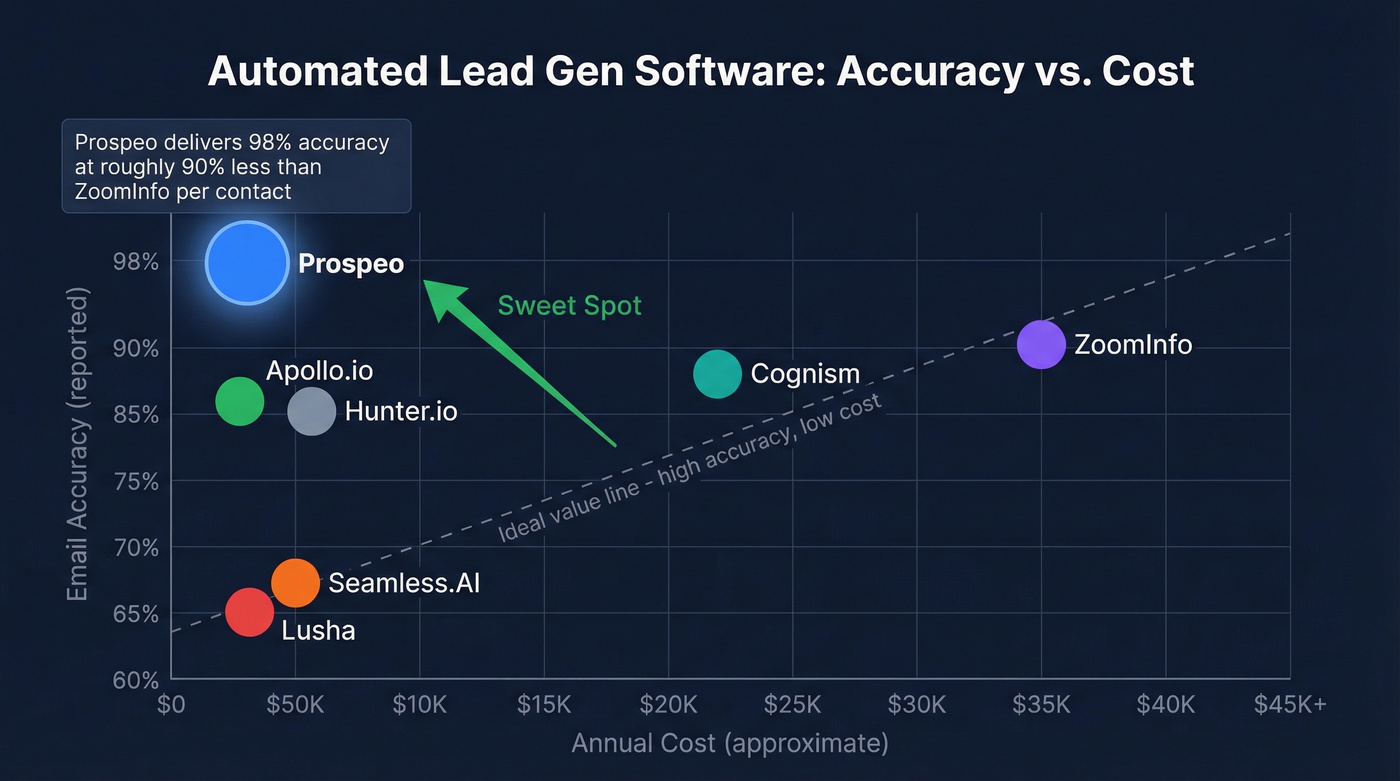
| Tool | Starting Price | Database Size | Email Accuracy | Best For |
|---|---|---|---|---|
| Apollo.io | Free-$119/mo per user | 275M+ contacts | ~85% | Free tier + sequencing |
| ZoomInfo | ~$15K-$45K+/yr | 100M+ contacts | ~88-92% | Enterprise, intent data |
| Clay | Free-$800/mo | 50+ sources | Varies by source | Custom enrichment |
| HubSpot | Free-$15+/seat/mo | N/A (inbound) | N/A | Inbound lead capture |
| Cognism | ~$22.5K+/yr | 400M+ profiles | High (verified) | EU/GDPR, mobile numbers |
| Seamless.AI | Free-$147/mo | 1B+ | ~60-75% | High-volume prospecting |
| Lusha | $29-$99/mo | 45M+ contacts | ~60-70% | Quick lookups |
| Leadfeeder | Free | N/A (visitor ID) | N/A | Anonymous traffic ID |
| Hunter.io | Free-$499/mo | 200M+ emails | Good | One-off email lookups |
| OptinMonster | $21/mo | N/A (capture) | N/A | On-site lead capture |
| Outreach | ~$100-150/user/mo | N/A (sequencer) | N/A | Multi-channel sequences |
12 Best Tools Reviewed
Prospeo
Use this if you care about email deliverability above everything else, or if bad data from another provider has already damaged your sender domain.
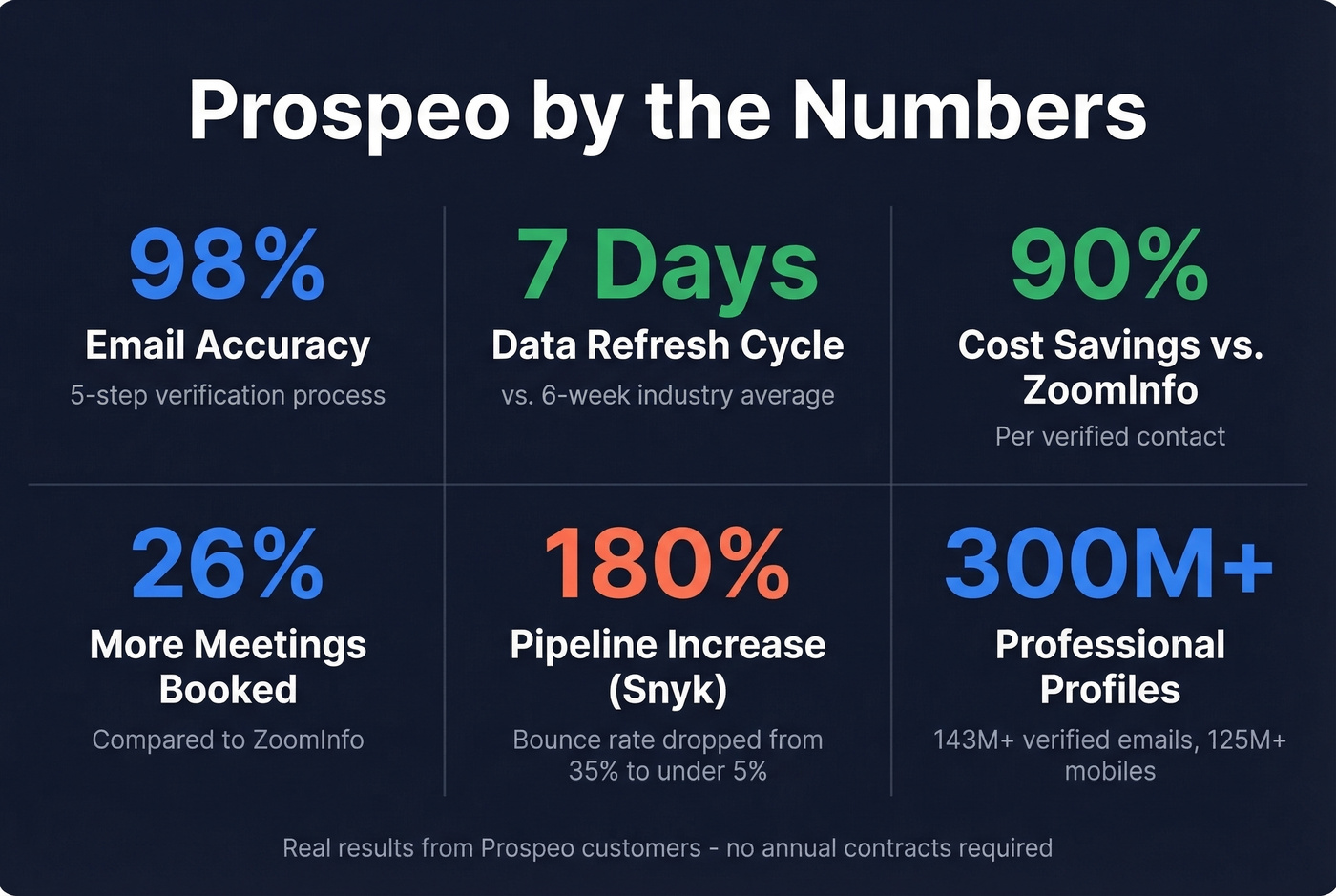
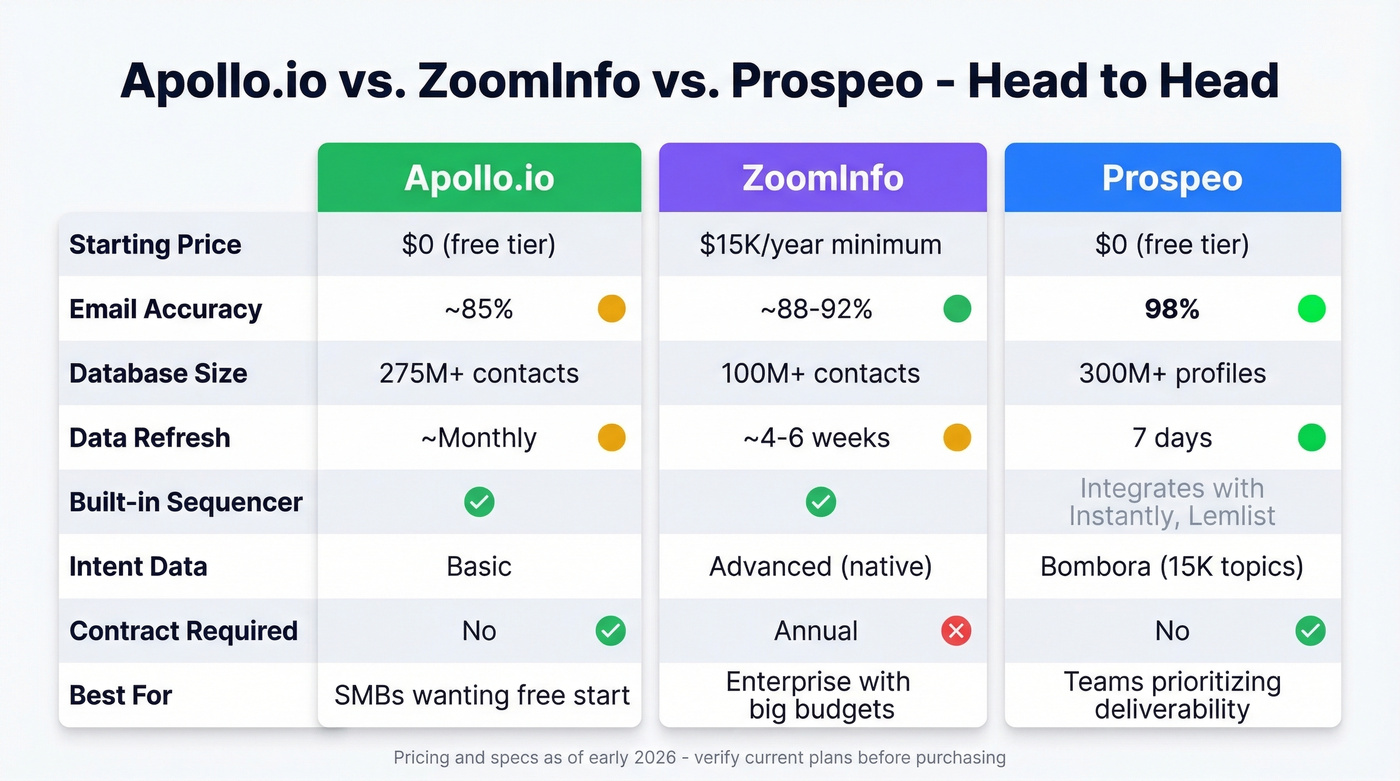
Prospeo's database covers 300M+ professional profiles with 143M+ verified emails and 125M+ verified mobile numbers. Email accuracy sits at 98%, backed by a proprietary 5-step verification process that includes catch-all handling, spam-trap removal, and honeypot filtering. The platform runs its own email-finding infrastructure rather than reselling third-party data, which is why accuracy holds instead of degrading through data broker chains. Where most providers refresh data every six weeks, Prospeo runs a 7-day cycle. (If you're building a broader stack, compare data enrichment services too.)

The search interface gives you 30+ filters including buyer intent powered by Bombora across 15,000 topics, technographics, job changes, headcount growth, and funding signals. The Chrome extension (40K+ users) works on any website - company pages, professional profiles, even your CRM - to pull verified contact data in one click. Native integrations cover Salesforce, HubSpot, Clay, Instantly, Lemlist, Zapier, and Make. (More on firmographic and technographic data if you're tightening ICP filters.)
The numbers back it up: teams book 26% more meetings compared to ZoomInfo and 35% more compared to Apollo. Snyk's 50-person sales team cut bounce rates from 35-40% to under 5% after switching, and AE-sourced pipeline jumped 180%. GreyScout doubled their sales team and saw pipeline climb 140% while cutting rep ramp time from 8-10 weeks to 4. If you're diagnosing why outbound isn't converting, start with pipeline health.
Pricing starts free (75 emails/month) and scales at roughly $0.01 per verified email - about 90% cheaper than ZoomInfo's effective per-contact cost. No contracts, no sales calls, no annual lock-in.
Apollo.io
Use this if you're an SMB team that needs a free starting point with built-in email sequencing - and you don't mind managing credit burn carefully. (Also see our roundup of free lead generation tools.)
Skip this if email accuracy is your top priority or you're running high-volume outbound where an 85% accuracy rate will torch your domain.
Apollo's database covers 275M+ contacts with a genuinely generous free tier: 50 AI credits, basic contact access, and up to two active sequences. That's enough to validate whether the tool fits your workflow before spending anything. Paid plans run $49/mo per user (Basic), $79/mo per user (Professional), and $119/mo per user (Organization, minimum three seats).
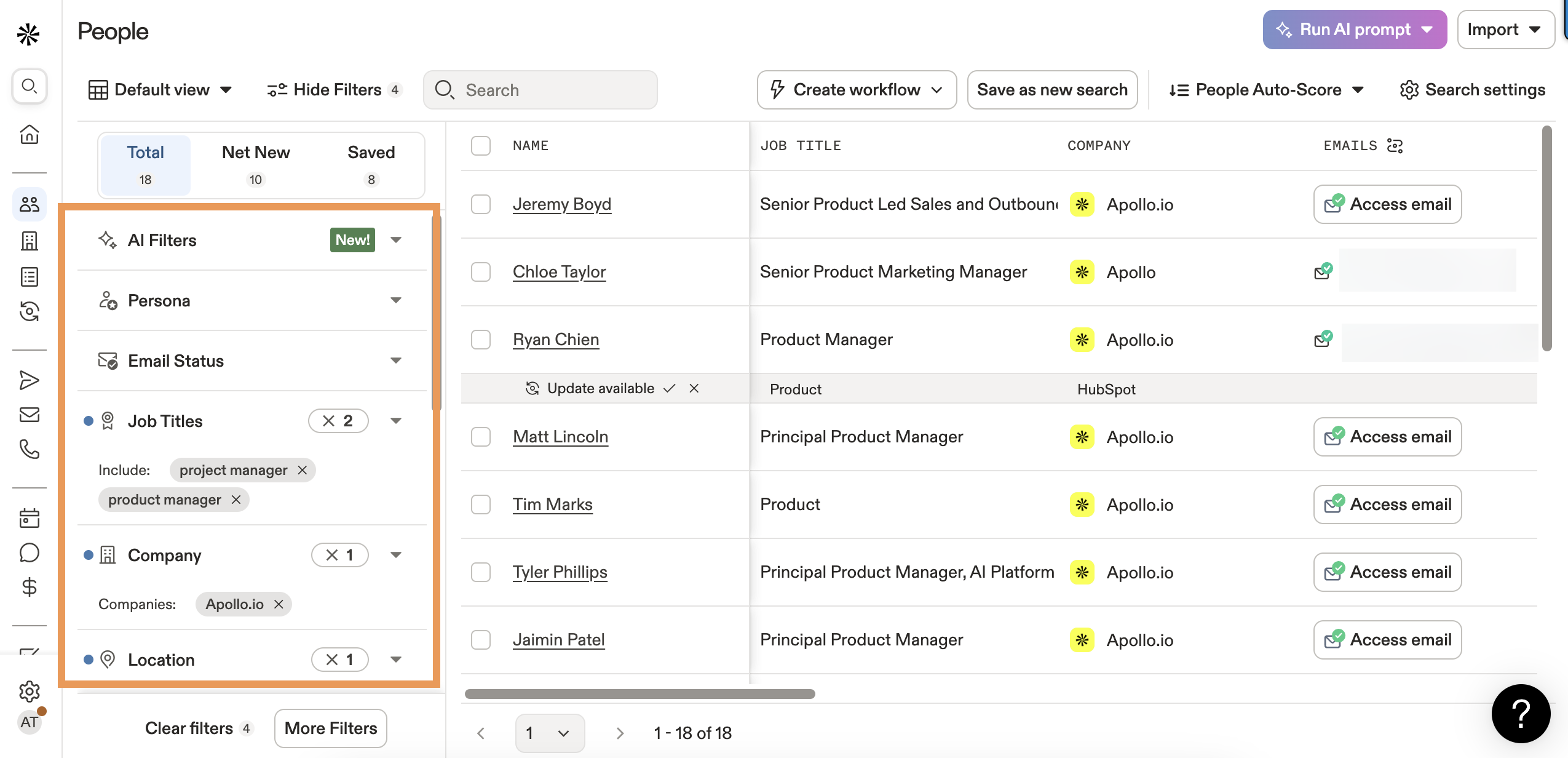
The built-in sequencer is Apollo's real differentiator against pure data providers. You can find contacts and launch multi-step email sequences without leaving the platform - a genuine workflow advantage for lean teams that want discovery and outreach in one place. If you're standardizing outreach ops, use a sequence management framework.
Here's the thing, though: credits expire monthly and don't roll over. A slow prospecting month means those credits vanish. Waterfall enrichment queries burn credits faster than expected depending on your ICP and geography. Email accuracy runs around 85% - solid for initial outreach, but you'll want to verify separately for high-stakes campaigns. Compared to ZoomInfo, Apollo wins on price and ease of use but loses on database depth for enterprise accounts and intent data sophistication.
ZoomInfo
$15K minimum. Still worth it - if you'll actually use the platform.
ZoomInfo remains the default enterprise B2B data platform with 100M+ contacts and accuracy around 88-92% in typical benchmarks. The platform bundles intent data, website visitor tracking, conversation intelligence, and workflow automation into tiered packages. Typical annual costs land around $15-18K/yr for Professional, $22-28K/yr for Advanced, and $35-45K+ for Elite. All annual, no monthly option.
ZoomInfo holds a 4.5/5 across 9,337 G2 reviews - that's real social proof. But the #1 complaint on Reddit and G2 alike is consistent: you're paying for modules you never activate. Renewals typically increase 10-20%, and there's a minimum seat requirement. A 10-seat Advanced contract with intent data can easily run $40-60K/year.
Where ZoomInfo still wins over every alternative: US database depth, workflow breadth, and the fact that enterprise procurement teams already have it approved. Where it loses: pricing transparency, flexibility for smaller teams, and data freshness. Many legacy providers refresh on 4-6 week cycles, lagging weekly-refresh tools by weeks.
Clay
Clay isn't a database - it's a workshop. You bring raw materials in from dozens of data sources, then use AI agents like Claygent and Sculptor to research, enrich, and score leads automatically. Think of it as the middleware layer between your data sources and your sequencer. If you're going deep here, follow a Clay list building workflow.
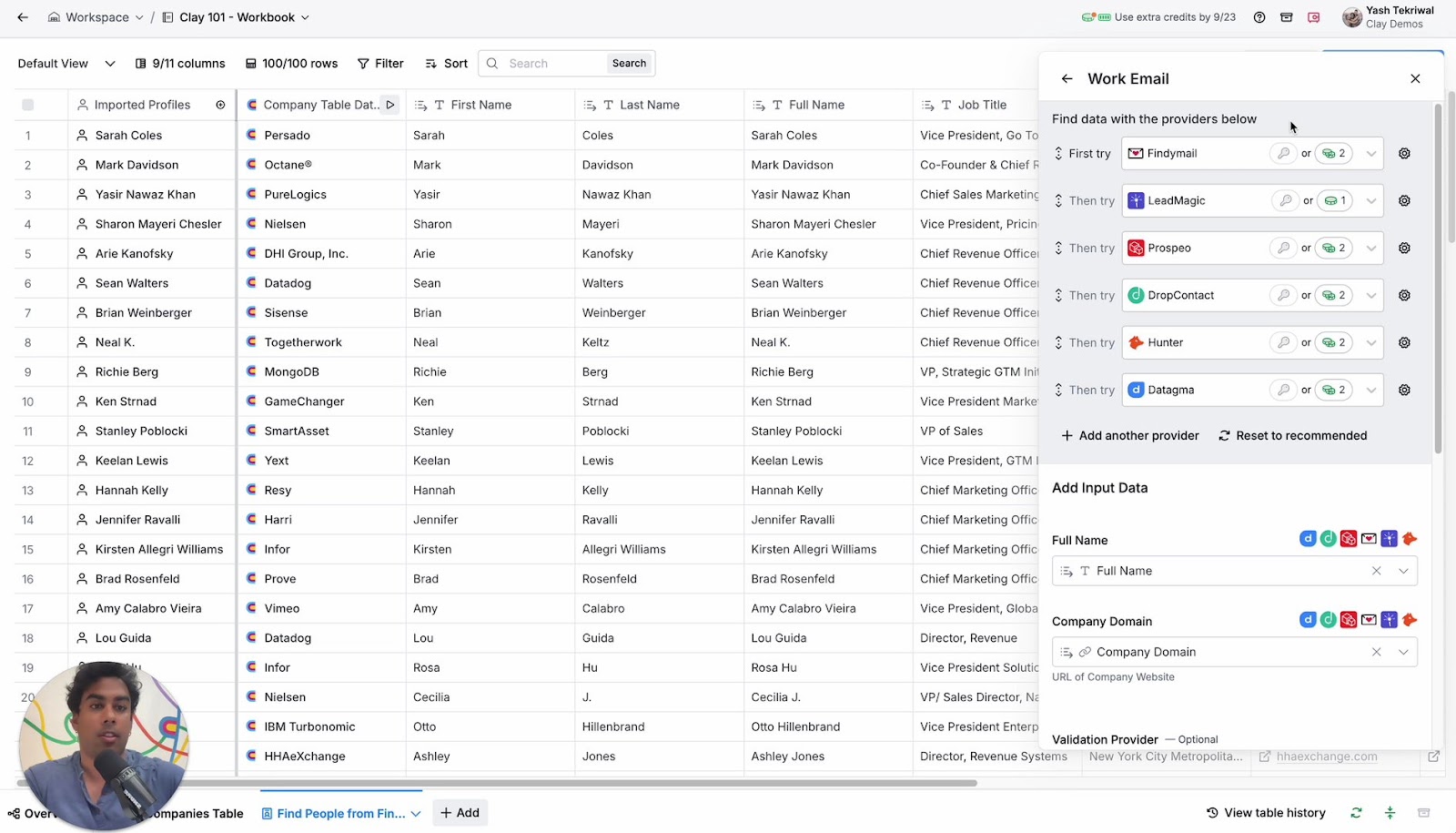
In one r/sales thread, the OP called Clay their favorite tool - but also warned about the learning curve. Your SDRs won't be productive on day one without training.
Pricing is credit-based: Free (100 credits/mo), Starter ($149/mo, 2,000 credits), Explorer ($349/mo, 10,000 credits), and Pro ($800/mo, 50,000 credits). Complex workflows burn through credits fast - a multi-step enrichment waterfall hitting five providers per contact adds up quickly. Clay holds SOC 2 Type II, GDPR, CCPA, and ISO 27001 certifications, which matters for enterprise procurement.
Compared to ZoomInfo, Clay trades out-of-the-box simplicity for extreme customization. It's the tool for teams that have outgrown single-source databases and want to orchestrate data from everywhere.
HubSpot Marketing Hub
HubSpot isn't a prospecting database - it's the inbound lead capture and nurturing engine that most B2B teams already have somewhere in their stack. The free CRM is genuinely useful, and paid plans start at $15/seat/month for Starter, scaling to $740+/mo for Marketing Hub Professional with the full suite of forms, landing pages, email automation, and lead scoring.
HubSpot shines at turning anonymous website visitors into nurtured leads through content workflows. It falls short on outbound prospecting - you'll need to pair it with a data provider to feed contact records into the system. The integration ecosystem is broad, which makes HubSpot the CRM/marketing layer in most recommended stacks rather than the data source itself.
Cognism
Cognism owns the GDPR-compliant mobile number space, and it's not particularly close.
Their "Diamond Data" phone-verified mobiles deliver a 3x connection rate over standard databases. For teams selling into the UK and EU, that compliance posture is non-negotiable. Pricing is quote-based with a platform fee plus per-user licensing - expect roughly $22,500/year for five users on the Grow plan, or $37,500/year on Elevate based on Vendr-reported figures. Fair-use limits cap exports at around 2,000 records per user per month. There's no built-in sequencer, so budget for Outreach or Salesloft on top. Compared to ZoomInfo, Cognism wins on EMEA coverage and mobile verification but can't match ZoomInfo's US database depth or workflow breadth.
Seamless.AI
Seamless.AI is a high-volume prospecting tool with a free plan to test and Basic plans starting at $147/mo. They position their coverage at 1B+ contacts. The Chrome extension is useful for quick lookups while browsing company websites.
The accuracy concern is real, though: typical benchmarks put email accuracy around 60-75%, which means you're verifying separately or accepting higher bounce rates. Best for high-volume prospectors who treat Seamless as a discovery layer and run everything through a verification tool before sequencing.
Lusha
Lusha's strength is simplicity - a clean UI, quick lookups, and pricing that starts at just $29/mo. The database covers 45M+ contacts, and the Pro plan gives you 250 credits per month. Those credits can evaporate within a week of active prospecting, and they expire monthly. Accuracy runs around 60-70%, which is low enough to cause real deliverability damage at scale.
Use Lusha for occasional lookups when you need a quick phone number or email. Don't build your outbound engine on it.
Leadfeeder (Dealfront)
Leadfeeder identifies companies visiting your website - not individual contacts. It's a fundamentally different tool than the prospecting databases above. The free lite plan tracks up to 100 companies, and paid plans run around $139/mo for uncapped identified companies and unlimited storage. It's GDPR compliant and integrates well with most CRMs.
The real value is converting anonymous website traffic into account-level intent signals, which you then feed into an outbound tool to find the right contacts. Pair it with a data provider for the actual prospecting.
Hunter.io
Hunter covers 200M+ emails with solid domain search and email verification capabilities. Free plan available, paid plans run up to $499/mo. It's best for one-off email lookups and domain-level research, not full prospecting workflows.
OptinMonster
OptinMonster is a lead capture tool - pop-ups, exit-intent overlays, and embedded forms - starting at $21/mo with a 14-day money-back guarantee instead of a free trial. It captures inbound leads on your website. It's not a prospecting database.
Outreach
Outreach is a sales engagement platform handling multi-channel sequencing, dialing, and analytics at enterprise scale. Pricing typically runs $100-150 per user per month on annual contracts. It's not a data provider - pair it with a contact database for the actual prospecting layer.

Most automated lead generation tools decay faster than they deliver. Prospeo refreshes every 7 days - not the 6-week industry average - so your outbound never runs on stale data. 98% email accuracy, 300M+ profiles, $0.01/email.
Stop stacking tools to cover accuracy gaps. Start with data that works.
Data Accuracy Benchmarks Compared
Here's the table most vendors don't want you to see side by side.
| Tool | Email Accuracy | Data Refresh | Verification Method |
|---|---|---|---|
| Prospeo | 98% | 7 days | 5-step proprietary |
| ZoomInfo | ~88-92% | ~4-6 weeks | Community + automated |
| Apollo.io | ~85% | Varies | Automated |
| Lusha | ~60-70% | Varies | Automated |
| Seamless.AI | ~60-75% | Varies | Automated |

B2B data decays at roughly 3% per month. Over a six-week refresh cycle - the industry average - that's nearly 5% of your database going stale between updates. A 7-day refresh cycle cuts that decay window by more than 80%. If you're trying to protect deliverability at scale, prioritize spam trap removal and list hygiene.
Why does this matter beyond vanity metrics? One in five emails bouncing burns your sender domain. Once your domain reputation drops, even your valid emails start landing in spam. We've seen teams spend months rebuilding domain reputation after running sequences off a database with 70% accuracy. The cost of bad data isn't the subscription - it's the pipeline you lose while your domain recovers. Recent AI compliance research from Gartner shows organizations running compliant, high-accuracy systems see 40% lower opt-out rates and 22% higher conversion. (If you're in recovery mode, follow a plan to improve sender reputation.)
What These Tools Actually Cost
Published pricing is just the starting point. The real cost includes credit mechanics, renewal inflation, and hidden fees that vendors don't mention on their pricing pages.
A GrowthList analysis showed how a tool advertised at $99/mo can become $3,452 in year one after add-ons, implementation fees, and overage charges. That's not an edge case - it's the norm for mid-market tools with opaque pricing.
Apollo's credit expiration is the most common surprise. Credits don't roll over month to month. If your team has a slow prospecting week, those credits vanish. The Organization plan requires a minimum of three seats at $119/mo each - that's $4,284/year before you burn a single credit on enrichment.
ZoomInfo renewals typically increase 10-20% annually. A $22K Advanced contract in year one becomes $26K+ by year two. Add onboarding fees ($2-5K is common) and API overages, and the total cost of ownership climbs fast.
Cognism's "unlimited" access comes with fair-use limits of roughly 2,000 records per user per month. Exceed that and you're negotiating overage fees. Since Cognism doesn't include a sequencer, add $100-150/user/month for Outreach or Salesloft.
Let's be honest: the sticker price on any of these tools is fiction. You need to model total cost of ownership across 12 months, including overages, seat minimums, and the tools you'll need to bolt on.
Lead Automation Stacks by Budget
The best setup isn't one tool - it's a stack. Data source, sequencer, CRM. Here's what works at each budget level.
Budget stack (~$100/mo): Prospeo free tier + Instantly ($30-97/mo). You get verified emails, push them into Instantly for automated cold email sequences, and track replies in Instantly's built-in CRM. This is enough to run a legitimate outbound motion for a founder or solo SDR.
Mid-market stack (~$500-1,000/mo): A paid data provider + Clay for enrichment + Salesloft for sequencing. Clay pulls from dozens of data sources and enriches contacts with firmographic and technographic data. Your verification layer handles email accuracy. Salesloft handles multi-channel outreach. This is the stack for a 5-15 person sales team that needs scale without enterprise pricing.
Enterprise stack (~$50K+/yr): ZoomInfo for database and intent + Outreach for sequencing + HubSpot or Salesforce for CRM. This is the established playbook for large sales orgs. It works, but it's expensive and takes months to implement properly. In our experience, teams at this level often still run a secondary verification layer because even ZoomInfo's 88-92% accuracy leaves enough bounces to cause domain issues at high volume.
Compliance Checklist for 2026
Automated lead generation sits in an increasingly regulated space. Here's what your tool stack needs to handle.
- GDPR consent tracking. Granular, auditable consent records for every EU contact. Fines reach EUR 20M or 4% of global annual turnover. Your tool must support DSAR fulfillment within 30 days.
- FCC consent rules. The January 2025 rule requires prior express written consent for every lead. If you're calling US numbers, your data provider needs to demonstrate compliance.
- Data minimization. Only collect and store the data you actually need. "Grab everything and sort later" is a compliance liability.
- Audit logging. 78% of enterprises now require AI systems to log consent for audit purposes. If your lead gen software can't produce an audit trail, enterprise procurement will flag it.
- Opt-out enforcement. Global opt-out lists must be respected across your entire stack, not just individual tools.
- Data retention policies. Set retention windows and automate deletion for contacts that haven't been engaged within a defined period.
The IAPP's guide to B2B data compliance is worth bookmarking if you're building a stack from scratch.
Snyk's 50 AEs dropped bounce rates from 35% to under 5% and grew AE-sourced pipeline 180% after switching. That's what happens when your lead generation software runs on proprietary verification, not recycled third-party data.
Automate lead gen with data accurate enough to protect your domain.
FAQ
What is automated lead generation software?
Software that finds, verifies, and delivers prospect contact data - emails, phone numbers, company info - without manual research. Most tools combine a B2B database with search filters, enrichment, and CRM integrations so you can build targeted prospect lists in minutes instead of hours.
How much does lead gen software cost?
It ranges from free to $45,000+/year for enterprise platforms like ZoomInfo Elite. Most mid-market teams spend $50-$500/month. Watch for hidden costs: expiring credits, annual renewal increases of 10-20%, per-seat minimums, and onboarding fees that can add $2-5K.
Which tool has the most accurate email data?
Prospeo leads with 98% verified email accuracy and a 7-day data refresh cycle. ZoomInfo sits around 88-92%, Apollo around 85%, and Lusha around 60-70%. A 10% accuracy gap translates directly into deliverability damage and lost pipeline.
Can I use multiple lead gen tools together?
Yes - and most teams do. A common setup: one data source for contact discovery, one sequencer like Instantly or Lemlist for outreach, and one CRM like HubSpot or Salesforce for pipeline management. Zapier or Make connects them without custom development.
Is automated lead generation GDPR compliant?
It can be, but compliance depends on the tool and your implementation. Demand granular consent tracking, DSAR workflows within 30 days, and data minimization controls from every vendor. GDPR fines reach EUR 20M or 4% of global revenue - this isn't theoretical risk.