

B2B Customer Acquisition: Benchmarks, Channels, and Strategies That Work
B2B customer acquisition costs rose 40-60% between 2023 and 2025. That's not a rounding error - it's a structural shift driven by ad platform inflation, privacy regulations gutting attribution, and every competitor flooding the same channels. In 2026, the pressure has only intensified.
Most guides on this topic list tactics without numbers. You're left with "try ABM" and "invest in content" but no idea what a good CAC looks like for your industry, which channels actually convert, or where your funnel is leaking money. This one gives you the numbers.
The Quick Version
Find your CAC benchmark. Scroll to the industry table below - B2B SaaS averages $239, financial services runs $784, and eCommerce B2B sits at just $86. If you don't know your number, you can't improve it.
Focus on the two highest-ROI channels. SEO can run as low as ~$290 CAC, and SEO-driven funnels hit a 51% MQL-to-SQL conversion rate. Outbound email, with short sequences, verified data, and tight targeting, consistently outperforms paid channels on cost-per-closed-deal.
Fix the hidden cost driver nobody talks about. Bad data silently inflates your CAC. If your email bounce rate is above 5%, you're torching domain reputation, wasting sequences, and paying to acquire contacts that don't exist. Data quality isn't a "nice to have" - it's the foundation everything else sits on.
What Customer Acquisition Cost Actually Means
Customer acquisition cost is straightforward math: total sales and marketing spend divided by new customers acquired in the same period. But the number you get depends entirely on what you include.
Organic CAC captures spend on channels like SEO and organic social - lower cost, longer payback. Inorganic CAC covers paid search, paid social, and outbound - faster results, higher price tag. Most companies blend both, and the combined average weights roughly 75% organic / 25% inorganic depending on channel mix.
Don't confuse CAC with cost per lead. A lead costs you money whether or not it closes. CAC only counts customers who actually signed. That distinction matters when you're evaluating channel performance, and it's the one most marketing dashboards quietly obscure.
CAC Benchmarks by Industry
A "good" CAC is meaningless without context. $400 is catastrophic for a B2B eCommerce company and a bargain for a cybersecurity vendor selling six-figure contracts. These benchmarks cover January 2022 through August 2025.
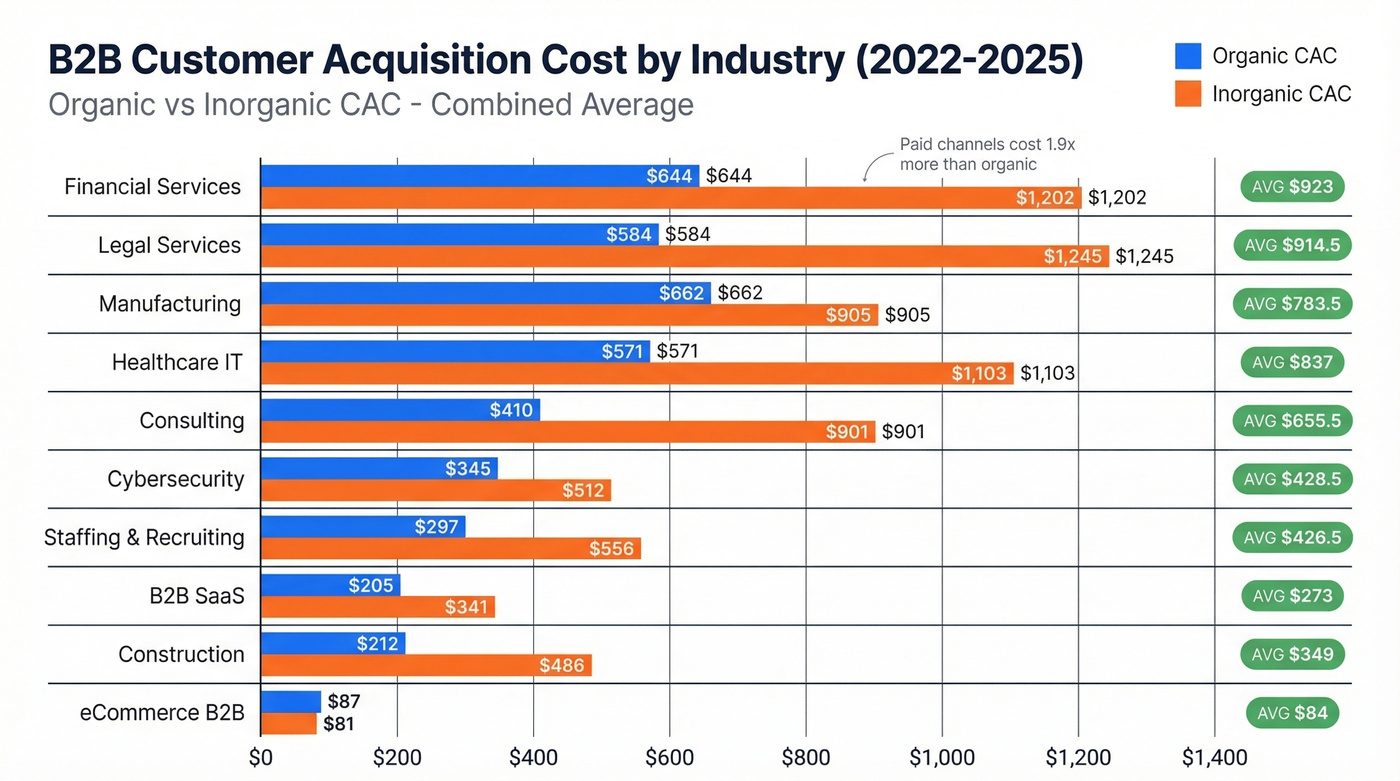
| Industry | Organic CAC | Inorganic CAC | Combined Avg |
|---|---|---|---|
| B2B SaaS | $205 | $341 | $239 |
| Cybersecurity | $345 | $512 | $387 |
| Financial Services | $644 | $1,202 | $784 |
| Manufacturing | $662 | $905 | $723 |
| Legal Services | $584 | $1,245 | $749 |
| Healthcare IT | $571 | $1,103 | $692 |
| Consulting / Professional Services | $410 | $901 | $533 |
| Staffing & Recruiting | $297 | $556 | $371 |
| Construction | $212 | $486 | $281 |
| eCommerce (B2B) | $87 | $81 | $86 |
The gap between organic and inorganic CAC is striking. Financial services companies pay about 1.9x more per customer through paid channels than organic ones. Healthcare IT shows a similar spread. That's a strong argument for investing in SEO early, even if the payback takes 6-12 months.
CAC by Company Size in SaaS
CAC scales dramatically with deal size. Enterprise motions tolerate higher acquisition costs because the contracts justify them.
| Sub-Industry | SMB | Mid-Market | Enterprise |
|---|---|---|---|
| Fintech | $1,461 | $4,923 | $14,774 |
| Security | $833 | $5,330 | $10,226 |
| Legaltech | $321 | $2,652 | $6,477 |
| Ecommerce SaaS | $299 | $1,407 | $2,206 |
The median SaaS company now spends $2.00 in sales and marketing to acquire $1.00 of new ARR - up 14% from 2023. CAC payback periods have increased 12.5% since 2022. The healthy benchmark remains a 3:1 LTV:CAC ratio, but fewer companies are hitting it. If your ratio is below 3:1, the answer usually isn't "spend more" - it's "spend smarter."
Here's the thing: if your average contract value is under $15k, you probably don't need enterprise-grade acquisition infrastructure. A verified email list, a 3-email sequence, and a sharp ICP will outperform a $200k/year tech stack nine times out of ten.
CAC by Acquisition Channel
Not all channels are created equal. This is the table worth screenshotting.
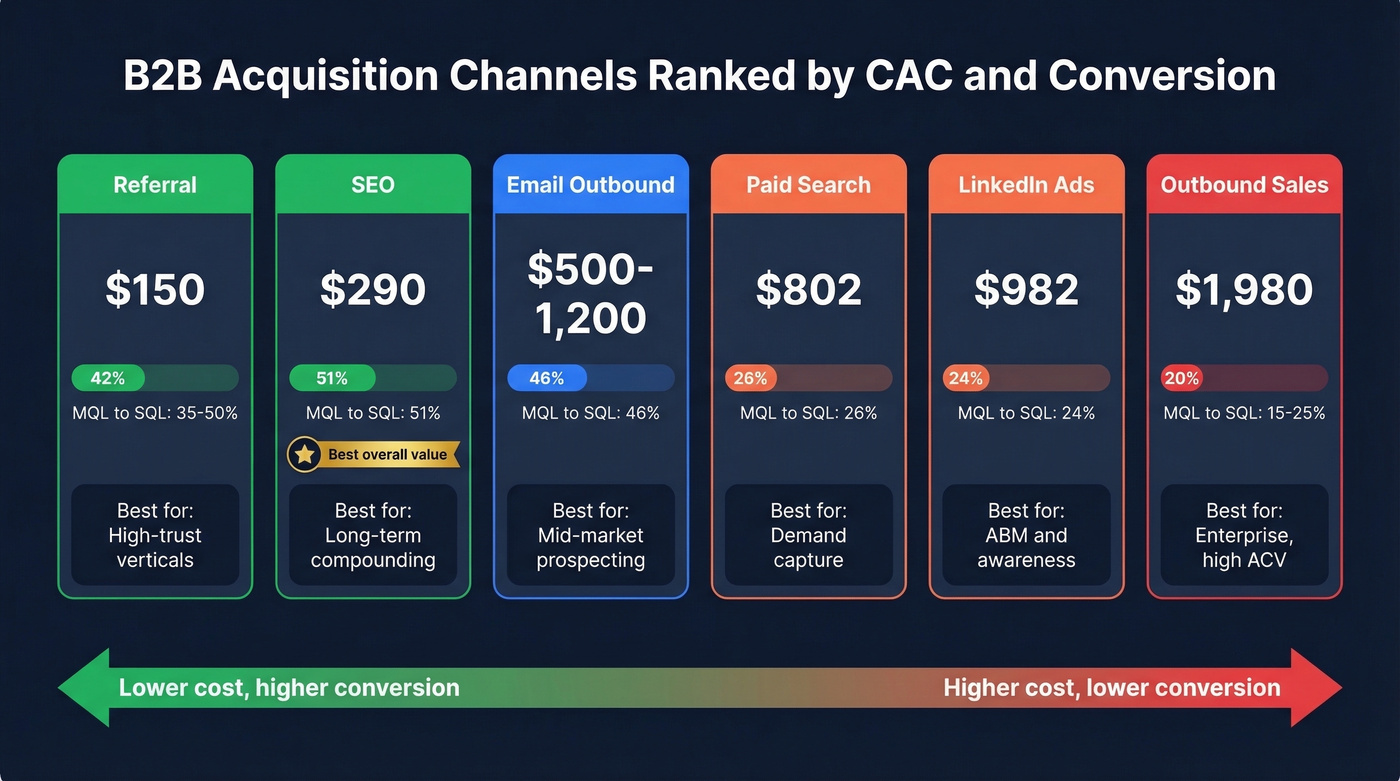
| Channel | Avg CAC | MQL-to-SQL Rate | Best For |
|---|---|---|---|
| SEO | ~$290 | 51% | Long-term compounding |
| Referral | ~$150 | ~35-50% | High-trust verticals |
| Email (outbound) | ~$500-1,200 | 46% | Mid-market prospecting |
| Paid Search | $802 | 26% | Demand capture |
| LinkedIn Ads | $982 | 24% | ABM / awareness |
| Outbound Sales | $1,980 | ~15-25% | Enterprise, high ACV |
SEO is the most underpriced acquisition channel in B2B right now. At ~$290 CAC and a 51% MQL-to-SQL conversion rate, it outperforms every paid channel on cost-per-closed-deal. The catch: it takes 6-12 months to compound, and most teams don't have the patience. Paid search captures existing demand faster but at about 2.8x the cost and roughly half the conversion rate.
Referral programs are the quiet winner at ~$150 CAC, but they're hard to scale predictably.
Outbound sales at $1,980 per customer looks expensive until you realize it's the only channel that reliably lands $50k+ enterprise deals. The channel isn't expensive - it's meant for big contracts. LinkedIn Ads at $982 CAC and a 24% MQL-to-SQL rate is a tough sell for anything below mid-market. We've seen teams burn through $20k/month on LinkedIn with nothing but MQLs that never convert to pipeline. If your deal size doesn't justify four-figure acquisition costs, skip it.

Bad data is the hidden CAC multiplier. Every bounced email burns domain reputation, wastes sequence steps, and inflates your cost per closed deal. Prospeo's 98% email accuracy and 7-day data refresh cycle keep your outbound running on contacts that actually exist - at $0.01 per email.
Stop paying to acquire contacts that don't exist.
Funnel Conversion Benchmarks
Knowing your CAC is half the picture. The other half is understanding where prospects drop off. We've audited dozens of B2B funnels, and the MQL-to-SQL handoff is where most money dies.
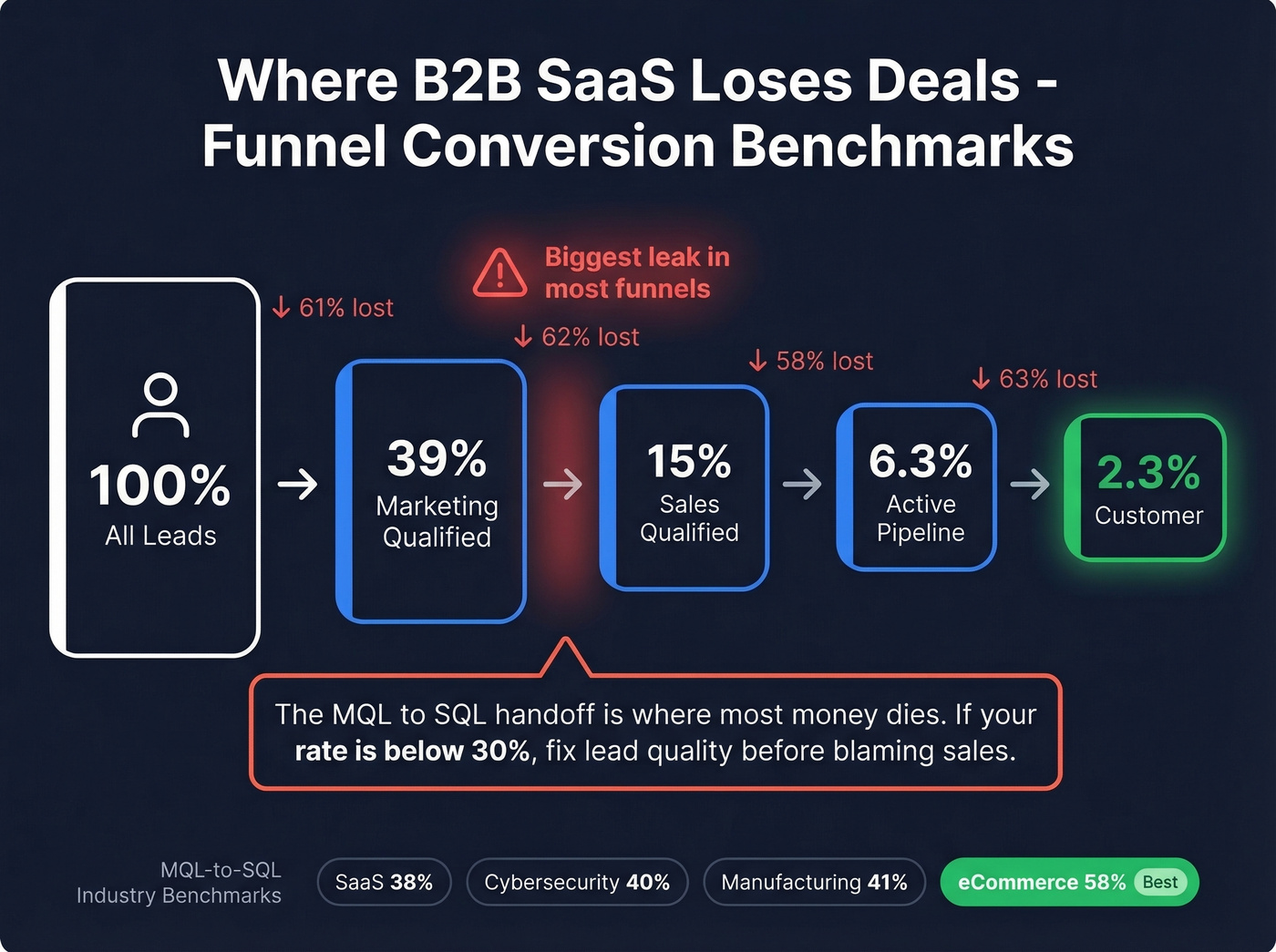
| Industry | Lead-to-MQL | MQL-to-SQL | SQL-to-Opp | SQL-to-Closed Won |
|---|---|---|---|---|
| B2B SaaS | 39% | 38% | 42% | 37% |
| Cybersecurity | 24% | 40% | 43% | 46% |
| Manufacturing | 26% | 41% | 46% | 51% |
| Financial Services | 29% | 38% | 49% | 53% |
| eCommerce | 23% | 58% | 66% | 60% |
B2B SaaS loses 62% of MQLs before they ever become SQLs. That's the handoff between marketing and sales - and it's where misaligned ICPs, bad data, and slow follow-up destroy pipeline.
If your MQL-to-SQL rate is below 30%, the problem usually isn't your sales team. It's the quality of leads marketing is passing over. Fix the input, and the conversion follows.
Strategies That Reduce CAC in 2026
Tighten Your ICP Annually
Spray and pray is dead. Broad targeting burns enrichment credits, wastes rep time, and inflates CAC across every channel. Your ICP should be refreshed at least annually based on revenue per customer (which segments actually pay?), sales cycle length (shorter cycles = lower CAC), support burden, upsell potential, and input from both sales and CS - they see different parts of the picture.
If you can't articulate why a specific company belongs on your list, it shouldn't be there.
Fix Your Outbound Email
Most outbound email is broken. Here's a checklist based on what the r/b2bmarketing community and top-performing teams agree on:
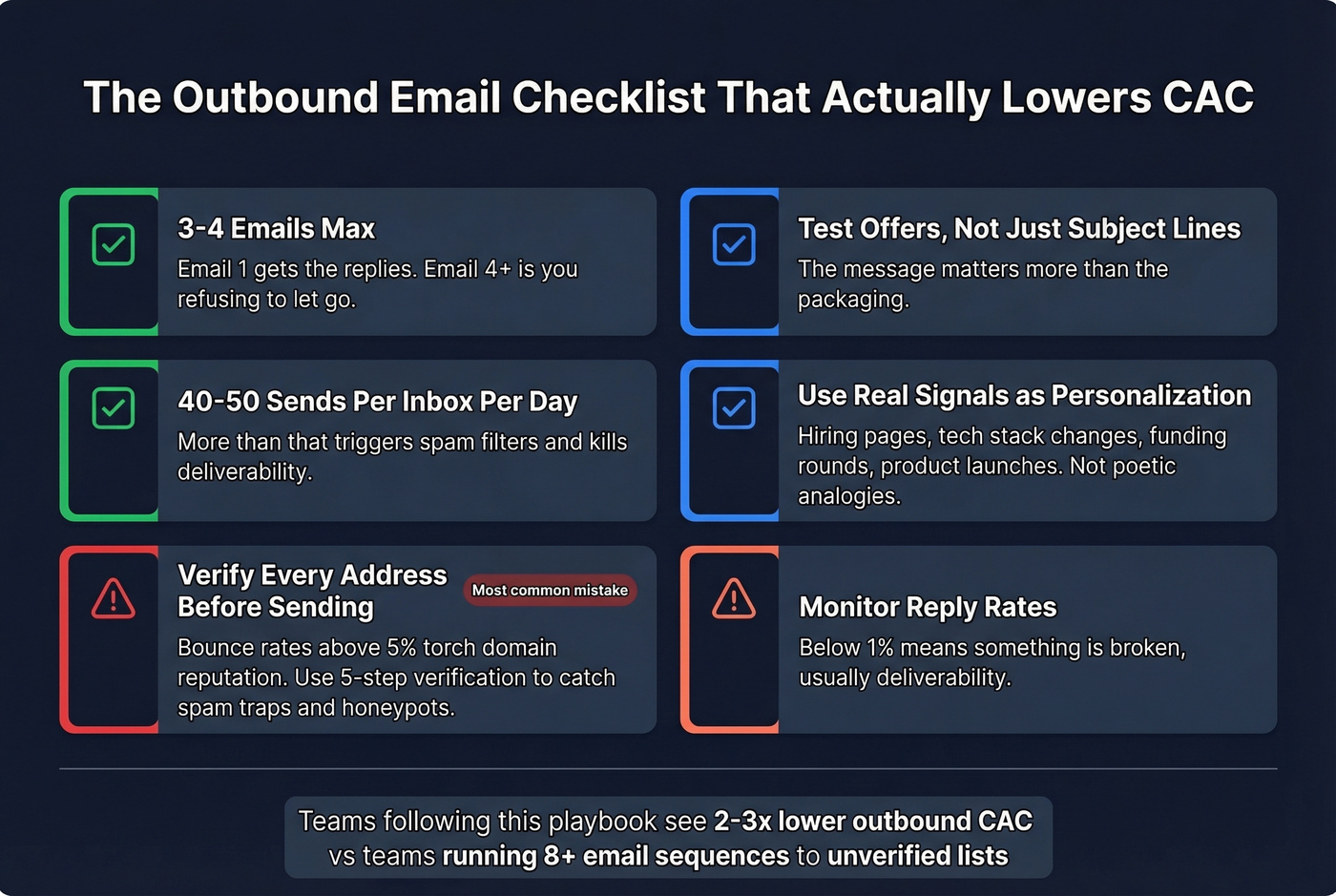
- Cap sequences at 3-4 emails. Email #1 gets the replies. Email #4+ is you refusing to let go. (More on sequence management.)
- Limit volume to 40-50 sends per inbox per day. More than that triggers spam filters. (See email velocity.)
- Verify every address before sending. Bounce rates above 5% torch domain reputation. Prospeo's 5-step verification catches bad addresses, spam traps, and honeypots - the free tier gives you 75 verifications per month to start. (Use an email deliverability guide to diagnose issues.)
- Test offers and angles, not just subject lines. The message matters more than the packaging. (Pull from cold email subject line examples.)
- Use "receipts" as personalization. Hiring pages, tech stack changes, funding rounds, product launches. Not poetic analogies. (Frameworks in personalized outreach.)
- Monitor reply rates. Below 1% means something's broken - usually deliverability.
Invest in SEO Early
At ~$290 CAC and 51% MQL-to-SQL, SEO is the best deal in B2B. The problem is patience. Most teams want pipeline this quarter, so they pour budget into paid channels at 2-3x the cost and wonder why CAC keeps climbing.
If you're not investing at least 20% of your acquisition budget in organic content, you're subsidizing your competitors' future advantage. SEO compounds. Paid search doesn't.
Layer Intent Data on Outreach
Adding intent-based signals to outreach campaigns increased conversions by almost 50% in documented tests. Reaching someone actively researching your category is fundamentally different from cold outreach - and the data backs that up. (See intent based segmentation.)
Respond Within 24 Hours
Contacting leads within 24 hours increases conversion by 5x. Most B2B teams take 48+ hours. Some take a week. (Use sales follow-up templates to standardize speed.)
This is the easiest CAC lever to pull because it costs nothing. Every hour of delay is money left on the table. If your SDR team isn't responding same-day, you're paying full acquisition cost for half the close rate.
Use AI to Scale What Works
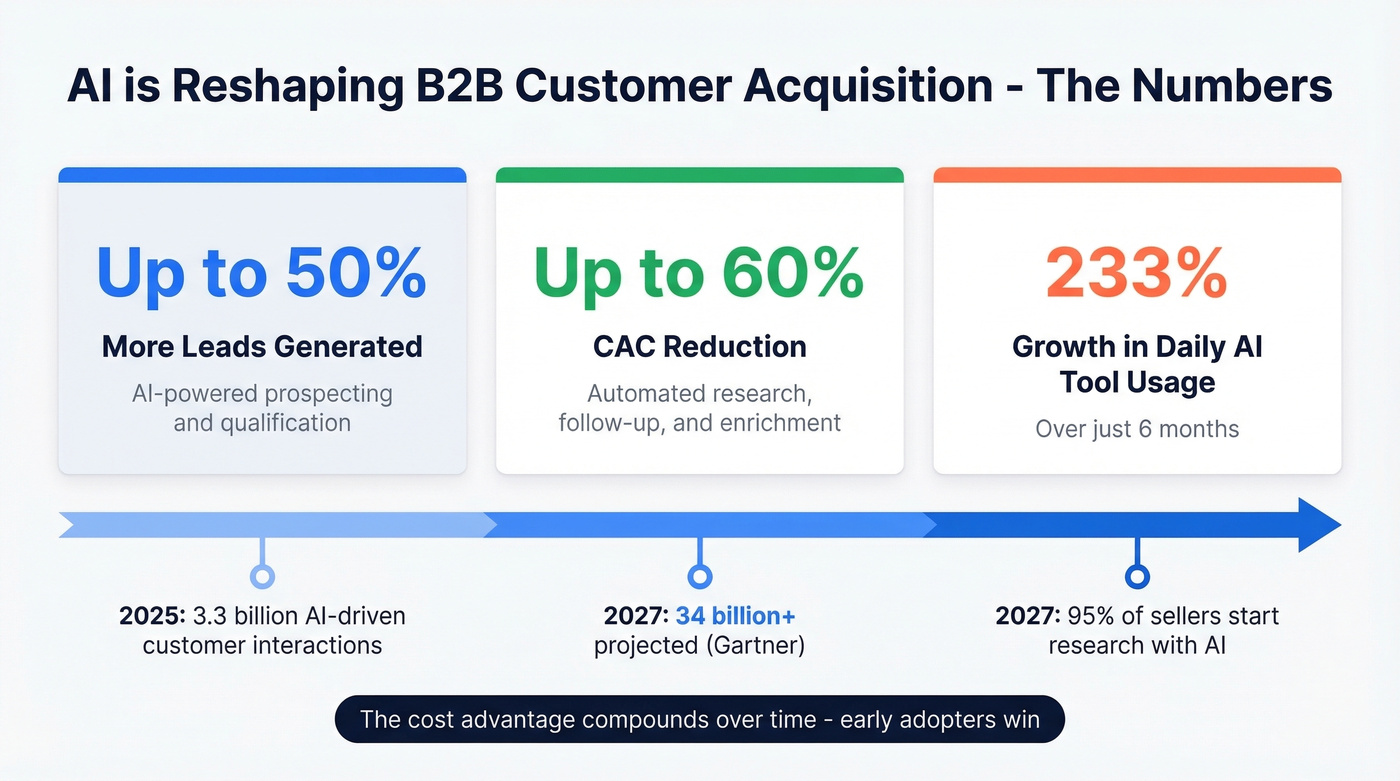
AI tools can increase leads by up to 50% and cut CAC by up to 60%. That's not hype - it's math. AI handles the repetitive qualification, follow-up, and research tasks that eat 30-40% of a rep's week. (Tactics in AI cold email outreach.)
| AI Adoption Signal | Data Point |
|---|---|
| Daily AI tool usage growth | Up 233% in 6 months |
| Seller research starting with AI by 2027 | 95% (Gartner projection) |
| AI-driven customer interactions by 2027 | 34 billion+ (up from 3.3B in 2025) |
The teams adopting AI for prospecting, enrichment, and sequencing now are building a structural cost advantage that compounds over time.
Don't Forget Retention
The cheapest customer to acquire is one you already have. If your annual churn rate is above 10%, fixing retention will lower your effective CAC faster than any channel optimization. Expansion revenue from existing accounts carries near-zero acquisition cost and directly improves your LTV:CAC ratio. In our experience, the best-performing B2B teams spend at least 15-20% of their "acquisition" budget on customer success and expansion plays - for SaaS companies in particular, where annual contracts and usage-based pricing create natural expansion opportunities, retention is often the highest-leverage investment you can make. (Related: churn analysis.)
Bad Data Is Silently Inflating Your CAC
Let's be honest about the cost driver nobody puts in their CAC analysis: data quality.
When Snyk's 50-person AE team was running outbound, their bounce rate sat at 35-40%. Four out of every ten emails hit dead addresses. The downstream effects were brutal - damaged domain reputation, sequences that never reached inboxes, and reps spending 4-6 hours per week prospecting contacts that didn't exist. After switching their data infrastructure, bounce rates dropped below 5%, AE-sourced pipeline jumped 180%, and the team generated 200+ new opportunities per month. The difference wasn't strategy. It was data quality.
If your data provider's bounce rates are above 5%, they're not a data provider - they're a liability. Prospeo's 98% email accuracy and 7-day refresh cycle exist specifically to solve this problem, running 300M+ profiles through a 5-step verification process with catch-all handling, spam-trap removal, and honeypot filtering. (Compare options in data enrichment services.)
Outbound email at $500-$1,200 CAC beats paid search and LinkedIn Ads - but only when your data connects. Teams using Prospeo book 35% more meetings than Apollo users and cut bounce rates from 35% to under 4%. 300M+ profiles, 30+ filters to nail your ICP, and zero annual contracts.
Tighter targeting, cleaner data, lower CAC. Start free today.
Mistakes That Inflate Your CAC
These are the five most common CAC killers we see across B2B teams:
- Running sequences past 4 emails. Email #1 gets the replies. Everything after email #3 is diminishing returns that risks deliverability for marginal gain.
- Broad targeting without a clear ICP. If your list criteria is "VP+ at companies with 50-500 employees," you don't have an ICP - you have a census. Tighten it.
- Ignoring deliverability metrics. Reply rates below 1%, bounce rates above 5%, or spam complaints trending up all signal that your data or sending infrastructure is broken.
- Slow lead follow-up. Every hour past the 24-hour window costs you conversion. If your SDR team isn't responding same-day, you're paying full price for half the close rate.
- Never refreshing your ICP. Markets shift. Your best customer segment from 18 months ago isn't necessarily your best segment today. Interview sales and CS quarterly, refresh formally once a year.
FAQ
What's a good B2B customer acquisition cost?
It depends on your LTV:CAC ratio - 3:1 is the standard benchmark for sustainable growth. B2B SaaS averages $239, financial services runs $784, and eCommerce B2B sits at $86. If you're spending more than $2.00 to acquire $1.00 of new ARR, you're above the median and need to optimize.
Which channel has the lowest CAC?
Referral programs at ~$150 and SEO at ~$290 consistently deliver the lowest acquisition costs. SEO also converts at 51% MQL-to-SQL, making it the best cost-per-closed-deal channel. The tradeoff is time - organic takes 6-12 months to compound, while paid channels deliver faster at 2-3x the cost.
How do you reduce acquisition cost quickly?
Start with data quality - eliminating bounces immediately improves deliverability and conversion across every outbound channel. Then tighten your ICP, shorten email sequences to 3-4 touches, and follow up within 24 hours. The consensus on r/sales is that most teams overthink the strategy and underthink the data - and the benchmarks back that up.
How is AI changing B2B customer acquisition?
AI tools can increase leads by 50% and cut CAC by up to 60%. By 2027, 95% of seller research will start with AI. The biggest impact today is in prospecting automation, lead qualification, and personalized sequencing at scale - tasks that previously consumed 30-40% of a rep's week.