

B2B Customer Engagement Strategies That Work in 2026
You sent 500 emails last quarter. 200 bounced. Another 150 landed in spam. The 150 that actually reached an inbox got ignored because the messaging was generic. Your "engagement strategy" generated exactly zero pipeline. That's not a channel problem or a content problem - it's a foundation problem.
84% of reps missed quota last year. And 73% of buyers actively avoid suppliers that send irrelevant outreach. Those two stats aren't coincidental. Most B2B customer engagement strategies fail because they're built on bad data, aimed at the wrong people, and measured with vanity metrics. The playbook that follows is what actually works - strategies grounded in real benchmarks, not recycled platitudes about "adding value."
Here's the thing: most teams don't have an engagement problem. They have a data quality problem dressed up as an engagement problem. Fix the foundation and the strategies start working almost immediately.
What Makes B2B Engagement Different
B2B engagement isn't B2C with a longer sales cycle. The average B2B buying cycle runs 11.3+ months. Each deal involves roughly 11 stakeholders, and those buyers consume about 13 pieces of content before making a decision.
The channels have exploded, too. Buyers now use an average of 10 interaction channels - up from 5 in 2016. 80% of B2B sales interactions happen through digital channels, per Gartner. McKinsey's "rule of thirds" still holds: at any stage, roughly one-third of buyers prefer in-person, one-third remote, and one-third digital self-serve. You can't pick one channel and hope for the best. You need to meet the committee where they are, with the right message, at the right time - across all of them simultaneously.
The Priority Stack
If you're short on time, here's what matters most. Everything else is secondary.
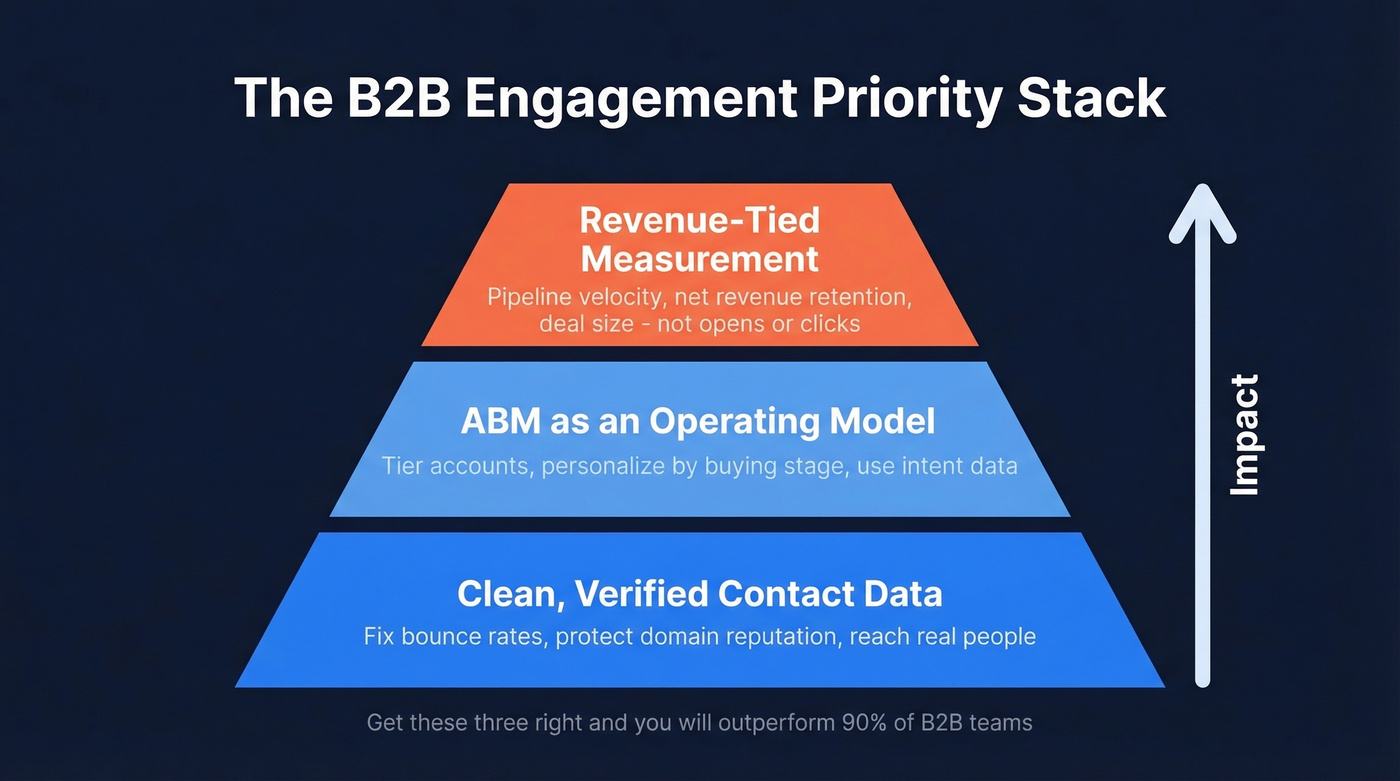
- ABM as an operating model. Stop spraying leads. Tier your accounts, personalize by buying stage, and use intent data to time your outreach.
- A measurement framework tied to revenue. Not opens. Not clicks. Pipeline velocity, net revenue retention, and deal size.
Get those three right and you'll outperform 90% of B2B teams running engagement programs.
Five Mistakes That Kill Your Pipeline
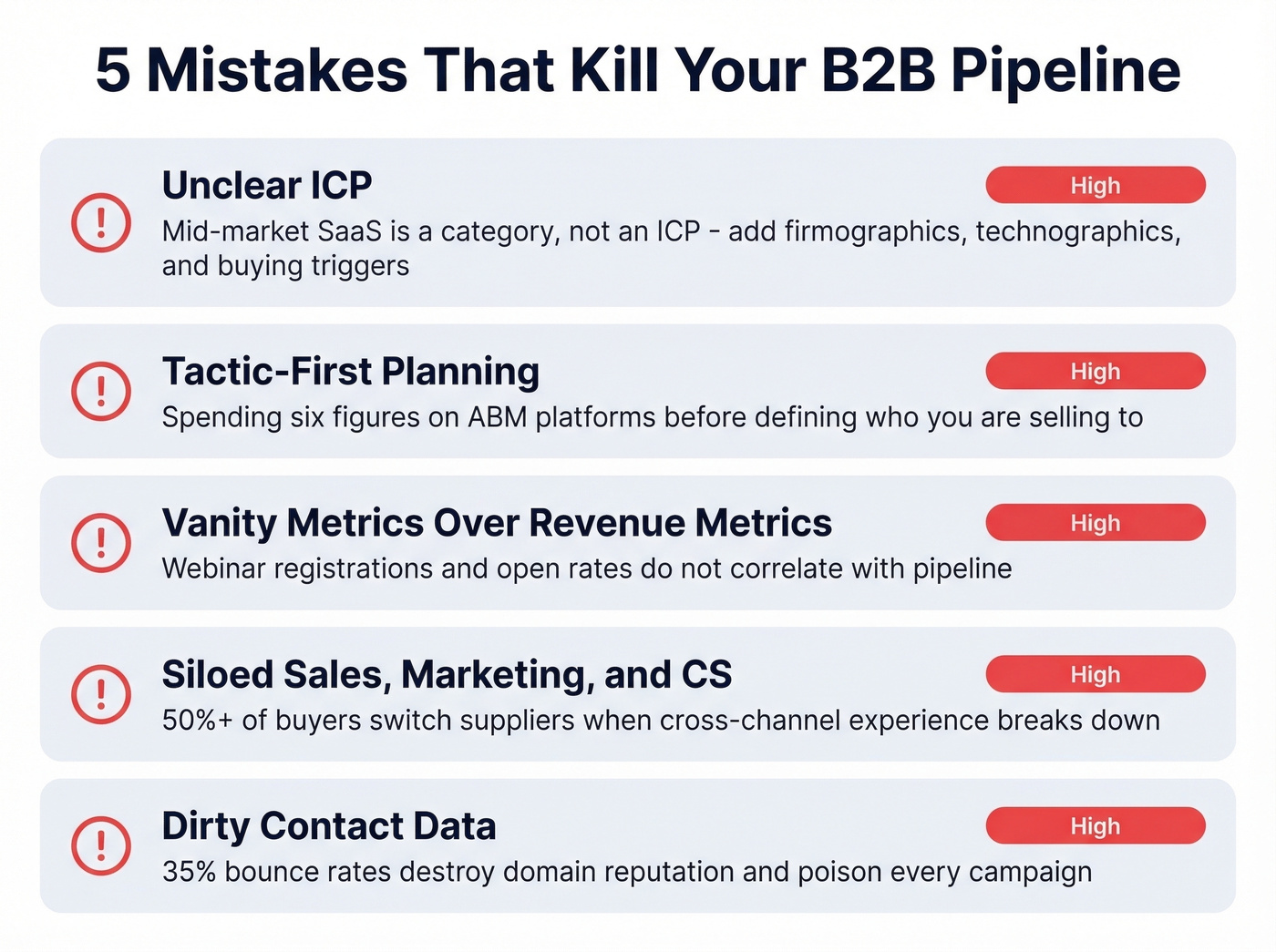
Unclear ICP
If your sales and marketing teams can't agree on who you're selling to, every downstream activity is wasted effort. "Mid-market SaaS companies" isn't an ICP - it's a category. A real ICP includes firmographic filters, technographic signals, buying triggers, and disqualification criteria.
Tactic-First Planning
I've watched teams spend six figures on ABM platforms before defining their ICP. It never ends well. Tactics without strategy is just expensive noise. Start with the revenue goal and work backward.
Vanity Metrics Over Revenue Metrics
Webinar registrations, email open rates, social impressions - none of these correlate reliably with pipeline. If your dashboard doesn't show pipeline velocity, deal progression, or CLV, you're measuring the wrong things.
Siloed Sales, Marketing, and CS
Buyers are nearly 70% through their purchasing process before engaging a seller. If marketing hands off a lead and walks away, you've lost the thread. Over 50% of B2B buyers will switch suppliers if the cross-channel experience isn't smooth. Alignment isn't a nice-to-have. It's a retention mechanism.
Dirty Contact Data
If 35% of your emails bounce, your personalization strategy is irrelevant. Bad data destroys domain reputation, wastes rep time, and poisons every campaign it touches. Meritt experienced this firsthand - a 35% bounce rate that cratered their outreach until they switched to a provider with 98% email accuracy and a 7-day data refresh cycle. Their pipeline tripled from $100K to $300K per week. The engagement strategy starts with clean data, or it doesn't start at all. (If you need to diagnose the root cause, start with bounce rate benchmarks and fixes.)

Dirty data killed Meritt's engagement - 35% bounce rates, wasted rep time, zero pipeline. After switching to Prospeo's 300M+ database with 98% email accuracy and a 7-day refresh cycle, their bounce rate dropped to under 4% and pipeline tripled to $300K/week. Your engagement strategy starts with data that actually connects.
Start with 75 free verified emails and see the difference in your first campaign.
Three B2B Engagement Models
Not every account deserves the same level of attention. The model you choose should match your deal economics.
| Model | Best For | Key Channels | Resource Intensity |
|---|---|---|---|
| High-touch | Enterprise, $100K+ ACV | Dedicated CSM, exec alignment, custom content | High |
| Low-touch | SMB, self-serve products | Automated sequences, in-app, webinars | Low |
| Hybrid | Mid-market, mixed portfolio | Tiered by revenue - high-touch top 20%, automate the rest | Medium |
The Value-Quality-Trust framework is a useful lens here. High-touch accounts need all three delivered through human relationships. Low-touch accounts get value through product experience and quality through automation. Hybrid models - which is what most mid-market companies should run - segment by revenue potential and allocate accordingly.
McKinsey's rule of thirds applies to model selection, too. Even your high-touch accounts want digital self-serve options for certain interactions. Don't force a 30-minute call when a self-serve demo page would convert better.
Strategies That Move Pipeline
Start With Clean Data
Use this if: Your bounce rate exceeds 5%, reps complain about outdated contacts, or you've been flagged by email providers.
Skip this if: You're running a small, hand-curated list of 50 accounts and personally verify every contact.
Before you personalize a single email or launch an ABM campaign, verify your contact data. Prospeo's 300M+ profile database with a 7-day refresh cycle means you're reaching real people at current companies. The free tier gives you 75 verified emails plus 100 Chrome extension credits per month to test the impact on your bounce rates. If you're building lists from scratch, use a repeatable workflow like Clay list building to keep enrichment consistent.
When you fix data quality first, pipeline moves faster because your best messaging finally reaches the right inboxes. Meritt's results - bounce rate from 35% to under 4%, pipeline tripled - show what happens when you stop building on a broken foundation. Snyk saw similar gains: bounce rates dropped from 35-40% to under 5% while AE-sourced pipeline climbed 180%.
Run ABM as an Operating Model
ABM isn't a campaign. It's an operating model. Companies running ABM see a 171% increase in ACV, and 76% of marketers report higher ROI from ABM than any other strategy.
If you want the sales side to match the marketing motion, use account-based selling best practices to keep targeting, messaging, and follow-up aligned.
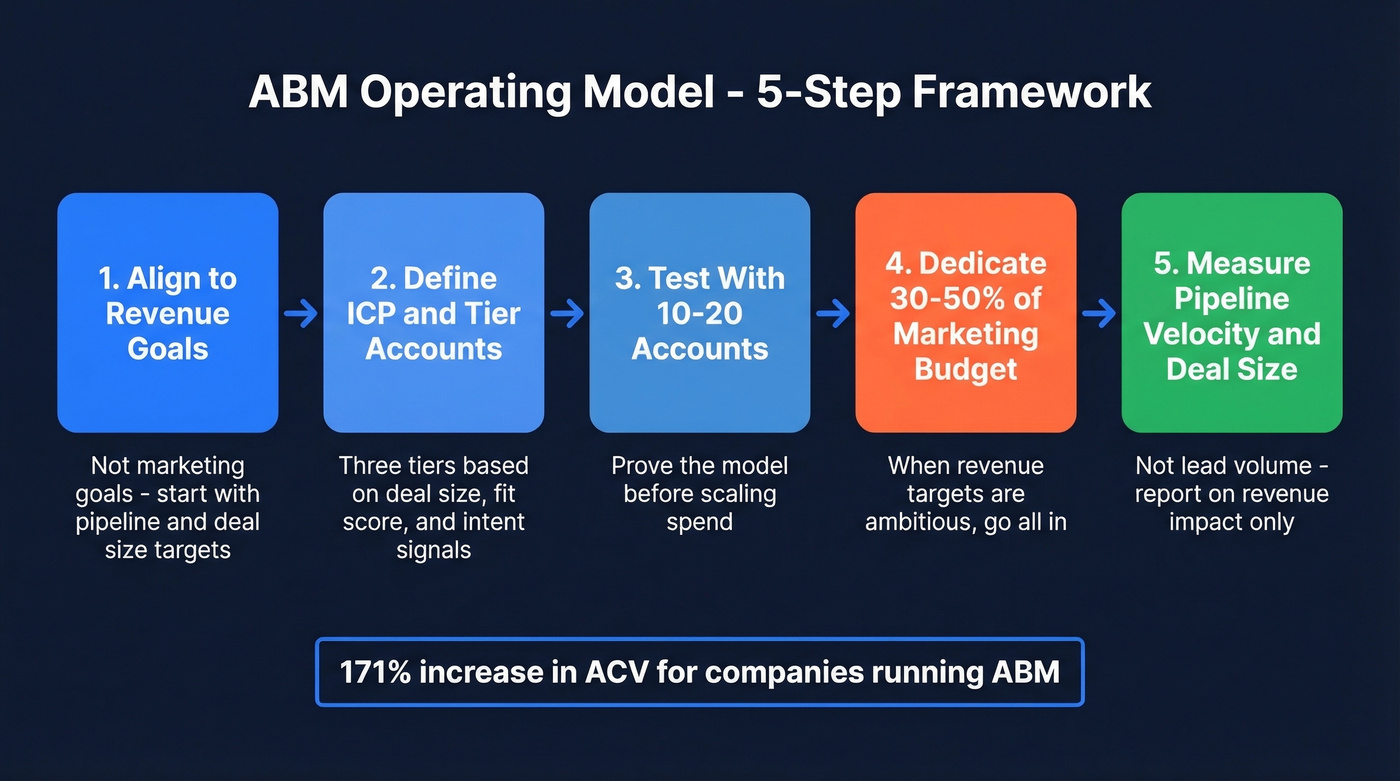
Here's the five-step framework we've seen work consistently:
- Align with revenue goals - not marketing goals
- Define your ICP with precision, then tier accounts into three buckets
- Test with 10-20 accounts before scaling
- Dedicate 30-50% of marketing resources to ABM when revenue targets are ambitious
- Report on pipeline velocity and deal size, not lead volume
Enrich your target account list with buyer intent, technographics, job changes, and headcount growth signals before launching account-specific campaigns. Layering intent data onto your ABM tiers is what separates "spray and pray" from precision targeting - tools tracking 15,000+ intent topics via Bombora make this practical at scale.
Orchestrate the Buying Committee
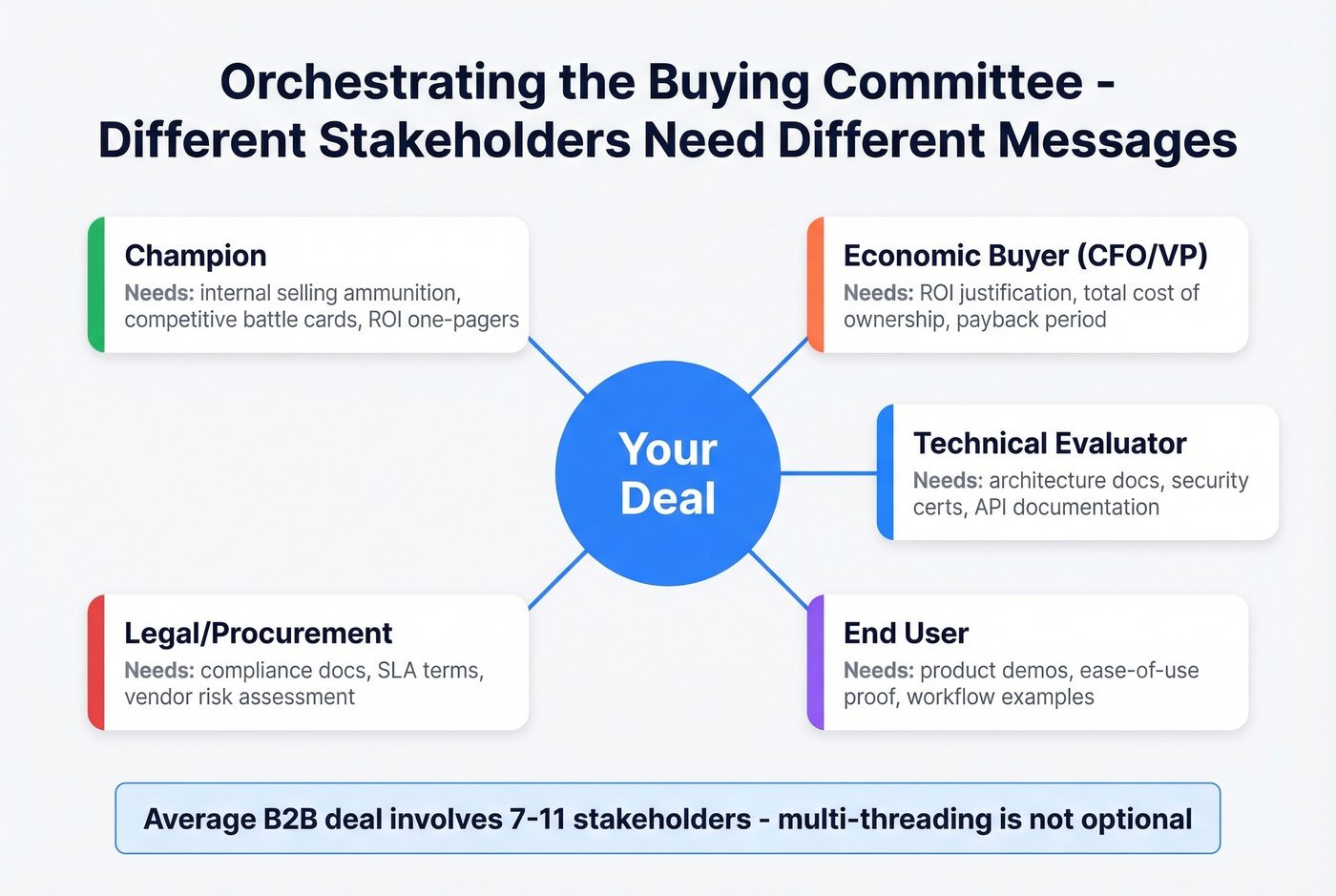
With 7-11 stakeholders on every deal, sending the same email to the entire buying committee is a guaranteed way to lose. Your champion needs ammunition to sell internally. The economic buyer needs ROI justification. The technical evaluator needs architecture docs and security certifications. (If you need a clean way to map roles, start with technical buyer vs economic buyer.)
Multi-threading - building relationships with multiple contacts at the same account - isn't optional anymore. We've seen deals die because the single champion changed roles and nobody else at the account knew the project existed. Thread wide and thread early.
Personalize at Scale With AI
42% of organizations already apply AI in sales and marketing, and daily AI tool usage jumped 233% in just six months according to Slack's Workforce Index. The practical applications are moving fast.
AI lead scoring that weights behavioral signals is the biggest win. Pricing page revisits matter more than a single whitepaper download. Real-time journey triggers - a demo page view fires a tailored follow-up, not a generic nurture drip - are table stakes for teams that want to compete. And intent prediction based on competitor research, content consumption clusters, and multi-stakeholder engagement from the same company is where the real edge lives. (If you want a scoring system you can actually operationalize, see lead scoring.)
Automated customer interactions via AI agents are projected to grow from 3.3 billion in 2025 to 34 billion+ by 2027. Only about a third of B2B orgs have implemented agentic AI at scale, which means there's a real first-mover advantage for teams that adopt now.
Build Multi-Channel Engagement
Buyers use 10 channels on average and spend only 17% of their buying time meeting suppliers. The rest is independent research and internal deliberation.
For multi-channel to actually convert, build for how buyers prefer to evaluate: self-serve pages that answer real objections, short demo content that gets to value fast, and customer proof embedded into the content people already consume. Give buyers what they need to sell internally, on their own timeline, in the format they prefer. The consensus on r/sales is pretty clear on this - buyers hate being forced into a channel that serves the seller, not them.
Invest in Proactive Customer Success
Expansion revenue accounts for 35% of ARR at healthy SaaS companies. Net revenue retention should exceed 100% as a baseline - top-tier companies hit 110%+.
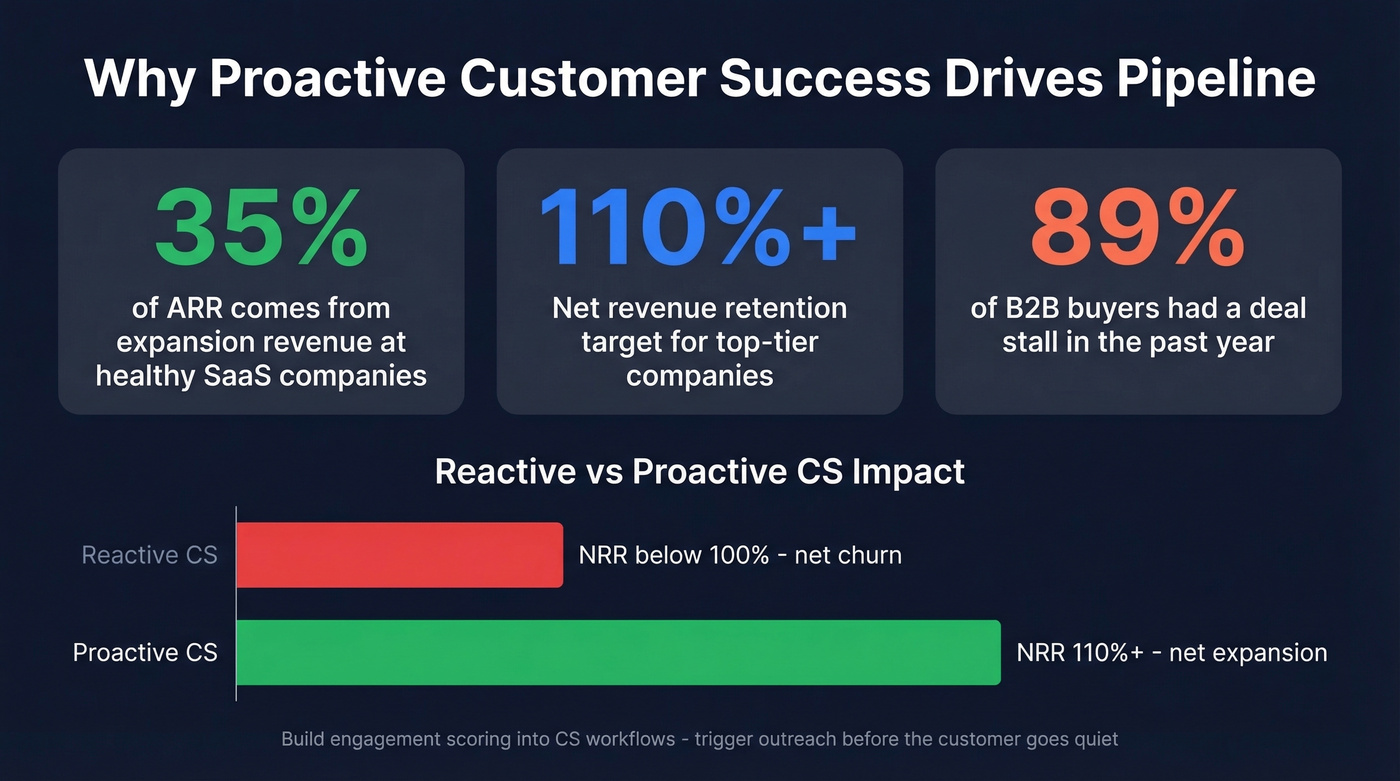
With 89% of B2B buyers reporting a deal stalled in the past year, proactive re-engagement isn't just a retention play - it's a pipeline recovery mechanism. Build engagement scoring into your CS workflows and trigger outreach before the customer goes quiet. Track CSAT and NPS as leading indicators, but tie everything back to NRR and CLV.
Reading Buyer Engagement Signals
Knowing what to track matters as much as tracking it. This framework from Highspot's engagement research maps signals to actions:
| Signal | What It Means | What To Do |
|---|---|---|
| Content shared internally | Internal comparison happening | Send competitive battle cards |
| Questions shift tactical to strategic | Urgency increasing | Push timeline, propose next steps |
| Time gaps between milestones | Deal deprioritized | Re-engage with new value prop |
| New stakeholders appear late | Broader alignment needed | Prepare executive summary |
| Declining engagement | Narrative or owner shifted | Adjust messaging, re-qualify |
Declining engagement doesn't always mean lost interest. Sometimes the internal champion changed, the budget owner rotated, or the project got reassigned. Your response should be to re-qualify, not to blast more emails.
Measuring Engagement ROI
Most teams default to single-touch attribution because it's simple. The problem is it massively oversimplifies ABM, where a deal might involve 30+ touchpoints across 8 stakeholders over 6 months.
Single-touch assigns all credit to one interaction - first touch or last touch. Simple to implement, but it'll mislead you about which channels actually drive pipeline. Multi-touch distributes credit across every interaction, which is more accurate but requires integrated CRM, marketing automation, and ad platform data. Most teams underestimate the implementation lift.
Weighted/hybrid balances clarity with precision. Weight by engagement depth, buying stage progression, and account tier. This is where most mature teams land - and where you should aim. (If you want a tighter set of revenue-leading indicators, use a pipeline health scorecard.)
The more sophisticated approach is what MarketBridge calls the Marketing Income Statement - built from account-level multi-touch attribution combined with brand models. The core question becomes counterfactual: "If we hadn't done X, how much revenue would we have lost?" Building an Account Longitudinal Record - a GTM fingerprint across leads, opportunities, contacts, and stimuli over time - makes this possible.
Let's be honest: most teams aren't there yet. But SAP's "Inspire the Future" campaign proves this works at scale. They drove 48% higher engagement than their other social campaigns, generated a EUR 924.4M pipeline, and projected EUR 266.15M in revenue. They measured it because they built the attribution infrastructure first.
ABM doesn't work when you're targeting stale contacts at companies that already churned. Prospeo gives you 30+ filters - buyer intent, technographics, job changes, headcount growth - so you reach the right stakeholders on the buying committee while they're actively in-market. All at $0.01 per email.
Build your ABM target list with intent data and verified contacts in minutes.
FAQ
What's the difference between B2B and B2C customer engagement?
B2B involves 7-11 stakeholders, 11+ month buying cycles, and rational buying committees evaluating across 10+ channels. B2C targets individual consumers with shorter, emotion-driven decisions. B2B engagement has to address multiple roles with tailored messaging for each - you can't treat the CFO and the end user the same way.
How do you engage B2B customers effectively?
Start with verified contact data, then layer on account-based targeting and multi-channel orchestration. Reaching the right stakeholders with role-specific messaging at the moment they're actively evaluating is the core of it. Generic outreach to a single contact doesn't work when buying committees average 11 people.
What are the most important B2B engagement KPIs?
Pipeline velocity, net revenue retention (target 100%+), account progression rate, CLV, and deal size. The 2026 shift is toward revenue-based KPIs - if a metric doesn't connect to pipeline or retention, drop it from your dashboard.
How does data quality affect engagement results?
Bad contact data causes bounced emails, damages sender reputation, and wastes rep hours on dead leads. A 7-day refresh cycle and 98% email accuracy set the baseline - anything less and your campaigns reach outdated contacts at companies people left months ago. Meritt cut their bounce rate from 35% to under 4% and tripled pipeline as a direct result of fixing this one thing.
Is ABM worth the investment for mid-market companies?
Yes - companies running ABM see 171% higher ACV. Start small with 10-20 accounts, dedicate 30-50% of marketing resources when revenue targets are ambitious, and measure pipeline velocity rather than lead volume. The "crawl, walk, run" approach lets you prove ROI before scaling.