

B2B IT Marketing: What Actually Works When You're Selling to Technical Buyers
95% of B2B buyers are out of market at any given time. The average B2B sales cycle runs 379 days. And yet, most B2B IT marketing guides hand you the same generic playbook - build awareness, capture leads, nurture with emails - as if selling cybersecurity infrastructure to a 10-person buying committee is the same as selling HR software to a single VP.
It's not. Marketing to IT buyers works differently because your audience is more technical, more skeptical, and more committee-driven than almost any other B2B segment. The strategies that work for a marketing automation vendor won't survive first contact with a CISO who wants your SOC 2 report before they'll even take a meeting.
What follows is built for that reality. Real benchmarks, real buyer personas, and a framework you can execute against - not another recycled listicle.
The Short Version
If you're pressed for time, here's what matters most.
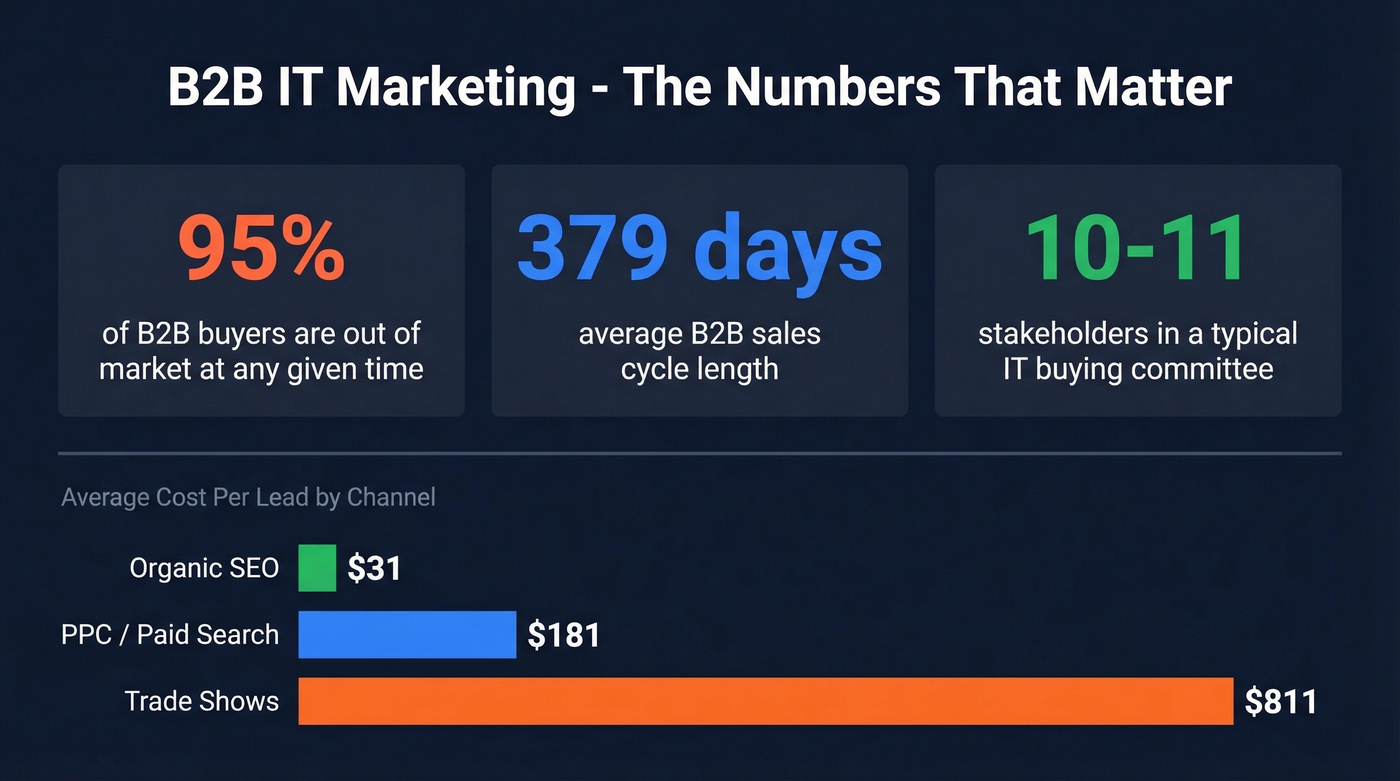
Map your buying committee first. The average B2B tech purchase involves 10-11 stakeholders, and 79% require CFO sign-off. Each stakeholder needs different proof. If your marketing treats them all the same, you're losing deals you should be winning.
Invest in SEO and content before anything else. Organic search delivers leads at $31 CPL versus $181 for PPC and $811 for trade shows. The ramp is 3-6 months, but nothing else compounds like this. If you want a tighter execution model, start with a clear definition of B2B content marketing and build from there.
Fix your data infrastructure before scaling campaigns. Every channel - ABM, email, paid - degrades when your contact data is stale. A 30% bounce rate doesn't just waste budget; it tanks deliverability for every campaign that follows. If you're diagnosing issues, use email bounce rate benchmarks as your baseline.
What Makes IT Marketing Different
Generic B2B marketing assumes a relatively simple buying process: one or two decision-makers, a demo, a proposal, a close. B2B IT marketing breaks that model in almost every dimension.
The buying committee is massive. We're talking 10-11 stakeholders who each evaluate your solution through a completely different lens. The CISO cares about your incident response plan. The CTO wants your API documentation. The CFO wants a payback period calculation. And 79% of the time, that CFO has veto power regardless of what everyone else thinks. This is exactly why frameworks like team selling matter in IT.
Compliance isn't optional - it's table stakes. Before an IT buyer will even schedule a technical evaluation, they want to see SOC 2 reports, ISO 27001 certification, pentest results, and data handling policies. If you can't produce these on demand, you're not in the conversation.
Then there's the visibility problem. Roughly 70% of your website traffic is anonymous, thanks to cookie deprecation and privacy tools that IT buyers adopt faster than any other segment. Your form-fill strategy captures maybe 30% of the people actually evaluating you. And IT buying decisions happen in dark social - private Slack groups, WhatsApp threads, closed Discord communities - where attribution can't follow.
The consensus on r/b2bmarketing captures a common frustration: LinkedIn feels saturated with spam, and a lot of real vendor evaluation happens in channels marketers can't track. Your brand reputation in these invisible channels matters more than your ad spend.
IT Buyer Personas That Actually Get Used
Most persona exercises produce fluffy documents that nobody opens after the kickoff meeting. For B2B marketing for IT companies, you need personas tied to specific proof requirements and content formats. Here are the five roles that matter.
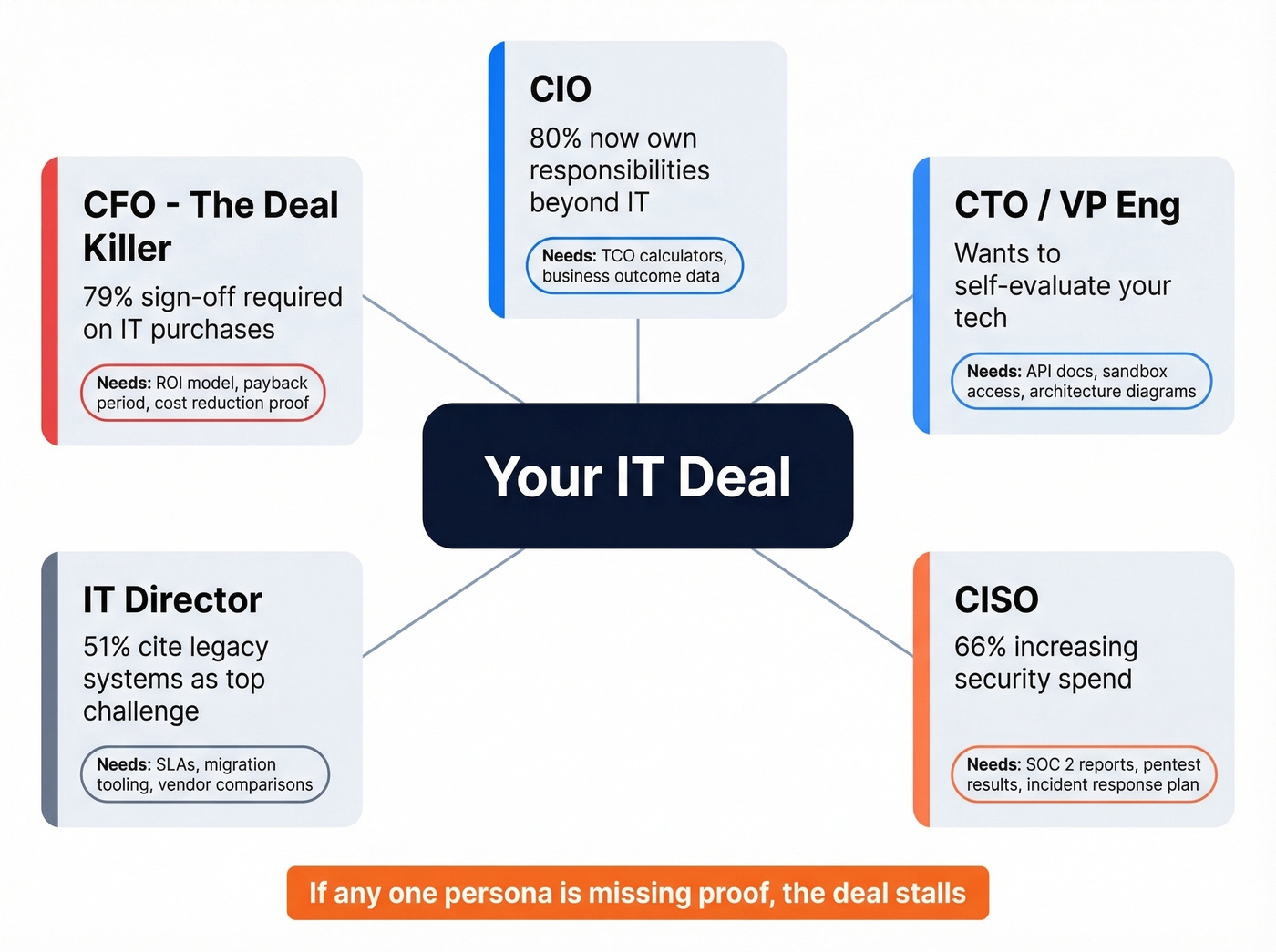
| Role | Key Stat | Primary Pain | Content They Need |
|---|---|---|---|
| CIO | 80% expanded beyond IT | Innovation vs. operations | TCO calculators, roadmaps |
| CTO / VP Eng | Technical validation | Integration complexity | API docs, architecture diagrams |
| CISO | 66% increasing security spend | Breach risk | SOC 2, pentest results |
| IT Director | 51% cite legacy systems | Modernization pressure | SLAs, vendor comparisons |
| CFO | 79% sign-off required | Budget justification | ROI data, payback periods |
The CIO
The CIO role has fundamentally changed. Per Gartner's CIO Agenda Survey, 80% of CIOs have expanded their responsibilities beyond traditional IT, with 18% now leading non-IT functions and 10% owning P&L. Your marketing can't just speak to technology - it needs to speak to business outcomes.
The core tension for every CIO is balancing innovation with operational excellence. Content that resonates: business outcome data tied to specific use cases, total cost of ownership calculators that include migration costs, and implementation roadmaps that acknowledge the complexity of their existing environment. Lead with the business problem your solution eliminates, not the features you built.
CTO / VP Engineering
Here's the thing: the fastest way to lose a CTO is to gate your technical documentation behind a form. This persona lives in technical validation mode. They don't want your marketing deck - they want architecture diagrams, API documentation, integration guides, and a sandbox environment they can test themselves.
Make it all public. Let them self-evaluate. If your product can't survive technical scrutiny without a sales rep present, that's a product problem, not a marketing problem.
CISO
66% of IT leaders plan to increase cybersecurity investments, which means budget exists - but the bar for vendor evaluation is brutally high. CISOs need SOC 2 reports, penetration test results, incident response plans, and data processing agreements before they'll engage in a meaningful conversation. Create a dedicated security page on your site with all of this documentation available without a form fill. Every day you make a CISO wait for a PDF is a day they're evaluating your competitor instead.
IT Director / Procurement
51% of IT directors rank legacy systems as a top-three challenge. They're the ones who have to actually implement whatever the CIO approves, so they care about SLAs, support documentation, migration tooling, and vendor comparison matrices. They're also the most likely to run a formal RFP process, which means your marketing needs to produce assets that survive a procurement spreadsheet.
CFO - The Deal Killer
Picture this: you've won the CTO with a flawless technical evaluation. The CISO signed off on your security posture. The IT Director loves your migration tooling. Then the CFO kills the deal because your marketing never produced a single piece of financial proof they could evaluate in 15 minutes.
With 79% of IT purchases requiring CFO sign-off, this happens constantly. Build TCO analyses, payback period calculations, ROI projections with clear assumptions, and - ideally - a customer case study with hard revenue or cost-reduction numbers. If your CFO-facing content doesn't exist, build it before your next campaign.
The Stakeholder Proof Matrix
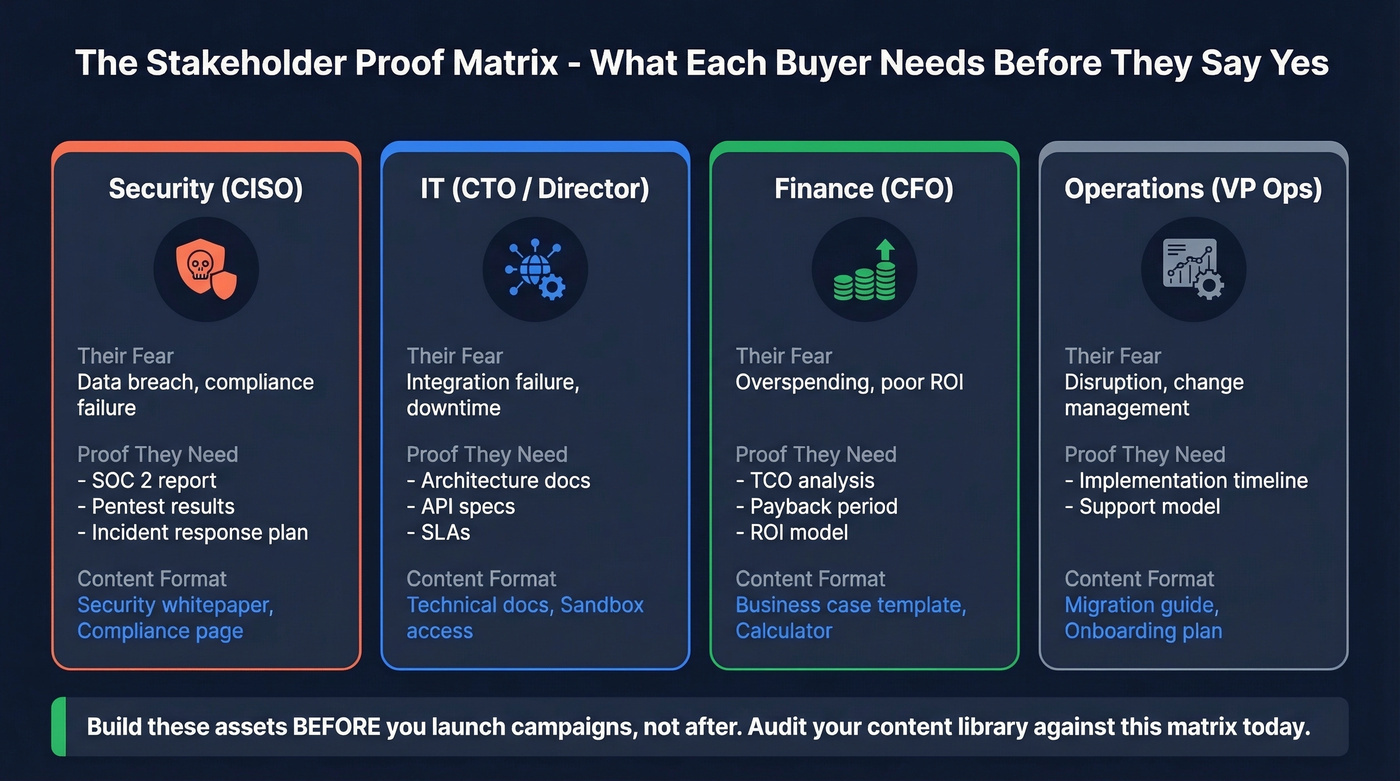
Before you run a single campaign, you need to know what proof each stakeholder requires. This matrix, adapted from Leadfeeder's B2B tech research, is the most useful framework we've found for IT marketing planning. Copy it into your planning doc and audit your content library against it.
| Stakeholder | Their Fear | Proof They Need | Content Format |
|---|---|---|---|
| Security (CISO) | Data breach, compliance failure | SOC 2, pentest results, incident response plan | Security whitepaper, compliance page |
| IT (CTO/Director) | Integration failure, downtime | Architecture docs, API specs, SLAs | Technical docs, sandbox access |
| Finance (CFO) | Overspending, poor ROI | TCO analysis, payback period, ROI model | Business case template, calculator |
| Operations (VP Ops) | Disruption, change management | Implementation timeline, support model | Migration guide, onboarding plan |
The critical insight: create these assets before you launch campaigns, not after. We've seen teams pour money into ABM programs targeting 10-person buying committees, only to realize they don't have a single piece of content that addresses the CFO's concerns. The campaign generates interest from the CTO, the deal stalls at budget approval, and marketing blames sales for not closing. The real problem was a missing asset.
Build the proof matrix. Audit your content library against it. Fill the gaps. Then run campaigns.
Core Strategies That Drive Pipeline
SEO and Content Marketing
Organic search delivers the lowest cost per lead in B2B at $31, while content marketing as a broader category runs $92 CPL. Both compound over time, unlike paid channels where spend stops and leads stop. The tradeoff is patience: expect 3-6 months before content starts ranking. If you want to tie SEO to revenue, build a system for SEO sales leads instead of chasing traffic.
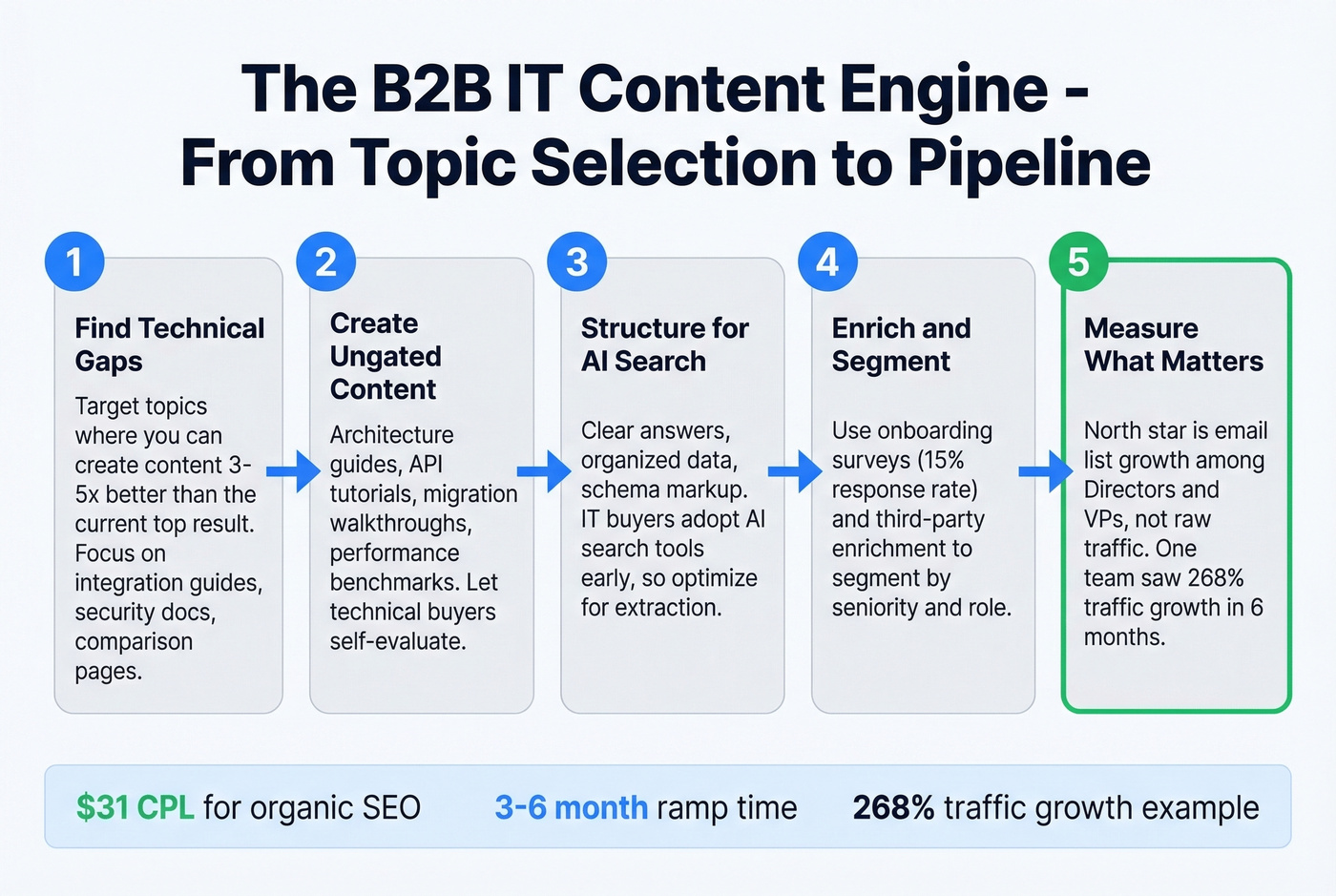
Here's where IT companies have a structural advantage most of them ignore. Generic B2B content is everywhere. Technical content - architecture guides, integration tutorials, security whitepapers, performance benchmarks - ranks because competitors don't create it. If you're an IT infrastructure company and you publish a detailed guide on migrating from on-prem Active Directory to a cloud identity provider, you're competing against two or three other pieces of content instead of two hundred.
The execution model that works: only target topics where you can create content that's 3-5x better than the current #1 result. One team using this approach saw 268% traffic growth in six months, going from 90k to 242k monthly visitors. But the north-star metric wasn't traffic - it was email list growth among directors and VPs. They supplemented this with an onboarding enrichment survey that hit a 15% response rate, enriching non-responders via third-party data to segment subscribers by seniority. Small tactic, massive impact on content targeting.
One thing to plan for in 2026: AI overviews and generative search are reshaping how technical buyers find information. IT buyers are early adopters of AI-powered search tools, which means your content needs to be structured for extraction - clear answers, well-organized data, schema markup - not just traditional keyword optimization.
IT-specific content that consistently performs: comparison pages (your product vs. alternatives), integration guides, security compliance documentation, and "how we built X" engineering blog posts.
Account-Based Marketing
81.5% of B2B marketers now consider ABM a strategic priority, and for IT marketing, it's non-negotiable. When you're selling to 10-11 stakeholders per deal, spray-and-pray demand gen doesn't work. If you want the sales side to match the marketing motion, align ABM with account-based selling best practices.
The shift happening right now is from account-level targeting to buying group orchestration. Instead of targeting "Acme Corp" as a single entity, you're running coordinated campaigns to the CTO (technical proof), CISO (security documentation), CFO (ROI data), and IT Director (implementation details) - all simultaneously, each with role-specific messaging. Some teams are moving beyond MQLs entirely to track Marketing Qualified Buying Groups, measuring engagement across the full committee rather than individual leads.
AI is accelerating this. Most organizations are 6-12 months into AI experimentation for ABM, primarily using it for account research, personalized messaging, and multichannel orchestration. The ROI so far is mostly productivity gains - faster research, better personalization at scale. But those gains compound quickly. A team that can research and personalize for 50 accounts per week instead of 10 has a massive advantage.
Email and Outbound
Email runs a $53 CPL - competitive with most channels and significantly cheaper than paid or events. But it's also the channel most damaged by bad data. Bounce rates above 5% don't just waste sends; they destroy your domain reputation, which tanks deliverability for every future campaign. If you need a remediation plan, start with an email deliverability guide and work backward to list hygiene.
IT buyers expect personalization by role. Sending the same nurture sequence to a CISO and a CFO is worse than sending nothing - it signals that you don't understand their world. Use the stakeholder proof matrix to segment your outreach and match content to each persona's specific concerns.
Paid Media
For IT companies running paid campaigns, budget allocation matters more than total spend:
| Platform | Budget Share | Why |
|---|---|---|
| Google Ads | 35-45% | High intent, $48.96 CPL, 3.75% conversion rate |
| 25-35% | Best MQL-to-SQL (14-18%), unmatched targeting | |
| Bing | 15-20% | 253% ROI, massively overlooked |
| Meta | 5-10% | Retargeting only |
The most overlooked channel? Bing Ads. It delivers the highest ROI of any major B2B platform. IT decision-makers skew toward Bing more than you'd expect, partly because of Microsoft ecosystem defaults in enterprise environments.
LinkedIn's MQL-to-SQL conversion rate of 14-18% versus Google's 7-12% makes it the clear winner for lead quality, even though CPLs are higher. 89% of B2B marketers use LinkedIn for lead gen, and 40% cite it as their most effective channel for high-quality leads. For IT marketing specifically, LinkedIn's targeting by job title and company size lets you reach the exact stakeholders in your proof matrix.
Events and Community
Trade shows cost $811 per lead - the highest of any channel by a wide margin. But IT buyers still attend for technical validation, peer networking, and hands-on product evaluation. Don't cut events entirely; be strategic about which ones you attend and measure them on pipeline influence rather than badge scans.
The bigger opportunity is community-led growth. Private Slack groups like Rands Leadership Slack, Discord servers, and industry-specific forums are where IT buyers actually discuss vendor evaluations. This is the dark social channel that attribution can't track but that heavily influences purchasing decisions. Invest in building or participating in owned communities before increasing trade show budgets. The cost is lower, the influence is higher, and the compounding effect is real.

You just mapped 5 IT buyer personas who each need different proof. Now you need to actually reach them. Prospeo gives you 30+ filters - including buyer intent, technographics, and department headcount - so you can build targeted lists for CISOs, CTOs, and CFOs separately. 98% email accuracy means your campaigns land, not bounce.
Stop marketing to the wrong stakeholders. Find the right ones at $0.01 per email.
Benchmarks and Budget Allocation
Here are concrete numbers on what "good" looks like, drawn from Understory's SaaS analysis and Digital Bloom's PPC research.
| Channel | CPL | Notes |
|---|---|---|
| SEO | $31 | Lowest cost, 3-6 mo. ramp |
| $53 | Requires clean data | |
| Webinars | $72 | Strong mid-funnel |
| Content | $92 | Compounds over time |
| PPC | $181 | Volume play, high intent |
| Trade Shows | $811 | Relationships, not leads |
| Metric | Average | Top Performers |
|---|---|---|
| MQL-to-SQL | 15-21% | 25-35% |
| LinkedIn MQL-to-SQL | 14-18% | - |
| Google Ads MQL-to-SQL | 7-12% | - |
| CAC ratio | $2 per $1 new ARR | - |
| SaaS median growth | 26% | - |
| NRR | 101% | - |
The CAC trend is moving in the wrong direction - median new-customer acquisition cost is up 14% year-over-year, now sitting at $2 for every $1 of new ARR. Payback periods have increased 12.5% since 2022. This makes channel efficiency and data quality more important than ever. If you need a clean definition and calculation model, use this cost to acquire customer guide.
Let's be honest about something: if your average contract value is under $25k, you probably can't afford a 379-day sales cycle. The math doesn't work. Either shorten the cycle with product-led growth, or move upmarket where the unit economics justify the committee-driven buying process. Most IT marketing teams are stuck in the middle - enterprise sales motions with SMB deal sizes - and it's killing their CAC ratios.
For budget allocation, growth-stage IT companies should target 8-12% of revenue on marketing. Mature companies with established market positions can operate at 5-8%. The mistake most teams make is spreading that budget across too many channels. Pick two or three from the table above, go deep, and measure pipeline contribution - not lead volume.
Brand Investment - The Undervalued Play
The model is moving from awareness-based marketing to influence-based marketing, where pipeline contribution replaces MQL volume as the north star. If you're formalizing this, it helps to start with a clear B2B brand positioning doc.
The data on brand investment is unambiguous. B2B brand fame campaigns deliver 2.2x ROI versus 0.7x for pure activation campaigns. And 81% of B2B buyers ultimately purchase from a brand they already knew on Day 1 of their buying process. If you're not in the consideration set before the buyer starts evaluating, your demand gen campaigns are fighting for the remaining 19%.
The BT Enterprise case study makes this concrete. Their brand campaign ("All business. No drama.") delivered GBP 6.32 short-term ROMI per GBP 1 spent and GBP 13.52 long-term ROMI. It moved quality perceptions by +22 points, trust by +11, and consideration by +7. Those aren't vanity metrics - they're the foundation that makes every downstream campaign more effective.
For IT companies, brand investment means thought leadership that demonstrates genuine technical expertise. Your CTO publishing architecture decisions. Your security team sharing incident response learnings. Your engineering blog becoming a resource that buyers bookmark. When the 379-day sales cycle finally reaches the evaluation phase, the company whose content the buyer has been reading for six months has a significant advantage.
Most IT marketing budgets allocate 90%+ to activation and demand gen. Flip that to at least 70/30 in favor of activation, but give brand a real budget. The compounding returns justify it.
Five Mistakes That Kill Pipeline
1. Jargon overload. Your homepage says "synergistic cloud-native infrastructure orchestration platform" and your CIO prospect has no idea what you actually do. The fix is simple but painful: rewrite everything to lead with the business problem you solve. "We cut cloud infrastructure costs by 40%" beats "AI-powered multi-cloud optimization engine" every time.
2. Treating every stakeholder the same. Sending the same nurture sequence to a CISO and a CFO is actively harmful. The CISO wants your pentest results; the CFO wants your payback period. Use the proof matrix to segment by role and match content to each persona's specific concerns.
3. Chasing MQL volume over pipeline. Your CMO is celebrating 10,000 webinar registrations, but only 12 turned into pipeline. The fix: measure pipeline velocity and deal quality, not lead volume. A campaign that generates 50 leads and 8 opportunities is infinitely more valuable than one that generates 500 leads and 2 opportunities.
4. Ignoring data quality. Your SDR team is complaining that half the contacts in your CRM have bounced emails. They're right to complain - and the problem is upstream. Stale databases with 30%+ bounce rates don't just waste outreach effort; they damage your sender reputation and make every future email campaign less effective. Verify before you send, and refresh regularly. In our experience, teams that switch to a 7-day data refresh cycle see bounce rates drop from 30%+ to under 5% almost immediately. If you want a deeper playbook, see how to improve sender reputation.
5. Spreading budget across too many channels. When you're running Google Ads, LinkedIn, content, webinars, trade shows, a podcast, and a community Slack - all with a four-person marketing team - nothing gets done well. Pick two or three channels based on the CPL benchmarks above, invest deeply, and measure pipeline contribution before adding a fourth.
Data Quality as Marketing Infrastructure
Your data infrastructure determines the ceiling of every campaign you run.
The ABM execution gap is real. You've mapped 10 stakeholders at your target account. You've built role-specific content. You've designed a multichannel orchestration sequence. And then half your emails bounce because the contact data in your CRM is six months old. The strategy was sound. The data killed it. If you're rebuilding the stack, start by comparing data enrichment services and choosing one source of truth.

Industry-average data refresh cycles run 6 weeks, which means by the time you're sending outreach, a meaningful percentage of your contacts have changed roles, companies, or email addresses. For IT buying committees - where turnover in technical leadership roles is high and org structures shift frequently - stale data is even more damaging.
When you're building target account lists for 10-person IT buying committees, you need emails that actually land. Prospeo combines 300M+ professional profiles, 143M+ verified emails, and 125M+ verified mobile numbers with 98% email accuracy and a 7-day refresh cycle. The platform's 30+ search filters include buyer intent across 15,000 topics, technographics, department headcount, and job changes - so for IT companies specifically, you can filter for organizations running specific tech stacks before you ever send a message.
The article says 70% of your website traffic is anonymous and your form-fill strategy captures maybe 30%. Prospeo's Chrome extension and enrichment API identify and verify the contacts behind that hidden demand - returning 50+ data points per contact with a 92% match rate. Refreshed every 7 days, not every 6 weeks.
Turn anonymous IT buyers into verified contacts before your competitors do.
2026 Trends Worth Watching
AI operationalization. 94% of marketers report using generative AI, but most are still in experimentation mode. The teams pulling ahead are integrating AI into specific workflows - account research, personalized messaging at scale, multichannel orchestration - rather than using it as a generic content generator. Pick one workflow where AI can save your team 5+ hours per week and build a repeatable process around it.
Privacy-first data. Cookie deprecation combined with IT buyers' technical sophistication (they're the ones running ad blockers and VPNs) means third-party tracking data is increasingly worthless for this audience. First-party and zero-party data - email lists, community membership, enrichment data - are the gold standard. Build owned data assets aggressively. Every email subscriber and community member is worth more than a thousand anonymous website visits.
RevOps as operating model. The silos between marketing, sales, and customer success are collapsing into a single revenue operations function with shared pipeline metrics. For IT marketing teams, this means your KPIs need to align with pipeline and revenue, not just MQL volume. If your marketing dashboard doesn't show pipeline contribution by channel, fix that before optimizing anything else. If you're hiring for it, this RevOps manager breakdown is a useful reference.
Community-led growth. Private communities and messaging groups are where IT buying decisions increasingly happen. You can't track it, you can't attribute it, and you can't buy your way in. Invest in building or sponsoring communities where your buyers already gather. The ROI won't show up in your attribution model, but it'll show up in your pipeline.
Intent data maturity. The most sophisticated IT marketing teams are layering buyer intent with technographics and job change signals to identify in-market accounts before competitors even know they're looking. Build intent-based trigger workflows that automatically route high-signal accounts to your ABM program.
FAQ
What's the difference between B2B IT marketing and B2B SaaS marketing?
B2B IT marketing covers the full spectrum of technology products and services - managed services, infrastructure, cybersecurity, consulting, and hardware - while SaaS marketing focuses specifically on subscription software. IT marketing typically involves longer sales cycles (379 days average), more stakeholders (10-11), and heavier compliance requirements like SOC 2 and ISO 27001.
What's the best channel for IT companies on a limited budget?
SEO and content marketing at $31 CPL. It has the longest ramp time (3-6 months) but the lowest cost per lead and compounds over time. Pair it with email outreach using verified contact data for faster pipeline generation while your content engine builds momentum.
How many stakeholders are in a typical IT purchase?
Research shows 10-11 stakeholders influence the average B2B tech purchase, and 79% require CFO sign-off. Your marketing needs to address each role's specific concerns - security, technical, financial, and operational - with dedicated content and proof points mapped through a stakeholder proof matrix.
How do I build accurate contact lists for IT buying committees?
Use a B2B data platform with department-level filtering and real-time verification. Look for 30+ search filters covering job title, department headcount, technographics, and buyer intent - then verify every email before outreach. A 7-day data refresh cycle ensures contacts stay current even in fast-moving IT organizations where technical leadership changes frequently.