

B2B Sales Promotion: 9 Types With Real Numbers, Not B2C Recycling
It's Thursday afternoon. Your VP of Sales just pinged you: "We need a Q4 promotion by Friday. Something to accelerate pipeline." You pull up every B2B sales promotion guide your team has bookmarked, and they all say the same thing - offer a free trial. That's not a strategy. You need the actual math and the promotion types that work when a dozen stakeholders have to agree before anyone signs anything.
Why B2B Promotion Isn't B2C
A B2C promotion targets one person making an impulse decision. A B2B promotion targets a buying committee averaging 13 decision-makers, with 80% of interactions happening digitally before a rep ever gets involved. The median B2B conversion rate sits at just 2.9%, and the biggest funnel leak - MQL to SQL - drops off at roughly 15%.
Your promotion isn't competing for attention. It's competing for consensus across a dozen stakeholders, each with different priorities, over a sales cycle that stretches months. B2B contracts run six and seven figures. Buyers justify purchases on ROI, not emotion. That means your promotion needs to reduce evaluation friction, not just manufacture urgency.
What You Need (Quick Version)
If you sell direct: Start with free trials and a referral program baked into onboarding. These compress evaluation cycles and bring in higher-LTV customers.
If you sell through partners: Launch a SPIFF or tiered rebate program immediately - the most underused lever in B2B. It drives individual rep behavior faster than anything else.
Regardless of motion: Verify your contact data before you promote anything. A brilliant offer sent to dead inboxes is just wasted budget. (If you need a process, use this email verification guide.)
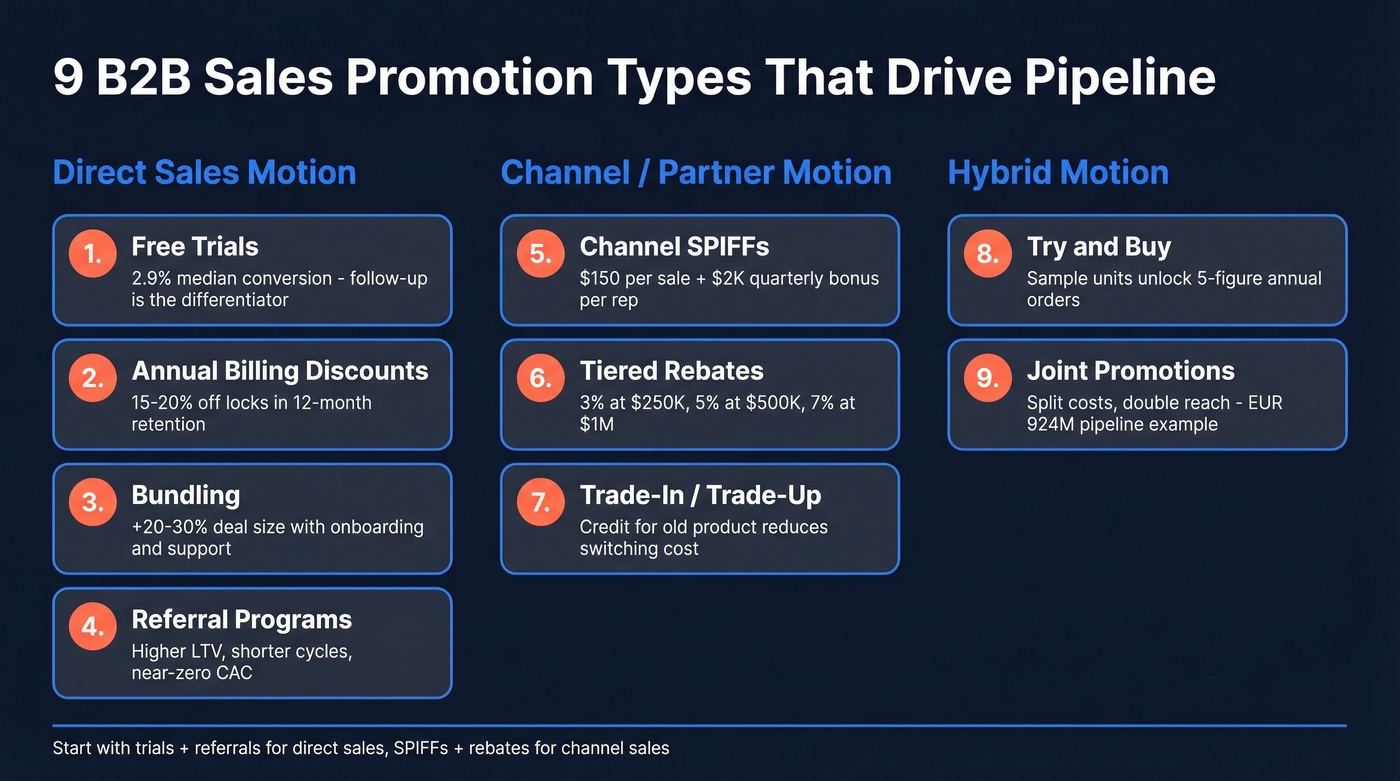
9 Promotion Types That Drive Pipeline
1. Free Trials
Pipedrive's 14-day, no-credit-card trial is the textbook case. With a 2.9% median B2B conversion rate, trials compress evaluation by letting prospects self-qualify. But here's the thing - the trial itself isn't the differentiator anymore. Your follow-up sequence is. We've seen teams double trial-to-paid conversion just by adding a personalized check-in on day three and a use-case-specific email on day seven, while the generic "how's your trial going?" drip converts almost nobody. (If you want templates, start with sales cadence templates.)
2. Annual Billing Discounts
Most SaaS platforms offer 15-20% off for annual commitment. The real value isn't the margin you give up; it's the 12-month lock-in that kills monthly churn and improves LTV. If you're not offering an annual incentive, you're leaving retention on the table. (Related: monthly churn rate.)
3. Bundling
Bundling often adds 20-30% to deal sizes when the add-ons solve real problems. Package your core product with onboarding, training, and premium support as a single deal. Buyers feel like they're getting more value, and you maintain pricing integrity - a critical distinction from discounting, which trains your market to wait for the next sale. (This ties directly to upsell opportunities.)
4. Referral Programs
One Reddit practitioner baked referral requests directly into their onboarding flow and hit $500K ARR in 8 months. Referred customers have higher LTV and shorter cycles because trust transfers from the referrer. Make the ask systematic, not occasional. The consensus on r/SaaS is that most founders wait too long to formalize referrals - by the time they build a program, they've already missed hundreds of warm introductions their happy customers would have made if asked. (If you need more plays, see these strategies to increase sales.)
5. Channel SPIFFs
Let's be honest: channel partner incentives are the most underused promotion lever in B2B, and it's not close. Channel SPIFFs reward individual partner reps, not the organization - that's what makes them work. A common structure is $150 per product sold plus a $2,000 quarterly bonus for the top partner salesperson. For a 50-rep partner network, a typical SPIFF budget lands around $25K-$75K per quarter depending on volume and whether you add leaderboard bonuses. If you're selling through channel and haven't tried SPIFFs, start here. (More context: B2B sales channels.)
6. Tiered Rebates
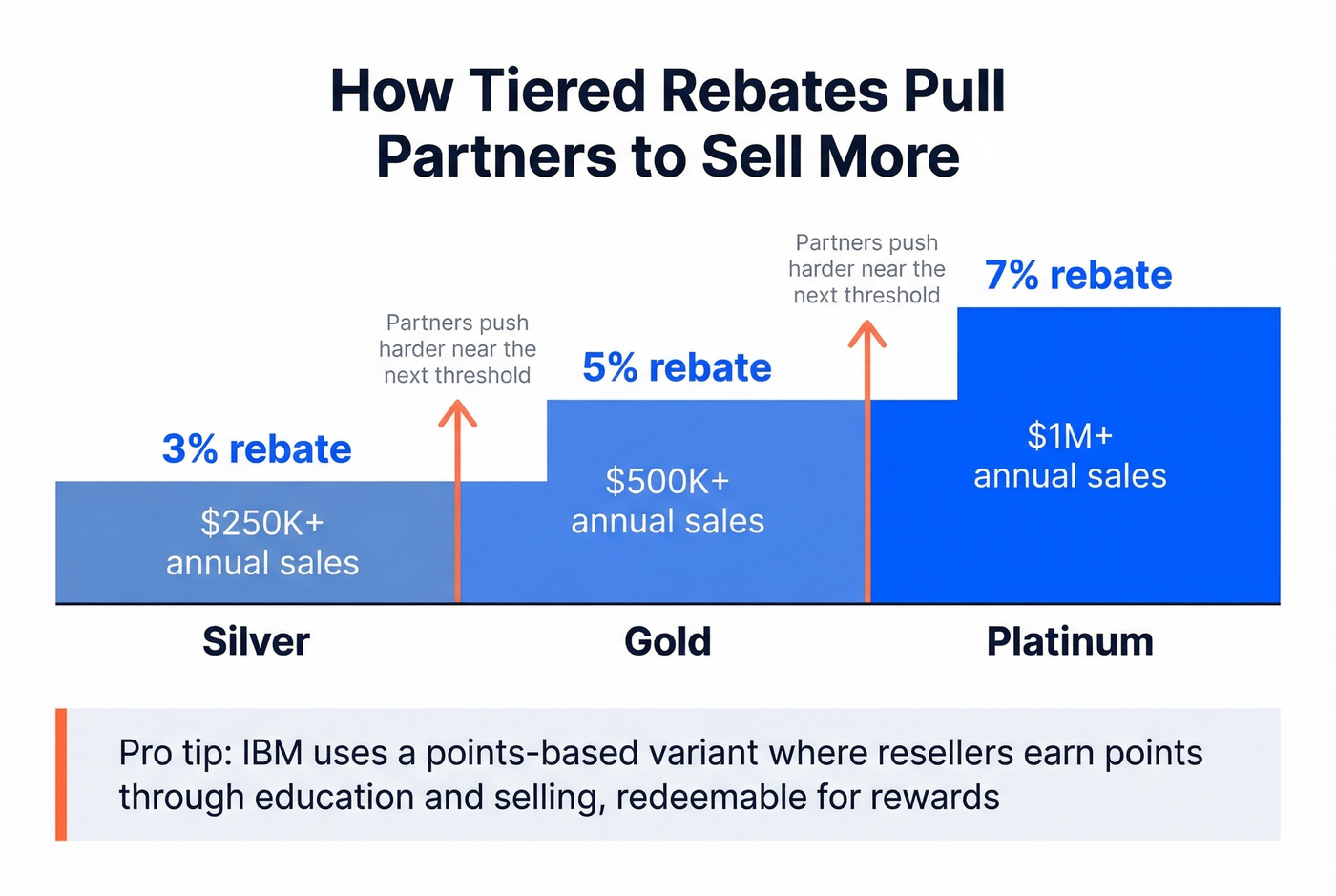
Structure rebates to reward volume: 3% after $250K, 5% after $500K, 7% after $1M in annual sales across Silver, Gold, and Platinum tiers. IBM's "Know Your IBM" program uses a points-based variant where resellers earn points through education and selling, redeemable for rewards. The tiered structure creates a natural pull - partners push harder once they're close to the next threshold.
7. Trade-In / Trade-Up
Epson Italy ran a reseller trade-in program to push B2B inkjet solutions, reducing switching costs for partners sitting on competitor inventory. Give credit for the old product toward the new one, and set firm cashback deadlines to prevent indefinite deferral. (This is a classic competitor buy-back campaign pattern.)
8. Try & Buy
In hardware, a few hundred dollars in sample units can unlock five-figure annual orders. Netgear combined a try-and-buy program with a sweepstakes to increase NAS channel penetration. Start with accessories or low-cost add-ons to limit risk exposure - try-and-buy gets expensive fast with high-value hardware.
9. Joint Promotions
SAP and Capgemini's "Inspire the Future" campaign generated EUR 924.4M in pipeline and EUR 266.15M in projected revenue, with 48% higher engagement than SAP's other social campaigns. You split costs and double reach. The catch: don't attempt this with a partner you haven't worked with before. Alignment on targeting and lead routing takes real coordination, and misaligned joint campaigns burn relationships faster than they build pipeline. (If you're planning this as ABM, use an ABM campaign planning template.)

Every promotion in this article - trials, referrals, SPIFFs, joint campaigns - fails if your outreach bounces. Prospeo's 98% email accuracy and 7-day data refresh mean your promotion lands in real inboxes, not spam traps. At $0.01 per verified email, the data costs less than a single wasted Google click.
Stop sending brilliant promotions to dead inboxes.
How to Distribute Your Promotion
The promotion itself is half the equation. Distribution determines whether anyone sees it. (For a broader playbook, see outreach methods.)
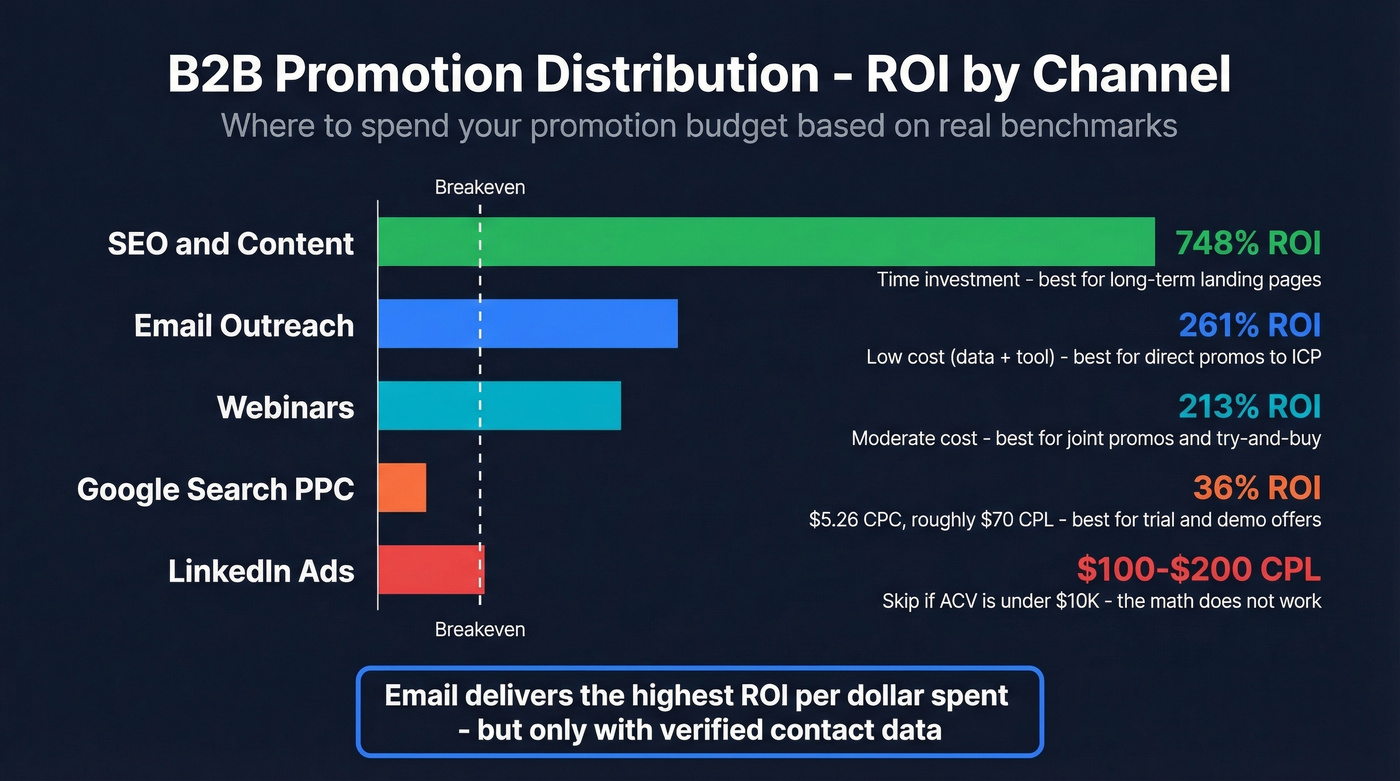
| Channel | Avg Cost | Expected ROI | Best For |
|---|---|---|---|
| Email outreach | Low (data + tool) | 261% | Direct promos to ICP |
| Google Search | $5.26 CPC / ~$70 CPL | 36% (PPC avg) | Trial/demo offers |
| LinkedIn Ads | $3.94-$10+ CPC | Strong targeting, high CPL ($100-$200) | Senior decision-makers |
| Webinars | Moderate | 213% | Joint promos, try & buy |
| SEO/Content | Time investment | 748% | Long-term landing pages |
Email delivers 261% ROI and costs a fraction of paid channels - but only if your list is accurate. A promotion sent to unverified contacts doesn't just bounce; it craters your sender reputation for every future campaign. In our experience, email outreach to a verified list is the highest-ROI distribution channel for most B2B promotions, full stop. LinkedIn CPL runs $100-$200 for senior targeting - real money if you're promoting a free trial with a 2.9% conversion rate. (If you're building sequences, use these sales email sequence templates.)

Skip LinkedIn Ads entirely if your ACV is under $10K. The math just doesn't work at that price point. Webinars pair well with joint promotions and try-and-buy offers because they let you demonstrate value live, but they require a committed audience - cold webinar invites convert poorly without a warm list to start from.
Measuring Promotion ROI
Average B2B marketing delivers a 5:1 ROI. Your promotion should beat that baseline. Track conversion at every funnel stage: (If you need the formula, use this ROI in sales breakdown.)
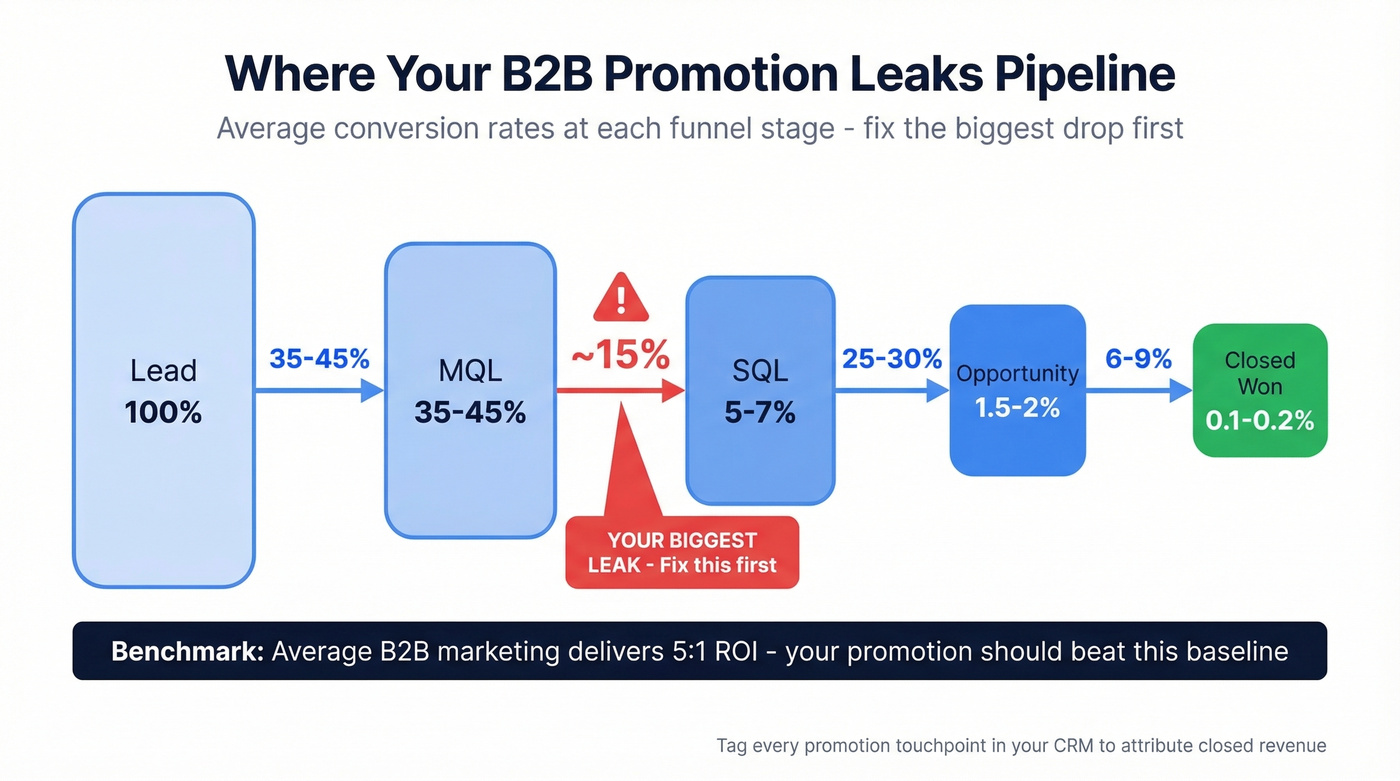
- Lead to MQL: 35-45%
- MQL to SQL: ~15% (your biggest leak - fix this first)
- SQL to Opportunity: 25-30%
- Opportunity to Closed-won: 6-9%
The SAP-Capgemini campaign tracked pipeline-to-revenue conversion at a clear ratio - that's the measurement standard. Tag every promotion touchpoint in your CRM so you can attribute closed revenue back to the specific offer. If you can't trace a deal back to the promotion that influenced it, you're guessing. (This is exactly what pipeline attribution is for.)
3 Mistakes That Kill B2B Promotions
1. Bad contact data. You send a 20% discount to 5,000 contacts, 1,800 bounce, and your sender reputation craters. The promotion didn't fail - your data did. Tools like Prospeo verify emails at 98% accuracy on a 7-day refresh cycle, which means your list stays clean between campaigns instead of decaying into a bounce-rate liability. (If you're troubleshooting, start with invalid emails.)
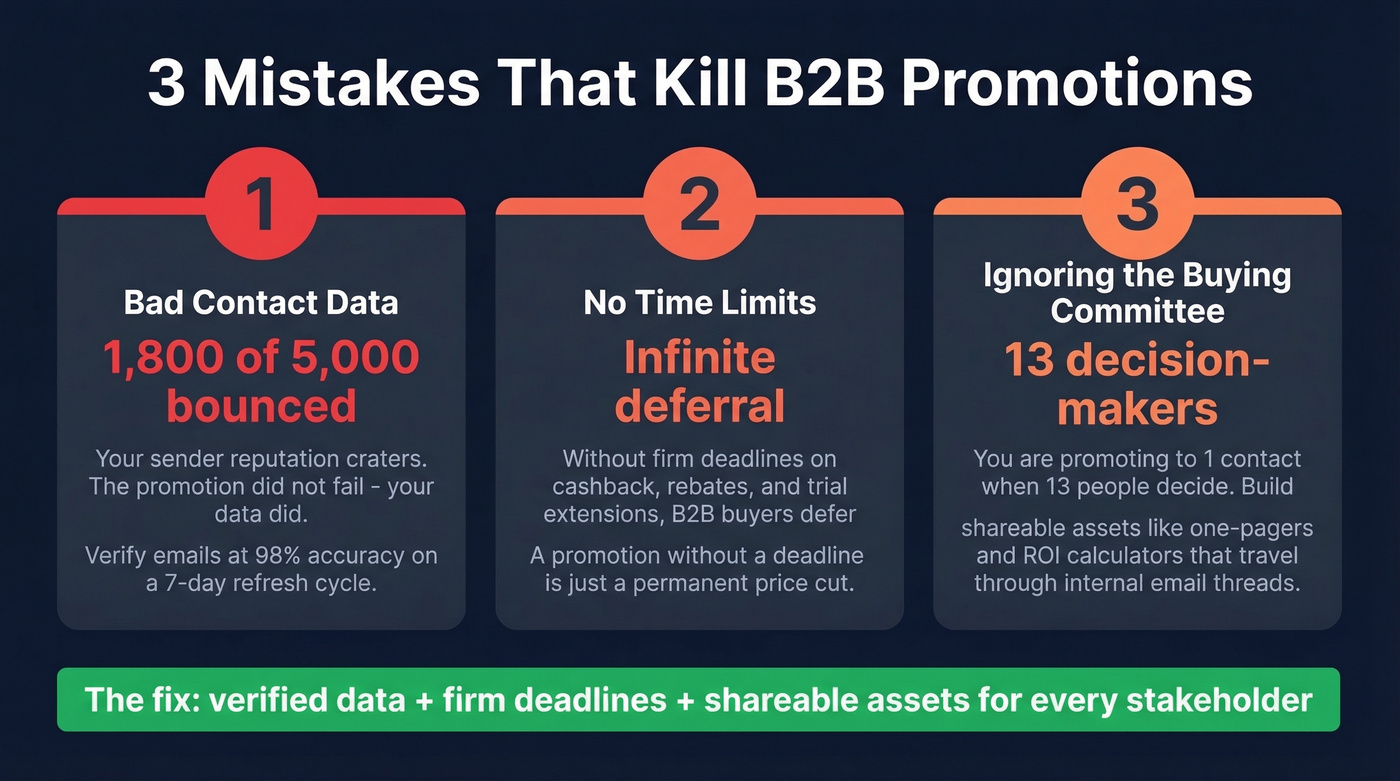
2. No time limits. Without firm deadlines on cashback, rebates, and trial extensions, B2B buyers defer indefinitely. A promotion without a deadline is just a permanent price cut.
3. Ignoring the buying committee. You're promoting to one contact when 13 people decide. If the champion can't forward your offer to the CFO with a clear ROI case, the promotion dies in committee. Build shareable assets - one-pagers, ROI calculators, comparison sheets - that travel through internal email threads without losing context.
Email outreach delivers 261% ROI - but only with clean data. Prospeo gives you 300M+ profiles with 30+ filters to target exact buying committees: by intent, tech stack, headcount growth, and job changes. Build the list that matches your promotion's ICP in minutes, not days.
Reach every stakeholder on the buying committee with verified contact data.
FAQ
What's an example of a B2B sales promotion activity?
A channel SPIFF paying individual partner reps $150 per product sold plus $2,000 quarterly bonuses is a classic example. Other proven types include free trials, annual billing discounts of 15-20%, tiered volume rebates, referral programs, and joint promotions with strategic partners.
What's the difference between B2B and B2C promotions?
B2B promotions target buying committees of 13+ stakeholders over months-long sales cycles and must justify ROI with hard numbers. B2C promotions drive impulse purchases from individuals using emotional triggers and short deadlines. The mechanics are fundamentally different - a coupon code doesn't move a $200K enterprise deal.
Which B2B promotion type has the highest ROI?
Referral programs and channel SPIFFs consistently outperform blanket discounts. Referrals deliver higher-LTV customers at near-zero acquisition cost, while SPIFFs drive individual rep motivation. One practitioner hit $500K ARR in 8 months through systematic referral asks baked into onboarding.
How do I build a target list for a B2B promotion?
Use a verified B2B database filtered by buyer role, company size, and in-market intent signals. Accuracy matters more than volume - a 5,000-contact list with 98% deliverability will outperform a 20,000-contact list with 60% deliverability every time, because your sender reputation stays intact for future campaigns.