

BDR Lead Generation: The 2026 Playbook for Booking More Meetings Without Burning Out
A BDR on r/sales described their reality: 15 new meetings per week from cold outreach, 12-hour days, and the sinking feeling that manual research would never scale. That post isn't an outlier. It's the norm for teams still running a "list, research, email, hope" workflow.
BDR lead generation isn't a grind problem - it's a system problem. The teams booking the most meetings in 2026 have figured out the system, and we've spent the last year watching what actually works versus what just sounds good in a LinkedIn post.
What the BDR Role Looks Like Now
BDR and SDR titles are used interchangeably at most companies. Some orgs split them - BDRs handle outbound, SDRs handle inbound - but the core job is the same: generate qualified meetings for AEs. Don't overthink the title.
What's changed is the operating model. The old playbook was volume-first: more dials, more emails, more hours. The 2026 playbook is targeting-first: better data, verified contacts, multichannel cadence, and signal-based prioritization. Around 60% of BDR teams now use AI tools in their workflow, and 58% expanded headcount last year, so the role isn't going away. It's evolving. The reps who aren't adapting are the ones burning out.
The Stack-Before-Send Workflow
Most BDRs spend 60-70% of their day on research that fails because the data underneath it is stale - 30% of B2B contact data decays every year. A modern lead generation workflow front-loads qualification and enrichment so outreach time goes to prospects who can actually convert.
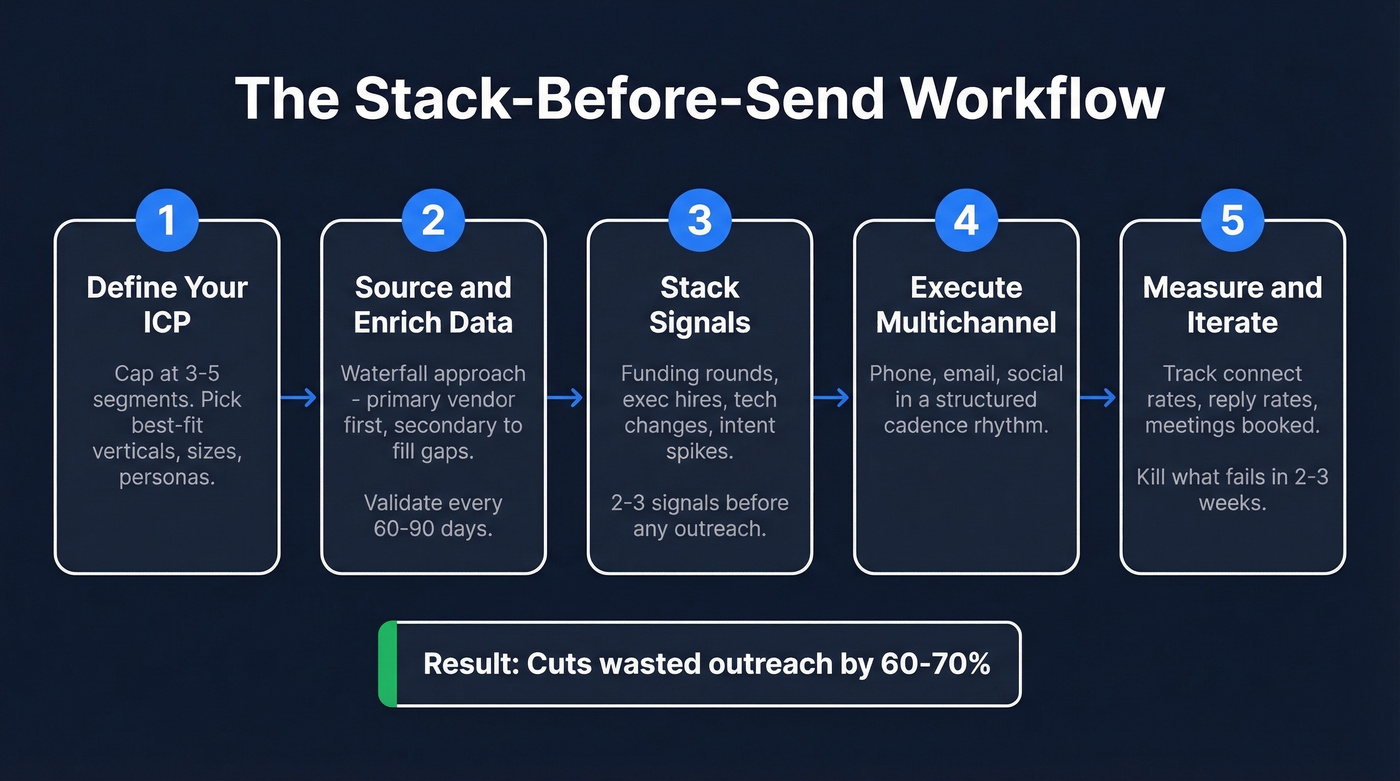
Step 1: Define your ICP tightly. Cap it at 3-5 segments. We've seen teams build 47 micro-segments and then wonder why nobody can execute. Pick your best-fit verticals, company sizes, and buyer personas. Move on. (If you need a starting point, use an Ideal Customer Profile Template and scoring rubric.)
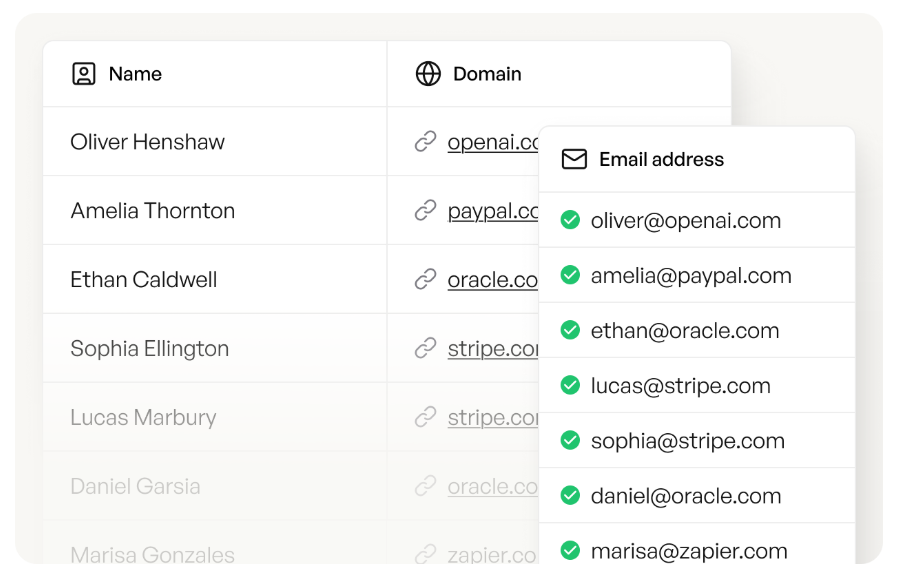
Step 2: Source and enrich your data. Use a waterfall approach - primary vendor first, secondary vendor to fill gaps, skip the rest. Prospeo works well as the primary layer with 300M+ profiles, 98% email accuracy, and a 7-day data refresh cycle versus the 6-week industry average. Validate your list every 60-90 days minimum. If you're comparing vendors, start with data enrichment services and work backward from accuracy + refresh rate.
Step 3: Stack signals before outreach. Don't reach out because someone matches your ICP. Reach out because they match your ICP and two or three signals fired - a funding round, an executive hire, a technology change, a spike in intent on a relevant topic. This is the "Stack-Before-Send" rule, and it cuts wasted outreach by 60-70% when you apply pre-qualification filters before the first touch. (More on operationalizing this in identifying buying signals.)
Step 4: Execute multichannel - phone, email, social in a structured rhythm. Step 5: Measure and iterate - track connect rates, reply rates, and meetings booked per channel. Kill what doesn't work within 2-3 weeks.
2026 BDR Benchmarks
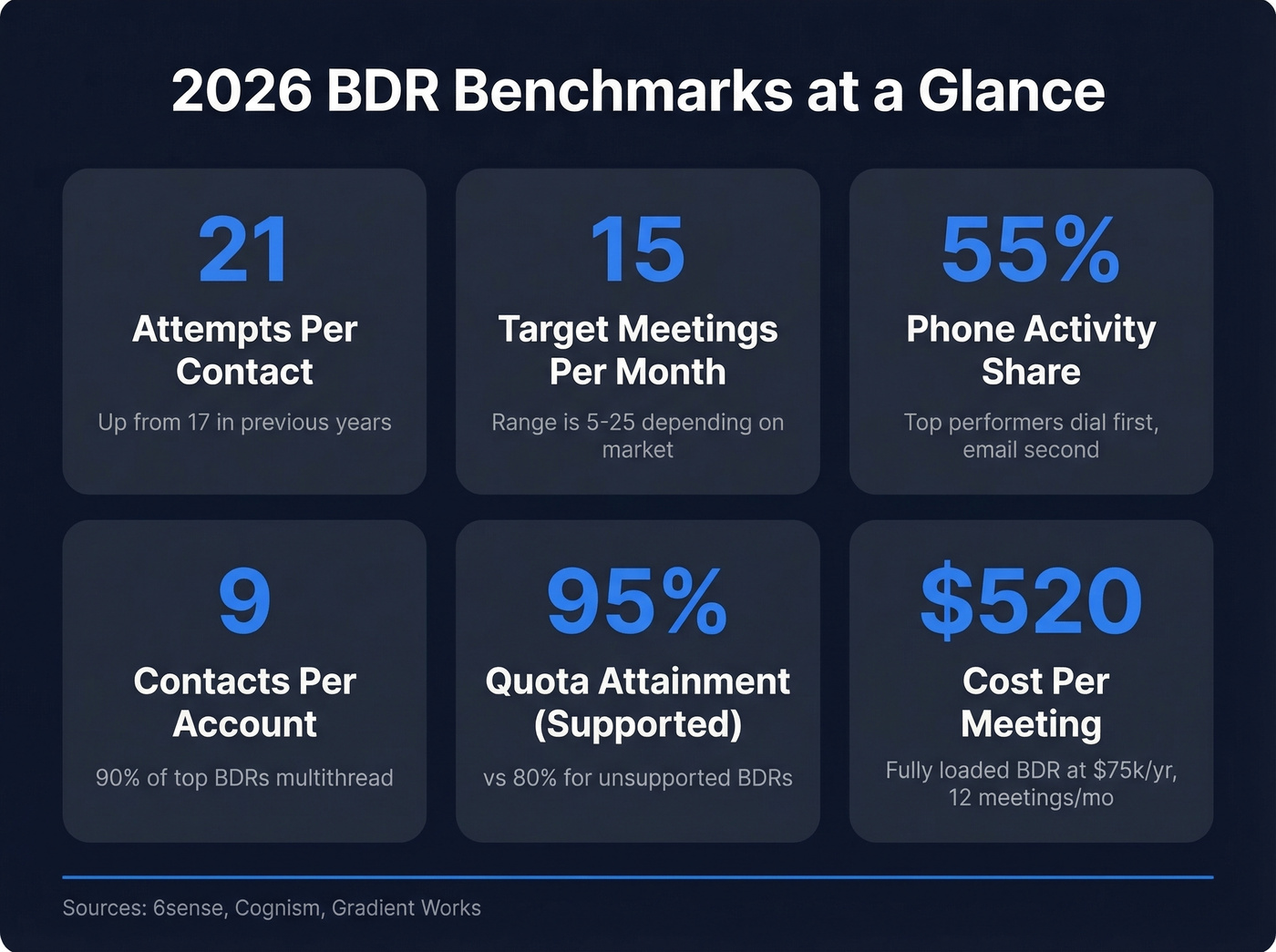
These benchmarks draw from the 6sense BDR Benchmark report, Cognism's State of Outbound, and compiled data from Gradient Works.
| Metric | Benchmark | Source |
|---|---|---|
| Attempts per contact | ~21 (up from 17) | 6sense |
| Cadence length | 53 days avg | 6sense |
| Meetings booked/month | 5-25 (target: 15) | Operatix via Gradient Works |
| Cold call answer rate | 13.3% (w/ verified contacts) | Cognism |
| Cold email reply rate | 1-5% typical, 12% optimized | GMass/Outreach via Gradient Works |
| Channel mix (top performers) | 55% phone / 30% social / 15% email | Cognism |
| Contacts per account (multithreading) | 9 avg (90% of BDRs multithread) | 6sense |
| Quota attainment (supported BDRs) | 95% vs 80% unsupported | 6sense |
Two things jump out. Supported BDRs - those with marketing air cover, enablement, and good tooling - hit 95% of quota versus 80% for unsupported reps. The tooling investment pays for itself. And the channel mix is phone-heavy. Email gets all the attention in content marketing, but the best BDR teams are dialing first and emailing second.
Here's the thing: if your average deal size is under $15k and you're spending $150/user/month on Outreach plus $30k/year on ZoomInfo, you're over-tooled. A $99/month data platform plus a $39/month sequencer will get you 90% of the way there.
A useful cost benchmark: a fully loaded in-house BDR at $75k/year booking 12 held meetings per month runs roughly ~$520 per meeting. That's the number to beat when evaluating alternatives.

You just read that 30% of B2B data decays annually and stale contacts kill BDR productivity. Prospeo refreshes all 300M+ profiles every 7 days - not the 6-week industry average. At $0.01 per email with 98% accuracy, your reps spend time dialing real buyers instead of bouncing off dead inboxes.
Stop burning outreach hours on decayed data. Fix your stack today.
Building a Multichannel Cadence
Cognism recommends a 5-day cycle: call first, email recap, social touch, then repeat. Across a full cadence, BDRs average ~21 attempts per contact - roughly 8 calls, 8 emails, and 5 social touches - spread over 53 days before moving on. 90% of top-performing BDRs multithread, reaching an average of 9 contacts per account rather than betting everything on a single champion.
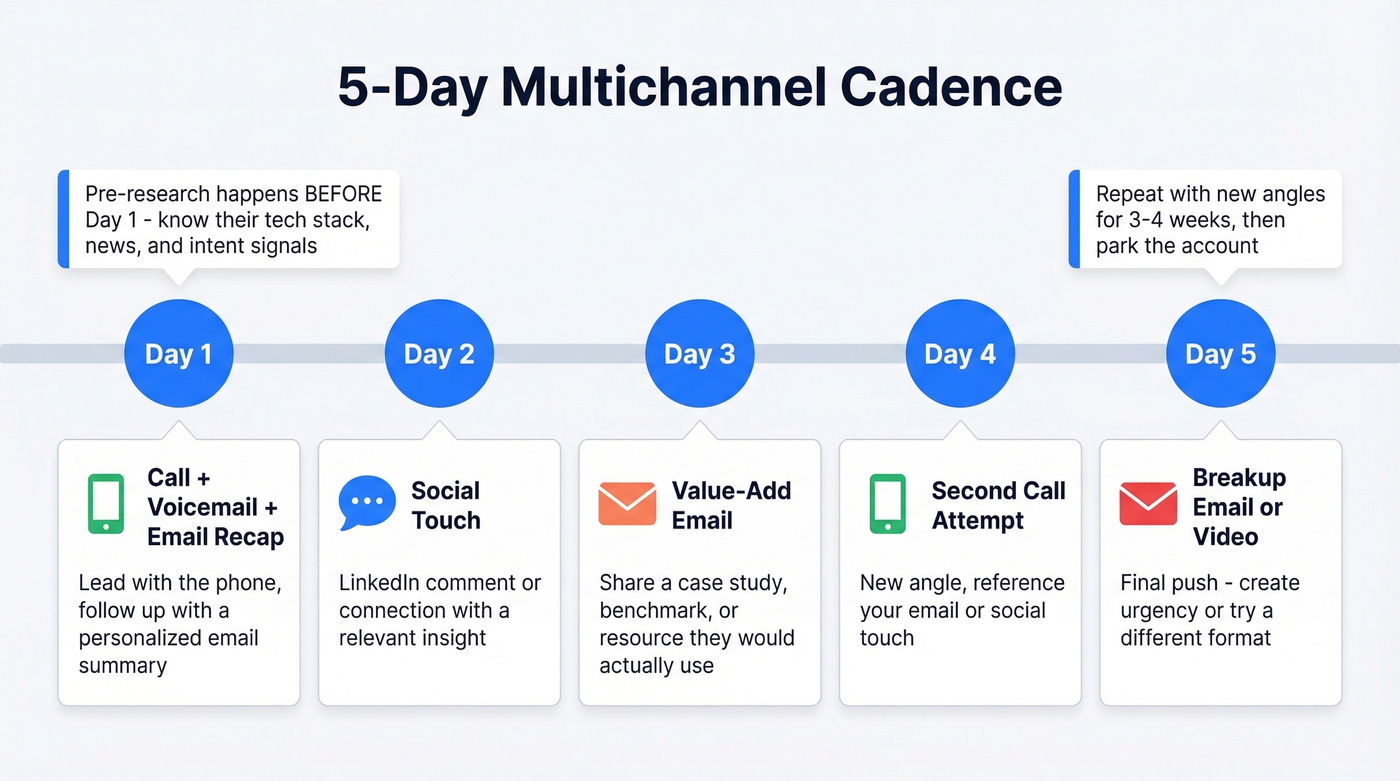
The key is that personalization happens before the first touch, not during it. By the time you pick up the phone, you should already know the prospect's tech stack, recent company news, and which intent topics they're spiking on. That research phase is what turns a cold call into a warm-ish one. If you want more repeatable patterns, borrow from these sales prospecting techniques.
Day 1 is a call plus voicemail plus email recap. Day 2, a social touch. Day 3, a follow-up email with value-add content. Day 4, another call attempt. Day 5, a breakup-style email or video message. Repeat with new angles for 3-4 weeks. If you're still getting silence after that, the account isn't ready - park it and let marketing nurture do its job. (For copy you can plug in fast, use these sales follow-up templates.)
Using Intent Data to Prioritize Accounts
70% of the buyer journey happens before a potential customer talks to a vendor. That stat should change how you think about timing. Intent data tells you who's in that invisible research phase right now - and who's just sitting in your ICP list collecting dust.
Split your signals into first-party (website visits, webinar attendance, trial signups) and third-party (off-site research behavior tracked by providers like Bombora or 6sense). Route by intensity: low-intent accounts get marketing nurture, medium-intent gets targeted content, and high-intent gets immediate BDR outreach. If you need a practical framework, map this to intent based segmentation.
Intentsify reported a 44% increase in scheduled meetings and 13% increase in call pickups when BDRs used intent-guided outreach versus spray-and-pray. That's the difference between calling someone who's actively researching your category and calling someone who has no idea why you're on the phone. In our experience, even a basic intent layer - just tracking which accounts visit your pricing page - can cut wasted dials by a third.
AI BDRs vs Human BDRs
Let's be honest about this one. The "AI will replace all BDRs" takes are as overblown as the "cold calling is dead" takes from 2019.
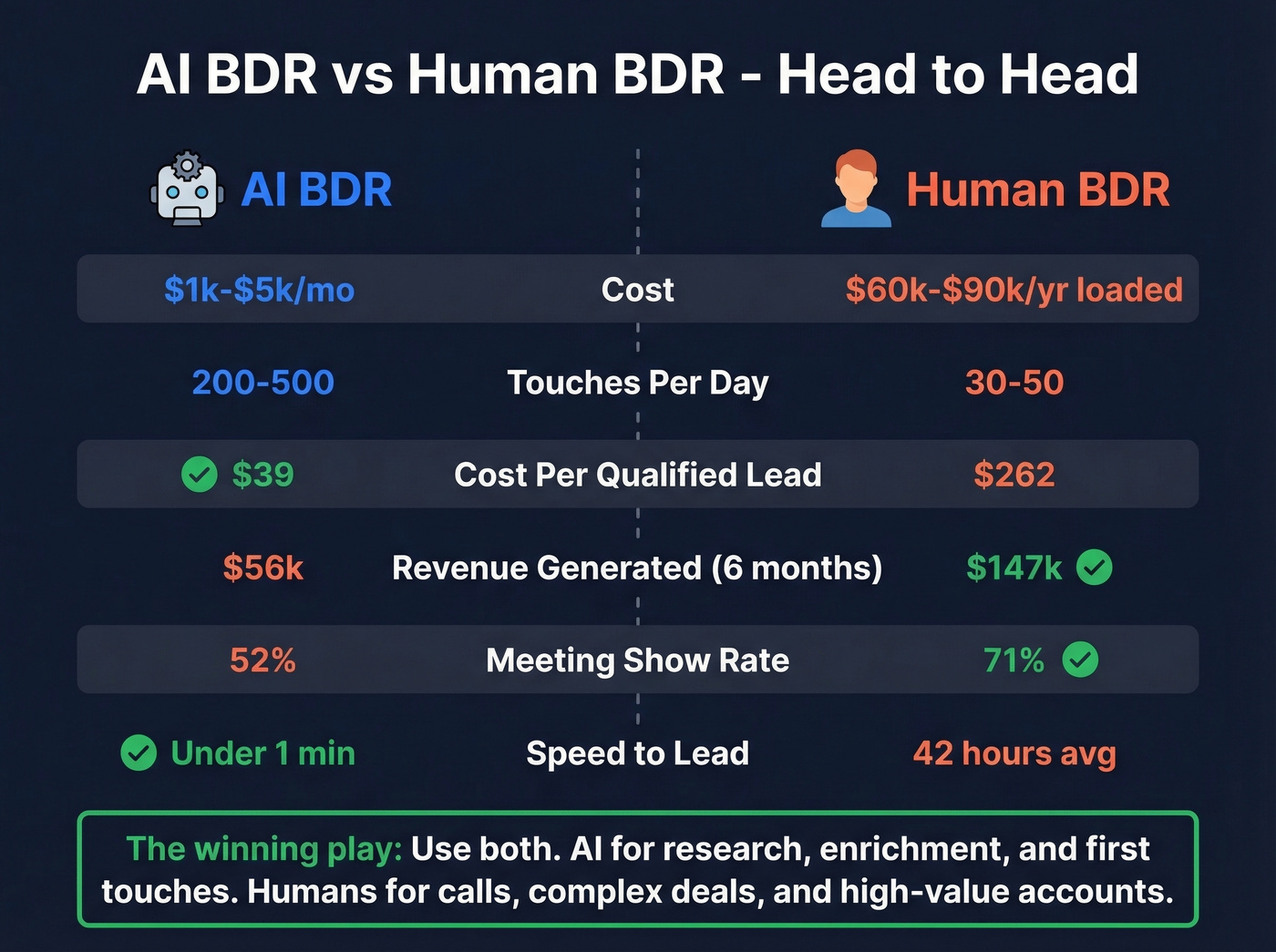
| Dimension | AI BDR | Human BDR |
|---|---|---|
| Cost | $1k-$5k/mo | $60k-$90k/yr loaded |
| Touchpoints/day | 200-500 | 30-50 |
| Cost per qualified lead | ~$39 | ~$262 |
| Revenue generated (6-mo test) | $56k | $147k |
| Meeting show rate | 52% | 71% |
| Speed to lead | <1 min | 42 hrs avg |
| Best for | Volume, initial touches, inbound response | Complex deals, trust, conversations |
AI is ~6.7x cheaper per qualified lead. But human BDRs generated 2.6x more revenue and had a 37% higher meeting show rate in a head-to-head experiment. The speed-to-lead gap is staggering - AI responds in under a minute versus a 42-hour average for human teams, which drives a 391% conversion boost on inbound leads alone.
The answer isn't either/or. Use AI for research, enrichment, initial email sequences, and instant inbound response. Use humans for phone conversations, complex objection handling, and high-value accounts. If you're a Series A company with two BDRs, an AI layer for research and first-touch email makes your humans 3x more productive. Skip this approach if you're selling six-figure enterprise deals where every touchpoint needs to feel personal - AI-generated outreach still reads as generic to senior buyers, and they'll ignore it. (If you're building this motion, start with generative AI lead generation.)
The Tech Stack That Matters
You don't need 10 tools. You need three.
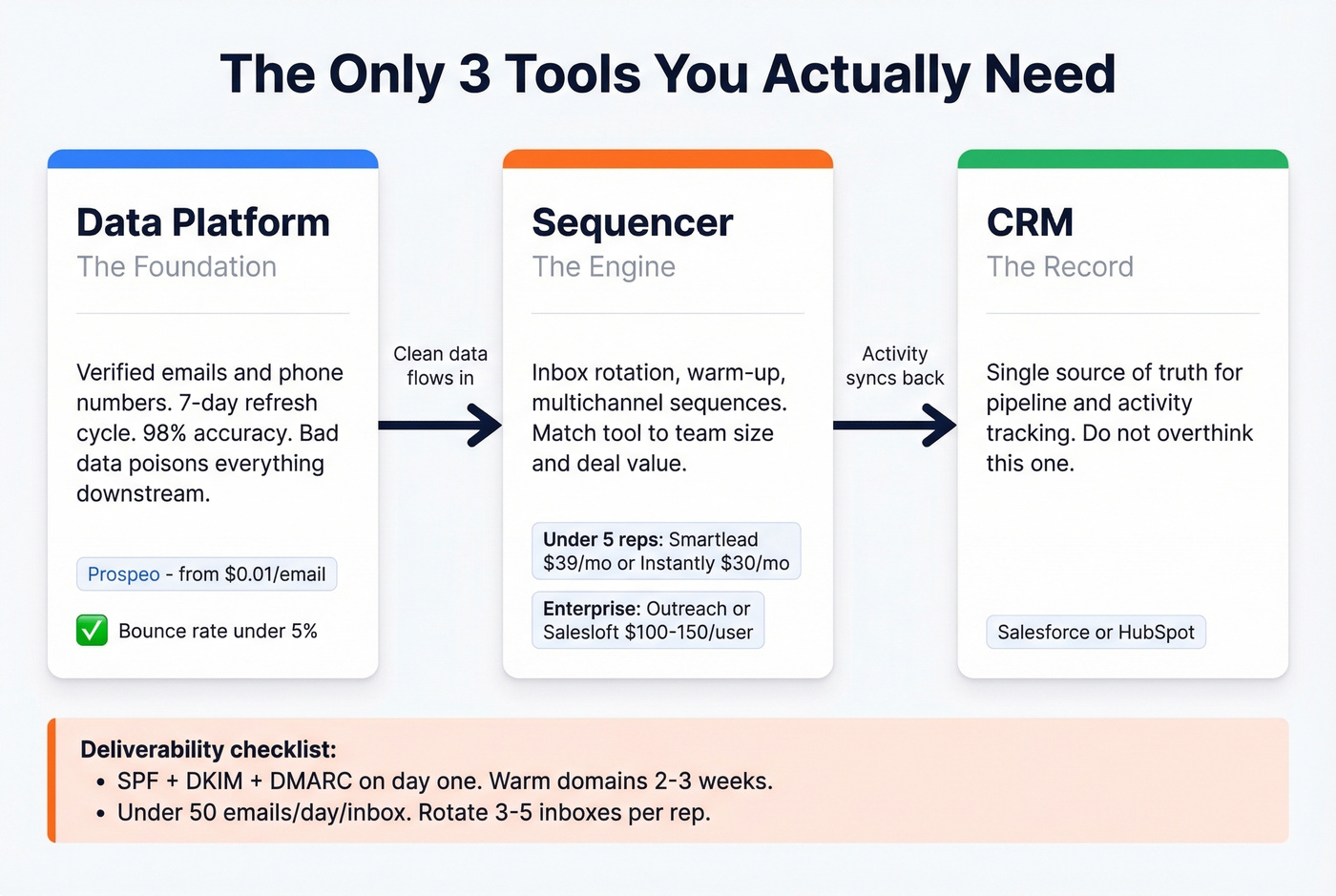
Data platform: This is the foundation. Bad data poisons everything downstream - your sequences bounce, your reps waste dials on wrong numbers, and your domain reputation tanks. I've watched teams spend $40k/year on a data vendor and still run 30%+ bounce rates because the refresh cycle was measured in months, not days. Prospeo runs 300M+ profiles at ~$0.01 per email with 98% accuracy and a 7-day refresh cycle. Snyk's team dropped their bounce rate from 35-40% to under 5% after switching, and their AE-sourced pipeline jumped 180%. That's the kind of data quality difference that compounds across every sequence you send. If you're auditing list quality, start with email bounce rate benchmarks and fixes.

Sequencer: For email-heavy outbound, Smartlead ($39-$94/mo) or Instantly ($30-$77/mo) handle inbox rotation and warm-up well. For enterprise multichannel, Outreach or Salesloft run ~$100-$150/user/month. If your team is under 5 reps and deal sizes are under $25k, the cheaper tools are the right call. (If you're evaluating options, see our roundup of outbound lead generation tools.)
CRM: Salesforce or HubSpot. Don't overthink this one.
One deliverability note worth memorizing: set up SPF, DKIM, and DMARC on day one. Warm new sending domains for 2-3 weeks. Keep volume under 50 emails per day per inbox during warm-up. Rotate 3-5 inboxes per rep. Ignore this and your entire outbound motion dies before it starts. For a deeper setup checklist, use this email deliverability guide.
The benchmarks show phone is king - 55% of top BDR activity is calls. But dials only work when the number connects. Prospeo delivers 125M+ verified mobile numbers with a 30% pickup rate, nearly 3x the industry average. Stack that with intent data across 15,000 Bombora topics and your reps call buyers who are actively researching your category.
Turn your BDRs into meeting machines with direct dials that actually pick up.
FAQ
How many meetings should a BDR book per month?
Benchmarks range from 5-25 depending on market and deal size, with 15 booked meetings as a common target. At an 80% show rate, that yields ~12 held meetings monthly. Consistently exceeding 20 usually signals your ICP is too broad or your qualification bar is too low.
Is cold calling dead for BDRs?
No. Phone still accounts for ~55% of top-performing BDR activity, and reps using verified contact data achieve a 13.3% answered rate. Calling works best inside a multichannel cadence, not in isolation. The reps who say it's dead are usually dialing unverified numbers from a stale list.
Should I use an AI BDR or hire a human?
Use both. AI is ~6.7x cheaper per qualified lead, but human reps generate 2.6x more revenue and 37% higher meeting show rates. The hybrid model - AI for research, enrichment, and initial touches; humans for conversations and complex accounts - outperforms either alone.
What's the most cost-effective BDR data platform?
Prospeo offers 300M+ profiles at ~$0.01 per email with 98% accuracy and a 7-day refresh cycle - roughly 90% cheaper than ZoomInfo. The free tier includes 75 emails and 100 Chrome extension credits monthly, which makes it a strong starting point for teams that need verified contacts without enterprise contracts.