

7 Benefits of a Sales Funnel (With Benchmarks That Actually Prove It)
Only 32% of businesses have a clearly defined sales funnel. The other 68% are guessing where deals die, why reps miss quota, and what's actually driving revenue. If you've spent any time in B2B communities on Reddit or elsewhere, you've seen the same theme surface over and over: it's not that teams have no funnel - it's that the funnel doesn't work the way it's supposed to.
Here's the quick version: a well-built sales funnel gives you diagnostic visibility, predictable revenue, and lower acquisition costs. Businesses with a documented funnel generate 2.3x more ROI. And the biggest threat to your funnel isn't strategy - it's bad contact data rotting the pipeline from the inside (see pipeline health).
What's the Purpose of a Sales Funnel?
A sales funnel maps the journey from stranger to customer - awareness, interest, decision, action (AIDA) or the TOFU/MOFU/BOFU framework most B2B teams use. Think of it as a diagnostic tool, not a rigid pipeline.
B2B buying committees of 6-10 people don't follow a linear path. They loop back, stall, skip stages entirely. The funnel's value is showing you where things break so you can fix them before you scale a broken process that wastes budget and rep time. (If you want a stage-by-stage build, use a B2B sales funnel template.)
7 Sales Funnel Advantages Backed by Data
1. Predictable Revenue
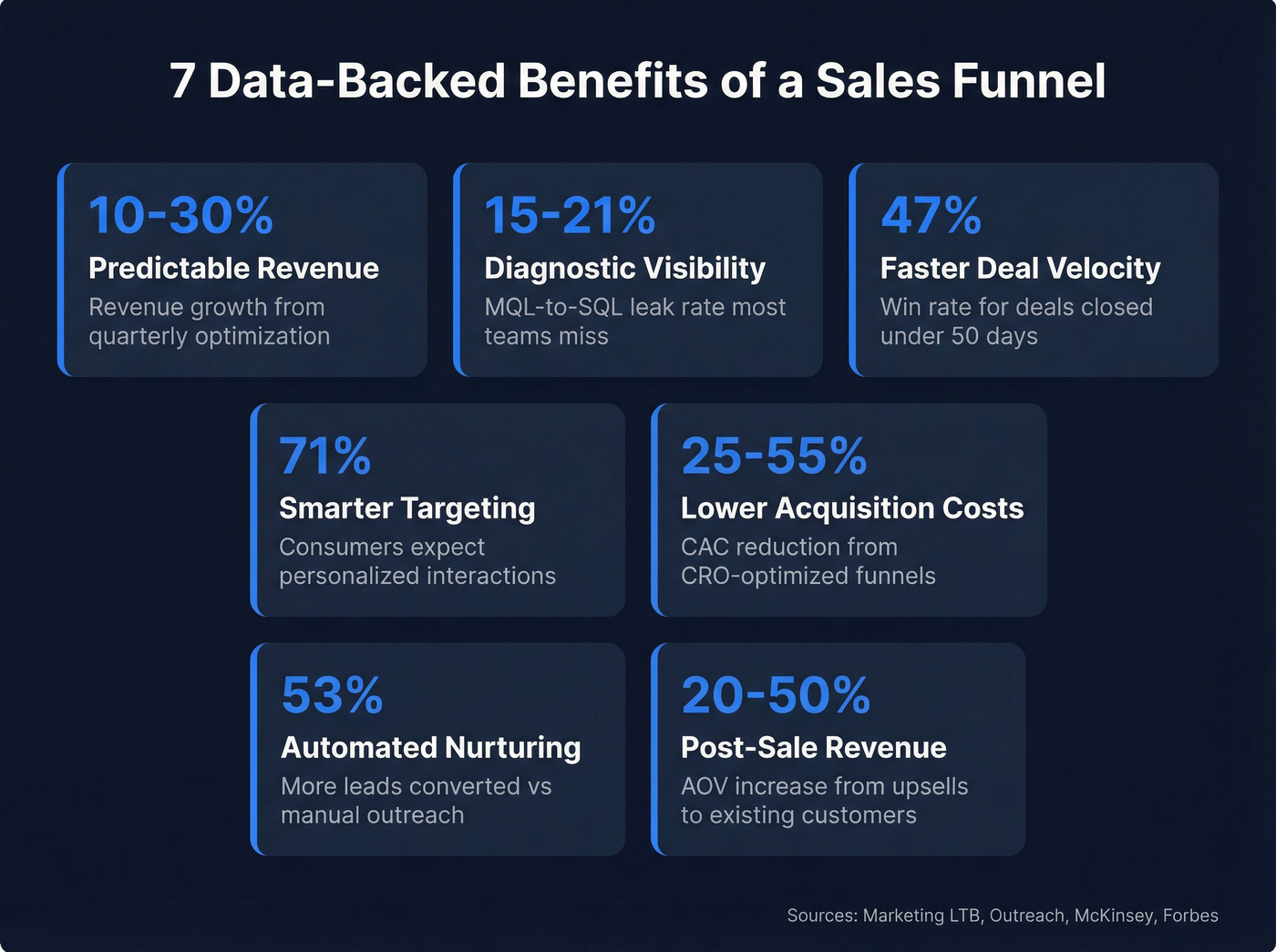
Companies that optimize their funnel quarterly see 10-30% revenue growth. Without stage-by-stage tracking, forecasting is just vibes. A funnel turns "we think Q3 looks good" into "we have 140 SQLs converting at 38%, so we'll close roughly 53 deals." That's the difference between a plan and a prayer (and why sales forecasting solutions matter).
2. Diagnostic Visibility
You can't fix what you can't see. A funnel shows you exactly where deals die - and for most B2B teams, the biggest leak is MQL-to-SQL at 15-21%. That's the handoff between marketing and sales, and it's where misaligned teams hemorrhage pipeline. We've watched teams pour six figures into top-of-funnel campaigns while this handoff quietly destroyed their ROI (track the right funnel metrics to catch it early).
3. Faster Deal Velocity
Deals closed under 50 days hit a 47% win rate. After 50 days? Roughly 20%.
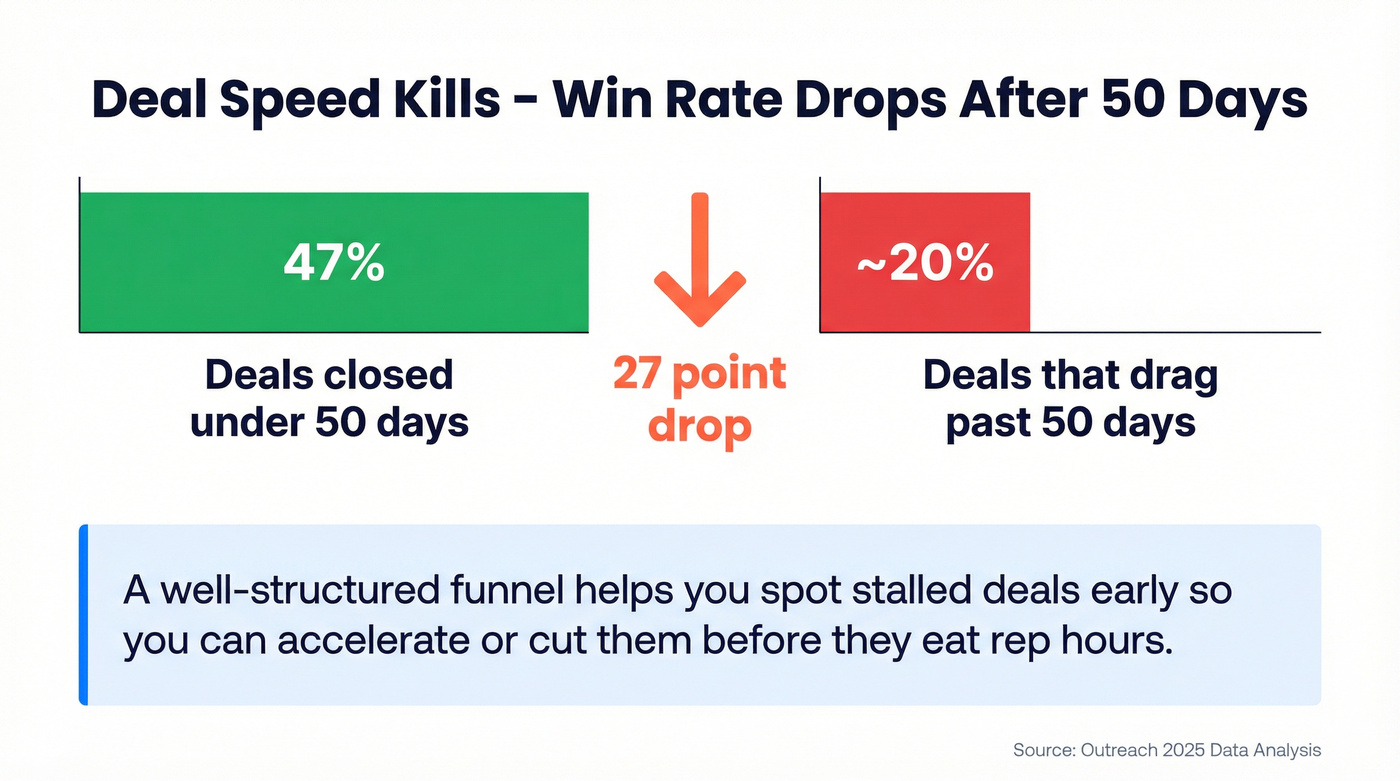
Deal velocity matters more than most teams realize. A well-structured funnel helps you spot stalled deals early so you can accelerate them or cut them loose before they eat rep hours that should go toward winnable opportunities (common sales pipeline challenges show up here first).
4. Smarter Targeting
71% of consumers expect personalized interactions, per McKinsey research. A funnel segments your audience by stage so you're sending the right message at the right time - not blasting the same pitch to someone who just discovered you and someone ready to sign (see personalized outreach).
5. Lower Acquisition Costs
What if you could cut customer acquisition costs by 25-55%? That's what CRO-optimized funnels deliver. When you know which stages leak and which channels convert, you stop pouring budget into top-of-funnel ads that generate leads nobody follows up on. The savings compound fast (especially when you understand cost to acquire customer).
6. Automated Nurturing
Sales teams spend an estimated 21 hours per week on manual reporting and follow-up. Automated workflows convert 53% more leads than manual outreach. The funnel tells you when to trigger sequences, what content to send, and who needs human attention versus autopilot (pair this with strong sequence management).
About 45% of teams already use hybrid AI-SDR models to scale this execution, and the consensus on r/sales is that the teams seeing results aren't replacing reps with AI - they're using automation to handle the repetitive mid-funnel touches so reps can focus on high-intent conversations (more on AI sales follow-up).
7. Post-Sale Revenue
The funnel doesn't end at "closed-won." Upsells increase average order value by 20-50%, and most teams over-invest in acquisition while completely ignoring the cheapest revenue source they already have: existing customers. Skip this benefit at your own expense - it's the one with the highest margin and the lowest effort (see upsell vs cross-sell in SaaS).

Every funnel stage leaks more when contact data is wrong. Meritt cut bounce rates from 35% to under 4% with Prospeo's 98% verified emails - and tripled weekly pipeline to $300K. Your nurture sequences, lead scoring, and deal velocity all depend on reaching real people.
Stop optimizing a funnel that's full of dead emails.
Funnel Benchmarks by Stage
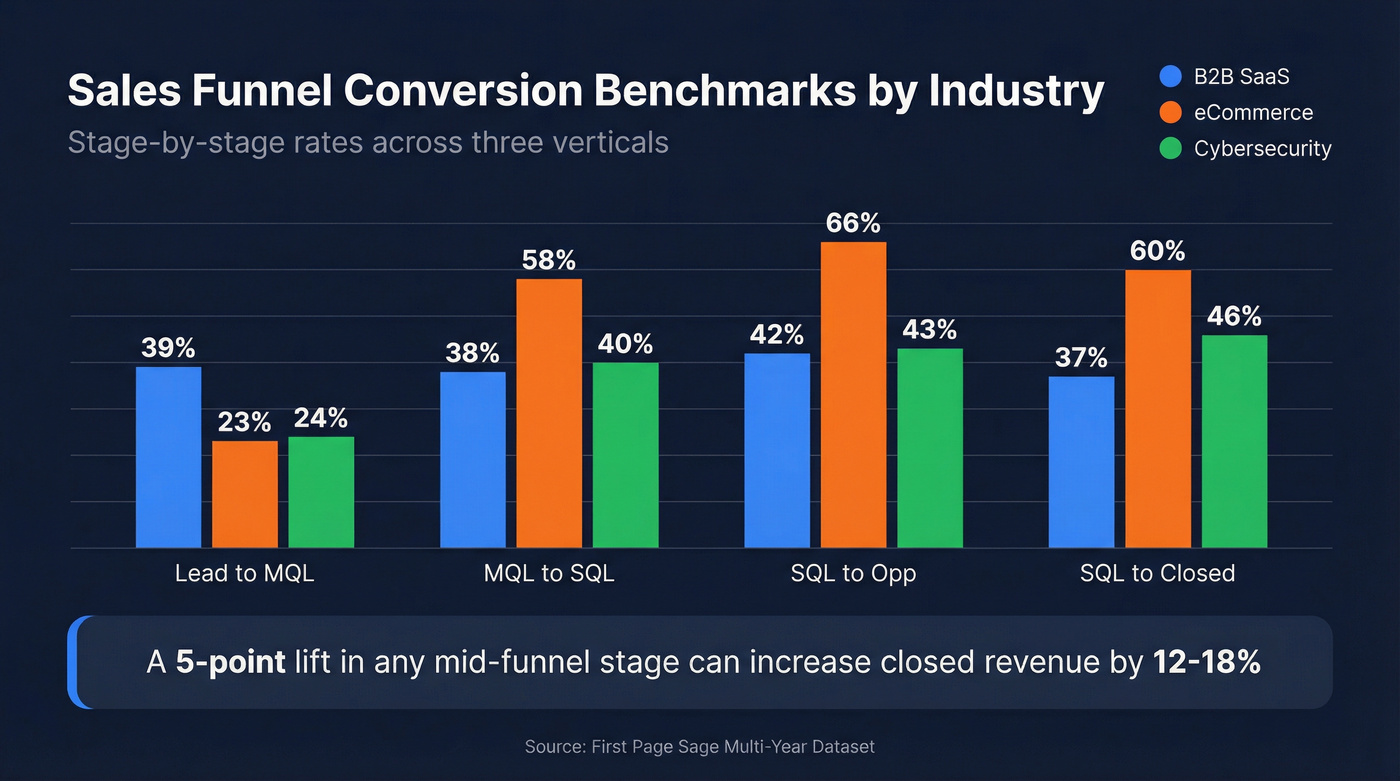
Benchmarks vary wildly by industry. Here's what First Page Sage's multi-year dataset shows across three verticals:
| Stage | B2B SaaS | eCommerce | Cybersecurity |
|---|---|---|---|
| Lead → MQL | 39% | 23% | 24% |
| MQL → SQL | 38% | 58% | 40% |
| SQL → Opp | 42% | 66% | 43% |
| SQL → Closed | 37% | 60% | 46% |
The channel you acquire leads through matters just as much as the stage. SEO leads convert MQL-to-SQL at 51% versus 26% for PPC. In our experience, that gap widens further for teams with longer sales cycles because organic visitors tend to arrive with higher intent (compare against broader sales conversion rate benchmarks).
Let's be honest: a 5-point lift in any mid-funnel stage can increase closed revenue by 12-18%. You don't need to overhaul everything. Find the one stage that's underperforming your industry benchmark and focus there.
If your MQL-to-SQL rate is below 30%, you don't have a lead gen problem - you have a qualification problem. Adding more leads at the top just creates more expensive waste (tighten lead scoring first).
Three Mistakes That Kill Funnel Performance
Bad data in, bad results out. If 35% of your emails bounce, nurture sequences never land and your domain reputation tanks. This is the one that frustrates us most because it's so fixable. Prospeo's 98% email accuracy and 7-day data refresh cycle means the leads entering your funnel are real people at real companies. Meritt saw bounce rates drop from 35% to under 4%, and pipeline tripled from $100K to $300K per week (see email bounce rate benchmarks and fixes).
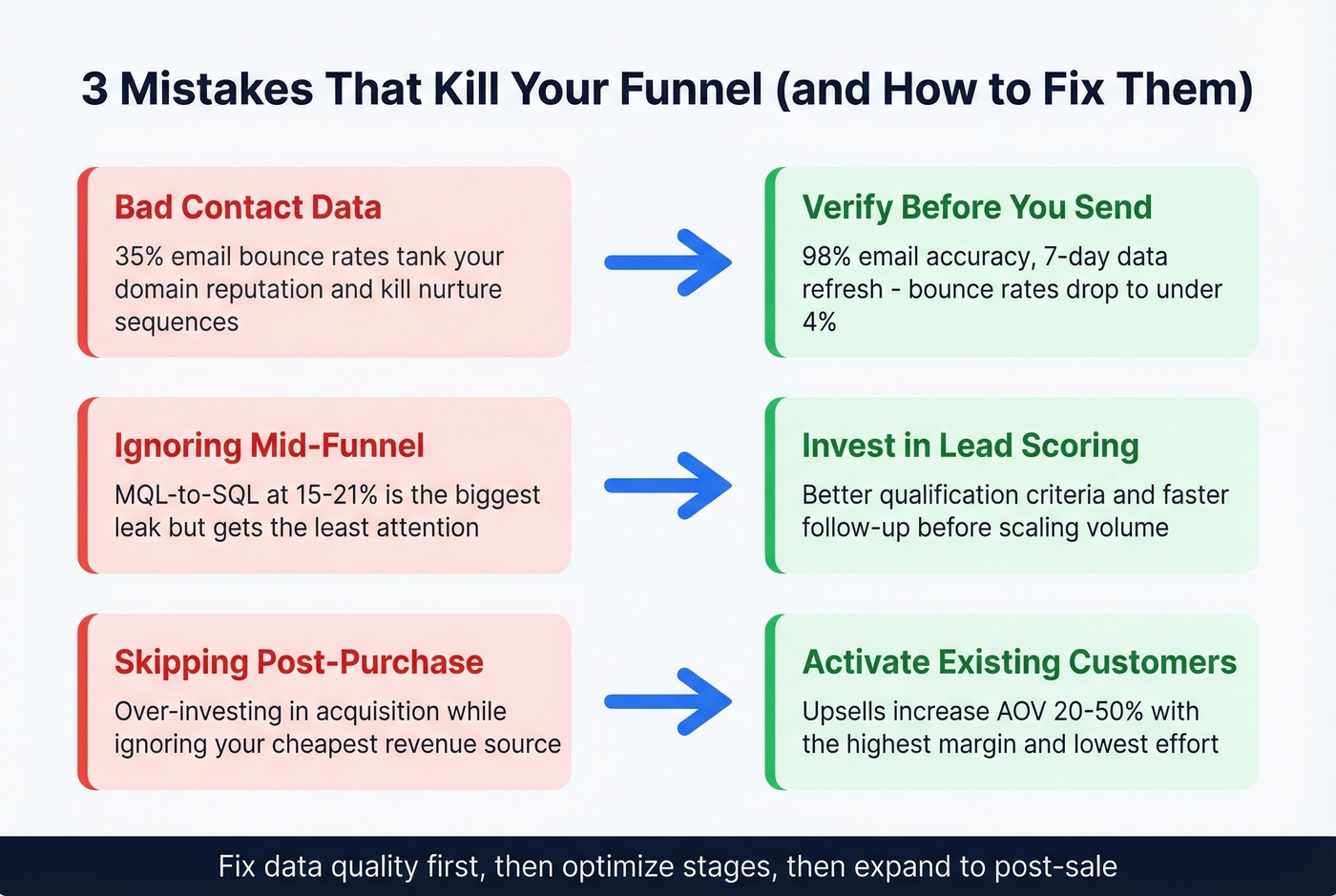
Ignoring mid-funnel. MQL-to-SQL is the biggest bottleneck in most B2B funnels, yet teams keep dumping budget into top-of-funnel lead gen. Invest in lead scoring, faster follow-up, and better qualification criteria before you scale volume. For teams that need faster rep response times, even simple round-robin routing and SLA alerts make a measurable difference.
Skipping post-purchase. Upsells increase AOV 20-50%, and something as simple as shortening forms from 7 fields to 3 increases conversion by 42%. The cheapest pipeline you'll ever build comes from customers who already trust you.
You just saw that a 5-point lift in any mid-funnel stage can increase closed revenue by 12-18%. The fastest way to get that lift? Make sure every lead entering your funnel has a verified email and direct dial. Prospeo refreshes 300M+ profiles every 7 days - not every 6 weeks like competitors.
Feed your funnel data that actually converts - starting at $0.01 per email.
FAQ
What's a good sales funnel conversion rate?
Overall, 3-5% end-to-end is average across industries; top-performing landing pages hit 11%+. But the overall number matters less than stage-by-stage rates. A funnel converting 4% could have a stellar top-of-funnel and a broken MQL-to-SQL handoff hiding underneath. Use the benchmarks table above to diagnose where you sit relative to your vertical.
Why do you need a sales funnel?
Without one, you've got no systematic way to measure where prospects drop off or which stages need investment. Teams that operate without a funnel react to missed quotas instead of preventing them. The advantages compound over time - each quarter of optimization builds on the last, which is why companies with documented funnels see 2.3x more ROI.
How long does it take to see results?
Companies optimizing quarterly see 10-30% revenue growth, with ROI from funnel analytics typically showing up in 3-12 months depending on sales cycle length. The fastest wins come from fixing your worst-performing stage first rather than trying to optimize everything at once.
What's the biggest reason sales funnels fail?
Bad input data. If a third of your emails bounce, nurture sequences never reach anyone and sender reputation degrades. Fix data quality first, then optimize stages. Our team has seen this pattern dozens of times: a company blames their funnel strategy when the real problem is that 30%+ of their contact records are outdated or invalid.