

Building a Sales Pitch That Actually Gets Responses
Nearly 70% of the buyer's journey is complete before a rep ever gets involved. The average B2B deal now involves 7.4 decision-makers. Building a sales pitch that works in 2026 means reaching the right person, at the right moment, with something worth responding to - not just polishing your deck.
Here's the short version before we get into the details:
- Pick one framework - SPIN for complex B2B, Challenger for selling change - and build every pitch around it. Consistency beats creativity.
- Structure as Hook > Problem > Solution > Proof > CTA > Follow-up. The follow-up IS the pitch. Most guides stop at CTA, and that's why most pitches die.
- Verify your prospect list before you write a single word. A perfect pitch that bounces is worse than a mediocre one that lands.
6 Components of a Pitch That Converts
Every pitch that gets a response - email, phone, deck - follows the same skeleton:
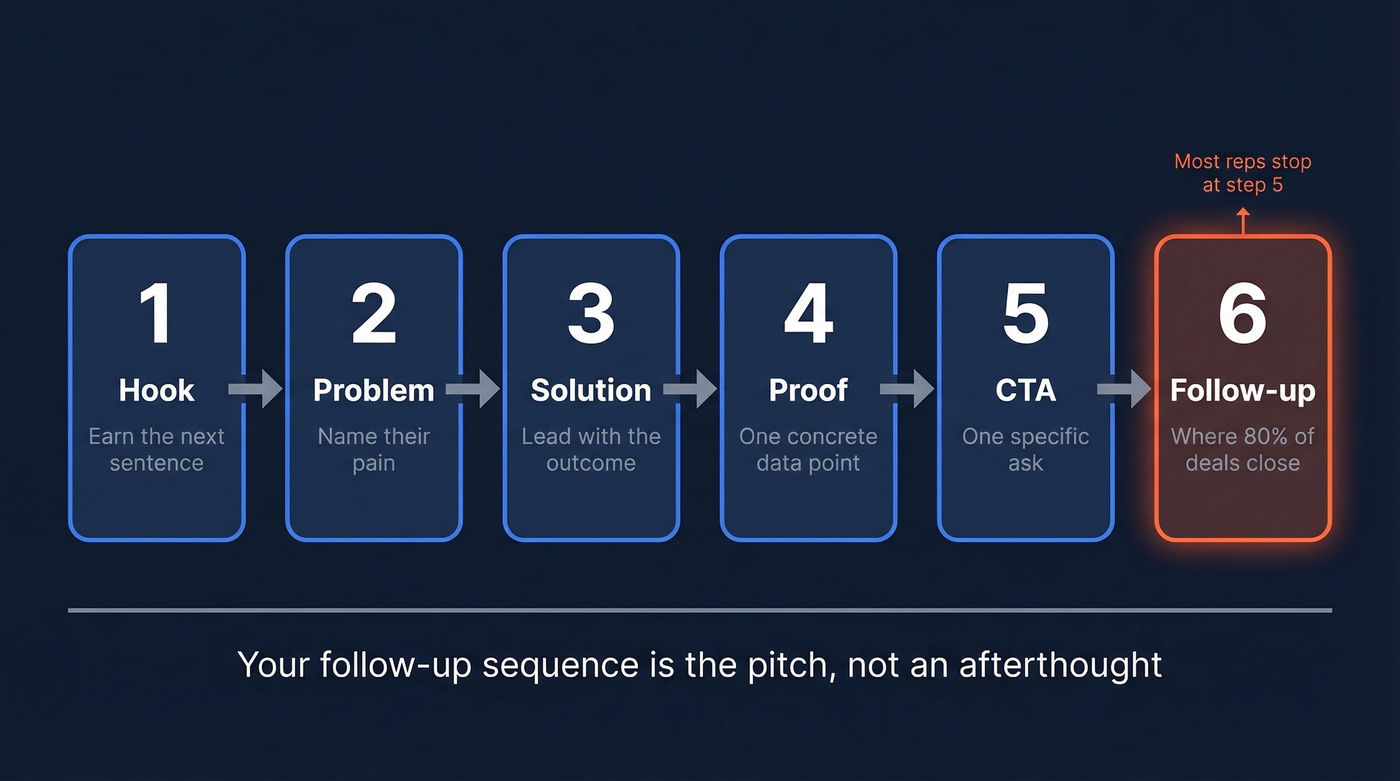
- Hook. One sentence that earns the next sentence. Reference a trigger event, a shared problem, or a specific result. (If you need ideas, start with sales prospecting techniques that create real triggers.)
- Problem. Name the pain they're living with. If you can't articulate their problem better than they can, you haven't done enough research.
- Solution. Not your product - the outcome. "Cut prospecting time by 60%" beats a jargon-stuffed feature dump every time.
- Proof. A number, a customer name, a before/after. One concrete proof point outweighs three paragraphs of positioning.
- CTA. One clear ask. Personalized CTAs outperform generic ones by 202%, so "Can you do 15 minutes Thursday at 2?" beats "Let me know if you'd like to chat." (More examples: email call to action.)
- Follow-up. 80% of sales require five or more follow-ups, but 92% of reps quit after four. Your follow-up sequence isn't an afterthought - it's the pitch. (Use these sales follow-up templates to build a sequence fast.)
Pick a Framework and Commit
Most reps wing it. The ones who consistently close pick a methodology and internalize it until it becomes instinct.
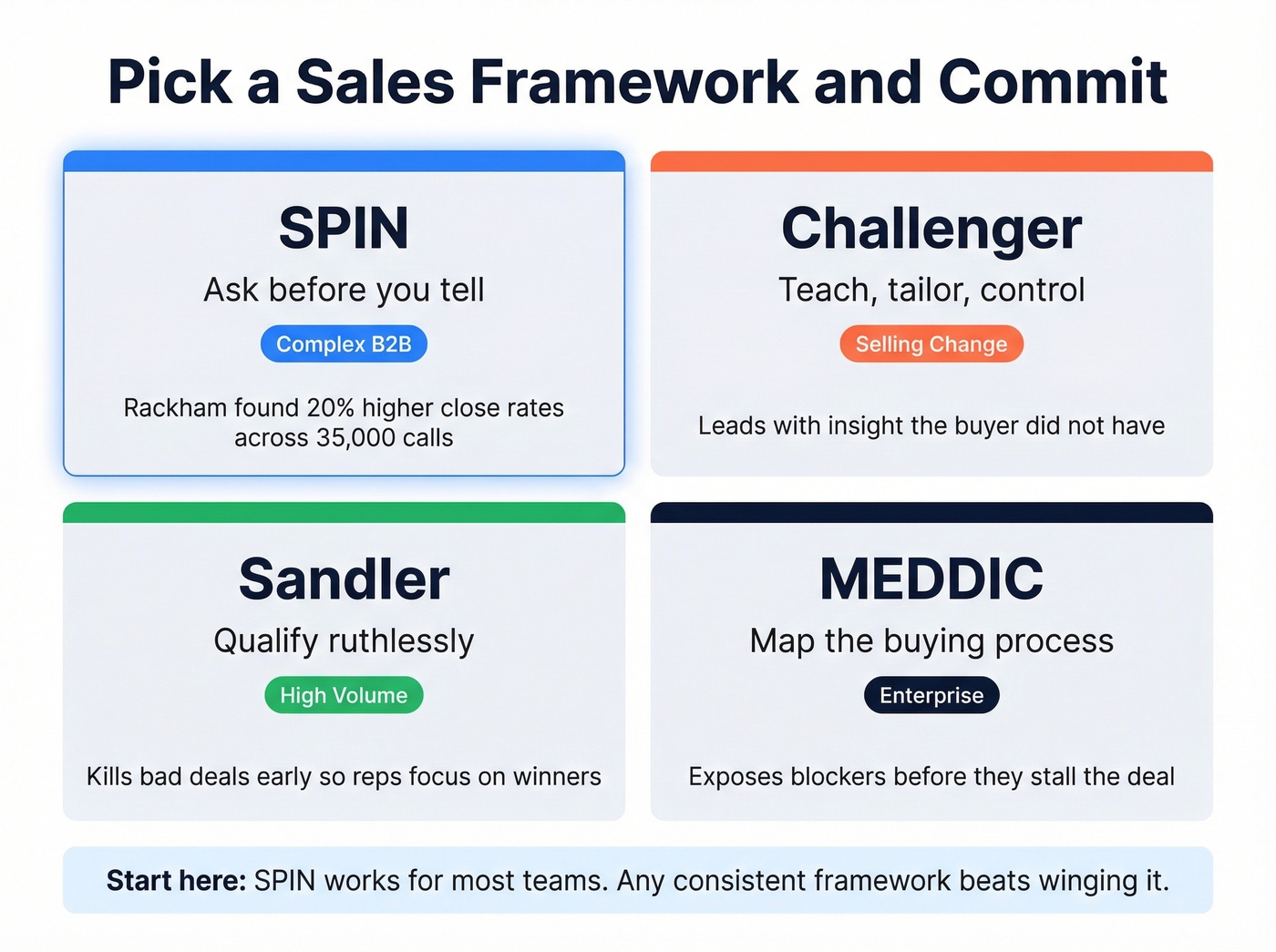
| Framework | Core Idea | Best For | What It Changes |
|---|---|---|---|
| SPIN | Ask before you tell | Complex B2B sales | Forces discovery first |
| Challenger | Teach, tailor, control | Selling change | Leads with insight |
| Sandler | Qualify ruthlessly | High-volume pipelines | Kills bad deals early |
| MEDDIC | Map the buying process | Enterprise deals | Exposes blockers |
Start with SPIN if you're building your first structured pitch. Rackham's research across 35,000 sales calls showed a 20% increase in close rates just from shifting to Situation-Problem-Implication-Need-payoff questioning. That's not a marginal gain - it's the difference between hitting quota and missing it. (If you want to go deeper on questioning, see discovery questions.)
Here's the thing: most teams don't need a complex methodology. They need any methodology, applied consistently. A rep running basic SPIN on every call will outsell a rep who "goes with the flow" every single quarter. We've watched it happen across dozens of teams.
Structure Your Pitch as a Story
The Sales Hero's Journey gives you a repeatable narrative arc: establish trust, introduce the force of change, set the stakes, position your brand as the guide, then walk through the plan. The customer is the hero, not you. Your product is the guide that helps them win.
Two story patterns that work consistently for your problem slide or opening email: "It's been done for X, we're doing it for Y" reframes the market, and "The system is broken" validates frustration. Both come from a practical breakdown of pitch-deck storytelling worth bookmarking. One constraint that forces clarity: if your founding story runs longer than 90 seconds, you've lost the room. (For more structure, borrow frameworks from sales deck storytelling.)
Before and After: A Cold Email Hook
Bad: "Hi [Name], I'd love to introduce you to our platform that helps companies streamline their sales processes through AI-powered insights and data-driven solutions."
Good: "Hi [Name], [Competitor X] cut their prospecting time by 60% last quarter. Your team is 3x their size - the math gets interesting. Worth 15 minutes Thursday?"
The first pitch is about you. The second is about them. That's the entire game.
Match Your Pitch to the Channel
A pitch that works on a cold call will bomb in an email. Lead with email, follow up by phone, and save the deck for when you've earned a scheduled meeting.
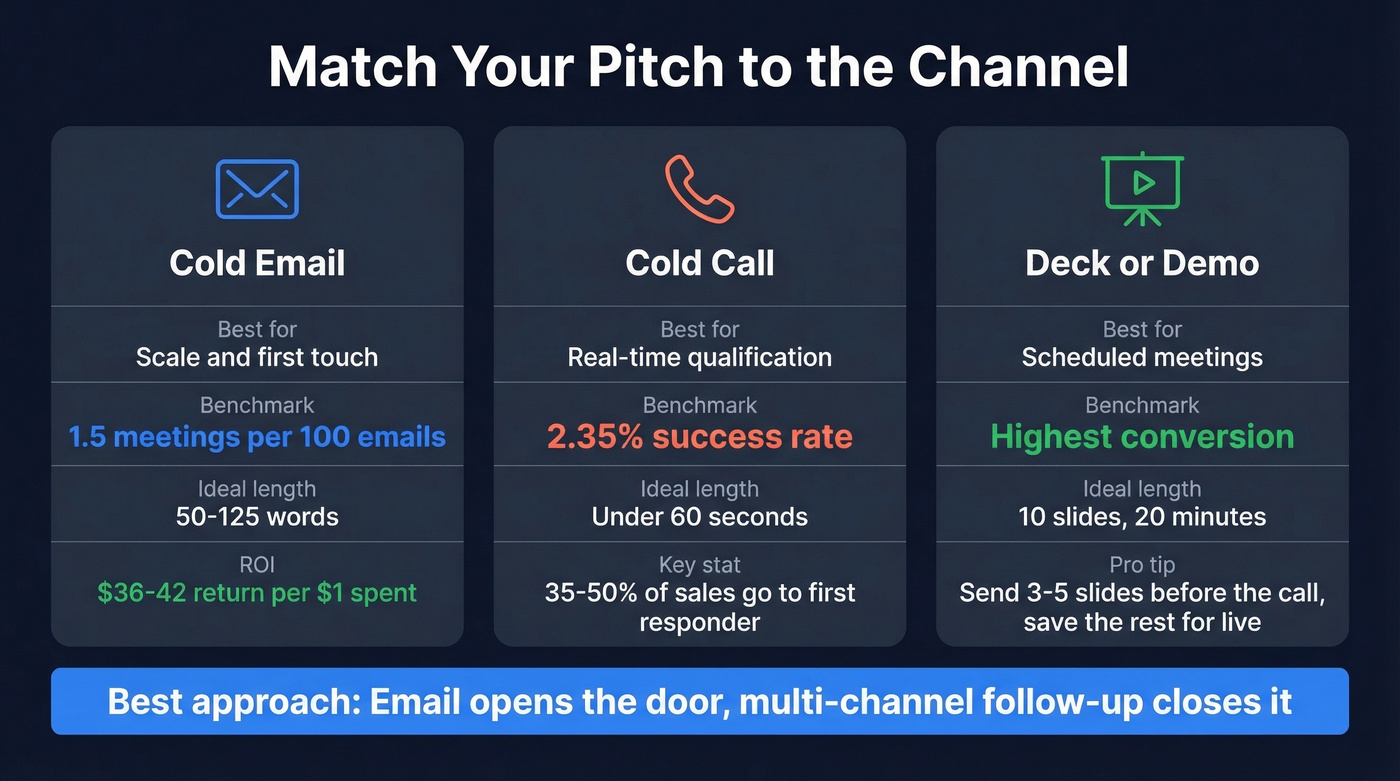
| Channel | Best For | Benchmark | Ideal Length |
|---|---|---|---|
| Cold email | Scale + first touch | ~1.5 meetings per 100 emails | 50-125 words |
| Cold call | Real-time qualification | ~2.35% success rate | Under 60 seconds |
| Deck/demo | Scheduled meetings | Conversion varies | 10 slides, 20 min |
Cold email ROI runs $36-42 per $1 spent, and 73% of B2B buyers prefer email as the initial contact method. But email-only lead rates fell 29% year-over-year. Email opens the door; multi-channel follow-up closes it. (To systematize this, build a B2B cold email sequence.)
Building a Sales Pitch Deck
When you've earned the meeting, your deck needs to carry the same narrative arc as your email - just with more room to breathe. Limit yourself to 10 slides: title, problem, stakes, solution, proof, pricing, and CTA. Some teams prepare two versions - a pre-meeting deck they send ahead to set context, and a fuller version for the live presentation. The pre-meeting version should be three to five slides max, enough to frame the problem without giving away the whole story. If you're sending more than five slides before the call, you're giving the prospect reasons to say no before you've had a chance to address objections live. (If you present live, use these virtual sales presentation tips.)

You just built the perfect pitch structure - hook, problem, proof, CTA. Now make sure it actually lands. Prospeo delivers 98% email accuracy with a 7-day refresh cycle, so your carefully crafted cold emails reach real inboxes, not dead ends. Teams using Prospeo book 35% more meetings than Apollo users.
Stop perfecting pitches that bounce. Start sending ones that land.
Present Your Company to Prospects
Your customer pitch should change based on who you're selling to and what they're buying. A pitch for consulting services leads with expertise and outcomes - "We helped [Client] reduce churn by 22% in 90 days" - while a product-focused pitch leads with measurable impact. An edtech pitch centers on student outcomes and implementation speed; a 3PL pitch focuses on fulfillment accuracy and cost-per-order reductions.
The principle is the same regardless of vertical: lead with the outcome your prospect cares about, not the features you're proud of. (If you're selling bigger deals, align the pitch to enterprise B2B sales realities.)
Personalize the Problem, Not the Person
Let's be honest about personalization - it's more nuanced than most sales content admits. A Gartner study of 1,464 buyers found that personalization generated negative experiences for 53% of customers. Those customers were 3.2x more likely to regret a purchase and 2x more likely to feel overwhelmed by the buying process.
The distinction matters. "Surveillance personalization" - mentioning someone's alma mater or congratulating them on a promotion you found on their profile - feels creepy. "Course-changing personalization" - demonstrating you understand their specific business problem and have a relevant solution - makes buyers 2.3x more likely to confidently complete a purchase. Personalized CTAs outperform generic ones by 202%, but only when you're personalizing the problem, not the person. (For a system, see personalized outreach.)
From Pitch to Proposal
Once the pitch lands, you need a document that formalizes the conversation. A strong proposal bridges the gap between "interested" and "signed" - it recaps the problem you diagnosed, the solution you proposed, and the specific terms. Whether you're drafting a B2B proposal or a product proposal for a retail chain, the structure stays the same: executive summary, scope, proof, pricing, and next steps.
Think of the proposal as a strategy document in miniature. It should include an implementation section that outlines milestones and expected outcomes - this is your argument for how the prospect's business improves, not a brochure about yours. Start by copying the narrative arc from your pitch deck and adding specifics: timelines, deliverables, and pricing tiers. (If you need a full process, follow these steps to close a sale.)
The Step Everyone Skips: Clean Data
Send 200 cold emails, watch 70 bounce, and your domain reputation tanks - now even your good emails land in spam. We've seen this pattern destroy outbound programs that had everything else right.
Before you prepare any pitch, make sure you have somewhere to send it. Your pitch is only as good as your prospect list. We use Prospeo for this - 98% email accuracy, a 7-day data refresh cycle compared to the six-week industry average, and a free tier with 75 verified emails per month to test. Snyk's team went from a 35-40% bounce rate to under 5% after switching, which opened up 200+ new opportunities per month. (If you're troubleshooting, start with email bounce rate and then tighten your email deliverability.)
Mistakes That Kill Your Pitch
The biggest pitch killers are predictable. Top reps let prospects speak 57% of the time - if you're monologuing, you're losing. Talking too much comes up everywhere for a reason, right alongside "pitching features instead of outcomes." Nobody cares about your architecture. They care about what changes for them.
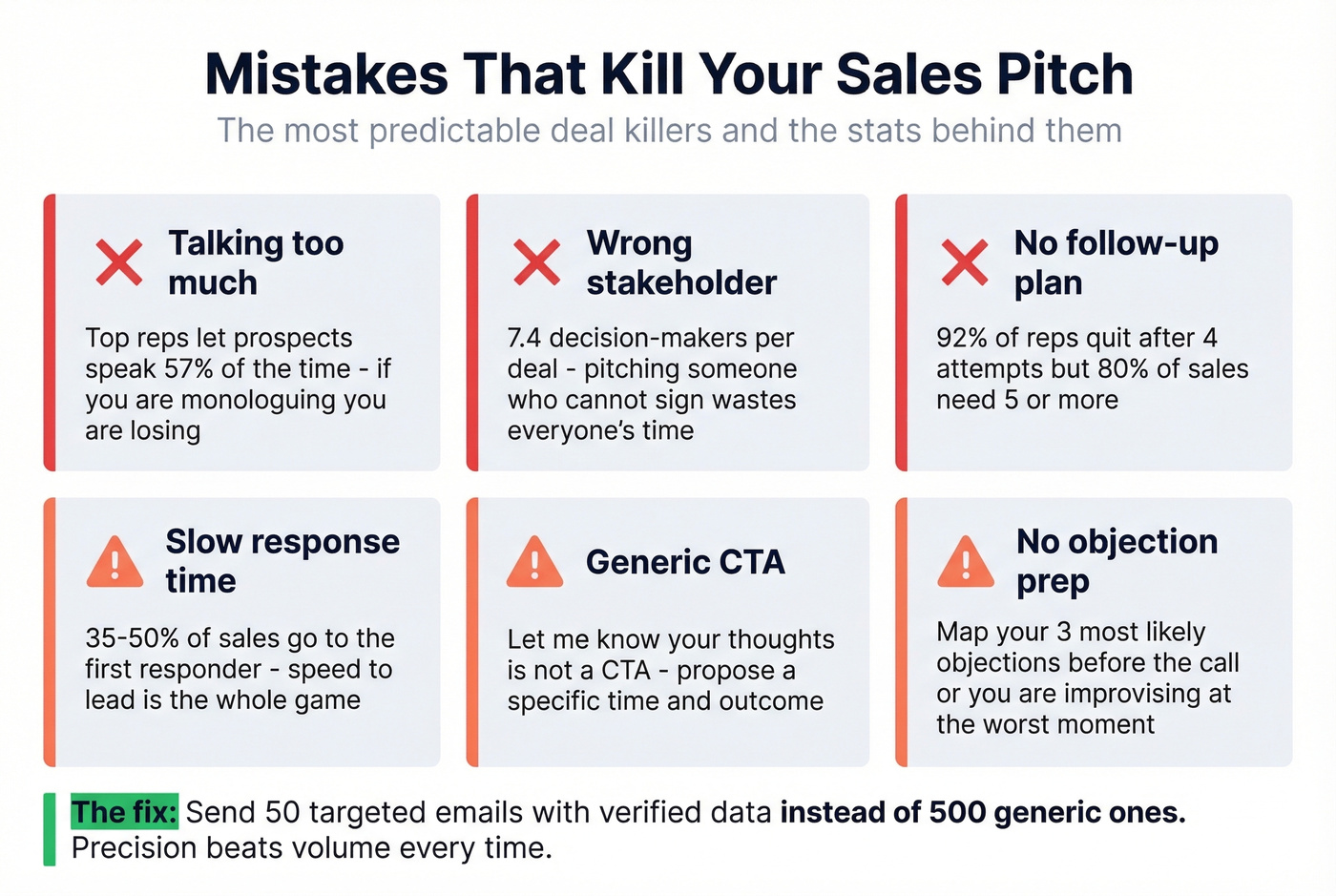
Beyond the conversation itself, five structural mistakes sink more deals than bad delivery:
- Wrong stakeholder. With 7.4 decision-makers per deal, pitching the person who can't sign is a waste of everyone's time.
- No follow-up plan. 92% of reps quit after four attempts. The deal closes on attempt five or later.
- No objection prep. If you haven't mapped the three most likely objections before the call, you're improvising at the worst possible moment. (Build a simple sales battle card and keep it updated.)
- Slow response time. 35-50% of sales go to the first responder. Speed-to-lead isn't a nice-to-have - it's the whole game.
- Generic CTA. "Let me know your thoughts" isn't a call to action. Propose a specific time and a specific outcome.
- Neglecting pitch design. A cluttered slide or a wall-of-text email signals low effort. Clean formatting, white space, and a single visual proof point do more than a dozen bullet points ever will.
Skip the "spray and pray" approach entirely. If you're sending the same pitch to 500 people and hoping for the best, you'd be better off sending 50 highly targeted emails with verified contact data and a problem-specific hook. The math favors precision every time.
Multi-channel follow-up closes deals, but only if you have the right contact data. Prospeo gives you verified emails and 125M+ direct mobile numbers in one platform - so your pitch reaches prospects on email, then by phone, without switching tools or burning your domain reputation.
Get the email and the direct dial. Build pitches that actually connect.
FAQ
How long should a sales pitch be?
Email: 50-125 words. Phone: under 60 seconds before you ask a question. Deck: 10 slides, 20 minutes max. Match the format to the channel - conciseness signals confidence and respect for the prospect's time.
What's the best framework for building a sales pitch?
SPIN Selling is the strongest starting point. Across 35,000 analyzed calls, shifting to Situation-Problem-Implication-Need-payoff questioning increased close rates by 20%. Layer in Challenger or MEDDIC as your deals grow more complex.
How do I make sure my pitch reaches the right person?
Verify your contact data before sending. Prospeo checks emails in real time with 98% accuracy and refreshes data every seven days - so your pitch lands in an inbox, not a bounce log.
How do I prepare a pitch for a product I haven't sold before?
Start with customer research, not slide design. Interview three to five people in your target market, map their top three pain points, and build your pitch around the one your product solves best. A proposal grounded in real conversations always outperforms one built from assumptions.
What's the difference between a pitch and a proposal?
The pitch earns the meeting; the proposal closes the deal. A pitch is a concise, verbal or written argument for why the prospect should care. A proposal formalizes that argument with scope, pricing, and terms - it's the document the buying committee circulates internally after you leave the room.